

 Download PDF
Market Overview
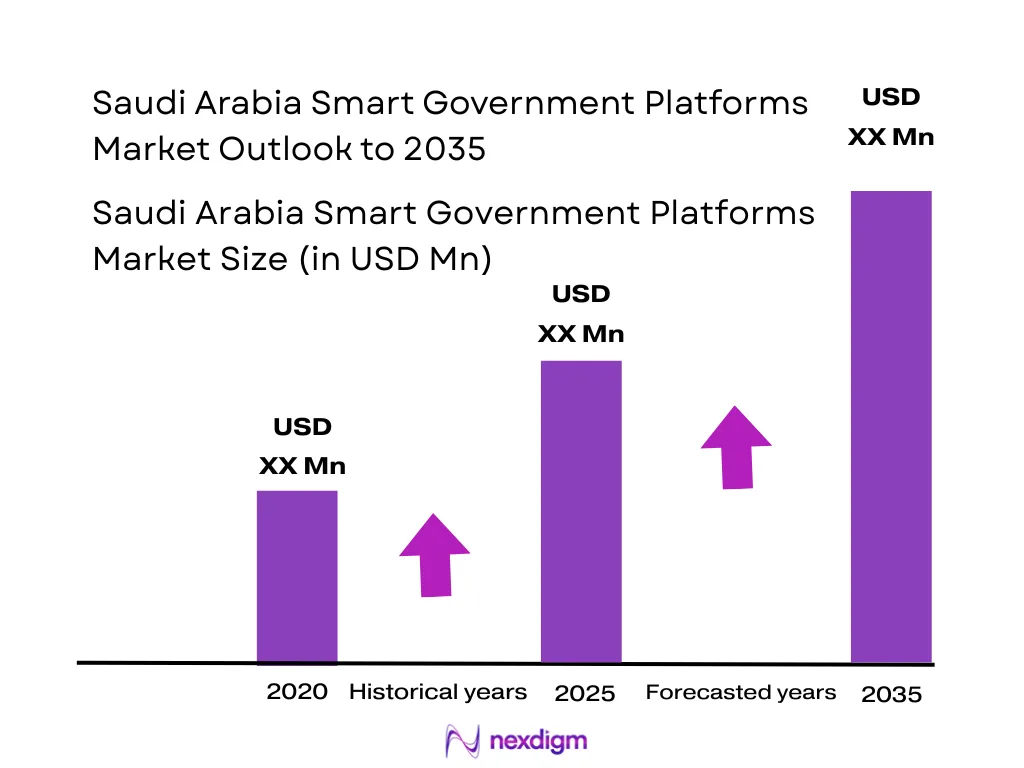
Saudi Arabia’s smart government platforms market is valued at USD ~ million in 2025, while the Digital Government Authority reported about SAR 38 billion in new government ICT contracts in 2024 and over SAR 113 billion in cumulative ICT spending during 2022–2024. Demand is being driven by 4,500+ digital government services, 97%+ digitization of government services, and 430+ million Absher electronic transactions in 2024.
Riyadh is the dominant center because regulation, procurement, cloud planning, and platform governance are concentrated there through the DGA, major ministries, PIF-backed digital champions, and municipal reform programs. The city also sits behind Saudi Arabia’s jump to rank 6 globally in the UN EGDI in 2024, while the Kingdom remained first in MENA in the 2024 GEMS index with a 96% maturity score. NEOM is the main greenfield innovation node, while Makkah–Jeddah remains a high-volume service corridor due to municipal, mobility, airport, and pilgrim-linked digital workflows.
Market Segmentation
By ICT Service Category
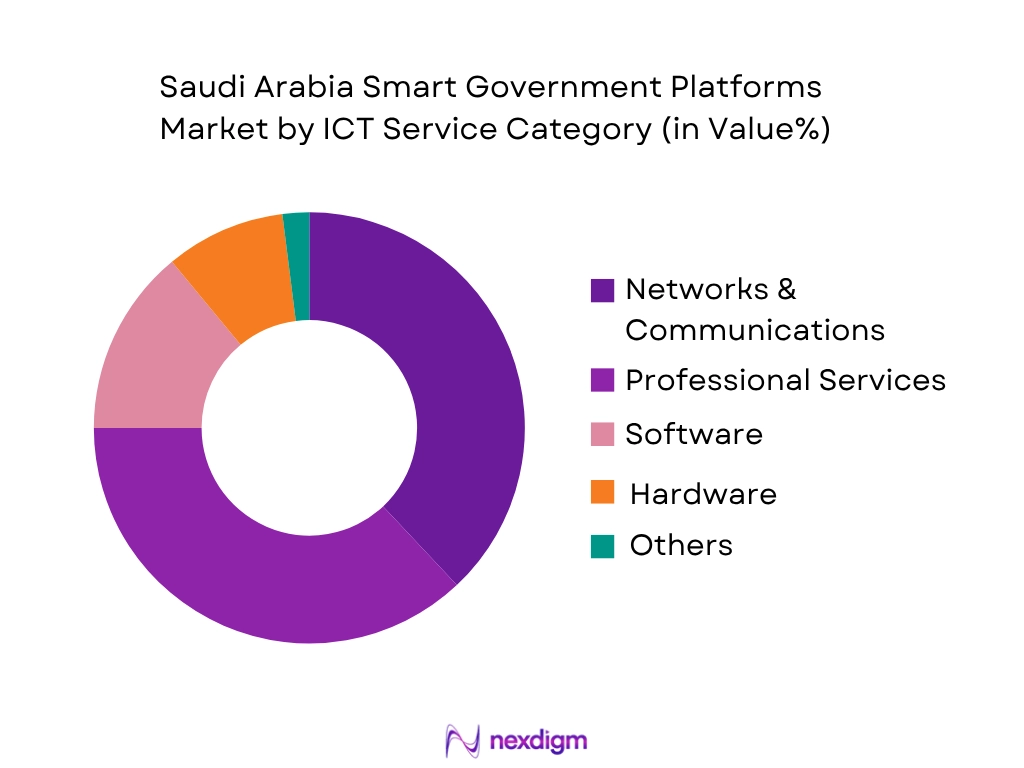
Saudi Arabia Smart Government Platforms market demand is segmented by ICT service category into networks and communications, professional services, software, hardware, cloud, and AI and emerging technologies. Recently, networks and communications held the largest share under this segmentation. Its lead is structural: smart government platforms cannot scale without resilient national connectivity, secure inter-agency links, identity routing, data-center interconnection, and real-time service delivery infrastructure. In Saudi Arabia, platform expansion is happening alongside the “whole-of-government” digitization push, meaning ministries and public agencies still spend heavily on the underlying secure network fabric before layering automation, analytics, and AI. The near-parity of professional services shows that integration work remains critical, but the largest current budget pool still sits in the connectivity and communications backbone that keeps government platforms interoperable, always-on, and citizen-facing at national scale.
By Government End-Use Vertical
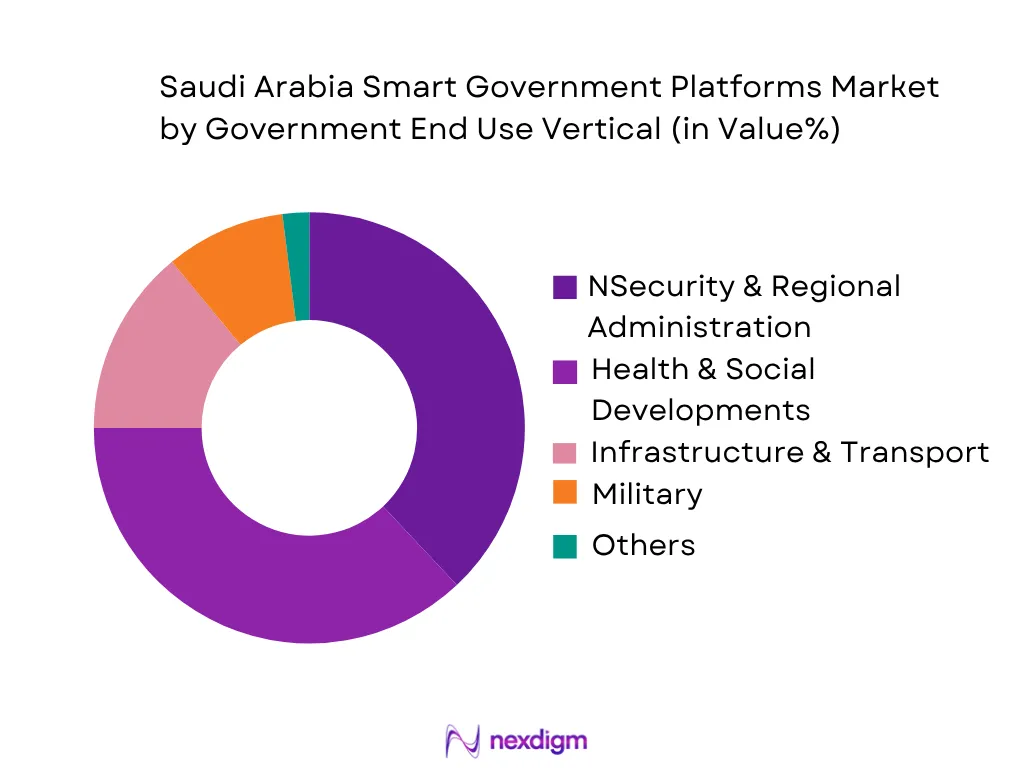
Saudi Arabia Smart Government Platforms market demand is segmented by government end-use vertical into security and regional administration, health and social development, infrastructure and transport, military, education, economic resources, municipal services, and public administration. Recently, security and regional administration was a joint-leading segment, alongside health and social development. Its strength comes from Saudi Arabia’s emphasis on secure digital identity, citizen and resident transactions, regional service coordination, border-related workflows, public safety systems, and administrative control platforms. These workloads are unusually platform-intensive because they require high uptime, strong cybersecurity, audited workflows, and integration across multiple entities. Health and social development is equally important, but security and regional administration remains especially central to smart government benchmarking because it sits at the intersection of service delivery, sovereignty, identity, trust, and regulatory enforcement—the core conditions that shape platform selection and long-term public-sector digital architecture in the Kingdom.
Competitive Landscape
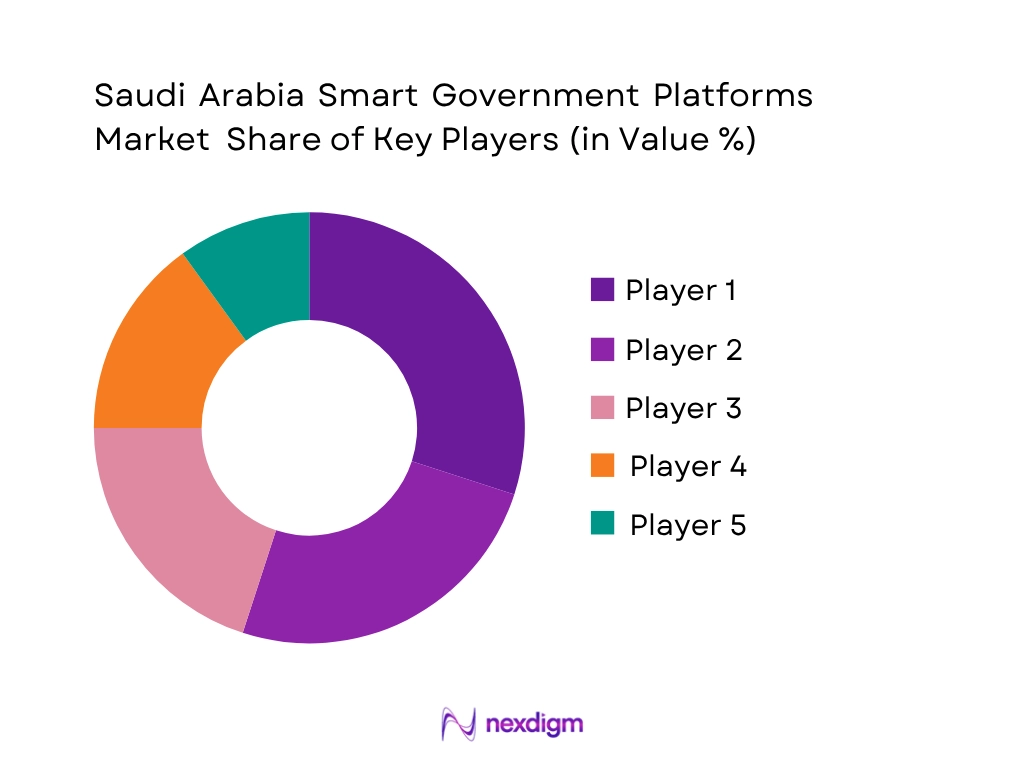
The Saudi Arabia Smart Government Platforms market is led by a mix of Saudi-native public-sector digital champions, large ICT integrators, and global cloud/software vendors. Local firms such as Elm, solutions by stc, SBM, and SITE are especially strong where public procurement, localization, cybersecurity, and sovereign-delivery requirements matter most, while global firms remain influential in cloud, enterprise applications, AI tooling, and platform modernization. The market is therefore not simply fragmented; it is layered, with local firms strongest in execution and compliance, and global firms strongest in foundational platforms and hyperscale ecosystems.
| Company | Est. Year | Headquarters | Public-Sector Positioning | Core Smart-Gov Strength | Saudi Delivery Model | Data Sovereignty / Locality Angle | Cyber / Secure-Gov Depth | Benchmark View |
| Elm | 1988 | Riyadh | – | – | – | – | – | – |
| solutions by stc | 1995* | Riyadh | – | – | – | – | – | – |
| Saudi Business Machines (SBM) | 1981 | Jeddah | – | – | – | – | – | – |
| SITE | 2017 | Riyadh | – | – | – | – | – | – |
| Giza Systems | 1974 | New Cairo | – | – | – | – | – | – |
Saudi Arabia Smart Government Platforms Market Analysis
Growth Drivers
Expansion of Vision 2030 Digital Transformation Programs
Saudi Arabia’s smart government platforms market is being accelerated by the scale and institutional depth of Vision 2030 execution. The Digital Government Authority reported that the Kingdom now provides more than 4,500 digital government services, covering over 97% of all government services, while cumulative government ICT spending exceeded SAR 113 billion during the latest three-year period and new ICT contracts reached about SAR 38 billion in 2024. That demand is being supported by a macro backdrop in which Saudi Arabia’s real GDP growth reached 2.0 in 2024, GDP totaled about USD 1.24 trillion, and non-oil real GDP grew 4.5 in 2024, with the IMF projecting overall real GDP to accelerate to 3.9 by 2026. For platform vendors, this matters because Vision 2030 has shifted digital-government spending from isolated portals toward nationwide workflow, identity, data, and service orchestration layers that require long-duration platform deployments rather than one-off digitization projects.
Rapid Adoption of Digital Identity & Unified Platforms
Digital identity is becoming one of the strongest demand engines for Saudi Arabia’s smart government platforms market because it reduces physical verification, shortens service journeys, and enables secure access across ministries and public agencies. The Ministry of Interior stated that unified digital identities issued through Absher exceeded 28 million by late 2024, while the National Platform’s digital-enabler framework describes identity management capabilities serving around 60 million users across authentication, credential, and access-management layers. In parallel, the DGA’s 2024 digital experience index reached 85.04, and Saudi Arabia rose to 6th globally in the UN e-government ranking and 4th globally in the digital services index. These adoption gains are supported by favorable demand conditions: the World Bank shows Saudi Arabia’s population reached 35,300,280 in 2024, while urban population stood at 85.17 of the total, which increases the natural addressable base for mobile-first government service delivery. Together, these figures explain why identity-centric, unified platforms are becoming the backbone of public-sector digital architecture in the Kingdom.
Market Challenges
Integration with Legacy Government Systems
Legacy integration remains one of the hardest barriers in Saudi Arabia’s smart government platforms market because digitization has advanced faster than full architectural unification across agencies. The DGA’s 2024 digital transformation measurement involved 233 government agencies, with an introductory workshop attended by more than 2,000 specialists, which shows how broad and heterogeneous the government IT landscape has become. At the same time, the Kingdom already runs 4,500+ digital government services, meaning vendors are often integrating new platforms into large installed estates rather than starting with clean-sheet environments. This complexity is amplified by scale: the Ministry of Finance digital systems handled more than 400,000 contracts in a highlighted 2024 workflow, illustrating the transaction-heavy administrative base that modernization must connect with. On the macro side, the IMF reports robust domestic demand and 4.5 non-oil GDP growth in 2024, which keeps transformation moving, but it also means integration pressure rises as more agencies digitize simultaneously.
Data Governance & Interoperability Issues
Interoperability is a market challenge precisely because Saudi Arabia’s data ecosystem is expanding quickly. The National Platform states that the open-data ecosystem now includes more than 338 data providers and over 18,679 published datasets, while the Data Sharing Policy identifies the Government Service Bus as a secure channel for inter-entity data exchange. The DGA’s API guideline also highlights the Saudi Open Data Portal and real-time API access as part of the digital-government operating model. These are positive signals, but they also mean agencies must manage data quality, schema alignment, access permissions, metadata consistency, and secure cross-entity use at a much larger scale than before. Macroeconomic conditions reinforce the importance of solving this issue: the World Bank shows USD 1.24 trillion GDP and 35.3 million people in 2024, while the IMF projects further growth by 2026. As public services become more connected, data governance and interoperability move from technical preferences to core market selection criteria.
Opportunities
AI-Driven Government Automation Platforms
AI-led automation is one of the clearest growth opportunities in the Saudi Arabia smart government platforms market because the enabling conditions are already visible in current usage and policy. The Saudi Internet 2024 report found that 21.5 of internet users in the Kingdom used artificial intelligence applications, while SDAIA issued Generative AI guidelines in 2024 and continues to position data and AI as national enablers. The DGA’s digital experience report already documents AI use cases inside public platforms, including sentiment analysis, biometric verification, machine learning, and advanced job-matching workflows. These examples show that the market is moving from experimentation toward embedded AI inside operational government journeys. The macro backdrop remains supportive: the IMF recorded 4.5 non-oil GDP growth in 2024 and expects 3.9 overall GDP growth by 2026, while the World Bank places Saudi population at 35.3 million. That mix of policy support, live use cases, and a large digitally active base creates fertile ground for AI-powered case management, proactive service delivery, fraud reduction, and citizen-service automation platforms.
Expansion of Open Data & API Marketplaces
Open data and API-based service exchange represent a major future-growth opportunity because Saudi Arabia already has the institutional ingredients for a platform economy inside government. The National Platform reports 338+ data providers and 18,679+ datasets in the Saudi open-data ecosystem, while the DGA’s API guideline explicitly points to real-time API access through the Saudi Open Data Portal. At the governance layer, the Data Sharing Policy identifies the Government Service Bus as the secure mechanism for inter-entity data exchange and automation. This combination matters commercially because it expands demand for API gateways, developer portals, consent layers, metadata management, monitoring tools, and reusable middleware that help agencies move from isolated applications to interoperable services. The opportunity is strengthened by macro scale: Saudi Arabia’s GDP reached about USD 1.24 trillion in 2024, with 2.0 GDP growth and 35.3 million residents. As data-sharing becomes operational rather than experimental, platform vendors that can productize interoperability will be positioned for durable growth.
Future Outlook
Saudi Arabia’s smart government platforms market has a strong forward runway because the Kingdom is moving from digitizing individual services to orchestrating whole-of-government platforms. That shift favors vendors that can combine secure infrastructure, API-led integration, identity, analytics, and AI. Over the medium term, procurement is likely to move further toward larger, higher-value programs rather than isolated point deployments. Over the longer term, sovereign cloud, AI-enabled public services, and urban operating systems around Riyadh and giga projects should keep demand structurally elevated.
Market Opportunity Analysis
The biggest opportunity is no longer simple portal creation; it is platform convergence. Saudi entities already digitize services at high levels, so the next spending wave should concentrate on cross-agency orchestration, unified identity, secure data exchange, low-code service design, AI copilots for government workflows, and analytics layers that improve policy execution. Riyadh remains the anchor opportunity because ministries, regulators, and municipal transformation all converge there, but NEOM offers the cleanest “from-scratch” platform laboratory for digital twins, urban operating systems, and integrated resident services.
Commercially, the clearest white spaces sit in interoperability middleware, beneficiary experience platforms, sector-specific AI assistants, sovereign data platforms, and secure-by-design managed services for agencies that do not want to build everything in-house. The DGA’s focus on procurement discipline and spending efficiency also means opportunity is strongest for vendors that can prove reusability, faster deployment, and measurable service-quality impact, not just sell licenses. In this market, benchmark winners will be the firms that combine localization, cybersecurity, public-sector workflow knowledge, and long-term operating support.
Major Players
- Elm
- solutions by stc
- Saudi Business Machines (SBM)
- SITE
- Giza Systems
- IBM
- Microsoft
- Oracle
- SAP
- Amazon Web Services (AWS)
- Google Cloud
- Accenture
- Tata Consultancy Services (TCS)
- Wipro
- Infosys
Key Target Audience
- Government and Regulatory Bodies (Digital Government Authority, SDAIA, National Cybersecurity Authority, Ministry of Communications and Information Technology, Ministry of Investment)
- Investments and Venture Capitalist Firms
- Sovereign Wealth and State-Backed Investment Vehicles
- Public-Sector System Integrators and Managed Service Providers
- Hyperscale Cloud and Sovereign Cloud Operators
- Cybersecurity Vendors and National-Security Technology Providers
- Smart City, Municipal, and Giga-Project Digital Authorities
- Enterprise Software, AI, and Data Platform Providers
Research Methodology
Step 1: Identification of Key Variables
The first step mapped the Saudi smart government platforms ecosystem across regulators, ministries, delivery arms, cloud providers, integrators, cybersecurity firms, and citizen-service platforms. Secondary research focused on DGA publications, UN digital-government indicators, company disclosures, and official public-sector platform announcements. The aim was to isolate the variables that actually shape this market: procurement intensity, digitized-service depth, security requirements, cloud readiness, and localization.
Step 2: Market Analysis and Construction
The second step constructed the market using a hybrid model. Official Saudi ICT spending and contract data were used to understand the size and demand structure of digital-government-related buying, while commercial smart-government market data was used to benchmark vendor-revenue scale. This combination was necessary because official sources expose spending and maturity more transparently than they expose a standalone “platform market” revenue total.
Step 3: Hypothesis Validation and Expert Framing
The third step validated hypotheses through cross-comparison of public indicators: service digitization levels, government transaction volumes, maturity rankings, hyperscaler investment moves, and vendor positioning claims. At this stage, the market was stress-tested around three questions: who wins in sovereign workloads, who wins in complex integration, and where future platform budgets are most likely to expand.
Step 4: Research Synthesis and Final Output
The final step synthesized market size, segmentation, competitive benchmarking, and opportunity analysis into a decision-useful structure for business professionals. Greater weight was assigned to official Saudi and UN sources for demand, governance, and maturity, while company and commercial-research sources were used to frame vendor positioning, market structure, and the long-range growth benchmark.

- Executive Summary
- Research Methodology (Market Definitions and Scope of Smart Government Platforms, Abbreviations, Digital Government Maturity Framework, Market Sizing Approach for GovTech Platforms, Bottom-Up Demand Modeling by Ministries & Entities, Top-Down Budget Allocation Analysis, Primary Research with Government Stakeholders & System Integrators, Secondary Research from Vision 2030 Programs, Data Triangulation Approach, Limitations and Assumptions)

- Definition and Scope
- Evolution of Digital Government in KSA (Yesser Program to Vision 2030)
- Smart Government Ecosystem Architecture (Platforms, Data Layers, Services)
- Key Stakeholders (Ministries, Authorities, Giga Projects, Private Tech Vendors)
- Value Chain Analysis (Platform Providers, Integrators, Cloud Providers, Data Providers)
- Regulatory & Policy Landscape (National Data Management Office, SDAIA, NCA)
- Digital Government Maturity Index Positioning

- Growth Drivers
Expansion of Vision 2030 Digital Transformation Programs
Rapid Adoption of Digital Identity & Unified Platforms
Increase in Government Cloud Adoption (Sovereign Cloud Push)
Growth in Smart City & Giga Project Investments
Rising Demand for Citizen-Centric Digital Services - Market Challenges
Integration with Legacy Government Systems
Data Governance & Interoperability Issues
Cybersecurity Risks in Public Platforms
Dependence on Global Technology Vendors
Shortage of Skilled Digital Government Talent - Opportunities
AI-Driven Government Automation Platforms
Expansion of Open Data & API Marketplaces
Growth of Smart City Digital Twins
Public-Private Partnerships in GovTech
Cross-Border Digital Government Integration - Trends
Emergence of Government Super Apps
Rise of Predictive & Proactive Governance
Adoption of Low-Code/No-Code Platforms
Digital Twin for Urban Governance
Hyper-Personalization in Citizen Services - Government Regulations (Data Protection Laws, Cloud First Policy, National Cybersecurity Authority Guidelines, Data Localization Rules, Digital Identity Regulations)
- SWOT Analysis (Strength of Digital Infrastructure, Weakness in Integration, Opportunities in AI, Threats from Cyber Risks)
- Stakeholder Ecosystem (Government Entities, Cloud Providers, System Integrators, Startups, Regulators)
- Porter’s Five Forces (Supplier Power, Buyer Power, Competitive Rivalry, Threat of Substitutes, Barriers to Entry in GovTech)
- Competitive Landscape Dynamics (Local vs Global Vendors, Partnership Models, Platform Ecosystems, Pricing Models, Innovation Capabilities)

- By Value, 2020-2025
- By Government ICT Spending Allocation, 2020-2025
- By Platform Deployment Scale (National vs Entity-Level), 2020-2025
- By Cloud vs On-Premise Share, 2020-2025
- By Public Sector Digital Transaction Volume, 2020-2025

- By Platform Type (In Value %)
National Unified Portals (Absher, GOV.SA)
Digital Identity & Authentication Platforms
Government Data Exchange & API Platforms
Smart City & IoT Governance Platforms
AI-Driven Decision Intelligence Platforms - By Technology Stack (In Value %)
Cloud-Native Platforms
Hybrid Government Cloud Platforms
AI & Analytics-Enabled Platforms
Blockchain-Based Government Systems
Cybersecurity-Integrated Platforms - By End-User Entity (In Value %)
Ministries & Federal Entities
Municipalities & Smart Cities
Regulatory Authorities
Vision 2030 Giga Projects
Security & Defense Institutions - By Application Area (In Value %)
Citizen Service Platforms
Business Licensing & Compliance Platforms
Smart Infrastructure & Mobility Platforms
Healthcare & Education Digital Platforms
Public Safety & Emergency Platforms - By Deployment Model (In Value %)
Public Cloud
Private Government Cloud
Hybrid Cloud
Multi-Cloud Platforms
Edge-Integrated Platforms - By Region (In Value %)
Riyadh Region
Makkah Region
Eastern Province
Madinah Region
Other Regions

- Local Champions vs Global Integrators (Contract Penetration Across Ministries, Localization Compliance, Public Sector Relationships)
- Strategic Government Contracts & Mega Project Participation (NEOM, Red Sea, Digital Government Authority Programs)
- Platform Differentiation Analysis (Super App Capabilities, API Ecosystems, AI Integration Depth, Citizen Experience Design)
- Partnership & Alliance Mapping (Cloud Partnerships, System Integrator Alliances, Public-Private Collaborations)
- Innovation & R&D Focus (AI Governance Platforms, Digital Twin Deployments, Smart City Operating Systems)
- Localization & Saudization Strategies (Local Talent Development, In-Country Data Hosting, Regulatory Alignment)
- Go-To-Market Models (Direct Government Contracts, Consortium Bidding, Managed Services, Platform-as-a-Service Models)
- Competitive Benchmarking Heatmap (Capability vs Deployment Scale vs Government Reach)

- Market Share Analysis (Platform Deployments, Government Contracts, Project Value Distribution)
- Cross Comparison Parameters (Platform Capabilities, Government Contract Portfolio, Cloud Partnerships, Data Sovereignty Compliance, AI/Analytics Integration Depth, Cybersecurity Certifications, API Ecosystem Strength, Smart City Integration Capability)
- SWOT Analysis of Major Players
- Pricing & Contract Analysis (Project-Based Pricing, Subscription Models, Managed Services Contracts)
- Detailed Profiles of Major Companies
Saudi Business Machines (SBM)
Elm Company
STC Solutions
SITE (Saudi Information Technology Company)
Accenture
IBM
Microsoft
Oracle
SAP
Amazon Web Services
Google Cloud
Huawei
Tata Consultancy Services
Infosys
Wipro

- Government Digital Spending Allocation Patterns (Budget Allocation by Ministries)
- Platform Adoption Lifecycle (Pilot, Scale, National Rollout)
- Procurement & Tendering Process (RFP Complexity, Vendor Qualification Criteria)
- Key Pain Points (Integration, Data Silos, Security Concerns)
Decision-Making Framework (Centralized vs Decentralized Procurement)

- By Value, 2026-2035
- By Government Digital Spending, 2026-2035
- By Platform Adoption Rate, 2026-2035
- By Cloud Penetration, 2026-2035

- Total Addressable Market (TAM) Expansion Across Ministries & Public Entities
- Opportunity Mapping by Vision 2030 Programs (Smart Cities, Digital Economy, Public Sector Transformation)
- White Space Analysis (Undigitized Government Services, Low Automation Areas, Data Integration Gaps)
- Sector-Wise Opportunity Assessment (Healthcare, Education, Transport, Public Safety, Utilities)
- Technology Opportunity Mapping (AI, Blockchain, Digital Identity, API Economy, Gov Cloud Platforms)
- Regional Opportunity Clusters (Riyadh Digital Hub, NEOM Smart Infrastructure, Eastern Industrial Digitalization)
- Investment & Funding Landscape (Government Budgets, Sovereign Funds, PPP Models)
- Future Demand Outlook (Citizen Digital Adoption Rate, E-Service Penetration, Smart City Expansion)


 Request a Sample
 Ask for Customization
 Get a Quote
 Enquire Now