

 Download PDF
Market Overview
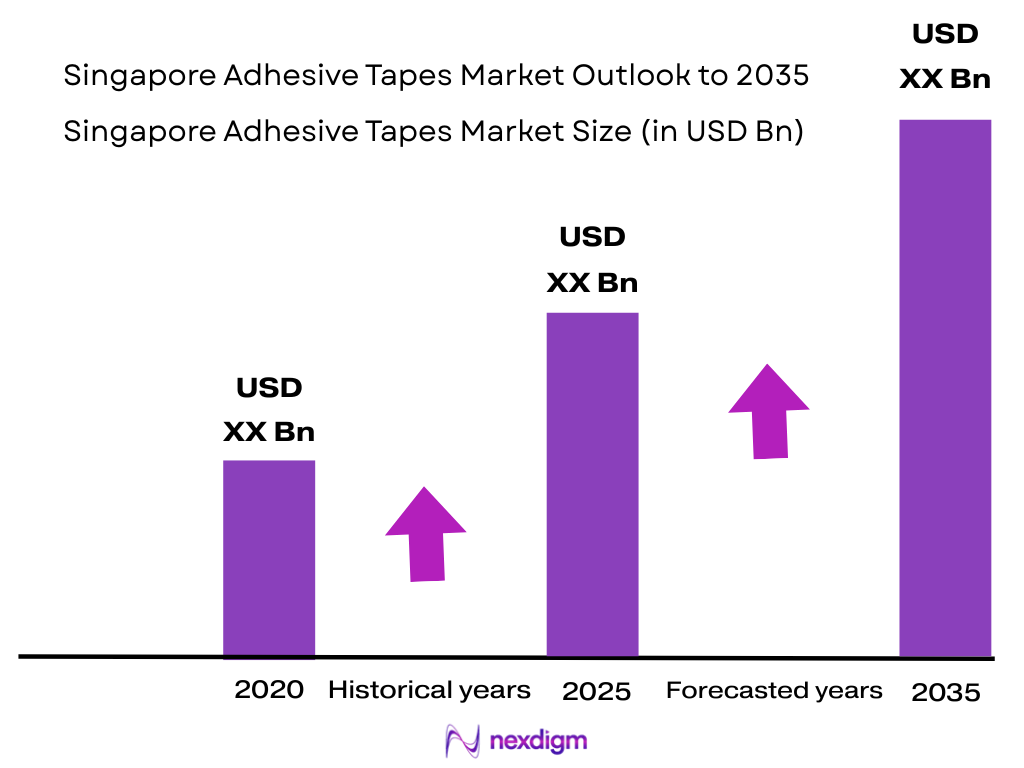
The Singapore Adhesive Tapes Market is estimated at ~USD XX million, supported by the country’s highly developed manufacturing, electronics, logistics and construction ecosystem. Singapore’s manufacturing output reached S$423.6 billion, while manufacturing value added reached S$114.5 billion, providing a substantial industrial customer base for adhesive tape applications. Electronics accounted for S$44.0 billion of manufacturing value added. Separately, construction output reached S$38.4 billion, reinforcing demand for mounting, insulation, masking and sealing tapes.
Singapore’s adhesive-tape demand is concentrated around Jurong Island, Tuas, Changi, Woodlands, Tampines and the western manufacturing corridor, reflecting the country’s concentration of electronics, precision engineering, biomedical manufacturing, chemicals, logistics and industrial facilities. Electronics is particularly important: Singapore’s electronics manufacturing cluster recorded strong production momentum, while semiconductor and related manufacturing activities create demand for cleanroom-compatible, thermal-resistant, high-temperature and precision adhesive tapes. The country’s construction pipeline also supports substantial demand for HVAC, MEP, insulation and mounting applications.
Market Segmentation
By Adhesive Technology
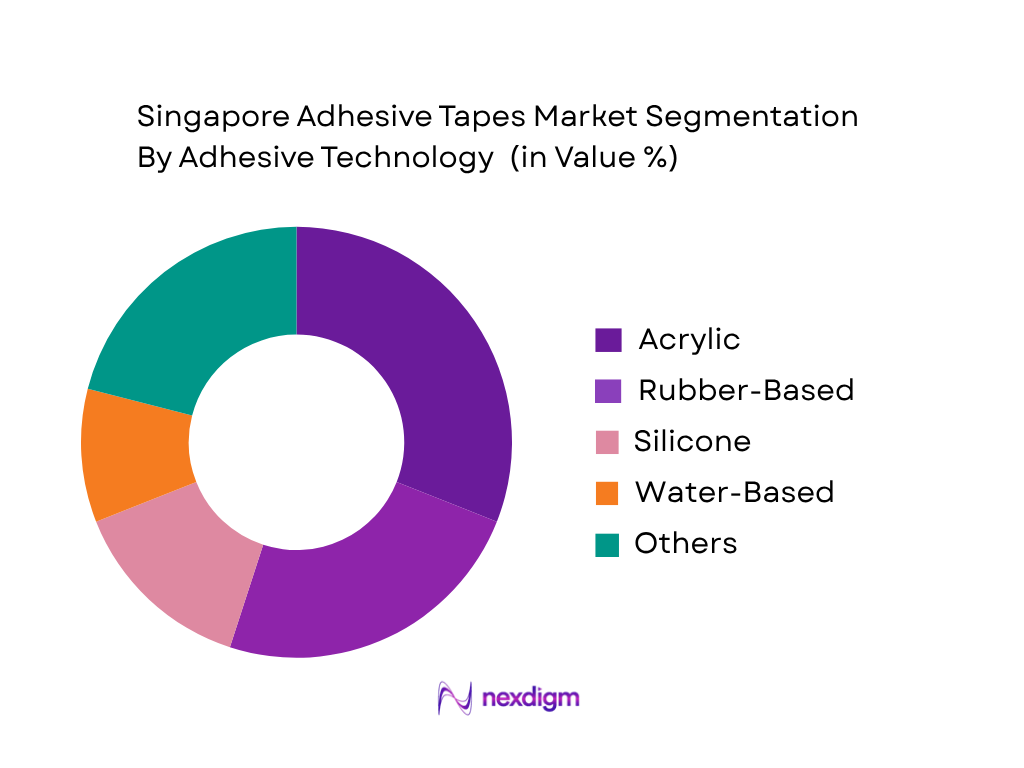
The Singapore Adhesive Tapes Market is segmented by adhesive technology into acrylic, rubber-based, silicone, water-based, solvent-based and hot-melt adhesives. Acrylic adhesive tapes are expected to command the largest share, reflecting their broad suitability across industrial bonding, electronics, packaging, construction and mounting applications. Acrylic systems provide strong adhesion, aging resistance and comparatively reliable performance across diverse substrates, making them particularly relevant to Singapore’s electronics, precision-engineering and industrial customer base. Silicone tapes occupy an important premium position where high-temperature performance and demanding substrate compatibility are required, particularly in electronics and specialty industrial applications. Rubber-based and hot-melt systems remain relevant for packaging and general-purpose applications where high initial tack and efficient converting are important. Water-based technologies benefit from environmental considerations, while solvent-based systems retain relevance where specialized performance characteristics are required. Singapore’s electronics manufacturing output provides an important structural demand base for higher-performance acrylic and silicone technologies, with electronics manufacturing value added reaching S$44.0 billion.
By End-Use Industry
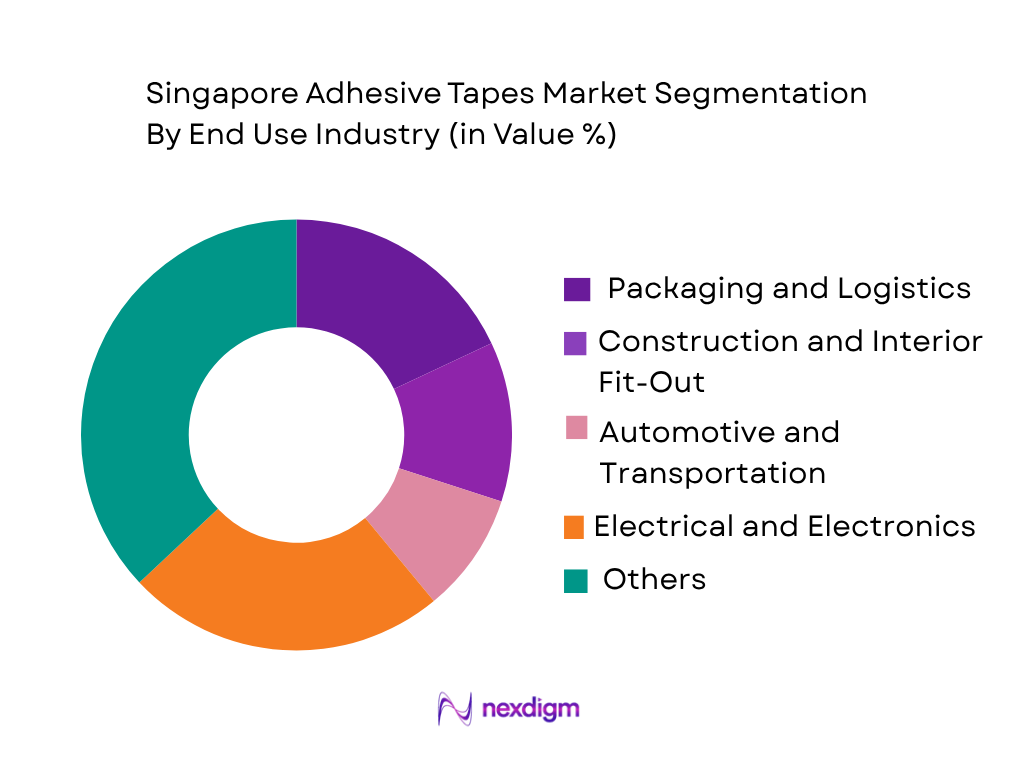
The Singapore Adhesive Tapes Market is segmented by end-use industry into packaging and logistics, construction and interior fit-out, automotive and transportation, electrical and electronics, HVAC and MEP, healthcare and pharmaceuticals, industrial manufacturing, aerospace and defense, furniture and interiors, food and beverage, and marine and specialty applications. Electrical and electronics is expected to represent the dominant end-use segment, supported by Singapore’s established semiconductor, electronics, precision-engineering and advanced manufacturing ecosystem. Adhesive tapes are increasingly used for component mounting, insulation, masking, wire management, thermal management, display assembly and surface protection where mechanical fastening can add weight or complicate automated production. Singapore’s electronics cluster contributed S$44.0 billion in manufacturing value added, while electronics represented the largest manufacturing cluster by value added in the cited government data. Packaging and logistics also represent a major consumption base because Singapore functions as a regional trade and distribution hub, while construction demand supports mounting, sealing, insulation and protection tapes.
Competitive Landscape
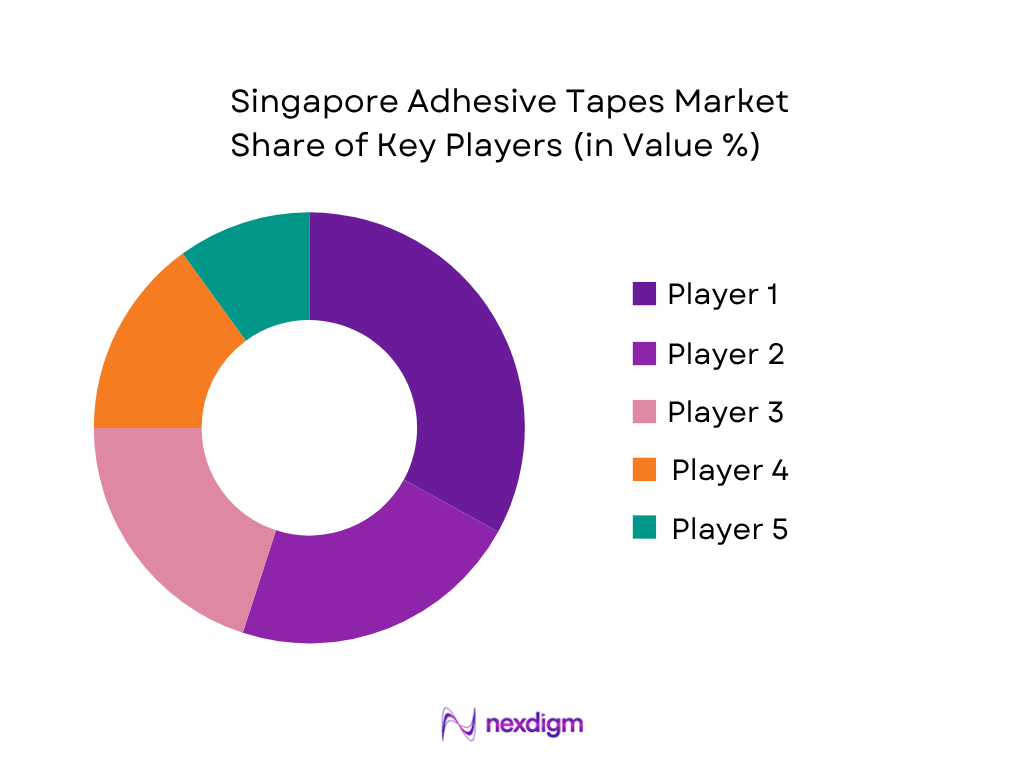
The Singapore Adhesive Tapes Market is characterized by a combination of global adhesive-material manufacturers, specialty tape producers and regional suppliers serving multinational manufacturers and local industrial users. Companies compete through adhesive chemistry, tape construction, application engineering, OEM qualification, product customization and supply reliability. The competitive environment is particularly influenced by Singapore’s electronics and semiconductor ecosystem, where technical specifications, cleanroom suitability, temperature resistance, dimensional stability and consistent batch performance can be more important than commodity pricing.
| Company | Establishment | Headquarters | Core Tape Technologies | Key Singapore Applications | Technical Differentiator | Financial / Corporate Parameter |
| 3M | 1902 | St. Paul, Minnesota, USA | ~ | ~ | ~ | ~ |
| Nitto Denko | 1918 | Osaka, Japan | ~ | ~ | ~ | ~ |
| tesa SE | 1896 | Norderstedt, Germany | ~ | ~ | ~ | ~ |
| Avery Dennison | 1935 | Mentor, Ohio, USA | ~ | ~ | ~ | ~ |
| LINTEC | 1934 | Tokyo, Japan | ~ | ~ | ~ | ~ |
Singapore Adhesive Tapes Market Analysis
Growth Drivers
Electronics Manufacturing Output
Singapore’s electronics manufacturing base is a principal demand generator for adhesive tapes because semiconductor, electronics, precision-engineering and advanced-packaging operations require technically engineered bonding, masking, insulation, protection and assembly solutions. Singapore’s manufacturing sector recorded S$429.584 billion in total output and S$116.595 billion in value added, while the electronics cluster generated S$181.166 billion in output and S$46.813 billion in value added. The scale of this industrial base supports recurring consumption of acrylic, silicone, double-sided, thermal-management, conductive, polyimide and specialty process tapes. The semiconductor ecosystem is also continuing to deepen: VisionPower Semiconductor Manufacturing Company began construction of a 300mm wafer fabrication facility in Tampines, with initial production planned for 2027 and an expected capacity of 55,000 300mm wafers per month once fully operational. Applied Materials also announced plans to double its Singapore manufacturing capacity, workforce and R&D activities, while its advanced-packaging activities directly support semiconductor manufacturing requirements. These developments strengthen the addressable market for precision adhesive tapes, particularly products requiring cleanroom compatibility, controlled outgassing, dimensional stability, high-temperature resistance and reliable adhesion to metals, polymers and semiconductor substrates. The concentration of high-value electronics production therefore supports both volume demand and premiumization within Singapore’s adhesive-tape market.
Packaging Demand and E-Commerce Fulfilment
Packaging and logistics represent a recurring consumption base for adhesive tapes because Singapore operates as a major regional trade, distribution and transshipment centre serving Southeast Asian supply chains. Singapore recorded S$1,285.864 billion in total merchandise trade, comprising S$674.505 billion of exports and S$611.359 billion of imports. Re-exports alone reached S$387.907 billion, demonstrating the scale of goods movement through the country and creating continuing requirements for carton sealing, palletizing, bundling, label attachment, protective packaging and secondary packaging applications. Adhesive tapes used in logistics must support automated packing lines, carton closure, high-speed converting and reliable adhesion across corrugated-board substrates. The growth of fulfilment operations also creates demand for specialty packaging tapes with improved holding power, easy application and compatibility with automated dispensing equipment. Singapore’s extensive merchandise flows increase the number of packaging touchpoints across import, storage, fulfilment and re-export activities, supporting recurring tape consumption even where final manufacturing occurs outside Singapore. The logistics ecosystem is therefore relevant not only to conventional packaging tape but also to printed tapes, reinforced filament tapes, tamper-evident solutions and specialty tapes designed for high-throughput distribution environments.
Market Challenges
Imported Master-Roll Dependency and Polymer Feedstock Exposure
Singapore’s position as a highly open manufacturing and trading economy creates exposure to international supply chains for adhesive raw materials, polymer films, release liners, specialty chemicals and master rolls. The country’s merchandise imports reached S$611.359 billion, while total merchandise trade reached S$1,285.864 billion, illustrating the scale of external trade dependence across industrial inputs and finished goods. For adhesive-tape producers and converters, this structure can increase exposure to disruptions involving acrylic monomers, synthetic rubber, silicone polymers, BOPP films, PET films, release coatings and specialty liners. The issue is particularly relevant for advanced tapes because specialized substrates and adhesive formulations may have fewer qualified suppliers than commodity packaging materials. Singapore’s chemicals cluster itself recorded S$95.155 billion of manufacturing output and S$17.512 billion of value added, highlighting the importance of chemical inputs to the wider industrial ecosystem while also demonstrating the scale of industries competing for sophisticated chemical supply chains. Companies operating in adhesive tapes consequently need supply-chain redundancy, inventory planning and alternative sourcing arrangements to maintain continuity for OEM customers. The challenge is amplified when tape products require customer qualification, because replacing a qualified polymer, liner or adhesive formulation can require application testing before the substitute can be introduced into production.
Technical Qualification Barriers and High-Temperature Performance Requirements
Singapore’s concentration of semiconductor, electronics, biomedical and precision-engineering manufacturing raises the technical threshold for adhesive-tape suppliers because industrial customers increasingly require consistent performance under controlled production conditions rather than basic adhesion alone. Singapore’s electronics manufacturing generated S$181.166 billion of output, while precision engineering generated S$51.983 billion, creating a substantial customer base where tapes may be exposed to elevated temperatures, humidity, chemicals, mechanical stress, cleanroom environments and automated processing. Advanced applications can require tight specifications for peel strength, shear resistance, dielectric performance, thermal stability, residue, outgassing, dimensional stability and compatibility with sensitive substrates. The establishment of a new semiconductor manufacturing facility by VisionPower and the expansion of advanced semiconductor-related activities reinforce this requirement. Tape suppliers therefore face qualification barriers when entering OEM production lines because customers may require application testing, reliability validation and process compatibility before approving a new product. This creates a challenge for smaller suppliers that may have technically capable products but limited local application-engineering resources or qualification history. It also increases the importance of technical support, laboratory capabilities and product consistency, making the Singapore market structurally more demanding than a purely commodity-oriented tape market.
Market Opportunities
Advanced Electronics Bonding and Semiconductor Process Tapes
Singapore’s expanding semiconductor ecosystem creates a strong opportunity for higher-value adhesive tapes designed specifically for electronics assembly and semiconductor processing. Electronics manufacturing generated S$181.166 billion in output and S$46.813 billion in value added, establishing a large industrial base for precision bonding and functional adhesive materials. The country also attracted S$13.5 billion in fixed-asset investment commitments, including S$11.1 billion in manufacturing, with major investment activity concentrated in semiconductors and biomedical manufacturing. These developments support demand for tapes used in wafer processing, temporary fixation, component mounting, semiconductor packaging, thermal management, insulation, surface protection and precision assembly. Advanced packaging is particularly relevant because Applied Materials is expanding manufacturing and R&D activities in Singapore, while Advanced Substrate Technologies began construction of a facility for high-end FC-BGA substrates used in advanced semiconductor products, including AI and machine-learning systems. Such applications create opportunities for acrylic, silicone, polyimide, thermal-interface and other functional tape technologies that can deliver controlled adhesion, clean removal, high-temperature stability and dimensional precision. Suppliers capable of supporting qualification, customization and local application engineering can therefore target higher-value niches beyond conventional packaging tapes.
Specialty Tape Converting and Sustainable Adhesive Systems
Singapore provides an opportunity for specialized tape converting because its industrial base combines electronics, biomedical manufacturing, aerospace, chemicals, precision engineering, construction and logistics within a compact manufacturing ecosystem. Total manufacturing output reached S$429.584 billion, with 9,858 manufacturing establishments operating across the sector. The diversified customer base creates scope for locally converted products such as die-cut electronic-component tapes, narrow-width industrial tapes, laminated constructions, custom adhesive formats and application-specific masking or protection products. Sustainability also creates an opportunity for low-VOC, water-based, bio-derived and recyclable tape constructions, particularly as manufacturers seek to reduce material intensity and improve environmental performance without sacrificing bonding reliability. Singapore’s investment environment is supporting projects across semiconductors, specialty chemicals, biomedical manufacturing, aerospace and sustainable products, with S$23.5 billion of projected annual value-added contribution associated with the year’s committed investments. This broad industrial pipeline can increase demand for application-specific adhesive solutions rather than standardized commodity rolls. Specialty converters that combine slitting, laminating, die-cutting and technical application support can consequently occupy a more defensible position by supplying customized tape formats to OEMs and contract manufacturers.
Future Outlook
The Singapore Adhesive Tapes Market is expected to experience continued structural demand from electronics, semiconductor manufacturing, packaging, construction, healthcare and advanced industrial applications. Growth should increasingly favor engineered tapes rather than undifferentiated commodity products as manufacturers seek lightweight bonding, automation compatibility, thermal resistance and cleaner production processes. Singapore’s manufacturing ecosystem provides an important foundation, with total manufacturing output reaching S$423.6 billion and manufacturing value added reaching S$114.5 billion.
Construction should remain another important demand channel. Actual construction demand reached S$44.2 billion, while construction output reached S$38.4 billion, supporting continued applications in HVAC, MEP, insulation, mounting, flooring and building-envelope systems. The market should also benefit from Singapore’s regional trading position. World Bank WITS data recorded US$74.997 million of Singapore imports under HS 391910 self-adhesive tapes in 2024, alongside US$97.854 million of exports, illustrating the country’s role in regional adhesive-tape distribution and trade flows.
Major Players
- 3M Company
- Nitto Denko Corporation
- tesa SE
- Avery Dennison Corporation
- LINTEC Corporation
- Saint-Gobain
- Scapa Group
- Intertape Polymer Group
- H.B. Fuller Company
- Berry Global
- Lohmann GmbH & Co. KG
- Shurtape Technologies
- CCT Tapes
- Advance Tapes International
- Mactac
Key Target Audience
- Adhesive Tape Manufacturers and Specialty Tape Converters
- Semiconductor, Electronics and Precision-Engineering Manufacturers
- Packaging, Logistics and Fulfilment Companies
- Construction, HVAC and MEP Contractors
- Automotive, Aerospace and Transportation Component Manufacturers
- Investments and Venture Capitalist Firms
- Government and Regulatory Bodies (Singapore Economic Development Board, Enterprise Singapore, Building and Construction Authority, Singapore Standards Council)
- Industrial Procurement, OEM Engineering and Strategic Sourcing Departments
Research Methodology
Step 1: Identification of Key Variables
The initial stage develops a Singapore-specific adhesive-tape ecosystem covering adhesive formulators, backing-film suppliers, tape manufacturers, converters, distributors, OEMs and industrial end users. Variables include tape construction, adhesive chemistry, substrate compatibility, application requirements, import dependence and end-use demand. Secondary research incorporates Singapore government statistics, trade databases, corporate disclosures and industry-specific technical information.
Step 2: Market Analysis and Construction
Historical market demand is reconstructed through a bottom-up assessment of adhesive-tape applications across packaging, electronics, construction, HVAC, automotive, healthcare and industrial manufacturing. Import and export flows are reconciled with domestic consumption and local converting activity. Trade data for HS 391910 is incorporated as a supply-chain indicator, with Singapore recording 8.10 million kg of imports and 7.90 million kg of exports under the relevant classification in 2024. (WITS)
Step 3: Hypothesis Validation and Expert Consultation
Market hypotheses are validated through structured discussions with tape manufacturers, converters, distributors, procurement professionals and application engineers. The consultation framework focuses on adhesive selection, OEM qualification, application failure points, replacement cycles, technical specifications and purchasing criteria. Inputs are cross-checked against company disclosures, trade statistics and manufacturing indicators to minimize reliance on individual stakeholder estimates.
Step 4: Research Synthesis and Final Output
The final stage integrates top-down industrial indicators with bottom-up tape consumption estimates. Demand is mapped against Singapore’s electronics, construction, manufacturing and logistics ecosystem, while competitive benchmarking evaluates product portfolios, technical capabilities, distribution reach and financial strength. The resulting analysis distinguishes commodity tapes from specialty and engineered adhesive solutions to identify the most commercially relevant growth pockets.

- Executive Summary
- Research Methodology (Market Definition, Market Boundary, Adhesive Tape Inclusion Criteria, Exclusion Criteria, Primary Research Framework, Secondary Research Sources, Top-Down Market Sizing, Bottom-Up Market Sizing, Volume-to-Value Conversion, Manufacturer Revenue Mapping, Import–Export Reconciliation, End-Use Demand Modeling, Distributor Validation, Data Triangulation, Forecasting Framework, Sensitivity Analysis, Assumptions and Limitations)

- Market Definition and Scope
- Adhesive Tapes Industry Structure
- Evolution of Adhesive Tape Technologies
- Singapore Adhesive Tapes Value Chain
- Singapore Adhesive Tapes Supply Chain
- Raw Material to Finished-Tape Conversion Ecosystem
- Singapore’s Regional Role in Asia-Pacific Adhesive Tape Trade
- Import Dependency and Re-Export Dynamics
- Manufacturing, Slitting, Coating and Converting Ecosystem
- Key Demand Centers and Industrial Clusters

- Market Growth Drivers (Electronics Manufacturing Output, Packaging Demand, E-Commerce Fulfilment, Construction Activity, Industrial Production, Logistics Throughput, HVAC Installation, Semiconductor Manufacturing, Precision Assembly, Lightweight Bonding Adoption)
- Market Challenges (Imported Master-Roll Dependency, Polymer Feedstock Exposure, Adhesive Chemistry Dependency, Humidity Exposure, High-Temperature Performance Requirements, Limited Domestic Tape Manufacturing, Technical Qualification Barriers, Commodity-Tape Price Competition)
- Market Opportunities (Advanced Acrylic Foam Tapes, Electronics Bonding Tapes, EV and Battery Assembly Tapes, Semiconductor Process Tapes, Low-VOC Adhesive Systems, Sustainable BOPP Tapes, Bio-Based Adhesives, HVAC Foil Tapes, Solar Applications, Smart Functional Tapes, Specialty Tape Converting)
- Market Trends (Miniaturized Electronics Assembly, Lightweight Bonding, High-Temperature Adhesives, Low-VOC Formulations, Solvent-Free Manufacturing, Sustainable Backings, Thin-Gauge Tapes, Automation-Compatible Tapes, Functional Surface Protection, Premiumization)
- Regulatory and Standards Landscape (Singapore Standards, Workplace Safety Requirements, Environmental Compliance, Chemical Management, VOC Requirements, Product Safety, Packaging Requirements, Hazard Communication, Waste Management)
- PESTLE Analysis
- Porter’s Five Forces Analysis
- SWOT Analysis

- By Market Value (2020-2025)
- By Tape Consumption Volume (2020-2025)
- By Average Selling Value per Unit Area (2020-2025)
- By Adhesive Tape Production Volume (2020-2025)
- By Import Volume (2020-2025)
- By Export and Re-Export Volume (2020-2025)
- By Domestic Consumption Volume (2020-2025)
- By Local Production Versus Imported Supply (2020-2025)

- By Adhesive Technology (in value %)
Acrylic Adhesive Tapes
High-Performance Acrylic
Modified Acrylic
UV-Curable Acrylic
Rubber-Based Adhesive Tapes
Natural Rubber
Synthetic Rubber
Resin-Modified Rubber
Silicone Adhesive Tapes
High-Temperature Silicone
Low-Surface-Energy Silicone
Electrical-Grade Silicone
Water-Based Adhesive Tapes
Solvent-Based Adhesive Tapes
Hot-Melt Adhesive Tapes
Hybrid and Specialty Adhesive Systems - By Tape Construction (in value %)
Single-Sided Tapes
Double-Sided Tapes
Adhesive Transfer Tapes
Foam Tapes
PE Foam
PU Foam
Acrylic Foam
Film Tapes
BOPP
PET
PVC
PE
Polyimide
Paper and Masking Tapes
Cloth and Duct Tapes
Filament-Reinforced Tapes
Foil Tapes
Non-Woven Tapes
Specialty Functional Tapes - By End-Use Industry (in value %)
Packaging and Logistics
Construction and Interior Fit-Out
Automotive and Transportation
Electrical and Electronics
HVAC and MEP
Healthcare and Pharmaceuticals
Industrial Manufacturing
Aerospace and Defense
Furniture and Interiors
Food and Beverage
Marine and Specialty Applications - By Application (in value %)
Bonding and Permanent Assembly
Mounting and Attachment
Sealing and Joining
Electrical Insulation
Thermal Management
Masking and Surface Protection
Splicing and Web Joining
Lamination
Wire Harnessing and Cable Management
Packaging Closure and Reinforcement - By Backing Material (in value %)
BOPP
PET
PVC
PE
Polyimide
Foam
Paper
Cloth
Aluminum Foil
Non-Woven - By Distribution Channel (in value %)
Direct Manufacturer-to-Industrial Customer
Authorized Distributors
Specialty Tape Converters
Electrical and Electronics Distribution
Industrial Supply Distributors
Construction and Hardware Distribution
Online B2B and E-Commerce

- Market Share of Major Players (By Value, Volume, Adhesive Technology, Tape Construction, End-Use Industry, Application and Distribution Channel)
- Cross Comparison Parameters (Adhesive Technology Breadth, Backing Material Portfolio, Specialty Tape SKU Breadth, Local Converting Capability, Electronics & Semiconductor Qualification, Industrial Distribution Reach, Customization & Application Engineering)
- SWOT Analysis of Major Players
- Detailed Profiles of Major Companies
3M Company
tesa SE
Nitto Denko Corporation
Avery Dennison Corporation
LINTEC Corporation
Scapa Group
Intertape Polymer Group
Lohmann GmbH & Co. KG
Saint-Gobain Performance Solutions
Berry Global
Shurtape Technologies, LLC
IPG – Intertape Polymer Group
H.B. Fuller Company
tesa tape Asia Pacific Pte. Ltd.
Scapa Industrial

- Industrial Purchasing Behavior
- Application-Specific Tape Selection
- OEM and Engineering Specification Requirements
- Electronics and Semiconductor Tape Demand Analysis
- Packaging User Analysis

- By Market Value (2026-2035)
- By Tape Consumption Volume (2026-2035)
- By Average Selling Value per Unit Area (2026-2035)
- By Adhesive Tape Production Volume (2026-2035)
- By Import Volume (2026-2035)
- By Export and Re-Export Volume (2026-2035)
- By Domestic Consumption Volume (2026-2035)
- By Local Production Versus Imported Supply (2026-2035)


 Request a Sample
 Ask for Customization
 Get a Quote
 Enquire Now