
 Download PDF
Market Overview
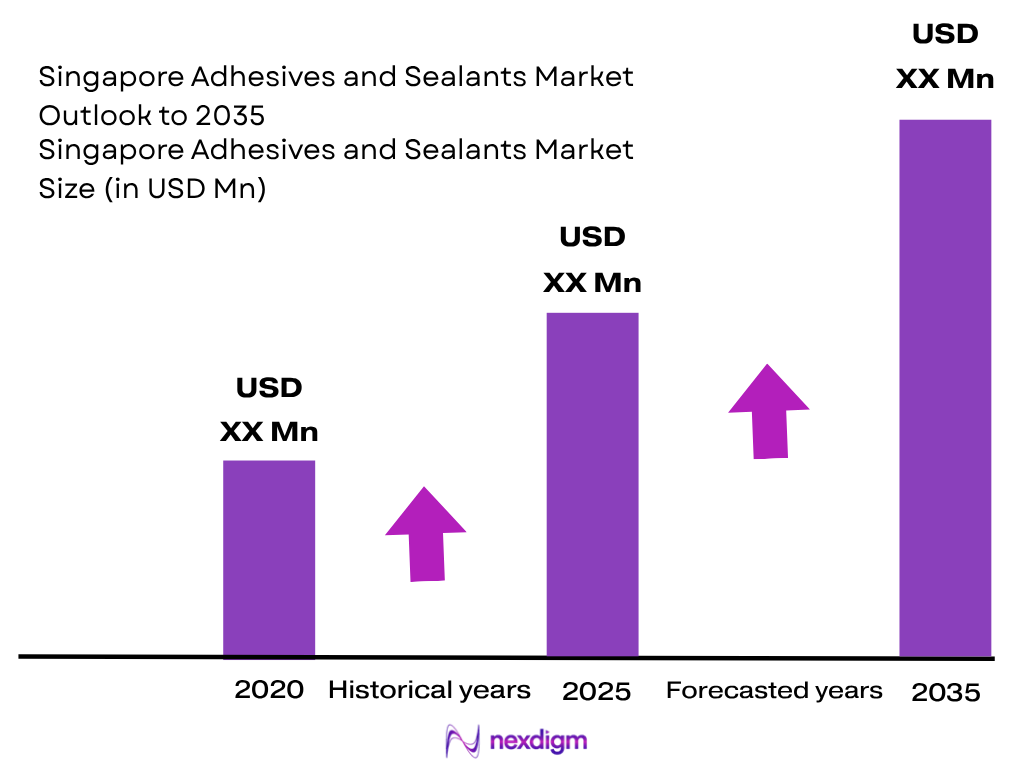
The Singapore Adhesives and Sealants Market recorded revenue of USD 287.1 million and consumption of 80.1 kilotons in the latest completed market assessment, compared with a preceding-period market supported by construction demand of S$33.8 billion. Adhesive and sealant consumption is driven by packaging, electronics, semiconductor assembly, building construction, aerospace MRO and industrial manufacturing. Construction activity subsequently reached S$44.2 billion, strengthening demand for structural adhesives, façade sealants, waterproofing systems and assembly solutions.
Singapore’s adhesives and sealants demand is concentrated around its principal manufacturing, construction, logistics and advanced-industry clusters. The West Region, including Jurong and Tuas, benefits from chemicals, industrial manufacturing and port-linked activity, while the East Region benefits from Changi-linked aerospace and logistics operations. National fixed-asset investment commitments stood at S$12.7 billion, with chemicals accounting for about 35% and electronics 24.2%, reinforcing demand for technically advanced bonding, encapsulation and sealing materials.
Market Segmentation
By Product Type
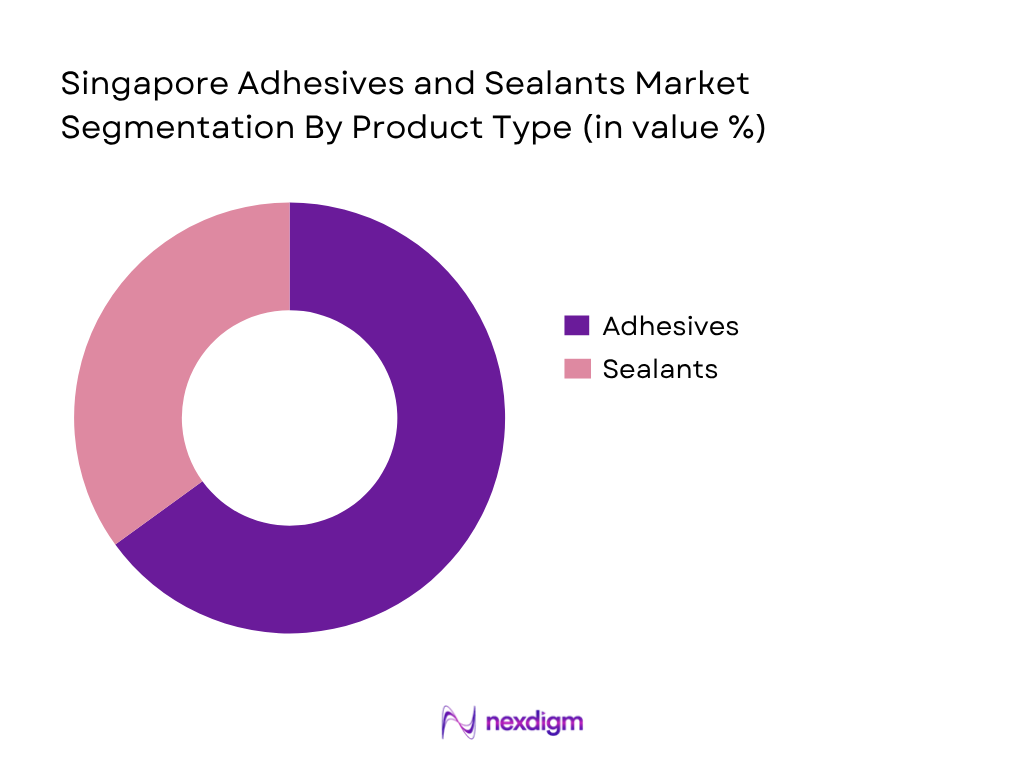
The Singapore Adhesives and Sealants Market is segmented by product type into adhesives and sealants. Adhesives represent the dominant sub-segment, supported by their wider application across packaging, electronics and electrical equipment, healthcare products, industrial assembly, aerospace and construction. Packaging requires substantial volumes of adhesives for flexible laminates, labels, cartons, tapes and case sealing, while Singapore’s advanced manufacturing ecosystem creates demand for higher-value epoxy, acrylic, polyurethane and UV-curable bonding materials. Sealants remain particularly important for construction, façade systems, glazing, waterproofing, aerospace and industrial joints. Their application intensity is supported by Singapore’s dense urban construction environment and requirements for weather resistance, moisture protection and joint movement. The adhesive category also benefits from continued migration from mechanical fastening toward lightweight bonding in precision manufacturing. Separate market research identifies adhesives as the larger product category in Singapore.
By End-Use Industry
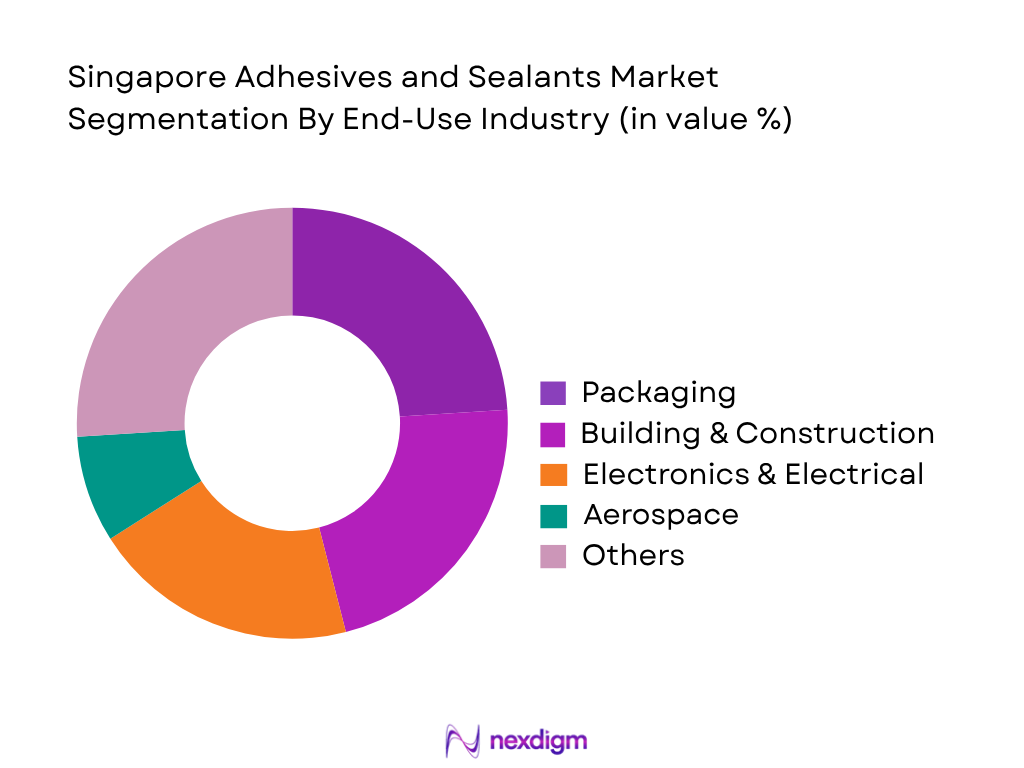
The Singapore Adhesives and Sealants Market is segmented by end-use industry into packaging, building and construction, electronics and electrical, aerospace, automotive and transportation, healthcare, woodworking and joinery, and other industrial applications. Packaging is a major adhesive-consuming application because bonding materials are essential for flexible packaging, folding cartons, labels, tapes and case-and-carton sealing. Research on Singapore’s adhesives market specifically identifies packaging as the leading adhesive end-user, supported by food and beverage packaging and e-commerce applications. Construction simultaneously represents a particularly important sealant demand center because silicone, polyurethane and hybrid products are extensively used in façades, structural glazing, waterproofing and movement joints. Singapore’s electronics manufacturing base further shifts the market toward higher-value materials used for encapsulation, thermal management, component assembly and protection. Aerospace MRO adds another technically demanding application pool requiring qualified, high-performance bonding and sealing systems.
Competitive Landscape
The Singapore Adhesives and Sealants Market features multinational chemical and specialty-material suppliers with extensive technology portfolios and established industrial relationships. Henkel, 3M, H.B. Fuller, Arkema/Bostik and Sika are repeatedly identified among major participants in Singapore’s adhesive market. Competition extends beyond product pricing toward resin chemistry, application engineering, technical service, OEM qualification, sustainability performance and the ability to supply specialized products for electronics, packaging, construction, aerospace and industrial assembly.
| Company | Established | Headquarters | Key Chemistry / Technology | Major Singapore Applications | Technical Capability | Distribution Model | Sustainability Focus | Market Positioning |
| Henkel | 1876 | Düsseldorf, Germany | ~ | ~ | ~ | ~ | ~ | ~ |
| 3M | 1902 | Minnesota, USA | ~ | ~ | ~ | ~ | ~ | ~ |
| H.B. Fuller | 1887 | Minnesota, USA | ~ | ~ | ~ | ~ | ~ | ~ |
| Sika | 1910 | Baar, Switzerland | ~ | ~ | ~ | ~ | ~ | ~ |
| Arkema / Bostik | 1889 / 1889 | Colombes, France | ~ | ~ | ~ | ~ | ~ | ~ |
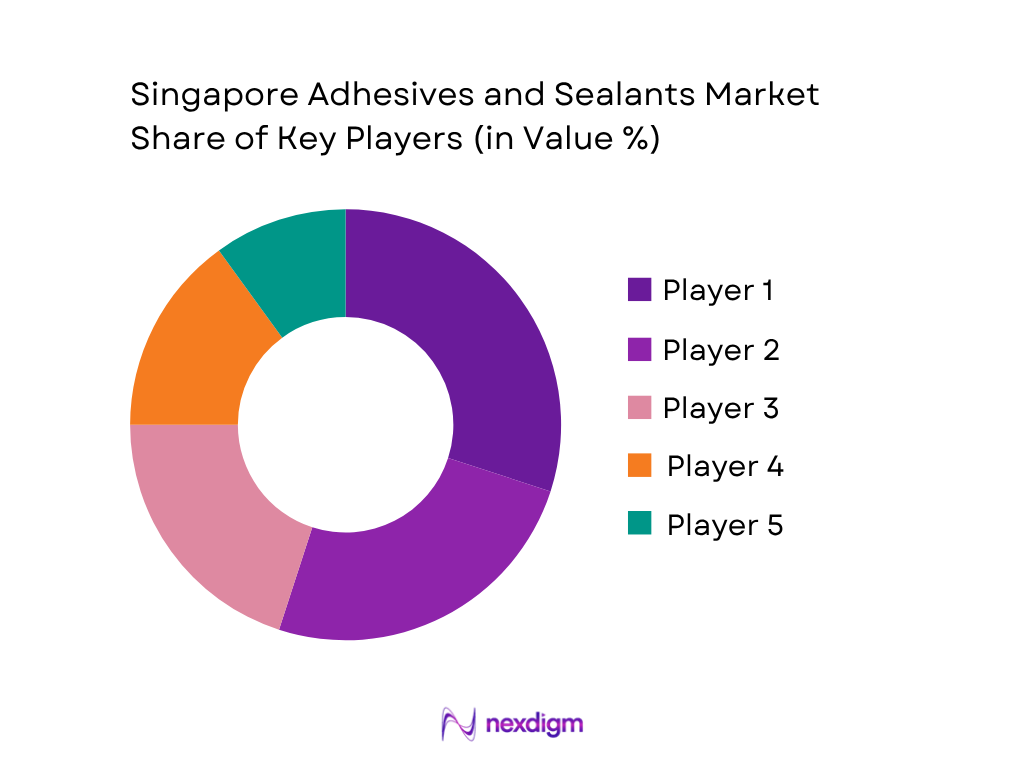
Singapore Adhesives and Sealants Market Analysis
Growth Drivers
Expansion of Electronics, Semiconductor and Advanced Manufacturing Applications
Singapore’s electronics and advanced-manufacturing base is a direct demand engine for high-performance adhesives used in semiconductor packaging, die attach, underfill, encapsulation, PCB assembly, thermal management, optical bonding and equipment assembly. Singapore’s electronics manufacturing cluster generated S$181.166 billion of output in 2024, compared with S$160.56 billion in 2023, while electronics value added increased from S$39.762 billion to S$46.813 billion. Across manufacturing, Singapore operated 9,858 establishments, producing S$429.584 billion of output and S$116.595 billion of value added in 2024. These figures provide a substantial industrial base for epoxy, acrylic, silicone, polyurethane and UV-curable bonding materials. Singapore also produces approximately 1 in every 10 chips globally and around 1 in every 5 units of global semiconductor equipment, creating applications extending from electronic-component assembly to bonding and sealing within production equipment. Singapore recorded S$13.5 billion of fixed-asset investment commitments in 2024, of which S$11.1 billion originated from manufacturing. These commitments are associated with 18,700 jobs and S$23.5 billion of annual value added when realised. Singapore’s GDP stood at US$547.39 billion, with GDP per capita at US$90,674.1 in 2024, reinforcing the country’s position as a high-value manufacturing economy supporting technically advanced adhesive applications.
Construction, Infrastructure and Aerospace Activity Expanding Sealant and Structural Bonding Demand
Singapore’s construction pipeline and aerospace manufacturing ecosystem create substantial application demand for silicone, polyurethane, acrylic and hybrid-polymer sealants alongside structural and assembly adhesives. S$44.2 billion of construction contracts were awarded in 2024, compared with S$33.8 billion in 2023, supported by public institutional developments and public and private housing projects. This construction activity generates material requirements across façade joints, structural glazing, window and door perimeter sealing, waterproofing, flooring, roofing, expansion joints, precast components and mechanical-and-electrical installations. Aerospace provides an additional technically differentiated demand base. Singapore’s aerospace output exceeded S$18 billion in 2024, supported by approximately 22,000 workers and more than 130 aerospace companies. Investment commitments associated with 10 aerospace projects exceeded S$750 million, covering manufacturing and maintenance, repair and overhaul activities. Singapore Aero Engine Services also announced S$242 million for additional MRO facilities, alongside plans for 500 technician and engineering jobs. GE Aerospace’s local operations employ more than 2,000 people, while Singapore handles more than 60 units out of every 100 units of GE Aerospace’s global repair volume. Singapore’s nominal GDP reached S$731.436 billion in 2024, with GDP per capita of S$121,161, providing a strong macroeconomic and industrial environment for specialized construction sealants, structural adhesives and aerospace-grade bonding solutions.
Market Challenges
Dependence on Imported Feedstocks and Material-Intensive Chemical Supply Chains
The Singapore Adhesives and Sealants Market operates within an internationally integrated chemicals ecosystem, making the availability of polymers, monomers, additives, tackifiers, fillers and specialty formulation inputs dependent on regional and global supply chains. This is particularly relevant for polyurethane systems requiring polyols and isocyanates, epoxy formulations requiring specialty resins and hardeners, silicone products requiring siloxane-based inputs and acrylic systems dependent on petrochemical derivatives. Singapore’s chemicals manufacturing cluster generated S$95.155 billion of output in 2024, while its value added amounted to S$17.512 billion. Total business costs for the chemicals manufacturing cluster reached S$86.244 billion, demonstrating the considerable material and operating inputs flowing through the country’s chemical-production ecosystem. The challenge extends beyond feedstock procurement because adhesives used in electronics, aerospace and precision manufacturing require consistent chemistry, traceability and controlled storage rather than straightforward substitution between inputs. Singapore’s nominal GDP stood at approximately US$547.5 billion, with GDP per capita exceeding US$90,600 and a population of approximately 6.0 million in 2024, highlighting a relatively small domestic resource base supporting a disproportionately large manufacturing and trading ecosystem. Manufacturing output reached S$429.584 billion across 9,858 establishments, while electronics generated S$181.166 billion and precision engineering produced another S$51.983 billion of output, increasing the importance of reliable specialty-chemical supply chains.
High Qualification, Compliance and Application-Performance Requirements
Singapore’s end-use structure creates substantial technical qualification requirements for adhesive and sealant suppliers because significant demand originates from advanced manufacturing, aerospace, high-specification construction and electronics rather than solely from general-purpose bonding applications. The electronics cluster produced S$181.166 billion of manufacturing output in 2024, with S$46.813 billion of value added, while precision engineering generated S$51.983 billion of output and S$17.750 billion of value added. Adhesives entering these applications may require controlled cure characteristics, dielectric performance, thermal conductivity, low ionic contamination, moisture resistance, batch traceability and compatibility with automated dispensing systems. Aerospace applications impose similarly demanding conditions. Singapore hosts more than 130 aerospace companies, while sector output exceeded S$18 billion in 2024, supported by approximately 22,000 workers. GE Aerospace’s Singapore operation employs more than 2,000 people across 3 plants, while local engine-component MRO operations handle more than 60 units per 100 units of the company’s global repair volume. Safran also established a 2,800-square-metre aeronautical electrical-equipment manufacturing and MRO facility at Seletar Aerospace Park, initially accommodating 50 employees. Singapore’s packaging regulations add another compliance dimension, requiring applicable companies with annual turnover exceeding S$10 million to report packaging information and maintain relevant records for 5 years, increasing the importance of product documentation and material-management capabilities.
Market Opportunities
High-Performance Adhesives for Semiconductor, Electronics and Precision Manufacturing
The transition toward specialized bonding materials for semiconductor packaging, electronics assembly, thermal management and precision manufacturing represents a significant opportunity for the Singapore Adhesives and Sealants Market. Singapore’s electronics industry generated S$181.166 billion of manufacturing output in 2024, compared with S$160.56 billion in 2023, while electronics value added increased from S$39.762 billion to S$46.813 billion. Precision engineering contributed another S$51.983 billion of output and S$17.750 billion of value added. These production ecosystems create adhesive-use points across die attachment, semiconductor underfill, encapsulation, conformal protection, PCB bonding, camera and sensor assembly, optical bonding, heat dissipation and equipment-component assembly. Singapore manufactures roughly 1 in every 10 chips produced globally and around 1 in every 5 units of global semiconductor equipment, establishing a concentrated customer ecosystem for specialty epoxies, silicones, acrylics, UV-curable materials and thermally conductive systems. Singapore also secured S$13.5 billion of fixed-asset investment commitments in 2024, with S$11.1 billion attributable to manufacturing. These commitments are associated with approximately 18,700 jobs and S$23.5 billion of annual value added when realised. Combined with GDP of US$547.39 billion and GDP per capita of US$90,674.1, the existing industrial base supports opportunities for low-outgassing, electrically insulating, thermally conductive and precision-dispensable adhesive technologies.
Aerospace MRO, Green Construction and Sustainable Packaging Applications
Aerospace MRO, advanced construction and sustainable packaging provide another important opportunity for suppliers of differentiated adhesives and sealants in Singapore. Aerospace output exceeded S$18 billion in 2024, supported by approximately 22,000 workers and more than 130 aerospace companies spanning manufacturing, maintenance, repair, overhaul and aftermarket operations. Investment commitments associated with 10 aerospace projects exceeded S$750 million, while Singapore Aero Engine Services separately committed S$242 million to additional engine-MRO facilities and plans for 500 technician and engineering jobs. These operations create applications for structural bonding, threadlocking, gasketing, potting, interior assembly and specialized sealants capable of operating under demanding temperature, vibration and chemical-exposure conditions. Construction provides a broader volume opportunity, with S$44.2 billion of construction contracts awarded in 2024, compared with S$33.8 billion in 2023. This activity supports façade sealants, structural glazing materials, waterproofing adhesives, flooring systems, movement-joint sealants and bonding products for prefabricated components. Packaging sustainability creates another product-development avenue because packaging represents approximately 1 out of every 3 units of domestic waste disposed of in Singapore, while applicable companies exceeding S$10 million in annual turnover must report packaging information and maintain relevant records for 5 years. Singapore’s US$547.39 billion GDP and US$90,674.1 GDP per capita further support a high-value environment for advanced bonding and sealing technologies.
Future Outlook
The Singapore Adhesives and Sealants Market is expected to expand through the next decade as demand becomes increasingly oriented toward specialty and performance-driven formulations. The market is forecast to register a ~X.X% CAGR during 2026–2035, with growth supported by advanced manufacturing, semiconductor packaging, infrastructure investment, aerospace MRO, sustainable packaging and green-building applications.
Construction will remain an important demand foundation. BCA expects medium-term construction demand to average S$39–46 billion annually, supported by Changi Airport Terminal 5, public housing, Cross Island Line works, healthcare infrastructure, industrial estates and urban rejuvenation projects. These developments create recurring requirements for silicone and hybrid sealants, façade bonding, waterproofing, flooring and structural adhesive systems.
Major Players
- Henkel
- 3M
- H.B. Fuller
- Sika
- Arkema / Bostik
- Dow
- WACKER
- MAPEI
- Saint-Gobain
- PPG Industries
- Parker Hannifin
- Huntsman Corporation
- Momentive Performance Materials
- Shin-Etsu Chemical
- Avery Dennison
Key Target Audience
- Adhesives and Sealants Manufacturers and Formulators
- Specialty Resin, Polymer and Chemical Feedstock Manufacturers
- Electronics, Semiconductor and Advanced Manufacturing Companies
- Construction, Building Materials and Infrastructure Companies
- Packaging Converters and Flexible Packaging Manufacturers
- Aerospace MRO, Marine and Industrial Manufacturing Companies
- Investments and Venture Capitalist Firms
- Government and Regulatory Bodies (Singapore Economic Development Board [EDB], Building and Construction Authority [BCA], National Environment Agency [NEA], Enterprise Singapore, Ministry of Trade and Industry [MTI])
Research Methodology
Step 1: Identification of Key Variables
The initial phase involves constructing the Singapore Adhesives and Sealants Market ecosystem across resin suppliers, formulators, distributors, OEMs, packaging converters, construction contractors and industrial end users. Secondary research identifies critical variables including resin consumption, adhesive technology, sealant chemistry, application intensity, imports, manufacturing activity, construction demand and pricing.
Step 2: Market Analysis and Construction
Historical market information is compiled across value, volume, product categories and major end-use industries. A top-down assessment evaluates Singapore’s manufacturing, construction, electronics, packaging and aerospace activity, while bottom-up analysis assesses adhesive and sealant consumption by application, customer group and chemistry to construct the market model.
Step 3: Hypothesis Validation and Expert Consultation
Market hypotheses are validated through computer-assisted telephone interviews (CATIs) and structured discussions with adhesive formulators, distributors, raw-material suppliers, construction specialists, packaging converters, electronics manufacturers and industrial users. Primary interviews are used to verify pricing, product substitution, procurement behavior, distribution structures, application trends and competitive positioning.
Step 4: Research Synthesis and Final Output
The final phase triangulates secondary evidence, trade statistics, corporate disclosures and primary industry inputs. Market value and volume estimates are reconciled using both demand-side and supply-side models. Forecast variables are then stress-tested against construction activity, manufacturing investment, electronics demand, technology substitution, sustainability requirements and specialty-product adoption to produce the final market outlook.

- Executive Summary
- Research Methodology (Market Definition and Scope, Singapore Adhesives and Sealants Market Classification, Adhesive and Sealant Product Mapping, Resin-Level Assessment, Technology-Level Assessment, Application-Level Demand Analysis, End-Use Industry Assessment, Domestic Formulation and Manufacturing Assessment, Import and Export Trade Analysis, Raw Material Supply Assessment, Demand-Side Assessment, Supply-Side Assessment, Top-Down Market Sizing, Bottom-Up Market Sizing, Primary Industry Interviews, Data Triangulation, Forecasting Framework, Market Share Validation, Limitations and Future Conclusions)

- Definition and Scope
- Singapore Adhesives and Sealants Industry Evolution and Development of Specialty Chemical Formulation, Advanced Manufacturing and Industrial Application Infrastructure
- Adhesives and Sealants Value Chain Analysis
- Adhesives and Sealants Supply Chain Analysis
- Resin and Chemical Feedstock Suppliers, Adhesive Formulators, Sealant Manufacturers, Importers, Authorized Distributors, Industrial OEMs, Construction Contractors, Packaging Converters, Electronics Manufacturers, Aerospace MRO Companies, Marine and Offshore Companies, End-Use Industries
- Adhesive Integration Across Electronics and Semiconductors, Packaging, Building and Construction, Aerospace, Marine and Offshore, Automotive and Transportation, Industrial Assembly, Woodworking and Consumer Applications
- Sealant Integration Across Building and Construction, Electronics and Semiconductors, Aerospace MRO, Marine and Offshore, Infrastructure, Structural Glazing, Fenestration, Industrial Assembly and General Engineering Applications

- Growth Drivers (Expansion of Electronics and Semiconductor Manufacturing, Growth of Advanced Semiconductor Packaging, Building and Construction Activity, Green Building and Refurbishment Demand, Aerospace MRO Expansion, Marine and Offshore Repair Activity, Flexible Packaging Demand, Industrial Automation, Increasing Demand for High-Performance Structural Bonding Systems)
- Market Challenges (Dependence on Imported Chemical Feedstocks and Finished Specialty Products, Volatility in Silicone, Polyurethane and Epoxy Raw Material Prices, High Specialty Product Qualification Requirements, Limited Domestic Manufacturing Scale, Stringent VOC and Chemical Compliance Requirements, Shelf-Life and Controlled-Storage Requirements, Skilled Applicator Availability, High Technical-Service Requirements)
- Market Opportunities (Semiconductor Packaging Adhesives, Thermally Conductive Electronics Adhesives, Low-Outgassing Adhesive Systems, Aerospace Structural Adhesives and Sealants, Hybrid Polymer Construction Sealants, Low-VOC and Green-Building Adhesives, Solvent-Free Flexible Packaging Adhesives, Marine Bonding and Sealing Solutions, Automated Adhesive Dispensing Systems, Singapore-to-ASEAN Specialty Adhesives Distribution)
- Market Trends (Low-VOC and Solvent-Free Formulation Adoption, Silicone and Hybrid Polymer Sealant Adoption, High-Performance Electronics Bonding, Thermal Management Adhesives, Structural Bonding Replacing Mechanical Fastening, Faster-Cure Adhesive Systems, Automated Precision Dispensing, Sustainable Packaging Adhesives, Green-Certified Construction Products, Specialty Adhesive Premiumization)
- Government Regulations and Standards (Building and Construction Authority Green Mark Requirements, Singapore Green Labelling Scheme Adhesives and Sealants Criteria, VOC and Indoor Air Quality Requirements, Workplace Safety and Health Chemical Requirements, Hazardous Chemical Storage and Handling Requirements, Building Material Performance Standards, Electronics Product Qualification Requirements, Food-Contact Packaging Requirements, Product Safety and Labeling Requirements)
- SWOT Analysis
- Porter’s Five Forces Analysis
- PESTLE Analysis
- Stakeholder Ecosystem
- Competition Ecosystem

- By Market Value (2020-2025)
- By Market Volume (2020-2025)
- By Adhesives Consumption Volume (2020-2025)
- By Sealants Consumption Volume (2020-2025)
- By Domestic Production and Formulation Volume (2020-2025)
- By Import Volume (2020-2025)
- By Export and Re-Export Volume (2020-2025)
- By Average Selling Price (2020-2025)

- By Adhesives Resin Type (In Value %)
Polyurethane Adhesives
Epoxy Adhesives
Acrylic Adhesives
Silicone Adhesives
Cyanoacrylate Adhesives
VAE / EVA Adhesives
Polyvinyl Acetate Adhesives
Other Specialty Adhesive Resins - By Adhesives Technology (In Value %)
Water-Borne Adhesives
Solvent-Borne Adhesives
Reactive Adhesives
Hot-Melt Adhesives
UV / Light-Cured Adhesives
Pressure-Sensitive Adhesives - By Sealants Resin Type (In Value %)
Silicone Sealants
Polyurethane Sealants
Acrylic Sealants
Epoxy Sealants
Polysulfide Sealants
MS Polymer / Silyl-Modified Polymer Sealants
Butyl Sealants
Other Specialty Sealant Resins - By Application Type (In Value %)
Building and Construction
Electronics and Semiconductors
Paper, Packaging and Flexible Packaging
Aerospace and Aviation MRO
Marine and Offshore
Automotive and Transportation
Industrial Assembly and General Engineering
Woodworking and Furniture
Healthcare and Medical Devices
Consumer and Household Applications - By End-Use Industry (In Value %)
Construction Industry
Electronics and Semiconductor Industry
Packaging Industry
Aerospace and Aviation MRO Industry
Marine and Offshore Industry
Automotive and Transportation Industry
Industrial Manufacturing Industry
Healthcare and Medical Device Industry
Furniture and Woodworking Industry
Renewable Energy and Electrical Equipment Industry - By Distribution Channel (In Value %)
Direct Industrial and OEM Sales
Authorized Distributors
Specialty Chemical Distributors
Construction Chemical and Building Material Dealers
Industrial Supply Distributors
Specialist Applicators and Contractors
Hardware and DIY Retailers
E-Commerce and Online Industrial Platforms - By End-Use Location (In Value %)
Central Region
East Region
West Region
North Region
North-East Region

- Market Share of Major Players (By Singapore Revenue, Adhesives Sales Volume, Sealants Sales Volume, Resin Portfolio, Technology Portfolio, End-Use Industry Exposure, Local Formulation and Supply Capability, Distribution Network Coverage, Industrial Customer Coverage, Electronics and Semiconductor Application Coverage, Aerospace and Marine Qualification Coverage, Product Certification Coverage, R&D and Application-Laboratory Capability)
- Cross Comparison Parameters (Adhesives and Sealants Revenue, Adhesive Resin and Technology Portfolio Breadth, Sealant Chemistry Portfolio Breadth, Singapore Distribution and Supply Network Reach, Local Application Engineering and Technical Support Capability, Electronics and Semiconductor-Grade Adhesive Capability, Aerospace and Marine Adhesive and Sealant Qualification Capability, Low-VOC and Sustainable Product Portfolio)
- SWOT Analysis of Major Players
- Competitive Positioning Matrix
- Adhesive Product Portfolio and Application Benchmarking
- Sealant Product Portfolio and Application Benchmarking
- Resin Formulation and Adhesive Technology Assessment
- Detailed Profiles of Major Companies
Henkel Adhesive Technologies
3M Singapore
H.B. Fuller
Sika Singapore
Arkema / Bostik
Dow
Wacker Chemie
MAPEI
Saint-Gobain
PPG Industries
Parker Hannifin
Huntsman Corporation
Momentive Performance Materials
Shin-Etsu Chemical
Avery Dennison

- Electronics and Semiconductor Manufacturer Adhesive Procurement Assessment
- Semiconductor Packaging and Assembly Adhesive Requirement Analysis
- Flexible Packaging Converter Adhesive Application Assessment
- Building and Construction Adhesive and Sealant Procurement Analysis
- Façade, Structural Glazing and Waterproofing Sealant Requirement Assessment
- Aerospace MRO Adhesive and Sealant Requirement Analysis
- Marine and Offshore Bonding and Sealing Requirement Assessment
- Industrial OEM Structural Bonding Requirement Analysis
- Automotive and Transportation Adhesive Procurement Assessment

- By Market Value (2026-2035)
- By Market Volume (2026-2035)
- By Adhesives Consumption Volume (2026-2035)
- By Sealants Consumption Volume (2026-2035)
- By Adhesives Resin Type (2026-2035)
- By Adhesives Technology (2026-2035)
- By Sealants Resin Type (2026-2035)
- By Application Type (2026-2035)
- By End-Use Industry (2026-2035)
- By End-Use Location (2026-2035)


 Request a Sample
 Ask for Customization
 Get a Quote
 Enquire Now