

 Download PDF
Market Overview
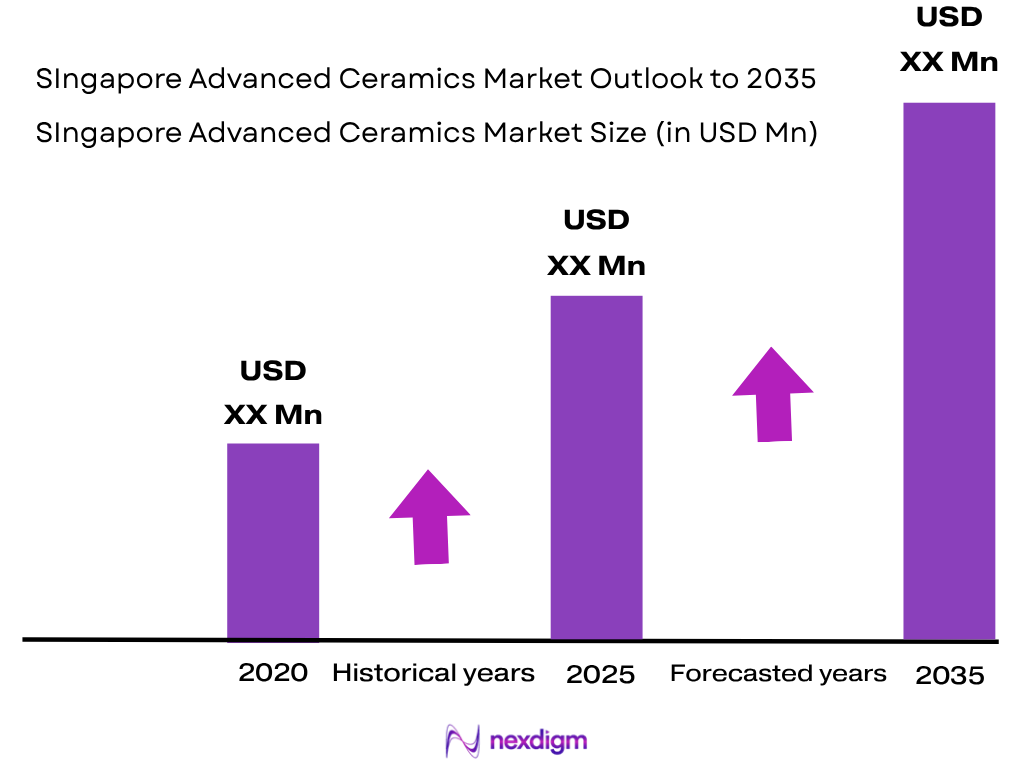
The Singapore Advanced Ceramics Market is supported by the country’s highly developed semiconductor, electronics, precision-engineering and aerospace ecosystems. Singapore accounts for 10% of global semiconductor chip production and 20% of global semiconductor equipment production, creating a substantial downstream requirement for high-purity ceramic components, wafer-handling parts, substrates and equipment components. A*STAR also reports capabilities in advanced packaging, MEMS, silicon photonics and sensors, strengthening demand for technically specialized ceramic materials and components.
Singapore itself constitutes the principal geographic center because advanced ceramics demand is concentrated around the country’s semiconductor fabrication, electronics, aerospace, biomedical, precision-engineering and chemical-processing clusters rather than being distributed across multiple cities. The semiconductor ecosystem is particularly important: A*STAR describes Singapore as an integral node in the global semiconductor supply chain, while its research activities cover advanced packaging and semiconductor equipment manufacturing. Companies operating in Singapore also supply ceramic and related components into semiconductor applications, reinforcing the country’s concentration of high-value ceramic demand.
Market Segmentation
By Material Type
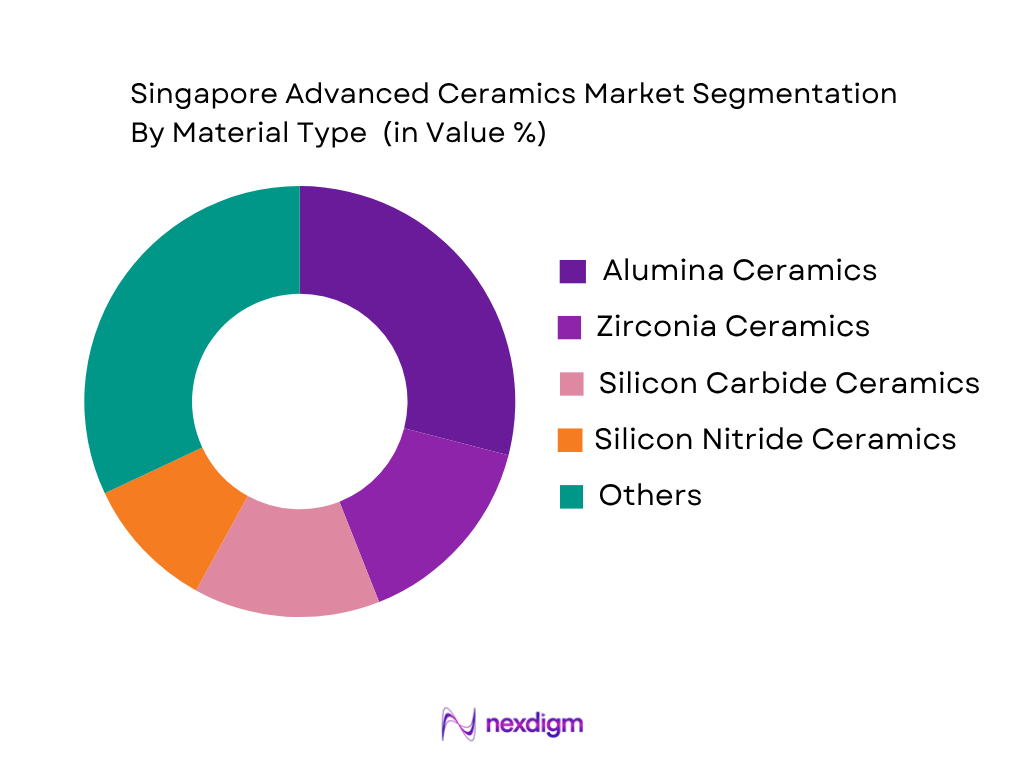
The Singapore Advanced Ceramics Market is segmented by material type into alumina ceramics, zirconia ceramics, silicon carbide ceramics, silicon nitride ceramics, aluminum nitride ceramics, titanate ceramics, ferrite ceramics, piezoelectric ceramics, bioceramics and ceramic matrix composites. Alumina ceramics are expected to hold the dominant share at ~% in 2024, supported by their combination of electrical insulation, hardness, wear resistance, thermal stability and comparatively broad application coverage. Alumina is particularly relevant to semiconductor equipment, electrical insulation, industrial wear components, precision engineering and electronics. Silicon carbide and aluminum nitride remain strategically important where thermal performance and high-temperature resistance are critical. Singapore’s semiconductor ecosystem creates demand for materials capable of operating under demanding process conditions, while its precision-engineering sector supports applications requiring dimensional stability and wear resistance. The market is therefore characterized by a broad material mix, although alumina benefits from its established manufacturing technology and wide application base. High-purity grades are particularly relevant for semiconductor and electronics applications, while zirconia is positioned strongly in precision and biomedical uses.
By End-Use Industry
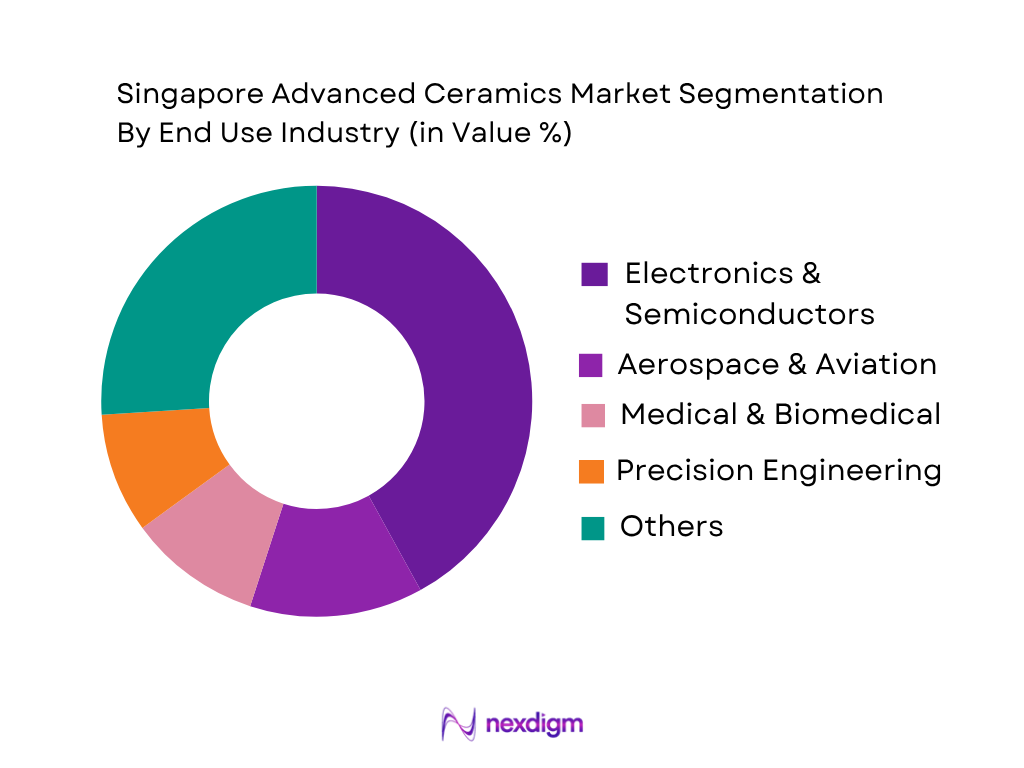
The Singapore Advanced Ceramics Market is segmented by end-use industry into electronics and semiconductors, aerospace, medical and biomedical, automotive and mobility, energy and power, chemical processing, precision engineering, defense and security, environmental applications and industrial machinery. Electronics and semiconductor applications are expected to represent the largest share at ~% in 2024, reflecting Singapore’s unusually concentrated semiconductor manufacturing and equipment ecosystem. A*STAR reports that Singapore produces 10% of global chips and 20% of global semiconductor equipment, creating demand for ceramic components used in wafer processing, equipment assemblies, thermal management and advanced packaging. The sector also benefits from continued investment in semiconductor R&D, including advanced packaging and front-end equipment component manufacturing. Ceramic requirements extend beyond conventional insulation into high-purity, plasma-resistant, thermally stable and dimensionally precise components. Aerospace and biomedical applications provide additional demand, but semiconductor manufacturing offers the strongest combination of technical specifications, recurring component requirements and local industrial concentration.
Competitive Landscape
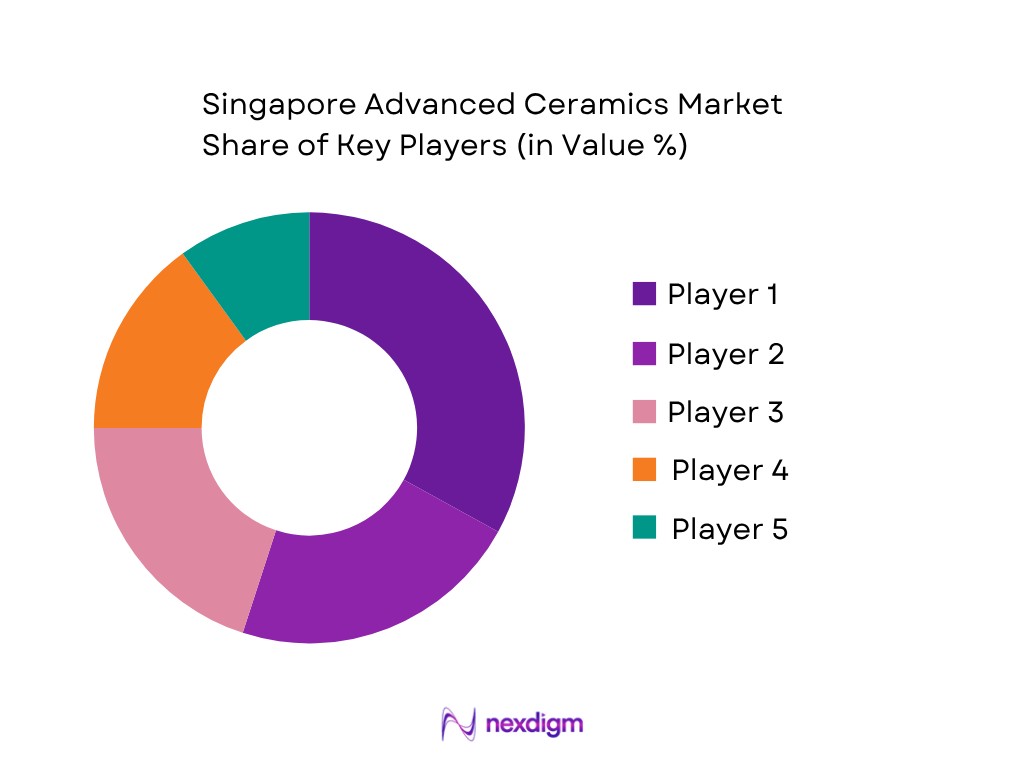
The Singapore Advanced Ceramics Market has a combination of global advanced-material manufacturers, specialized ceramic producers, semiconductor-component suppliers and Singapore-based precision-engineering companies. Competition is influenced less by commodity-scale ceramic production and more by material purity, dimensional precision, application engineering, qualification capability, semiconductor compatibility and customization. Companies such as Kyocera, Morgan Advanced Materials and CoorsTek have established global technical-ceramics capabilities, while Singapore-based specialists and precision-engineering firms increasingly participate in localized manufacturing and application development. The semiconductor ecosystem is particularly important because Singapore’s equipment and chip-production position creates opportunities for suppliers able to meet demanding process specifications.
| Company | Established | Headquarters | Core Ceramic Materials | Semiconductor Applications | Manufacturing Capability | Precision Engineering | Key End-Use Industries |
| Kyocera Corporation | 1959 | Kyoto, Japan | ~ | ~ | ~ | ~ | ~ |
| CoorsTek | 1910 | Golden, USA | ~ | ~ | ~ | ~ | ~ |
| Morgan Advanced Materials | 1856 | Windsor, UK | ~ | ~ | ~ | ~ | ~ |
| Saint-Gobain | 1665 | Paris, France | ~ | ~ | ~ | ~ | ~ |
| Ferrotec Holdings | 1951 | Tokyo, Japan | ~ | ~ | ~ | ~ | ~ |
Singapore Advanced Ceramics Market Analysis
Growth Drivers
Semiconductor Manufacturing Intensity
Semiconductor manufacturing intensity is a primary growth driver for the Singapore Advanced Ceramics Market because ceramic materials are integral to wafer-processing equipment, semiconductor packaging, insulation, thermal management and high-purity process components. Singapore accounts for about 10% of global semiconductor output, 5% of global wafer-fabrication capacity and 20% of global semiconductor equipment production, establishing a concentrated domestic customer base for advanced ceramic suppliers. The semiconductor industry also employs more than 35,000 people and contributes nearly 6% of Singapore’s GDP, demonstrating its importance to the national industrial structure. In addition, Singapore recorded S$11.1 billion in manufacturing fixed-asset investment commitments in 2024, with major investments directed toward semiconductors and related manufacturing activities. These conditions support demand for alumina, aluminum nitride, silicon carbide, silicon nitride and other engineered ceramics requiring high purity, thermal stability, chemical resistance and dimensional precision. The continued development of advanced packaging, AI-related semiconductor infrastructure and equipment manufacturing is likely to increase the technical requirements placed on ceramic components. Consequently, Singapore’s unusually deep semiconductor ecosystem provides a structural demand base for specialized advanced ceramics rather than commodity ceramic products.
Aerospace MRO and Component Manufacturing
Aerospace MRO and component manufacturing provides another important demand channel for advanced ceramics because aircraft engines, avionics, thermal systems, electrical assemblies and precision-engineered components require materials capable of operating under high temperature, mechanical stress and demanding reliability conditions. Singapore’s aerospace industry generated more than S$18 billion of output in 2024 and recorded 19% year-on-year growth, while the country’s aerospace ecosystem includes more than 130 companies and approximately 22,000 workers. Singapore also accounts for about 10% of global MRO output and close to 20% of global engine MRO output, creating a substantial installed base for specialized materials and components. Investment is reinforcing this ecosystem: Singapore Aero Engine Services committed S$242 million to expand its MRO presence, with capacity expected to increase by 40%, while GE Aerospace committed S$15 million to develop a smart factory at its Singapore engine-repair facility. Such investments increase the requirement for high-performance ceramic components, insulation systems, wear-resistant parts and thermal-management materials. The concentration of aerospace manufacturing and MRO activities therefore provides advanced-ceramics suppliers with opportunities to serve both original component production and recurring maintenance requirements.
Market Challenges
Dependence on Imported Ceramic Feedstocks
Dependence on imported ceramic feedstocks and specialized components represents a structural challenge for the Singapore Advanced Ceramics Market because Singapore has a limited domestic base for extracting and processing many ceramic raw materials. The country’s advanced manufacturing model is strongly integrated with international supply chains, making availability of high-purity alumina, zirconia, silicon carbide, silicon nitride and specialty powders dependent on overseas suppliers. This exposure becomes more significant for semiconductor applications, where material purity, particle characteristics and process consistency are critical. Singapore’s semiconductor ecosystem itself operates as a globally connected manufacturing node, with the country producing about 10% of global chips and 20% of global semiconductor equipment, meaning ceramic-component demand is closely linked to international equipment and materials supply chains. Singapore’s manufacturing sector also attracted S$11.1 billion of fixed-asset investment commitments in 2024, highlighting the scale of industrial activity that must be supported by reliable upstream inputs. For advanced-ceramics producers, imported feedstocks can therefore create qualification, logistics, inventory and supply-continuity requirements. The challenge is particularly relevant where customers require consistent high-purity materials and traceable specifications. Expanding local processing and component manufacturing can reduce exposure, but Singapore’s compact industrial footprint means complete upstream raw-material localization remains difficult.
Limited Domestic Raw Material Availability
Limited domestic raw-material availability constrains the development of a fully integrated advanced-ceramics value chain in Singapore. The country is primarily an advanced manufacturing, processing and technology hub rather than a large-scale producer of mineral feedstocks required for alumina, zirconia, silicon carbide and other technical ceramic systems. This creates a structural distinction between Singapore’s strong downstream demand and its relatively limited upstream resource base. The challenge is particularly important for semiconductor and aerospace applications because suppliers must maintain consistent material chemistry, purity, particle size and thermal characteristics across production batches. Singapore’s semiconductor sector represents approximately 10% of global chip output, while semiconductor equipment production represents around 20% globally, creating technically demanding downstream requirements. At the same time, Singapore’s manufacturing sector accounts for nearly one-fifth of national GDP, demonstrating the broader economic importance of maintaining uninterrupted industrial inputs. The country therefore relies heavily on international trade networks to connect domestic manufacturers with upstream specialty-material producers. This increases exposure to shipping disruptions, geopolitical restrictions, foreign production outages and qualification constraints when alternative feedstocks are introduced. Advanced-ceramics companies can mitigate this challenge through multi-source qualification, local powder processing, recycling and regional supplier partnerships, but establishing domestic mineral extraction is not a practical pathway for Singapore’s industrial structure.
Market Opportunities
Semiconductor Ceramic Component Localization
Semiconductor ceramic component localization represents a major opportunity because Singapore already possesses a concentrated semiconductor manufacturing and equipment ecosystem that can support higher-value domestic ceramic production. The country accounts for approximately 10% of global semiconductor output, 5% of global wafer-fabrication capacity and 20% of global semiconductor equipment production, providing a substantial nearby customer base for precision ceramic components. Singapore’s semiconductor industry also employs more than 35,000 people, while 2024 manufacturing fixed-asset investment commitments reached S$11.1 billion, with semiconductors among the principal investment areas. These conditions create opportunities to manufacture locally customized alumina, aluminum nitride, silicon carbide and other ceramic components used in wafer-processing equipment, thermal systems, insulation and advanced packaging. The opportunity is reinforced by Singapore’s existing research and advanced-manufacturing infrastructure, which enables ceramic suppliers to work with equipment manufacturers on application-specific geometries, coatings and material formulations. Localization can also shorten qualification and engineering cycles for customers while reducing dependence on imported finished components. Rather than competing primarily on commodity ceramic volumes, Singapore-based suppliers can focus on high-purity, tight-tolerance and application-engineered components. This model aligns with Singapore’s broader Manufacturing 2030 strategy and its emphasis on higher-value manufacturing capabilities, technology development and integration into global supply chains.
Advanced Ceramic Substrates
Advanced ceramic substrates offer an attractive opportunity because Singapore’s semiconductor, electronics and power-electronics ecosystem requires materials capable of providing electrical insulation while efficiently managing heat. Aluminum nitride, alumina and silicon nitride are particularly relevant to applications requiring combinations of thermal conductivity, dielectric performance, mechanical strength and dimensional stability. Singapore’s semiconductor industry contributes around 10% of global chip output and 20% of global semiconductor equipment production, creating a concentrated base of potential users for high-performance substrates and related ceramic packages. The country is also strengthening capabilities in advanced packaging, semiconductor equipment and next-generation electronics, creating opportunities for ceramic suppliers to move beyond conventional insulating components into engineered substrates and packages. Singapore’s National Robotics Programme received a further S$60 million tranche in 2024, taking cumulative committed funding above S$450 million, demonstrating continued public investment in advanced automation and manufacturing technologies that can generate additional demand for high-performance electronic components. The opportunity therefore extends across semiconductor packaging, power modules, sensors, RF electronics, industrial electronics and automated equipment. Suppliers capable of delivering high-purity substrates, controlled thermal expansion, fine metallization compatibility and customized geometries can position themselves within Singapore’s high-value electronics ecosystem while also using the country as a regional base for Southeast Asian customers.
Future Outlook
The Singapore Advanced Ceramics Market is expected to benefit from the continued development of Singapore’s semiconductor and advanced-manufacturing ecosystem. Demand is likely to move toward higher-purity ceramic materials, tighter dimensional tolerances, advanced ceramic substrates and specialized semiconductor equipment components.
The development of local manufacturing capabilities should gradually complement Singapore’s existing import-oriented supply structure. The ASTAR–Applied Materials collaboration is specifically designed to develop semiconductor equipment components and strengthen local manufacturing capabilities, while the ASTAR–Grand Venture Technology collaboration targets a customized advanced-ceramics manufacturing platform. Future demand is also expected to diversify across advanced packaging, power electronics, aerospace, biomedical ceramics, precision engineering and additive ceramic manufacturing. Singapore’s role as a semiconductor and advanced-manufacturing hub makes application-specific ceramics, rather than conventional high-volume ceramics, the principal strategic opportunity.
Major Players
- Kyocera Corporation
- CoorsTek
- Morgan Advanced Materials
- Saint-Gobain Performance Ceramics & Refractories
- Ferrotec Holdings Corporation
- Murata Manufacturing
- MARUWA Co., Ltd.
- NGK Insulators
- TOTO Ltd.
- CeramTec
- 3M
- Rauschert
- Vesuvius
- CUMI – Carborundum Universal
- Materion Corporation
Key Target Audience
- Semiconductor Manufacturers and Wafer Fabrication Companies
- Semiconductor Equipment Manufacturers and Component Procurement Teams
- Electronics and Power Electronics Manufacturers
- Aerospace OEMs, MRO Providers and Component Manufacturers
- Medical Device and Biomedical Component Manufacturers
- Precision Engineering and Advanced Manufacturing Companies
- Investments and Venture Capitalist Firms (Technology Investors, Industrial Investors, Advanced-Manufacturing Funds)
- Government and Regulatory Bodies (Economic Development Board, Enterprise Singapore, Agency for Science, Technology and Research, Ministry of Trade and Industry)
Research Methodology
Step 1: Identification of Key Variables
The research begins by mapping Singapore’s advanced-ceramics ecosystem across ceramic-material suppliers, component manufacturers, semiconductor equipment companies, electronics manufacturers, aerospace firms, biomedical manufacturers and precision-engineering companies. Key variables include material type, product form, manufacturing process, application, end-use industry, import dependency and localization potential.
Step 2: Market Analysis and Construction
Historical market information is compiled through analysis of ceramic-material consumption, imports and exports, semiconductor manufacturing activity, electronics production, aerospace activity and precision-engineering demand. The bottom-up model assesses ceramic requirements across individual applications, while the top-down model validates the resulting market structure against industrial activity.
Step 3: Hypothesis Validation and Expert Consultation
Market hypotheses are validated through discussions with ceramic manufacturers, semiconductor-equipment suppliers, precision-engineering companies, electronics manufacturers and industrial buyers. Particular emphasis is placed on qualification requirements, material specifications, procurement structures, imported versus locally manufactured components and application-specific demand.
Step 4: Research Synthesis and Final Output
The final analysis triangulates supply-side information with end-user requirements, trade flows, manufacturing capacity and industry indicators. Company-level capabilities are assessed against material portfolios, processing technologies, semiconductor applications, precision machining, customization and regional supply-chain reach to establish the final market outlook.

- Executive Summary
- Research Methodology (Market Definition and Scope, Advanced Ceramics Classification, Market Boundary and Inclusion Criteria, Market Sizing Framework, Top-Down Market Estimation, Bottom-Up Market Reconstruction, Demand-Side Validation, Supply-Side Mapping, Import-Export Reconciliation, Primary Industry Interviews, Manufacturer Validation, End-User Validation, Data Triangulation, Forecasting Framework, Scenario Analysis, Assumptions and Limitations)

- Definition and Scope
- Advanced Ceramics Industry Evolution in Singapore
- Development of Singapore’s Technical and Advanced Materials Ecosystem
- Advanced Ceramics Value Chain Analysis
- Advanced Ceramics Supply Chain Mapping
- Domestic Manufacturing and Processing Capability

- Growth Drivers (Semiconductor Manufacturing Intensity, Aerospace MRO and Component Manufacturing, Biomedical Manufacturing Expansion, Precision Engineering Capabilities, Advanced Electronics Production, Power Electronics Demand, Specialty Chemicals Manufacturing, Advanced Manufacturing Investment)
- Market Challenges (Dependence on Imported Ceramic Feedstocks, Limited Domestic Raw Material Availability, High Precision Manufacturing Requirements, Small Domestic Production Footprint, Skilled Technical Workforce Requirements, Complex OEM Qualification Processes, High Purity Requirements for Semiconductor Applications, Regional Competition from Lower-Cost Manufacturing Hubs)
- Market Opportunities (Semiconductor Ceramic Component Localization, Advanced Ceramic Substrates, Ceramic Packaging for Power Electronics, Technical Ceramic Additive Manufacturing, Aerospace Ceramic Components, Biomedical Ceramics, High-Purity Ceramic Processing, Regional Ceramic Component Supply, Advanced Ceramic R&D Commercialization)
- Market Trends (Miniaturized Ceramic Components, High-Thermal-Conductivity Ceramics, Semiconductor Equipment Ceramics, Ceramic Additive Manufacturing, Advanced Ceramic Packaging, SiC and AlN Adoption, Precision Micro-Ceramics, Digital Manufacturing, Application-Specific Ceramic Formulations)
- Government and Industrial Policy Landscape (Manufacturing 2030, Research Innovation and Enterprise, Advanced Manufacturing, Semiconductor Development, Biomedical Manufacturing, Aerospace Development, Industry 4.0, Additive Manufacturing, Technology Commercialization)
- SWOT Analysis
- Porter’s Five Forces Analysis
- PESTLE Analysis

- By Market Value (2020-2025)
- By Production Volume (2020-2025)
- By Domestic Consumption Volume (2020-2025)
- By Domestic Production (2020-2025)
- By Import Volume (2020-2025)
- By Export Volume (2020-2025)
- By Material Consumption (2020-2025)
- By Product Revenue (2020-2025)

- By Material Type (In Value %)
Alumina Ceramics
Zirconia Ceramics
Silicon Carbide Ceramics
Silicon Nitride Ceramics
Aluminum Nitride Ceramics
Titanate Ceramics
Ferrite Ceramics
Piezoelectric Ceramics
Hydroxyapatite and Bioceramics
Cordierite Ceramics
Ceramic Matrix Composites
Other Advanced Ceramic Materials - By Product Type (In Value %)
Monolithic Advanced Ceramics
Ceramic Substrates
Ceramic Packages
Ceramic Components
Ceramic Powders
Ceramic Tubes and Rods
Ceramic Plates and Discs
Ceramic Filters and Membranes
Ceramic Coatings
Precision Ceramic Parts
Ceramic Matrix Composite Components - By Functional Property (In Value %)
Electrical Insulation
High Thermal Conductivity
High Temperature Resistance
Wear Resistance
Corrosion Resistance
High Hardness
Fracture Toughness
Dielectric Performance
Biocompatibility
Optical and Electromagnetic Performance - By Manufacturing Process (In Value %)
Powder Processing
Dry Pressing
Isostatic Pressing
Injection Molding
Extrusion
Tape Casting
Slip Casting
Hot Pressing
Hot Isostatic Pressing
Pressureless Sintering
Spark Plasma Sintering
Precision Grinding and Machining - By End-Use Industry (In Value %)
Semiconductor Manufacturing
Electronics and Electrical
Aerospace and Aviation
Biomedical and Medical Technology
Specialty Chemicals
Energy and Power Electronics
Precision Engineering
Automotive and Mobility
Marine and Offshore
Industrial Machinery
Telecommunications and RF
Defence and Security - By Application (In Value %)
Semiconductor Processing Components
Wafer Handling Components
Ceramic Chucks and End Effectors
Ceramic Substrates and Packages
RF and Microwave Components
Power Electronics Substrates
Thermal Management Components
Aerospace Engine Components
MRO Components
Biomedical and Dental Components
Chemical Processing Components
Wear and Corrosion Components - By Customer Type (In Value %)
Semiconductor Manufacturers
Semiconductor Equipment Manufacturers
Electronics OEMs
Aerospace OEMs and MRO Providers
Biomedical and MedTech Manufacturers
Specialty Chemical Producers
Precision Engineering Companies
Energy and Power Electronics Manufacturers
Industrial Equipment Manufacturers

- Market Share Analysis of Major Players (By Material Type, Product Type, Application, End-Use Industry, Domestic Manufacturing, Imported Supply)
- Cross Comparison Parameters (Advanced Ceramic Material Portfolio, Semiconductor Ceramic Component Coverage, Ceramic Substrate and Packaging Capability, Precision Machining Capability, High-Purity Processing Capability, Additive Ceramic Manufacturing Capability, Aerospace and Biomedical Application Coverage, R&D and Technology Commercialization Capability)
- SWOT Analysis of Major Players
- Singapore Advanced Ceramics Pricing and Cost Structure Analysis
- Detailed Profiles of Major Companies
CeramTec
CoorsTek
KYOCERA Corporation
Morgan Advanced Materials
Saint-Gobain Performance Ceramics & Refractories
3M
Murata Manufacturing
MARUWA Co., Ltd.
NGK Insulators
TOTO Ltd.
Ferrotec Holdings Corporation
Rauschert
Vesuvius
CUMI – Carborundum Universal
Materion Corporation

- Semiconductor Manufacturer Requirements
- Semiconductor Equipment Ceramic Requirements
- Electronics OEM Requirements
- Aerospace and MRO Requirements
- Biomedical and MedTech Requirements
- Specialty Chemical Industry Requirements
- Power Electronics Requirements

- By Market Value (2026-2035)
- By Production Volume (2026-2035)
- By Domestic Consumption Volume (2026-2035)
- By Domestic Production (2026-2035)
- By Import Volume (2026-2035)
- By Export Volume (2026-2035)
- By Material Consumption (2026-2035)
- By Product Revenue (2026-2035)


 Request a Sample
 Ask for Customization
 Get a Quote
 Enquire Now