

 Download PDF
Market Overview
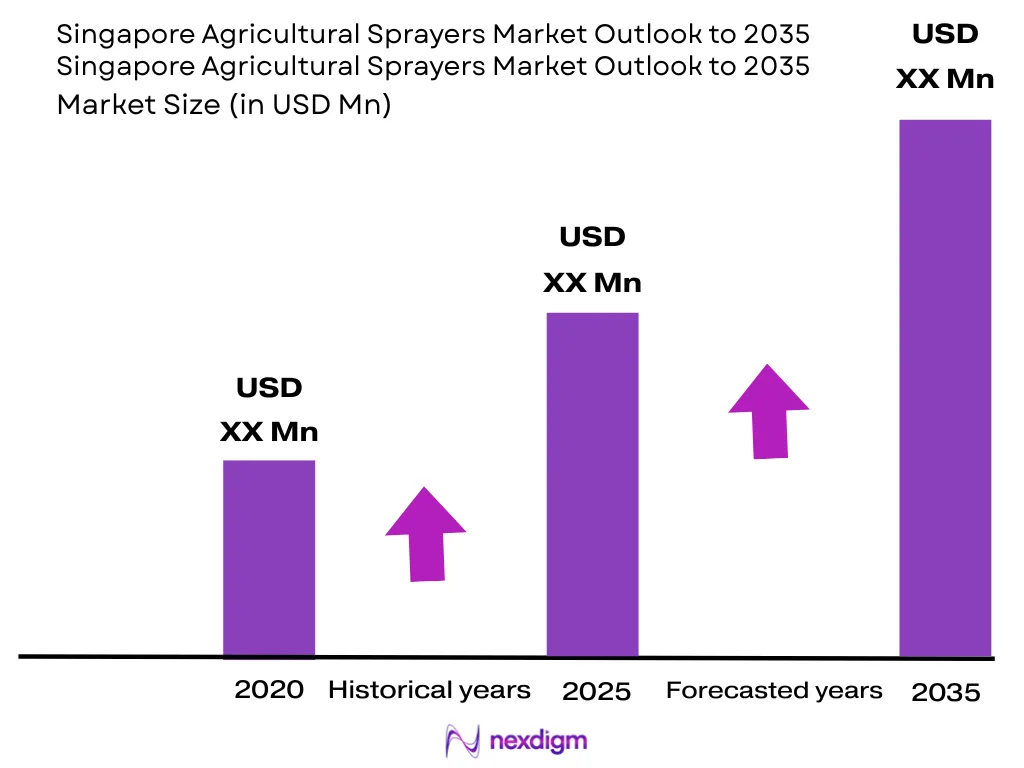
The Singapore Agricultural Sprayers Market was valued at approximately USD ~ million in 2024 based on a comprehensive assessment of agricultural technology equipment procurement, urban farm installations, crop protection equipment demand, and government-led agri-food investment programs. The market operates within a uniquely constrained agricultural landscape, as Singapore’s land area of approximately 733 square kilometers supports only a limited footprint of active farming operations. Singapore produces roughly 10% of its own food supply domestically, with the government actively pursuing the “30 by 30” goal of producing 30% of nutritional needs locally by 2030 under the Singapore Green Plan. Agricultural activity is heavily concentrated in high-tech indoor farming, vertical farms, controlled environment agriculture, and rooftop urban farms. Spraying equipment demand is driven by precision crop protection requirements within these technologically advanced growing environments, with strong emphasis on automation, minimal chemical usage, worker safety, and produce quality traceability. Government grants and agri-technology investment programs administered by the Singapore Food Agency and Enterprise Singapore have accelerated adoption of advanced spraying systems across commercial farm operators and research institutions.
Market Segmentation
By Sprayer Type
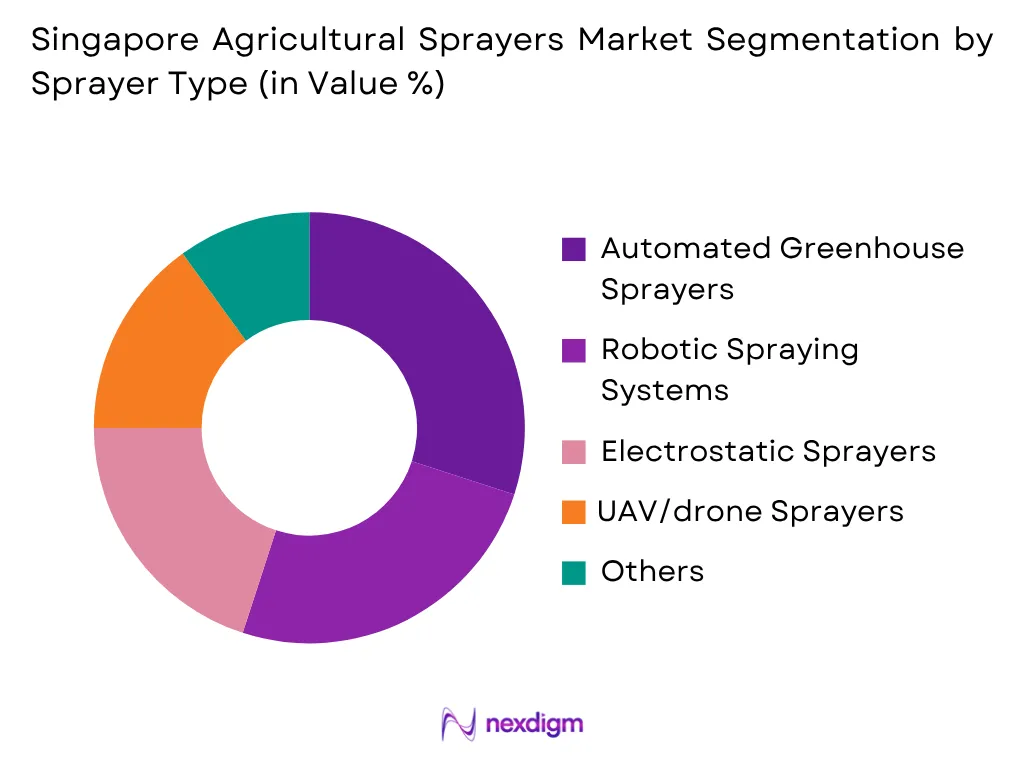
Singapore Agricultural Sprayers Market is segmented by sprayer type into UAV/drone sprayers, backpack and portable sprayers, automated greenhouse sprayers, robotic spraying systems, mounted sprayers, electrostatic sprayers, misting and fogging systems, and manual hand sprayers. Automated greenhouse sprayers and robotic spraying systems represent the fastest-growing segments, reflecting Singapore’s strong emphasis on precision agriculture within controlled indoor farming environments. Given the predominance of vertical farms, plant factories, and high-technology growing facilities, spraying equipment must be compatible with enclosed spaces, sensitive crop varieties, and stringent food safety standards. Electrostatic sprayers and precision misting systems are increasingly adopted for their ability to deliver highly targeted chemical application with minimal drift and chemical waste, critical attributes for indoor farming operations. UAV/drone sprayers are gaining traction for application across open-space farms, rooftop gardens, and larger outdoor growing areas such as the Lim Chu Kang farming estate. The emphasis on labor efficiency, automation, and precision application continues to shift demand toward technologically advanced and integrated spraying solutions across all farming typologies in Singapore.
By Crop Type
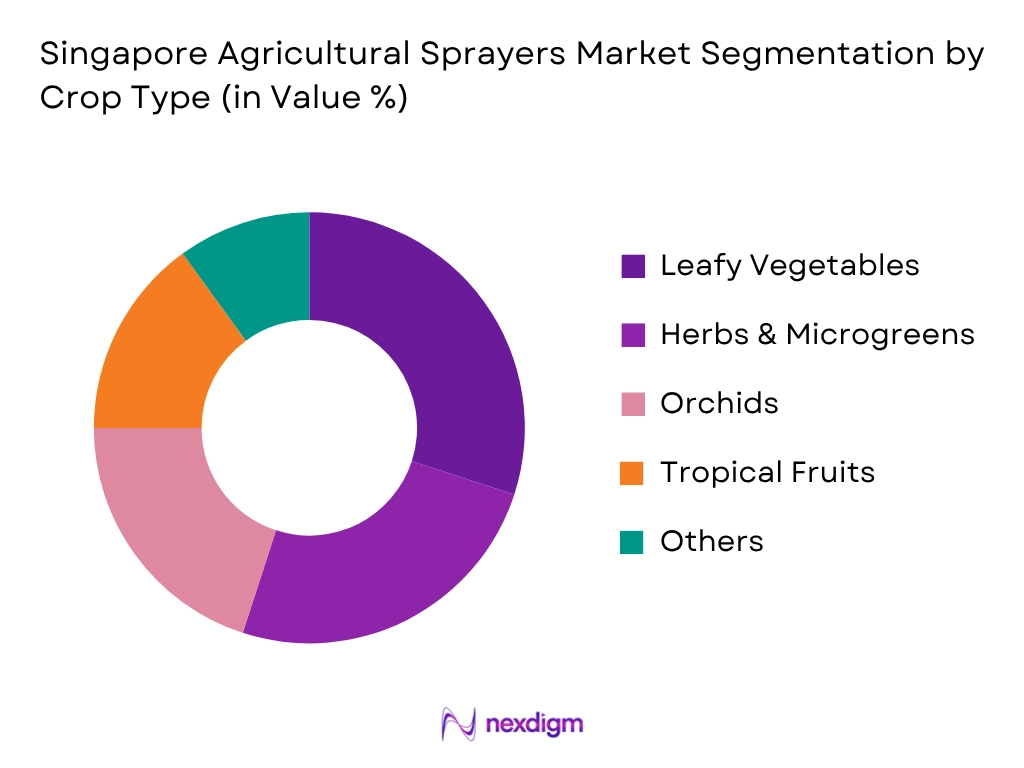
Singapore Agricultural Sprayers Market is segmented by crop type into leafy vegetables, herbs and microgreens, orchids and ornamentals, tropical fruits, aquaponic and hydroponic produce, mushrooms, and other specialty crops. Leafy vegetables account for the largest share of domestic agricultural production and spraying equipment demand, driven by high consumer consumption rates and government prioritization of vegetable self-sufficiency under the 30 by 30 initiative. Singapore’s indoor and vertical farms predominantly cultivate high-turnover leafy crops such as spinach, kai lan, bayam, xiao bai cai, and lettuce, which require regular pest and disease management interventions within tightly controlled growing cycles. Orchid cultivation represents a historically significant agricultural activity in Singapore, with the orchid industry maintaining strong commercial relevance for export and hospitality markets. The diversity of crop types cultivated within space-constrained and technologically intensive environments creates demand for versatile, compact, and precision-capable spraying equipment adaptable to multiple growing systems.
Competitive Landscape
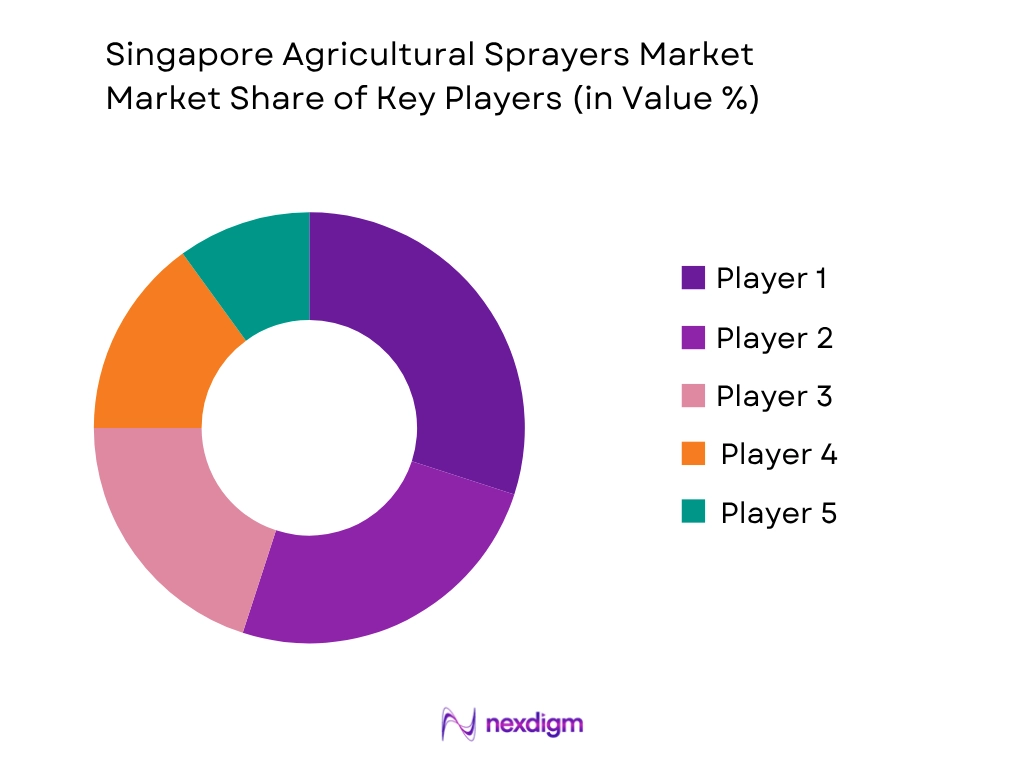
The Singapore Agricultural Sprayers Market is characterized by the presence of international agricultural equipment suppliers, agri-technology solution providers, and specialized urban farming equipment distributors. The competitive environment is relatively niche and technology-oriented, with suppliers differentiated by their ability to offer precision-capable, automation-compatible, and indoor-farm-ready spraying solutions. Government procurement programs and enterprise development grants play an important role in shaping purchasing decisions among commercial farm operators and research institutions. International equipment brands with strong technology credentials are well positioned, while local agri-tech firms increasingly develop proprietary spraying solutions tailored to Singapore’s unique urban farming context.
| Company | Establishment Year | Headquarters | Product Portfolio | Precision Agriculture Integration
|
Tank Capacity Range | Dealer Network Strength | After-Sales Support | Innovation Capability |
| John Deere Singapore | 1837 | ~ | ~ | ~ | ~ | ~ | ~ | ~ |
| DJI Agriculture | 2006 | ~ | ~ | ~ | ~ | ~ | ~ | ~ |
| AGCO Corporation (Massey Ferguson ) | 1990 | ~ | ~ | ~ | ~ | ~ | ~ | ~ |
| Hardi Singapore | 1957 | ~ | ~ | ~ | ~ | ~ | ~ | ~ |
| Yamaha Motor | 1958 | ~ | ~ | ~ | ~ | ~ | ~ | ~ |
Singapore Agricultural Sprayers Market
Growth Drivers
Singapore Green Plan 2030 and the 30 by 30 Food Security Goal
Singapore’s agricultural sprayers market is fundamentally shaped by the government’s strategic commitment to strengthening domestic food production capacity through the Singapore Green Plan 2030 and the Singapore Food Agency’s 30 by 30 initiative. The 30 by 30 goal targets local production of 30% of Singapore’s nutritional needs by 2030, a significant increase from the current approximately 10% domestic production level. To support this ambition, the Singapore Food Agency has allocated substantial funding through programs such as the Agri-Food Cluster Transformation (ACT) Fund, the Singapore Agro-Food Enterprises Excellence Framework (SAFEE), and the Agriculture Productivity Fund. These grant schemes directly support commercial farm operators in acquiring advanced agricultural equipment including automated spraying systems, robotic crop management tools, and precision application technologies. Government-funded research institutions and test farms such as those operated by Temasek Life Sciences Laboratory and the Singapore Food Agency’s own experimental farms also generate demand for advanced spraying equipment. The policy-driven expansion of high-technology farming infrastructure, combined with sustained public investment in agri-food innovation, constitutes the most significant structural demand driver for the Singapore Agricultural Sprayers Market.
Expansion of High-Technology Indoor and Vertical Farming
Singapore’s rapid expansion of indoor farming, vertical farming, and controlled environment agriculture installations is creating growing demand for specialized spraying and crop protection equipment suited to enclosed and precision-managed growing systems. Commercial vertical farms operated by companies such as Sustenir Agriculture, ComCrop, Archisen, and Edible Garden City have expanded their production footprints to supply leafy vegetables, herbs, and specialty produce to Singapore’s retail, foodservice, and institutional buyers. These facilities require spraying equipment capable of operating within compact, multi-tier growing structures, delivering precise chemical application with minimal operator exposure and negligible chemical residue risk. Automated misting systems, electrostatic sprayers, and robotic application platforms are increasingly integrated into farm management systems to enable scheduled, data-driven crop protection interventions. The Lim Chu Kang farming estate redevelopment, overseen by the Singapore Food Agency, is expected to incorporate next-generation farming technologies across newly tendered farm plots, further expanding the addressable market for advanced spraying solutions. Growing investment by local and international agri-tech firms in Singapore’s urban farming ecosystem continues to create new deployment opportunities for technology-forward spraying equipment providers.
Market Challenges
Extremely Limited Agricultural Land and Small Domestic Market Scale
Singapore’s agricultural sprayers market faces an inherent structural constraint stemming from the city-state’s extremely limited land availability for farming activities. With a total land area of approximately 733 square kilometers and competing demands from residential, commercial, industrial, and infrastructure development, Singapore’s total dedicated farming area represents a small fraction of national territory. The Lim Chu Kang farming zone and scattered rooftop and indoor farm installations constitute the primary agricultural footprint, collectively representing a market of significantly smaller scale than conventional agricultural economies. This land constraint fundamentally limits the volume of spraying equipment deployable within the domestic market, restricting unit sales potential and reducing economies of scale for equipment suppliers. Market participants must serve a highly specialized customer base of technology-intensive farm operators, research institutions, and urban gardening enterprises, each with distinct equipment requirements and procurement behaviors. The niche nature of Singapore’s agricultural sector means that equipment suppliers must often justify participation through value-added services, technology differentiation, and government grant leveraging rather than volume-based commercial models.
High Operating Costs and Skilled Workforce Constraints
Operating costs within Singapore’s agricultural sector are significantly elevated relative to regional competitors, reflecting the city-state’s high land lease costs, energy expenses, labor rates, and compliance requirements. Agricultural enterprises operating in Singapore face persistent challenges in recruiting and retaining skilled farm workers capable of operating advanced spraying equipment and precision farming systems. Singapore’s tight labor market and restrictions on foreign worker employment in certain agricultural categories create workforce availability constraints for farm operators seeking to scale production. The high cost of acquiring and maintaining technologically advanced spraying equipment, combined with limited domestic technical support infrastructure, increases the total cost of ownership for farm operators. Equipment investment decisions are often heavily dependent on government grant availability, given the capital-intensive nature of precision spraying systems relative to the revenue generating capacity of Singapore’s small-scale farm operations. The combination of elevated operational costs, labor scarcity, and high technology investment requirements creates a challenging environment for sustained equipment adoption without continued public sector support.
Market Opportunities
AgriFood Technology Integration and Smart Spraying Innovation
Singapore’s strong technology ecosystem and government commitment to agri-food innovation present significant opportunities for advanced spraying technology providers. The Republic’s position as a regional hub for agri-food technology development, supported by institutions such as the Singapore Food Agency, A*STAR, Temasek Life Sciences Laboratory, and Enterprise Singapore, creates a conducive environment for piloting and commercializing next-generation spraying solutions. IoT-enabled spray monitoring systems, AI-powered pest detection platforms, autonomous robotic sprayers, and closed-loop chemical management tools are areas of active development and investment within Singapore’s agri-tech community. The ACT Fund and other enterprise development grants support technology adoption by commercial farm operators, enabling procurement of innovative equipment that would otherwise be cost-prohibitive at the scale of Singapore’s farm operations. Singapore also serves as a demonstration and export base for agri-technology solutions targeting the broader Southeast Asian market, where demand for precision agriculture equipment is growing rapidly. Equipment providers capable of delivering validated, grant-eligible, and integration-ready spraying solutions are well positioned to capture both domestic deployment opportunities and regional market development potential through Singapore-based commercial partnerships.
Expansion of Sustainable and Residue-Free Production Systems
Growing consumer demand for food safety, minimal chemical residues, and environmentally responsible farming practices is creating opportunities for precision spraying technologies that enable targeted, low-volume chemical application within Singapore’s farming sector. Singapore’s affluent and food-safety-conscious consumer base places high value on produce traceability, organic certification, and low-pesticide growing methods, incentivizing farm operators to invest in spraying systems capable of minimizing chemical usage while maintaining effective crop protection. Electrostatic sprayers, precision misting technologies, and biological input application systems are increasingly relevant within this sustainability-oriented market context. Government sustainability requirements embedded within farm tenancy conditions and grant eligibility criteria further encourage adoption of environmentally optimized spraying equipment. The Singapore Food Agency’s emphasis on safe food production standards and the National Environment Agency’s pesticide usage regulations create a compliance environment that favors precision and low-drift spraying technologies over conventional application methods. As sustainability commitments deepen across Singapore’s food supply chain, demand for advanced spraying solutions supporting residue reduction, worker safety, and responsible chemical management is expected to strengthen progressively.
Future Outlook
The Singapore Agricultural Sprayers Market is expected to experience steady growth over the forecast period, driven by continued government investment in domestic food production capacity, expansion of high-technology farming infrastructure, and progressive adoption of precision agriculture and automation technologies. Demand for advanced spraying systems integrated with farm management platforms, IoT sensors, and AI-driven application controls is anticipated to grow as Singapore’s farm operators seek greater productivity, sustainability, and food safety performance. The Lim Chu Kang farming estate redevelopment and ongoing expansion of vertical and indoor farming installations are expected to create new equipment deployment opportunities. Singapore’s role as a regional agri-technology hub will continue attracting international equipment providers and supporting the development of locally adapted precision spraying solutions with broader Southeast Asian market applicability.
Major Players
- DJI Agriculture
- Yamaha Motor
- John Deere
- AGCO Corporation (Massey Ferguson)
- Hardi International
- Kuhn Group
- Buhler Industries
- Garuda Robotics
- VoloAgri
- Archisen
- ComCrop
- Sustenir Agriculture
- Edible Garden City
- AgriForce Singapore
- Temasek Life Sciences Laboratory
Key Target Audience
- Agricultural Equipment Manufacturers and Agri-Technology Solution Providers
- Commercial Indoor Farm and Vertical Farm Operators
- Government Research Institutions and Statutory Boards
- Precision Agriculture Technology Developers
- Crop Protection Chemical Manufacturers
- Investments and Venture Capitalist Firms
- Government and Regulatory Bodies (Singapore Food Agency, National Environment Agency, Enterprise Singapore, A*STAR)
- Pest Control and Sanitation Service Providers
Research Methodology
Step 1: Identification of Key Variables
The initial phase involves constructing an ecosystem map encompassing all major stakeholders within the Singapore Agricultural Sprayers Market. This process includes extensive secondary research through industry publications, government agricultural databases, agri-technology reports, trade associations, and agricultural equipment procurement records. The objective is to identify critical market variables including equipment demand, farm installation counts, technology adoption rates, government grant utilization, and purchasing behavior among Singapore’s specialized farm operator community.
Step 2: Market Analysis and Construction
Historical market data relating to agricultural equipment procurement, urban farm installations, government grant disbursements, and spraying technology adoption are collected and analyzed. Demand-side assessment focuses on farm operator purchasing patterns and crop protection requirements across indoor, vertical, and open-space farming environments, while supply-side analysis evaluates distributor revenues, dealer sales, product portfolios, and service capabilities. Both approaches contribute to market size estimation and forecasting within Singapore’s specialized agri-food context.
Step 3: Hypothesis Validation and Expert Consultation
Preliminary market findings and assumptions are validated through structured interviews with industry participants including agricultural equipment suppliers, urban farm operators, agri-technology developers, agronomists, government program administrators, and industry associations. These consultations provide practical insights regarding market trends, technology developments, regulatory dynamics, operational challenges, and future demand outlook, thereby strengthening the reliability of the research findings within Singapore’s unique agricultural context.
Step 4: Research Synthesis and Final Output
The final stage involves triangulating information collected from primary interviews, secondary research sources, and proprietary databases. Market estimates are refined through cross-verification across multiple data points and stakeholder perspectives. Forecast models are developed using Singapore’s food production targets, technology adoption trajectories, government grant program outlooks, and agri-food investment patterns to generate comprehensive and reliable market intelligence.

- Executive Summary
- Research Methodology (Market Definitions and Assumptions, Abbreviations, Market Sizing Approach, Top-Down Analysis, Bottom-Up Analysis, Demand-Side Assessment, Supply-Side Assessment, Primary Industry Interviews, Distributor and Dealer Validation, Farm-Level Survey Assessment, Data Triangulation, Forecasting Framework, Limitations and Future Conclusions)

- Definition and Scope
- Industry Evolution and Market Genesis
- Timeline of Technological Advancements in Agricultural Spraying
- Agricultural Equipment Value Chain Analysis
- Agricultural Sprayer Supply Chain Analysis

- Growth Drivers (Singapore Green Plan 2030, Urban Food Security Initiatives, High-Tech Indoor Farming Expansion, Precision Agriculture Adoption, Rising Demand for Food Safety and Traceability)
- Market Challenges (Extremely Limited Agricultural Land, High Operating Costs, Skilled Workforce Constraints, Heavy Import Dependence, Small Domestic Market Scale)
- Market Opportunities (AgriFood Tech Integration, Vertical Farming Expansion, Smart Spraying Systems for Controlled Environments, Export of Agri-Technology Expertise, Sustainable Urban Farming Solutions)
- Market Trends (IoT-Enabled Spray Monitoring, AI-Powered Pest Detection, Autonomous Robotic Sprayers, Closed-Loop Chemical Management, Low-Volume Precision Misting)
- Government Regulations (Singapore Food Agency Standards, National Environment Agency Pesticide Controls, AVA Historical Regulations, Green Plan 2030 Sustainability Requirements, Building and Construction Authority Rooftop Farm Guidelines)
- SWOT Analysis
- PESTLE Analysis
- Stakeholder Ecosystem
- Porter’s Five Forces Analysis
- Competition Ecosystem

- By Market Value (2020-2025)
- By Units Sold (2020-2025)
- By Average Selling Price (2020-2025)

- By Sprayer Type (In Value %)
UAV/Drone Sprayers
Backpack and Portable Sprayers
Automated Greenhouse Sprayers
Robotic Spraying Systems
Mounted Sprayers
Electrostatic Sprayers
Misting and Fogging Systems
Manual Hand Sprayers - By Application (In Value %)
Pesticide Application
Fungicide Application
Foliar Fertilizer Application
Disinfection and Sanitation
Biological Inputs Application - By Crop Type (In Value %)
Leafy Vegetables
Herbs and Microgreens
Orchids and Ornamentals
Tropical Fruits
Aquaponic and Hydroponic Produce
Mushrooms
Other Specialty Crops - By Distribution Channel (In Value %)
OEM Direct Sales
Agri-Technology Solution Providers
Government Procurement Programs
Online Agricultural Equipment Platforms
Specialized Agricultural Equipment Dealers - By End User (In Value %)
Commercial Indoor Farms and Vertical Farms
Government Research and Test Farms
Rooftop and Community Urban Farms
Orchid and Ornamental Cultivation Facilities
Institutional and Estate Grounds Management
Pest Control and Sanitation Service Providers

- Market Share of Major Players (By Value, Units Sold, Sprayer Type, Crop Segment, End User)
- Cross Comparison Parameters (Application Precision, Tank Capacity Range, Automation Level, Integration with Farm Management Systems, Dealer Network Strength, After-Sales Service Reach, Spray Drift Reduction Technology, Government Grant Eligibility)
- Competitive Positioning Matrix (Technology Leadership, Pricing Competitiveness, Brand Recognition, Sector Presence)
- SWOT Analysis of Major Players
- Pricing Analysis by Sprayer Category and Capacity
- Detailed Profiles of Major Companies
DJI Agriculture
Yamaha Motor
John Deere
AGCO Corporation (Massey Ferguson)
Hardi International
Kuhn Group
Buhler Industries
AgriForce Singapore
Garuda Robotics
VoloAgri
Archisen
ComCrop
Sustenir Agriculture
Edible Garden City
Temasek Life Sciences Laboratory

- Farm Equipment Ownership and Utilization Analysis (Hours of Operation, Spraying Frequency, Fleet Age, Seasonal Utilization Rate)
- Farm Mechanization Assessment (Mechanization Index, Equipment Density per Square Meter, Technology Adoption Rate)
- Purchasing Power and Investment Capacity Analysis (Farm Income, Access to Government Grants, ROI Expectations, Capital Expenditure Trends)
- Crop Protection Spending Analysis (Chemical Input Spend, Application Cost per Square Meter, Spray Frequency by Crop)
- Farmer Needs and Pain Point Assessment (Labor Availability, Input Efficiency, Contamination Control, Coverage Accuracy, Energy Consumption)

- By Market Value (2026-2035)
- By Units Sold (2026-2035)
- By Average Selling Price (2026-2035)


 Request a Sample
 Ask for Customization
 Get a Quote
 Enquire Now