
 Download PDF
Market Overview
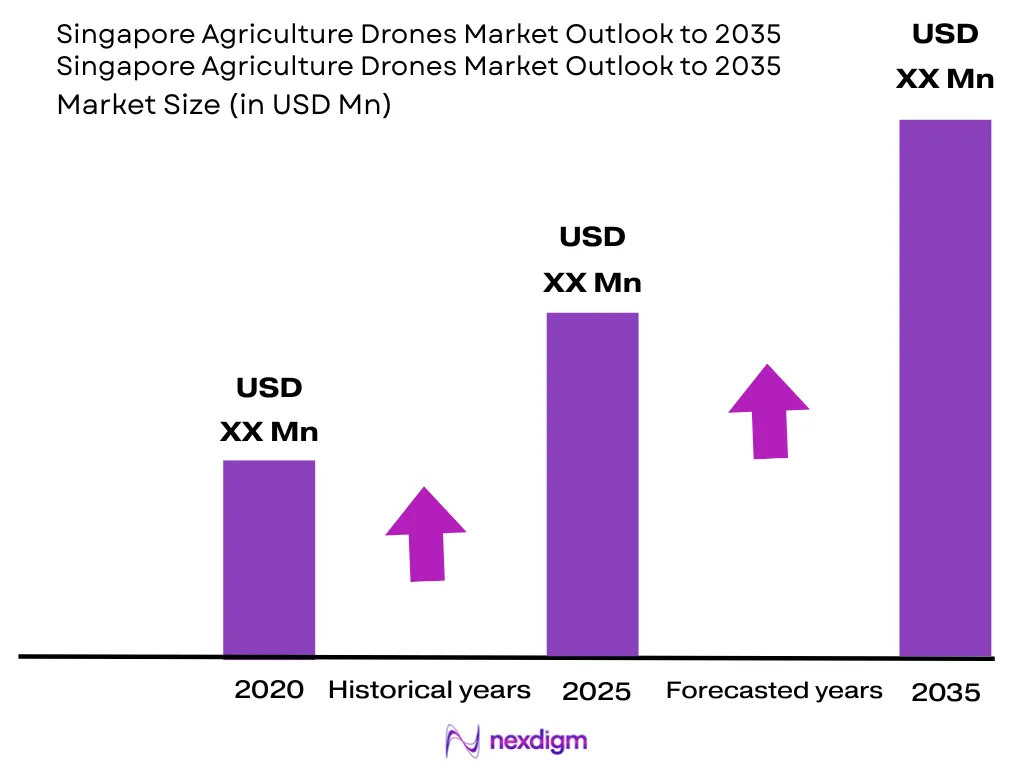
The Singapore Agriculture Drones Market was valued at USD ~ Million in 2024 and has emerged as a strategically important component of Singapore’s agrifood technology ecosystem. The market is supported by increasing adoption of precision farming technologies, government-backed agrifood transformation initiatives under the Singapore Green Plan 2030 and the 30 by 30 food security goal, and rising investment in high-technology indoor and urban farming infrastructure. Singapore recorded agrifood GDP contributing a modest but strategically significant share to the national economy in 2024, while its cultivated agricultural land base remains highly limited due to the city-state’s land constraints. The country’s agrifood strategy is focused on maximizing productivity per unit of land through advanced technologies including controlled environment agriculture, vertical farming, and precision drone applications. The growing requirement for automated monitoring and targeted interventions within indoor farm facilities, aquaculture operations, and rooftop cultivation areas has accelerated interest in compact and sensor-equipped agricultural drones. Furthermore, the Singapore Food Agency (SFA) and Enterprise Singapore continue to encourage agrifood technology adoption and support local agritech startups, creating favorable conditions for drone-based farming solutions across commercial enterprises and research institutions.
Market Segmentation
By Drone Type
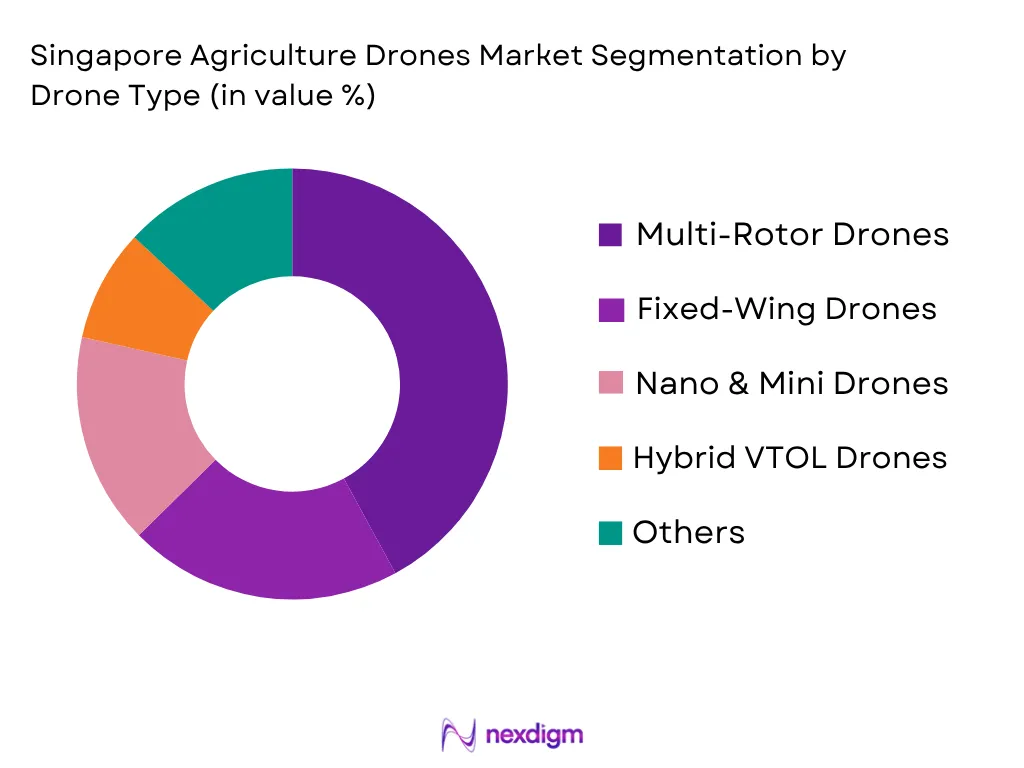
Singapore Agriculture Drones Market is segmented by drone type into multi-rotor drones, fixed-wing drones, hybrid VTOL drones, single rotor drones, and nano & mini agricultural drones. Recently, multi-rotor drones and nano & mini agricultural drones have maintained the dominant combined market share within this segment owing to their suitability for Singapore’s predominant indoor and controlled environment farming operations. These compact platforms can navigate precisely within vertical farm structures, greenhouse facilities, and rooftop cultivation areas, enabling highly targeted monitoring, imaging, and intervention without disrupting sensitive growing environments. The growing adoption of high-technology indoor farming, hydroponics, and aeroponics across Singapore has further strengthened demand for compact multi-rotor and mini drone platforms. In addition, government-supported precision agrifood initiatives and strong awareness among commercial operators regarding automation and operational efficiency have accelerated deployment. Their compatibility with multispectral sensors, thermal imaging systems, gas detection modules, and AI-based crop monitoring solutions continues to position these drone types as the preferred choice across Singapore’s unique agricultural landscape.
By Application
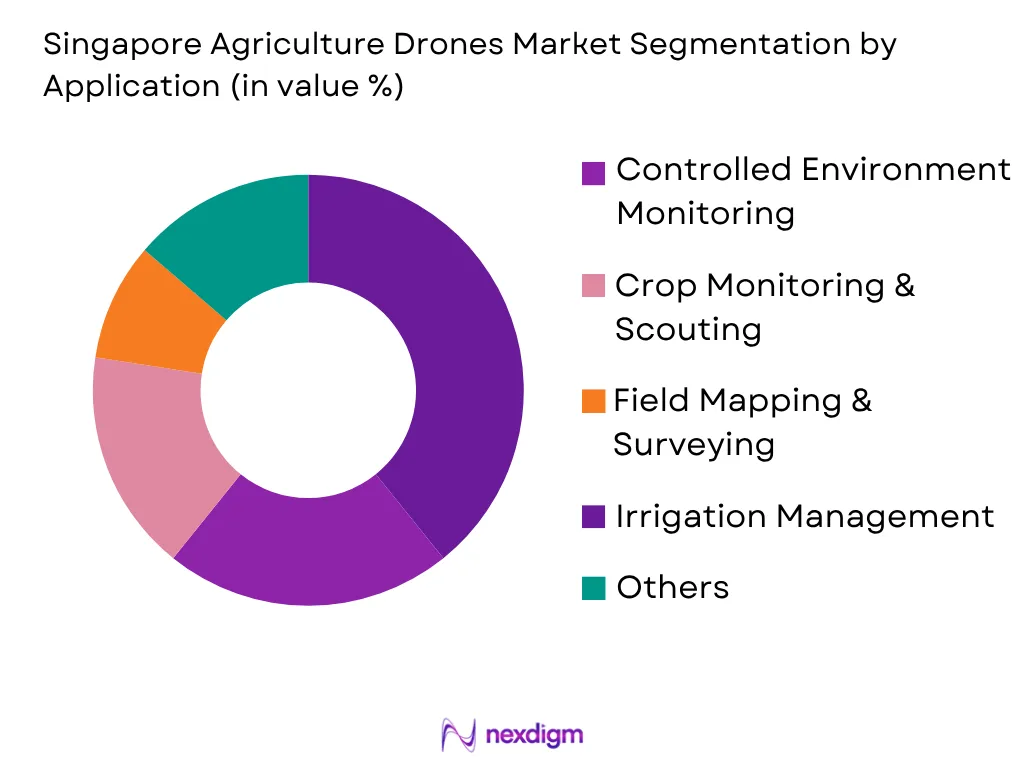
Singapore Agriculture Drones Market is segmented by application into crop monitoring and scouting, controlled environment monitoring, field mapping and surveying, crop health assessment, irrigation management, yield estimation and analytics, precision spraying, and planting and seeding. Controlled environment monitoring currently dominates the market owing to Singapore’s strategic focus on indoor and vertical farming as the primary modality for domestic food production. Agricultural drones equipped with multispectral, thermal, and gas-sensing payloads enable continuous assessment of crop conditions, air quality, humidity distribution, and growth uniformity within enclosed farming facilities. Given the high capital intensity of Singapore’s indoor farms and the need to maximize output per square metre, drone-assisted monitoring provides measurable advantages in identifying issues early and optimizing growing conditions. Agrifood enterprises operating high-value crops including leafy vegetables, microgreens, mushrooms, and ornamental plants increasingly rely on drone-assisted monitoring to reduce manual inspection requirements and improve yield consistency. The integration of autonomous flight planning, computer vision, and cloud-based analytics has further enhanced adoption. As Singapore’s agrifood enterprises pursue productivity improvements aligned with the 30 by 30 goal, controlled environment monitoring remains the most commercially significant application segment in the market.
Competitive Landscape
The Singapore Agriculture Drones Market is characterized by the presence of global drone manufacturers, regional agritech companies, and locally developed drone solution providers. International companies such as DJI Agriculture, XAG, Trimble, and AgEagle Aerial Systems have established positions through advanced drone technologies and integrated farm analytics platforms. Locally, companies such as Garuda Robotics and Poladrone have developed drone solutions tailored to Southeast Asian agricultural and indoor farming environments. Competition is increasingly driven by technological innovation, indoor navigation capability, payload adaptability, multispectral imaging solutions, and after-sales support services. Strategic collaborations with agrifood enterprises, research institutions, and government-linked programs are becoming key differentiators among market participants.
| Company | Establishment Year | Headquarters | Agriculture Drone Portfolio | Max Payload Capacity | Precision Spraying Capability | AI Analytics Integration | Singapore Distribution Network | Precision Agriculture Solutions |
| DJI Agriculture | 2006 | ~ | ~ | ~ | ~ | ~ | ~ | ~ |
| XAG | 2007 | ~ | ~ | ~ | ~ | ~ | ~ | ~ |
| AgEagle Aerial Systems | 2010 | ~ | ~ | ~ | ~ | ~ | ~ | ~ |
| Trimble | 1978 | ~ | ~ | ~ | ~ | ~ | ~ | ~ |
| Sentera | 2014 | ~ | ~ | ~ | ~ | ~ | ~ | ~ |
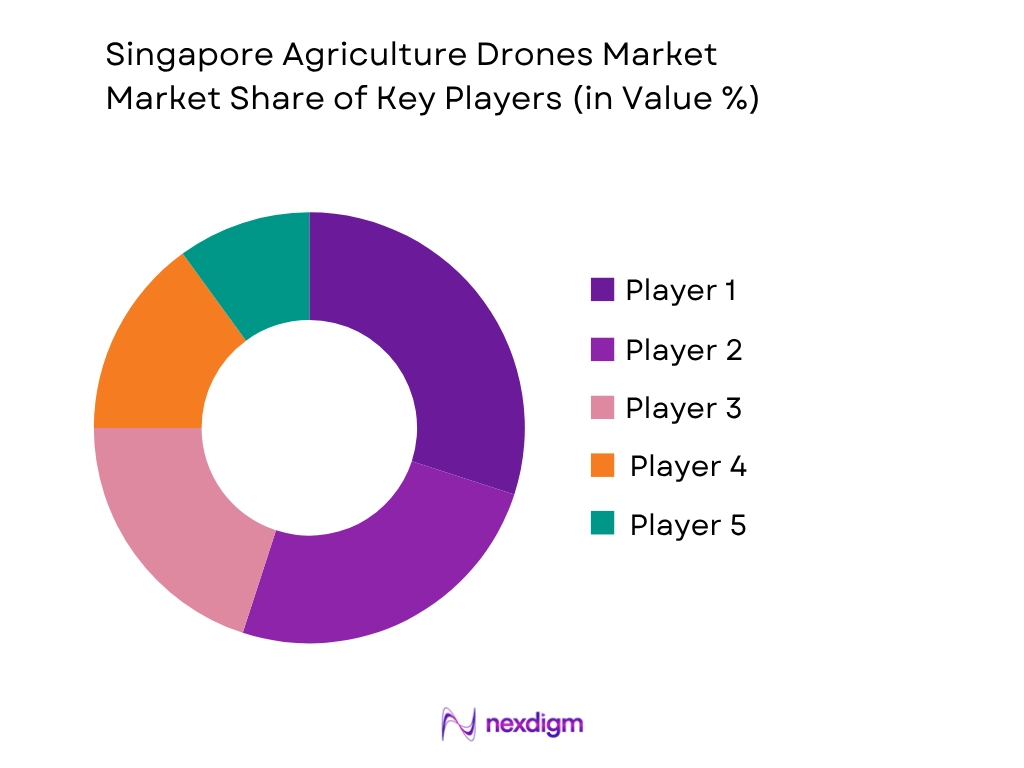
Singapore Agriculture Drones Market Analysis
Growth Drivers
Government Support for Precision Agriculture and Food Security
Singapore’s robust government investment in agrifood technology modernization is a major driver for agriculture drone adoption. Under the Singapore Green Plan 2030 and the 30 by 30 food security goal—which aims to produce 30% of the country’s nutritional needs locally by 2030—the government is prioritizing high-technology farming and efficient resource utilization across the agrifood sector. According to the World Bank, Singapore’s GDP exceeded USD 500 billion in current prices, reflecting one of the world’s highest per capita income levels and strong public investment capacity in strategic sectors including agrifood technology. The Singapore Food Agency (SFA) and Enterprise Singapore continue to promote smart farming practices and provide grants, accelerators, and co-investment support to agritech companies developing drone and precision farming solutions. Singapore faces fundamental land scarcity, with total agricultural land representing a negligible share of the country’s 733 square kilometres, creating an imperative for technologies that maximize output per unit area. Agriculture drones enable targeted monitoring, crop health assessment, and data analytics that support productivity optimization objectives across indoor farms, vertical facilities, and aquaculture operations. Furthermore, rising adoption of digital technologies, artificial intelligence, and Internet of Things applications across farming operations strengthens the business case for drone deployment, making precision agrifood technology one of the most significant growth catalysts for the Singapore Agriculture Drones Market.
Expansion of High-Technology Indoor and Urban Farming
The expansion of high-technology indoor farming, vertical agriculture, rooftop cultivation, and urban agrifood enterprises across Singapore is accelerating demand for agricultural drones suited to enclosed and controlled environments. Singapore’s population of approximately 5.9 million people and its near-total dependence on food imports have reinforced the strategic importance of domestic agrifood production. The government has invested substantially in developing new indoor farming facilities, aquaculture systems, and agrifood innovation clusters such as the Agri-Food Innovation Park (AFIP) in Sungei Tengah. Agrifood enterprises operating within these facilities require advanced monitoring technologies that can efficiently assess large numbers of growing modules, racks, and tanks without the labor costs associated with manual inspection. Drone-based monitoring provides the scalability and data richness necessary to manage complex indoor cultivation environments. Commercial operators growing high-value crops including leafy vegetables, microgreens, tilapia, and ornamental plants increasingly rely on drone-enabled monitoring to maintain consistent quality and improve operational efficiency. Growing investments in aquaculture technology, precision nutrition systems, and vertical farm automation further increase the need for aerial and semi-autonomous monitoring technologies. As Singapore seeks to meet its 30 by 30 goal through technology-intensive agrifood production, agriculture drones are becoming an important component of next-generation farming operations.
Market Challenges
Severe Land Scarcity and Limited Outdoor Farming Area
One of the defining challenges shaping the Singapore Agriculture Drones Market is the country’s extreme land scarcity, which fundamentally constrains the scale and nature of agricultural operations. With less than 1% of total land area available for agriculture and virtually no large-scale outdoor farms, the conventional use cases for agricultural drones—such as field spraying, wide-area crop scouting, and large-scale mapping—are largely inapplicable in the Singapore context. The market must therefore adapt to indoor, vertical, and aquaculture environments where drone flight paths, payload requirements, and operational protocols differ substantially from conventional agriculture. Drone hardware designed primarily for open-field applications may require significant customization or redesign to function effectively within enclosed growing facilities, rooftop farms, and multi-level vertical structures. This limits the range of off-the-shelf solutions available to Singapore operators and may increase per-unit costs relative to markets with larger conventional farming sectors. Additionally, the relatively small total addressable market created by Singapore’s limited agricultural footprint constrains revenue opportunities for drone manufacturers and service providers, potentially affecting the commercial viability of dedicated Singapore-focused product development.
Airspace Management Constraints and Regulatory Complexity
Singapore’s highly controlled and congested urban airspace presents significant operational and regulatory challenges for agricultural drone deployment. The Civil Aviation Authority of Singapore (CAAS) maintains strict frameworks for unmanned aerial vehicle operations, including registration requirements, operator certification, operational altitude limits, and geo-fencing restrictions across much of the city-state. Agricultural drone operators must navigate these frameworks carefully, particularly when operating near residential areas, transportation corridors, and the controlled airspace surrounding Changi Airport. Obtaining necessary permits and approvals for drone operations can be time-consuming and may limit operational flexibility, particularly for service providers seeking to scale drone-based monitoring or spraying services across multiple client sites. Furthermore, as drone technology evolves and new applications emerge, regulatory frameworks must be continuously updated, creating ongoing compliance requirements for operators and manufacturers. The need to coordinate operations within Singapore’s Urban Traffic Management System for drones (UTM) adds additional complexity. While CAAS has actively pursued innovation-friendly policies including the Drone Advisory Committee and designated test corridors, the regulatory environment continues to require careful navigation by market participants, particularly smaller agritech startups with limited regulatory expertise.
Market Opportunities
Integration of Artificial Intelligence and Advanced Analytics for Indoor Farming
The increasing integration of artificial intelligence, computer vision, machine learning, and advanced sensor analytics presents substantial opportunities for the Singapore Agriculture Drones Market, particularly within the context of high-technology indoor and vertical farming. Singapore is a recognized global hub for digital innovation and AI development, creating a uniquely favorable environment for deploying AI-enabled agricultural drone technologies. Drones equipped with multispectral imaging, thermal cameras, and gas sensors can generate high-resolution datasets from within vertical farm structures, enabling continuous assessment of crop health, microclimate uniformity, irrigation performance, and pest activity. Agrifood enterprises operating at scale within Singapore’s indoor farming facilities are increasingly seeking autonomous monitoring solutions that reduce labor costs and improve yield predictability. AI-powered drone systems can identify anomalies such as disease outbreaks, nutrient deficiencies, or equipment malfunctions before they materially impact production, enabling timely intervention. The convergence of drone hardware, AI analytics, and Internet of Things sensor networks creates opportunities for integrated farm management platforms that deliver comprehensive operational intelligence. Singapore’s strong intellectual property protections, research ecosystem, and proximity to major Southeast Asian agricultural markets further enhance the commercial potential for developing and exporting AI-driven agritech drone solutions from Singapore.
Export of Agritech Solutions and Regional Market Development
Singapore’s strategic position as a regional hub for technology commercialization, finance, and trade creates significant opportunities for agritech drone companies to develop Singapore-validated solutions for export to broader Southeast Asian markets. Countries such as Malaysia, Indonesia, Vietnam, Thailand, and the Philippines possess large agricultural sectors with growing demand for precision farming technologies and drone-based crop management solutions. Singapore-based agritech companies can leverage the country’s strong regulatory credibility, research infrastructure, and business networks to develop, test, and commercialize drone solutions that are subsequently scaled across the region. The Agri-Food and Veterinary Authority’s successor organization, the Singapore Food Agency, actively supports the internationalization of Singapore agritech companies through trade promotion, innovation grants, and bilateral agrifood cooperation agreements. Furthermore, Singapore’s well-developed financial ecosystem—including venture capital firms, family offices, and corporate investors—provides capital access for agritech drone startups pursuing regional expansion. As Southeast Asia’s agricultural sector continues modernizing and precision farming adoption accelerates, Singapore-originated drone and agritech solutions are well-positioned to capture growing regional demand, creating commercial opportunities that extend well beyond the domestic market.
Future Outlook
The Singapore Agriculture Drones Market is expected to witness focused and technology-intensive growth during the forecast period, supported by ongoing agrifood transformation efforts, rising adoption of precision indoor farming technologies, and increasing integration of AI and IoT within controlled environment agriculture. Government initiatives under the Singapore Green Plan 2030 and the 30 by 30 food security goal are anticipated to encourage greater deployment of smart farming solutions across indoor vertical farms, aquaculture facilities, and urban agrifood enterprises. Advances in compact drone design, autonomous indoor navigation, computer vision, and sensor miniaturization are likely to enhance the practical effectiveness of agricultural drones in Singapore’s unique enclosed farming environments. Furthermore, increasing emphasis on food resilience, import diversification, resource efficiency, and sustainable urban food production is expected to create favorable conditions for long-term market expansion. Singapore’s growing ambition to become a global agrifood innovation hub further strengthens the outlook for domestic drone technology development and regional commercialization.
Major Players
- DJI Agriculture
- XAG
- Trimble
- AgEagle Aerial Systems
- Sentera
- AeroVironment
- Delair
- Parrot Drones
- Drone Volt
- Quantum Systems
- Yamaha Motor
- Flyability
- SZ DJI Technology
- Garuda Robotics
- Poladrone
Key Target Audience
- Agriculture Drone Manufacturers
- Precision Agrifood Technology Solution Providers
- Commercial Indoor and Vertical Farming Enterprises
- Aquaculture Farm Operators
- Government-Linked Agrifood Enterprises
- Investments and Venture Capitalist Firms
- Government and Regulatory Bodies (Singapore Food Agency; Civil Aviation Authority of Singapore)
- Agricultural Technology Integrators and Agritech Startups
Research Methodology
Step 1: Identification of Key Variables
The initial phase involves constructing an ecosystem map encompassing all major stakeholders within the Singapore Agriculture Drones Market. This step is supported through extensive secondary research, government publications, industry databases, regulatory frameworks, and technology assessments. The objective is to identify the critical variables influencing market demand, technology adoption, operational efficiency, and competitive dynamics specific to Singapore’s high-technology agrifood environment.
Step 2: Market Analysis and Construction
In this phase, historical market information is compiled and analyzed using both top-down and bottom-up methodologies. The analysis includes agrifood technology penetration, drone deployment trends, precision farming adoption rates, crop-specific utilization patterns, and revenue generation across various drone applications within controlled environment and indoor farming contexts. The collected information is validated through multiple data triangulation techniques.
Step 3: Hypothesis Validation and Expert Consultation
Market assumptions and forecasts are validated through computer-assisted telephone interviews (CATIs) and discussions with agrifood technology providers, drone manufacturers, farm operators, research institutions, and regulatory experts. These consultations provide practical insights into technology adoption barriers, investment trends, customer preferences, and operational requirements within Singapore’s unique agrifood ecosystem.
Step 4: Research Synthesis and Final Output
The final phase involves synthesizing information obtained through primary and secondary research into a comprehensive market assessment. Direct engagement with industry participants enables verification of segmentation assumptions, competitive positioning, technological developments, and future growth opportunities. The resulting report delivers a robust and validated view of the Singapore Agriculture Drones Market.

- Executive Summary
- Research Methodology (Market Definitions and Assumptions, Abbreviations, Market Sizing Approach, Top-Down Analysis, Bottom-Up Analysis, Demand-Side Assessment, Supply-Side Assessment, Primary Industry Interviews, Data Triangulation, Forecasting Framework, Limitations and Future Conclusions)

- Definition and Scope
- Market Evolution and Industry Genesis
- Timeline of Major Industry Developments
- Agriculture Drone Ecosystem Analysis
- Precision Agriculture Value Chain Analysis

- Growth Drivers (Singapore Green Plan 2030 and Agrifood Strategy, 30 by 30 Food Security Goal, Rising Precision Farming Adoption, Labor Efficiency Requirements, Expansion of High-Technology Indoor Farming)
- Market Challenges (Severe Land Scarcity and Limited Outdoor Farming Area, High Capital Investment Requirements, Skilled Operator Shortage, Regulatory Compliance Complexity, Airspace Management Constraints)
- Market Opportunities (AI-Powered Indoor Farm Analytics, Drone-as-a-Service Expansion, Smart Controlled Environment Integration, Autonomous Crop Management, Export of Agritech Solutions to Regional Markets)
- Market Trends (Multispectral Imaging Adoption, AI-Based Crop Diagnostics, Autonomous Flight Planning, Cloud-Based Farm Management Platforms, Drone Integration with IoT Sensor Networks)
- Government Regulations (CAAS Drone Regulations, Singapore Food Agency Policies, Agrifood Industry Transformation Map, UAV Licensing Framework, Urban Airspace Management Framework)
- SWOT Analysis
- Porter’s Five Forces Analysis
- PESTLE Analysis
- Stakeholder Ecosystem
- Competition Ecosystem

- By Market Value (2020-2025)
- By Volume (2020-2025)
- By Average Selling Price (2020-2025)

- By Drone Type (In Value %)
Fixed-Wing Drones
Multi-Rotor Drones
Hybrid VTOL Drones
Single Rotor Drones
Nano and Mini Agricultural Drones - By Application (In Value %)
Crop Monitoring and Scouting
Precision Spraying
Field Mapping and Surveying
Crop Health Assessment
Controlled Environment Monitoring
Irrigation Management
Planting and Seeding
Yield Estimation and Analytics - By Farm Type (In Value %)
Indoor Vertical Farms
Rooftop and Urban Farms
Aquaculture Farms
Hydroponic and Aeroponic Facilities
Research and Innovation Farms
Government-Linked Agrifood Enterprises - By Region (In Value %)
Central Region
North Region
North-East Region
East Region
West Region - By End User (In Value %)
Commercial Agrifood Enterprises
Government-Linked Farming Facilities
Government Agricultural Agencies
Agricultural Technology Service Providers
Research and Development Institutions
Smart Urban Farming Enterprises

- Market Share of Major Players (By Value, Volume, Drone Type, Application)
- Cross Comparison Parameters (Drone Payload Capacity, Flight Endurance, Precision Spraying Capability, AI Analytics Integration, Multispectral Imaging Capability, Distribution Network Reach, After-Sales Service Infrastructure, Agricultural Software Ecosystem)
- SWOT Analysis of Major Players
- Pricing Analysis by Drone Model and Payload Category
- Detailed Profiles of Major Companies
DJI Agriculture
XAG
AeroVironment
AgEagle Aerial Systems
Trimble
Sentera
Parrot Drones
Yamaha Motor
Drone Volt
Quantum Systems
Delair
Flyability
SZ DJI Technology
Garuda Robotics
Poladrone

- Agricultural Technology Adoption Analysis (Farm Size, Crop Type, Digital Readiness, Automation Level)
- Farmers Purchasing Behaviour Analysis
- Precision Farming Awareness Assessment
- Operational Pain Point Analysis
- Budget Allocation Analysis

- By Market Value (2026-2035)
- By Volume (2026-2035)
- By Average Selling Price (2026-2035)


 Request a Sample
 Ask for Customization
 Get a Quote
 Enquire Now