

 Download PDF
 Download PDF
Market Overview
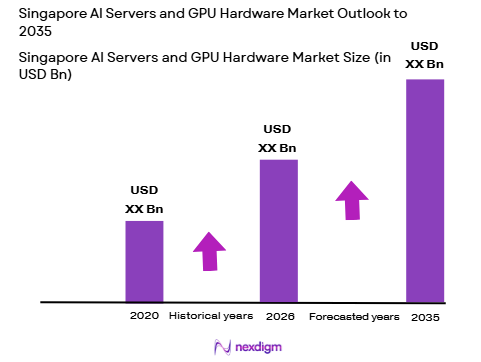
Singapore’s AI servers and GPU hardware market reached approximately USD ~ billion based on a recent historical assessment, driven by hyperscale GPU cluster deployments, sovereign AI compute initiatives, and enterprise adoption of accelerated analytics across finance, digital services, and manufacturing sectors. Global cloud providers and data center operators are installing dense GPU server racks and accelerator systems to support regional AI workloads. Continuous refresh cycles of advanced AI hardware and expansion of training clusters sustain infrastructure investment within Singapore’s digital economy.
Singapore dominates Asia-Pacific AI server and GPU hardware deployments due to concentration of hyperscale data centers, multinational technology headquarters, and regional cloud zones requiring centralized accelerated compute capacity. Jurong and Tuas host large GPU-dense data center campuses supported by industrial power and cooling systems, while central business districts concentrate enterprise AI workloads. Strong connectivity, regulatory stability, and digital ecosystem maturity position Singapore as the region’s primary AI compute hardware hub.
Market Segmentation
By Product Type
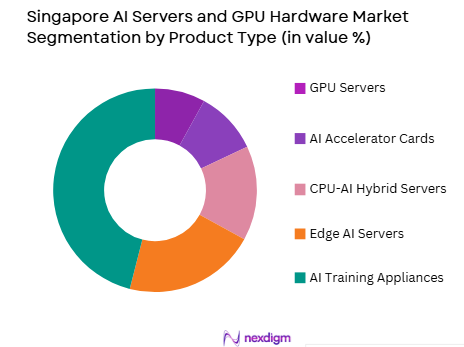
Singapore AI Servers and GPU Hardware Market is segmented by product type into GPU servers, AI accelerator cards, CPU-AI hybrid servers, edge AI servers, and AI training appliances. Recently, GPU servers have a dominant market share due to factors such as hyperscale AI cluster deployments, cloud AI service expansion, and enterprise generative AI workloads requiring integrated accelerated compute nodes. Hyperscale providers deploy rack-scale GPU servers to deliver AI training and inference services across Asia-Pacific markets from Singapore. Financial institutions, digital platforms, and technology firms rely on high-density GPU server clusters hosted in domestic data centers. Continuous accelerator generation upgrades and server refresh cycles reinforce procurement dominance. National AI research programs and supercomputing initiatives also depend on GPU server infrastructure. Singapore’s role as regional AI compute hub concentrates accelerated server investment in this segment across its hardware ecosystem.
By End User
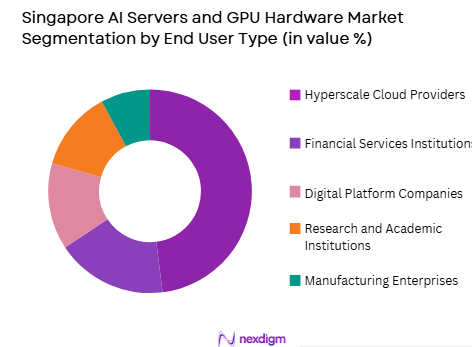
Singapore AI Servers and GPU Hardware Market is segmented by end user into hyperscale cloud providers, financial services institutions, digital platform companies, research and academic institutions, and manufacturing enterprises. Recently, hyperscale cloud providers have a dominant market share due to factors such as regional AI workload aggregation, large-scale GPU cluster hosting, and AI-as-a-service delivery from Singapore data centers. Global cloud firms deploy massive GPU hardware fleets to serve Southeast Asia and Asia-Pacific enterprises. Hyperscale campuses in Jurong and Tuas concentrate GPU compute for training and inference platforms. Enterprises prefer hyperscale-hosted AI compute instead of private clusters. Continuous scaling of cloud AI services increases hardware demand. These dynamics position hyperscale cloud providers as primary buyers and operators of AI server and GPU hardware in Singapore.
Competitive Landscape
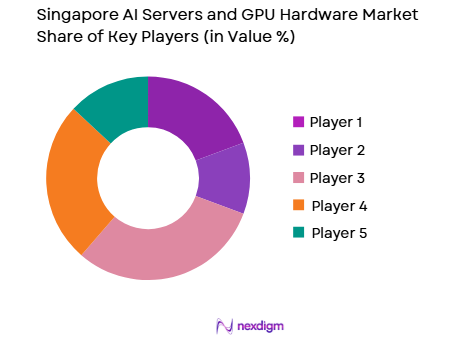
Singapore’s AI servers and GPU hardware market is highly concentrated among global GPU technology leaders, hyperscale cloud providers, and enterprise server vendors deploying large-scale accelerated compute clusters. Market leadership is defined by GPU architecture capability, server integration scale, and hyperscale deployment partnerships with data center operators. Continuous accelerator innovation and hyperscale procurement cycles reinforce dominance of major global hardware vendors supplying Singapore’s regional AI compute infrastructure.
| Company Name | Establishment Year | Headquarters | Technology Focus | Market Reach | Key Products | Revenue | Singapore Deployment Role |
| NVIDIA | 1993 | USA | ~ | ~ | ~ | ~ | ~ |
| Dell Technologies | 1984 | USA | ~ | ~ | ~ | ~ | ~ |
| Hewlett Packard Enterprise | 2015 | USA | ~ | ~ | ~ | ~ | ~ |
| Supermicro | 1993 | USA | ~ | ~ | ~ | ~ | ~ |
| Lenovo | 1984 | China | ~ | ~ | ~ | ~ | ~ |
Singapore AI Servers and GPU Hardware Market Analysis
Growth Drivers
Hyperscale AI Cluster Expansion and Regional GPU Workload Centralization
Singapore’s AI servers and GPU hardware market growth is primarily driven by hyperscale expansion of GPU clusters by global cloud providers centralizing AI training and inference workloads for Southeast Asia and Asia-Pacific within Singapore data center campuses. Multinational enterprises and digital platforms deploy AI applications regionally while hosting compute centrally in Singapore due to connectivity, regulatory stability, and infrastructure maturity. Hyperscale cloud providers continuously deploy large fleets of GPU servers and accelerators to support AI-as-a-service offerings across industries. Regional enterprises lacking domestic GPU infrastructure rely on Singapore-hosted compute capacity, increasing cluster scale. Cloud operators refresh GPU hardware frequently to maintain performance competitiveness in AI services. Singapore’s subsea cable connectivity enables cross-border data ingestion into local GPU clusters. Government support for digital infrastructure encourages hyperscale campus growth. Data center operators invest in high-power and liquid-cooling systems for GPU density. AI startups and platform providers colocate GPU hardware in Singapore to access regional markets. These hyperscale centralization dynamics structurally anchor sustained GPU hardware demand.
Enterprise Generative AI Adoption Across Finance and Digital Economy
Rapid enterprise adoption of generative AI, analytics, and automation across Singapore’s finance, digital services, healthcare, and manufacturing sectors significantly drives demand for GPU servers and accelerators required for large-scale model training and inference. Financial institutions deploy AI for risk modeling, fraud detection, and algorithmic trading requiring accelerated compute. Digital platforms and e-commerce firms rely on recommendation and language models hosted in GPU clusters. Healthcare and biomedical research utilize AI for genomics and diagnostics workloads. Manufacturing firms deploy AI-driven optimization and robotics connected to central compute clusters. Enterprise migration to cloud-hosted AI platforms increases centralized GPU hardware demand. National AI strategy programs encourage enterprise AI adoption and innovation. Continuous model retraining and data processing workloads sustain accelerator utilization. AI startups and research institutes expand compute requirements. Singapore’s innovation ecosystem accelerates commercialization of AI applications. These enterprise generative AI adoption dynamics expand GPU hardware deployment across Singapore’s economy.
Market Challenges
Power Density Limits and Data Center Expansion Constraints
Singapore’s AI servers and GPU hardware market faces constraints from power allocation limits and data center expansion restrictions affecting deployment of energy-intensive GPU clusters required for AI compute growth. Government regulation of data center energy consumption restricts new facility capacity. GPU servers require high-density power and advanced cooling exceeding conventional infrastructure limits. Competition for grid allocation among hyperscale operators increases project complexity. Limited land availability constrains campus expansion. Operators must adopt high-efficiency and liquid-cooled architectures to maximize capacity. GPU cluster densification raises engineering challenges. Sustainability compliance extends deployment timelines. Capacity constraints may shift some GPU deployments to regional markets. These physical and energy limitations restrict long-term scaling of GPU hardware in Singapore.
High Energy Costs and Hardware Lifecycle Economics
Deployment and operation of GPU servers in Singapore are challenged by high electricity costs and rapid hardware refresh cycles associated with AI accelerator evolution, affecting cost efficiency for operators. GPU clusters consume substantial power increasing operational expenditure. Energy price volatility affects competitiveness relative to regional compute hubs. Frequent GPU generation upgrades shorten hardware lifecycle. Capital expenditure for next-generation accelerators is high. Cooling and infrastructure upgrades add cost. Enterprises may prefer cloud consumption over ownership due to economics. Depreciation cycles accelerate replacement needs. Sustainability compliance increases operational cost. Financial planning for GPU infrastructure becomes complex. These economic pressures challenge scalable GPU hardware deployment.
Opportunities
High-Density Liquid-Cooled GPU Infrastructure Innovation
Singapore has opportunity to lead development and deployment of high-density liquid-cooled GPU server architectures enabling greater compute capacity within constrained power and space environments of its data centers. Liquid cooling and immersion technologies allow higher GPU density per rack. Energy efficiency improvements reduce operational cost and sustainability impact. Singapore’s advanced engineering ecosystem supports innovation in dense AI hardware infrastructure. Operators can retrofit existing facilities to host next-generation GPUs. High-density architectures maximize limited grid allocation. Hyperscale providers deploy advanced GPU systems efficiently. Technology expertise can be exported regionally. AI hardware vendors collaborate on optimized designs. This innovation pathway enables continued GPU hardware scaling in Singapore.
Regional GPU-as-a-Service and AI Compute Export Platform
Singapore can expand GPU-as-a-service offerings and export AI compute services regionally leveraging hyperscale infrastructure, connectivity, and trusted digital environment to serve Southeast Asia enterprises lacking domestic GPU capacity. Cloud providers deliver AI training and inference services from Singapore GPU clusters. Regional firms centralize AI workloads in Singapore facilities. Managed GPU services create new revenue streams. Cross-border data frameworks support compute export. AI startups access Singapore GPU resources. Financial and digital platforms rely on Singapore compute. Government digital trade initiatives enable service export. Regional disaster recovery and AI backup hosting demand increases hardware deployment. This export-oriented GPU service model expands market scale.
Future Outlook
Singapore’s AI servers and GPU hardware market is expected to expand steadily over the next five years driven by hyperscale GPU cluster densification, enterprise generative AI adoption, and regional AI workload hosting demand. High-density and energy-efficient hardware architectures will enable scaling within constrained infrastructure. Continuous accelerator innovation and refresh cycles will sustain investment. Singapore will remain Asia-Pacific’s primary GPU compute and AI server deployment hub.
Major Players
- NVIDIA
- Dell Technologies
- Hewlett Packard Enterprise
- Supermicro
- Lenovo
- Amazon Web Services
- Microsoft
- ST Telemedia Global Data Centres
- Equinix
- Digital Realty
- Singtel
- Sustainable Metal Cloud
- Firmus Technologies
- BDx Data Centers
Key Target Audience
- Hyperscale cloud providers
- Financial institutions
- Digital platform companies
- AI startups and developers
- Research and AI institutes
- Data center developers and operators
- Government and regulatory bodies
- Investments and venture capitalist firms
Research Methodology
Step 1: Identification of Key Variables
Key variables including GPU server deployments, accelerator shipments, hyperscale cluster capacity, and enterprise AI adoption were identified across Singapore’s AI compute ecosystem. Demand drivers across finance, digital services, and research sectors were mapped to hardware requirements. Supply-side variables such as data center capacity and vendor presence were defined.
Step 2: Market Analysis and Construction
Primary and secondary inputs were integrated to construct the Singapore AI servers and GPU hardware market model incorporating hyperscale expansion, enterprise AI adoption, and regional compute hosting trends. Segmentation by product and end user was applied to estimate shares. Competitive roles of GPU and server vendors were analyzed.
Step 3: Hypothesis Validation and Expert Consultation
Assumptions regarding GPU demand growth, hyperscale densification, and enterprise AI expansion were validated through consultations with data center operators, AI infrastructure architects, and hardware vendors. Alignment with Singapore digital infrastructure policies was verified. Sensitivity checks were applied to hardware deployment scenarios.
Step 4: Research Synthesis and Final Output
Validated insights were synthesized into a structured Singapore AI servers and GPU hardware market report covering segmentation, competitive landscape, and strategic outlook. Quantitative estimates were aligned with deployment evidence and policy direction. The final output integrates drivers, constraints, and opportunities shaping GPU hardware growth in Singapore.

- Executive Summary
- Research Methodology (Definitions, Scope, Industry Assumptions, Market Sizing Approach, Primary & Secondary Research Framework, Data Collection & Verification Protocol, Analytic Models & Forecast Methodology, Limitations & Research Validity Checks)

- Market Definition and Scope
- Value Chain & Stakeholder Ecosystem
- Regulatory / Certification Landscape
- Sector Dynamics Affecting Demand
- Strategic Initiatives & Infrastructure Growth

- Growth Drivers
Regional AI and data center hub positioning
High AI adoption in finance, biotech, and digital sectors
Concentration of hyperscale and HPC infrastructure - Market Challenges
Energy and space constraints for GPU clusters
Dependence on imported AI chips and servers
Intense competition for AI engineering talent - Market Opportunities
AI supercomputing for finance and biotech research
Regional AI training and cloud GPU services
Sovereign AI compute for regulated sectors - Trends
Liquid-cooled high-density GPU server racks
Integration of training and inference clusters
AI-as-a-service GPU cloud platforms - Government regulations
AI governance and data protection laws
Data center sustainability and energy mandates
Cybersecurity and critical infrastructure policies - SWOT analysis
- Porters five forces

- By Market Value, 2020-2025
- By Installed Units, 2020-2025
- By Average System Price, 2020-2025
- By System Complexity Tier, 2020-2025

- By System Type (In Value%)
GPU Accelerated AI Servers
CPU-GPU Heterogeneous Servers
High Density AI Rack Systems
Edge AI Servers
AI Training Superclusters - By Platform Type (In Value%)
On-Premise AI Servers
Cloud AI GPU Instances
Hybrid AI Server Platforms
HPC AI Clusters
Edge AI Compute Platforms - By Fitment Type (In Value%)
Hyperscale AI Data Centers
Enterprise AI Deployments
Research and Supercomputing Facilities
Edge and Telco AI Installations
Financial Sector AI Infrastructure - By End User Segment (In Value%)
Financial Services and Fintech
Government and Smart Nation Programs
Healthcare and Biomedical Research
Manufacturing and Logistics
Cloud and Digital Service Providers - By Procurement Channel (In Value%)
Direct OEM Procurement
Hyper scaler and Cloud Procurement
System Integrators and HPC Vendors
Government Technology Programs
Research and Innovation Funding

- Market Share Analysis
- Cross Comparison Parameters (GPU Architecture and Performance Class, Server Density and Rack Integration, Cooling and Thermal Management, AI Training and Inference Optimization, Interconnect and Networking Bandwidth, Power Efficiency and TCO, Scalability of GPU Clusters, Software Stack and Framework Support, Deployment Form Factors, Regional Integration and Support Ecosystem)
- SWOT Analysis of Key Competitors
- Pricing & Procurement Analysis
- Key Players
NVIDIA
AMD
Intel
Hewlett Packard Enterprise
Dell Technologies
Lenovo
Supermicro
Inspur
IBM
Fujitsu
Gigabyte Technology
ASUS
Huawei
Sugon
Atos

- Financial firms deploying AI clusters for risk and trading analytics
- Government building national AI compute platforms
- Biotech and healthcare using GPU HPC for research
- Cloud providers expanding GPU-as-a-service capacity

- Forecast Market Value, 2026-2035
- Forecast Installed Units, 2026-2035
- Price Forecast by System Tier, 2026-2035
- Future Demand by Platform, 2026-2035


 Request a Sample
 Ask for Customization
 Get a Quote
 Enquire Now