
 Download PDF
 Download PDF
Market Overview
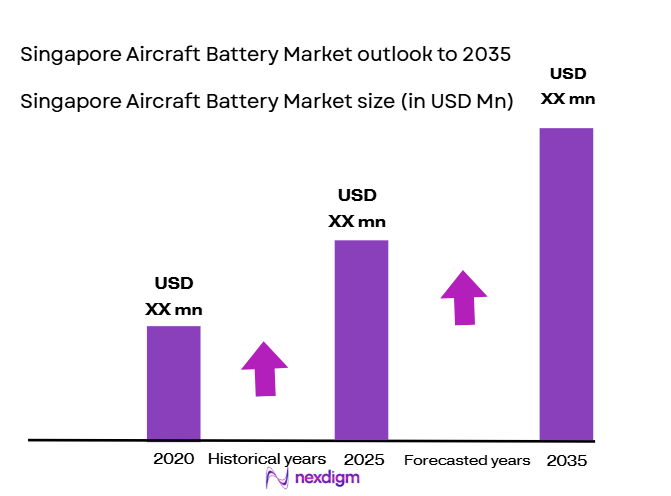
The Singapore Aircraft Battery Market is valued at approximately USD ~ million in 2024. This market is primarily driven by the rapid growth in the aviation industry, particularly with the increasing adoption of electric and hybrid aircraft. Government incentives and regulations promoting sustainable aviation technologies are pivotal to this growth. As the aviation sector pushes toward greener technologies, innovations in battery efficiency and energy density have spurred investments, with both public and private players focusing on this space to meet future demands.
Singapore, a prominent hub for global aviation, plays a leading role in the aircraft battery market due to its strategic geographical location and strong aviation infrastructure. The country’s well-established airports and its position as a major global aviation hub make it a significant player in the market. Additionally, Singapore’s governmental policies aimed at reducing carbon emissions and encouraging green aviation technologies have attracted international players to invest in the region. This dominance is also fueled by the rising demand for sustainable aviation solutions from both commercial and military sectors.
Market Segmentation
By System Type
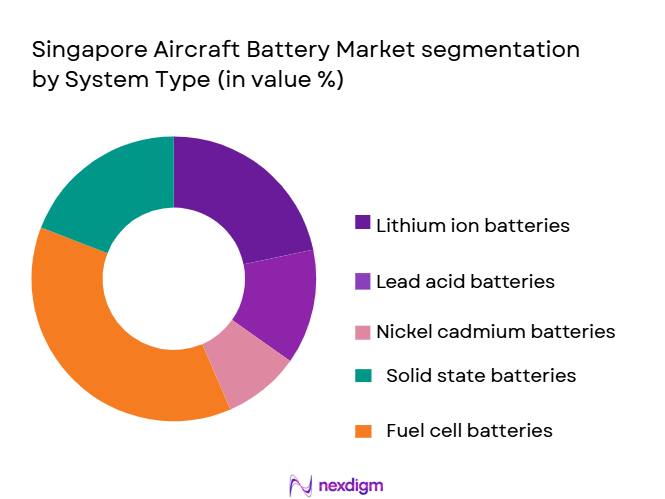
The Singapore Aircraft Battery market is segmented by system type into lithium-ion batteries, lead-acid batteries, nickel-cadmium batteries, solid-state batteries, and hybrid battery systems. Lithium-ion batteries have a dominant market share, largely due to their high energy density, long cycle life, and lighter weight compared to other types. Their widespread adoption in both commercial and military aircraft applications is further supported by advancements in technology, such as improved charging times and enhanced battery management systems. As the global aviation sector moves towards more efficient energy systems, lithium-ion batteries remain the preferred choice due to their ability to meet the demanding power requirements of modern aircraft while reducing overall weight.
By Platform Type
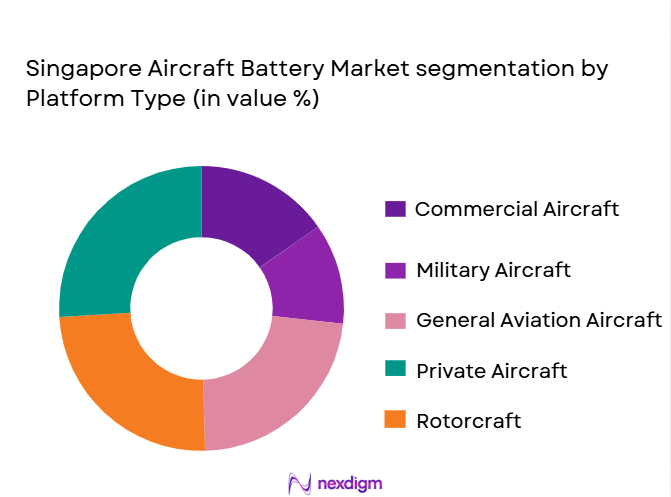
The market is segmented by platform type into commercial aircraft, military aircraft, private jets, UAVs (Unmanned Aerial Vehicles), and helicopters. Commercial aircraft dominate the market share due to the significant demand for energy-efficient solutions and the larger number of fleets operating worldwide. Airlines are increasingly investing in electric and hybrid aircraft to reduce fuel consumption and lower emissions, driving the growth of the battery segment. Additionally, the push towards net-zero emissions in aviation by 2050, supported by both governmental regulations and consumer demand for greener travel options, ensures that commercial aircraft will remain a dominant market platform for the foreseeable future.
Competitive Landscape
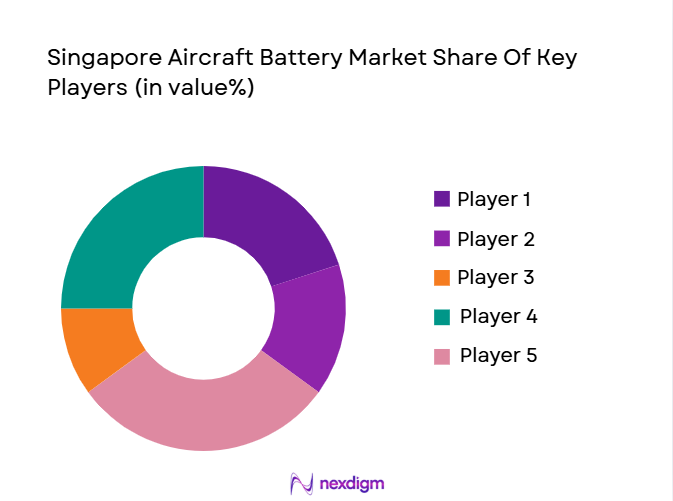
The Singapore Aircraft Battery market is dominated by key players such as Rolls-Royce, GE Aviation, Honeywell Aerospace, Saft Batteries, and Aerospace Systems & Components. These players have a strong presence due to their long-standing experience in the aviation industry and their continued innovation in battery technologies. Their ability to provide highly reliable and efficient energy storage systems for various aircraft types is crucial in maintaining their market leadership. These companies focus on developing advanced battery management systems and enhancing the energy density of their products, allowing them to meet the rising demand for sustainable aviation solutions.
| Company | Establishment Year | Headquarters | Technology Focus | Product Range | Market Focus | Global Reach |
| Rolls-Royce | 1906 | United Kingdom | ~ | ~ | ~ | ~ |
| GE Aviation | 1917 | United States | ~ | ~ | ~ | ~ |
| Honeywell Aerospace | 1960 | United States | ~ | ~ | ~ | ~ |
| Saft Batteries | 1918 | France | ~ | ~ | ~ | ~ |
| Aerospace Systems & Components | 2005 | Singapore | ~ | ~ | ~ | ~ |
Singapore Aircraft Battery Market Dynamics
Growth Drivers
Increasing Demand for Energy-Efficient Aviation Systems
The growing demand for energy-efficient aviation systems is being driven by both the airline industry’s commitment to sustainability and governmental regulations targeting lower carbon emissions. Singapore, in line with global trends, has set ambitious goals to reduce its carbon emissions by 36% by 2030, including those from aviation. As part of this effort, the Civil Aviation Authority of Singapore (CAAS) is supporting the development of green technologies for aviation. These efforts are complemented by the global push for net-zero emissions in aviation by 2050, further driving the demand for energy-efficient aircraft powered by advanced battery systems. As a key aviation hub, Singapore is contributing significantly to this demand, with the government committing SGD ~ billion to sustain green initiatives in transport by 2025.
Government Incentives for Sustainable Aviation Technologies
The Singaporean government has committed to significant investments to support sustainable aviation technologies, as part of its national agenda to meet the Paris Agreement’s climate targets. By 2026, Singapore plans to introduce various green initiatives, including those that promote the development of electric and hybrid aircraft, supported by its Aviation Green Plan. This policy, alongside incentives for companies developing energy-efficient aircraft systems, has accelerated the adoption of sustainable aviation technologies. The Singapore government’s backing of research and development into electric aircraft and battery systems has become a vital growth driver, as evidenced by the introduction of tax incentives for companies involved in developing next-generation aviation technologies.
Market Challenges
High Initial Cost of Advanced Battery Technologies
A major challenge in the adoption of advanced aircraft battery systems is the high initial investment required for the development and integration of these technologies. In 2024, the upfront cost of advanced battery solutions for electric aircraft remains a significant barrier. This is due to the complexity and cost of the materials, including high-performance lithium, cobalt, and nickel, which are essential for the construction of next-generation batteries. These materials contribute to a higher per-kilowatt cost, which makes electric aircraft unaffordable for many operators. Furthermore, the integration of these advanced battery systems into existing aircraft platforms requires substantial investments in new infrastructure and R&D.
Limited Charging Infrastructure for Aircraft Batteries
The lack of a widespread and standardized charging infrastructure for electric aircraft is another key challenge hindering the growth of the market. As of 2024, the development of charging stations capable of supporting electric aircraft remains in the early stages. While some airports, especially in Singapore, are making strides in this area, most global airports still lack the infrastructure to support electric aviation at scale. The absence of fast-charging networks and the limited number of charging points at major airports poses a significant barrier to the widespread adoption of electric aircraft, limiting the ability to transition from traditional fossil fuel-based propulsion systems.
Market Opportunities
Growing Adoption of Electric Aircraft and Hybrid Propulsion Systems
The growing adoption of electric and hybrid aircraft presents a promising opportunity for the Singapore Aircraft Battery Market. With global calls for reducing carbon emissions, the aviation industry is increasingly turning toward electric and hybrid solutions. In Singapore, the government has already begun to invest heavily in electric aircraft technology, including providing funding for electric vertical take-off and landing (eVTOL) projects. This shift toward electric aviation is expected to further accelerate in the coming years, presenting a significant opportunity for battery manufacturers to supply high-performance battery systems to these new platforms. As aviation companies move toward electric propulsion to meet sustainability targets, battery technology will play a crucial role in facilitating this transition.
Increase in Demand for Eco-friendly Aviation Solutions
The increasing demand for eco-friendly aviation solutions is a key opportunity for growth in the aircraft battery market. As climate change becomes an increasingly urgent issue, the push for sustainable aviation solutions is intensifying. In 2024, global aviation emissions account for around 2-3% of total global CO2 emissions, with significant efforts being made to reduce these figures. This has led to governments and airlines worldwide focusing on reducing carbon footprints by adopting electric and hybrid-powered aircraft, driving demand for efficient battery systems. The focus on green technologies, including the support for sustainable aviation fuels and electric aircraft, is fueling the growth of the aircraft battery market.
Future Outlook
Over the next decade, the Singapore Aircraft Battery market is expected to experience significant growth, driven by continuous technological advancements, regulatory support for greener aviation solutions, and increasing investments in electric and hybrid aircraft. As airlines and the military sector continue to adopt eco-friendly power solutions, demand for efficient and high-capacity batteries will grow substantially. Moreover, the rise of electric vertical take-off and landing (eVTOL) aircraft will further contribute to the market’s expansion.
Major Players
- Rolls-Royce
- GE Aviation
- Honeywell Aerospace
- Saft Batteries
- Aerospace Systems & Components
- Airbus
- Boeing
- Sky Power GmbH
- Parker Aerospace
- Eviation Aircraft
- Zunum Aero
- Panasonic
- BYD Company Ltd.
- Siemens AG
- Kokam Co. Ltd.
Key Target Audience
- Airlines and Aircraft Operators
- Military Defense Organizations (Singapore Ministry of Defence)
- Aerospace OEMs (Original Equipment Manufacturers)
- Battery Manufacturers
- Investments and Venture Capitalist Firms
- Government and Regulatory Bodies (Civil Aviation Authority of Singapore)
- UAV Operators
- Private Jet Owners
Research Methodology
Step 1: Identification of Key Variables
The initial phase involves identifying all significant market variables impacting the Singapore Aircraft Battery market. This includes gathering secondary data from industry reports, government publications, and proprietary research databases to map out the market dynamics. The aim is to understand how different battery types and platforms are influencing market growth.
Step 2: Market Analysis and Construction
Historical data from market reports will be gathered and analyzed to establish key growth trends, market size, and forecasts. The analysis includes understanding market penetration, growth in various battery technologies, and revenue generation patterns. Detailed metrics on battery usage and consumption will be assessed to provide accurate forecasting.
Step 3: Hypothesis Validation and Expert Consultation
To validate market hypotheses, consultations with industry experts, such as battery manufacturers, aircraft operators, and aerospace engineers, will be conducted. These insights will ensure that the gathered data is aligned with real-world trends and validate the assumptions made during the analysis.
Step 4: Research Synthesis and Final Output
In the final phase, a synthesis of all collected data will be conducted. This includes verifying the data with key manufacturers and stakeholders, and refining the market forecasts based on the results. The final output will include actionable insights on key market trends, challenges, and forecasts for the Singapore Aircraft Battery market.

- Executive Summary
- Market Research Methodology
(Definitions, Scope, Industry Assumptions, Market Sizing Approach, Primary & Secondary Research Framework, Data Collection & Verification Protocol, Analytic Models & Forecast Methodology, Limitations & Research Validity Checks)

- Market Definition and Scope
- Value Chain & Stakeholder Ecosystem
- Regulatory / Certification Landscape
- Sector Dynamics Affecting Demand
- Strategic Initiatives & Infrastructure Growth

- Growth Drivers
Increasing demand for energy-efficient aviation systems
Government incentives for sustainable aviation technologies
Technological advancements in battery energy density and safety - Market Challenges
High initial cost of advanced battery technologies
Limited charging infrastructure for aircraft batteries
Battery life cycle and environmental concerns - Market Opportunities
Growing adoption of electric aircraft and hybrid propulsion systems
Increase in demand for eco-friendly aviation solutions
Partnerships between battery manufacturers and aircraft OEMs for next-gen technologies - Trends
Rise of electric aircraft and urban air mobility
Integration of AI and machine learning for battery management systems
Development of fast-charging technologies for aviation batteries
- Government Regulations & Defense Policy
FDI Rules
Offset Obligations
Export Licenses - SWOT Analysis (Capability Strengths, Cost Vulnerabilities, Competitive Pressures)
- Porter’s Five Forces (Procurement Power, Supplier Concentration, Substitutes, Barriers to Entry)

- By Market Value 2020-2025
- By Installed Units 2020-2025
- By Average System Price 2020-2025
- By System Complexity Tier 2020-2025

- By System Type (In Value%)
Lithium-Ion Batteries
Lead-Acid Batteries
Nickel-Cadmium Batteries
Solid-State Batteries
Hybrid Battery Systems - By Platform Type (In Value%)
Commercial Aircraft
Military Aircraft
Private Jets
UAVs (Unmanned Aerial Vehicles)
Helicopters - By Fitment Type (In Value%)
Retrofit Systems
OEM (Original Equipment Manufacturer) Systems
Battery Packs for Autonomous Systems
Modular Battery Solutions
Integrated Power Systems - By End User Segment (In Value%)
Airlines
Military Defense
Aerospace OEMs
UAV Operators
Private Jet Owners - By Procurement Channel (In Value%)
Direct Procurement from Manufacturers
Distributors and Retailers
Government and Military Contracts
Third-Party Aircraft Maintenance Providers
OEM Partnerships

- Market Share Analysis
- Cross Comparison Parameters
(Market Share, Technological Innovation, Battery Efficiency, Price Competitiveness, Global Reach) - SWOT Analysis of Key Competitors
- Pricing & Procurement Analysis
- Key Players
Rolls-Royce
GE Aviation
Honeywell Aerospace
Saft Batteries
Lufthansa Technik
Aerospace Systems & Components
AeroVironment
Airbus
Boeing
Sky Power GmbH
Eviation Aircraft
Parker Aerospace
Nissan Motor Corporation
Gulfstream Aerospace
Zunum Aero

- Airlines investing in electric aircraft fleets for cost efficiency
- Military sector focusing on high-performance battery systems for UAVs
- OEMs targeting lightweight and high-capacity battery solutions for aircraft
- Private jet owners seeking more efficient, long-lasting batteries

- Forecast Market Value, 2026-2035
- Forecast Installed Units, 2026-2035
- Price Forecast by System Tier, 2026-2035
- Future Demand by Platform,
2026-2035


 Request a Sample
 Ask for Customization
 Get a Quote
 Enquire Now