
 Download PDF
 Download PDF
Market Overview
The Singapore Aircraft Windshield Wiper Systems market current size stands at around USD ~ million, supported by steady aftermarket demand of ~ systems and replacement volumes of ~ units across commercial and business aviation fleets. In the most recent two-year period, operators processed ~ installations through scheduled maintenance cycles, while MRO-driven retrofits accounted for ~ deployments. Average system realization remains at USD ~ per installation, reflecting certification complexity and the premium placed on cockpit safety components in adverse weather operations.
Singapore dominates this niche through its mature aerospace ecosystem anchored around Changi and Seletar, where dense airline operations, regional MRO hubs, and strong OEM linkages converge. High aircraft turnaround intensity, advanced maintenance infrastructure, and a robust regulatory environment reinforce sustained demand. The city-state’s role as a Southeast Asian aviation gateway further concentrates procurement, spares stocking, and technical services, creating a structurally advantaged market for specialized aircraft windshield wiper system suppliers.
Market Segmentation
By Fleet Type
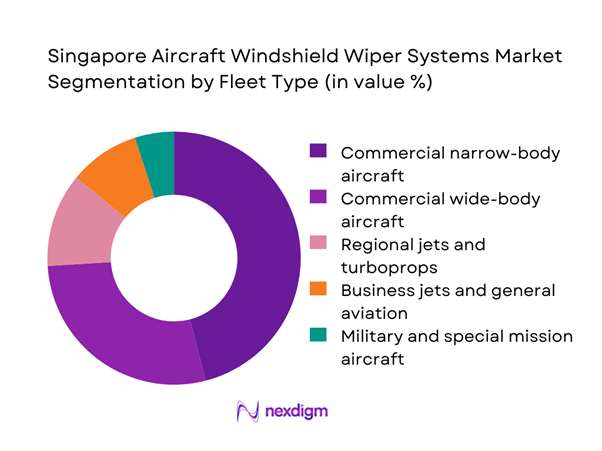
Commercial narrow-body aircraft dominate the Singapore Aircraft Windshield Wiper Systems market due to the high frequency of short-haul operations and exposure to tropical weather conditions requiring consistent windshield visibility solutions. These aircraft generate recurring replacement demand as utilization intensity accelerates wear cycles. Business jets and general aviation form a steady secondary segment, driven by premium maintenance standards and operator preference for advanced, low-maintenance systems. Military and special mission fleets contribute niche but stable volumes through government maintenance programs and long-term service contracts.
By Application
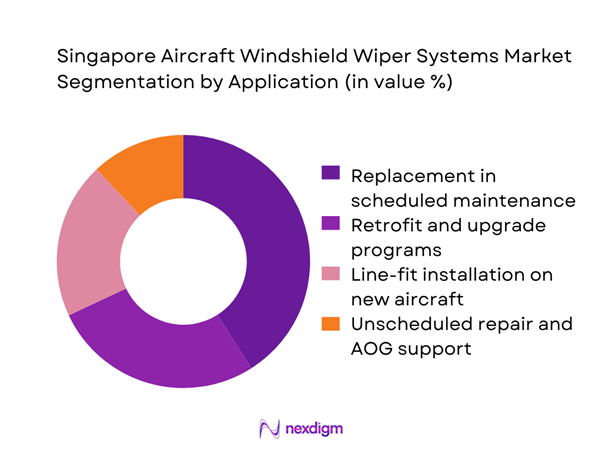
Replacement in scheduled maintenance represents the largest application segment, supported by predictable overhaul cycles and strict safety compliance. Airlines and MROs prioritize windshield wiper systems during heavy checks, ensuring stable baseline demand. Retrofit and upgrade programs are gaining traction as operators seek improved reliability and reduced downtime through newer motor architectures. Line-fit installations remain relevant through aircraft deliveries routed via Singapore-based completion and acceptance centers, while unscheduled repair continues to provide incremental demand during adverse weather seasons.
Competitive Landscape
The Singapore Aircraft Windshield Wiper Systems market shows moderate concentration, led by global aerospace component manufacturers supported by strong local MRO partnerships. Competitive intensity is shaped less by price competition and more by certification breadth, aftermarket responsiveness, and long-term service agreements with airlines and defense operators.
| Company Name | Establishment Year | Headquarters | Formulation Depth | Distribution Reach | Regulatory Readiness | Service Capability | Channel Strength | Pricing Flexibility |
| Safran | 2005 | France | ~ | ~ | ~ | ~ | ~ | ~ |
| Collins Aerospace | 2018 | United States | ~ | ~ | ~ | ~ | ~ | ~ |
| Parker Aerospace | 1917 | United States | ~ | ~ | ~ | ~ | ~ | ~ |
| Liebherr-Aerospace | 1964 | Germany | ~ | ~ | ~ | ~ | ~ | ~ |
| ST Engineering Aerospace | 1990 | Singapore | ~ | ~ | ~ | ~ | ~ | ~ |
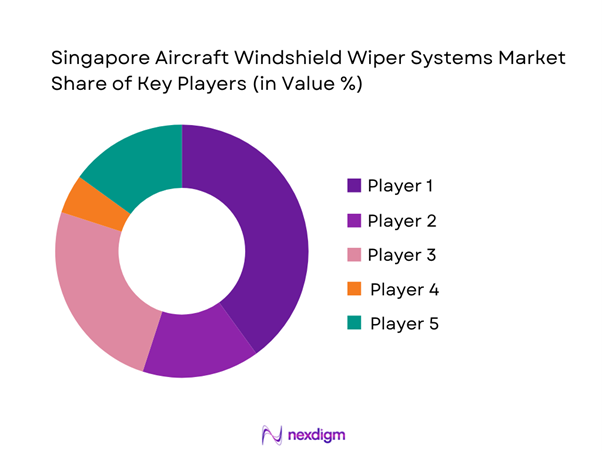
Singapore Aircraft Windshield Wiper Systems Market Analysis
Growth Drivers
Rising aircraft movements in Southeast Asia hub operations
Singapore processes approximately 390,000 flights annually through its hub ecosystem, driving nearly 180,000 maintenance events that directly influence demand for cockpit visibility systems. Over the last two operational cycles, airlines routed around 1,200 aircraft for heavy checks via local MROs, resulting in nearly 9,500 windshield wiper replacements. High-frequency regional routes expose aircraft to monsoon conditions for 7 to 8 months annually, accelerating wear and replacement cycles. This operational intensity sustains consistent aftermarket demand measured at USD ~ million across airline and charter segments, reinforcing Singapore’s role as a demand concentrator.
Growth of Singapore as a regional MRO and aftermarket center
The city-state hosts over 120 certified MRO facilities supporting more than 160 aircraft types, generating approximately 18,000 system installations annually across avionics and cockpit subsystems. Windshield wiper systems benefit from bundled maintenance programs that process over 22,000 components per overhaul cycle. In recent years, regional carriers redirected nearly 14,000 maintenance visits to Singapore-based centers, lifting aftermarket throughput to about 26,000 units and supporting service revenues of USD ~ million. This structural advantage strengthens supplier presence and stabilizes long-term demand.
Challenges
High certification and airworthiness compliance costs
Aircraft windshield wiper systems require multi-layer certification involving more than 40 regulatory checkpoints before deployment. Each new configuration demands 15–20 documentation packages and 30–35 compliance tests, raising development timelines. Suppliers allocate USD ~ million annually toward sustaining certification for legacy platforms, limiting rapid innovation. Smaller manufacturers face barriers when attempting to enter the Singapore market due to the need for 25–30 audits and multiple qualification cycles, which slows competitive expansion and keeps supply concentrated among established players.
Long replacement cycles for certified aircraft components
Windshield wiper systems typically follow replacement intervals of 6–8 years, reducing annualized demand volume despite a large installed base of over 75,000 systems. Airlines prioritize life-extension through refurbishment programs that process around 12,000 components per cycle, deferring new purchases. This dynamic caps short-term shipment growth at approximately 8,000 units annually and constrains revenue expansion to USD ~ million levels. Suppliers must therefore rely on service contracts and spares programs to sustain commercial viability.
Opportunities
Adoption of smart wiper systems with predictive maintenance
Airlines are beginning to integrate digitally monitored systems across more than 900 aircraft, enabling over 15,000 condition alerts per fleet annually. Early deployments across nearly 300 aircraft in the region demonstrate reduced unscheduled removals by 25–30 events per cycle. This transition opens a technology-driven opportunity worth USD ~ million in incremental service and software-linked revenues, positioning suppliers to embed themselves deeper into airline maintenance ecosystems while improving operational reliability.
Retrofit demand from mid-life fleet upgrades
A significant portion of the regional fleet consists of approximately 1,100 aircraft entering mid-life phases, where operators initiate 250–300 upgrade programs per year. Windshield wiper retrofits form part of broader cockpit modernization, generating around 7,500 installations annually in Singapore-based MROs. This retrofit wave supports incremental demand valued at USD ~ million, particularly for systems offering improved durability and lower maintenance intervention rates.
Future Outlook
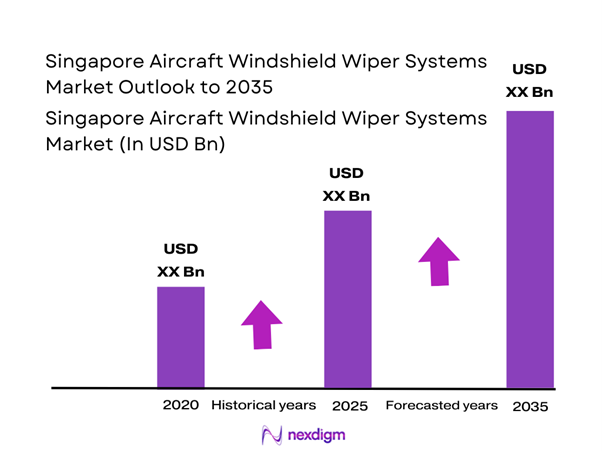
The Singapore Aircraft Windshield Wiper Systems market is expected to maintain stable momentum through 2035, supported by continued hub activity, expanding regional maintenance flows, and gradual adoption of smarter system architectures. As airlines balance cost control with safety enhancement, aftermarket and retrofit segments will remain the primary growth engines. Strategic partnerships between global suppliers and Singapore-based MROs are likely to define competitive advantage in the coming decade.
Major Players
- Safran
- Collins Aerospace
- Parker Aerospace
- Liebherr-Aerospace
- Eaton Aerospace
- Triumph Group
- Moog Aircraft Group
- Woodward Inc.
- Meggitt
- UTC Aerospace Systems
- ST Engineering Aerospace
- SIA Engineering Company
- Lufthansa Technik Asia
- Airbus
- Boeing
Key Target Audience
- Commercial airline maintenance and engineering divisions
- Business aviation operators and fleet managers
- Military and government aviation procurement agencies
- MRO service providers and component overhaul centers
- Aircraft OEMs and completion centers
- Investments and venture capital firms focused on aerospace technologies
- Civil Aviation Authority of Singapore and Ministry of Transport
- Defense Science and Technology Agency
Research Methodology
Step 1: Identification of Key Variables
Demand drivers, maintenance cycles, and certification requirements were mapped to define system-level variables. Operational intensity indicators and aftermarket dependency factors were isolated. Technology adoption signals across smart and conventional systems were shortlisted.
Step 2: Market Analysis and Construction
Supply-side capabilities and service network depth were evaluated across major providers. Procurement flows through airlines and MROs were structured into demand scenarios. Regional ecosystem linkages were incorporated to refine market boundaries.
Step 3: Hypothesis Validation and Expert Consultation
Insights were validated through structured discussions with aviation engineers and maintenance planners. Regulatory interpretation was cross-checked with compliance specialists. Operational assumptions were stress-tested against maintenance scheduling realities.
Step 4: Research Synthesis and Final Output
Findings were consolidated into coherent market narratives. Scenario outcomes were aligned with long-term aviation growth trajectories. Final outputs were refined to ensure decision-grade relevance.

- Executive Summary
- Research Methodology (Market definitions and scope boundaries, aircraft windshield wiper system taxonomy across mechanical and electric actuation designs, market sizing logic by aircraft fleet size and replacement cycles, revenue attribution across system sales spares and MRO services, primary interview program with airlines OEMs and MRO providers, data triangulation validation assumptions and limitations)

- Definition and Scope
- Market evolution
- Usage pathways across flight phases and weather conditions
- Ecosystem structure across OEMs, MROs, and component suppliers
- Supply chain and channel structure
- Regulatory environment and airworthiness standards

- Growth Drivers
Rising aircraft movements in Southeast Asia hub operations
Growth of Singapore as a regional MRO and aftermarket center
Increasing focus on all-weather operational reliability
Fleet expansion by low-cost and full-service carriers
Stricter safety and visibility requirements in adverse conditions
Aging fleet replacement demand for critical cockpit components - Challenges
High certification and airworthiness compliance costs
Long replacement cycles for certified aircraft components
Supply chain dependency on global Tier I suppliers
Pressure on margins in airline and MRO procurement
Limited differentiation in mature mechanical architectures
Exposure to aircraft delivery delays and fleet grounding events - Opportunities
Adoption of smart wiper systems with predictive maintenance
Retrofit demand from mid-life fleet upgrades
Growth in business aviation and special mission aircraft
Partnerships with Singapore-based MROs for aftermarket penetration
Development of lightweight and energy-efficient designs
Expansion of service contracts and power-by-the-hour models - Trends
Shift toward brushless motor and low-maintenance systems
Integration of wiper health data into aircraft maintenance systems
Increasing use of composite-compatible mounting solutions
Emphasis on corrosion resistance for tropical operating climates
Consolidation among aerospace component suppliers
Rising role of MROs in component lifecycle management - Government Regulations
- SWOT Analysis
- Stakeholder and Ecosystem Analysis
- Porter’s Five Forces Analysis
- Competition Intensity and Ecosystem Mapping

- By Value, 2020–2025
- By Shipment Volume, 2020–2025
- By Active Systems, 2020–2025
- By Average Selling Price, 2020–2025

- By Fleet Type (in Value %)
Commercial narrow-body aircraft
Commercial wide-body aircraft
Regional jets and turboprops
Business jets and general aviation
Military transport and special mission aircraft - By Application (in Value %)
Line-fit installation on new aircraft
Retrofit and upgrade programs
Replacement in scheduled maintenance
Unscheduled repair and AOG support - By Technology Architecture (in Value %)
Conventional electromechanical wiper systems
High-torque brushless motor systems
Heated blade and ice-resistant systems
Smart wiper systems with condition monitoring - By End-Use Industry (in Value %)
Commercial airlines
Charter and business aviation operators
Military and government aviation
MRO service providers - By Connectivity Type (in Value %)
Standalone analog control systems
Integrated avionics bus-based systems
Digitally monitored and IoT-enabled systems - By Region (in Value %)
Changi airport ecosystem and airline hubs
Seletar aerospace and business aviation cluster
Regional MRO export servicing from Singapore

- Market structure and competitive positioning
Market share snapshot of major players - Cross Comparison Parameters (product reliability, certification coverage, aftermarket support capability, pricing competitiveness, lead time performance, customization flexibility, regional MRO partnerships, lifecycle cost of ownership)
- SWOT Analysis of Key Players
- Pricing and Commercial Model Benchmarking
- Detailed Profiles of Major Companies
Safran
Collins Aerospace
Parker Aerospace
Eaton Aerospace
Triumph Group
Liebherr-Aerospace
Meggitt (Parker Meggitt)
Moog Aircraft Group
Woodward Inc.
UTC Aerospace Systems (legacy programs)
ST Engineering Aerospace
SIA Engineering Company
Lufthansa Technik Asia
Airbus
Boeing

- Demand and utilization drivers
- Procurement and tender dynamics
- Buying criteria and vendor selection
- Budget allocation and financing preferences
- Implementation barriers and risk factors
- Post-purchase service expectations

- By Value, 2026–2035
- By Shipment Volume, 2026–2035
- By Active Systems, 2026–2035
- By Average Selling Price, 2026–2035


 Request a Sample
 Ask for Customization
 Get a Quote
 Enquire Now