
 Download PDF
Market Overview
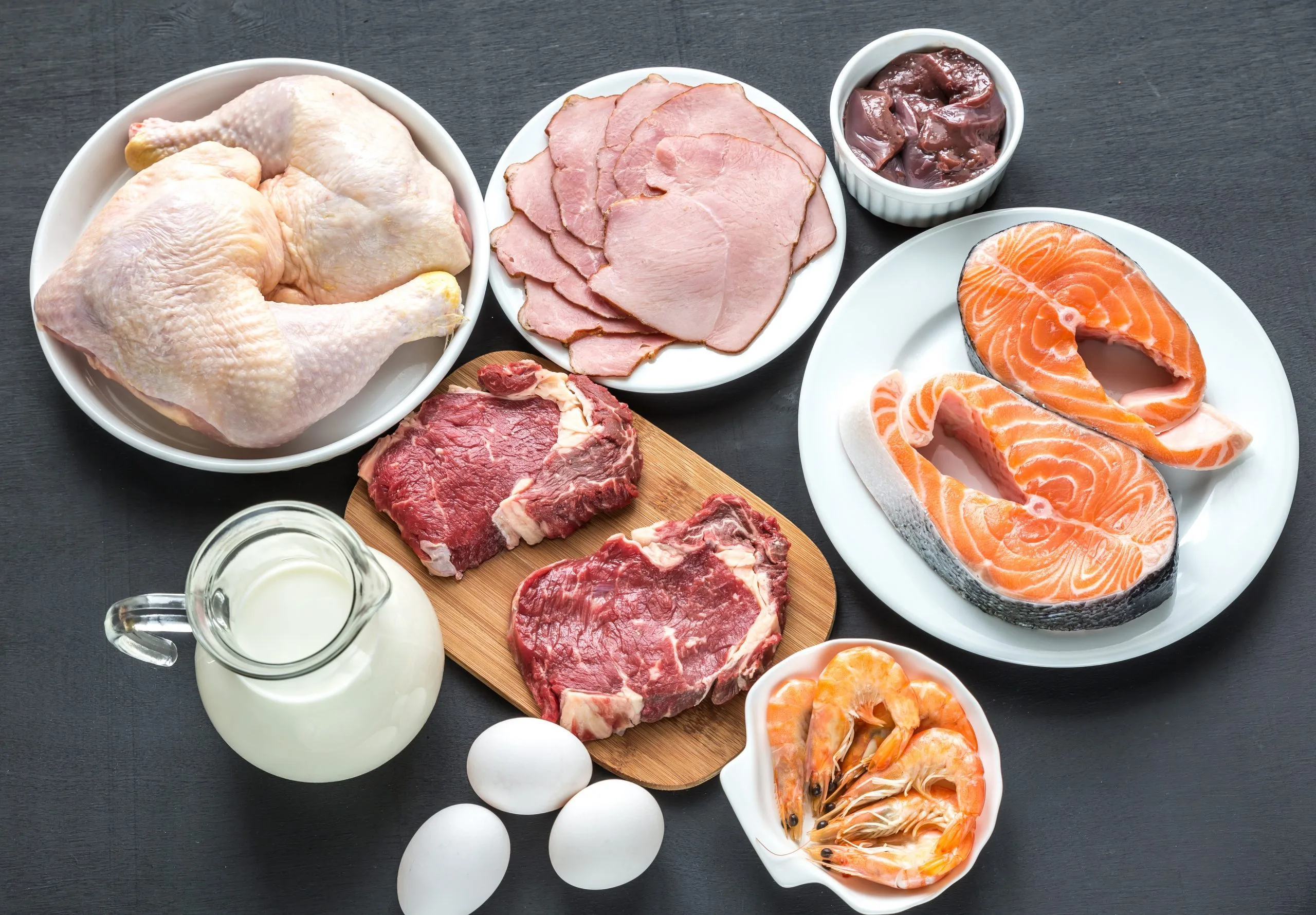
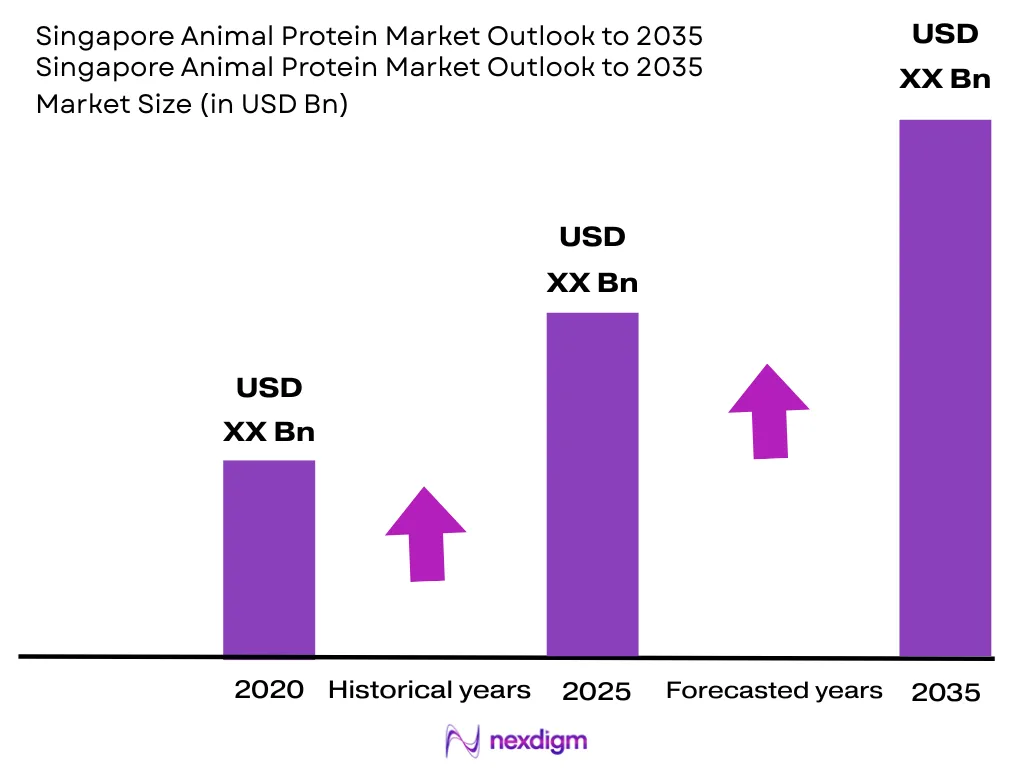
The Singapore Animal Protein Market was valued at USD ~ Billion in 2024, based on import statistics, domestic production, processing revenues, and retail and foodservice consumption across poultry, pork, seafood, eggs, and processed protein products. Singapore imported approximately 90% of its food supply, with animal protein imports representing a significant portion of total food trade, according to data published by the Singapore Food Agency (SFA), Enterprise Singapore, and the Department of Statistics Singapore (SingStat). The market is driven by a highly urbanized and affluent consumer base, a dynamic foodservice and hospitality sector, continuous government investments in food security, and growing consumer demand for premium, sustainable, and innovative protein products.
Market Segmentation
By Protein Type
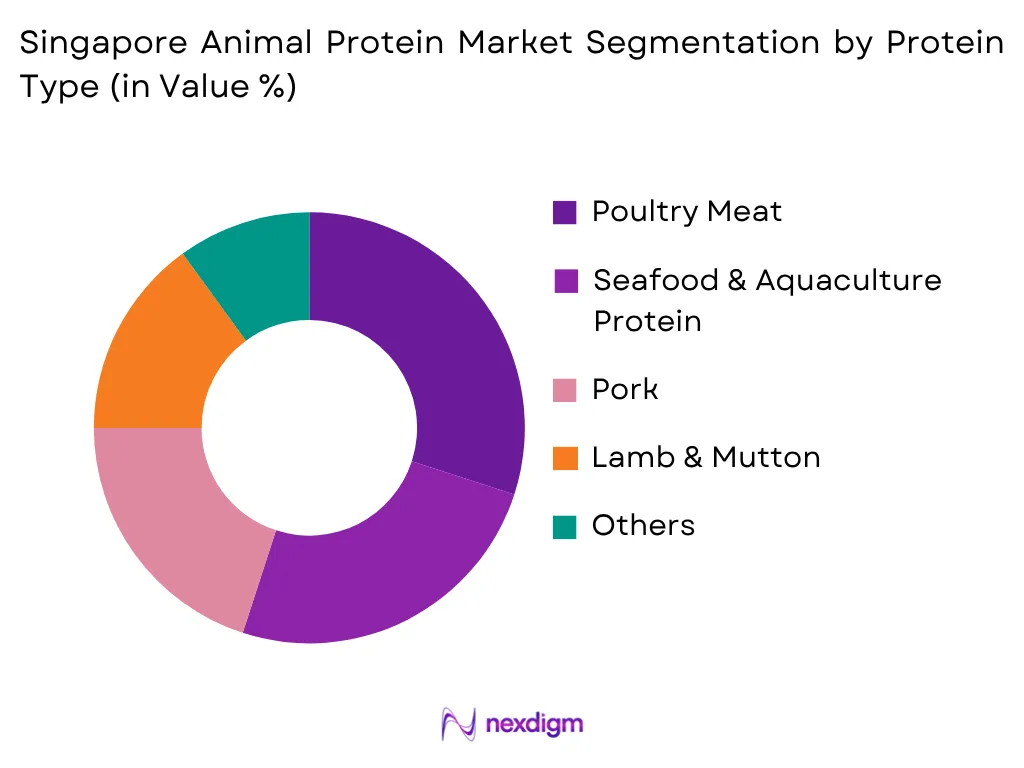
The Singapore Animal Protein Market is segmented by protein type into Poultry Meat, Pork, Seafood & Aquaculture Protein, Eggs, Processed Animal Protein Products, and Plant-Based & Alternative Proteins. Poultry meat accounts for the largest share of the market owing to its cultural acceptance across Singapore’s multiethnic population, affordability compared to other protein categories, and widespread availability in both wet markets and modern retail outlets. Singapore sources the majority of its poultry from Malaysia, Brazil, and Thailand, with government-approved suppliers maintaining internationally certified halal, food safety, and quality standards. The poultry segment benefits from a deeply embedded culinary culture, including iconic dishes such as Hainanese chicken rice, as well as diverse processed and value-added poultry offerings across retail, hawker centres, and food manufacturing channels. Continuous investments in alternative sourcing arrangements, chilled import protocols, and local controlled-environment poultry farming further underpin the segment’s position across Singapore’s protein market.
By Distribution Channel
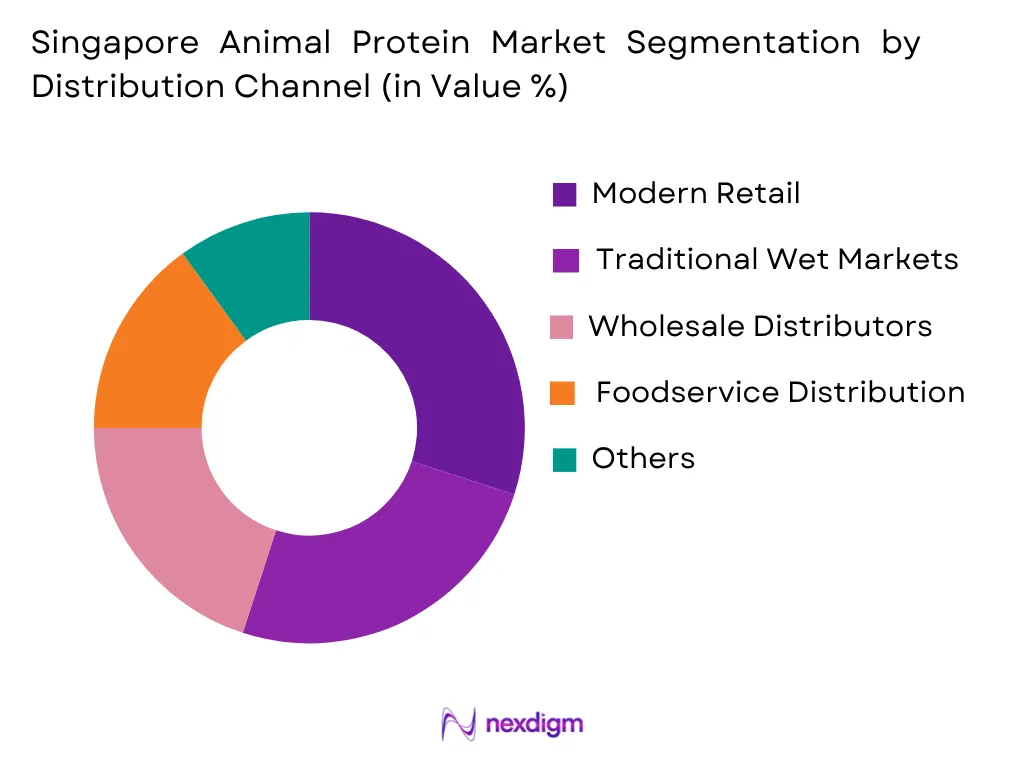
The Singapore Animal Protein Market is segmented by distribution channel into Modern Retail, Traditional Wet Markets, Wholesale Distributors, Foodservice Distribution, Online Grocery & Direct Sales, and Institutional & Government Supply. Modern retail remains a dominant distribution channel due to the widespread presence of supermarkets, hypermarkets, and convenience chains such as FairPrice, Cold Storage, Giant, and Sheng Siong across Singapore’s urban landscape. Consumers increasingly prefer modern retail outlets for their food safety assurances, refrigerated storage, product variety, private label offerings, and convenient shopping experiences. These retailers maintain procurement relationships with approved overseas suppliers and local importers to ensure consistent product availability, cold chain compliance, and competitive pricing. Traditional wet markets continue to serve a significant segment of consumers, particularly older Singaporeans and those seeking fresh, chilled, or live animal protein. The rapid expansion of online grocery platforms and last-mile delivery services has further diversified protein distribution, enabling consumers to access premium and specialty protein products directly from suppliers, farms, and specialized retailers.
Competitive Landscape
The Singapore Animal Protein Market is characterized by the presence of major international food companies, regional agri-food conglomerates, and specialized local importers and distributors. Companies compete on import procurement efficiency, cold chain capabilities, product portfolio breadth, halal certification, sustainability credentials, and foodservice distribution reach. Singapore’s strategic position as a regional trading hub, its sophisticated food safety regulatory framework, and its high consumer purchasing power attract a diverse range of global and regional protein suppliers. Investment in value-added processing, food innovation, and sustainability programmes differentiates market participants across retail, foodservice, and institutional segments.
| Company | Establishment Year | Headquarters | Primary Protein Focus | Processing Facilities
|
Export Presence | Production Integration | Sustainability Programs | Value-Added Product Portfolio |
| Olam Food Ingredients (OFI) | 1989 | ~ | ~ | ~ | ~ | ~ | ~ | ~ |
| SATS Ltd. | 1972 | ~ | ~ | ~ | ~ | ~ | ~ | ~ |
| Japfa Ltd. | 1971 | ~ | ~ | ~ | ~ | ~ | ~ | ~ |
| Cargill Singapore | 1972 | ~ | ~ | ~ | ~ | ~ | ~ | ~ |
| Sustenir Group | 2013 | ~ | ~ | ~ | ~ | ~ | ~ | ~ |
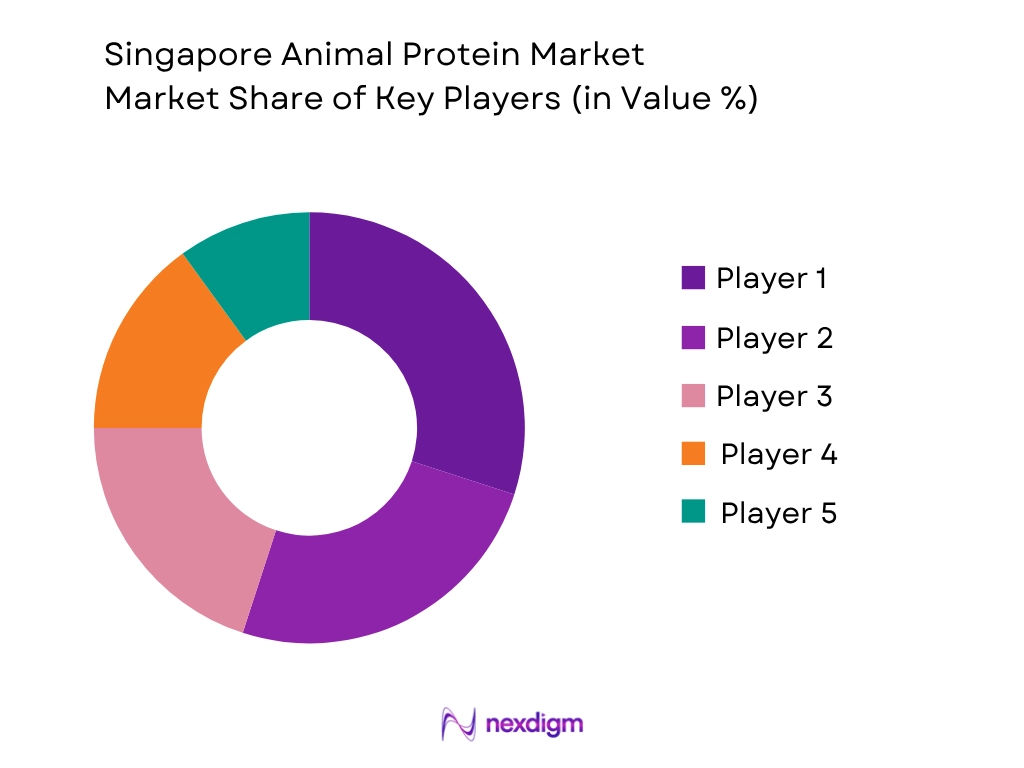
Singapore Animal Protein Market Analysis
Growth Drivers
Food Security Imperatives and the 30 by 30 Goal
Singapore’s strong government commitment to enhancing domestic food production is one of the most significant structural growth drivers for the animal protein market. The Singapore Food Agency (SFA) has established the national ’30 by 30′ goal, targeting the local production of 30% of Singapore’s nutritional needs by 2030, with animal protein forming a critical component of this objective. According to SFA, Singapore currently produces less than 10% of its food domestically, making supply chain diversification and local production investments a national priority. The Singapore Food Story R&D Programme has allocated substantial funding to advance aquaculture, egg production, and alternative protein technologies. Enterprise Singapore and Temasek Holdings have co-invested in food technology ventures and agri-food innovation to strengthen local production capabilities. According to the Department of Statistics Singapore (SingStat), Singapore’s total merchandise imports exceeded SGD 500 billion during the latest reporting period, reflecting the scale of the country’s import-dependent economy, including its reliance on imported animal protein. The government’s active investments in controlled-environment aquaculture, vertical layer-farming, and precision fermentation are expected to gradually increase domestic protein production while reducing vulnerability to import disruptions. These policy initiatives create direct market opportunities for companies investing in local production, food technology, and sustainable animal protein supply chains.
Rising Affluence, Urbanization, and Premium Protein Demand
Singapore’s high per capita income and sophisticated urban consumer base continue to drive demand for premium, high-quality, and innovative animal protein products. According to the World Bank, Singapore’s GDP per capita exceeded USD 65,000 in 2024, positioning it among the highest-income economies globally. The International Monetary Fund (IMF) projects continued economic resilience for Singapore, supported by its role as a leading financial and trade hub in Southeast Asia. Affluent Singaporean consumers increasingly demand premium-grade meats, traceable seafood, organic poultry, and specialty protein products from domestic and international markets. The Department of Statistics Singapore reported consistent growth in household expenditure on food, including dining out, premium groceries, and specialty food products. The island city-state’s thriving hotel, restaurant, and catering (HoReCa) sector continues to generate strong institutional demand for premium cuts, specialty seafood, and certified animal protein. Increasing health consciousness, sports nutrition awareness, and functional food demand further contribute to protein consumption growth across demographic segments. These demand dynamics create significant market opportunities for companies supplying premium, traceable, certified, and innovative animal protein products to Singapore’s discerning consumer and institutional markets.
Market Challenges
Heavy Import Dependency and Supply Chain Vulnerabilities
Singapore’s near-total reliance on imported animal protein represents a fundamental structural challenge for the market, exposing consumers, businesses, and the government to global supply chain disruptions. According to the Singapore Food Agency (SFA), Singapore imports food from more than 170 countries and regions, with animal protein imports from key supplier nations including Malaysia, Brazil, Indonesia, Australia, and Thailand. The COVID-19 pandemic demonstrated the acute vulnerability of Singapore’s food supply system, with temporary disruptions to Malaysian chicken exports in 2022 causing significant market stress, price spikes, and supply shortfalls across the domestic market. The SFA responded by accelerating import diversification programs and approving new animal protein sources from additional countries to strengthen supply resilience. According to the Department of Statistics Singapore, food import expenditure represents a significant portion of Singapore’s total import bill, reflecting the structural nature of the country’s food dependency. Disruptions arising from animal disease outbreaks, export restrictions, climate events, or geopolitical tensions in supplier countries can rapidly affect protein availability and pricing in Singapore. Continued investments in supply diversification, strategic food stockpiling, alternative protein technologies, and local production capacity are therefore essential to managing the country’s long-term food security risks.
Limited Land and High Operating Cost Constraints
Singapore’s extremely limited land area and high operating costs present significant barriers to scaling domestic animal protein production. According to the Department of Statistics Singapore, Singapore covers approximately 733 square kilometres, making it one of the world’s most land-scarce nations. The SFA manages a small number of licensed farms operating on constrained land parcels, with aquaculture operations conducted within a designated marine fish farming zone in the Strait of Johor and surrounding coastal waters. High land costs, labour expenses, energy costs, and regulatory compliance requirements significantly increase the cost of local animal protein production relative to imported alternatives. While controlled-environment farming technologies and vertical aquaculture systems have the potential to improve space efficiency, the capital investment required remains substantial. Enterprise Singapore and the SFA’s Agri-Food Cluster Transformation (ACT) Fund provide grants and co-investment support to reduce barriers for innovative food producers. Despite these efforts, achieving cost-competitive local production at meaningful scale remains a significant challenge. Singapore’s food businesses must therefore maintain sophisticated import procurement strategies, efficient supply chain operations, and value-added processing capabilities to remain competitive in one of Asia’s most demanding food markets.
Market Opportunities
Expansion of High-Value Aquaculture and Sustainable Seafood Production
Singapore’s strategic coastal location, advanced biotechnology capabilities, and strong institutional support create significant opportunities for expanding high-value aquaculture and sustainable seafood production. The Singapore Food Agency continues to develop the aquaculture sector through licensing, technology adoption grants, and the Aquaculture Innovation Centre established to advance precision farming technologies. According to SFA, Singapore’s fish farms produced approximately 5,000 tonnes of food fish annually in recent years, representing a target for significant expansion under the 30 by 30 initiative. Enterprise Singapore has co-invested in advanced aquaculture ventures, including closed-loop recirculating aquaculture systems (RAS), offshore cage farming, and integrated marine protein production. Global demand for sustainably certified seafood continues to grow, with Singapore’s reputation for regulatory rigour and food safety providing competitive advantages for locally produced and certified protein products. Investment in tropical marine species, shrimp, sea bass, grouper, and tilapia production offers diversification opportunities alongside innovation in seaweed and algae-based protein derivatives. The World Bank’s Blue Economy framework identifies sustainable aquaculture as a critical growth area for coastal and island nations, aligning with Singapore’s strategic positioning. Companies investing in advanced aquaculture technologies in Singapore are well positioned to capture both domestic market demand and regional export opportunities across Asia’s growing premium seafood market.
Alternative Protein Innovation and Singapore’s Food-Tech Ecosystem
Singapore has emerged as a leading global hub for alternative protein research, investment, and commercialisation, creating unique opportunities for market participants across the animal protein value chain. The Economic Development Board (EDB) and Enterprise Singapore have actively recruited global alternative protein companies to establish research, development, and manufacturing operations in Singapore. Companies such as Eat Just (producer of cultivated chicken), Impossible Foods, and multiple precision fermentation ventures have established significant presences in Singapore. According to Good Food Institute Asia Pacific, Singapore was among the first countries globally to approve the sale of cultivated meat for human consumption, signalling regulatory leadership in the alternative protein sector. The SFA’s novel food regulatory framework provides a structured pathway for innovative protein products to achieve commercial approval, positioning Singapore as a preferred market entry point for the region. Strong venture capital investment, government grants, and collaboration with leading universities including the National University of Singapore (NUS) and Nanyang Technological University (NTU) continue to strengthen Singapore’s alternative protein research ecosystem. While alternative proteins represent a smaller market share relative to conventional animal protein, their rapid growth trajectory and Singapore’s regulatory and innovation advantages create significant long-term opportunities for companies active in this space. The convergence of food technology, sustainability imperatives, and consumer openness to innovation makes Singapore a critical market for alternative protein commercialisation across the Asia-Pacific region.
Future Outlook
The Singapore Animal Protein Market is expected to maintain steady long-term growth supported by increasing domestic protein demand from an affluent and growing population, continued government investments in food security, and expansion of value-added processing and food innovation capabilities. Progress toward the 30 by 30 production goal will gradually increase local protein supply, while import diversification strategies are anticipated to strengthen supply chain resilience. Technological advancements in aquaculture, precision fermentation, controlled-environment farming, and alternative protein production will reshape the competitive landscape. The HoReCa sector is expected to continue generating strong institutional demand for premium animal protein as Singapore’s hospitality and tourism industries maintain their international prominence. Furthermore, increasing consumer awareness of sustainability, animal welfare, and traceability is likely to drive premiumisation across protein categories and strengthen demand for certified, branded, and innovative protein products.
Major Players
- Olam Food Ingredients (OFI)
- SATS Ltd.
- Japfa Ltd.
- Cargill Singapore
- Sustenir Group
- Prima Limited
- Tee Yih Jia Food Manufacturing
- Mandai Link Cold Storage
- Sing Long Food Industries
- Jack’s Place Group
- Charoen Pokphand (Singapore)
- QL Foods Singapore
- Pacific Meat Company
- Harvey’s Farm
- Apollo Aquaculture Group
Key Target Audience
- Animal Protein Importers, Distributors and Food Trading Companies
- Local Aquaculture Producers and Controlled-Environment Protein Farmers
- Food Processing and Packaged Food Manufacturers
- Retail Chains, Wet Market Operators and Foodservice Companies
- Export, Re-Export and International Trading Companies
- Investments and Venture Capitalist Firms
- Government and Regulatory Bodies (Singapore Food Agency (SFA), Enterprise Singapore, Economic Development Board (EDB), Agri-Food & Veterinary Authority (AVA), Department of Statistics Singapore (SingStat))
- Cold Chain Logistics, Storage and Distribution Companies
Research Methodology
Step 1: Identification of Key Variables
The research process begins by identifying the complete ecosystem of the Singapore Animal Protein Market, including protein importers, local producers, food processors, distributors, retailers, foodservice operators, and regulatory agencies. Extensive secondary research is conducted using government publications, trade association reports, import and export statistics, company reports, and proprietary industry databases. This stage helps determine the major variables influencing import volumes, domestic production, consumption trends, pricing dynamics, and investment activity across the market.
Step 2: Market Analysis and Construction
Historical market information is compiled and analyzed to estimate the overall market size using both top-down and bottom-up approaches. Import volumes, domestic production statistics, retail and foodservice consumption data, processing revenues, and pricing trends are evaluated to construct a comprehensive market model. Demand-side and supply-side assessments are performed to validate the consistency of market estimates across various industry participants and distribution channels.
Step 3: Hypothesis Validation and Expert Consultation
The preliminary market findings are validated through computer-assisted telephone interviews (CATIs) and structured discussions with executives from food import companies, protein processors, distributors, foodservice operators, industry associations, and regulatory authorities. These consultations provide valuable insights regarding procurement strategies, pricing dynamics, regulatory requirements, investment priorities, and emerging market opportunities, ensuring that the assumptions used in the research accurately reflect current industry conditions in Singapore.
Step 4: Research Synthesis and Final Output
The final stage integrates findings obtained from secondary research and primary interviews to develop a comprehensive market assessment. Market estimates are cross-verified using company financial reports, trade databases, government production statistics, and industry publications. The resulting analysis provides detailed insights into market size, competitive positioning, segmentation, growth drivers, challenges, future opportunities, and strategic recommendations for stakeholders operating within the Singapore Animal Protein Market.

- Executive Summary
- Research Methodology (Market Definitions and Assumptions, Abbreviations, Market Sizing Framework, Top-Down Analysis, Bottom-Up Analysis, Demand-Side Assessment, Supply-Side Assessment, Primary Industry Interviews, Trade Flow Validation, Data Triangulation, Forecasting Framework, Limitations and Future Conclusions)

- Definition and Scope
- Market Evolution and Industry Genesis
- Timeline of Major Industry Developments
- Singapore Animal Protein Industry Ecosystem
- Supply Chain Analysis

- Growth Drivers (Food Security Imperatives, Rising Affluence and Protein Demand, Agri-Food Innovation Investments, Government-Supported Local Production, Strong HoReCa Sector, Premium and Ethnic Protein Consumption)
- Market Challenges (Heavy Import Dependency, Limited Land and Water Resources, Supply Chain Vulnerabilities, High Operating Costs, Regulatory Compliance, Consumer Price Sensitivity)
- Market Opportunities (30 by 30 Food Production Goal, Alternative Protein Development, Precision Aquaculture, High-Value Processing Hub, Digital Food Supply Chain, Premium Branded Protein Products)
- Market Trends (Vertical Farming Integration, Sustainable Seafood Certification, Alternative Protein Mainstreaming, Smart Aquaculture, Protein Product Premiumization, Automation in Food Processing)
- Government Regulations (SFA Food Safety Standards, Agri-Food & Veterinary Authority Guidelines, Halal Certification, Environmental Sustainability Requirements, Import Licensing, Sanitary & Phytosanitary Standards)
- Trade Policy Analysis (Import Agreements, Tariff Structure, Import Diversification, Veterinary Protocols, Market Access Requirements)
- Feed Industry Assessment (Import-Dependent Feed Supply, Alternative Feed Research, Feed Conversion Efficiency, Feed Cost Structure)
- SWOT Analysis
- PESTLE Analysis
- Porter’s Five Forces Analysis
- Stakeholder Ecosystem
- Competition Ecosystem

- By Market Value (2020-2025)
- By Volume Consumption (2020-2025)
- By Average Selling Price (2020-2025)

- By Protein Type (In Value %)
Poultry Meat
Pork
Seafood & Aquaculture Protein
Eggs
Processed Animal Protein Products
Plant-Based & Alternative Proteins - By Product Form (In Value %)
Fresh/Chilled
Frozen
Processed & Value-Added
Cooked & Ready-to-Eat
Marinated & Seasoned Products - By End User (In Value %)
Retail Consumers
Foodservice & HoReCa
Food Processing Industry
Institutional Buyers
Export & Re-export Buyers - By Distribution Channel (In Value %)
Modern Retail
Traditional Wet Markets
Wholesale Distributors
Foodservice Distribution
Online Grocery & Direct Sales
Institutional & Government Supply - By Production System (In Value %)
Imported Conventional Production
Local Controlled-Environment Farming
Aquaculture & Marine Capture
Certified Halal Production
Certified Organic & Premium Production - By Animal Protein Grade (In Value %)
Commodity Grade
Premium Grade
Certified Sustainable
Halal Certified
Specialty & Functional Protein - By Region (In Value %)
Central Singapore
North Singapore
East Singapore
West Singapore
North-East Singapore

- Market Share of Major Players (By Value, Import Volume, Processing Volume, Protein Category, Distribution Reach)
- Cross Comparison Parameters (Processing Capacity, Import Procurement, Retail & Foodservice Reach, Cold Storage Capacity, Product Portfolio Diversity, Sustainability & Halal Certifications, Value-Added Product Portfolio)
- SWOT Analysis of Major Players
- Pricing Analysis (By Protein Category, Processing Level, Import vs Local Pricing)
- Detailed Profiles of Major Companies
Olam Food Ingredients (OFI)
SATS Ltd.
Japfa Ltd.
Cargill Singapore
Sustenir Group
Prima Limited
Tee Yih Jia Food Manufacturing
Mandai Link Cold Storage
Sing Long Food Industries
Jack’s Place Group
Charoen Pokphand (Singapore)
QL Foods Singapore
Pacific Meat Company
Harvey’s Farm
Apollo Aquaculture Group

- Consumption Pattern Assessment (Per Capita Protein Consumption, Protein Preference, Meal Frequency, Household Penetration)
- Demographic Demand Analysis (Income Group, Age Group, Resident vs Expatriate, Ethnic Group Preferences)
- Household Expenditure Analysis
- Protein Affordability Assessment
- Fresh vs Frozen Product Preference

- By Market Value (2026-2035)
- By Volume Consumption (2026-2035)
- By Average Selling Price (2026-2035)


 Request a Sample
 Ask for Customization
 Get a Quote
 Enquire Now