

 Download PDF
Market Overview
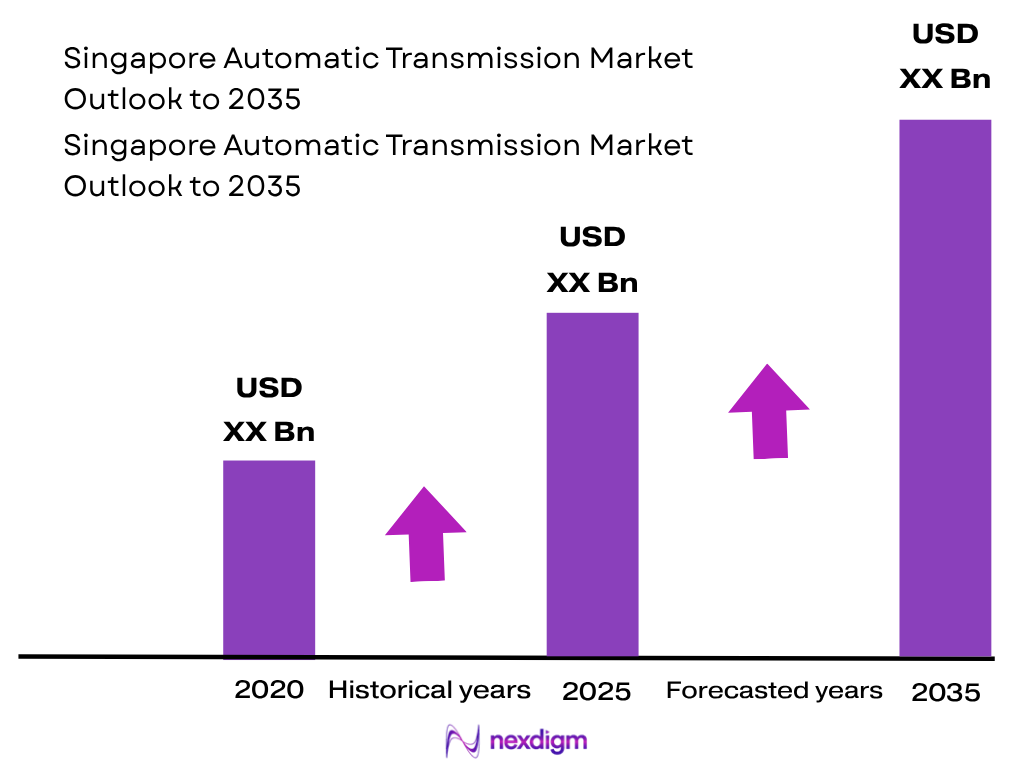
The Singapore Automatic Transmission Market is valued at approximately ~USD XX million, supported by a tightly controlled but technologically advanced vehicle fleet. Total motor vehicles under the Vehicle Quota System increased from 996,732 units to 1,007,094 units across the two latest annual periods, while new registrations rose from 50,881 to 65,228 vehicles. Singapore also maintained 657,744 cars, creating sustained demand for automatic-transmission fitment, replacement components, diagnostics, rebuilding and servicing.
Singapore’s automatic-transmission demand is concentrated across the island’s principal automotive, fleet and workshop corridors rather than being divided into separate regional markets. The vehicle base increased from 651,302 cars to 657,744 cars, while Category A vehicles rose from 319,837 to 321,611 units and Category B vehicles from 331,007 to 335,675 units. Dense urban driving, authorized distributor networks, taxi and private-hire operations, and established workshop clusters reinforce demand for CVTs, e-CVTs, DCTs and multi-speed automatics.
Market Segmentation
By Transmission Technology
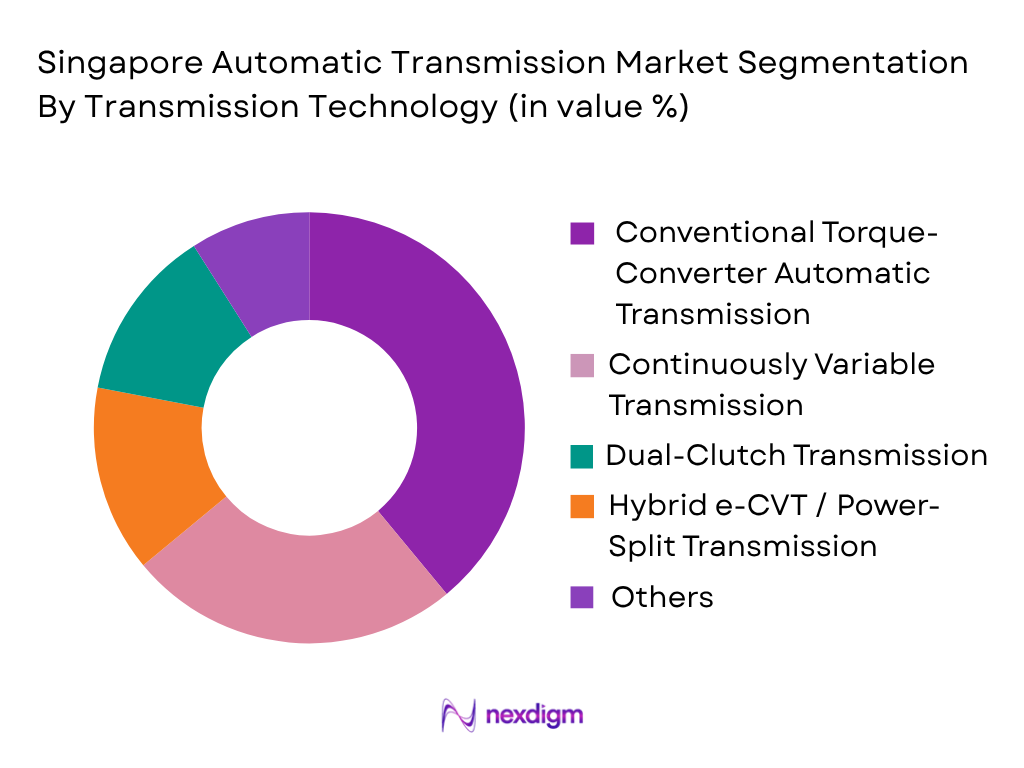
The Singapore Automatic Transmission Market is segmented into conventional torque-converter automatic transmission, continuously variable transmission, dual-clutch transmission, hybrid e-CVT/power-split transmission, automated manual transmission and other advanced architectures. Conventional torque-converter automatics hold the leading position because Singapore has a substantial installed base of Japanese, European and Korean passenger vehicles using electronically controlled 6-speed, 8-speed and higher-ratio automatic gearboxes. Premium European cars reinforce multi-speed AT demand, while Japanese vehicles create substantial CVT exposure. Hybrid systems are becoming increasingly important because Singapore’s petrol-electric car population expanded from 79,256 units in 2023 to 99,157 units in 2024, creating a growing installed base of e-CVTs, hybrid transaxles and integrated electrified drivetrains. The conventional automatic category nevertheless remains important because the market includes older COE-renewed cars and premium vehicles that require continued servicing of torque converters, valve bodies, solenoids and control modules. The segmentation therefore reflects both the existing vehicle parc and Singapore’s accelerating transition toward hybrid and electrified drivetrain architectures.
By Vehicle Type
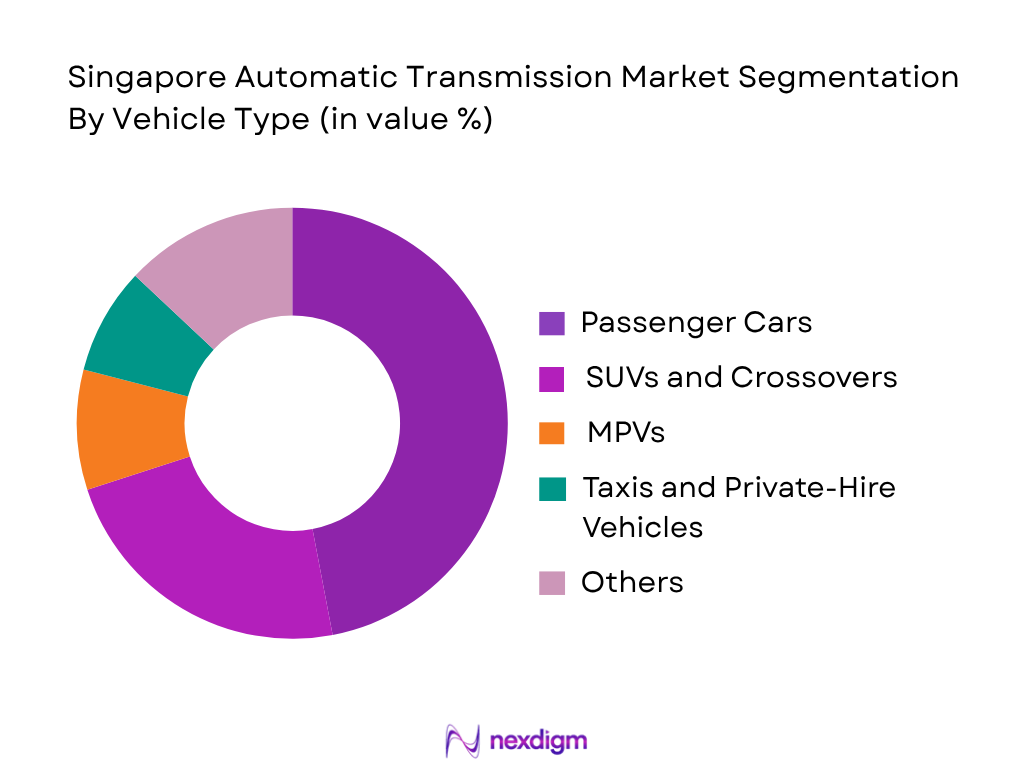
The Singapore Automatic Transmission Market is segmented into passenger cars, SUVs and crossovers, MPVs, taxis and private-hire vehicles, light commercial vehicles and other commercial vehicles. Passenger cars dominate because Singapore had 657,744 cars in the latest annual vehicle population, compared with 651,302 cars in the preceding period. Private cars alone accounted for 524,418 vehicles, creating a sizeable installed base requiring transmission servicing throughout the COE lifecycle. Passenger vehicles also contain the broadest mix of transmission technologies, ranging from Japanese CVTs and hybrid e-CVTs to European DCTs and 8-speed or 9-speed automatics. SUVs and crossovers are increasingly important because they combine premium powertrains with automatic transmissions, while taxi and private-hire fleets generate disproportionately intensive drivetrain use. Commercial vehicles form a smaller transmission-value pool but require robust automatic or automated systems suited to higher duty cycles. Singapore’s controlled fleet size makes technology mix and replacement intensity more important than unrestricted vehicle-volume expansion.
Competitive Landscape
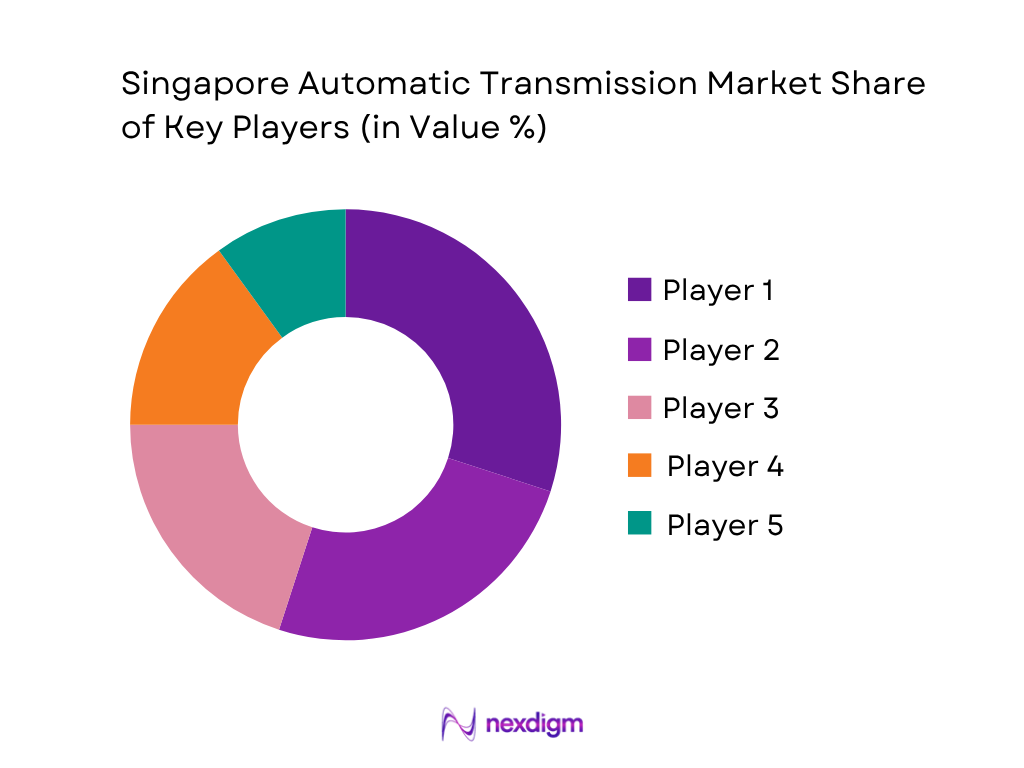
The Singapore Automatic Transmission Market is characterized by global transmission technology companies, OEM-captive drivetrain suppliers and automotive manufacturers operating through regional Asia-Pacific offices, authorized distributors and established service networks. AISIN and JATCO are particularly relevant to the Japanese vehicle base and CVT/hybrid applications, while ZF has strong exposure to European premium multi-speed automatics. Hyundai Transys supports Korean vehicle platforms, while BorgWarner provides clutch, transmission and electrified drivetrain technologies. Competition increasingly depends on hybrid readiness, mechatronics capability, OEM fitment breadth, local parts availability and aftermarket diagnostic support.
| Major Player | Establishment Year | Headquarters | Core Transmission Technologies | Singapore / ASEAN Position | Passenger Vehicle Fitment | Hybrid / Electrified Capability | Mechatronics & Controls | Aftermarket Support |
| AISIN Corporation | 1965 | Kariya, Japan | ~ | ~ | ~ | ~ | ~ | ~ |
| ZF Friedrichshafen AG | 1915 | Friedrichshafen, Germany | ~ | ~ | ~ | ~ | ~ | ~ |
| JATCO Ltd. | 1999 | Fuji, Japan | ~ | ~ | ~ | ~ | ~ | ~ |
| Hyundai Transys Inc. | 1999 | Seosan, South Korea | ~ | ~ | ~ | ~ | ~ | ~ |
| BorgWarner Inc. | 1928 | Auburn Hills, USA | ~ | ~ | ~ | ~ | ~ |
Singapore Automatic Transmission Market Analysis
Growth Drivers
Expansion of Hybrid Vehicle Population Supporting e-CVT and Electrified Transmission Demand
Singapore’s rapid expansion of hybrid vehicles is directly increasing demand for e-CVTs, power-split transaxles, integrated hybrid transmissions, electric oil pumps, reduction assemblies and drivetrain-control electronics. Singapore had 99,157 petrol-electric cars and 1,556 plug-in petrol-electric cars at the end of 2024. The installed petrol-electric car population increased further to 118,695 units at the end of 2025, while plug-in petrol-electric cars reached 2,449 units. Taxis provide another transmission-intensive application, with 11,348 petrol-electric taxis in 2024 and 11,547 in 2025, indicating a substantial high-utilization hybrid fleet requiring transmission servicing and component support. Hybrid vehicles are especially relevant to Singapore because dense urban operation repeatedly activates regenerative braking, electric-assist and power-split drivetrain functions, increasing the importance of technically capable transmission diagnostics. The macroeconomic backdrop also supports adoption of advanced powertrain technology, with Singapore recording 2024 GDP of USD 547.39 billion and GDP per capita of USD 90,674.1. These vehicle and economic indicators support continued demand for sophisticated hybrid transmission systems rather than purely mechanical conventional gearboxes.
Growing Private-Hire and High-Utilization Vehicle Fleet Strengthening Transmission Servicing Demand
Singapore’s expanding private-hire vehicle fleet is a market-specific driver for automatic transmission maintenance because these cars typically operate under intensive urban duty cycles involving repeated acceleration, deceleration, gear selection and prolonged daily usage. Private-hire cars increased from 90,383 vehicles at the end of 2024 to 95,857 vehicles at the end of 2025. Within that fleet, chauffeur-driven private-hire cars rose from 59,371 to 62,092 vehicles, while self-drive private-hire cars increased from 31,012 to 33,765 vehicles. Singapore simultaneously maintained 659,889 cars and station-wagons in 2025, compared with 657,744 in 2024, creating a large installed base of CVTs, torque-converter automatics, DCTs and hybrid transaxles requiring fluid servicing, valve-body diagnostics, clutch work and electronic calibration. High-mileage private-hire operation can accelerate wear on transmission fluids, bearings, clutch packs and electronically controlled hydraulic systems, strengthening demand for specialist workshops and remanufactured units. Singapore recorded 2024 nominal GDP of USD 547.5 billion and a population of 6.0 million, supporting substantial mobility demand within a compact urban economy.
Market Challenges
Rapid Battery-Electric Vehicle Adoption Reducing Conventional Multi-Speed Transmission Content
The increasing battery-electric vehicle population represents a structural challenge for Singapore’s conventional automatic transmission market because most battery-electric passenger cars replace torque converters, CVT pulley systems, clutch packs and multi-speed planetary gearsets with simpler single-speed reduction drives. The electric-car population increased from 26,225 vehicles at the end of 2024 to 49,110 vehicles at the end of 2025. The transition continued during 2026, with electric cars reaching 51,454 in January, 53,688 in February, 56,770 in March, 59,735 in April, 62,653 in May and 66,005 in June. Over the same period, conventional petrol cars declined from 513,943 at the end of 2024 to 475,455 at the end of 2025, demonstrating a material change in the drivetrain composition of Singapore’s vehicle parc. This shift reduces the long-term addressable base for conventional AT, CVT and DCT replacement while increasing demand for reducers, bearings, e-drive assemblies and electrical diagnostics. Singapore’s 2024 GDP stood at USD 547.39 billion, while GDP per capita reached USD 90,674.1, indicating that the drivetrain transition is occurring in a high-income automotive market capable of adopting advanced electrified vehicles rapidly.
Vehicle Quota and COE Framework Constraining Unrestricted Transmission Unit Expansion
Singapore’s Vehicle Quota System and Certificate of Entitlement framework limit unrestricted growth in the vehicle population, making the automatic transmission market more dependent on technology replacement, refurbishment and fleet lifecycle management than on continuous increases in new vehicle volumes. Singapore’s total motor-vehicle population increased only from 1,007,094 vehicles in 2024 to 1,012,023 vehicles in 2025. Cars and station-wagons moved from 657,744 to 659,889 units, while private cars remained nearly flat at 524,418 vehicles in 2024 and 524,312 in 2025. The COE system also ties replacement supply to deregistration and quota allocation, with the February-to-April 2025 COE quota established at 17,133 certificates. For transmission suppliers, this structure limits volume expansion arising solely from vehicle population growth and increases dependence on COE-renewed vehicles, high-mileage fleets and technically complex repairs. Singapore recorded 2024 nominal GDP of USD 547.5 billion and GDP per capita of USD 90,689, indicating substantial purchasing capacity despite deliberate administrative controls over the number of vehicles operating in the country.
Market Opportunities
COE-Renewed Vehicles Creating Scope for Transmission Rebuilding and Remanufacturing
Singapore’s COE framework creates a distinctive future opportunity for automatic transmission rebuilding because vehicles retained beyond their initial entitlement period require owners to evaluate whether major drivetrain refurbishment is economically and mechanically justified. Singapore recorded 26,770 COE revalidations in 2024, including 2,922 five-year and 1,659 ten-year Category A renewals, together with 1,152 five-year and 3,332 ten-year Category B renewals. During January–September 2025, total COE revalidations reached 25,507, including 3,832 five-year and 2,231 ten-year Category A renewals and 1,481 five-year and 4,025 ten-year Category B renewals. These renewed cars remain in service beyond their original COE cycle, expanding the addressable base for CVT rebuilding, torque-converter refurbishment, DCT clutch replacement, valve-body repair, solenoid replacement and transmission-control programming. Eligible vehicles can renew COEs for 5 or 10 years, making drivetrain condition an important ownership consideration. Singapore’s 2024 GDP reached USD 547.39 billion, while GDP per capita stood at USD 90,674.1, supporting the financial capacity for technically sophisticated vehicle refurbishment and transmission maintenance.
Hybrid and Electrified Drivetrain Servicing Creating a New Specialist Transmission Ecosystem
Singapore’s transition toward hybrid and electrified vehicles creates an opportunity for transmission businesses to expand from conventional gearbox repair into e-CVTs, hybrid transaxles, reduction gears, integrated electric drives and electronically controlled drivetrain systems. Singapore had 99,157 petrol-electric cars, 1,556 plug-in petrol-electric cars and 26,225 electric cars at the end of 2024. At the end of 2025, these populations reached 118,695 petrol-electric cars, 2,449 plug-in petrol-electric cars and 49,110 electric cars. The transition continued in 2026, with petrol-electric cars reaching 126,034 units and plug-in petrol-electric cars 3,040 units in June, while electric cars reached 66,005 units. This enlarges the potential customer base for hybrid power-split gearsets, motor-integrated transaxles, electric oil pumps, reduction assemblies, bearings, sensors and control electronics. It also creates demand for workshops capable of combining mechanical transmission knowledge with high-voltage diagnostics and software calibration. Singapore recorded 2024 nominal GDP of USD 547.5 billion, GDP per capita of USD 90,689, and a population of 6.0 million, providing a substantial economic foundation for advanced drivetrain specialization.
Future Outlook
The Singapore Automatic Transmission Market is expected to expand at approximately ~X.X% CAGR during 2026–2035. Growth will increasingly be determined by transmission technology complexity rather than unrestricted expansion in vehicle numbers. Hybridization, COE renewals, high-mileage private-hire vehicles, sophisticated premium drivetrains and advanced transmission electronics will sustain demand, while battery-electric vehicles will progressively reduce conventional multi-speed automatic transmission fitment. Hybrid transmissions are expected to become one of the most strategically important areas. Singapore’s petrol-electric car population expanded significantly between the two latest annual reporting periods, demonstrating that the installed base of power-split transaxles, e-CVTs and integrated hybrid drivetrain systems is already becoming substantial. Hybrid vehicles retain transmission-specific components such as planetary gearsets, bearings, oil pumps, motor-integrated transaxles, reduction assemblies, controllers and thermal-management components.
Conventional CVTs should remain relevant because Japanese passenger cars represent an important component of Singapore’s vehicle parc. The aftermarket opportunity will increasingly include CVT valve-body servicing, pulley and belt diagnostics, transmission-fluid management, control-module faults and complete exchange units. Vehicle owners renewing COEs may choose drivetrain repair or refurbishment rather than immediate deregistration, supporting specialized transmission workshops.
Major Players
- AISIN Corporation / AISIN Asia Pacific
- ZF Friedrichshafen AG / ZF Asia Pacific Pte. Ltd.
- JATCO Ltd.
- Hyundai Transys Inc.
- BorgWarner Inc.
- Schaeffler AG
- Magna International Inc. / Magna Powertrain
- Valeo
- Allison Transmission Holdings, Inc.
- Toyota Motor Corporation
- Honda Motor Co., Ltd.
- Nissan Motor Co., Ltd.
- Mercedes-Benz Group AG
- BMW Group
- Volkswagen Group
Key Target Audience
- Automotive OEMs and Authorized Vehicle Distributors
- Automatic Transmission and Drivetrain Technology Manufacturers
- Automotive Parts Importers and Transmission Distributors
- Automatic Transmission Repair, Rebuilding and Remanufacturing Companies
- Taxi, Private-Hire, Leasing and Commercial Fleet Operators
- Automotive Aftermarket and Authorized Workshop Networks
- Investments and Venture Capitalist Firms
- Government and Regulatory Bodies (Land Transport Authority, National Environment Agency, Ministry of Transport, Enterprise Singapore, Singapore Customs)
Research Methodology
Step 1: Identification of Key Variables
The initial phase involves constructing a complete ecosystem map of the Singapore Automatic Transmission Market, covering transmission manufacturers, vehicle OEMs, authorized distributors, parts importers, workshops, fleet operators and drivetrain specialists. Critical variables include transmission technology, vehicle type, propulsion architecture, COE category, vehicle age, hybrid penetration, OEM fitment, import dependency, replacement requirement and aftermarket servicing intensity.
Step 2: Market Analysis and Construction
Historical vehicle-population, new-registration, deregistration, COE renewal, fuel-type and vehicle-make data are analyzed to construct the demand framework. Top-down analysis establishes the overall addressable vehicle base, while bottom-up modeling maps transmission technologies to individual vehicle categories. Replacement demand is assessed using vehicle age, COE lifecycle, transmission architecture and expected service requirements.
Step 3: Hypothesis Validation and Expert Consultation
Market hypotheses are validated through structured discussions with transmission specialists, parts distributors, authorized workshops, independent repairers, vehicle distributors and fleet-maintenance professionals. The validation process examines technology fitment, repair-versus-replacement behaviour, CVT and DCT failure patterns, hybrid-transmission servicing, parts availability, diagnostic requirements and the effect of COE renewal on major drivetrain repairs.
Step 4: Research Synthesis and Final Output
The final phase triangulates government vehicle statistics, supplier information, OEM fitment data and aftermarket evidence to refine market segmentation and competitive positioning. Transmission demand is reconciled across conventional automatic, CVT, DCT, hybrid and electrified architectures. The resulting analysis establishes the market structure, competitive landscape, aftermarket opportunity, technology transition and long-term outlook for the Singapore Automatic Transmission Market.

- Executive Summary
- Research Methodology (Market Definition and Scope, Singapore Automatic Transmission Taxonomy, Torque-Converter Automatic Transmission Classification, Continuously Variable Transmission Mapping, Dual-Clutch Transmission Mapping, Automated Manual Transmission Assessment, Hybrid e-CVT and Electrified Transmission Classification, Vehicle Fitment Mapping, COE Category Mapping, Vehicle Age and Deregistration Assessment, Import Dependency Assessment, Replacement Demand Assessment, Market Sizing Framework)

- Definition and Scope
- Singapore Automatic Transmission Industry Evolution and Technology Development
- Automatic Transmission Value Chain Analysis
- Singapore Automatic Transmission Supply Chain Analysis
- Vehicle Import-to-Transmission Fitment Framework
- Automatic Transmission Component, Mechatronics and Control-System Ecosystem
- Analysis
- Singapore Automatic Transmission Import Dependency Assessment
- COE-Driven Vehicle Replacement and Transmission Demand Framework

- Growth Drivers (High Automatic Transmission Fitment Across Passenger Cars, Strong Hybrid Vehicle Adoption, Taxi and Private-Hire Fleet Utilization, High-Value Vehicle Ownership, COE Renewal Supporting Older Vehicle Maintenance, Increasing CVT and e-CVT Fitment, Premium Vehicle Multi-Speed AT Demand, Commercial Fleet Transmission Servicing)
- Market Challenges (Battery-Electric Vehicle Substitution, Restricted New Vehicle Population Through Vehicle Quota System, High Vehicle Turnover at COE Expiry, Complete Transmission Import Dependency, High Mechatronics Complexity, Limited Local Transmission Manufacturing, Model-Specific Software and Calibration Requirements, Skilled Transmission Technician Constraints)
- Market Opportunities (Hybrid e-CVT Repair and Diagnostics, CVT Rebuilding, DCT Mechatronics Servicing, Premium 8-Speed and 9-Speed Automatic Transmission Repair, COE-Renewed Vehicle Transmission Refurbishment, Taxi and Private-Hire Transmission Maintenance, Commercial Fleet Automatic Transmission Service, Transmission Control Electronics and Software Diagnostics)
- Market Trends (Hybrid e-CVT Expansion, CVT Penetration in Japanese Passenger Cars, Dual-Clutch Adoption in European Vehicles, 8-Speed and 9-Speed Automatic Fitment in Premium Cars, Shift-by-Wire Adoption, Integrated Hybrid Drivetrains, Transmission Software Calibration, OE-Quality Remanufacturing)
- Regulatory and Standards Landscape (Land Transport Authority Vehicle Quota System, Certificate of Entitlement Framework, Category A and Category B Vehicle Classification, Cleaner-Energy Vehicle Registration Policy, Vehicular Emissions Scheme, Early Turnover Scheme, Vehicle Inspection Requirements, Statutory Vehicle Lifespan Requirements)
- SWOT Analysis
- Porter’s Five Forces Analysis
- PESTLE Analysis
- Stakeholder Ecosystem
- Competition Ecosystem

- By Market Value (2020-2025)
- By Automatic Transmission Unit Demand (2020-2025)
- By OEM-Fitted Automatic Transmission Volume (2020-2025)
- By Imported Automatic Transmission Volume (2020-2025)
- By Replacement Transmission Volume (2020-2025)
- By Rebuilt and Remanufactured Transmission Volume (2020-2025)
- By Passenger Car Automatic Transmission Demand (2020-2025)
- By Taxi and Private-Hire Vehicle Transmission Demand (2020-2025)
- By Hybrid Transmission and e-CVT Demand (2020-2025)

- By Transmission Technology (In Value %)
Conventional Torque-Converter Automatic Transmission
Continuously Variable Transmission
Dual-Clutch Transmission
Automated Manual Transmission
Hybrid e-CVT / Power-Split Transmission
Dedicated Hybrid Transmission
Integrated Hybrid Automatic Transmission
High-Torque Commercial Vehicle Automatic Transmission
Automated Commercial Vehicle Transmission
Single-Speed Electrified Reduction Transmission
Other Advanced Transmission Architectures - By Number of Forward Speeds (In Value %)
4-Speed and Below Automatic Transmission
5-Speed Automatic Transmission
6-Speed Automatic Transmission
7-Speed Dual-Clutch Transmission
8-Speed Automatic Transmission
9-Speed Automatic Transmission
10-Speed Automatic Transmission
Continuously Variable Ratio Systems
Hybrid e-CVT Systems
Other Multi-Ratio Transmission Systems - By Vehicle Type (In Value %)
Hatchbacks and Compact Cars
Sedans
Crossovers
Compact SUVs
Mid-Size SUVs
Premium and Luxury Cars
MPVs
Sports and Performance Vehicles
Taxis
Private-Hire Cars
Light Goods Vehicles
Heavy Goods Vehicles
Buses and Coaches
Special-Purpose Commercial Vehicles - By Sales Channel (In Value %)
OEM Vehicle Fitment
Authorized Vehicle Distributor Channel
Authorized Transmission and Drivetrain Distributor
Authorized Dealer Service Centres
Independent Automotive Workshops
Transmission Specialist Workshops
Transmission Rebuilders and Remanufacturers
Automotive Parts Importers and Distributors
Taxi and Private-Hire Fleet Maintenance Networks
Commercial Fleet Maintenance Operators
Online Automotive Parts Platforms
Used and Reconditioned Transmission Channels - By Vehicle Ownership and Usage Type (In Value %)
Private Passenger Cars
Company-Owned Cars
Taxi Fleets
Private-Hire Vehicle Fleets
Car-Leasing Fleets
Car-Sharing Fleets
Light Commercial Fleets
Heavy Commercial Fleets
Bus Operators
Government and Public-Service Fleets - By Vehicle Age / COE Lifecycle (In Value %)
Early-Life Vehicles
Mid-Life Vehicles
Pre-COE Expiry Vehicles
COE-Renewed Vehicles
Five-Year COE Renewal Vehicles
Ten-Year COE Renewal Vehicles
Extended-Life Commercial Vehicles
Vehicles Approaching Deregistration

- Market Share of Major Players (By Revenue, Transmission Unit Volume, Transmission Technology, Vehicle Segment, Propulsion Type, OEM Fitment, Aftermarket Presence, Distribution Channel)
- Cross Comparison Parameters (Automatic Transmission Architecture and Gear-Speed Portfolio, Singapore and ASEAN Distribution-Service Footprint, Japanese-European-Korean OEM Fitment Coverage, CVT-DCT-Torque Converter Technology Breadth, Hybrid e-CVT and Electrified Transmission Readiness, Taxi-Private-Hire and High-Mileage Fleet Capability, Transmission Mechatronics and Diagnostic Support, COE-Aged Vehicle Aftermarket and Remanufacturing Support)
- SWOT Analysis of Major Players
- Competitive Positioning Matrix
- Transmission Technology and Product Portfolio Benchmarking
- Distribution and Aftermarket Support Benchmarking
- Market Entry Strategy Assessment
- Detailed Profiles of Major Companies
AISIN Corporation / AISIN Asia Pacific
ZF Friedrichshafen AG / ZF Asia Pacific Pte. Ltd.
JATCO Ltd.
Hyundai Transys Inc.
BorgWarner Inc.
Schaeffler AG
Magna International Inc. / Magna Powertrain
Valeo
Allison Transmission Holdings, Inc.
Toyota Motor Corporation
Honda Motor Co., Ltd.
Nissan Motor Co., Ltd.
Mercedes-Benz Group AG
BMW Group
Volkswagen Group

- Buyer Segmentation
- OEM and Distributor Procurement Behaviour
- Supplier Selection Criteria
- Buyer Pain Points
- Technology Adoption Assessment
- Replacement and Repurchase Behaviour

- By Market Value (2026-2035)
- By Automatic Transmission Unit Demand (2026-2035)
- By OEM-Fitted Automatic Transmission Volume (2026-2035)
- By Imported Automatic Transmission Volume (2026-2035)
- By Replacement Transmission Volume (2026-2035)
- By Rebuilt and Remanufactured Transmission Volume (2026-2035)
- By Passenger Car Automatic Transmission Demand (2026-2035)
- By Taxi and Private-Hire Vehicle Transmission Demand (2026-2035)
- By Hybrid Transmission and e-CVT Demand (2026-2035)


 Request a Sample
 Ask for Customization
 Get a Quote
 Enquire Now