

 Download PDF
Market Overview
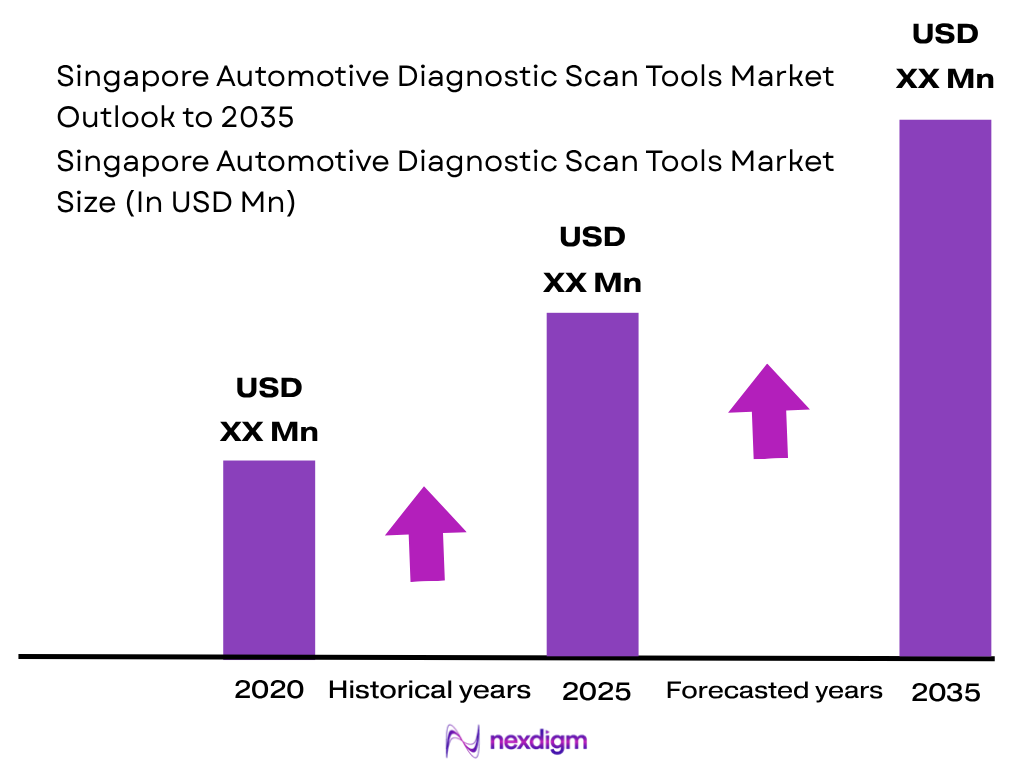
The Singapore Automotive Diagnostic Scan Tools Market is valued at approximately USD ~ billion in 2024, compared with USD ~ billion in 2023. Demand is supported by Singapore’s technologically advanced vehicle fleet, increasing electronic content in modern vehicles, growing adoption of hybrid and electric vehicles, and the increasing diagnostic complexity of electronically controlled systems. The market is also benefiting from workshop digitalization, greater use of advanced ECU diagnostics, increasing ADAS-equipped vehicles, and demand for faster fault identification, vehicle programming, and preventive maintenance solutions.
Singapore itself represents the principal market and operating hub because of its concentrated automotive ecosystem, high vehicle technology standards, established dealership networks, and sophisticated independent workshop infrastructure. Singapore City and surrounding industrial areas are particularly important because automotive dealerships, repair centers, parts distributors, fleet operators, and vehicle technology companies are concentrated within a compact geographic area. The country’s strong digital infrastructure and high adoption of connected automotive technologies further support demand for wireless, cloud-enabled, and advanced diagnostic platforms.
Market Segmentation
By Product Type
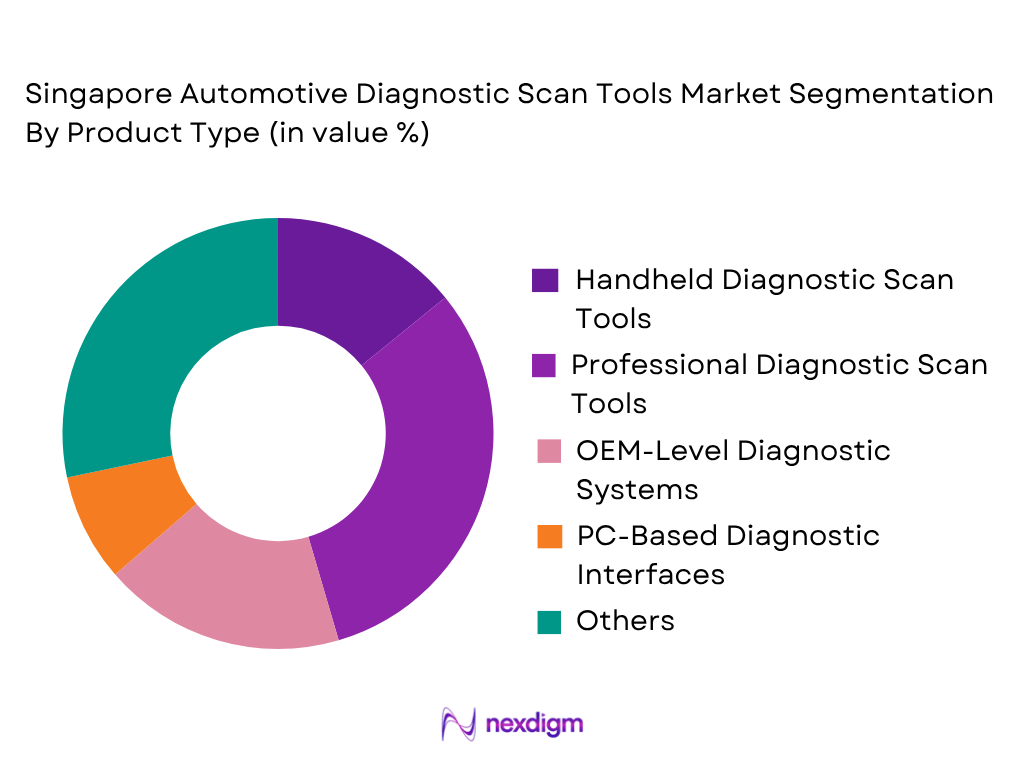
The Singapore Automotive Diagnostic Scan Tools Market is segmented by product type into handheld diagnostic scan tools, professional diagnostic scan tools, OEM-level diagnostic systems, PC-based diagnostic interfaces, wireless Bluetooth diagnostic scanners, tablet-based diagnostic platforms, and remote diagnostic systems. Professional diagnostic scan tools are expected to hold the dominant position with a 2024 market share of ~%, supported by their broad vehicle coverage, advanced ECU functionality, live-data capabilities, bidirectional testing, coding functions, and suitability for independent workshops and multi-brand service centers. Their ability to diagnose multiple vehicle systems from a single platform makes them more commercially attractive than basic code readers. Demand is further supported by the increasing electronic complexity of passenger vehicles and the need to diagnose ABS, airbag, transmission, engine, body-control, and ADAS systems. Professional platforms can also integrate software updates, technical databases, service functions, and remote support. As workshops increasingly handle hybrid and electric vehicles, advanced tools capable of battery and high-voltage diagnostics are expected to reinforce the segment’s position.
By Vehicle Type
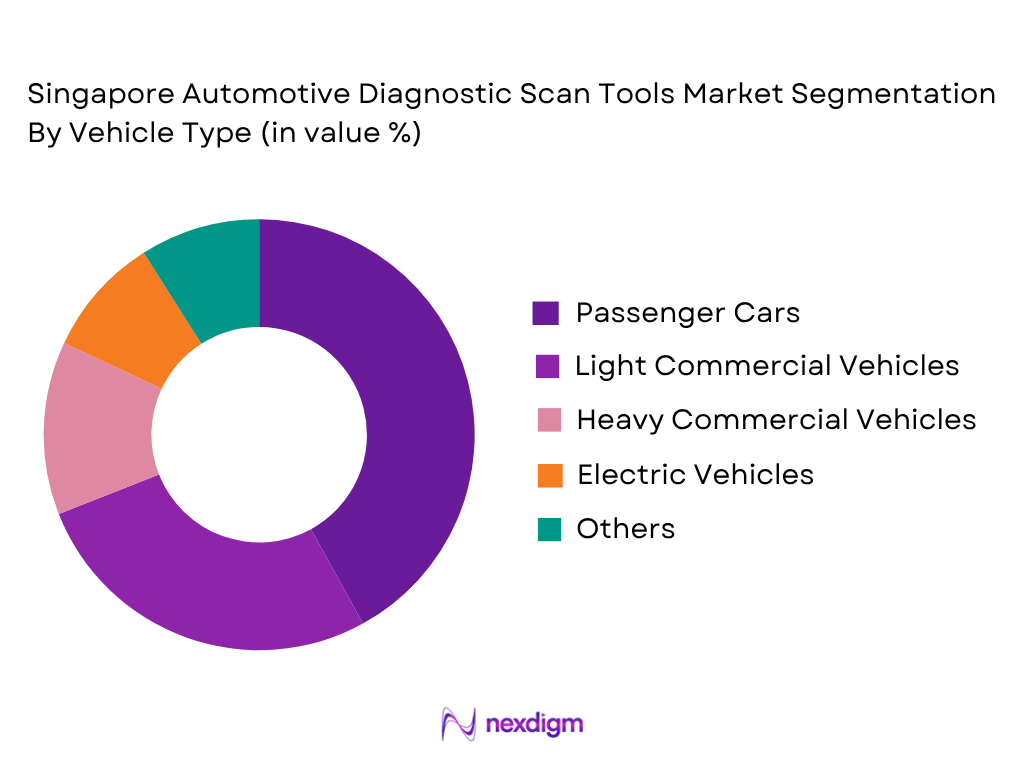
The Singapore Automotive Diagnostic Scan Tools Market is segmented by vehicle type into passenger cars, light commercial vehicles, heavy commercial vehicles, electric vehicles, and hybrid electric vehicles. Passenger cars are expected to account for the largest market share of ~% in 2024, reflecting the country’s substantial passenger-vehicle population and the high concentration of electronically controlled systems in modern cars. Passenger vehicles increasingly incorporate engine management systems, advanced transmissions, airbags, ABS, infotainment, body-control modules, ADAS sensors, and connected vehicle functions, creating recurring diagnostic requirements. Passenger-car workshops also represent a broad customer base for multi-brand diagnostic equipment because independent service centers frequently support multiple manufacturers. The expansion of hybrid and electric passenger vehicles is adding further diagnostic requirements involving battery management systems, high-voltage components, charging systems, thermal management, and power electronics. Luxury and premium vehicles additionally require sophisticated diagnostic and programming capabilities. Consequently, the passenger-car segment provides the largest installed base for diagnostic equipment while simultaneously creating demand for increasingly advanced software and hardware capabilities.
Competitive Landscape
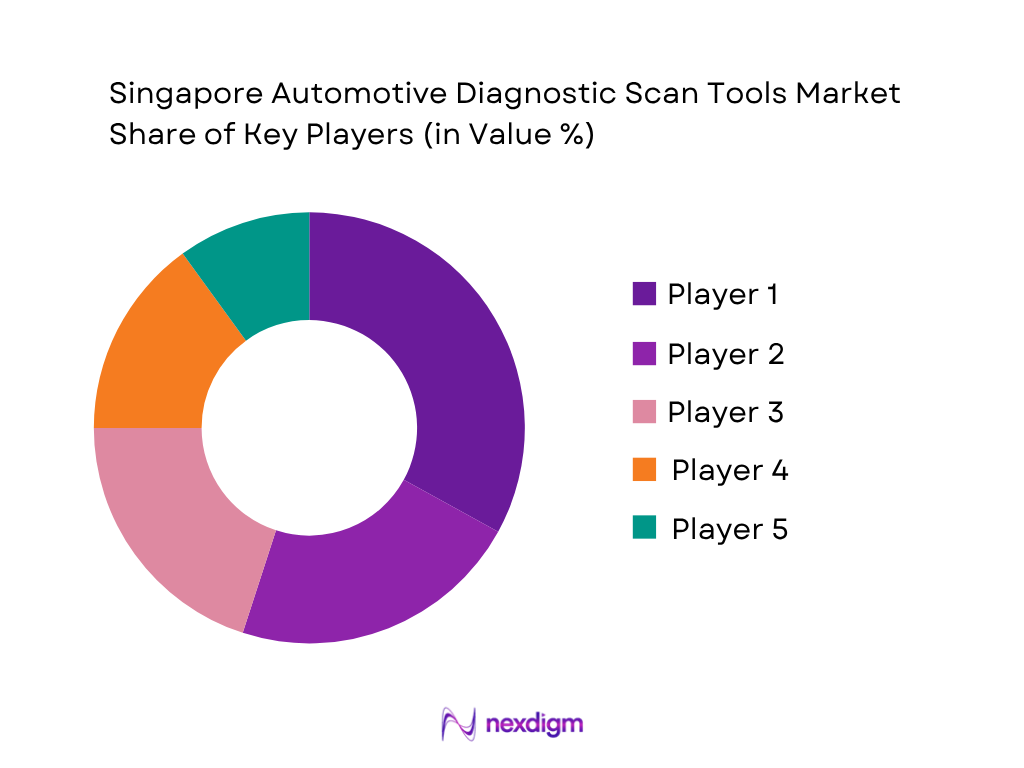
The Singapore Automotive Diagnostic Scan Tools Market is characterized by competition among established automotive technology suppliers, specialist diagnostic-equipment manufacturers, OEM technology providers, and global aftermarket diagnostic brands. Competition is increasingly shifting from basic fault-code reading toward comprehensive diagnostic ecosystems covering ECU programming, bidirectional testing, ADAS calibration, EV battery diagnostics, secure gateway access, cloud connectivity, and continuous software updates. Suppliers with broad vehicle coverage, strong technical databases, local distribution capabilities, and advanced software platforms are positioned to compete effectively across dealerships, independent workshops, fleet operators, and specialist service centers.
| Company | Establishment Year | Headquarters | Product Portfolio | OEM Partnerships | EV Diagnostic Capability | Manufacturing Footprint | R&D Capability |
| Bosch | 1886 | Gerlingen, Germany | ~ | ~ | ~ | ~ | ~ |
| Snap-on | 1920 | Kenosha, USA | ~ | ~ | ~ | ~ | ~ |
| Autel | 2004 | Shenzhen, China | ~ | ~ | ~ | ~ | ~ |
| LAUNCH | 1992 | Shenzhen, China | ~ | ~ | ~ | ~ | ~ |
| DENSO | 1949 | Kariya, Japan | ~ | ~ | ~ | ~ | ~ |
Singapore Automotive Diagnostic Scan Tools Market Analysis
Growth Drivers
Rising Vehicle Electronics Complexity
The increasing electronic content of Singapore’s vehicle fleet is strengthening demand for advanced automotive diagnostic scan tools because workshops must increasingly identify faults across engine, transmission, braking, airbag, body-control, ADAS, infotainment, battery-management, and other electronically controlled systems. Singapore had 1,007,094 motor vehicles at the end of 2024, compared with 996,732 in 2023, creating a substantial installed vehicle base requiring periodic inspection, servicing, troubleshooting, and electronic diagnostics. (Land Transport Authority) The shift toward software-defined vehicle architectures is making conventional code readers less sufficient, increasing requirements for live-data analysis, bidirectional testing, ECU coding, programming, and secure gateway access. Singapore’s digital infrastructure further supports this transition: the World Bank recorded 94% internet usage in 2024, while Singapore’s digital economy reached S$128.1 billion in value added, equivalent to 18.6% of GDP, demonstrating the depth of digitalization across the economy. (World Bank Open Data) This environment supports workshops adopting connected diagnostic platforms, cloud-based technical databases, wireless interfaces, and regularly updated software. The presence of 13,800 registered EV charging points by August 2024 also indicates a rapidly expanding technologically enabled automotive ecosystem, increasing the need for diagnostic equipment capable of handling increasingly sophisticated vehicle electronics.
Increasing EV and Hybrid Vehicle Adoption
The rapid electrification of Singapore’s vehicle fleet is creating a structural requirement for diagnostic equipment capable of addressing battery-management systems, high-voltage components, charging systems, electric powertrains, thermal-management systems, and electronically controlled safety functions. Electric vehicles accounted for about one-third of new car registrations in 2024, compared with 18% in 2023, while electric cars represented 4% of the total car population at the end of 2024. Electric light-goods vehicles also reached 4.7% of their vehicle population, and approximately half of new light-goods-vehicle registrations were electric. (Land Transport Authority) The transition is relevant to diagnostic-tool suppliers because EV servicing requires capabilities beyond conventional OBD fault-code reading, including high-voltage system checks, battery-state analysis, insulation monitoring, charging-system diagnostics, and battery-management-system communication. Singapore also recorded approximately 18,000 electric cars in the first half of 2024 and had around 13,800 registered charging points, with charging infrastructure already deployed across approximately 1,000 HDB carparks. (Land Transport Authority) Government incentives have further accelerated cleaner-vehicle adoption, with around 20,000 electric cars and taxis having benefited from VES rebates and/or the Early Adoption Incentive since 2021. (Land Transport Authority) As this installed base expands, workshops require scan tools with EV-specific software, high-voltage diagnostics, battery-management access, and manufacturer-specific protocols, supporting demand for professional diagnostic platforms.
Market Challenges
High Diagnostic Software Complexity
Rapid growth in vehicle electronic systems is increasing the technical complexity of automotive diagnostic software and raising the capabilities required from Singapore workshops. The country had 1,007,094 motor vehicles at the end of 2024, including 321,611 Category A vehicles, 335,675 Category B vehicles, 153,040 goods vehicles and buses, and 147,349 motorcycles, creating a highly diverse diagnostic environment across vehicle categories. (Land Transport Authority) Modern vehicles can contain numerous interconnected electronic control units, meaning a diagnostic platform must interpret manufacturer-specific communication protocols, live parameters, fault codes, actuation commands, coding functions, and increasingly secure gateway systems. The challenge becomes more significant as EV adoption accelerates: EVs represented approximately one-third of new car registrations in 2024, while electric cars represented 4% of the total car population. (Land Transport Authority) Diagnostic providers therefore need continuous software development and vehicle-model coverage rather than static hardware products. Singapore’s digital economy reached S$128.1 billion in 2024, with digitalization contributing S$86.8 billion of value added outside the information and communications sector, illustrating the scale of technology integration across non-technology industries. (IMDA) For diagnostic suppliers, this creates pressure to provide frequent firmware and database updates, secure authentication, cloud connectivity, and technician support while maintaining compatibility across multiple generations of vehicles.
OEM Software and Protocol Restrictions
Restricted access to proprietary diagnostic functions represents a significant challenge for aftermarket scan-tool providers because advanced vehicle diagnostics increasingly depend on manufacturer-specific software, security credentials, communication protocols, and protected vehicle gateways. Singapore’s vehicle ecosystem includes 1,007,094 motor vehicles across passenger, commercial, motorcycle, taxi, and other categories, requiring diagnostic suppliers to maintain broad compatibility across numerous manufacturers and vehicle platforms. (Land Transport Authority) The challenge is becoming more pronounced as vehicle electronics and cybersecurity architectures evolve. Singapore’s Cyber Security Agency recorded 159 ransomware cases in 2024, compared with 132 cases in 2023, while infected infrastructure increased to 117,300 systems from 70,200. (Cyber Security Agency of Singapore) Although these figures are not automotive-specific, they demonstrate the wider cybersecurity environment in which connected diagnostic equipment operates. Diagnostic platforms increasingly need secure authentication and controlled access to vehicle networks rather than unrestricted communication with ECUs. EV adoption adds another layer, with electric vehicles accounting for about one-third of new car registrations in 2024 and electric cars reaching 4% of the total car population. (Land Transport Authority) Consequently, aftermarket suppliers must balance comprehensive diagnostic functionality with cybersecurity, authorization, software licensing, and OEM access requirements, potentially increasing development complexity and limiting the functions available through generic diagnostic equipment.
Market Opportunities
EV High-Voltage Diagnostics
The expansion of electric vehicles creates a substantial opportunity for specialized diagnostic equipment capable of safely testing high-voltage architectures, battery-management systems, charging systems, insulation performance, power electronics, and electric-drive components. Singapore recorded approximately 18,000 electric cars in the first half of 2024, while electric vehicles represented almost one-third of new car registrations during the same period. (Land Transport Authority) By the end of 2024, electric cars represented 4% of the total car population, demonstrating that EVs were progressing from an emerging technology toward an established component of the vehicle fleet. (Land Transport Authority) The charging ecosystem is developing alongside vehicle adoption, with approximately 13,800 registered charging points across Singapore and charging infrastructure installed in around 1,000 HDB carparks. (Land Transport Authority) This creates opportunities for workshops to invest in diagnostic platforms that combine conventional vehicle scanning with EV-specific capabilities, including battery-state assessment, cell-level fault identification, high-voltage isolation checks, charging-system analysis, and thermal-management diagnostics. The opportunity is strengthened by Singapore’s broader digital economy, which reached S$128.1 billion in 2024 and accounted for 18.6% of GDP, indicating a strong environment for software-enabled automotive service technologies. (IMDA) Diagnostic suppliers able to combine EV safety procedures, advanced measurement capabilities, vehicle-specific software, and remote technical support can therefore address an expanding technology requirement within Singapore’s automotive service ecosystem.
ADAS Calibration Systems
Increasing deployment of advanced driver-assistance systems creates an opportunity for diagnostic suppliers to expand from electronic fault scanning into integrated ADAS diagnostics and calibration. Modern vehicles increasingly combine cameras, radar, electronic control units, braking systems, steering systems, and other sensors, requiring specialized equipment for fault identification, calibration, sensor alignment, and post-repair verification. Singapore’s vehicle base reached 1,007,094 motor vehicles at the end of 2024, compared with 996,732 in 2023, providing a large installed fleet in which electronically controlled safety systems require ongoing servicing and repair. (Land Transport Authority) The opportunity is reinforced by the rapid digitalization of the automotive ecosystem. Singapore’s digital economy reached S$128.1 billion in 2024, while value added from digitalization across the rest of the economy reached S$86.8 billion, indicating continued integration of digital technologies into industrial and service activities. (IMDA) Vehicle electrification is simultaneously increasing electronic-system complexity, with EVs accounting for approximately one-third of new car registrations in 2024 and electric cars representing 4% of the total car population. (Land Transport Authority) These developments create opportunities for suppliers to integrate ADAS calibration with scan tools, diagnostic software, wheel-alignment equipment, camera-target systems, radar calibration, and automated diagnostic reporting. Workshops adopting multifunctional platforms can address a broader range of electronic repair requirements through a single technology ecosystem.
Future Outlook
Over the next decade, the Singapore Automotive Diagnostic Scan Tools Market is expected to transition toward intelligent, connected, and software-driven diagnostic platforms. Growth will be supported by increasing vehicle electronic content, expansion of EV and hybrid fleets, ADAS adoption, and increasing dependence on software-controlled vehicle functions.
Diagnostic equipment is expected to evolve from standalone scanners into connected workshop platforms combining hardware, cloud software, vehicle databases, remote technical assistance, and automated fault interpretation. EV battery diagnostics, high-voltage safety testing, ADAS calibration, secure gateway access, and ECU programming are expected to become increasingly important purchasing criteria. The increasing complexity of software-defined vehicles is also likely to create opportunities for diagnostic suppliers capable of delivering continuous software updates and secure access to vehicle communication architectures.
Major Players
- Bosch
- Snap-on
- Autel
- LAUNCH
- DENSO
- Continental
- ZF
- ACTIA
- Hella
- MAHLE
- AVL
- TOPDON
- DG Technologies
- Drew Technologies
- MOTOR Information Systems
Key Target Audience
- Automotive OEMs and vehicle manufacturers
- Authorized dealership service networks
- Independent automotive workshops and multi-brand service centers
- Fleet operators and commercial vehicle maintenance organizations
- Automotive parts distributors and diagnostic equipment distributors
- Investments and venture capitalist firms
- Government and regulatory bodies (Land Transport Authority, Ministry of Transport Singapore, Enterprise Singapore)
- Automotive technology, EV service, and workshop-equipment companies
Research Methodology
Step 1: Identification of Key Variables
The initial phase involves mapping the Singapore Automotive Diagnostic Scan Tools Market ecosystem, covering diagnostic equipment manufacturers, distributors, dealerships, independent workshops, fleet operators, vehicle manufacturers, and technology providers. Key variables include vehicle parc, diagnostic equipment penetration, vehicle electronics complexity, EV adoption, ADAS installation, workshop digitalization, and software subscription requirements.
Step 2: Market Analysis and Construction
Historical and current market information is compiled through analysis of vehicle registrations, workshop infrastructure, automotive aftermarket activity, diagnostic equipment deployment, product portfolios, distribution channels, and technological developments. A bottom-up framework is applied to estimate equipment adoption across dealership, independent workshop, fleet, and specialist diagnostic channels.
Step 3: Hypothesis Validation and Expert Consultation
Market hypotheses are validated through structured discussions with automotive service professionals, diagnostic equipment distributors, workshop operators, fleet-maintenance personnel, and technology specialists. Expert inputs are used to assess diagnostic purchasing behavior, preferred equipment functionality, vehicle coverage requirements, software-update practices, and emerging EV and ADAS diagnostic needs.
Step 4: Research Synthesis and Final Output
The final analysis combines top-down market assessment with bottom-up equipment deployment analysis and industry validation. Findings are cross-checked across product type, vehicle type, diagnostic capability, workshop type, and connectivity technology. The resulting framework supports market sizing, competitive benchmarking, segmentation analysis, future projections, and strategic recommendations.

- Executive Summary
- Research Methodology (Market Definition and Scope, Diagnostic Scan Tool Ecosystem Mapping, Market Sizing Framework, Top-Down Analysis, Bottom-Up Validation, Demand-Side Assessment, Supply-Side Assessment, Workshop Interviews, Automotive Service Network Assessment, Vehicle Parc Analysis, Data Triangulation, Forecasting Framework, Research Limitations)

- Definition and Scope
- Automotive Diagnostic Scan Tools Ecosystem in Singapore
- Evolution of Vehicle Diagnostics and Workshop Technology
- Singapore Automotive Aftermarket Structure
- Automotive Diagnostic Workflow Analysis

- Growth Drivers (Rising Vehicle Electronics Complexity, Increasing EV and Hybrid Vehicle Adoption, Expansion of Multi-Brand Workshops, Growth of Advanced ECU Diagnostics, Increasing ADAS Calibration Requirements, Expansion of Connected Vehicle Diagnostics)
- Market Challenges (High Diagnostic Software Complexity, OEM Software and Protocol Restrictions, Rapid Vehicle Model Updates, Technician Skill Requirements, Cybersecurity Constraints, Fragmented Independent Workshop Technology Adoption)
- Market Opportunities (EV High-Voltage Diagnostics, ADAS Calibration Systems, Remote Vehicle Diagnostics, Cloud-Based Diagnostic Platforms, AI-Assisted Fault Detection, Connected Workshop Management Integration)
- Market Trends (Cloud-Connected Diagnostics, Wireless Scan Tools, AI-Based Fault Detection, EV Battery Diagnostics, ADAS Calibration, Secure Gateway Diagnostics, Remote Diagnostic Services)
- Government Regulations and Automotive Standards (OBD Compliance, Vehicle Inspection Requirements, Automotive Cybersecurity, EV High-Voltage Safety, Data Protection Requirements, Vehicle Modification and Workshop Compliance)
- Porter’s Five Forces Analysis
- PESTLE Analysis

- By Market Value (2020-2025)
- By Diagnostic Tool Units Deployed (2020-2025)
- By Active Workshop Deployment (2020-2025)
- By Average Revenue per Diagnostic Device (2020-2025)
- By Diagnostic Software Subscription Base (2020-2025)
- By Vehicle Diagnostic Coverage (2020-2025)

- By Product Type (In Value %)
Handheld Diagnostic Scan Tools
Professional Diagnostic Scan Tools
OEM-Level Diagnostic Systems
PC-Based Diagnostic Interfaces
Wireless Bluetooth Diagnostic Scanners
Tablet-Based Diagnostic Platforms
Remote Diagnostic Systems - By Vehicle Type (In Value %)
Passenger Cars
Light Commercial Vehicles
Heavy Commercial Vehicles
Electric Vehicles
Hybrid Electric Vehicles
Luxury and Premium Vehicles - By Diagnostic Capability (In Value %)
OBD-II Code Readers
Advanced ECU Diagnostics
ABS and Airbag Diagnostics
Transmission Diagnostics
Engine Performance Diagnostics
ADAS Calibration and Diagnostics
EV Battery and High-Voltage System Diagnostics - By Workshop Type (In Value %)
Authorized Dealership Workshops
Independent Automotive Workshops
Multi-Brand Service Centers
Specialized Diagnostic Centers
Fleet Maintenance Workshops
Mobile Automotive Service Providers - By Connectivity Technology (In Value %)
Wired Diagnostic Interfaces
Bluetooth Diagnostic Interfaces
Wi-Fi Diagnostic Systems
Cloud-Connected Diagnostic Platforms
Remote Telematics-Based Diagnostics

- Market Share Analysis of Major Players (By Revenue, Product Type, Diagnostic Capability, Vehicle Type, Workshop Type)
- Cross Comparison Parameters (Vehicle Brand and Model Coverage, ECU Diagnostic Depth, ADAS Calibration Capability, EV High-Voltage Diagnostic Capability, ECU Coding and Programming Functions, Diagnostic Software Update Frequency, Wireless Connectivity Capability, Technical Support and Workshop Coverage)
- SWOT Analysis of Major Players
- Detailed Profiles of Major Companies
Robert Bosch GmbH
Snap-on Incorporated
Autel Intelligent Technology Corp., Ltd.
Launch Tech Co., Ltd.
TOPDON Technology Co., Ltd.
DENSO Corporation
Continental AG
ZF Friedrichshafen
AGACTIA Group
Hella GmbH & Co. KGaA
MAHLE GmbH
DG Technologies
AVL List GmbH
MOTOR Information Systems
Drew Technologies

- Automotive Workshop Diagnostic Requirements
- Dealership Diagnostic Requirements
- Independent Workshop Adoption Assessment
- Fleet Diagnostic Requirements
- EV Workshop Diagnostic Requirements
- ADAS Diagnostic Requirements
- Diagnostic Tool Purchasing Criteria
- User Pain-Point Assessment

- By Market Value (2026-2035)
- By Diagnostic Tool Units Deployed (2026-2035)
- By Active Workshop Deployment (2026-2035)
- By Average Revenue per Diagnostic Device (2026-2035)
- By Diagnostic Software Subscription Base (2026-2035)
- By Vehicle Diagnostic Coverage (2026-2035)


 Request a Sample
 Ask for Customization
 Get a Quote
 Enquire Now