
 Download PDF
Market Overview
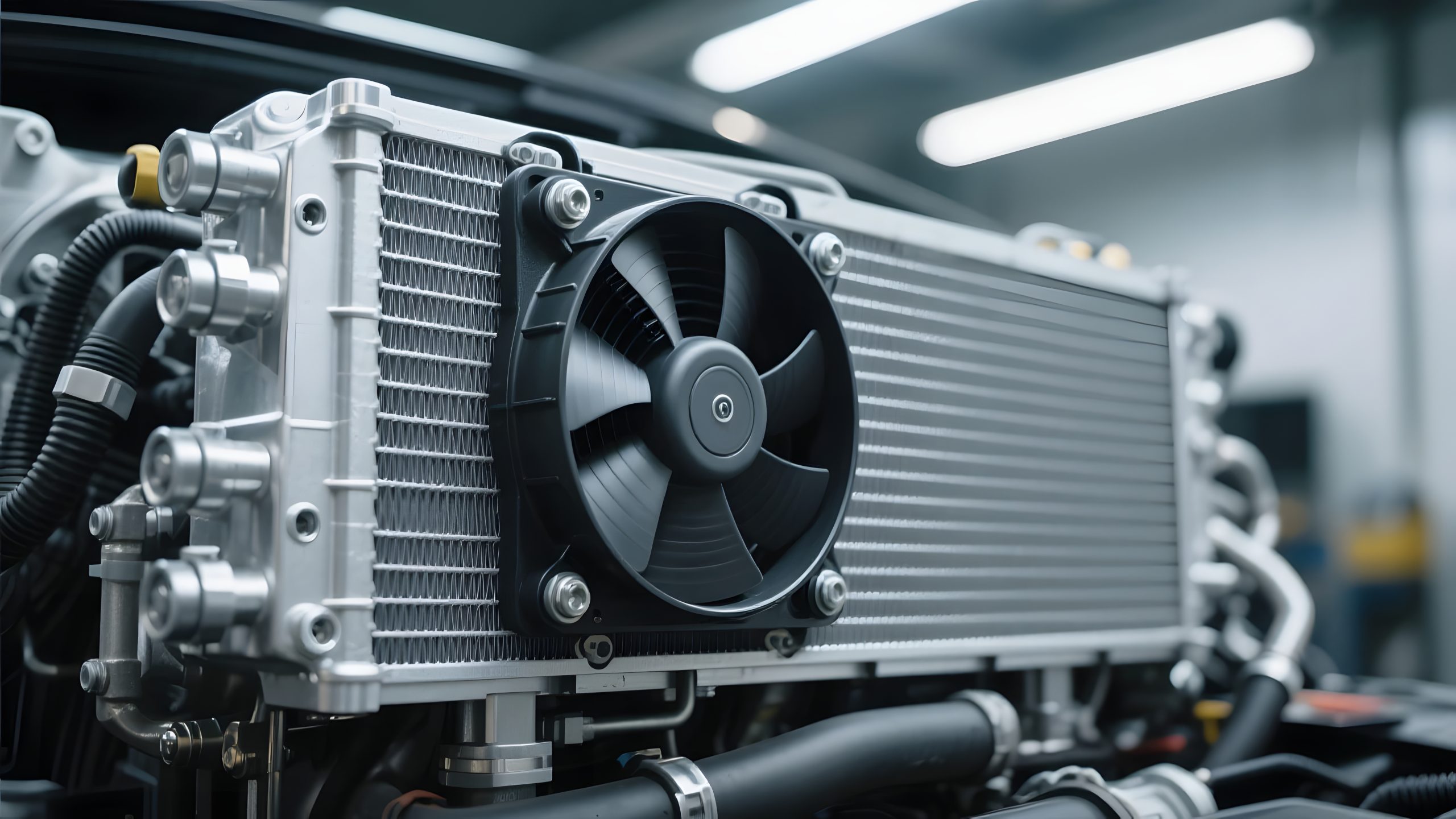
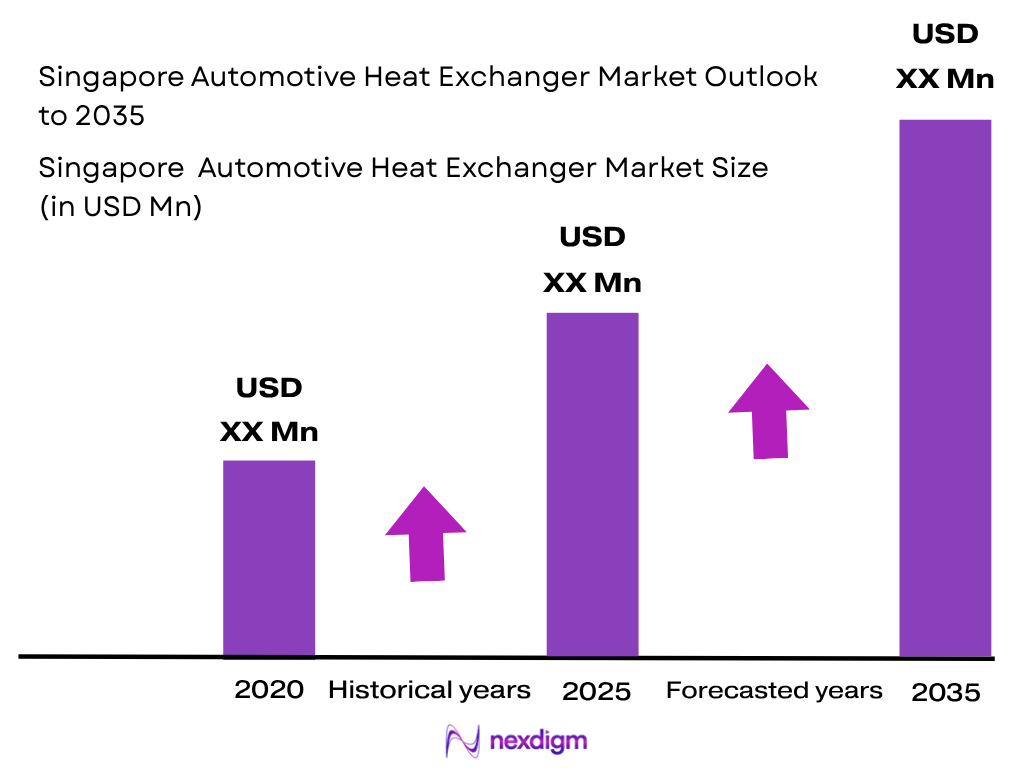
The Singapore Automotive Heat Exchanger Market is valued at ~USD XX million in 2024 and is projected to expand at a ~XX% CAGR during 2026-2035. Demand is supported by Singapore’s sizeable passenger-vehicle fleet, strong premium-car penetration, extensive use of automotive air-conditioning systems, and gradual electrification of road transport. Tropical operating conditions increase utilization of condensers, evaporators and HVAC heat exchangers, while expansion of battery-electric vehicles is creating demand for battery cooling plates, chillers and integrated thermal-management modules.
Automotive heat-exchanger demand is concentrated across Singapore’s main automotive distribution and servicing clusters, particularly Ubi, Leng Kee, Sin Ming, Jurong and Alexandra, where dealerships, authorized service centres, workshops and component distributors are concentrated. Singapore’s market is import-oriented rather than manufacturing-led, meaning Japanese, German, Korean, Chinese and European vehicle platforms strongly influence component specifications. Dense urban driving, frequent stop-start operation and continuous cabin cooling requirements make efficient condensers, radiators and HVAC systems particularly important for Singaporean vehicles.
Market Segmentation
By Heat Exchanger Type
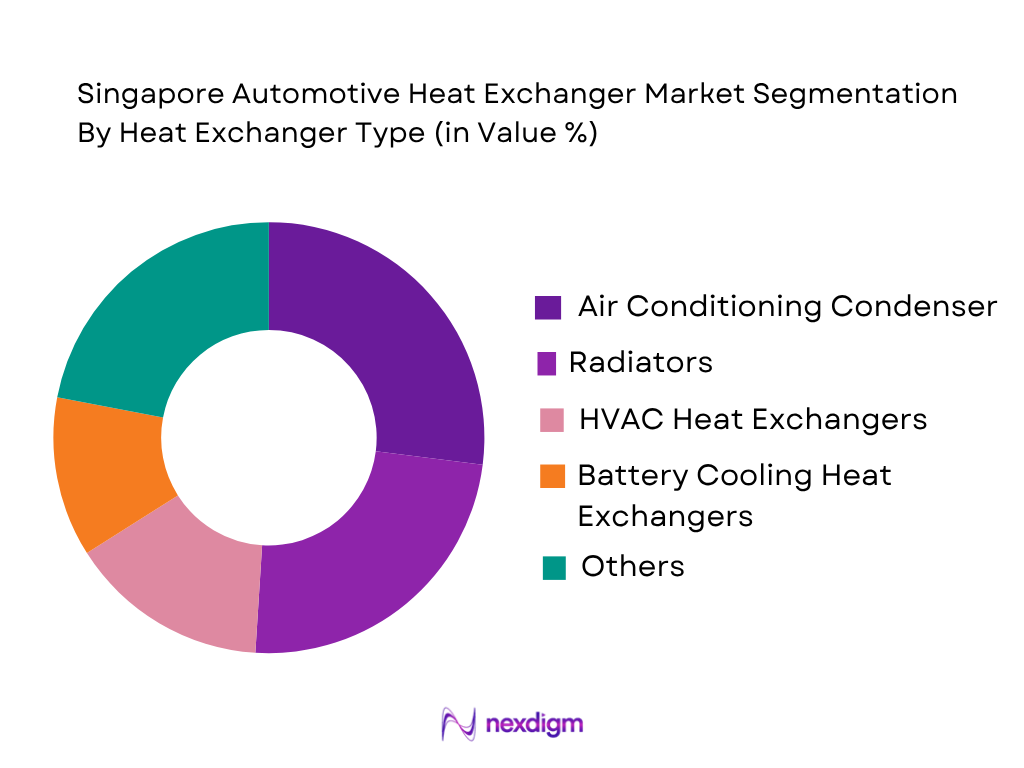
The Singapore Automotive Heat Exchanger Market is segmented into air-conditioning condensers, radiators, HVAC heat exchangers, battery cooling systems, oil coolers, intercoolers and EGR-related components. Air-conditioning condensers hold the dominant share, reflecting Singapore’s tropical climate and the intensive use of vehicle climate-control systems throughout the year. Passenger cars, taxis, private-hire vehicles and commercial fleets require reliable cabin cooling during dense urban operation, which places high thermal loads on condensers and evaporator systems. Radiators remain important because a large portion of the installed vehicle fleet continues to use internal-combustion engines. However, battery cooling heat exchangers are gaining strategic importance as battery-electric vehicles expand. These systems regulate battery packs, power electronics and electric drive units, making thermal management increasingly central to EV range, safety and charging performance. Singapore’s combination of high vehicle technology intensity and rising electrification is therefore gradually shifting demand from standalone conventional heat exchangers toward integrated thermal modules.
By Vehicle Type
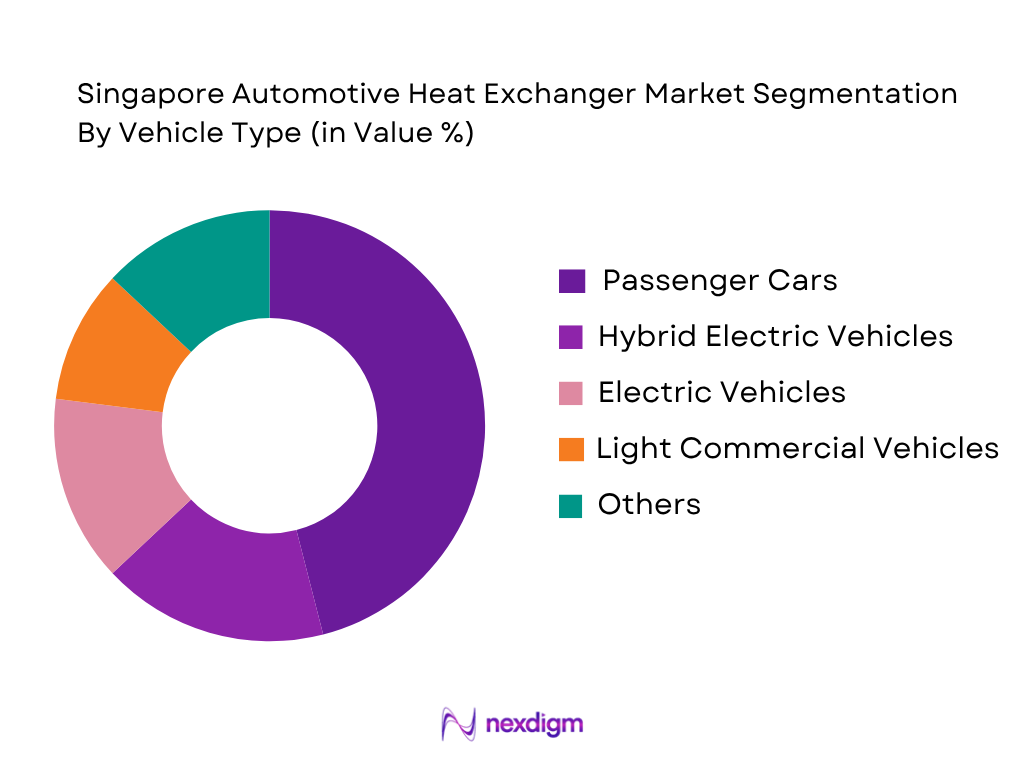
The Singapore Automotive Heat Exchanger Market is segmented into passenger cars, hybrid electric vehicles, battery-electric vehicles, light commercial vehicles, heavy commercial vehicles, and buses and fleet vehicles. Passenger cars dominate the market, supported by Singapore’s high concentration of privately owned and premium vehicles and extensive authorized servicing infrastructure. Passenger cars employ several thermal components, including radiators, condensers, evaporators, transmission coolers and turbocharger-related cooling units. Hybrid vehicles represent a significant secondary segment because Singapore has progressively shifted vehicle demand toward lower-emission powertrains. EVs are becoming more important because their thermal architectures require battery cooling plates, refrigerant chillers, electric compressor systems and power electronics cooling. Commercial fleets, taxis and private-hire vehicles also generate above-average thermal component demand because of higher annual utilization, frequent stop-start driving and prolonged operation of air-conditioning systems.
Competitive Landscape
The Singapore Automotive Heat Exchanger Market is dominated by global Tier-1 automotive suppliers because the country has limited indigenous automotive component manufacturing. Competition is based primarily on OEM compatibility, advanced thermal-management technology, aftermarket availability, tropical-climate durability and capability across both ICE and EV architectures. DENSO, Valeo, MAHLE, Hanon Systems and Modine represent important benchmark suppliers due to their broad thermal portfolios and global OEM relationships. Singapore’s rapid technology transition creates an advantage for companies capable of supplying integrated heat-pump systems, battery cooling modules and lightweight aluminium heat exchangers in addition to conventional radiators and condensers.
| Company | Establishment Year | Headquarters | Product Portfolio | OEM Partnerships | EV Thermal Management Capability | Manufacturing Footprint | R&D Capability | Aftermarket Presence |
| DENSO Corporation | 1949 | Kariya, Japan | ~ | ~ | ~ | ~ | ~ | ~ |
| Valeo | 1923 | Paris, France | ~ | ~ | ~ | ~ | ~ | ~ |
| MAHLE | 1920 | Stuttgart, Germany | ~ | ~ | ~ | ~ | ~ | ~ |
| Hanon Systems | 1986 | Daejeon, South Korea | ~ | ~ | ~ | ~ | ~ | ~ |
| Modine Manufacturing | 1916 | Racine, Wisconsin, USA | ~ | ~ | ~ | ~ | ~ | ~ |
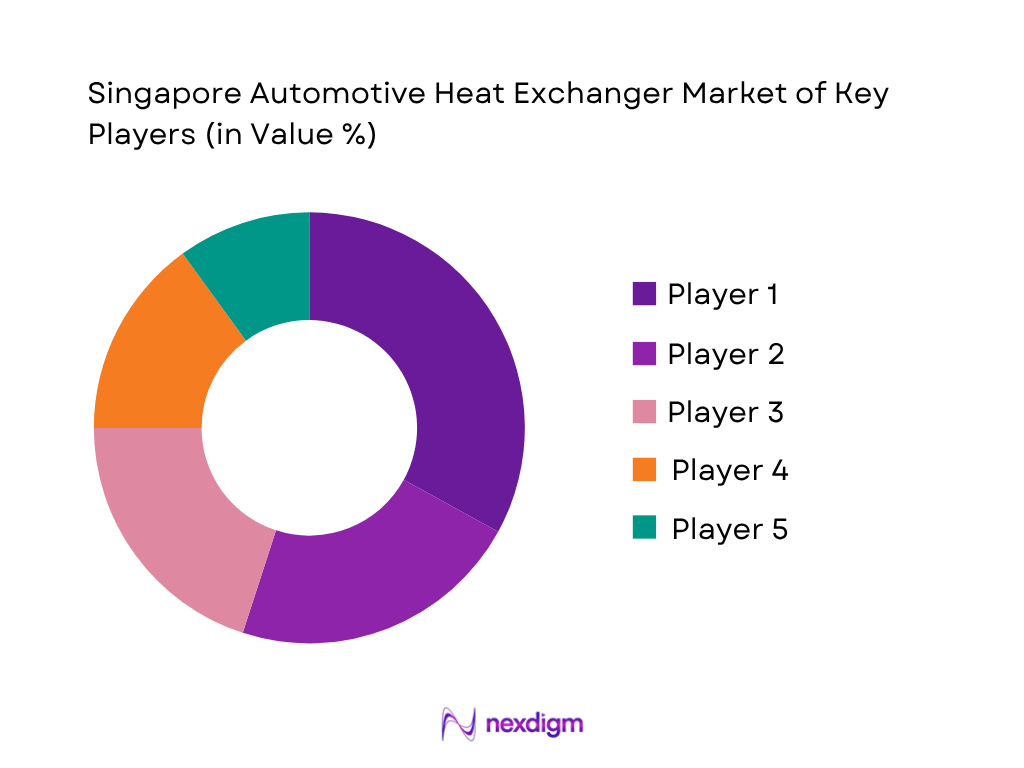
Singapore Automotive Heat Exchanger Market Analysis
Growth Drivers
Increasing Vehicle Electrification
Singapore’s accelerating shift toward electric and hybrid vehicles is creating a structurally stronger demand base for automotive heat exchangers because electrified vehicles require multiple thermal circuits for batteries, power electronics, traction motors, passenger HVAC and charging-related heat rejection. Land Transport Authority data show that Singapore’s electric-car population increased from 11,941 vehicles to 26,225 vehicles between the end of 2023 and the end of 2024, while petrol-electric cars increased from 79,256 units to 99,157 units and plug-in petrol-electric cars increased from 1,359 units to 1,556 units. Over the same period, the total car population expanded from 651,302 vehicles to 657,744 vehicles, demonstrating that electrification is occurring inside an already sizeable installed vehicle base rather than through a shrinking market. (Land Transport Authority) LTA subsequently reported that the total car population reached 659,889 vehicles in 2025, sustaining the installed base from which future thermal-management replacement demand can emerge.
High Demand for Automotive Air Conditioning Systems
Singapore’s climate creates unusually persistent operating requirements for automotive air-conditioning and cabin thermal-control systems, directly supporting demand for condensers, evaporators, refrigerant-to-coolant heat exchangers and associated cooling modules. The National Environment Agency’s Meteorological Service Singapore reported an annual average temperature of 28.4°C in 2024, with an annual mean daily maximum temperature of 32.1°C and an annual mean daily minimum temperature of 25.9°C. It also recorded a mean Wet Bulb Globe Temperature of 27.0°C, compared with 26.6°C in the preceding year, while 21 days reached high heat-stress conditions. (National Environment Agency) These conditions translate directly into long operating hours for compressors and heat exchangers in cars, taxis, private-hire vehicles, vans and buses. High ambient temperature reduces the temperature differential available for heat rejection at the condenser and radiator, increasing the performance burden on fins, tubes, refrigerant circuits and airflow systems. The market impact is amplified by Singapore’s large vehicle base: LTA recorded 1,007,094 motor vehicles in 2024, including 657,744 cars.
Market Challenges
High Dependence on Imported Components
Singapore’s Automotive Heat Exchanger Market faces a structural challenge from its reliance on international automotive and component supply chains, because the country operates primarily as an import, distribution, servicing and regional trading hub rather than a large-scale vehicle or heat-exchanger manufacturing base. Singapore Department of Statistics data show that total merchandise imports reached S$611.4 billion in 2024, while imports of machinery and transport equipment alone reached approximately S$322.1 billion. (Singapore Department of Statistics) This trade structure is relevant to automotive thermal management because radiators, condensers, intercoolers, oil coolers, electric compressors, battery chillers and integrated cooling modules are generally sourced through global OEM and Tier-1 production networks. Singapore’s vehicle population reinforces this exposure: LTA recorded 657,744 cars at the end of 2024 and 659,889 cars at the end of 2025, creating a large installed base requiring continuing replacement and service support.
Technology Transition from ICE to EV Systems
The shift from internal-combustion-engine vehicles toward hybrid and battery-electric architectures creates a substantial technical transition challenge for Singapore’s automotive heat exchanger ecosystem because the required product mix, servicing skills and system architecture are changing simultaneously. LTA recorded 513,943 petrol cars in 2024, compared with 26,225 electric cars, 99,157 petrol-electric cars and 1,556 plug-in petrol-electric cars. (Land Transport Authority) These numbers show that suppliers must support two thermal eras at once: a large conventional installed base requiring radiators, oil coolers, charge-air coolers and engine-related condensers, and a rapidly expanding electrified fleet requiring battery cooling plates, chillers, low-temperature radiators, electronic coolant pumps and integrated HVAC-battery heat-pump systems. The transition accelerated further as LTA reported that Singapore had approximately 18,000 electric cars during the first half of 2024 and approximately 13,800 registered charging points across the island.
Market Opportunities
EV Battery Cooling Systems
EV battery cooling represents one of the clearest future opportunities in the Singapore Automotive Heat Exchanger Market because the country already has a measurable and rapidly expanding base of vehicles that require dedicated battery thermal-control hardware. LTA recorded 26,225 electric cars at the end of 2024, compared with 11,941 electric cars one year earlier. During the same period, plug-in petrol-electric cars increased from 1,359 units to 1,556 units, adding another vehicle category dependent on battery cooling alongside conventional cabin HVAC. (Land Transport Authority) The supporting infrastructure is also sufficiently developed to sustain broader EV operation: Singapore had approximately 13,800 registered EV charging points during the first half of 2024, with installations already reaching approximately 1,000 HDB carparks. (Land Transport Authority) These current figures provide a strong base for future heat exchanger demand because battery thermal management becomes more important as charging frequency, vehicle utilization and power density increase. Singapore’s climate strengthens the opportunity. Meteorological Service Singapore recorded an average temperature of 28.4°C, an average daily maximum of 32.1°C, and a mean Wet Bulb Globe Temperature of 27.0°C in 2024.
Advanced Integrated Thermal Management Modules
Advanced integrated thermal-management modules offer a significant future opportunity because Singapore’s vehicle mix is moving toward platforms where cabin cooling, battery conditioning, power-electronics cooling and drivetrain temperature control are increasingly connected within a single electronically managed system. LTA’s 2024 fleet data show 26,225 electric cars, 99,157 petrol-electric cars and 1,556 plug-in petrol-electric cars, alongside 513,943 petrol cars. (Land Transport Authority) This coexistence creates a near-term market in which integrated modules can first expand through newer EV and hybrid platforms while conventional radiators and condensers continue serving the established fleet. The case for integrated thermal management is particularly strong in Singapore because climate loads are persistent. Meteorological Service Singapore reported an annual mean temperature of 28.4°C, an annual mean daily maximum of 32.1°C, and total annual rainfall of 2,739.8 mm in 2024. (National Environment Agency) These operating conditions demand reliable heat rejection, corrosion-resistant materials and stable HVAC performance, while EV batteries and power electronics add new temperature-control requirements.
Future Outlook
The Singapore Automotive Heat Exchanger Market is expected to transition steadily from conventional engine-cooling demand toward electrified thermal-management systems. Continued adoption of hybrid and battery-electric vehicles will increase the importance of battery chillers, cooling plates, heat pumps, electronically controlled coolant circuits and integrated HVAC-battery thermal modules.
Conventional radiators and oil coolers will remain relevant because Singapore’s installed vehicle fleet will continue to include ICE and hybrid vehicles for an extended period. However, suppliers with expertise in electric compressors, refrigerant management and battery temperature control are likely to capture a larger proportion of new-generation vehicle demand.
Major Players
- DENSO Corporation
- Valeo
- MAHLE GmbH
- Hanon Systems
- Modine Manufacturing Company
- Sanden Corporation
- T.RAD Co., Ltd.
- Marelli
- BorgWarner
- Dana Incorporated
- Nissens Automotive
- Koyorad
- Bosch Mobility
- Yinlun
- AKG Group
Key Target Audience
- Automotive OEMs and Vehicle Distributors
- Automotive Tier-1 and Tier-2 Component Suppliers
- Electric Vehicle Manufacturers and EV System Integrators
- Battery and Power Electronics Thermal Management Companies
- Automotive Aftermarket Distributors and Service Networks
- Commercial Fleet, Taxi and Private-Hire Fleet Operators
- Investments and Venture Capitalist Firms
- Government and Regulatory Bodies (Land Transport Authority, National Environment Agency, Enterprise Singapore)
Research Methodology
Step 1: Identification of Key Variables
The research begins by constructing an ecosystem map covering vehicle distributors, OEM-affiliated suppliers, thermal-management manufacturers, aftermarket distributors, fleet operators and EV technology providers. Key variables include vehicle parc composition, propulsion mix, heat exchanger installation intensity, replacement cycles, tropical-climate operating conditions and electrification levels. These variables establish the foundation for market segmentation and demand assessment.
Step 2: Market Analysis and Construction
Historical vehicle registrations, fleet composition, hybrid and EV penetration, automotive component imports and replacement demand are analyzed to construct the Singapore Automotive Heat Exchanger Market framework. Heat exchanger demand is assessed across radiators, condensers, HVAC systems, battery cooling systems, intercoolers and oil coolers. Bottom-up calculations are cross-checked against vehicle population and component consumption patterns.
Step 3: Hypothesis Validation and Expert Consultation
Market hypotheses are validated through discussions with automotive distributors, workshops, component suppliers, fleet operators and thermal-system specialists. These consultations help assess replacement frequency, supplier preference, EV thermal-system complexity, component compatibility and aftermarket dynamics. Expert feedback is used to refine assumptions regarding segment penetration and supplier positioning.
Step 4: Research Synthesis and Final Output
The final stage integrates demand-side, supply-side and competitive findings. Data is triangulated across vehicle registrations, supplier information, import patterns and thermal-system application requirements. The final output evaluates market structure, segment shares, competitive positioning, technology transitions and future opportunities across conventional and electrified vehicle platforms.

- Executive Summary
- Research Methodology (Market Definition and Scope, Automotive Thermal Management Ecosystem Mapping, Heat Exchanger Classification Framework, Market Sizing Approach, Top-Down Analysis, Bottom-Up Analysis, Vehicle Production Assessment, Vehicle Import and Registration Analysis, OEM and Tier Supplier Interviews, Demand-Side Assessment, Supply-Side Assessment, Data Triangulation, Forecasting Framework, Assumptions and Limitations)

- Definition and Scope
- Automotive Heat Exchanger Market Evolution and Industry Development Timeline
- Singapore Automotive Thermal Management Value Chain Analysis
- Automotive Heat Exchanger Supply Chain Ecosystem
- Singapore Automotive Manufacturing and Vehicle Import Ecosystem Analysis
- Role of Automotive Heat Exchangers in ICE, Hybrid and Electric Vehicle Thermal Management Systems

- Growth Drivers (Increasing Vehicle Electrification, Premium Vehicle Adoption, High Demand for Automotive Air Conditioning Systems, Automotive Aftermarket Expansion, Imported Vehicle Fleet Growth, Advanced Thermal Management Requirements)
- Market Challenges (High Dependence on Imported Components, Limited Domestic Manufacturing Base, High Land and Industrial Costs, Extreme Precision Manufacturing Requirements, Supply Chain Dependency, Technology Transition from ICE to EV Systems)
- Market Opportunities (EV Battery Cooling Systems, Advanced Integrated Thermal Management Modules, Lightweight Aluminium Heat Exchangers, Hybrid Vehicle Cooling Solutions, Smart Thermal Management Systems, Automotive Component Regional Export Opportunities)
- Market Trends (Electric Vehicle Thermal Management Integration, Lightweight Component Adoption, Aluminium Brazed Heat Exchanger Development, Integrated HVAC and Battery Cooling Modules, Connected Vehicle Thermal Monitoring)
- Government Regulations and Industry Standards (Land Transport Authority Vehicle Regulations, Singapore Green Vehicle Policies, National EV Charging Requirements, Vehicle Emission Standards, Automotive Component Import Regulations)
- SWOT Analysis
- Porter’s Five Forces Analysis
- PESTLE Analysis

- By Market Value (2020-2025)
- By Volume Consumption (2020-2025)
- By Vehicle Thermal System Installation Volume (2020-2025)
- By Average Replacement Demand (2020-2025)
- By OEM Supply Demand (2020-2025)
- By Aftermarket Replacement Demand (2020-2025)

- By Heat Exchanger Type (In Value %)
Radiators
Air Conditioning Condensers
Oil Coolers
Intercoolers / Charge Air Coolers
EGR Coolers
Battery Cooling Heat Exchangers
HVAC Heat Exchangers
Power Electronics Cooling Heat Exchangers
Transmission Oil Coolers - By Vehicle Type (In Value %)
Passenger Cars
Luxury Passenger Vehicles
Electric Vehicles
Hybrid Electric Vehicles
Light Commercial Vehicles
Heavy Commercial Vehicles
Buses and Fleet Vehicles - By Propulsion Type (In Value %)
Internal Combustion Engine Vehicles
Hybrid Electric Vehicles
Battery Electric Vehicles
Plug-in Hybrid Electric Vehicles - By Material Type (In Value %)
Aluminium Heat Exchangers
Copper-Brass Heat Exchangers
Composite Material Heat Exchangers
Lightweight Multi-Material Heat Exchangers - By Sales Channel (In Value %)
OEM Supply Channel
Authorized Automotive Service Centres
Independent Workshops
Automotive Parts Distributors
Online Automotive Component Platforms - By Application (In Value %)
Engine Cooling Systems
Battery Thermal Management Systems
HVAC Systems
Transmission Cooling Systems
Turbocharger Cooling Systems

- Market Share Analysis of Major Players (By Product Category, Vehicle Segment, OEM Supply, Aftermarket Channel)
- Cross Comparison Parameters (Product Portfolio Breadth, Heat Exchanger Manufacturing Capability, EV Thermal Management Expertise, OEM Partnership Network, Aluminium Processing Capability, Regional Manufacturing Presence, R&D and Engineering Capability, Aftermarket Distribution Strength)
Pricing and Product Positioning Analysis - SWOT Analysis of Major Players
- Detailed Profiles of Major Companies
DENSO Corporation
MAHLE GmbH
Valeo
Hanon Systems
Modine Manufacturing Company
Nissens Automotive
T.RAD Co., Ltd.
Sanden Holdings Corporation
Marelli
Bosch Mobility
BorgWarner
Visteon Corporation
Kelvion Holding GmbH
Pranav Vikas
Tokyo Radiator Manufacturing Co., Ltd.

- Vehicle Ownership Assessment
- Vehicle Usage Pattern Analysis
- Automotive Maintenance Behaviour Assessment
- Aftermarket Demand Analysis
- EV Thermal Management Requirement Assessment
- Vehicle Segment Preference Analysis

- By Market Value (2026-2035)
- By Volume Consumption (2026-2035)
- By Vehicle Thermal System Installation Volume (2026-2035)
- By Average Replacement Demand (2026-2035)
- By OEM Supply Demand (2026-2035)
- By Aftermarket Replacement Demand (2026-2035)


 Request a Sample
 Ask for Customization
 Get a Quote
 Enquire Now