
 Download PDF
Market Overview
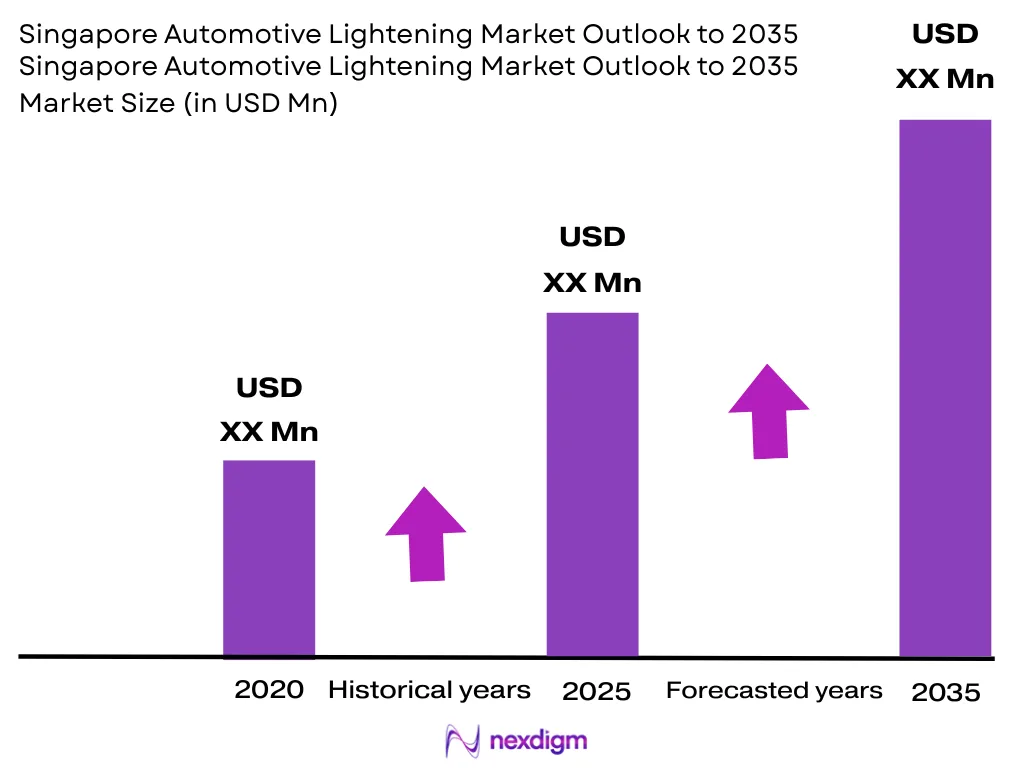
The Singapore Automotive Lighting Market is valued at USD ~ Million in 2024 based on a five-year historical assessment, driven by a highly regulated but affluent vehicle ownership base, rapid electrification of the national vehicle parc, and accelerating consumer migration toward LED and adaptive lighting technologies. According to the Land Transport Authority (LTA), Singapore’s total motor vehicle population stood at close to 1 million registered vehicles, sustained through the Certificate of Entitlement (COE) quota system that governs new vehicle registrations and drives periodic fleet renewal. As Singapore has no domestic vehicle assembly plants, the entire lighting market is import-dependent, with new-vehicle fitment lighting arriving pre-installed on imported vehicles and replacement lighting sourced through regional distributor networks. The implementation of the Vehicular Emissions Scheme (VES), the Electric Vehicle Early Adoption Incentive (EEAI), and Singapore’s Green Plan 2030 targets have accelerated demand for energy-efficient LED and adaptive lighting systems, which improve road safety, reduce power consumption, and extend electric vehicle range.
Market Segmentation
By Vehicle Type
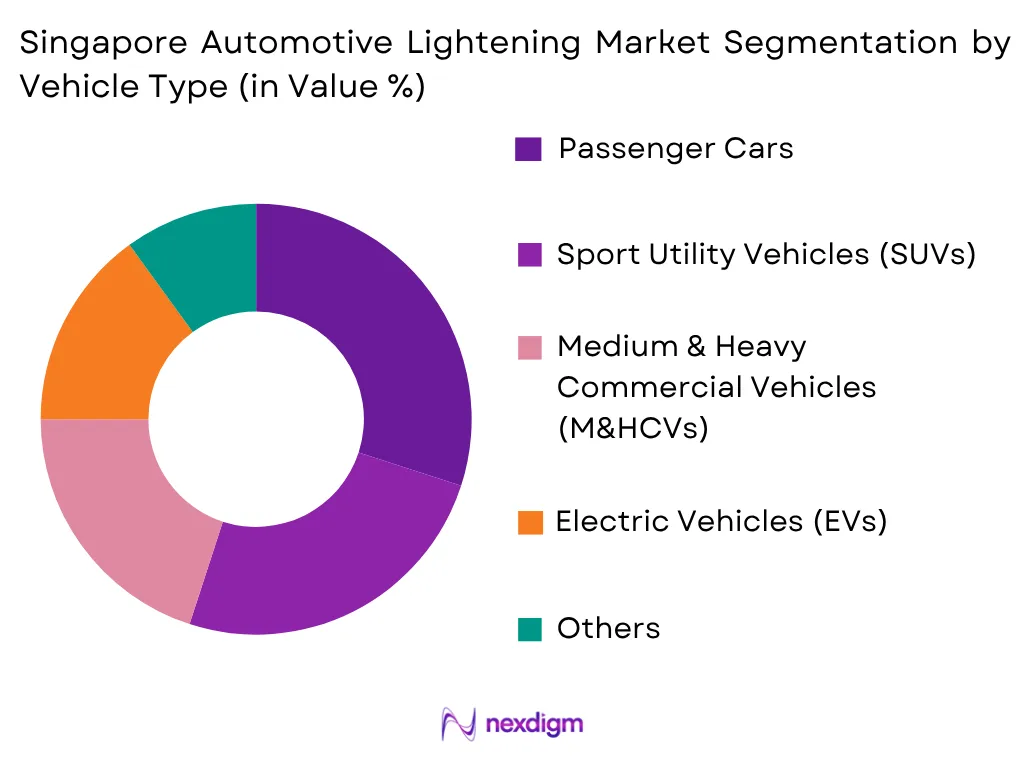
The Passenger Cars segment dominates the Singapore Automotive Lighting Market, supported by the country’s high proportion of privately owned passenger vehicles and a replacement cycle shaped by the COE renewal system. Passenger vehicles account for the largest share of the national vehicle parc, and owners increasingly favour styling-differentiated LED headlamps, signature daytime running lights, and ambient interior lighting as a mark of vehicle premiumisation. Distributors and authorised dealers are increasingly offering full-LED lighting packages on premium hatchbacks, sedans, SUVs, and hybrid vehicles to help owners meet Vehicular Emissions Scheme (VES) banding requirements while enhancing night-time visibility and safety. Furthermore, Singapore’s rapidly expanding electric passenger vehicle segment, supported by the Electric Vehicle Early Adoption Incentive and an expanding public charging network, requires specially engineered lighting systems that balance energy efficiency with the higher electrical loads of EV platforms. Continuous innovation in matrix-LED and adaptive driving beam technology further reinforces the dominance of the passenger car segment.
By Sales Channel
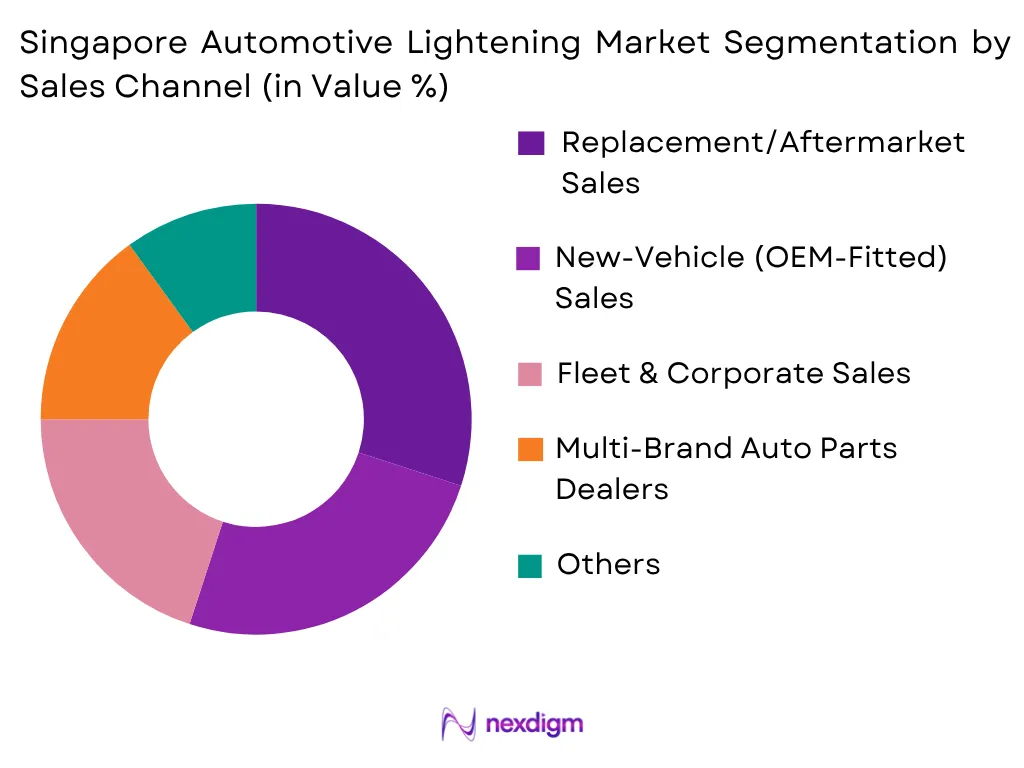
The Replacement/Aftermarket segment holds a significant share of the Singapore Automotive Lighting Market because vehicle owners replace lighting components multiple times over a vehicle’s COE-limited operating life, generating recurring demand driven by accident repairs, component wear, and technology upgrades. Singapore’s dense road network, high average annual mileage relative to its compact geography, and rising awareness of road safety have encouraged private motorists and commercial fleet operators alike to upgrade to advanced LED and adaptive lighting alternatives. Taxi and private-hire fleet operators, logistics companies, and last-mile delivery businesses increasingly prioritise durable, high-visibility lighting because even marginal improvements in illumination and energy efficiency translate into meaningful safety and cost benefits across intensively utilised urban fleets. The availability of technologically advanced products through authorised distributor networks, workshop chains, and online auto parts retail platforms has further strengthened replacement market penetration across the Singapore market.
Competitive Landscape
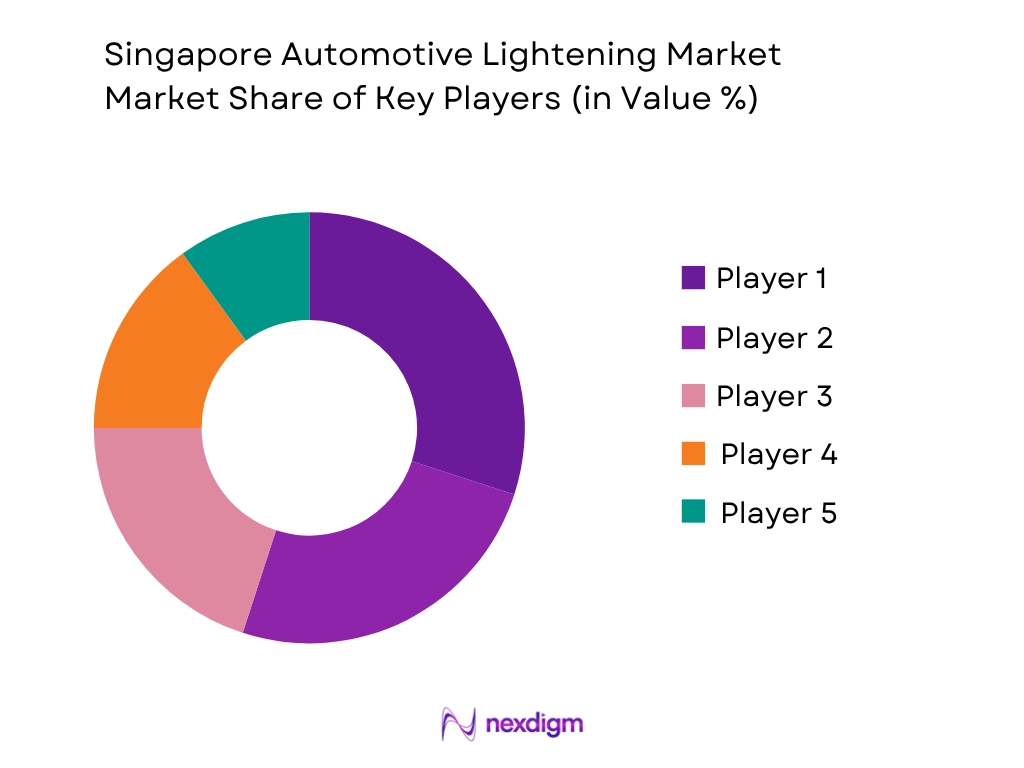
The Singapore Automotive Lighting Market is moderately consolidated and entirely import-driven, with global tier-1 lighting manufacturers operating through regional headquarters, authorised distributors, and dealer networks rather than local production facilities. Competition is shaped by regional Asia-Pacific hub strategies, product innovation, distributor partnerships, and advanced lighting technologies. Leading manufacturers leverage Singapore’s role as a logistics and trading hub to serve both the domestic market and wider Southeast Asia, competing through full-LED and matrix-LED systems, adaptive driving beam technology, and smart lighting solutions that improve road safety and energy efficiency while maintaining durability and styling appeal. Companies continue to strengthen their presence through regional warehousing investment, dealer network expansion, and long-term distribution agreements aligned with Singapore’s Vehicular Emissions Scheme and electric vehicle roadmap. The increasing electrification of the national vehicle parc and stricter safety regulations are also encouraging manufacturers to expand their LED and adaptive lighting product portfolios tailored to the Singapore market.
| Company | Establishment Year | Headquarters | OEM Partnerships | LED/Adaptive Lightening Portfolio
|
Manufacturing Presence in Singapore | Major End-Use Industries | Key Strategic Focus | Certifications & Compliance |
| FORVIA HELLA GmbH & Co. KGaA | 1899 | ~ | ~ | ~ | ~ | ~ | ~ | ~ |
| Koito Manufacturing Co., Ltd. | 1915 | ~ | ~ | ~ | ~ | ~ | ~ | ~ |
| Valeo SA | 1923 | ~ | ~ | ~ | ~ | ~ | ~ | ~ |
| Marelli Holdings Co., Ltd. | 1919 | ~ | ~ | ~ | ~ | ~ | ~ | ~ |
| Tye Soon Limited | 1973 | ~ | ~ | ~ | ~ | ~ | ~ | ~ |
Singapore Automotive Lightening Market Analysis
Growth Drivers
Certificate of Entitlement-Driven Fleet Renewal and Regulatory Compliance
Singapore’s unique Certificate of Entitlement (COE) system is one of the strongest structural drivers for the Automotive Lighting Market, as periodic vehicle renewal cycles sustain steady replacement and new-vehicle lighting demand. According to the Land Transport Authority (LTA), Singapore’s total registered motor vehicle population remains close to 1 million units, with COE quota premiums shaping the pace of vehicle turnover across passenger cars, commercial vehicles, and motorcycles. The Vehicular Emissions Scheme (VES), administered jointly by the LTA and the National Environment Agency (NEA), grades vehicles by pollutant emissions and rewards cleaner, more energy-efficient models with rebates, encouraging both importers and consumers to favour vehicles fitted with energy-efficient LED lighting systems. Singapore’s compact road network and high urban traffic density also make road safety and visibility performance meaningful considerations for private motorists and fleet operators alike. These structural and regulatory dynamics continue to create sustained demand for advanced lighting technologies across both new-vehicle and replacement channels.
Growth in Electric Mobility and Adaptive Lighting Adoption
The rapid electrification of Singapore’s vehicle parc and rising consumer preference for advanced lighting technologies are accelerating demand for LED and adaptive lighting systems. Under the Singapore Green Plan 2030 and the Land Transport Master Plan 2040, the government has set out targets to phase out internal combustion engine vehicle registrations, supported by the Electric Vehicle Early Adoption Incentive (EEAI) and continued expansion of the national EV charging network by the Energy Market Authority (EMA). The LTA reports steadily rising electric vehicle registrations across passenger cars, taxis, and buses, all of which require specially engineered lighting systems capable of supporting higher electrical loads while minimising power draw to preserve battery range. Premium passenger vehicles and electric SUVs increasingly utilise full-LED headlamps, matrix-LED modules, and adaptive driving beam systems engineered for higher efficiency and improved night-time visibility. As Singapore’s public transport and private-hire fleets continue to electrify, demand for technologically advanced automotive lighting continues to strengthen across the country’s compact but high-value automotive market.
Market Challenges
Full Import Dependence and Component Cost Volatility
The Singapore Automotive Lighting Market remains fully dependent on imports, as the country has no domestic vehicle assembly or lighting component manufacturing base. All finished lighting assemblies, LED modules, and specialty components are sourced through regional and global supply chains, exposing distributors and vehicle importers to fluctuations in semiconductor, aluminium, and freight costs. Singapore’s position as a regional logistics and re-export hub partially mitigates this exposure but does not eliminate sensitivity to global shipping disruptions, currency fluctuations, and port congestion. Distributors must also manage inventory carefully given Singapore’s limited land area and high warehousing costs, balancing product breadth across passenger, commercial, and EV-specific lighting systems without compromising availability or pricing competitiveness. These supply-side dynamics increase operational complexity for market participants while affecting procurement strategies and product availability across the replacement and new-vehicle channels.
Consumer Price Sensitivity and High Cost of Vehicle Ownership
Although LED and adaptive lighting systems offer long-term safety and energy efficiency benefits, adoption remains tempered by the already high cost of vehicle ownership in Singapore, driven by COE premiums, road taxes, and parking costs. A significant proportion of vehicle owners continue to prioritise upfront replacement cost over lifecycle performance benefits, particularly in the mass-market passenger vehicle and taxi fleet segments. The replacement market remains price-competitive, with consumers and fleet operators often comparing lighting component prices across authorised dealers, workshop chains, and online platforms rather than evaluating long-term energy efficiency and safety benefits. Fleet operators managing tight per-kilometre operating budgets, particularly private-hire and taxi companies, may prioritise lower upfront procurement costs despite the long-term advantages associated with advanced lighting systems. The limited but persistent presence of grey-market and parallel-imported lighting products in the price-sensitive segment further increases competitive pressure on authorised distributors of premium lighting products, moderating the pace of adoption across several vehicle categories.
Market Opportunities
Expansion of Electric Vehicle Adoption and Charging Infrastructure
Singapore’s rapidly expanding electric vehicle ecosystem presents significant opportunities for manufacturers of lighting systems designed for battery-powered vehicles. Electric vehicles require specialised lighting capable of supporting higher electrical loads, reduced power consumption, and enhanced styling while maximising driving range. Under the Singapore Green Plan 2030 and the Land Transport Master Plan 2040, the government continues to expand EV charging infrastructure through the Energy Market Authority (EMA) and to support EV adoption via the Electric Vehicle Early Adoption Incentive (EEAI) and updated Vehicular Emissions Scheme (VES) bandings. Public transport operators are simultaneously expanding electric bus fleets under LTA-led procurement programmes. Lighting manufacturers and distributors are responding by introducing EV-specific products incorporating matrix-LED modules, adaptive driving beam technology, and energy-efficient designs, creating favourable conditions for expanding distribution partnerships and replacement demand for advanced lighting systems across Singapore’s electrifying vehicle parc.
Growth of Singapore as a Regional Lighting Distribution and Fleet Modernisation Hub
Singapore’s strategic location, established port and logistics infrastructure, and business-friendly trade environment continue to create strong opportunities for its role as a regional automotive lighting distribution hub serving wider Southeast Asia. Major manufacturers maintain Asia-Pacific regional headquarters and warehousing operations in Singapore to coordinate distribution, product launches, and technical support across the region. Domestically, commercial fleet operators across logistics, e-commerce delivery, and private-hire transportation continue to focus on reducing operating costs and improving safety through advanced lighting systems and predictive maintenance strategies enabled by fleet telematics and connected vehicle technologies. LED and adaptive lighting systems help lower power consumption across intensively utilised urban fleets while supporting corporate sustainability commitments under Singapore’s broader Green Plan objectives. These structural advantages create sustained opportunities for lighting manufacturers and distributors supplying advanced products to both Singapore’s domestic market and the surrounding regional trade ecosystem.
Future Outlook
The Singapore Automotive Lighting Market is expected to witness steady and sustained growth over the coming years, supported by continued electrification of the vehicle parc, stricter Vehicular Emissions Scheme requirements, expanding EV charging infrastructure, and rising consumer and fleet awareness of road safety and total vehicle operating costs. Distributors and vehicle importers are increasingly integrating full-LED and adaptive lighting systems into new-vehicle offerings to enhance safety performance and support VES rebate qualification, while fleet operators continue adopting advanced lighting to lower operating expenses and improve safety across taxi, private-hire, and logistics fleets. Singapore’s continued positioning as a regional distribution and innovation hub for global lighting manufacturers is expected to further reinforce long-term market growth through 2035.
Major Players
- FORVIA HELLA GmbH & Co. KGaA
- Koito Manufacturing Co., Ltd.
- Valeo SA
- Marelli Holdings Co., Ltd.
- Stanley Electric Co., Ltd.
- ZKW Group GmbH
- ams OSRAM AG
- Varroc Engineering Ltd.
- Hyundai Mobis Co., Ltd.
- SL Corporation
- TYC Brother Industrial Co., Ltd.
- DEPO Auto Parts Ind. Co., Ltd.
- Robert Bosch (South East Asia) Pte Ltd
- Tye Soon Limited
- Cycle & Carriage Industries Pte Ltd
Key Target Audience
- Vehicle Importers and Distributors (Parallel and Authorised)
- Commercial Vehicle and Fleet Operators
- Automotive Lighting Manufacturers and Regional Distribution Companies
- Fleet Management, Taxi and Private-Hire Companies
- Automotive Component Distributors and Auto Parts Retail Chains
- Investment and Venture Capital Firms
- Government and Regulatory Bodies (Land Transport Authority (LTA), National Environment Agency (NEA), Enterprise Singapore, Energy Market Authority (EMA), Singapore Standards Council)
- Electric Vehicle Manufacturers and Mobility Solution Providers
Research Methodology
Step 1: Identification of Key Variables
The initial phase involves constructing a comprehensive ecosystem map covering all major stakeholders operating within the Singapore Automotive Lighting Market. Extensive desk research is undertaken using government publications, land transport databases, automotive component distribution reports, company annual reports, trade associations, and proprietary industry sources. The primary objective is to identify and define the critical variables influencing market dynamics, including vehicle population and COE renewal trends, replacement demand, new-vehicle fitment rates, LED and adaptive lighting technology adoption, import dependence, safety regulations, electric vehicle penetration, and consumer purchasing behaviour.
Step 2: Market Analysis and Construction
In this phase, historical market data relating to the Singapore Automotive Lighting Market are compiled and analysed to estimate market size and identify growth patterns. Both top-down and bottom-up approaches are employed to evaluate lighting demand across passenger vehicles, commercial vehicles, SUVs, buses, and electric vehicles. Market segmentation is validated by analysing new-vehicle fitment, replacement demand, distributor warehousing capacity, vehicle parc composition, sales channel performance, and regional demand across Singapore’s planning areas. Revenue estimates are cross-verified through import volumes, trade data, and end-user consumption patterns to ensure accuracy.
Step 3: Hypothesis Validation and Expert Consultation
Market hypotheses are developed using secondary research findings and subsequently validated through Computer-Assisted Telephone Interviews (CATI) and structured consultations with industry experts. Respondents include lighting component distributors, vehicle importers, regional manufacturer representatives, auto parts dealers, fleet operators, workshop chains, automotive engineers, and regulatory stakeholders. These discussions provide valuable commercial, operational, and technical insights that help validate market assumptions, assess technology adoption, understand purchasing trends, and refine future market projections across new-vehicle and replacement channels.
Step 4: Research Synthesis and Final Output
The final phase integrates findings from secondary research, primary interviews, and quantitative analysis to develop a comprehensive assessment of the Singapore Automotive Lighting Market. Data obtained through the bottom-up methodology are cross-validated using top-down analysis and multiple independent information sources to ensure consistency and reliability. The report is further verified through consultations with leading lighting distributors, vehicle importers, and industry experts regarding product innovation, distribution capacity, competitive developments, consumer preferences, and regulatory trends before publication, ensuring a robust and accurate market assessment.

- Executive Summary
- Research Methodology (Market Definitions and Assumptions, Abbreviations, Market Sizing Approach, Top-Down Analysis, Bottom-Up Analysis, Demand-Side Assessment, Supply-Side Assessment, Primary Industry Interviews, Data Triangulation, Forecasting Framework, Limitations and Future Conclusions)

- Definition and Scope
- Market Evolution and Industry Genesis
- Timeline of Major Industry Developments
- Automotive Lighting Value Chain Analysis
- Raw Material and Component Supply Chain Analysis
- New-Vehicle and Replacement Ecosystem Analysis
- Import, Warehousing and Distribution Framework

- Growth Drivers (Certificate of Entitlement-Driven Vehicle Renewal, Rising Electric Vehicle Adoption, Shift Towards LED and Adaptive Lighting, Vehicular Emissions Scheme-Linked Vehicle Upgrades, Growth of Premium and SUV Vehicle Sales, Expansion of Regional Distributor Partnerships, Rising Road Safety Regulations, Government Focus on Sustainable Mobility)
- Market Challenges (Full Dependence on Imported Components, High Cost of Vehicle Ownership Limiting Premium Adoption, Currency and Freight Cost Volatility, Limited Local Manufacturing Base, Consumer Price Sensitivity in Replacement Segment, Technical Complexity of Adaptive Lighting Systems, Grey-Market Product Availability, Supply Chain Disruptions)
- Market Opportunities (Expansion of Electric Vehicle Parc, Adaptive Driving Beam and Matrix LED Adoption, Smart and Connected Lighting Systems, Regional Distribution Hub Growth, Fleet Digitalisation, Premium Replacement Demand, Sustainable and Energy-Efficient Lighting Materials, Green Mobility Policies)
- Market Trends (Full-LED and Matrix-LED Headlamp Adoption, Adaptive Driving Beam (ADB) Systems, Signature and Ambient Lighting Integration, Miniaturisation and Micro-LED Development, AI-Based Lighting Design, Digital Lighting Diagnostics, Sustainable Raw Materials, High-Efficiency Low-Power Lighting)
- Government Regulations (Land Transport Authority (LTA) Vehicle Lighting Standards, Vehicular Emissions Scheme (VES), Certificate of Entitlement (COE) System, Enterprise Singapore Consumer Protection Safety Requirements, Electric Vehicle Early Adoption Incentive (EEAI), National Environment Agency (NEA) E-Waste Management Rules, Singapore Green Plan 2030, ASEAN Harmonized Vehicle Component Standards)
- SWOT Analysis
- PESTLE Analysis
- Porter’s Five Forces Analysis
- Stakeholder Ecosystem
- Competition Ecosystem

- By Market Value (2020-2025)
- By Unit Shipments (2020-2025)
- By Average Selling Price (2020-2025)

- By Vehicle Type (In Value %)
Passenger Cars
Sport Utility Vehicles (SUVs)
Light Commercial Vehicles (LCVs)
Medium & Heavy Commercial Vehicles (M&HCVs)
Electric Vehicles (EVs)
Buses - By Technology (In Value %)
Halogen Lighting
Light Emitting Diode (LED) Lighting
Xenon/High-Intensity Discharge (HID) Lighting
Laser and Matrix/Adaptive LED Lighting - By Application (In Value %)
Front Lighting (Headlamps, Daytime Running Lights)
Rear Lighting (Tail Lamps, Stop Lamps)
Side Lighting (Fog Lamps, Turn Indicators)
Interior & Ambient Lighting - By Sales Channel (In Value %)
New-Vehicle (OEM-Fitted) Sales
Replacement/Aftermarket Sales
Fleet & Corporate Sales
Online Auto Parts Retail
Multi-Brand Auto Parts Dealers - By Region (In Value %)
Central Region
East Region
North Region
North-East Region
West Region

- Market Share of Major Players (By Revenue, Unit Shipments, Vehicle Type, Sales Channel, Distributor Partnerships)
- Cross Comparison Parameters (Distributor & New-Vehicle Supply Partnerships, LED/Adaptive Lighting Portfolio, Regional Warehousing Capacity, EV Lighting Portfolio, Distribution & Dealer Network, R&D Capability, Regional Hub Footprint)
- SWOT Analysis of Major Players
- Pricing Analysis (Passenger Car Lighting SKU, Commercial Vehicle Lighting SKU, EV Lighting Pricing, New-Vehicle Fitment Pricing, Replacement Pricing)
- Detailed Profiles of Major Companies
FORVIA HELLA GmbH & Co. KGaA
Koito Manufacturing Co., Ltd.
Valeo SA
Marelli Holdings Co., Ltd.
Stanley Electric Co., Ltd.
ZKW Group GmbH
ams OSRAM AG
Varroc Engineering Ltd.
Hyundai Mobis Co., Ltd.
SL Corporation
TYC Brother Industrial Co., Ltd.
DEPO Auto Parts Ind. Co., Ltd.
Robert Bosch (South East Asia) Pte Ltd
Tye Soon Limited
Cycle & Carriage Industries Pte Ltd

- Fleet Utilization Assessment (Vehicle Kilometers Travelled, Replacement Cycle, Fleet Lighting Maintenance, Fleet Safety Compliance)
- Consumer Purchase Behavior (Styling and Brand Preference, Technology Preference, Replacement Frequency, Price Sensitivity)
- Technology Adoption Analysis (LED Penetration, Adaptive Lighting Awareness, EV Lighting Adoption, Smart Lighting Integration)
- Investment and Budget Allocation Analysis (Fleet Operating Budget, Component Procurement Strategy, Lifecycle Cost Analysis, ROI Expectations)
- Needs, Desires and Pain Point Analysis (Visibility and Safety Performance, Styling Differentiation, Maintenance Cost, Energy Efficiency, Durability)
- Vendor Selection Criteria (Brand Reputation, Distributor Approval, Warranty Coverage, Dealer Network, Product Availability)
- Decision-Making Process (Performance Evaluation, Cost Analysis, Dealer Recommendation, Vehicle Compatibility)

- By Market Value (2026-2035)
- By Unit Shipments (2026-2035)
- By Average Selling Price (2026-2035)


 Request a Sample
 Ask for Customization
 Get a Quote
 Enquire Now