

 Download PDF
Market Overview
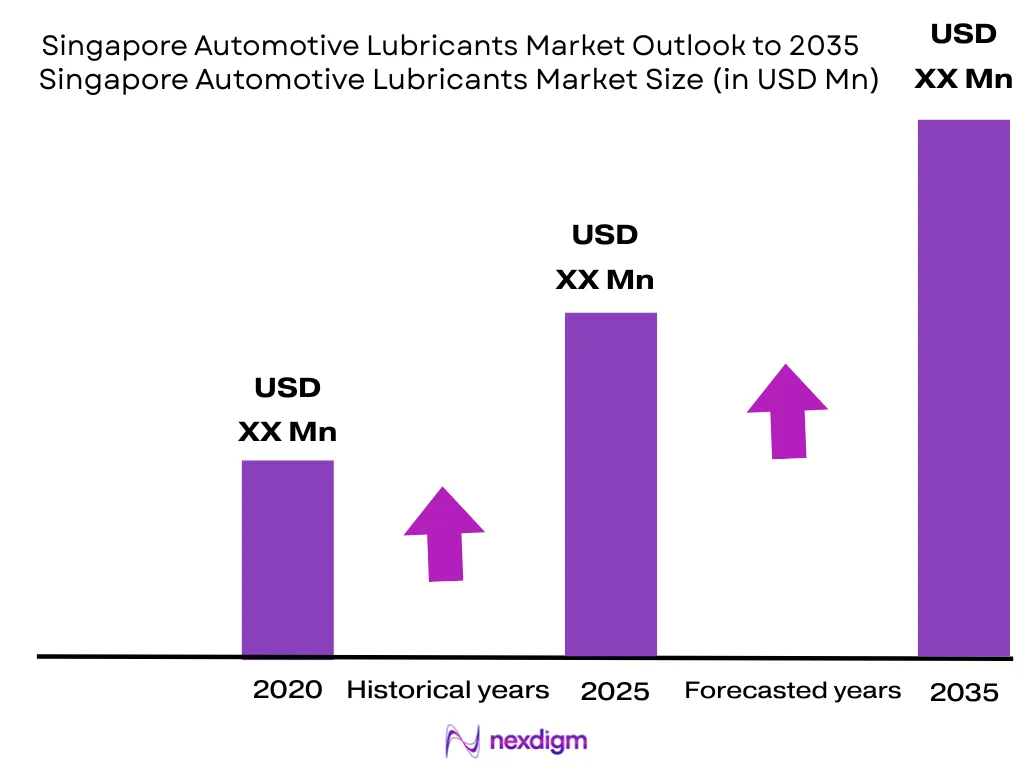
The Singapore Automotive Lubricants Market is valued at approximately ~ million, supported by a car population that increased from 653,768 vehicles to 660,339 vehicles. Petrol-electric vehicles simultaneously increased from 79,256 units to 99,157 units, creating additional demand for low-viscosity synthetic oils, hybrid-compatible transmission fluids and thermal-management products. Premium vehicle ownership, intensive scheduled servicing and stringent manufacturer specifications further support value-oriented lubricant consumption despite Singapore’s tightly controlled vehicle population. The Jurong–Tuas corridor dominates Singapore’s lubricant manufacturing and supply ecosystem because it hosts major blending, base-stock, storage and export infrastructure. Shell’s Tuas facility can supply up to 430 million litres of lubricants and greases, while TotalEnergies operates a 310,000-metric-tonne annual blending facility. Central and eastern Singapore remain important downstream consumption zones because dense passenger-car, taxi, private-hire, workshop and airport-related vehicle activity generates recurring requirements for engine oils, transmission fluids and functional fluids.
Market Segmentation
By Product Type
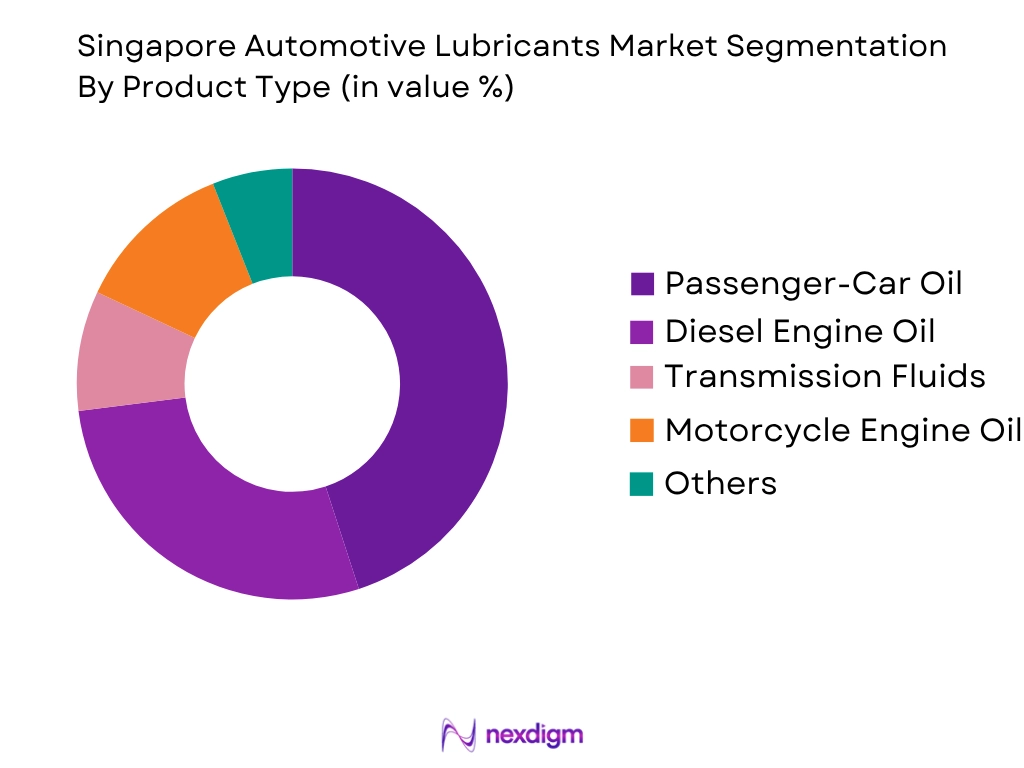
The Singapore Automotive Lubricants Market is segmented into passenger-car motor oil, heavy-duty diesel engine oil, motorcycle oil, transmission fluids, gear and axle oils, automotive greases, coolants and emerging EV fluids. Passenger-car motor oil currently represents the dominant product segment because Singapore maintained 660,339 cars, including a sizeable installed base of petrol and petrol-electric vehicles requiring recurrent service-fill lubrication. Petrol vehicles continue to account for hundreds of thousands of cars despite the rapid transition toward electrification. Full-synthetic 0W-20, 0W-30, 5W-30 and other OEM-specified formulations are particularly relevant because Singapore has a sophisticated vehicle mix containing Japanese, German, Korean and increasingly Chinese brands. Premium vehicles also support high-value ACEA and manufacturer-approved products. Transmission fluids form another important segment because automatic, CVT and dual-clutch transmissions are widespread. EV fluids remain smaller because fully electric vehicles eliminate conventional crankcase oil demand, but they create new requirements for e-drive fluids, reduction-gear lubrication, compressor lubricants and battery thermal-management products.
By Lubricant Technology
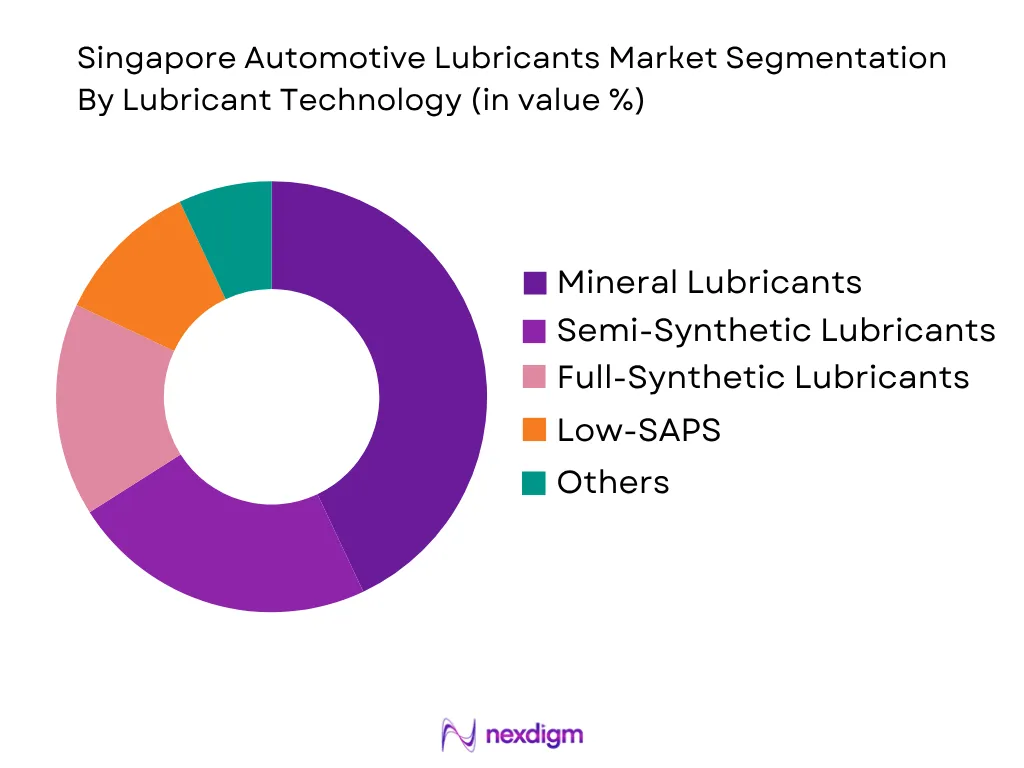
The Singapore Automotive Lubricants Market is segmented into mineral, semi-synthetic, full-synthetic, low-viscosity specialty, hybrid-specific and EV-specific fluids. Full-synthetic lubricants dominate the technology segmentation because Singapore’s vehicle market is concentrated around comparatively modern vehicles with strict OEM servicing requirements and strong penetration of Japanese, European and premium marques. LTA records show petrol-electric vehicle population increasing from 79,256 units to 99,157 units, while conventional petrol vehicles declined from 540,605 units to 513,943 units, illustrating a structural shift toward powertrains that increasingly use low-viscosity and high-performance fluids. Synthetic oils offer improved oxidation stability, deposit control, cold-start performance and compatibility with turbocharged and hybrid operating cycles. Mineral lubricants remain relevant for older vehicles and selected commercial applications but face structural pressure from vehicle deregistration and powertrain modernisation. Hybrid-specific oils are expanding because repeated engine stop-start cycles and lower engine operating utilisation create distinct lubricant requirements, while EV-specific fluids will become progressively more important as electric vehicle adoption accelerates.
Competitive Landscape
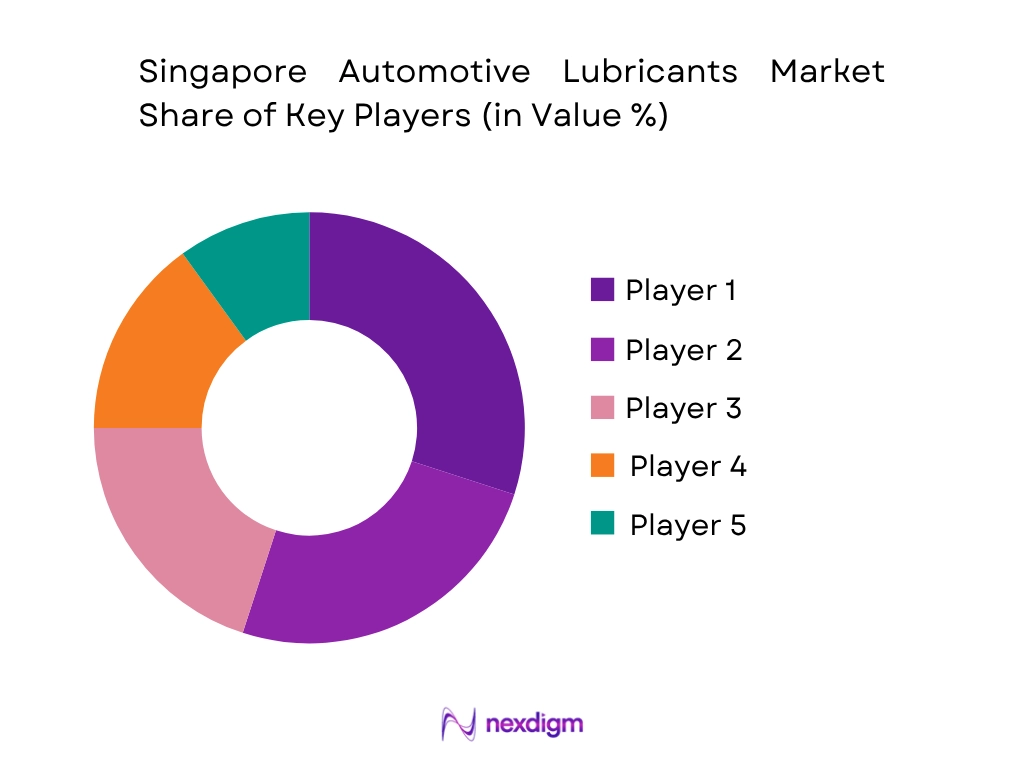
The Singapore Automotive Lubricants Market combines international lubricant majors with locally established petroleum and blending companies. Shell, ExxonMobil and TotalEnergies benefit from substantial Singapore manufacturing infrastructure, while Castrol competes strongly in premium passenger-car, motorcycle and commercial-vehicle lubricants. Singapore Petroleum Company provides a domestic downstream presence and established automotive-channel access. Singapore is therefore not merely an end-consumption market; it is an Asia-Pacific production and distribution centre supplying lubricants and base stocks to regional markets. Shell’s Tuas facility serves more than 40 countries, while ExxonMobil manufactures automotive lubricants and lubricant base stocks in Singapore for domestic and Asia-Pacific customers.
| Company | Establishment Year | Headquarters | Singapore Manufacturing Presence | Passenger-Car Portfolio | Synthetic Lubricant Capability | Hybrid/EV Fluid Readiness | Commercial Vehicle Capability | Regional Export Position |
| Shell | 1907 | London, UK | ~ | ~ | ~ | ~ | ~ | ~ |
| ExxonMobil / Mobil | 1999* | Spring, Texas, USA | ~ | ~ | ~ | ~ | ~ | ~ |
| Castrol | 1899 | UK | ~ | ~ | ~ | ~ | ~ | ~ |
| TotalEnergies | 1924 | Paris, France | ~ | ~ | ~ | ~ | ~ | ~ |
| Singapore Petroleum Company | 1969 | Singapore | ~ | ~ | ~ | ~ | ~ | ~ |
Singapore Automotive Lubricants Market Analysis
Growth Drivers
Expanding Hybrid Vehicle Base and High-Specification Lubricant Demand
Singapore’s rapidly changing passenger-car powertrain mix is strengthening demand for technologically advanced automotive lubricants even though overall vehicle ownership remains tightly controlled. Land Transport Authority data shows the total car population increasing from 653,768 vehicles in 2023 to 660,339 vehicles in 2024, while petrol-electric cars increased from 79,256 units to 99,157 units over the same period. Toyota alone operated 40,948 petrol-electric cars in 2024, while BMW’s overall installed car population reached 53,817 units, demonstrating the growing presence of hybrid and premium vehicles requiring manufacturer-approved fluids. New-car registrations also increased materially, from 30,225 units in 2023 to 43,022 units in 2024, adding newer engines and transmission architectures to Singapore’s servicing base. This fleet renewal is particularly important for lubricant suppliers because modern hybrid engines increasingly specify low-viscosity formulations such as SAE 0W-16 and 0W-20, while automatic, continuously variable and dual-clutch transmissions require dedicated fluids rather than generic lubricants. The Singapore Automotive Lubricants Market therefore benefits not simply from vehicle numbers but from increasing fluid complexity per vehicle. The macroeconomic environment reinforces this premiumisation trend. World Bank data places Singapore’s GDP at approximately USD 547.4 billion in 2024, with GDP per capita at USD 90,674.1, supporting ownership and maintenance of technologically sophisticated vehicles. The World Bank subsequently recorded GDP of approximately USD 603.87 billion in 2025 and GDP per capita of USD 98,814, indicating a high-income consumer and corporate base capable of supporting premium servicing products. The lubricant implication is substantial: as older conventional petrol cars are progressively replaced by hybrids, lubricant suppliers can shift portfolio emphasis toward full-synthetic engine oils, advanced friction-modified products, hybrid transmission fluids, long-life coolants and OEM-approved formulations. Hybrid powertrains also create unusual operating conditions because internal-combustion engines repeatedly shut down and restart, may remain inactive during portions of urban trips and experience different moisture and temperature cycles compared with continuously operating engines. This strengthens requirements for deposit control, oxidation resistance, corrosion protection and rapid lubrication during repeated starts. Singapore’s workshop and authorized dealership structure further supports this shift because vehicle owners frequently rely on manufacturer service schedules and recommended lubricant specifications rather than basic commodity oils. Consequently, expansion of hybrid vehicles is expected to sustain lubricant value creation even as pure internal-combustion vehicle numbers eventually decline.
Logistics, Port Activity and High-Utilisation Commercial Mobility
Singapore’s position as one of the world’s most important logistics and transshipment centres creates an important demand foundation for commercial-vehicle lubricants, particularly heavy-duty engine oils, transmission fluids, axle oils, hydraulic fluids, greases and coolants. The Maritime and Port Authority reported 622.67 million tonnes of cargo throughput in 2024, compared with 592.01 million tonnes in 2023, while container throughput reached a record 41.12 million TEUs in 2024. Vessel arrival tonnage exceeded 3 billion gross tonnes, reflecting the intensity of Singapore’s trade and logistics ecosystem. This activity directly supports road-based container haulage, warehouse movements, port support vehicles, light commercial vans, airport logistics and last-mile delivery fleets. Commercial vehicles generally operate longer hours and accumulate greater annual utilisation than privately owned passenger cars, causing lubricants to be consumed across more frequent maintenance cycles. Heavy goods vehicles require larger engine-oil sump capacities, while repetitive urban delivery cycles increase stress on transmissions, braking systems and cooling circuits. The connection between the wider economy and automotive lubricant demand is reinforced by Singapore’s role as a regional distribution hub. The Ministry of Trade and Industry identified transportation and storage as one of the sectors supporting economic activity during 2024, while World Bank data places national GDP at USD 547.4 billion and the country’s population at roughly 6 million people during the same period. Singapore’s compact geography does not eliminate lubricant demand; rather, the concentration of economic activity creates dense commercial movement around Jurong, Tuas, Changi, industrial estates and urban distribution corridors. MPA data also shows the logistics platform strengthening further, with container throughput reaching 44.66 million TEUs in 2025 and vessel arrivals reaching 3.22 billion gross tonnes. These figures matter for automotive lubricants because expanding container and cargo movements require dependable trucks, prime movers, vans and supporting equipment operating under strict uptime requirements. Fleet owners cannot tolerate prolonged drivetrain or engine failures, making preventive lubrication more strategically important than in low-utilisation private applications. Suppliers can therefore compete through heavy-duty API-approved engine oils, extended-drain formulations, automatic-transmission fluids, differential oils and high-load greases, while technical service becomes increasingly relevant. Oil-condition monitoring can help operators assess oxidation, contamination, viscosity deterioration and wear metals before failures occur. The same environment supports bulk lubricant delivery to fleet depots and workshop networks rather than reliance solely on small consumer packs. Singapore’s port-driven logistics economy also gives lubricant companies access to adjacent marine, industrial and regional distribution businesses, making local automotive products part of a broader lubricant supply chain. The principal supporting sources are the Maritime and Port Authority of Singapore, Ministry of Trade and Industry and World Bank.
Market Challenges
Rapid Electrification Reducing Conventional Engine-Oil Intensity
The accelerating transition toward electric vehicles represents the most important structural challenge for conventional automotive lubricant demand in Singapore because battery-electric vehicles eliminate routine crankcase engine-oil replacement. Land Transport Authority data indicates that Singapore had about 18,000 electric cars by the first half of 2024, and the overall electric-car population continued expanding through the end of the year. The scale of individual brands illustrates this transition clearly: Tesla’s installed population increased from 2,780 cars in 2023 to 5,163 cars in 2024, while BYD increased from 2,399 vehicles to 8,567 vehicles. Electric models from Volvo, Volkswagen, BMW and newer Chinese brands also expanded rapidly. At the same time, Singapore registered 43,022 new cars in 2024, compared with 30,225 in 2023, meaning a growing portion of fleet renewal is moving away from conventional petrol-only drivetrains. This directly reduces the lifetime requirement for passenger-car motor oil, oil filters and certain conventional service-fill products. Battery-electric vehicles still require lubricants and functional fluids, but the product basket changes materially toward reduction-gear oils, e-axle fluids, motor-bearing greases, brake fluids, compressor lubricants and battery thermal-management fluids. These products often have longer replacement cycles and lower fluid volumes than recurring engine-oil changes. Singapore’s regulatory direction intensifies this challenge. New diesel-car registrations ceased from 2025, while the national transition framework requires new car registrations to be cleaner-energy models from the next stage of the transition. In 2026, fully electric cars and taxis remain supported through an Additional Registration Fee incentive capped at SGD 7,500, while the Vehicular Emissions Scheme provides an applicable cleaner-vehicle rebate of SGD 22,500 for qualifying registrations. Heavy-vehicle electrification is also advancing: zero-tailpipe-emission heavy goods vehicles and buses registered from 2026 can access an incentive of SGD 40,000, accompanied by charging-support measures. For lubricant companies, the challenge is therefore twofold. They must continue supporting Singapore’s substantial conventional and hybrid installed vehicle base while simultaneously investing in products for electrified drivetrains whose aftermarket volumes are initially much smaller. This requires new testing capability involving dielectric properties, copper compatibility, material compatibility and thermal-management performance. Distributors also face inventory complications because declining petrol and diesel vehicle populations coexist with expanding hybrids and EVs, meaning legacy SAE grades, modern 0W oils, transmission fluids and emerging electric-drive fluids must all remain available. Companies that focus too heavily on conventional crankcase lubricants face long-term volume erosion, while businesses that move prematurely into highly specialised EV fluids may encounter limited near-term replacement frequency. The key supporting source is the Land Transport Authority.
Vehicle Quota Controls and Limited Expansion of the Addressable Fleet
Singapore’s Vehicle Quota System and Certificate of Entitlement framework place a structural ceiling on unrestricted expansion of automotive lubricant demand because lubricant consumption depends fundamentally on the number of vehicles operating on the road. Unlike larger regional markets where rapid population growth and rising household incomes can generate millions of incremental vehicle additions, Singapore manages vehicle growth through quota allocations, ownership costs, deregistration and COE renewal mechanisms. LTA data demonstrates the effect: the total car population moved from 653,768 vehicles in 2023 to 660,339 vehicles in 2024, an increase of only 6,571 cars despite the registration of 43,022 new cars during 2024. This indicates that substantial new registration activity largely replaces deregistered vehicles rather than producing equivalent net expansion in the fleet. For the Singapore Automotive Lubricants Market, this constrains conventional volume growth because each new vehicle entering the parc is frequently offset by an older vehicle leaving it. The composition of these replacements also matters. Older vehicles often consume higher-viscosity oils, require more frequent fluid top-ups and may have shorter service intervals because of wear, whereas replacement vehicles increasingly use high-performance synthetic oils with longer manufacturer-recommended drain intervals. Consequently, lubricant value per litre can improve while total replacement volume may not rise proportionately. Macroeconomic strength does not remove this structural limitation. World Bank figures place Singapore’s GDP at USD 547.4 billion in 2024 and USD 603.87 billion in 2025, while GDP per capita increased from USD 90,674.1 to USD 98,814. These indicators demonstrate substantial purchasing power, but vehicle ownership remains administratively constrained rather than determined only by affordability. This makes Singapore fundamentally different from automotive lubricant markets where economic growth translates directly into rapid fleet expansion. Manufacturers must therefore compete intensely for share within a relatively stable installed vehicle base. Premiumisation, specification upgrades and service-channel partnerships become more important than relying on broad-based vehicle-volume growth. The constraint is particularly relevant for mineral and conventional semi-synthetic oils because fleet renewal steadily removes older vehicles that traditionally consumed such products. Meanwhile, new hybrids and battery-electric vehicles require lower-viscosity or completely different fluids. The business model consequently shifts toward obtaining greater value from each servicing event rather than simply selling more litres. Workshop relationships become strategically important because authorized dealers and independent service centres influence lubricant-brand selection and determine whether owners remain with OEM-branded products or move toward aftermarket alternatives. Companies also need detailed vehicle-parc analytics to understand COE renewal behaviour and identify older vehicles that remain on the road beyond the conventional ownership cycle. High-mileage engine oils, seal-compatible formulations and transmission-fluid services can partly offset limited vehicle expansion among renewed vehicles. Nevertheless, the controlled vehicle population remains a fundamental restraint on unconstrained automotive lubricant volume growth. The main supporting sources are the Land Transport Authority and World Bank.
Market Opportunities
Advanced Hybrid, EV and Low-Viscosity Fluid Technologies
Singapore’s transition toward hybrid and electric mobility creates an opportunity for lubricant suppliers to reposition themselves from traditional engine-oil providers toward advanced automotive fluid specialists. The opportunity is supported by existing vehicle statistics rather than relying on future market projections. LTA recorded 99,157 petrol-electric cars in 2024, compared with 79,256 vehicles in 2023, while the country’s total car population reached 660,339 units. Toyota alone operated 40,948 petrol-electric cars, reflecting the significant installed base of hybrids requiring specialised engine oils and transmission fluids. New registrations also create continuous technology renewal: 43,022 cars were newly registered in 2024, compared with 30,225 in 2023. Electric vehicle growth is visible across multiple marques, with BYD’s fleet increasing from 2,399 to 8,567 vehicles, Tesla reaching 5,163 vehicles, and Volvo electric cars reaching 541 vehicles in 2024. These current statistics establish a meaningful addressable base for next-generation fluids. Hybrid engines present immediate opportunities because they retain internal-combustion engines but require oils adapted to repeated stop-start operation, intermittent engine activation and lower operating temperatures. SAE 0W-16 and 0W-20 formulations, advanced anti-wear additive packages and high moisture-control capability can therefore command increasing technical relevance. Electric vehicles open a second opportunity category. Although they remove engine oils, their electric drive units require fluids capable of protecting gears and bearings while maintaining electrical and material compatibility. Dedicated e-axle oils, dielectric thermal fluids, electric compressor lubricants, electric motor greases and battery coolants can create technically differentiated product categories with less commodity competition than conventional engine oils. Singapore provides an attractive environment for developing such products because its automotive fleet is technologically advanced and its broader manufacturing base includes sophisticated chemicals and lubricant operations. World Bank data shows an economy of USD 547.4 billion in 2024, supporting high-value technology adoption, while Singapore’s role as a regional headquarters and manufacturing platform gives product developers access beyond the domestic market. The regulatory framework also provides immediate infrastructure signals. Singapore’s Electric Vehicle Common Charger Grant supports 3,500 chargers at non-landed private residences through 2026, while the Electric Heavy Vehicle Charger Grant covers the first 500 chargers for qualifying heavy-vehicle deployment, subject to programme conditions. These are current policy commitments that demonstrate the physical ecosystem being built around electric mobility. Lubricant manufacturers that establish testing, OEM-validation and workshop-education capabilities now can position themselves to supply both the growing hybrid installed base and emerging EV fluid applications. The opportunity is therefore not simply replacing lost engine-oil litres; it involves increasing technical value per fluid through specialised products linked to modern drivetrains. The supporting sources are the Land Transport Authority and World Bank.
Singapore as a Regional Blending, Technical-Service and Circular-Lubricant Hub
Singapore’s established position as an Asian petroleum, chemical, port and logistics centre provides automotive lubricant companies with an opportunity that extends well beyond domestic vehicle consumption. Current maritime statistics demonstrate the scale of the country’s distribution ecosystem: Singapore handled 622.67 million tonnes of cargo in 2024, container throughput reached 41.12 million TEUs, and total vessel arrival tonnage exceeded 3 billion gross tonnes. Container throughput subsequently reached 44.66 million TEUs in 2025, reinforcing Singapore’s role as a regional physical-distribution hub. This infrastructure allows lubricant manufacturers to blend, package, store and export products efficiently to ASEAN and wider Asia-Pacific markets while using Singapore as a technical and commercial headquarters. The opportunity is especially important because domestic automotive lubricant volume is constrained by the vehicle quota system. Rather than relying solely on local replacement demand, manufacturers can use Singapore for contract blending, private-label production, specialty-fluid formulation and regional supply. The country’s chemical and manufacturing ecosystem gives lubricant formulators proximity to base stocks, additives, storage terminals, analytical laboratories and global shipping routes. Singapore’s macroeconomic scale also supports this higher-value role: World Bank data records GDP of USD 547.4 billion in 2024 and USD 603.87 billion in 2025, demonstrating the financial and industrial capacity of the operating environment. Circular lubricants constitute an additional opportunity. The National Environment Agency’s 2025 licensed toxic-industrial-waste collector list explicitly includes spent motor oils from petrol and diesel engines, used lubricating oil, used mineral oil and used hydraulic oil, confirming that an established regulated collection ecosystem already exists. Automotive workshops, commercial fleets, service stations and industrial facilities can therefore participate in structured used-oil recovery rather than unmanaged disposal. Lubricant suppliers can build closed-loop fleet programmes in which used oil is collected after service, directed toward licensed recovery or treatment channels, and integrated into broader sustainability reporting. Re-refined base stocks, where technically and commercially suitable, can create additional product-development possibilities for selected applications. Such circularity becomes particularly valuable for commercial fleets and corporate customers seeking auditable waste-management practices. The combination of port connectivity and environmental regulation allows Singapore to function as both a forward distribution hub and a reverse-logistics hub for lubricant containers and waste oils. Technical services offer another expansion avenue: manufacturers can provide oil-condition monitoring, laboratory wear analysis, lubricant consolidation and fleet-maintenance optimisation to customers operating across Singapore and neighbouring ASEAN markets. This model shifts competition away from simply supplying packaged engine oils and toward integrated lifecycle management. For international lubricant groups, Singapore can therefore support formulation development, regional technical support, specialized EV-fluid production, aftermarket distribution and circular-oil services from a single operating base. The primary supporting sources are the Maritime and Port Authority of Singapore, National Environment Agency and World Bank.
Future Outlook
The Singapore Automotive Lubricants Market is expected to expand at approximately ~ CAGR, although growth will increasingly occur through product-value premiumisation rather than unrestricted expansion of the vehicle parc. Full-synthetic, low-viscosity and hybrid-compatible engine oils should progressively displace conventional mineral formulations as older vehicles leave the fleet and newer petrol-electric vehicles enter service. Electrification will gradually reduce conventional passenger-car crankcase lubricant consumption. However, the transition will create specialised opportunities in electric drive-unit fluids, e-axle lubricants, dielectric cooling fluids, compressor oils and battery thermal-management solutions. Singapore’s stronger strategic opportunity lies in combining domestic consumption with its position as an Asia-Pacific lubricant manufacturing and export hub. Shell, TotalEnergies and ExxonMobil already operate substantial lubricant or base-stock assets in the country, providing infrastructure for next-generation formulation and regional distribution.
Major Players
- Shell Singapore
- ExxonMobil Singapore – Mobil
- Castrol Singapore
- TotalEnergies Singapore
- Singapore Petroleum Company – SPC Lubricants
- FUCHS Lubricants Singapore
- Idemitsu Lube Singapore
- Motul Singapore
- United Oil Company
- Chevron – Caltex Lubricants
- PETRONAS Lubricants International
- LIQUI MOLY Singapore
- Valvoline
- ENEOS
- Gulf Oil
Key Target Audience
- Automotive lubricant manufacturers and lubricant blenders
- Base-oil manufacturers and lubricant additive suppliers
- Passenger-car, commercial-vehicle and motorcycle OEMs
- Authorized dealerships, automotive workshops and service-centre operators
- Taxi, private-hire, rental, logistics and commercial fleet operators
- Automotive component, transmission and thermal-management system manufacturers
- Investments and venture capitalist firms
- Government and regulatory bodies
Research Methodology
Step 1: Identification of Key Variables
The initial phase involves constructing an ecosystem map covering lubricant manufacturers, base-stock suppliers, additive companies, automotive OEMs, dealerships, independent workshops, taxis, private-hire fleets, commercial vehicles and used-oil handlers. Core variables include vehicle parc by fuel type, annual mileage, vehicle age, COE renewal, engine sump capacity, drain intervals, SAE grades, hybrid penetration, EV penetration and workshop servicing patterns.
Step 2: Market Analysis and Construction
Historical market demand is constructed through a bottom-up assessment of passenger cars, taxis, private-hire vehicles, motorcycles, light goods vehicles, heavy goods vehicles and buses. LTA vehicle-registration and fuel-type statistics provide the principal vehicle-parc foundation, while lubricant demand is mapped using vehicle utilisation, replacement cycles, engine and transmission architecture, servicing behaviour and the penetration of mineral, semi-synthetic and full-synthetic products.
Step 3: Hypothesis Validation and Expert Consultation
Market hypotheses are validated through computer-assisted telephone interviews with lubricant manufacturers, distributors, authorized dealerships, independent workshops, commercial fleet operators and automotive-service businesses. Interviews are designed to validate lubricant-change frequency, viscosity-grade preference, OEM specification compliance, synthetic conversion, hybrid-oil requirements, transmission-fluid replacement, brand preference and future EV-fluid readiness.
Step 4: Research Synthesis and Final Output
Demand-side calculations are triangulated against Singapore’s lubricant manufacturing, base-stock and distribution ecosystem. Shell’s 430-million-litre Tuas capability, TotalEnergies’ 310,000-MT annual blending plant and ExxonMobil’s lubricant and base-stock operations provide supply-side reference points for assessing local production, regional exports and competitive positioning. The resulting model integrates domestic automotive consumption with Singapore’s wider role as an Asia-Pacific lubricant production and distribution hub.

- Executive Summary
- Research Methodology (Market Definitions and Assumptions, Abbreviations, Market Sizing Approach, Top-Down Analysis, Bottom-Up Analysis, LTA Vehicle Parc Assessment, Fuel-Type Vehicle Assessment, Vehicle Deregistration Assessment, Certificate of Entitlement Impact Assessment, Annual Mileage Mapping, Oil Drain Interval Assessment, Sump Capacity Analysis, Passenger Vehicle Demand Assessment, Commercial Vehicle Demand Assessment, Workshop and Service Centre Assessment, Lubricant Manufacturing Assessment, Import and Re-Export Analysis, Primary Industry Interviews, Workshop Interviews, Fleet Operator Interviews, Distributor Interviews, Data Triangulation, Forecasting Framework, Limitations and Future Conclusions)

- Definition and Scope
- Market Evolution and Industry Genesis
- Development of Singapore Automotive Lubricant Ecosystem
- Evolution of Passenger Car Lubrication Demand
- Hybridisation of Singapore Vehicle Parc

- Growth Drivers (High Vehicle Value, Intensive Maintenance, Premium Vehicle Mix, Hybrid Expansion, Logistics Activity)
- Market Challenges (Vehicle Population Controls, EV Transition, Long Drain Intervals, Limited Domestic Vehicle Growth, Specification Complexity)
- Market Opportunities (Hybrid Oils, EV Fluids, Premium Synthetic Products, Fleet Services, Regional Exports)
- Market Trends (Full Synthetic Migration, Low-Viscosity Oils, Hybridisation, EV Fluids, Digital Oil Selection)
- Government Regulations (Vehicle Population Control, Cleaner-Energy Transition, Waste Management, Hazardous Substances, Workshop Compliance)
- SWOT Analysis
- Porter’s Five Forces Analysis
- PESTLE Analysis

- By Market Value (2020-2025)
- By Lubricant Consumption Volume (2020-2025)
- By Passenger Car Lubricant Value (2020-2025)

- By Product Type (In Value %)
Passenger Car Motor Oil
Heavy-Duty Diesel Engine Oil
Motorcycle Engine Oil
Automatic Transmission Fluid
Continuously Variable Transmission Fluid - By Lubricant Technology (In Value %)
Mineral Lubricants
Semi-Synthetic Lubricants
Full-Synthetic Lubricants
Low-Viscosity Synthetic Lubricants
Low-SAPS Lubricants - By Vehicle Type (In Value %)
Private Passenger Cars
Company Cars
Taxis
Private-Hire Cars
Light Goods Vehicles - By Geographic Cluster (In Value %)
Central Singapore
East Singapore
West Singapore
North Singapore
North-East Singapore

- Market Share of Major Players (By Value, Volume, Passenger Car Lubricants, Commercial Vehicle Lubricants, Distribution Channel)
- Cross Comparison Parameters (Full-Synthetic and Low-Viscosity Portfolio Depth, Hybrid and EV Fluid Portfolio Readiness, API–ILSAC–ACEA–OEM Approval Coverage, Singapore Blending and Manufacturing Footprint, Authorized Workshop–Dealer–Fuel Station Distribution Reach, Passenger Car–Taxi–Private-Hire–Commercial Fleet Capability, Digital Oil Selection and Technical Service Capability, ASEAN Export–Used Oil–Circular Lubricant Capability)
- SWOT Analysis of Major Players
- Detailed Profiles of Major Companies
Shell Singapore
ExxonMobil Singapore – Mobil
Castrol Singapore
TotalEnergies Singapore
Singapore Petroleum Company – SPC Lubricants
FUCHS Lubricants Singapore
Idemitsu Lube Singapore
Motul Singapore
United Oil Company
Chevron – Caltex Lubricants
PETRONAS Lubricants International
LIQUI MOLY Singapore
Valvoline
ENEOS
Gulf Oil

- Private Passenger Car Owner Analysis
- Premium and Luxury Car Owner Analysis
- Hybrid Vehicle Owner Analysis
- COE-Renewed Vehicle Owner Analysis
- Taxi Operator Analysis
- Private-Hire Vehicle Analysis

- By Market Value (2026-2035)
- By Lubricant Consumption Volume (2026-2035)
- By Passenger Car Lubricant Value (2026-2035)


 Request a Sample
 Ask for Customization
 Get a Quote
 Enquire Now