
 Download PDF
Market Overview
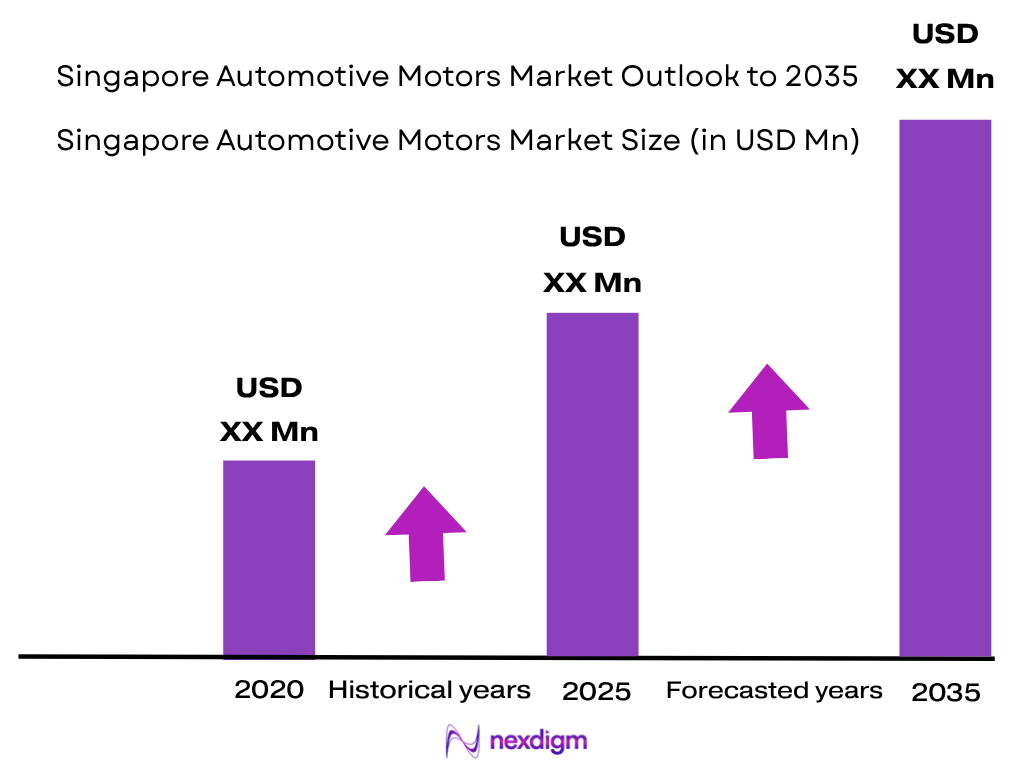
The Singapore Automotive Motors Market is valued at approximately ~USD XX million, based on the requested placeholder valuation. Demand is underpinned by a vehicle population exceeding 996,000 units, compared with more than 974,000 units in the preceding reporting period, alongside over 650,000 cars and station wagons. The combination of passenger cars, commercial vehicles, taxis, private-hire cars and buses sustains demand for starters, alternators, traction motors, HVAC motors, steering motors, electric pumps and other auxiliary motor systems.
Singapore’s automotive motor demand is concentrated around its principal vehicle ownership, logistics, workshop and distribution clusters rather than separate cities because Singapore operates as a city-state. Central, eastern and western industrial-commercial corridors dominate due to concentrations of vehicle distributors, workshops, logistics fleets and automotive parts operations. The national electric-car population expanded from approximately 18,000 units to more than 33,000 units across the two relevant reporting periods, strengthening demand for traction motors, electric thermal-management motors and integrated e-drive components alongside the established ICE and hybrid aftermarket.
Market Segmentation
By Motor Type
The Singapore Automotive Motors Market is segmented by motor type into starter motors, alternators and starter-generators, traction motors, electric power steering motors, HVAC and cooling motors, pump motors and other auxiliary automotive motors. Auxiliary automotive motors hold the dominant analytical market share because modern vehicles incorporate multiple small motors for air-conditioning, cooling, steering, windows, seats, wipers, pumps and other comfort or thermal-management functions. Singapore’s dense urban operating environment, high ambient temperatures and widespread use of air-conditioning increase utilisation of HVAC blowers, cooling fans and electrically driven pumps. The country’s large installed ICE and hybrid vehicle population simultaneously maintains replacement demand for starter motors and alternators. However, traction motors represent the fastest-evolving strategic product category as battery-electric vehicle adoption expands. Increasing hybridisation also creates demand for motor-generators, electric pumps and integrated starter-generator systems. The resulting market combines recurring replacement demand from conventional vehicles with progressively greater motor content from hybrid and battery-electric architectures.

By Vehicle Type
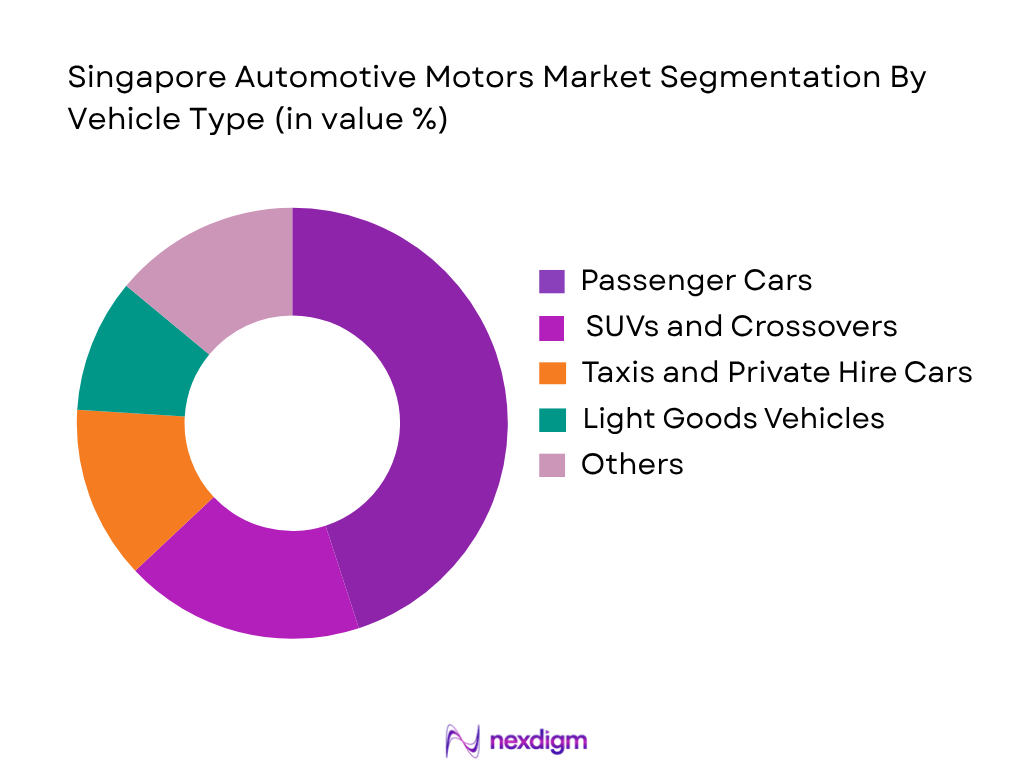
The Singapore Automotive Motors Market is segmented by vehicle type into passenger cars, SUVs and crossovers, taxis and private-hire cars, light goods vehicles, heavy goods vehicles, buses and coaches, and specialist vehicles. Passenger cars hold the dominant analytical market share because cars and station wagons constitute the largest vehicle category within Singapore’s operating vehicle population. Their motor requirements extend beyond starters and alternators to electric steering, HVAC blowers, cooling fans, pumps, power-window motors and increasingly high-voltage traction systems. Singapore’s Certificate of Entitlement framework and vehicle replacement dynamics also encourage comparatively modern vehicle technology, increasing exposure to electronically controlled and electrified systems. Taxi and private-hire fleets represent another important application because high vehicle utilisation increases component operating hours and maintenance requirements. Commercial vehicles and buses contribute demand for higher-output electrical systems, while fleet electrification is creating an emerging requirement for high-power traction motors. The market is therefore becoming increasingly differentiated by vehicle duty cycle and propulsion architecture.
Competitive Landscape
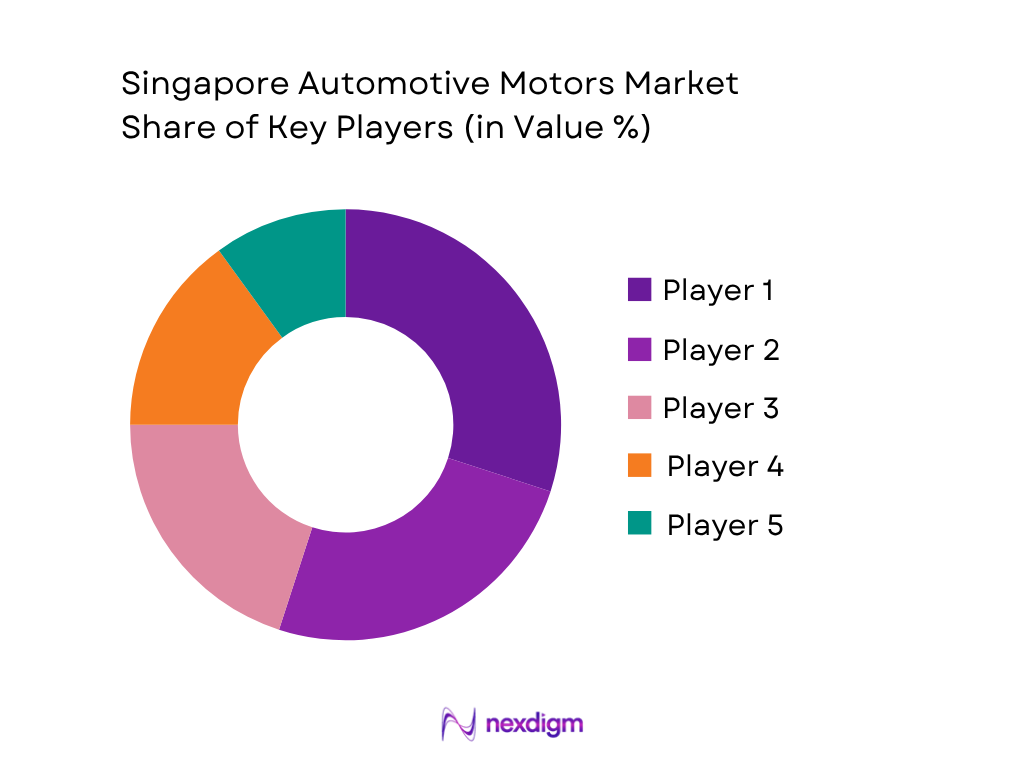
The Singapore Automotive Motors Market is primarily served by established global Tier-1 automotive component manufacturers rather than large domestic motor producers. Bosch, DENSO, Valeo, Mitsubishi Electric and Nidec maintain strong relevance through conventional automotive electrical systems, auxiliary motors and increasingly electrified drivetrain technologies. Competition is shifting toward permanent-magnet traction motors, integrated e-axles, hybrid motor-generators, brushless auxiliary motors and motor-inverter integration. Singapore’s position as a regional logistics and corporate hub additionally makes distribution capability, ASEAN technical support and aftermarket parts availability important competitive differentiators.
| Company | Establishment Year | Headquarters | Starter & Alternator Capability | Traction Motor / E-Drive Capability | Auxiliary Motor Capability | Hybrid / 48V Capability | Singapore / ASEAN Reach | Aftermarket Capability |
| Robert Bosch GmbH | 1886 | Gerlingen, Germany | ~ | ~ | ~ | ~ | ~ | ~ |
| DENSO Corporation | 1949 | Kariya, Japan | ~ | ~ | ~ | ~ | ~ | ~ |
| Valeo SE | 1923 | Paris, France | ~ | ~ | ~ | ~ | ~ | ~ |
| Mitsubishi Electric Corporation | 1921 | Tokyo, Japan | ~ | ~ | ~ | ~ | ~ | ~ |
| Nidec Corporation | 1973 | Kyoto, Japan | ~ | ~ | ~ | ~ | ~ |
Singapore Automotive Motors Market Analysis
Growth Drivers
Rapid Electrification of Singapore’s Passenger Vehicle Base
Electrification is a direct growth driver for the Singapore Automotive Motors Market because each battery-electric vehicle shifts demand from conventional starter motors and alternators toward traction motors, electric compressors, coolant-pump motors, battery thermal-management motors and other high-voltage auxiliaries. Land Transport Authority data show that Singapore’s electric-car population reached 26,225 units in 2024, compared with 11,941 units in 2023, while petrol-electric cars reached 99,157 units in 2024. The broader automotive base also remains substantial, with 1,007,094 motor vehicles operating in Singapore at the end of 2024 and 1,012,023 vehicles at the end of 2025. This means motor suppliers are simultaneously serving a large conventional replacement base and a rapidly expanding electrified fleet. Singapore’s economic capacity supports this technology transition: World Bank data place the country’s 2024 GDP at USD 547.39 billion and GDP per capita at USD 90,674.1. These conditions favor continued adoption of higher-content electric drivetrains and create sustained demand for permanent-magnet traction motors, motor-generators, e-drive assemblies and electronically controlled auxiliary motors.
Large Vehicle Parc and High-Utilisation Mobility Fleets Support Replacement Demand
Singapore’s sizeable operating vehicle population provides a recurring replacement base for starter motors, alternators, HVAC blower motors, cooling fans, electric steering motors, pumps, wiper motors and other automotive electrical components. Land Transport Authority records show 1,007,094 motor vehicles operating at the end of 2024, including 569,956 cars, 90,383 private-hire cars, 13,117 taxis, 18,698 buses and 167,057 goods and other vehicles. Private-hire vehicles are particularly important because their intensive daily operation increases operating hours for cooling, HVAC and auxiliary motor systems. The private-hire population subsequently reached 95,857 units in 2025, while Singapore’s total motor-vehicle population increased to 1,012,023 units. Maintenance intensity is also visible in inspection activity: LTA recorded 368,335 cars presented for inspection in 2024, with 332,560 passing on first inspection. These automotive fundamentals are supported by a 2024 GDP of USD 547.39 billion, according to the World Bank. A large installed vehicle base combined with commercial fleet utilisation therefore sustains aftermarket motor replacement even as propulsion technology changes.
Market Challenges
Import Dependence and Limited Domestic Automotive Manufacturing Increase Supply Exposure
The Singapore Automotive Motors Market is structurally dependent on overseas automotive manufacturing centres for starter motors, alternators, traction motors, permanent magnets, motor-control electronics and complete e-drive assemblies. Singapore has a sophisticated electronics and precision-manufacturing ecosystem, but it does not possess a large domestic passenger-vehicle production base capable of supplying automotive motor demand internally. This dependence is significant because the operating market contained 1,007,094 vehicles in 2024, including 657,744 cars and station wagons before separating private-hire vehicles in LTA’s summary classification. At the same time, the electric-car population reached 26,225 units and petrol-electric cars reached 99,157 units, broadening the range of imported motor technologies required by distributors and workshops. Singapore’s overall merchandise system illustrates its dependence on international trade flows: SingStat recorded S$611.3594 billion of merchandise imports and S$387.9073 billion of re-exports in 2024. World Bank data place 2024 GDP at USD 547.39 billion. Consequently, automotive motor suppliers must manage international sourcing, inventory availability and multiple technology platforms while serving a sophisticated but fundamentally import-led domestic automotive market.
Rapid ICE-to-EV Transition Creates Product, Inventory and Service Complexity
Singapore’s automotive motor suppliers face a dual-technology challenge because conventional internal-combustion, hybrid and fully electric vehicles coexist in substantial numbers. LTA recorded 513,943 petrol cars, 16,775 diesel cars, 99,157 petrol-electric cars, 1,556 plug-in petrol-electric cars and 26,225 fully electric cars at the end of 2024. These architectures require fundamentally different motor portfolios, ranging from 12V starter motors and alternators to hybrid motor-generators, permanent-magnet traction motors, electric compressors and high-voltage coolant pumps. The transition accelerated further in 2025, when Singapore prohibited new registrations of diesel and diesel-natural-gas cars and taxis from 1 January 2025. Vehicle turnover intensifies the challenge: 54,866 vehicles were deregistered in 2024, including 21,516 Category A vehicles, 14,621 Category B vehicles and 7,582 goods vehicles and buses. Suppliers must therefore constantly adjust fitment databases, workshop expertise and inventory composition as older architectures exit and electrified systems enter. World Bank data record Singapore’s 2024 GDP at USD 547.39 billion, underscoring that this technology transition is occurring within a highly developed automotive service economy requiring increasingly sophisticated diagnostics and technical support.
Market Opportunities
EV Charging Expansion Creates a Platform for Traction Motor and E-Drive Demand
Singapore’s expanding charging ecosystem creates a strong future opportunity for traction motors, integrated e-axles, motor-inverter assemblies and high-voltage auxiliary motors because infrastructure availability removes a key operational barrier to electric-vehicle adoption. Current government data already demonstrate substantial deployment. The Ministry of Transport reported more than 19,000 EV charging points across Singapore in March 2025, with more than 60% of HDB carparks equipped with chargers. By October 2025, the nationwide charging network exceeded 25,000 points, including more than 7,500 points across approximately 85% of HDB carparks. The addressable electrified vehicle base is also established: LTA recorded 26,225 electric cars in 2024, while the country had 657,744 cars and station wagons in the same period. This creates significant headroom for conversion of the existing fleet toward electric architectures. World Bank data show Singapore generated USD 547.39 billion of GDP in 2024, providing a strong macroeconomic foundation for technology-intensive transport infrastructure. As charging availability expands, suppliers positioned in PMSM traction motors, e-axles, electric pumps, compressors and thermal-management motors gain a larger future addressable automotive component base.
Commercial Vehicle and Public Bus Electrification Opens Higher-Power Motor Applications
Commercial and public-transport electrification provides an important future growth opportunity because these vehicles require higher-power traction motors, more robust thermal-management systems and electrically driven auxiliary equipment than conventional passenger vehicles. Singapore had around 52,000 heavy vehicles in 2025, according to the Land Transport Authority, creating a sizeable installed base for future drivetrain conversion. Public buses are already moving in this direction. LTA reported 70 electric buses in passenger service from December 2024 after the deployment of an additional 10 buses, while a procurement programme covered 420 electric buses following an additional order under an existing contract. In December 2025, LTA separately awarded contracts for another 660 electric buses, comprising 360 single-deck and 300 double-deck buses, for progressive deployment from the end of 2026. Singapore also recorded 18,268 buses and 143,209 goods and other vehicles in 2024, demonstrating the broader commercial-vehicle ecosystem supporting motor demand. World Bank data place 2024 GDP at USD 547.39 billion. These current indicators establish a clear future opportunity for heavy-duty traction motors, integrated e-drives, electric compressors, steering motors, coolant pumps and depot-oriented drivetrain service capability.
Future Outlook
The Singapore Automotive Motors Market is forecast to expand at approximately ~X.X% CAGR during 2026–2035, using the requested placeholder forecast. The market will progressively shift from conventional starter and alternator replacement demand toward hybrid motor-generators, high-voltage traction motors, integrated e-axles and electrically driven auxiliary systems. Singapore’s national vehicle-electrification strategy will be central to this transition. As battery-electric cars become a larger component of new registrations, conventional starter-motor requirements will gradually decline within new vehicles while demand for permanent-magnet synchronous motors, integrated drive units and high-voltage auxiliary motors increases.
Hybrid vehicles will remain strategically important during the transition because they combine combustion engines with motor-generators, electric pumps and electronically controlled thermal-management systems. This creates a technology bridge between conventional automotive electrical products and fully electric propulsion systems. Taxi, private-hire, bus and commercial fleets provide additional opportunities because their higher utilisation makes drivetrain efficiency, reliability and maintenance capability important. Suppliers capable of supporting both conventional and high-voltage vehicle architectures will be positioned to address Singapore’s changing automotive motor mix.
Major Players
- Robert Bosch GmbH – Starter Motors / Alternators / Auxiliary Motors / Electrified Drive Systems
- DENSO Corporation – Starter Motors / Alternators / Automotive Electrical Systems / Electrification Systems
- Valeo SE – Starter-Alternators / 48V Systems / Electric Motors / Electrified Powertrains
- Mitsubishi Electric Corporation – Starter Motors / Alternators / Electric Powertrain Systems
- Nidec Corporation – Traction Motors / E-Axle Systems / EPS and Auxiliary Automotive Motors
- BorgWarner Inc. – High-Voltage Traction Motors / Integrated Drive Modules / E-Mobility Systems
- ZF Friedrichshafen AG – Electric Motors / E-Drive Systems / Integrated Electric Axles
- MAHLE GmbH – Electric Traction Motors / Auxiliary Drives / Thermal-Electrification Systems
- SEG Automotive Germany GmbH – Starter Motors / Alternators / 48V Electrification Systems
- Magna International Inc. – Electric Motors / E-Drive Systems / Integrated Electric Powertrains
- Schaeffler AG – Electric Motors / Hybrid Modules / Electric Axle Drives
- Astemo, Ltd. – Electric Motors / Inverters / Integrated Electrified Drivetrain Systems
- Hyundai Mobis Co., Ltd. – Traction Motors / Electric Drive Systems / Integrated EV Power Electronics
- AISIN Corporation – Electric Drive Modules / E-Axles / Hybrid and Electrified Drivetrain Systems
- YASA Limited / Mercedes-Benz Group – Axial Flux Electric Motors / High-Performance EV Drive Systems
Key Target Audience
- Automotive Motor and Electric Drive Manufacturers
- Passenger Vehicle and Commercial Vehicle Distributors
- Automotive Component Importers and Authorized Distributors
- Automotive Aftermarket Parts Distributors and Workshop Networks
- Electric Vehicle, Hybrid Powertrain and E-Axle Manufacturers
- Taxi, Private Hire, Bus and Commercial Fleet Operators
- Investments and Venture Capitalist Firms
- Government and Regulatory Bodies (Land Transport Authority, Ministry of Transport, National Environment Agency, Enterprise Singapore, Energy Market Authority)
Research Methodology
Step 1: Identification of Key Variables
The initial phase involves constructing an ecosystem map encompassing automotive motor manufacturers, vehicle distributors, component importers, aftermarket suppliers, workshops, fleet operators and electric-drive companies within the Singapore Automotive Motors Market. Secondary and proprietary databases are assessed to identify vehicle population, propulsion architecture, motor content, replacement cycles, electrification, import dependency and distribution variables influencing market demand.
Step 2: Market Analysis and Construction
Historical information relating to Singapore vehicle registrations, vehicle population, electric and hybrid adoption, automotive component imports and replacement demand is compiled and analysed. Top-down and bottom-up methodologies are applied using vehicle parc, motor content per vehicle, propulsion architecture and replacement requirements to construct starter motor, alternator, traction motor and auxiliary motor demand.
Step 3: Hypothesis Validation and Expert Consultation
Market hypotheses are developed and validated through computer-assisted telephone interviews with automotive component distributors, vehicle dealers, workshops, fleet operators and automotive electrical specialists. These consultations evaluate vehicle fitment, replacement behaviour, product preferences, distribution structures, EV servicing requirements and technology adoption to refine and corroborate the market frameword.
Step 4: Research Synthesis and Final Output
The final phase triangulates demand-side vehicle information with supplier-side automotive motor availability. OEM fitment, aftermarket replacement, hybrid motor-generator adoption, EV traction motor requirements and auxiliary motor demand are reconciled to develop the final market analysis. This process also assesses Singapore’s electrification policy, fleet transition, workshop ecosystem and ASEAN distribution role to validate the market outlook.

- Executive Summary
- Research Methodology (Market Definition and Scope, Singapore Automotive Motor Taxonomy, Starter Motor and Alternator Classification, Traction Motor and E-Drive Classification, Auxiliary Automotive Motor Mapping, Vehicle Population Assessment, New Vehicle Registration Assessment, EV and Hybrid Vehicle Mapping, OEM Fitment Assessment, Aftermarket Replacement Assessment, Automotive Motor Import and Distribution Mapping, Workshop and Service Network Assessment, Market Sizing Framework)

- Definition and Scope
- Singapore Automotive Motor Industry Evolution and Electrification Development
- Automotive Motor Manufacturing and Assembly Process
- Automotive Motor Value Chain Analysis
- Singapore Automotive Motor Supply Chain Analysis
- Rotor, Stator, Electrical Steel, Copper Winding, Permanent Magnet, Bearing and Power Electronics Ecosystem Analysis
- Singapore Automotive Motor Import, Distribution and Regional Logistics Footprint Assessment
- OEM, Authorized Distributor, Independent Aftermarket and Automotive Workshop Framework

- Growth Drivers (Expansion of Electric Vehicle Registrations, High Hybrid Vehicle Penetration, Increasing Automotive Motor Content per Vehicle, Taxi and Private Hire Fleet Electrification, Expansion of EV Charging Infrastructure, Replacement Demand from Existing Vehicle Population, Public Bus Electrification, Increasing Adoption of Electrified Auxiliary Systems)
- Market Challenges (High Dependence on Imported Automotive Motors, Limited Domestic Automotive Manufacturing Base, Vehicle Turnover under Certificate of Entitlement Framework, EV Motor Repair Skill Requirements, High-Voltage Diagnostic Complexity, Permanent Magnet and Semiconductor Supply Exposure, Limited Domestic Vehicle Population, Rapid Transition from ICE to Electrified Motor Architectures)
- Market Opportunities (EV Traction Motor and E-Axle Systems, Hybrid Motor-Generator Systems, Electric Bus and Commercial Vehicle Motors, High-Efficiency Auxiliary Motors, EV Thermal-Management Motors, Traction Motor Diagnostics and Repair, Automotive Motor Remanufacturing, Singapore-Based ASEAN Automotive Parts Distribution)
- Market Trends (Permanent Magnet Synchronous Motor Adoption, Integrated E-Axles, 800V Electrical Architectures, Axial Flux Motor Development, Brushless Auxiliary Motor Adoption, Integrated Motor-Inverter-Reducer Systems, Electrification of Cooling and Pump Systems, Increasing Motor Content per Vehicle)
- Regulatory and Standards Landscape (Land Transport Authority Vehicle Registration Requirements, Electric Vehicles Charging Act, Singapore Standard SS 722 EV Charging Requirements, Vehicle Approval and Certification Requirements, Authorized Inspection Centre Requirements, Vehicular Emissions Scheme, Commercial Vehicle Emissions Scheme, Heavy Vehicle Zero Emissions Scheme, Singapore Green Plan Cleaner-Energy Vehicle Framework)
- SWOT Analysis
- Porter’s Five Forces Analysis
- PESTLE Analysis
- Stakeholder Ecosystem
- Competition Ecosystem

- By Market Value (2020-2025)
- By Automotive Motor Installation Volume (2020-2025)
- By Starter Motor Volume (2020-2025)
- By Alternator and Starter-Generator Volume (2020-2025)
- By Traction Motor Volume (2020-2025)
- By Auxiliary Automotive Motor Volume (2020-2025)

- By Motor Type (In Value %)
Starter Motors
Alternators
Integrated Starter Generators
Belt Starter Generators
EV Traction Motors
Hybrid Traction Motors
Electric Power Steering Motors
HVAC Blower Motors
Cooling Fan Motors
Electric Water Pump Motors
Electric Oil Pump Motors
Electric Compressor Motors
Power Window Motors
Power Seat Motors
Windshield Wiper Motors
Other Auxiliary Automotive Motors - By Vehicle Type (In Value %)
Passenger Cars
SUVs and Crossovers
Luxury and Performance Cars
Taxis
Private Hire Cars
Light Goods Vehicles
Heavy Goods Vehicles
Buses and Coaches
Government and Municipal Vehicles
Special-Purpose Vehicles - By Propulsion Type (In Value %)
Gasoline Internal Combustion Vehicles
Diesel Internal Combustion Vehicles
Petrol-Electric Hybrid Vehicles
Mild Hybrid Vehicles
Plug-In Hybrid Vehicles
Battery Electric Vehicles
Fuel Cell Electric Vehicles
Other Cleaner-Energy Powertrains - By Motor Technology (In Value %)
Brushed DC Motors
Brushless DC Motors
Permanent Magnet Synchronous Motors
AC Induction Motors
Switched Reluctance Motors
Wound Rotor Synchronous Motors
Axial Flux Motors
Integrated Motor-Generator Systems
Other Automotive Motor Technologies - By Sales Channel (In Value %)
OEM and Vehicle Distributor Fitment
Authorized Dealer Service Networks
Independent Automotive Parts Distributors
Independent Workshops and Garages
Fleet Maintenance Networks
Automotive Electrical Specialists
Online Automotive Parts Platforms
Regional Automotive Parts Distributors - By Vehicle Ownership Type (In Value %)
Private Passenger Vehicle Owners
Taxi Fleets
Private Hire Vehicle Fleets
Commercial Goods Vehicle Fleets
Public and Private Bus Fleets
Corporate Vehicle Fleets
Government Vehicle Fleets
Leasing and Rental Fleets

- Market Share of Major Players (By Revenue, Motor Type, Vehicle Application, Propulsion Type, OEM Fitment, Aftermarket Channel, Electrification Capability, Distribution Network)
- Cross Comparison Parameters (Singapore OE and Aftermarket Automotive Motor Portfolio Breadth, Starter Alternator and Hybrid Starter-Generator Capability, EV Traction Motor and Integrated E-Axle Capability, Auxiliary Motor and Thermal-Management Application Coverage, Passenger Taxi Private Hire Commercial and Bus Vehicle Fitment Coverage, High-Efficiency Urban Duty-Cycle and Thermal Performance Capability, Singapore Distributor Parts Availability Diagnostics and Technical Support Network, ASEAN Regional Headquarters Electrification and Automotive Parts Distribution Capability)
- SWOT Analysis of Major Players
- Competitive Positioning Matrix
- Product and Technology Portfolio Benchmarking
- Pricing and Distribution Network Benchmarking
- Market Entry Strategy Assessment
- Detailed Profiles of Major Companies
Robert Bosch GmbH – Starter Motors / Alternators / Auxiliary Motors / Electrified Drive Systems
DENSO Corporation – Starter Motors / Alternators / Automotive Electrical Systems / Electrification Systems
Valeo SE – Starter-Alternators / 48V Systems / Electric Motors / Electrified Powertrains
Mitsubishi Electric Corporation – Starter Motors / Alternators / Electric Powertrain Systems
Nidec Corporation – Traction Motors / E-Axle Systems / EPS and Auxiliary Automotive Motors
BorgWarner Inc. – High-Voltage Traction Motors / Integrated Drive Modules / E-Mobility Systems
ZF Friedrichshafen AG – Electric Motors / E-Drive Systems / Integrated Electric Axles
MAHLE GmbH – Electric Traction Motors / Auxiliary Drives / Thermal-Electrification Systems
SEG Automotive Germany GmbH – Starter Motors / Alternators / 48V Electrification Systems
Magna International Inc. – Electric Motors / E-Drive Systems / Integrated Electric Powertrains
Schaeffler AG – Electric Motors / Hybrid Modules / Electric Axle Drives
Astemo, Ltd. – Electric Motors / Inverters / Integrated Electrified Drivetrain Systems
Hyundai Mobis Co., Ltd. – Traction Motors / Electric Drive Systems / Integrated EV Power Electronics
AISIN Corporation – Electric Drive Modules / E-Axles / Hybrid and Electrified Drivetrain Systems
YASA Limited / Mercedes-Benz Group – Axial Flux Electric Motors / High-Performance EV Drive Systems

- Automotive Motor Buyer Segmentation
- Vehicle Distributor and Workshop Procurement Behaviour
- Automotive Motor Supplier Selection Criteria
- Fleet and Workshop Buyer Pain Points
- Motor Technology and Electrification Adoption Assessment
- Replacement and Repurchase Behaviour

- By Market Value (2026-2035)
- By Automotive Motor Installation Volume (2026-2035)
- By Starter Motor Volume (2026-2035)
- By Alternator and Starter-Generator Volume (2026-2035)
- By Traction Motor Volume (2026-2035)
- By Auxiliary Automotive Motor Volume (2026-2035)


 Request a Sample
 Ask for Customization
 Get a Quote
 Enquire Now