
 Download PDF
Market Overview
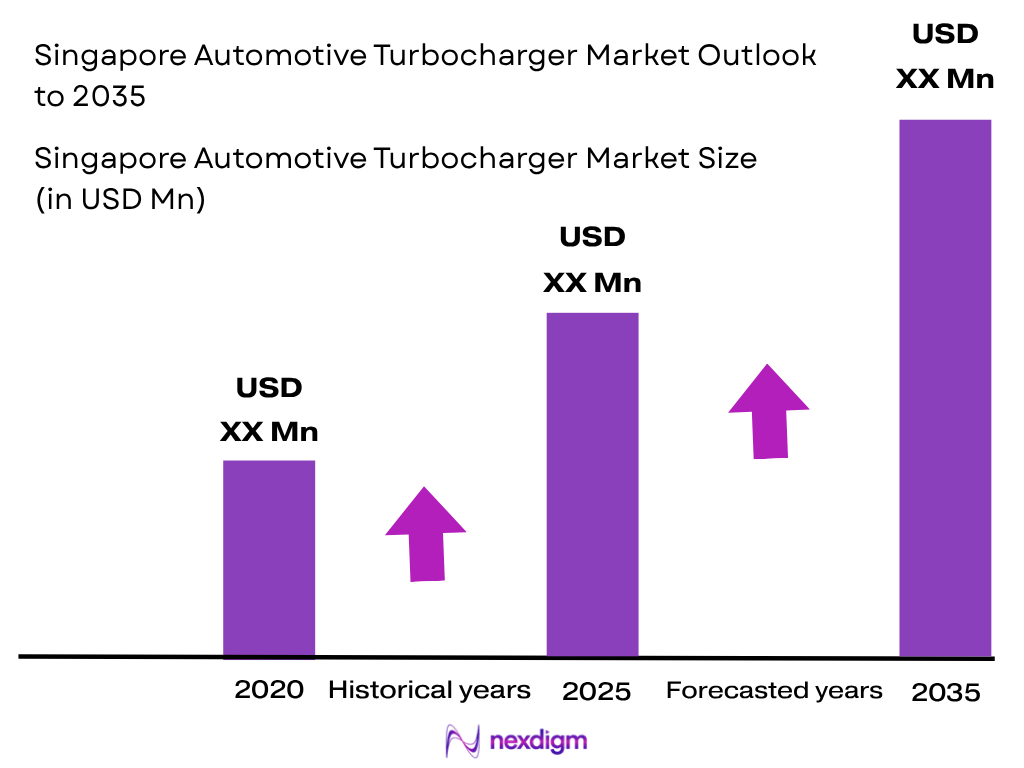
The Singapore automotive turbocharger market is valued at ~USD ~ million in 2024, compared with ~USD ~ million in 2023, supported by the country’s large installed vehicle base, continued turbocharged-engine fitment and replacement demand. LTA recorded 657,744 cars, 143,209 goods and other vehicles, and 18,268 buses at the end of 2024. The goods-vehicle population included 31,492 heavy goods vehicles and 16,723 very heavy goods vehicles, creating a recurring aftermarket requirement for diesel turbochargers, CHRAs, actuators and repair components.
Singapore’s turbocharger demand is concentrated around the Singapore metropolitan market, with commercial activity clustered around Jurong, Tuas, Changi, Woodlands and the central logistics corridors. This concentration reflects the country’s role as a regional logistics and automotive-service hub rather than a geographically dispersed vehicle market. LTA recorded 143,209 goods and other vehicles in 2024, including light, heavy and very heavy goods vehicles, while the country also had 18,268 buses. Singapore’s adoption of Euro VI for new and used imported petrol and diesel vehicles and WLTP requirements further supports technically advanced turbocharger applications.
Market Segmentation
By Vehicle Type
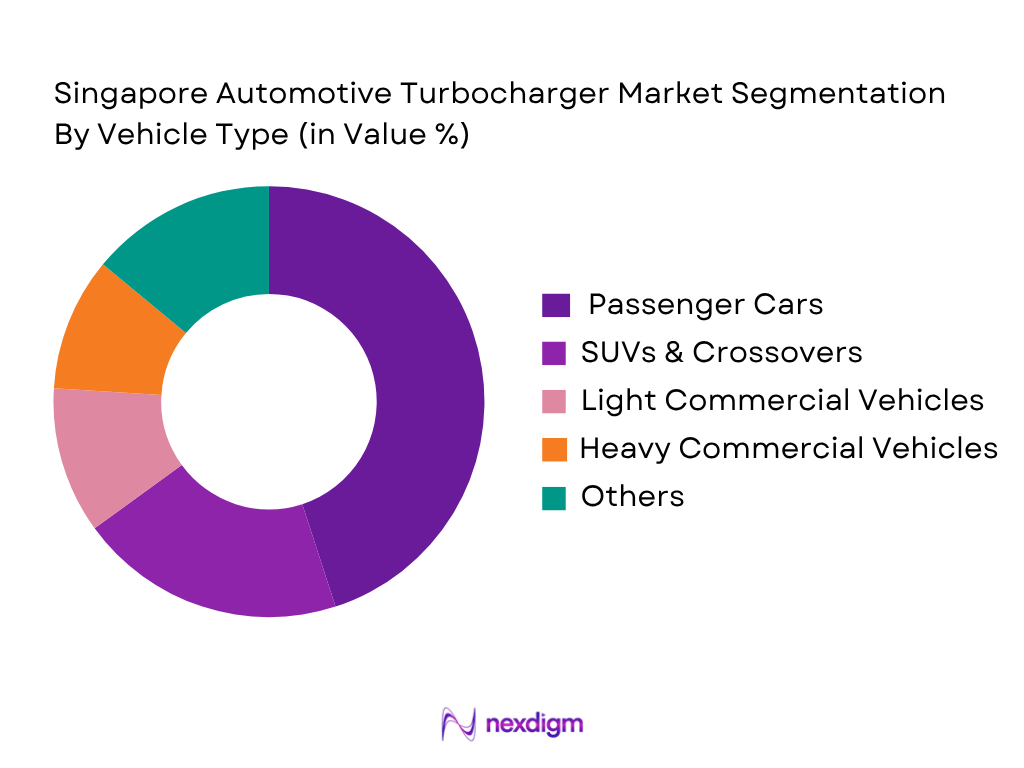
The Singapore automotive turbocharger market is segmented by vehicle type into passenger cars, SUVs and crossovers, light commercial vehicles, heavy commercial vehicles, very heavy commercial vehicles, buses, taxis and private-hire vehicles. Passenger cars represent the dominant segment at ~XX% of the 2024 market, primarily because of the substantially larger installed passenger-vehicle base and the growing use of turbocharged downsized gasoline engines. LTA recorded 657,744 cars and station wagons at the end of 2024, compared with 143,209 goods and other vehicles and 18,268 buses. Within commercial applications, diesel-powered HGVs and VHGVs remain important because of their higher utilization, payload requirements and dependence on forced induction for torque and engine efficiency. The passenger-car segment also benefits from turbocharging across premium vehicles, SUVs and smaller displacement engines where manufacturers use forced induction to deliver higher specific output while meeting fuel-efficiency and emissions requirements. Meanwhile, Singapore’s dense urban environment produces frequent stop-start operation, making component durability, thermal management and oil-quality maintenance important factors in turbocharger replacement. The relatively large passenger-car population therefore creates the broadest potential customer base, while commercial vehicles generate higher-value and more technically demanding replacement opportunities.
By Sales Channel
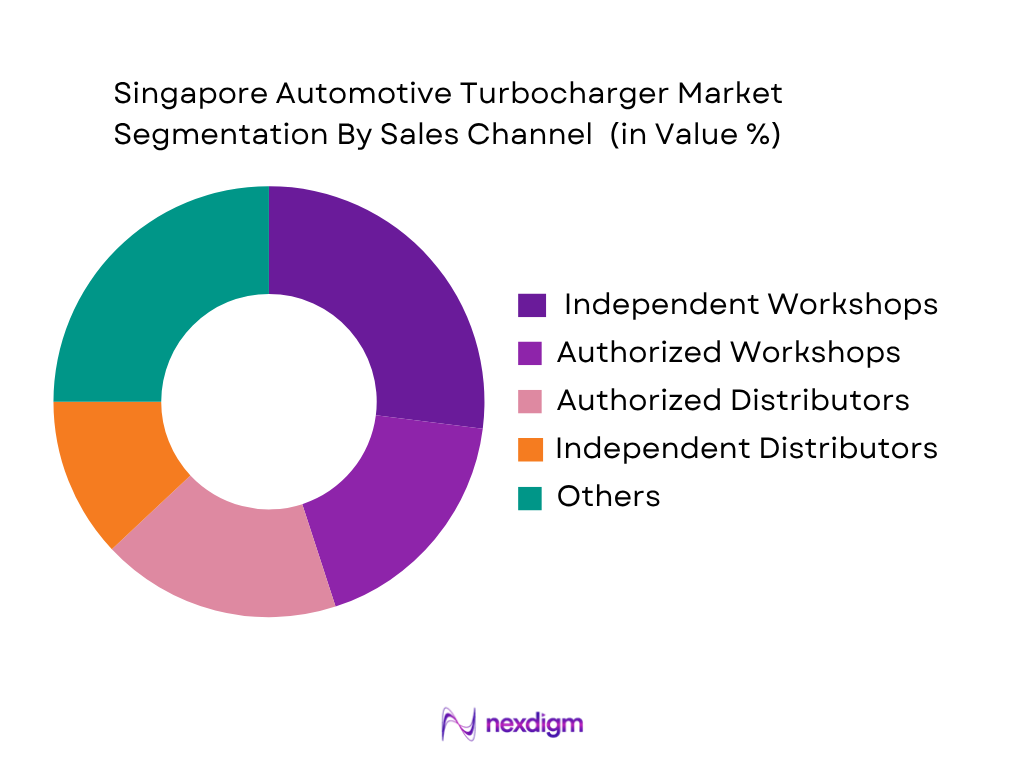
The Singapore automotive turbocharger market is segmented by sales channel into OEM supply, authorized distributors, independent distributors, authorized workshops, independent workshops, spare-parts retailers, e-commerce and remanufacturing specialists. The aftermarket and independent workshop channel accounts for the leading share at ~XX%, reflecting Singapore’s mature vehicle-maintenance ecosystem and the importance of replacement turbochargers after vehicles enter the operating fleet. LTA maintains dedicated datasets covering goods-vehicle and bus populations by make, vehicle age, maximum laden weight and fuel type, providing a strong structural base for aftermarket demand analysis. Singapore also has specialized turbocharger distributors with regional coverage; Turbo One, headquartered in Singapore, identifies Garrett, BorgWarner, Mitsubishi, Holset and IHI among its appointed brands. Independent workshops and diesel specialists influence purchasing decisions because turbocharger failures frequently require diagnosis, removal, balancing, CHRA replacement, actuator calibration or complete-unit replacement. The channel also benefits from the availability of OE-equivalent, remanufactured and component-level solutions, allowing fleet operators to select between complete replacement and repair depending on vehicle age and downtime requirements. OEM demand remains strategically important for newly registered turbocharged vehicles, but the aftermarket has greater relevance for the existing vehicle population and recurring replacement cycle.
Competitive Landscape
The Singapore automotive turbocharger market is characterized by international turbocharger manufacturers combined with specialized local distributors, repair specialists and aftermarket suppliers. Competition is shaped by OEM qualification, turbocharger technology, commercial-vehicle coverage, replacement-part availability, workshop support and regional distribution capability. Turbo One is particularly relevant to the Singapore market because it operates as a Singapore-headquartered master distributor for Garrett, BorgWarner, Mitsubishi, Holset and IHI across multiple Southeast Asian markets. PTI also identifies itself as an appointed dealer and service centre for these major turbocharger brands and provides repair capabilities for VNT and ball-bearing turbochargers.
| Company | Establishment | Headquarters | Key Product Focus | Technology Coverage | Vehicle Coverage | Singapore Market Position | Aftermarket Capability | Regional Reach |
| Garrett Motion | 1954 | Rolle, Switzerland | ~ | ~ | ~ | ~ | ~ | ~ |
| BorgWarner | 1928 | Auburn Hills, USA | ~ | ~ | ~ | ~ | ~ | ~ |
| Cummins / Holset | 1919 | Columbus, USA | ~ | ~ | ~ | ~ | ~ | ~ |
| Mitsubishi Heavy Industries | 1884 | Tokyo, Japan | ~ | ~ | ~ | ~ | ~ | ~ |
| IHI Corporation | 1853 | Tokyo, Japan | ~ | ~ | ~ | ~ | ~ | ~ |
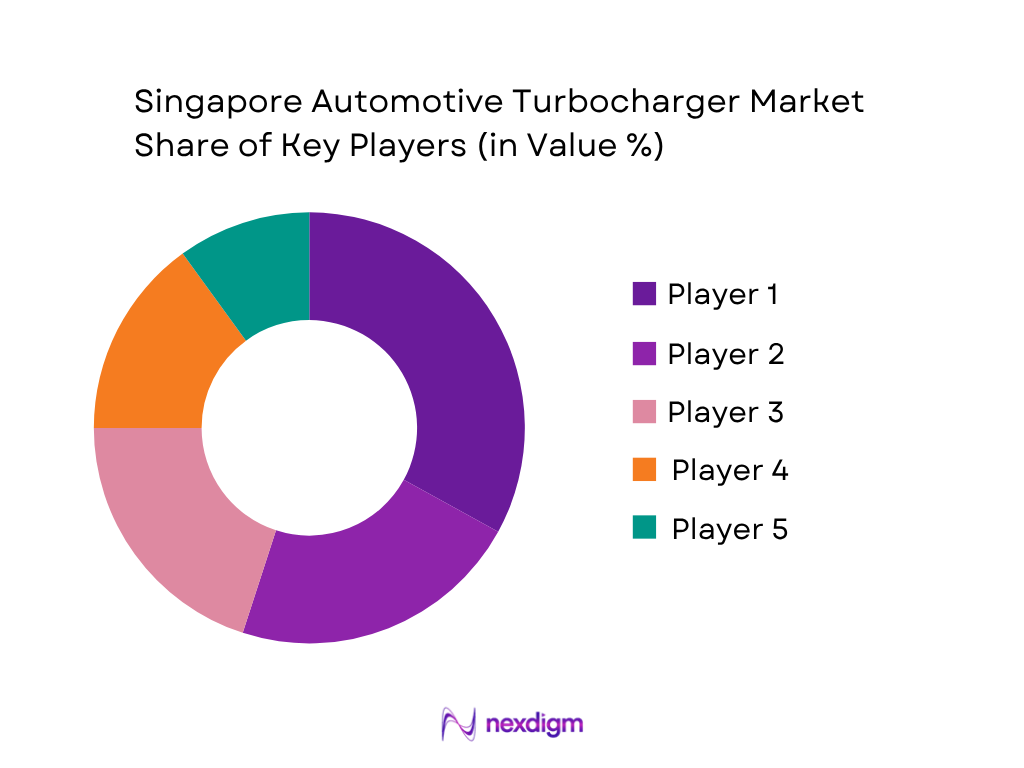
Singapore Automotive Turbocharger Market Analysis
Growth Drivers
Turbocharged Vehicle Penetration and Engine Downsizing
Singapore’s automotive market provides a technically favorable environment for turbocharger demand because the vehicle fleet is increasingly concentrated around newer, more efficient powertrains while the country maintains a substantial installed base of combustion and hybrid vehicles. The Land Transport Authority recorded 657,744 cars at the end of 2024, compared with 651,302 in 2022, providing a large installed base for turbocharged passenger-car applications. Within this fleet, 99,157 petrol-electric hybrid cars and 26,225 fully electric cars were recorded in 2024, while 16,775 diesel cars remained in operation. The continued presence of combustion and hybrid vehicles is particularly relevant because downsized turbocharged engines are widely used to deliver higher specific power while maintaining lower displacement. Singapore’s broader economic environment also supports continued vehicle replacement and technology upgrading: the World Bank recorded GDP of US$547.39 billion, GDP per capita of US$90,674.1, and 4.4% GDP growth in 2024. Manufacturing also remained substantial, with the Economic Development Board recording S$429.584 billion of manufacturing output and S$116.595 billion of manufacturing value added. Transport engineering output reached S$37.849 billion, up from S$32.6 billion in 2023. These indicators support demand for technologically advanced automotive components and replacement systems, including turbochargers, variable-geometry systems and electronically controlled boosting technologies.
Commercial Fleet Utilization and Vehicle-Parc Replacement
Singapore’s commercial vehicle ecosystem creates an important recurring demand base for turbochargers because goods vehicles, heavy vehicles and buses operate at higher utilization intensity than many private vehicles and therefore place greater operating demands on forced-induction systems. The Land Transport Authority recorded 143,209 goods and other vehicles and 18,268 buses in 2024. Within goods and other vehicles, the fleet included 92,661 light goods vehicles, 31,492 heavy goods vehicles, and 16,723 very heavy goods vehicles, while the number of goods and other vehicles remained above 143,000 units despite Singapore’s tightly controlled vehicle population. Singapore also applies a highly structured replacement environment through the Certificate of Entitlement system; the LTA reported 153,040 Category C goods vehicles and buses at the end of December 2024. This creates a defined vehicle-renewal cycle that supports continuing demand for turbocharger-equipped replacement vehicles as well as aftermarket service requirements for vehicles remaining in operation. The wider economic base reinforces commercial utilization: the World Bank recorded 4.4% GDP growth and US$547.39 billion GDP in 2024, while Singapore’s manufacturing sector generated S$429.584 billion in total output. Transport engineering alone generated S$37.849 billion, demonstrating a substantial industrial and logistics ecosystem requiring road-based commercial transportation. Singapore’s merchandise trade also provides a direct logistics underpinning, with machinery and transport equipment generating S$363.2 billion of non-oil merchandise exports and S$322.1 billion of imports in 2024. High utilization, structured fleet replacement and intensive logistics activity therefore sustain turbocharger servicing, replacement and component demand across light commercial, heavy commercial and bus applications.
Market Challenges
Limited Domestic Vehicle Manufacturing and Imported Component Dependence
Singapore’s automotive turbocharger industry faces structural dependence on imported vehicles, powertrain systems and replacement components because the country does not operate a large-scale domestic passenger-vehicle manufacturing base. This makes the market highly dependent on international OEM and aftermarket supply chains for turbocharger assemblies, cartridges, actuators, bearings, compressor wheels and related engine components. The scale of Singapore’s external trade demonstrates the depth of this dependence. SingStat recorded S$322.1 billion of machinery and transport-equipment imports in 2024, while machinery and transport equipment accounted for S$363.2 billion of exports. Singapore’s overall manufacturing sector remained highly integrated with international supply chains, generating S$429.584 billion in manufacturing output across 9,858 establishments in 2024. Transport engineering contributed S$37.849 billion, while precision engineering contributed S$51.983 billion, creating a sophisticated industrial base but not eliminating reliance on imported automotive platforms and specialized components. The World Bank recorded US$547.39 billion GDP and US$90,674.1 GDP per capita in 2024, indicating strong purchasing capacity but also a highly trade-dependent economy. The automotive installed base further illustrates the exposure: Singapore had 657,744 cars, 143,209 goods and other vehicles, and 18,268 buses at the end of 2024, yet the majority of vehicle brands and turbocharger systems originate from overseas manufacturers. Consequently, distributors and workshops must manage international lead times, model-specific component compatibility and inventory requirements across multiple global turbocharger families. For the aftermarket, this can increase technical complexity because turbochargers cannot always be substituted purely on physical dimensions; compressor maps, actuator calibration, electronic control architecture, oil-feed requirements and engine-management compatibility must also be matched.
Small Addressable Vehicle Base, High Parts Prices and Skilled Repair Requirements
Singapore’s compact vehicle population limits the absolute addressable volume for automotive turbocharger replacement compared with larger Southeast Asian markets, while the technical complexity of modern turbochargers raises the importance of specialized diagnostic and repair capabilities. The LTA recorded 657,744 cars, 143,209 goods and other vehicles, and 18,268 buses at the end of 2024, establishing a sizeable but geographically constrained vehicle parc. More importantly for turbocharger demand, the combustion fleet is gradually being displaced by electrification: Singapore recorded 26,225 fully electric cars, 99,157 petrol-electric hybrids, and 16,775 diesel cars in 2024. The LTA subsequently stated that EVs represented about one-third of new car registrations in 2024, compared with 18% in 2023, while about half of new light-goods-vehicle registrations were electric. The agency also identified approximately 52,000 heavy vehicles as contributing around 31% of land-transport emissions, making commercial electrification a strategic priority. These conditions create a dual challenge for turbocharger suppliers: the existing combustion fleet continues to require maintenance, but the addressable installed base is progressively shifting toward hybrid and battery-electric platforms. At the same time, turbocharger repair requires specialized capabilities covering shaft balancing, actuator calibration, variable-nozzle inspection, compressor and turbine-wheel assessment, oil-system diagnosis and electronic fault identification. Singapore’s manufacturing ecosystem provides technical depth, with S$51.983 billion of precision-engineering output and S$37.849 billion of transport-engineering output in 2024, but specialist turbocharger expertise remains a narrower aftermarket competency. The resulting market structure favors technically capable distributors and workshops while creating barriers for general repair businesses seeking to enter the turbocharger segment.
Market Opportunities
Aftermarket Replacement, VGT/VNT Adoption and Turbocharger Remanufacturing
The Singapore aftermarket presents an opportunity for suppliers that can combine replacement turbochargers with diagnostics, actuator servicing, variable-geometry maintenance and remanufacturing rather than competing solely through standard replacement units. Singapore’s installed commercial fleet provides a recurring technical-service base: the LTA recorded 31,492 heavy goods vehicles, 16,723 very heavy goods vehicles, 92,661 light goods vehicles, and 18,268 buses in 2024. These vehicles generally place greater thermal and mechanical loads on forced-induction systems and can generate higher-value repair requirements when turbocharger faults affect vehicle availability. The replacement opportunity is supported by Singapore’s structured fleet-renewal system. The LTA recorded 153,040 Category C goods vehicles and buses at the end of December 2024, creating a regulated fleet environment in which operators continuously evaluate replacement versus continued operation. Singapore’s industrial capabilities also support more sophisticated repair activities. The Economic Development Board recorded S$37.849 billion of transport-engineering output and S$51.983 billion of precision-engineering output in 2024, providing a substantial engineering ecosystem for machining, balancing, component refurbishment and electronic-system servicing. The wider economy recorded US$547.39 billion GDP and US$90,674.1 GDP per capita, supporting demand for uptime-oriented commercial services. VGT/VNT technology is particularly relevant to diesel commercial vehicles because variable turbine geometry can improve boost response across changing engine speeds and load conditions, while electronically controlled actuators create additional requirements for calibration and diagnostics. Remanufacturing can extend the addressable aftermarket by allowing workshops to restore turbocharger assemblies rather than relying exclusively on complete replacement. Suppliers able to provide cartridge-level repair, balancing, actuator testing and diagnostic support can therefore capture value from an existing vehicle parc even as new-vehicle electrification gradually increases.
E-Turbo Technology, Hybrid Turbocharging, Commercial Applications and Regional Distribution
Singapore’s combination of advanced manufacturing, strong logistics connectivity and rapid vehicle electrification creates an opportunity to transition from conventional turbochargers toward electrically assisted boosting, hybrid turbocharging and electronically managed forced-induction systems. The LTA reported that 26,225 fully electric cars and 99,157 petrol-electric hybrid cars were already present in Singapore at the end of 2024, while EVs represented about one-third of new car registrations during the year. This shift does not eliminate turbocharger demand immediately because hybrid vehicles can retain internal-combustion engines and increasingly require compact, responsive and electronically controlled boosting systems. Commercial vehicles provide an additional opportunity. Singapore had 31,492 heavy goods vehicles, 16,723 very heavy goods vehicles, and 18,268 buses in 2024, while the LTA identified around 52,000 heavy vehicles as accounting for about 31% of land-transport emissions. These figures create a policy and operational rationale for technologies that improve engine efficiency during the transition toward zero-emission commercial fleets. Singapore’s industrial infrastructure is suited to this technology shift: EDB recorded S$429.584 billion manufacturing output in 2024, including S$37.849 billion from transport engineering, S$51.983 billion from precision engineering, and S$181.166 billion from electronics. The electronics base is particularly relevant to electronically controlled turbocharger actuators, sensors, power electronics and integrated engine-management systems. Singapore’s trade position further strengthens its potential as a regional distribution hub: machinery and transport equipment generated S$363.2 billion in exports and S$322.1 billion in imports in 2024. Consequently, suppliers can use Singapore not only as a domestic aftermarket market but also as a distribution, technical-support and regional service center for advanced turbocharger components serving Southeast Asian vehicle fleets.
Future Outlook
Over the forecast period, the Singapore automotive turbocharger market is expected to expand at a ~XX% CAGR during 2026–2035, reaching approximately USD ~ million by 2035. Growth will be influenced by the installed base of turbocharged vehicles, commercial-fleet utilization, replacement demand and continued adoption of downsized engines. At the same time, battery-electric vehicles will progressively reduce the addressable internal-combustion-engine base. The transition will not eliminate turbocharger demand immediately. Hybrid vehicles can retain turbocharged internal-combustion engines, while commercial fleets continue to require high torque and energy efficiency. Singapore’s Euro VI framework also encourages increasingly sophisticated engine and air-management systems.
The strongest opportunities are expected in VGT/VNT systems, electronically actuated turbochargers, hybrid-compatible turbocharging, heavy-commercial-vehicle applications, remanufacturing, CHRA replacement and diagnostic-led aftermarket services. The availability of LTA datasets covering vehicle type, fuel, age, make and maximum laden weight provides a granular basis for forecasting replacement demand.
Major Players
- Garrett Motion
- BorgWarner Inc.
- Cummins Inc. / Holset
- Mitsubishi Heavy Industries
- IHI Corporation
- MAHLE GmbH
- Continental AG
- Robert Bosch GmbH
- BMTS Technology
- Marelli
- Toyota Industries Corporation
- Turbo Energy Private Limited
- Rotomaster
- Precision Turbo & Engine
- Turbo One Pte. Ltd.
Key Target Audience
- Automotive OEMs and Vehicle Importers
- Turbocharger Manufacturers and Component Suppliers
- Automotive Aftermarket Distributors and Spare-Parts Wholesalers
- Commercial Vehicle Fleet Operators and Logistics Companies
- Automotive Workshops and Turbocharger Repair Specialists
- Investments and Venture Capitalist Firms
- Government and Regulatory Bodies (Land Transport Authority, National Environment Agency, Ministry of Transport)
- Automotive Parts Trading and Regional Distribution Companies
Research Methodology
Step 1: Identification of Key Variables
The research begins with construction of a Singapore automotive turbocharger ecosystem covering vehicle OEMs, engine manufacturers, turbocharger suppliers, distributors, workshops, fleet operators and end users. Key variables include vehicle population, turbocharged-engine penetration, fuel type, vehicle age, mileage, engine displacement, turbocharger technology and replacement frequency.
Step 2: Market Analysis and Construction
Historical vehicle-population and registration datasets are analyzed alongside turbocharger fitment patterns and aftermarket replacement cycles. LTA’s vehicle statistics provide vehicle-type, fuel-type, age, make and maximum-laden-weight information, enabling the market to be reconstructed by passenger and commercial application. (Land Transport Authority)
Step 3: Hypothesis Validation and Expert Consultation
Market hypotheses are validated through interviews with turbocharger distributors, automotive workshops, commercial-fleet operators, parts suppliers and technical specialists. Discussions focus on replacement intervals, failure modes, preferred brands, product availability, repair-versus-replacement decisions and technology adoption.
Step 4: Research Synthesis and Final Output
Bottom-up estimates derived from vehicle population, turbocharger fitment and replacement demand are reconciled with supply-side assessments. Company portfolios, distribution structures and aftermarket presence are subsequently benchmarked to produce market sizing, segmentation, competitive positioning and future-market scenarios.

- Executive Summary
- Research Methodology (Market Definition, Scope, Market Boundary, Turbocharger Classification, Revenue Assessment, Unit-Volume Estimation, OEM Fitment Analysis, Vehicle-Parc Modeling, Replacement-Demand Modeling, Import and Distribution Analysis, Top-Down Market Sizing, Bottom-Up Market Sizing, Primary Interviews, Secondary Research, Data Triangulation, Forecasting Framework, Scenario Analysis, Sensitivity Analysis, Assumptions and Limitations)

- Definition and Scope
- Singapore Automotive Industry and Powertrain Landscape
- Evolution of Turbocharging in Singapore
- Automotive Turbocharger Value Chain
- Singapore Turbocharger Supply Chain

- Growth Drivers (Turbocharged Vehicle Penetration, Engine Downsizing, Fuel-Efficiency Requirements, Commercial Fleet Utilization, Vehicle-Parc Expansion, Replacement Demand)
Market Challenges (Limited Domestic Vehicle Manufacturing, Imported Component Dependence, Small Addressable Vehicle Base, High Parts Prices, Skilled Turbocharger Repair Requirements, EV Substitution) - Market Opportunities (Aftermarket Replacement, VGT/VNT Adoption, E-Turbo Technology, Hybrid Turbocharging, Commercial Vehicle Applications, Turbocharger Remanufacturing, Regional Distribution)
- Singapore Automotive Turbocharger Regulatory and Industry Environment (Vehicle Registration, Emissions Certification, Imported Vehicle Compliance, Fuel Quality, Vehicle Inspection, Commercial Vehicle Regulation)
- SWOT Analysis
- Porter’s Five Forces Analysis
- PESTLE Analysis

- By Market Value (2020-2025)
- By Turbocharger Unit Volume (2020-2025)
- By Average Selling Price (2020-2025)
- By OEM Turbocharger Revenue (2020-2025)
- By Aftermarket Turbocharger Revenue (2020-2025)
- By Turbocharged Vehicle Population (2020-2025)

- By Vehicle Type (in value %)
Passenger Cars
SUVs and Crossovers
Pickup Trucks
Light Commercial Vehicles
Medium Commercial Vehicles
Heavy Commercial Vehicles
Buses
Taxis and Private-Hire Vehicles - By Engine Type (in value %)
Gasoline Engines
Diesel Engines
Hybrid Gasoline Engines
Mild-Hybrid Engines
Plug-in Hybrid Engines
Natural-Gas Engines - By Turbocharger Technology (in value %)
Wastegate Turbochargers
Variable Geometry Turbochargers
Variable Nozzle Turbochargers
Twin-Turbochargers
Sequential Twin-Turbochargers
Two-Stage Turbochargers
Electrically Assisted Turbochargers
Electric Turbochargers - By Engine Displacement (in value %)
Below 1.0 Litre
1.0–1.5 Litres
1.5–2.0 Litres
2.0–3.0 Litres
3.0–4.0 Litres
Above 4.0 Litres - By Turbocharger Configuration (in value %)
Single Turbo
Twin Turbo
Parallel Twin Turbo
Sequential Twin Turbo
Two-Stage Turbo
Variable Geometry Turbo - By Fuel Type (in value %)
Petrol
Diesel
Hybrid Petrol
Hybrid Diesel
Natural Gas

- Market Share of Major Players (By Revenue, Unit Volume, OEM, Aftermarket, Vehicle Type, Engine Type, Technology, Sales Channel)
- Cross Comparison Parameters (OEM Platform Coverage, Turbocharger Product Portfolio Breadth, VGT/VNT Technology Capability, E-Turbo Technology Capability, Commercial Vehicle Engine Coverage, Aftermarket Part-Number Coverage, Singapore Distribution Network Reach, Repair and Remanufacturing Capability)
- SWOT Analysis of Major Players
- Detailed Profiles of Major Companies
Garrett Motion
BorgWarner Inc.
Cummins Inc. / Cummins Turbo Technologies
Mitsubishi Heavy Industries
IHI Corporation
MAHLE GmbH
Continental AG
Robert Bosch GmbH
BMTS Technology
Marelli
Toyota Industries Corporation
Turbo Energy Private Limited
Rotomaster
Precision Turbo & Engine
Turbo One Pte. Ltd.

- Vehicle Owner and Fleet Operator Profile
- Turbocharged Vehicle Usage Behavior
- Turbocharger Replacement Behavior
- OEM versus Aftermarket Purchase Preference
- Turbocharger Brand Preference
- Purchase Decision Factors
- Price Sensitivity and Value Perception

- By Market Value (2026-2035)
- By Turbocharger Unit Volume (2026-2035)
- By Average Selling Price (2026-2035)
- By OEM Turbocharger Revenue (2026-2035)
- By Aftermarket Turbocharger Revenue (2026-2035)
- By Turbocharged Vehicle Population (2026-2035)


 Request a Sample
 Ask for Customization
 Get a Quote
 Enquire Now