
 Download PDF
Market Overview
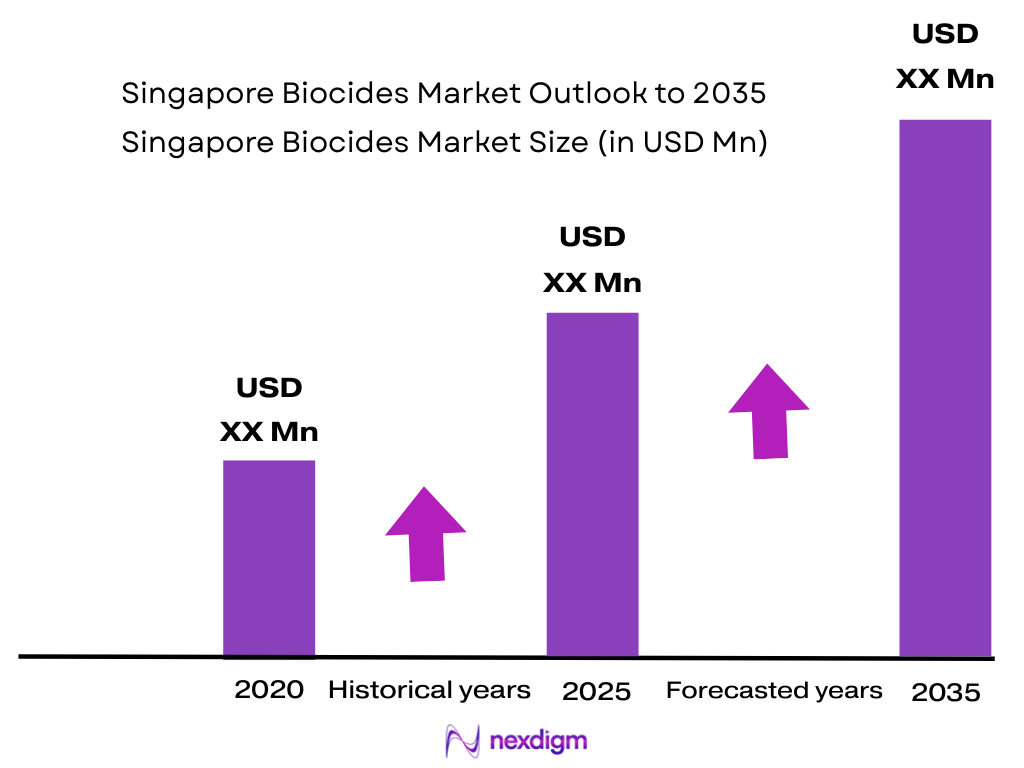
The Singapore Biocides Market is valued at ~USD 75.48 million in 2024, with demand supported by water reclamation, desalination, industrial cooling, semiconductor manufacturing, biopharmaceutical production, food processing and specialty chemicals. Singapore’s economy generated USD 547.39 billion of GDP in 2024, compared with approximately USD 511.18 billion in 2023, while GDP growth accelerated to 4.4 from 1.1. The country’s highly industrialized economy and water-intensive advanced-manufacturing base create recurring requirements for microbial control across process water, membranes, cooling systems and manufacturing environments.
Singapore is a city-state, so demand is concentrated within its principal industrial and commercial clusters rather than dispersed across multiple cities. Jurong Island, Tuas, Changi, Woodlands and the western industrial corridor are particularly important because they contain petrochemical, pharmaceutical, semiconductor, water-reclamation and advanced-manufacturing infrastructure. Singapore’s population reached 6,036,860 in 2024 versus 5,917,648 in 2023, while its economy expanded to USD 547.39 billion. The concentration of industrial infrastructure and extremely high water-quality requirements supports localized demand for specialty biocides.
Market Segmentation
By Product Type
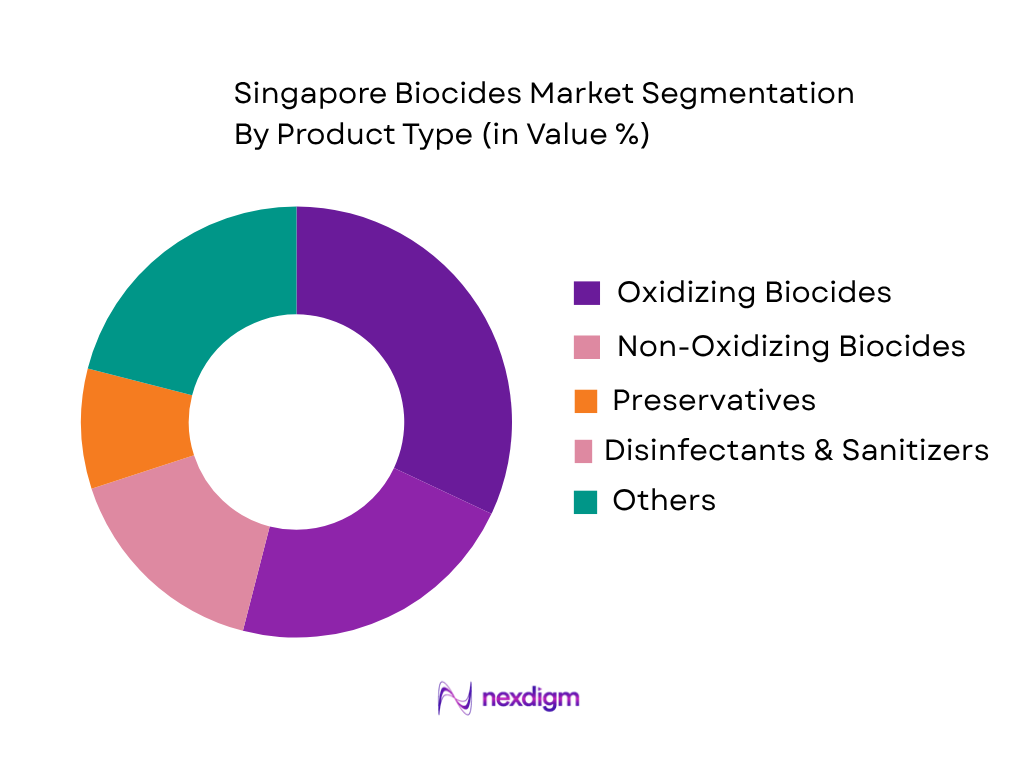
The Singapore Biocides Market is segmented into oxidizing biocides, non-oxidizing biocides, preservatives, disinfectants and sanitizers, antimicrobial additives, biofilm-control agents and other specialty biocides. Oxidizing biocides are positioned as a leading category because they provide broad-spectrum microbial control across water treatment, cooling systems, industrial sanitation and wastewater applications. Singapore’s highly integrated water system increases the relevance of microbial-control chemistry: PUB manages an extensive water-reclamation ecosystem in which NEWater is used for industrial applications, while the country’s total water demand is approximately 440 million gallons per day. Industrial users require consistent microbial control in cooling-water loops, process-water systems and membrane-related applications. Non-oxidizing biocides remain important where longer-lasting treatment or specific microbial targeting is required, while preservatives serve coatings, polymers, personal care and other formulated products. Disinfectants and sanitizers have a separate demand base in healthcare, food processing, hospitality and institutional applications. The product structure is therefore shaped less by household consumption and more by Singapore’s concentration of high-value industrial processes requiring controlled microbial environments.
By Application
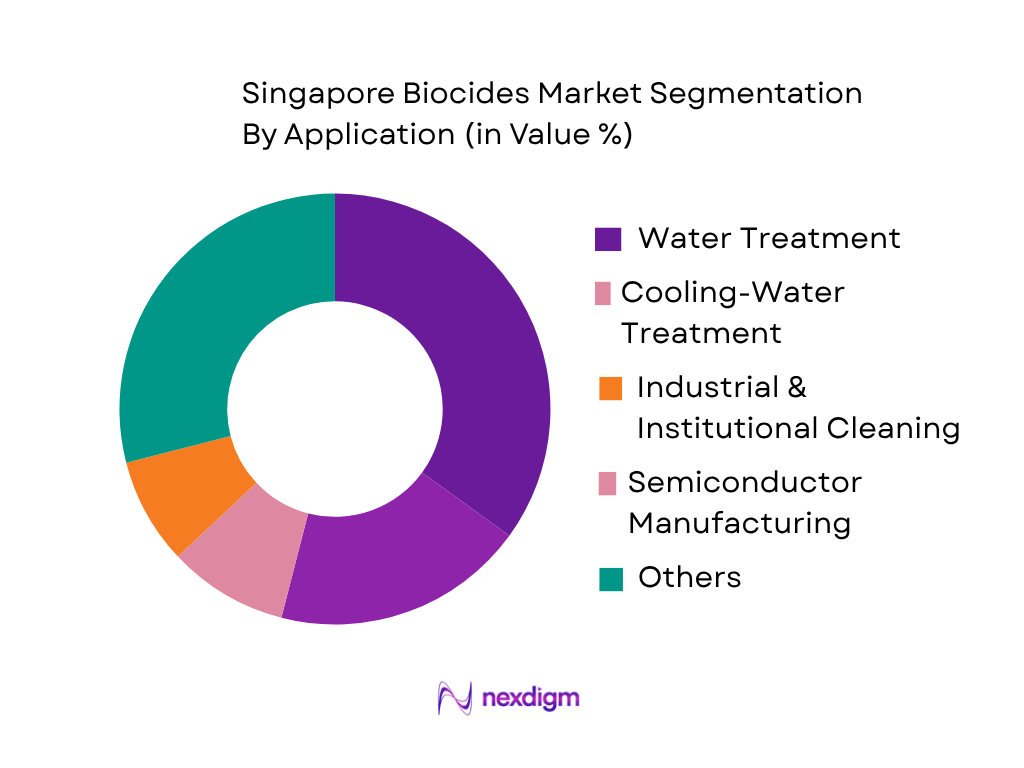
The Singapore Biocides Market is segmented by application into water treatment, cooling-water treatment, wastewater treatment, industrial and institutional cleaning, paints and coatings, food and beverage processing, semiconductor manufacturing, biopharmaceutical manufacturing, marine applications, personal care and other industrial applications. Water treatment represents the dominant application because Singapore’s national water strategy relies on desalination, water reclamation and NEWater, while industrial facilities require highly controlled water quality. PUB reports that Singapore’s water demand is approximately 440 million gallons per day, with the non-domestic sector accounting for approximately 60% of demand. NEWater is particularly important for industrial and air-conditioning cooling applications. PUB also closed the Bedok NEWater Factory in 2024 and plans replacement capacity through a third Changi NEWater Factory and a Tuas NEWater Factory being commissioned in phases. These systems create recurring requirements for microbial-control products protecting membranes, process-water circuits and industrial cooling systems.
Competitive Landscape
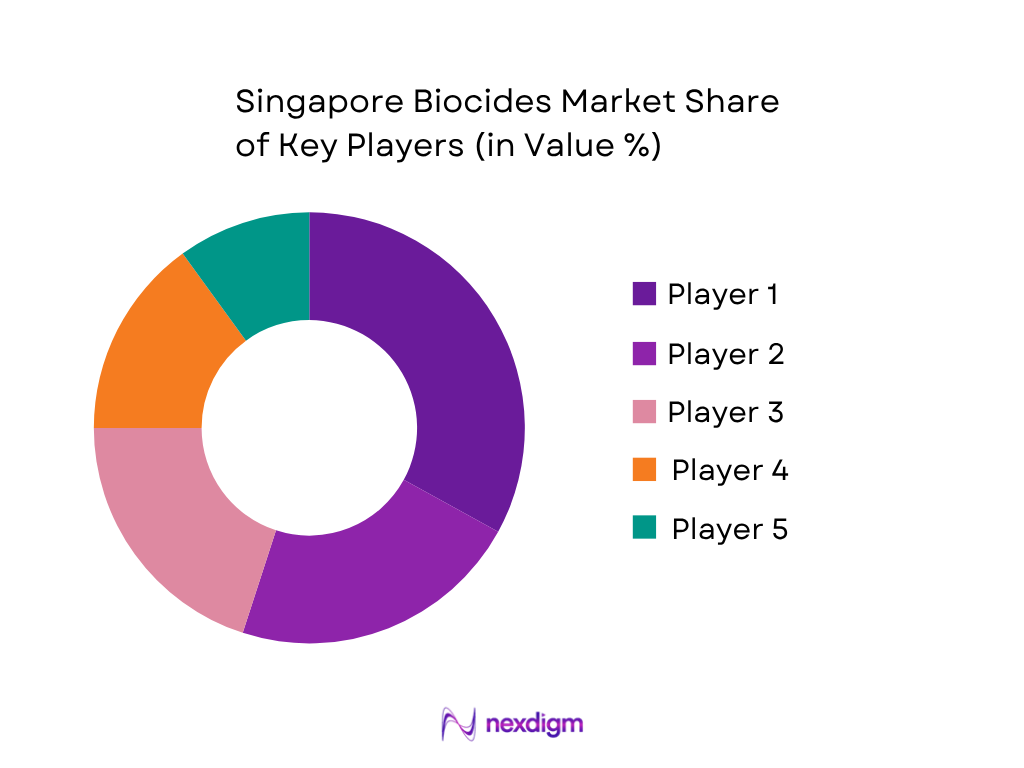
The Singapore Biocides Market is characterized by multinational specialty-chemical manufacturers competing with water-treatment specialists and regional chemical suppliers. Competitive differentiation is concentrated around active-ingredient breadth, membrane protection, industrial water-treatment expertise, semiconductor and pharmaceutical applications, regulatory compliance, local technical support and supply reliability. The market is particularly attractive to companies capable of supplying specialized formulations rather than only commodity disinfectants because Singapore’s manufacturing base includes semiconductor, pharmaceutical, petrochemical, food and advanced-engineering operations. Singapore’s EDB reported S$13.5 billion of fixed-asset investment commitments in 2024, including S$11.1 billion in manufacturing, reinforcing the importance of industrial applications.
| Major Player | Established | Headquarters | Active-Ingredient Portfolio | Water-Treatment Capability | Semiconductor Capability | Biopharma Capability | Local/Regional Support | Regulatory Capability |
| LANXESS | 2004 | Cologne, Germany | ~ | ~ | ~ | ~ | ~ | ~ |
| Ecolab | 1923 | St. Paul, USA | ~ | ~ | ~ | ~ | ~ | ~ |
| BASF | 1865 | Ludwigshafen, Germany | ~ | ~ | ~ | ~ | ~ | ~ |
| Arxada | 2021 | Basel, Switzerland | ~ | ~ | ~ | ~ | ~ | ~ |
| Nouryon | 2018 | Amsterdam, Netherlands | ~ | ~ | ~ | ~ | ~ | ~ |
Singapore Biocides Market Analysis
Market Growth Drivers
NEWater Expansion, Desalination Infrastructure and Industrial Water Demand
Singapore’s water-security infrastructure creates a structural demand base for biocides used in membrane protection, biofilm control, cooling-water treatment and wastewater systems. PUB reports that Singapore currently consumes about 440 million gallons of water per day, equivalent to approximately 2,000 Olympic-sized swimming pools, while total demand could almost double by 2065. The non-domestic sector is expected to account for about 60% of future demand, directly connecting water-treatment requirements with industrial activity. NEWater is already supplied to more than 850 non-domestic customers, including wafer-fabrication plants, petrochemical refineries, power stations and commercial premises. Singapore has 5 NEWater factories, with the Bedok facility closing in July 2024 and being replaced by a larger Changi facility. PUB has also mandated minimum water-recycling requirements for new wafer-fabrication, electronics and biomedical projects. These measures increase the number of industrial water loops requiring microbial management and strengthen demand for oxidizing and non-oxidizing biocides. Singapore’s 2024 GDP of USD 547.39 billion and 4.4% GDP growth, reported by the World Bank, further demonstrate the scale of economic activity supporting industrial water consumption.
Semiconductor Manufacturing, Biopharmaceutical Manufacturing and Advanced Industrial Production
Singapore’s concentration of high-value manufacturing provides a particularly important demand driver for specialized biocides because semiconductor, pharmaceutical and precision-manufacturing facilities require tightly controlled water and microbial environments. EDB reports that Singapore’s semiconductor industry contributes approximately 6% of GDP and employs more than 35,000 people, while 9 of the world’s 15 largest semiconductor companies have established operations in the country. NEWater is specifically supplied to wafer-fabrication facilities requiring ultra-clean water. The biopharmaceutical industry manufactured S$12.1 billion of products in 2024 and employed more than 9,000 skilled workers, creating requirements for microbial control across process utilities, manufacturing environments and water systems. Singapore’s overall manufacturing sector recorded S$429.584 billion in total output from 9,858 establishments in 2024. Electronics generated S$181.166 billion, chemicals generated S$95.155 billion, and biomedical manufacturing generated S$32.457 billion of output. These figures demonstrate the scale of industrial processes in which microbial contamination can disrupt production, water systems and product quality. Consequently, demand is shifting toward application-specific biocides capable of controlling bacteria, fungi, algae and biofilms without compromising high-purity manufacturing requirements.
Market Challenges
Limited Land Availability, Strict Chemical Regulation and High Water-Quality Requirements
Singapore’s compact geography and highly regulated industrial environment create operational constraints for biocide suppliers and users. The country’s population reached 6,036,860 in 2024, while its total land area is only about 735 square kilometres, creating intense competition for industrial, logistics and chemical-storage space. The World Bank records Singapore’s 2024 GDP at USD 547.39 billion and GDP per capita at USD 90,674.1, indicating a high-value economy in which environmental and operational standards are particularly stringent. PUB’s water system has subjected NEWater to more than 150,000 scientific tests, with twice-yearly external audits involving specialists in engineering, water chemistry, toxicology and microbiology. Such requirements increase the technical burden on biocide suppliers because products must achieve microbial-control objectives without creating unacceptable residuals or compromising downstream water quality. The challenge is especially relevant to membrane systems, semiconductor water circuits, pharmaceutical utilities and industrial wastewater treatment. PUB also requires water-intensive new wafer-fabrication, electronics and biomedical facilities to implement specified recycling measures, increasing the need for carefully controlled treatment chemistry. As a result, suppliers must balance microbial efficacy, environmental compatibility, dosing precision, material compatibility and regulatory compliance rather than compete solely on product availability.
Imported Specialty-Chemical Dependency, Supply-Chain Exposure and Biocide Resistance
Singapore’s position as a global chemical and manufacturing hub provides extensive access to specialty chemicals but also leaves many advanced formulations dependent on international supply networks. EDB’s manufacturing statistics show that the chemicals cluster generated S$95.155 billion of output in 2024, while electronics generated S$181.166 billion and biomedical manufacturing generated S$32.457 billion. Jurong Island hosts more than 100 companies and the energy-and-chemicals sector employs more than 27,000 people, creating a large industrial customer base for microbial-control chemistry but also increasing the consequences of interruptions in specialty-chemical supply. The challenge is amplified by the technical requirements of high-purity applications, where substitution between active ingredients is not always straightforward because formulations must satisfy microbial efficacy, compatibility and contamination-control requirements. Singapore’s water demand of approximately 440 million gallons per day further increases the importance of continuous chemical availability for water-treatment systems. Biocide resistance adds another technical challenge: repeated use of the same active ingredient can reduce treatment effectiveness against persistent microbial populations and biofilms, potentially requiring alternating chemistries or targeted treatment programs. Suppliers therefore need resilient inventories, multiple sourcing channels, technical formulation capabilities and resistance-management strategies to maintain reliable supply to Singapore’s water-intensive industrial sectors.
Market Opportunities
Advanced Membrane Biocides, NEWater Biofouling Control and Semiconductor Ultrapure-Water Applications
Singapore’s expanding emphasis on water recycling creates an opportunity for advanced biocides specifically designed for membrane systems, biofilm control and high-purity industrial water. PUB reports current water consumption of approximately 440 million gallons per day, with demand potentially almost doubling by 2065. NEWater already serves more than 850 non-domestic customers, while most NEWater is supplied to industries requiring large volumes of ultra-pure water, including semiconductor wafer fabrication and commercial air-conditioning systems. The Tuas NEWater Factory is being developed with planned capacity of 75 million gallons per day, creating an additional infrastructure base for microbial-control technologies. At the same time, PUB’s water-recycling requirements for new wafer-fabrication, electronics and biomedical projects increase the number of industrial water loops that need reliable microbial management. Singapore’s semiconductor industry employs more than 35,000 people and accounts for approximately 6% of GDP, making semiconductor-compatible microbial-control solutions a particularly attractive specialty application. Opportunities therefore extend beyond conventional chlorine-based treatment toward membrane-compatible oxidizing systems, non-oxidizing biocides, biofilm-specific chemistries and treatment programs designed around high-purity water. Current infrastructure rather than speculative future demand provides the basis for these opportunities.
Cooling-Tower Microbial Control, Pharmaceutical Preservation and Sustainable Low-Residual Biocides
Industrial cooling, pharmaceutical manufacturing and sustainable water management provide additional opportunities for specialized biocide formulations. Singapore’s manufacturing sector generated S$429.584 billion of output from 9,858 establishments in 2024, including S$181.166 billion from electronics, S$95.155 billion from chemicals and S$32.457 billion from biomedical manufacturing. These sectors operate cooling systems, process-water circuits and manufacturing utilities where bacteria, algae and biofilms can reduce heat-transfer efficiency, increase maintenance requirements and compromise system performance. The biopharmaceutical sector manufactured S$12.1 billion of products and employed more than 9,000 workers in 2024, creating applications for preservation and microbial-control chemistry in manufacturing environments and process utilities. Singapore’s water demand of 440 million gallons per day also increases the importance of water-efficient treatment programs that can control microorganisms while minimizing residual chemical loading. This creates opportunities for low-residual formulations, biofilm-specific treatments, automated dosing and monitoring technologies. Jurong Island’s ecosystem of 100+ companies and more than 27,000 energy-and-chemicals employees provides an established industrial customer base for specialized cooling-water and process-water solutions. The strongest opportunity is therefore in technically differentiated products that combine microbial efficacy with water-reuse compatibility and environmental performance.
Future Outlook
The Singapore Biocides Market is expected to remain closely linked to the country’s water-security infrastructure and high-value manufacturing ecosystem. NEWater, desalination, wastewater reclamation and industrial cooling should continue to provide a structural base for microbial-control demand. Semiconductor and biopharmaceutical manufacturing should increase the importance of high-purity, application-specific microbial-management solutions. Singapore’s pharmaceutical manufacturing base is substantial, with more than 60 biopharmaceutical manufacturing plants and $12.1 billion of biopharmaceutical manufacturing output reported for 2024. The market is therefore expected to move toward low-residual chemistry, membrane-compatible biocides, automated dosing, biofilm-specific treatment and digitally monitored microbial-control programs.
Major Players
- LANXESS
- Ecolab
- BASF
- Arxada
- Nouryon
- Dow
- Clariant
- Solenis
- Kemira
- Evonik Industries
- Veolia
- Buckman
- Italmatch Chemicals
- Troy Corporation
- Thor Group
Key Target Audience
- Biocides and specialty-chemical manufacturers
- Water-treatment and NEWater technology operators
- Semiconductor and electronics manufacturers
- Biopharmaceutical and pharmaceutical manufacturers
- Petrochemical, energy and specialty-chemical companies
- Investments and venture capitalist firms
- Government and regulatory bodies (PUB, National Environment Agency, Singapore Food Agency, Ministry of Health, Ministry of Manpower, Enterprise Singapore)
- Food processing, marine, healthcare, hospitality and advanced-manufacturing companies
Research Methodology
Step 1: Identification of Key Variables
The initial stage involves mapping Singapore’s biocides ecosystem across active-ingredient manufacturers, formulators, chemical distributors, water utilities, desalination operators and industrial end users. Variables include product chemistry, active ingredient, formulation, application, dosage, end-use industry, regulatory classification, import dependence and technical-service requirements.
Step 2: Market Analysis and Construction
Historical market data are constructed using product-level and application-level demand assessment. The analysis covers water treatment, NEWater, cooling systems, semiconductor manufacturing, biopharmaceutical production, petrochemicals, food processing, paints and coatings, institutional cleaning and marine applications.
Step 3: Hypothesis Validation and Expert Consultation
Market hypotheses are validated through discussions with biocide manufacturers, chemical distributors, water-treatment operators and industrial users. Interviews focus on active-ingredient selection, microbial-control requirements, procurement criteria, regulatory requirements, treatment frequency, formulation preferences and substitution patterns.
Step 4: Research Synthesis and Final Output
The final analysis triangulates company information, government statistics, water-sector documentation, industrial indicators, regulatory information and trade data. The resulting market model is reconciled across product type, active ingredient, application and end-use industry to avoid double counting and establish a consistent market baseline.

- Executive Summary
- Research Methodology (Market Definition and Scope, Biocide Classification Framework, Active Ingredient Mapping, Market Sizing Framework, Top-Down Assessment, Bottom-Up Assessment, Demand-Side Analysis, Supply-Side Analysis, Import-Export Assessment, End-Use Industry Mapping, Primary Interviews, Regulatory Review, Data Triangulation, Forecasting Framework, Scenario Analysis, Assumptions, Limitations)

- Definition and Scope
- Singapore Biocides Industry Structure
- Biocidal Active Ingredient Ecosystem
- Formulation and Product Development Landscape
- Evolution of Microbial-Control Technologies

- Market Growth Drivers (NEWater Expansion, Desalination Infrastructure, Industrial Water Demand, Semiconductor Manufacturing, Biopharmaceutical Manufacturing, Energy and Chemicals Production, Advanced Manufacturing, Food and Beverage Processing)
- Market Challenges (Limited Land Availability, Strict Chemical Regulation, Environmental Discharge Requirements, Imported Active Ingredient Dependency, High Water Quality Standards, Biocide Resistance, Specialty Chemical Supply-Chain Exposure, Hazardous Chemical Handling)
- Market Opportunities (Advanced Membrane Biocides, NEWater Biofouling Control, Semiconductor Ultrapure-Water Applications, Cooling-Tower Microbial Control, Pharmaceutical Manufacturing Preservation, Sustainable Low-Residual Biocides, Biofilm-Specific Technologies, Marine Biofouling Solutions, Local Formulation and Regional Distribution)
- Market Trends (Shift Toward Sustainable Biocides, Low-Residual Chemistry, Advanced Membrane Protection, Automated Chemical Dosing, Digital Microbial Monitoring, Biofilm-Specific Treatment, High-Purity Manufacturing Chemicals, Specialty Chemical Localization, Integrated Water Management)
- Regulatory and Chemical-Safety Landscape (Environmental Protection, Hazardous Substances, Pesticides, Disinfectants, Product Registration, Chemical Importation, Labeling, Safety Data Sheets, Workplace Exposure)
- SWOT Analysis
- Porter’s Five Forces Analysis
- PESTLE Analysis

- By Market Value (2020-2025)
- By Biocidal Active Ingredient Consumption Volume (2020-2025)
- By Formulated Biocide Consumption Volume (2020-2025)
- By Application Consumption (2020-2025)
- By End-Use Industry Consumption (2020-2025)
- By Domestic Production and Imported Biocides (2020-2025)

- By Product Type (In Value %)
Oxidizing Biocides
Non-Oxidizing Biocides
Preservatives
Disinfectants and Sanitizers
Antimicrobial Additives
Biofilm-Control Agents
Algaecides
Fungicides
Other Specialty Biocides - By Active Ingredient (In Value %)
Chlorine-Based Biocides
Bromine-Based Biocides
Chlorine Dioxide
Glutaraldehyde
Isothiazolinones
Quaternary Ammonium Compounds
DBNPA
Bronopol
Copper-Based Biocides
Organic Acids
Other Active Ingredients - By Application (In Value %)
Water Treatment
Cooling-Water Treatment
Wastewater Treatment
NEWater and Water-Reuse Systems
Industrial and Institutional Cleaning
Oil and Gas
Paints and Coatings
Food and Beverage Processing - By End-Use Industry (In Value %)
Semiconductors and Electronics
Biopharmaceutical Manufacturing
Energy and Chemicals
Water and Wastewater Utilities
Food and Beverage Manufacturing
Healthcare and Medical Facilities
Commercial Buildings and Hospitality
Marine and Offshore Industries
Precision Engineering and Advanced Manufacturing - By Formulation Type (In Value %)
Liquid Biocides
Powder and Granular Biocides
Concentrated Formulations
Ready-to-Use Disinfectants
Water-Soluble Formulations
Emulsion and Dispersion Formulations
Controlled-Release Formulations - By Function (In Value %)
Bacterial Control
Fungal Control
Biofilm Control
Slime Control
Preservation
Disinfection
Membrane Protection
Microbiologically Influenced Corrosion Control

- Market Share of Major Players (By Value, Volume, Product Type, Active Ingredient, Application, End-Use Industry, Distribution Channel)
- Cross Comparison Parameters (Active Ingredient Portfolio Breadth, NEWater and Desalination Expertise, Semiconductor Water-Treatment Capability, Biopharmaceutical Manufacturing Expertise, Energy and Chemicals Application Coverage, Regulatory and Environmental Compliance Capability, Local Technical-Service and Distribution Network, Sustainable and Low-Residual Product Capability)
- SWOT Analysis of Major Players
- Detailed Profiles of Major Companies
LANXESS
Ecolab
BASF
Arxada
Nouryon
Dow
Clariant
Solenis
Kemira
Evonik Industries
Veolia
Buckman
Italmatch Chemicals
Troy Corporation
Thor Group

- Industrial Water Treatment Demand Assessment
- NEWater Customer Analysis
- Semiconductor Customer Analysis
- Biopharmaceutical Customer Analysis
- Energy and Chemicals Customer Analysis
- Food and Beverage Customer Analysis
- Healthcare and Hospitality Customer Analysis

- By Market Value (2026-2035)
- By Biocidal Active Ingredient Consumption Volume (2026-2035)
- By Formulated Biocide Consumption Volume (2026-2035)
- By Application Consumption (2026-2035)
- By End-Use Industry Consumption (2026-2035)
- By Domestic Production and Imported Biocides (2026-2035)


 Request a Sample
 Ask for Customization
 Get a Quote
 Enquire Now