
 Download PDF
Market Overview
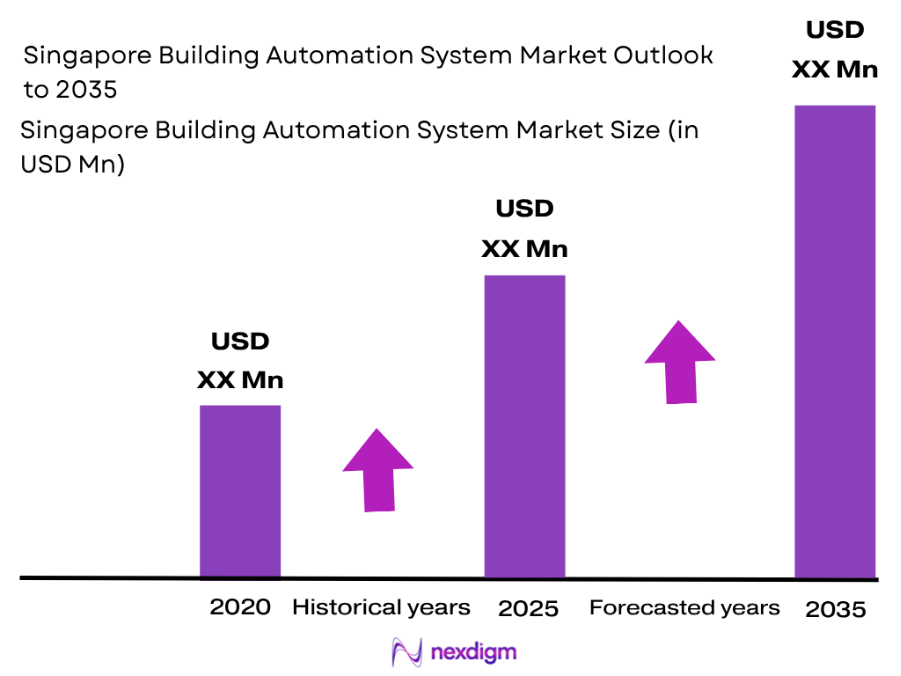
The Singapore Building Automation System Market is valued at ~USD XX billion in 2024, with a forecasted CAGR of ~XX% during 2026–2035. Demand is closely linked to the country’s active built-environment pipeline: construction demand increased from S$33.8 billion in 2023 to S$44.2 billion in 2024, according to the Building and Construction Authority. The pipeline includes public housing, institutional developments, commercial redevelopment, industrial facilities, healthcare projects and infrastructure, creating installation opportunities for HVAC controls, energy monitoring, lighting automation and integrated building management systems.
Singapore’s BAS demand is concentrated across the Central Region, East Region and West Region, reflecting the geographic concentration of commercial offices, integrated developments, industrial estates, logistics facilities and data centres. Singapore’s digital-infrastructure concentration is particularly important: the Infocomm Media Development Authority reported more than 1.4 GW of data-centre capacity and more than 70 data centres. The Central Business District and Marina Bay support sophisticated commercial BAS requirements, while Jurong, Tuas and the western industrial corridor support industrial and data-centre automation demand.
Market Segmentation
By Component Type
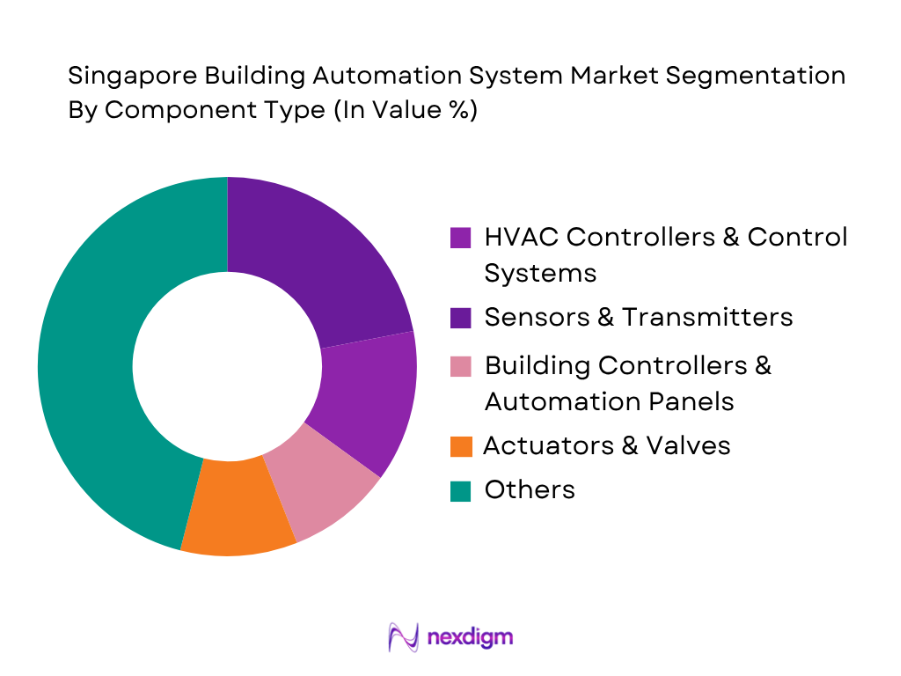
The Singapore Building Automation System Market is segmented by component type into HVAC controllers and control systems, sensors and transmitters, actuators and valves, building controllers and automation panels, variable frequency drives, smart meters and energy monitoring devices, gateways and communication interfaces, BAS software and supervisory platforms, cloud-based building management platforms, and building analytics and optimization software. HVAC controllers and control systems are expected to represent the largest component category because cooling is central to Singapore’s building operating environment and energy-management requirements. BAS platforms increasingly connect HVAC equipment with sensors, meters and analytics to provide real-time monitoring and automated optimization. Singapore’s Green Mark framework also places substantial emphasis on building environmental performance, while certified green buildings collectively save more than 4.2 billion kWh of energy annually, according to BCA. This creates a strong operational rationale for automated controls, metering, fault detection and HVAC optimization. Data-centre development strengthens the requirement for highly reliable cooling and environmental controls, while commercial retrofit projects create recurring demand for controllers, sensors, actuators and gateways.
By Building Type
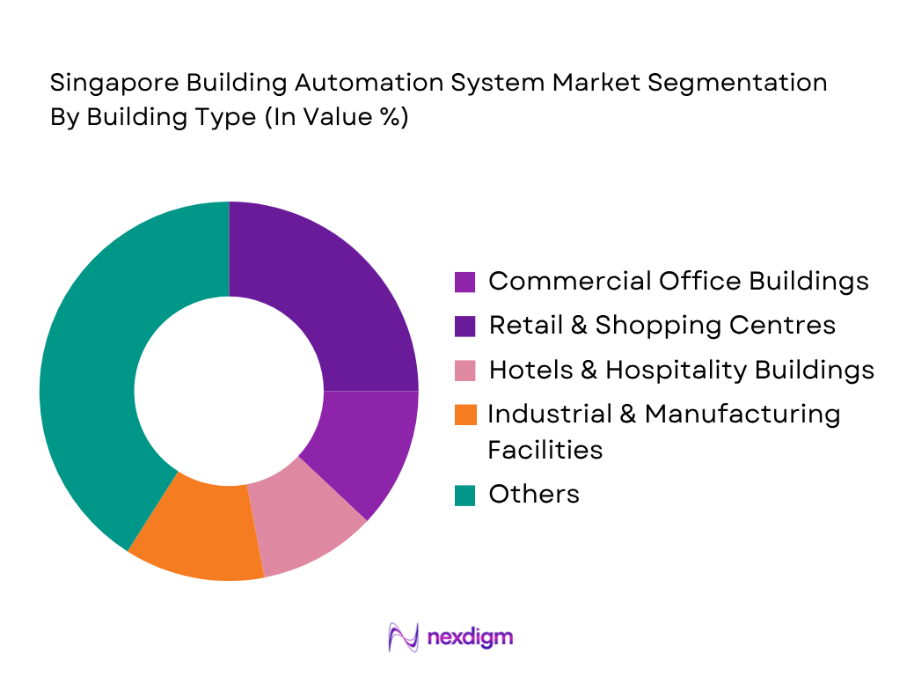
The Singapore Building Automation System Market is segmented by building type into commercial office buildings, retail and shopping centres, hotels and hospitality buildings, healthcare facilities, educational institutions, industrial and manufacturing facilities, data centres, government and public buildings, transportation facilities, and residential and mixed-use developments. Commercial office buildings are expected to maintain the leading position because Singapore has a large concentration of professionally managed commercial properties requiring centralized HVAC, lighting, access, energy and environmental monitoring. Modern commercial developments increasingly integrate BAS with energy-management and facility-management platforms, supporting continuous monitoring rather than isolated equipment control. Data centres represent a particularly important high-value application because Singapore has more than 1.4 GW of existing data-centre capacity and the Green Data Centre Roadmap targets at least 300 MW of additional capacity in the near term. Retail, hospitality and mixed-use properties also require automated scheduling, occupancy-based controls and centralized plant management. Green Mark requirements further encourage building owners to deploy technologies capable of measuring and improving operational performance.
Competitive Landscape
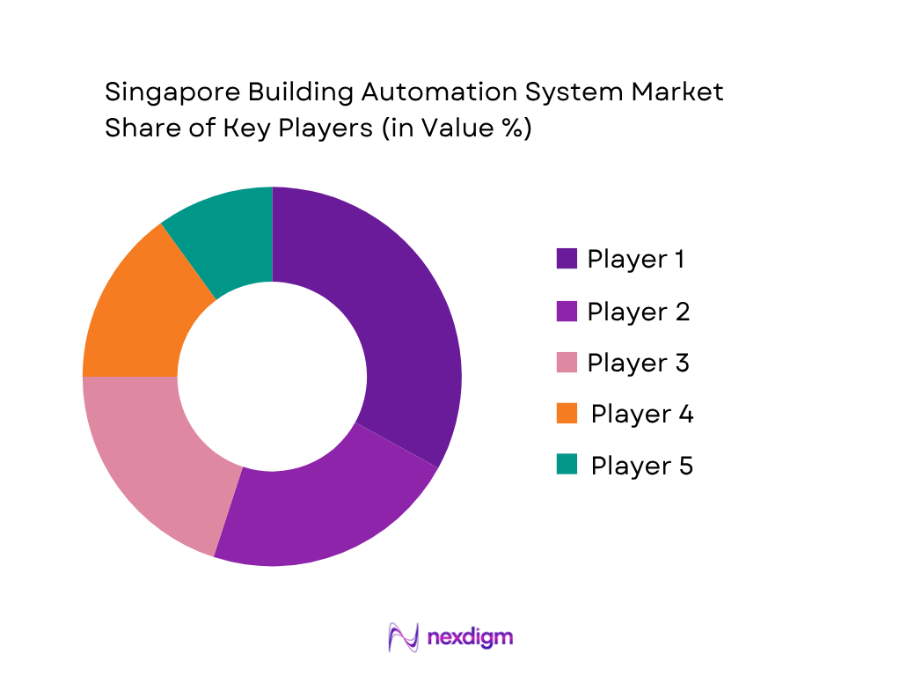
The Singapore Building Automation System Market is characterized by global automation, HVAC and electrical-equipment companies competing through integrated platforms rather than standalone controllers. Major suppliers combine HVAC automation, lighting control, energy management, IoT connectivity, analytics and facility-management software. Johnson Controls positions Metasys as a platform integrating HVAC, lighting, security and protection systems, while Schneider Electric’s EcoStruxure Building portfolio combines building controls, IoT connectivity, analytics and cloud services. Singapore’s emphasis on energy performance and smart buildings therefore favours vendors capable of delivering integrated, interoperable and service-supported solutions.
| Company | Establishment Year | Headquarters | Core BAS Platform | HVAC Automation | IoT / Cloud Capability |
| Johnson Controls | 1885 | Cork, Ireland | ~ | ~ | ~ |
| Siemens | 1847 | Munich, Germany | ~ | ~ | ~ |
| Schneider Electric | 1836 | Rueil-Malmaison, France | ~ | ~ | ~ |
| Honeywell | 1906 | Charlotte, USA | ~ | ~ | ~ |
| ABB | 1988 | Zurich, Switzerland | ~ | ~ | ~ |
Singapore Building Automation System Market Analysis
Growth Drivers
Green Building Masterplan and Green Mark Certification
Singapore’s Green Building Masterplan is strengthening the structural demand for building automation by linking building performance with measurable energy outcomes. The Building and Construction Authority states that buildings account for over 20% of Singapore’s carbon emissions, while the national 80-80-80 framework targets greening 80% of buildings by gross floor area by 2030. The Green Mark ecosystem had certified 2,590 buildings as of March 2025, with these buildings collectively saving more than 4.2 billion kWh of electricity annually. The savings demonstrate the operational relevance of automated controls, energy monitoring, HVAC optimization and intelligent building management. Green Mark requirements also require building owners and developers to consider energy performance and operational efficiency, creating demand for sensors, controllers, metering systems, analytics and integrated building-management platforms. The introduction of Green Mark Version 7 further strengthens this driver by introducing an energy-performance pathway and a SLE70 tier requiring at least 70% energy savings. For BAS suppliers, this creates opportunities to position automation as an operational-performance technology rather than simply an M&E control system. BCA’s framework therefore provides a continuing regulatory and investment rationale for advanced BAS deployment across new construction and existing-building modernization.
Commercial Building Modernization and HVAC Energy Optimization
Commercial construction and modernization provide a substantial addressable base for BAS deployment because HVAC systems are among the most important building energy-consuming systems in Singapore’s tropical environment. BCA reported total construction demand of S$44.2 billion in 2024, compared with S$33.8 billion in 2023, demonstrating the scale of building and infrastructure activity supporting automation opportunities. Commercial construction accounted for S$5.0 billion in combined public and private demand in the detailed 2024 construction-demand breakdown, while institutional and other building activity reached S$11.7 billion. Singapore also introduced the Mandatory Energy Improvement regime for energy-intensive buildings with gross floor area of 5,000 m² or more, requiring energy audits and implementation of measures intended to reduce energy consumption. Under the regime, affected owners must implement measures targeting a 10% reduction from the relevant historical EUI baseline. BAS technologies directly support this requirement through automated HVAC scheduling, chiller optimization, variable-speed control, temperature monitoring, occupancy-based operation and continuous energy measurement. With Singapore’s economy recording 4.4% GDP growth in 2024, according to the World Bank, investment conditions remained supportive of commercial-property activity and technology upgrades. This combination of construction activity, regulatory requirements and HVAC optimization needs supports sustained BAS adoption across offices, hotels, retail properties and institutional buildings.
Market Challenges
Legacy BMS Infrastructure and Retrofit Installation Complexity
Legacy building management systems represent a significant challenge because Singapore’s existing building stock contains systems installed under earlier generations of automation architecture, communication protocols and control hardware. Modernization frequently requires integration between legacy HVAC controllers, new sensors, variable-speed drives, meters, gateways and cloud platforms rather than simple replacement of individual components. BCA’s Mandatory Energy Improvement regime specifically targets energy-intensive commercial, healthcare, institutional and sports buildings with gross floor area of 5,000 m² or more, creating a substantial requirement for assessment and potential system upgrades. The regime requires an energy audit within 90 days of the relevant notice and submission of the resulting improvement plan within 1 year. Owners subsequently have 3 years to implement measures targeting a 10% reduction in energy consumption against the applicable baseline. These requirements can expose interoperability and retrofit constraints where existing controls are proprietary or poorly documented. Singapore’s construction sector also recorded S$44.2 billion of demand in 2024, meaning BAS suppliers must compete for new-build projects while simultaneously addressing technically complex retrofit opportunities. The challenge is therefore not simply hardware replacement; it involves controls migration, protocol conversion, M&E coordination, commissioning, cybersecurity and maintaining building operations during installation. This increases project complexity and can lengthen procurement and implementation cycles.
Interoperability, Cybersecurity and Multi-Vendor Integration Constraints
Singapore’s BAS market increasingly involves interconnected HVAC, lighting, electrical, access, security, fire-safety and energy-monitoring systems, making interoperability and cybersecurity important implementation constraints. BCA requires building owners to submit annual building information and energy-consumption data for benchmarking, with Energy Use Intensity calculated from annual electricity consumption and gross floor area. The Mandatory Energy Improvement framework additionally requires energy-intensive buildings to undertake formal audits and improvement planning, increasing the importance of reliable building data. As systems become increasingly IP-connected and cloud-enabled, controls networks can create additional cyber-physical security considerations because unauthorized access could affect HVAC operation, equipment schedules and critical environmental conditions. The issue is particularly important for data centres, where Singapore has more than 70 data centres and more than 1.4 GW of data-centre capacity, according to IMDA. Data-centre operations require highly reliable cooling, environmental monitoring and power-management systems, increasing the consequences of control-system disruption. Meanwhile, Singapore’s construction demand reached S$44.2 billion in 2024, creating a diverse pipeline of commercial, industrial, institutional and infrastructure projects with different technical specifications. BAS providers consequently need strong protocol support, secure network architecture, documented APIs, cybersecurity controls and engineering capabilities to integrate multiple vendors without compromising operational continuity or data integrity.
Market Opportunities
Data Centre BAS and Smart Chiller Controls
Data-centre development creates a high-value opportunity for Singapore’s Building Automation System Market because cooling, environmental monitoring and power management are operationally critical in these facilities. IMDA identifies Singapore as a regional data-centre hub with more than 1.4 GW of data-centre capacity and more than 70 cloud, enterprise and colocation data centres. The Green Data Centre Roadmap also targets at least 300 MW of additional capacity, while encouraging higher energy efficiency through hardware, software and facility-level optimization. This environment creates demand for BAS capabilities extending beyond conventional temperature control toward intelligent cooling optimization, real-time environmental monitoring, equipment sequencing, predictive fault detection and integrated power management. Singapore’s tropical climate further increases the relevance of automated cooling because data centres must manage heat and humidity continuously. IMDA has highlighted that data centres already account for approximately 7% of Singapore’s total electricity consumption, demonstrating why optimization technologies are strategically important. BAS platforms can integrate chillers, pumps, cooling towers, CRAH units, sensors, meters and analytics into centralized control architectures, enabling operators to identify abnormal performance and coordinate cooling assets. The opportunity extends to AI-based optimization and digital-twin applications, particularly where operators need to balance thermal resilience, equipment redundancy and energy performance. This positions data-centre automation as a specialized growth area within Singapore’s broader smart-building ecosystem.
Commercial Building Retrofits, Cloud BAS and AI-Enabled Energy Optimization
Singapore’s existing commercial-building stock creates a strong opportunity for retrofit-oriented BAS solutions, particularly where building owners need measurable improvements in energy performance without replacing entire M&E systems. The Mandatory Energy Improvement regime applies to energy-intensive commercial buildings, healthcare facilities, institutional buildings and sports and recreation centres with gross floor area of at least 5,000 m². Owners subject to the regime must conduct energy audits and implement improvement measures, creating a direct pathway for HVAC controls, sensors, energy meters, analytics and automated optimization. Singapore’s Green Mark ecosystem provides an additional modernization mechanism: more than 2,500 buildings had been Green Mark certified by 2025, and these buildings collectively saved more than 4.2 billion kWh annually. BCA’s construction pipeline also remains substantial, with S$44.2 billion of construction demand recorded in 2024 and S$50.5 billion preliminarily recorded in 2025. Cloud-based BAS can address multi-site portfolios by consolidating building data, alarms, energy performance and equipment conditions within centralized platforms. AI-enabled analytics can further identify inefficient chiller operation, abnormal HVAC behavior and equipment degradation, while occupancy analytics can dynamically adjust ventilation and cooling. The opportunity therefore combines regulatory-driven retrofit activity with a shift toward continuous digital optimization, creating demand for subscription-based platforms, remote monitoring, predictive maintenance and integrated facility-management services.
Future Outlook
Over the forecast period, the Singapore Building Automation System Market is expected to benefit from the convergence of energy efficiency, smart-building digitization, data-centre development and building modernization. Singapore’s construction pipeline provides a continuing base of new-build opportunities, while the large installed building stock creates retrofit and BMS-modernization demand. BCA’s Green Mark ecosystem increasingly connects sustainability outcomes with operational building performance, strengthening the role of automation and energy-management systems.
Major Players
- Johnson Controls
- Siemens
- Schneider Electric
- Honeywell
- ABB
- Bosch Building Technologies
- Mitsubishi Electric
- Daikin
- Azbil
- Delta Electronics
- ST Engineering Urban Solutions
- Quantum Automation
- A-Speed Infotech
- STiB Technologies
- Willowglen Services
Key Target Audience
- Commercial Real Estate Developers and Property Owners
- Data Centre Operators and Digital Infrastructure Investors
- Facility Management and Building Operations Companies
- HVAC and M&E Engineering Contractors
- Industrial and Manufacturing Facility Operators
- Investments and Venture Capitalist Firms
- Government and Regulatory Bodies (Building and Construction Authority, Energy Market Authority, Infocomm Media Development Authority)
- Building Automation System Manufacturers and System Integrators
Research Methodology
Step 1: Identification of Key Variables
The initial phase involves mapping the Singapore Building Automation System ecosystem across BAS manufacturers, HVAC equipment suppliers, system integrators, M&E contractors, facility managers, building owners and technology providers. The assessment identifies variables including installed building stock, connected HVAC assets, automation penetration, retrofit activity, Green Mark requirements, data-centre development and smart-building deployment.
Step 2: Market Analysis and Construction
Historical market information is compiled through bottom-up assessment of BAS hardware, software, integration and services. Building-level demand is evaluated across commercial, industrial, hospitality, healthcare, government, residential, transportation and data-centre facilities. The framework also evaluates HVAC automation, sensors, controllers, energy-management systems, cloud platforms and analytics deployment.
Step 3: Hypothesis Validation and Expert Consultation
Market hypotheses are validated through consultations with BAS manufacturers, system integrators, HVAC contractors, facility-management companies, developers and building operators. Discussions focus on procurement structures, technology adoption, retrofit requirements, protocol compatibility, project specifications, system integration and maintenance models to refine demand and competitive assessments.
Step 4: Research Synthesis and Final Output
The final research output integrates supply-side capacity, building-project pipelines, technology deployment, customer requirements and competitive positioning. Findings are triangulated against Singapore’s construction activity, Green Mark ecosystem, data-centre pipeline and building-efficiency initiatives to produce a market-specific assessment of current demand and future opportunities.

- Executive Summary
- Research Methodology (Market Definitions and Assumptions, Building Automation System Scope, BMS and IBMS Classification, Market Sizing Framework, Top-Down Market Sizing, Bottom-Up Market Sizing, Demand-Side Assessment, Supply-Side Assessment, Primary Industry Interviews, Building Stock Mapping, Green Mark Certification Mapping, Data Centre Pipeline Assessment, Project Pipeline Assessment, Data Triangulation, Forecasting Framework, Limitations and Assumptions)

- Definition and Scope
- Market Evolution and Development of Building Management Systems, Integrated Building Management Systems, HVAC Automation, Smart Building Controls, IoT-Based Building Automation, Cloud Building Management, AI-Enabled Building Optimization and Digital Building Platforms
- Singapore Building Automation Ecosystem Analysis (Building Owners, Developers, Facility Managers, M&E Contractors, System Integrators, Controls Manufacturers, HVAC Equipment Suppliers, Energy Service Companies, Government Agencies)
- Building Automation Value Chain Analysis (Controls Hardware, Sensors, Controllers, Gateways, Communication Networks, BAS Software, Analytics Platforms, System Integration, Commissioning, Maintenance and Managed Services)
- Building Automation Supply Chain Analysis (HVAC Equipment, Sensors and Actuators, Controllers, Variable Frequency Drives, Smart Meters, Network Infrastructure, Automation Software, System Integrators, M&E Contractors, Facility Management Providers)
- Smart Building Infrastructure Assessment (Building Connectivity, IoT Infrastructure, BACnet, Modbus, KNX, LonWorks, IP-Based Controls, Cloud Connectivity, Edge Computing)
- Green Building and Energy Management Ecosystem Assessment (Green Mark, Energy Performance, Smart Technologies, Building Energy Monitoring, Operational Optimization)

- Growth Drivers (Green Building Masterplan, Green Mark Certification, Commercial Building Modernization, HVAC Energy Optimization, Data Centre Development, Smart Building Adoption, Energy Efficiency Requirements, Building Energy Performance Benchmarking, Facility Management Digitization, IoT Sensor Deployment, Chiller Optimization, Indoor Air Quality Management)
- Market Challenges (Legacy BMS Infrastructure, Proprietary Control Platforms, Interoperability Constraints, Protocol Compatibility Issues, Retrofit Installation Complexity, Skilled Controls Engineer Requirements, Cybersecurity Vulnerabilities, Multi-Vendor Integration Constraints, Existing HVAC Integration Limitations, Building Data Management Complexity, Long Equipment Replacement Cycles, System Commissioning Complexity)
- Market Opportunities (Data Centre BAS, Cloud-Based Building Automation, AI-Enabled Energy Optimization, Predictive HVAC Maintenance, Smart Chiller Controls, Commercial Building Retrofits, Green Mark Modernization, Digital Twin Integration, Multi-Site Facility Management, Indoor Air Quality Monitoring, Occupancy Analytics, Demand Response Integration, Grid-Interactive Buildings, Building Electrification Controls, Solar and BMS Integration, EV Charging and Building Energy Management)
- Market Trends (Integrated Building Management Systems, IoT-Based Building Controls, AI-Driven HVAC Optimization, Cloud-Based BAS Platforms, Digital Twins, Smart Chiller Controls, Predictive Maintenance, Wireless Sensors, Open-Protocol Adoption, Occupancy-Based Automation, Real-Time Energy Monitoring, Automated Fault Detection and Diagnostics)
- Government Regulations and Standards (BCA Green Mark Certification, Green Mark 2021, Green Mark Version 7, Mandatory Energy Improvement Regime, Periodic Energy Audit Requirements, Building Control Act, Building Energy Performance Requirements, Green Mark for Data Centres, IMDA Data Centre Sustainability Requirements, Singapore Standards for Building Automation, Fire Safety Requirements, Cybersecurity Requirements)
- SWOT Analysis
- Porter’s Five Forces Analysis
- PESTLE Analysis
- Stakeholder Ecosystem
- Building Automation Competition Ecosystem

- By Market Value (2020-2025)
- By Installed BAS Systems (2020-2025)
- By Connected Building Floor Area (2020-2025)
- By Number of BAS-Controlled Buildings (2020-2025)
- By Building Automation Hardware Revenue (2020-2025)
- By BAS Software and Platform Revenue (2020-2025)

- By Component Type (In Value %)
HVAC Controllers and Control Systems
Sensors and Transmitters
Actuators and Valves
Building Controllers and Automation Panels
Variable Frequency Drives
Smart Meters and Energy Monitoring Devices
Gateways and Communication Interfaces
BAS Software and Supervisory Platforms
Cloud-Based Building Management Platforms
Building Analytics and Optimization Software - By Building Type (In Value %)
Commercial Office Buildings
Retail and Shopping Centres
Hotels and Hospitality Buildings
Healthcare Facilities
Industrial and Manufacturing Facilities
Data Centres
Government and Public Buildings
Transportation Facilities
Residential and Mixed-Use Developments - By System Application (In Value %)
HVAC and Chiller Plant Automation
Lighting Control
Energy Management
Fire and Life Safety Integration
Access and Security System Integration
Indoor Air Quality Monitoring
Elevator and Escalator Monitoring
Water and Pumping System Control
Occupancy and Space Management
Power Monitoring and Electrical Management - By Deployment Model (In Value %)
New Construction BAS
Existing Building Retrofit
BAS Modernization and Expansion
Integrated Building Management Systems
Cloud-Based BAS
On-Premise BAS
Hybrid BAS
Managed Building Automation Services - By Building Automation Technology (In Value %)
Conventional BMS
Integrated Building Management Systems
IoT-Enabled Building Automation
Wireless Building Automation
IP-Based Building Controls
AI-Enabled Building Optimization
Digital Twin-Based Building Management
Edge-Based Building Automation
Cloud-Based Building Automation
Open-Protocol Building Automation - By Region (In Value %)
Central Region
East Region
North Region
North-East Region
West Region

- Market Share of Major Players (By Revenue, BAS Hardware, BAS Software, System Integration, Building Type, Application, Project Value, Installed Building Base)
- Cross Comparison Parameters (BAS Product Portfolio Breadth, HVAC and Chiller Automation Capability, Integrated Building Management Platform Capability, IoT and Cloud Architecture, Open-Protocol Compatibility, AI and Analytics Capability, Green Mark and Energy Optimization Capability, Singapore System Integration and Service Network)
- SWOT Analysis
- Detailed Profiles of Major Companies
Johnson Controls
Siemens
Schneider Electric
Honeywell
ABB
Bosch Building Technologies
Mitsubishi Electric
Daikin
Azbil
Delta Electronics
ST Engineering Urban Solutions
Quantum Automation
A-Speed Infotech
STiB Technologies
Willowglen Services

- Building Owner BAS Requirement Assessment
- Commercial Property Owner Assessment
- Facility Manager Requirement Analysis
- Data Centre Operator BAS Assessment
- Hotel and Hospitality BAS Requirement Assessment

- By Market Value (2026-2035)
- By Installed BAS Systems (2026-2035)
- By Connected Building Floor Area (2026-2035)
- By Number of BAS-Controlled Buildings (2026-2035)
- By Building Automation Hardware Revenue (2026-2035)
- By BAS Software and Platform Revenue (2026-2035)


 Request a Sample
 Ask for Customization
 Get a Quote
 Enquire Now
