

 Download PDF
Market Overview
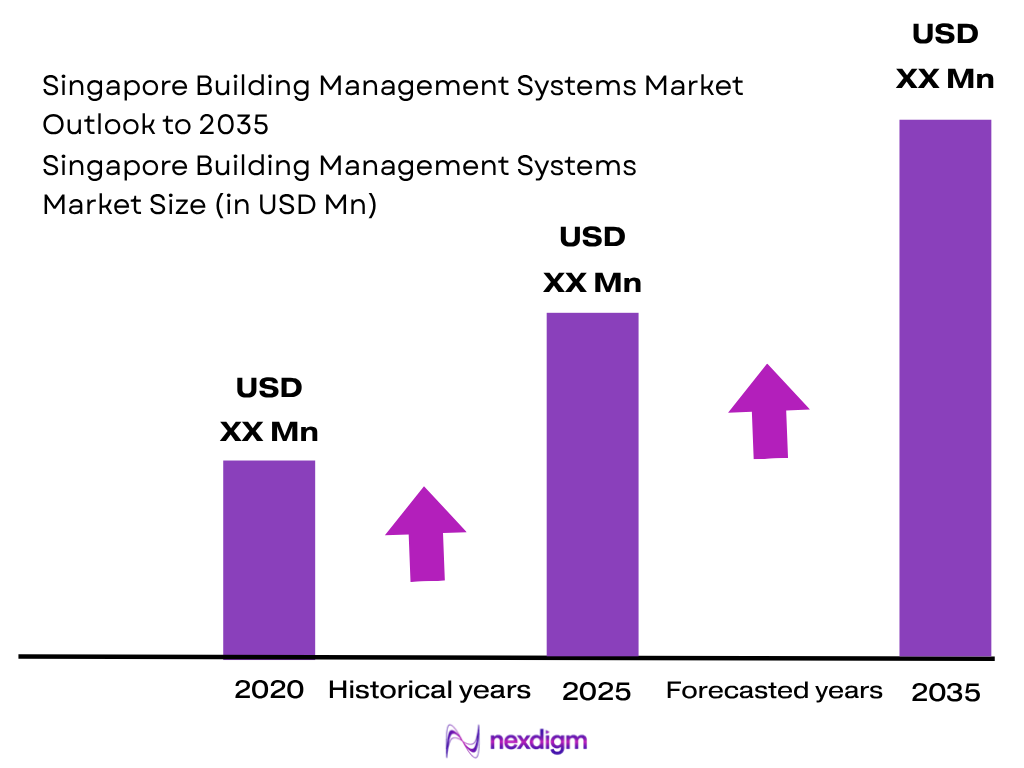
The Singapore Building Management Systems Market is valued at approximately USD ~ billion, supported by high building automation intensity, energy-efficiency requirements and continued construction activity. Construction demand increased from S$33.8 billion to S$44.2 billion across the latest two reported annual observations, while the country operates more than 70 cloud, enterprise and colocation data centres with over 1.4 GW of capacity. These assets require sophisticated HVAC, energy, environmental and reliability controls.
Downtown Core, Marina Bay, Jurong, Changi, one-north and Punggol Digital District represent important Singapore BMS demand clusters because of their concentration of commercial towers, mixed-use assets, business parks, digital infrastructure and institutional projects. Commercial construction and redevelopment remain substantial, while the data-centre ecosystem exceeds 1.4 GW across more than 70 facilities. Singapore also recorded 545,000 sq m GFA of retail space in the development pipeline, supporting future building-control installations.
Market Segmentation
By System Type
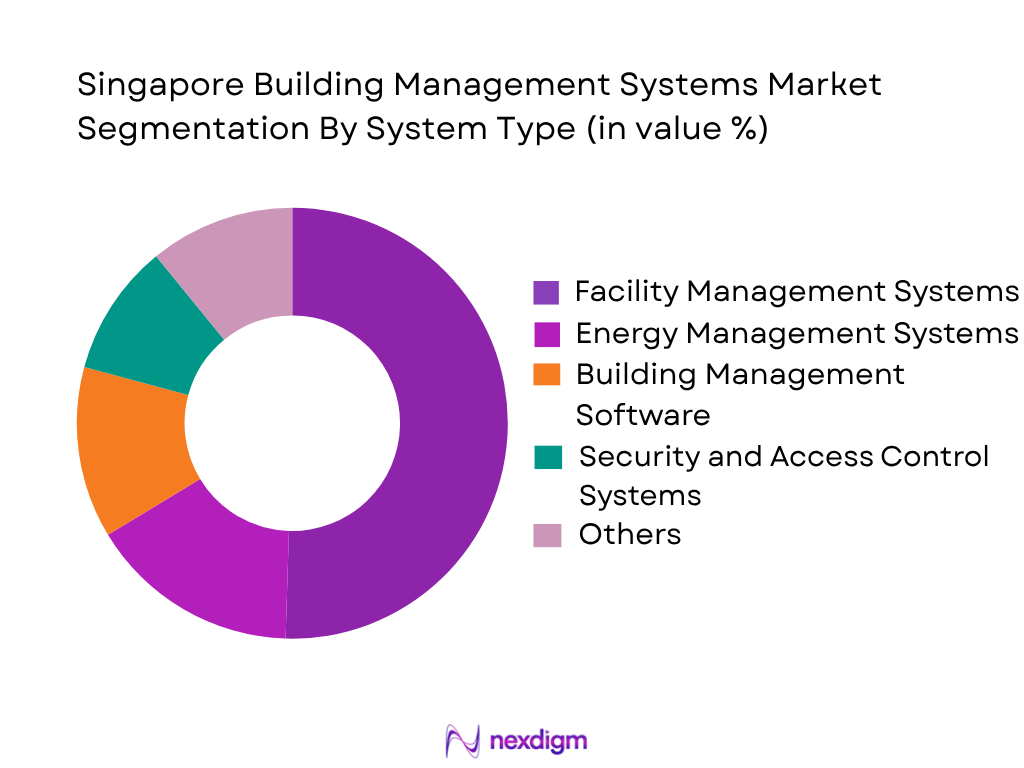
The Singapore Building Management Systems Market is segmented by system type into Facility Management Systems, Energy Management Systems, Building Management Software, Security and Access Control Systems, Fire Protection Systems and other integrated control systems. Facility Management Systems represent the dominant sub-segment, reflecting Singapore’s emphasis on integrated building operations, preventive maintenance and Smart Facilities Management. Large commercial buildings, hospitals, data centres and public facilities increasingly require a common platform linking alarms, HVAC performance, equipment status and maintenance workflows. Singapore’s high-density built environment strengthens the value of centralized operations, especially where building owners manage multi-site portfolios. BCA’s Green Mark framework further encourages monitoring, energy-performance management and intelligent controls, while government-backed digitalisation promotes integration between BMS, maintenance platforms and smart sensors. Published Singapore BMS market coverage also identifies Facility Management Systems as the largest system category, reinforcing the importance of operational integration rather than standalone control functions.
By Building Type
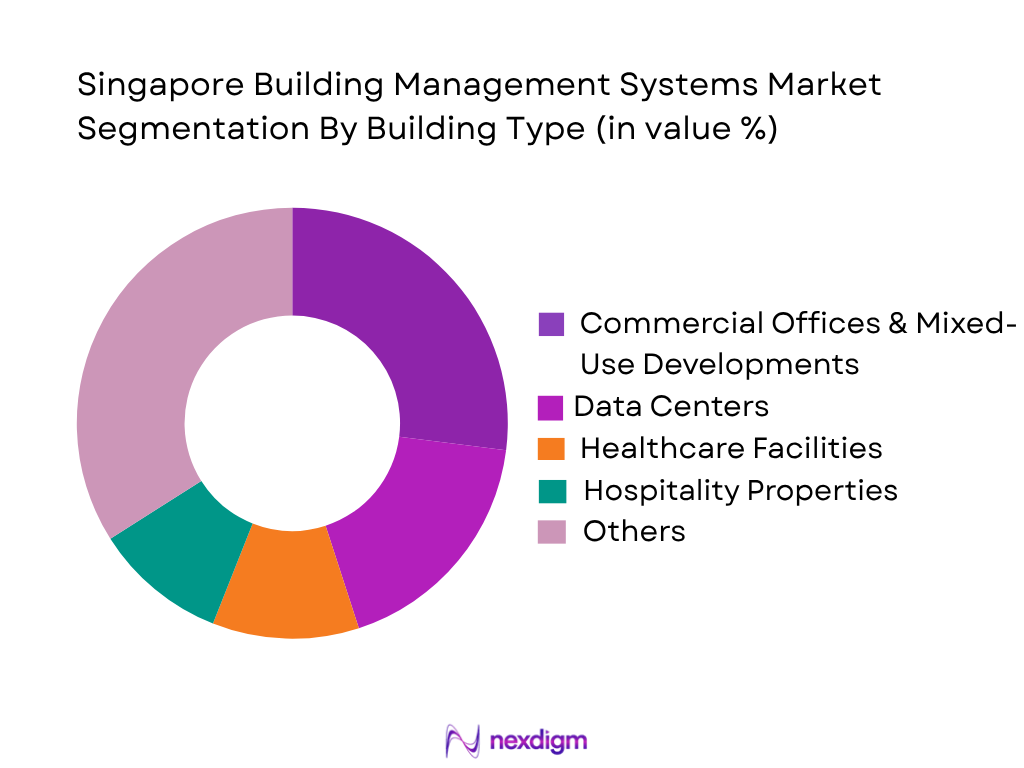
The Singapore Building Management Systems Market is segmented into commercial offices and mixed-use developments, data centers, healthcare facilities, hospitality properties, retail buildings, government and institutional buildings, industrial facilities, educational campuses and residential developments. Commercial offices and mixed-use buildings hold the dominant share because they combine high occupancy density with extensive ACMV, lighting, access-control, metering and vertical-transportation infrastructure. Singapore requires owners of applicable buildings with at least 5,000 square metres of gross floor area to submit annual building information and energy-consumption data for benchmarking, increasing the operational focus on energy performance. Large commercial properties can therefore justify sophisticated BMS platforms that automate occupancy schedules, monitor energy-use intensity, identify plant faults and integrate systems from multiple vendors. Singapore’s continued redevelopment of commercial properties and major mixed-use projects further reinforces the installed base for supervisory controllers, sensors, energy dashboards and cloud-connected facility platforms.
Competitive Landscape
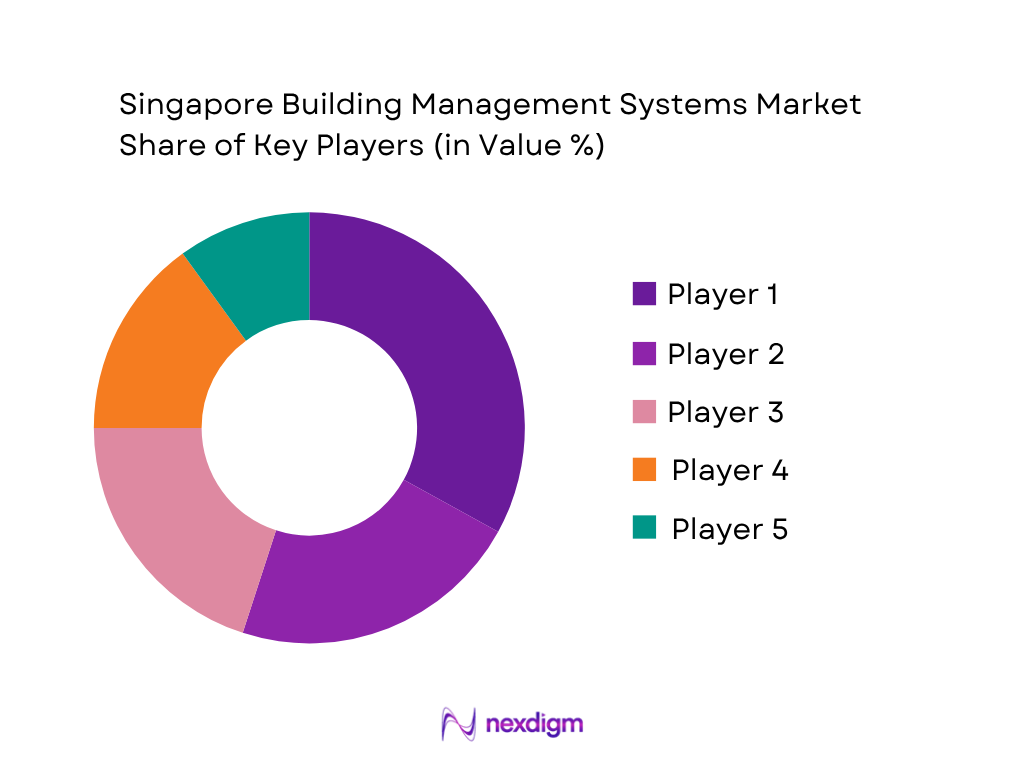
The Singapore Building Management Systems Market combines multinational automation companies with locally established engineering and smart-building providers. Honeywell, Johnson Controls, Siemens and Schneider Electric compete through broad hardware-software ecosystems, while ST Engineering provides a strong Singapore-based alternative focused on smart-energy and urban infrastructure. Competitive differentiation increasingly depends on HVAC and chiller controls, interoperability, cloud analytics, energy optimisation, data-centre capabilities and the ability to deliver commissioning and lifecycle services locally.
| Company | Establishment Year | Headquarters | Core BMS Platform | HVAC/Chiller Controls | Cloud & Analytics | Open-Protocol Capability | Energy Management | Singapore Integration & Service Capability |
| Honeywell International Inc. | 1906 | Charlotte, US | ~ | ~ | ~ | ~ | ~ | ~ |
| Johnson Controls International plc | 1885 | Cork, Ireland | ~ | ~ | ~ | ~ | ~ | ~ |
| Siemens AG | 1847 | Munich and Berlin, Germany | ~ | ~ | ~ | ~ | ~ | ~ |
| Schneider Electric SE | 1836 | Rueil-Malmaison, France | ~ | ~ | ~ | ~ | ~ | ~ |
| ST Engineering Urban Solutions Ltd | 1969 | Singapore | ~ | ~ | ~ | ~ | ~ | ~ |
Singapore Building Management Systems Market Analysis
Growth Drivers
Strong Construction Pipeline Expanding the Addressable Building Automation Base
Singapore’s sustained construction activity is creating a larger installed base for Building Management Systems across commercial buildings, healthcare facilities, high-specification industrial properties, transport infrastructure and mixed-use developments. The Building and Construction Authority reported S$44.2 billion of construction demand in 2024, while construction output reached S$38.4 billion. Large projects included institutional developments, public and private housing, transport works and high-specification industrial facilities, all of which require HVAC controls, energy monitoring, electrical integration, fire-system interfaces and centralized facility supervision. This activity is particularly relevant for BMS suppliers because automation can be embedded during design and commissioning rather than retrofitted after occupancy. Singapore’s macroeconomic capacity further supports investment in sophisticated building infrastructure. The International Monetary Fund reported US$547.5 billion of nominal GDP in 2024, with GDP per capita of US$90,689 and a population of approximately 6.0 million. These indicators reflect a high-value, infrastructure-intensive economy capable of supporting advanced smart-building specifications. Consequently, expanding construction activity directly strengthens demand for DDC controllers, supervisory platforms, smart meters, sensors, chiller controls, cloud connectivity and system-integration services across Singapore’s built environment.
Rising Building Electricity Load Strengthening Energy-Management Requirements
Singapore’s high electricity consumption across commercial and service-sector buildings is strengthening demand for sophisticated BMS platforms that can optimise chillers, air-handling units, pumps, ventilation systems, lighting and electrical loads. The Energy Market Authority recorded 58 TWh of total electricity consumption in 2024, of which the commerce and services sector consumed approximately 23 TWh, making it one of Singapore’s largest electricity-consuming segments. The Information and Communications sector is also becoming increasingly important because data centres, telecommunications assets and digital facilities contain intensive cooling and power-management requirements. This operating environment increases the importance of real-time metering, automated scheduling, demand-controlled ventilation, chiller sequencing, fault detection and portfolio-level energy analytics. Singapore’s economic structure supports continued investment in such digital building infrastructure. The World Bank reported US$547.39 billion of GDP in 2024 and GDP per capita of US$90,674.1, demonstrating the country’s concentration of high-value commercial and technology-intensive activities. For building owners, integrated controls provide a mechanism for managing increasingly complex electrical and mechanical systems rather than relying on isolated equipment-level controls. This reinforces BMS adoption in offices, hotels, malls, hospitals, business parks and data centres.
Market Challenges
Dependence on a Large Technical and Construction Workforce for BMS Deployment
Building Management Systems projects in Singapore depend on specialised manpower for electrical installation, ACMV integration, controls programming, networking, testing, commissioning and ongoing maintenance, creating execution challenges when construction activity is simultaneously elevated. The Ministry of Manpower recorded 1,576,500 foreign workers in December 2024, including 456,800 Work Permit holders in the construction, marine shipyard and process sectors. Total employment increased by 44,500 workers during 2024, while non-resident employment contributed 35,700 workers, with much of the increase concentrated in Work Permit occupations supporting construction activity. BMS installations compete for technical resources with mechanical, electrical, data-centre and infrastructure projects, while automation projects additionally require knowledge of BACnet, Modbus, DDC programming, network configuration, sensor calibration and equipment commissioning. Singapore’s high-value economy magnifies the importance of labour productivity: the IMF reported US$547.5 billion of nominal GDP in 2024 and GDP per capita of US$90,689. As building systems become more digital and integrated, shortages or scheduling constraints among qualified engineers, programmers and commissioning personnel can lengthen implementation cycles and complicate simultaneous deployment across multiple high-rise, commercial and mission-critical projects.
High System Complexity in Energy-Intensive and Mission-Critical Buildings
Singapore’s concentration of data centres and sophisticated commercial facilities creates a technical challenge for BMS suppliers because these buildings require extremely reliable integration between cooling, electrical distribution, environmental monitoring, alarms and digital infrastructure. The Infocomm Media Development Authority reported that Singapore hosts more than 70 cloud, enterprise and co-location data centres with combined capacity exceeding 1.4 GW. These facilities require continuous monitoring of temperature, humidity, chilled-water systems, airflow, power distribution and equipment operating conditions, making controls architecture materially more complex than conventional building automation. At the national level, the Energy Market Authority recorded 58 TWh of electricity consumption in 2024, with approximately 23 TWh consumed by commerce and services. Consequently, BMS failures, poor sensor calibration, communication faults or incomplete integration can affect both operating reliability and energy performance. The macroeconomic context reinforces the importance of resilient controls: World Bank data place Singapore’s GDP at US$547.39 billion in 2024, with GDP per capita of US$90,674.1. BMS vendors therefore need strong engineering, interoperability and commissioning capabilities to manage dense mechanical loads, redundant equipment architectures, multiple communication protocols and increasingly connected building networks.
Market Opportunities
Data Centre Automation Creating a High-Value BMS Expansion Opportunity
Singapore’s established position as a regional digital infrastructure hub creates a significant future opportunity for Building Management Systems vendors specialising in mission-critical cooling, power monitoring and environmental control. The Infocomm Media Development Authority reported more than 70 data centres operating across Singapore with combined capacity exceeding 1.4 GW in 2024. This installed base provides immediate demand for chiller optimisation, temperature and humidity sensing, differential-pressure monitoring, leak detection, electrical metering, alarm management and integration between BMS and data-centre infrastructure management platforms. BCA and IMDA have also introduced the GMDC:2024 Green Mark framework for both new and existing data centres, placing greater attention on energy performance, sustainable operations, digital innovation and smart systems. The opportunity is supported by Singapore’s broader economic profile: the IMF reported US$547.5 billion of nominal GDP in 2024, GDP per capita of US$90,689, and a population of approximately 6.0 million. This combination of a high-value digital economy and concentrated mission-critical infrastructure creates scope for BMS providers to expand beyond conventional controls into AI-based cooling optimisation, predictive fault detection, real-time energy analytics, cloud supervision and integrated lifecycle management.
Green Building Retrofits and Smart Facilities Management Expanding BMS Scope
Singapore’s mature green-building ecosystem creates a substantial opportunity for BMS vendors to move beyond basic equipment control toward building-performance analytics, Smart Facilities Management and continuous optimisation of existing properties. The Building and Construction Authority reported in 2026 that Green Mark buildings collectively deliver more than 4.2 billion kWh of annual energy savings, an amount equivalent to powering approximately 1 million four-room HDB flats. These operating results demonstrate the scale of energy that can be influenced through better building design, controls, monitoring and ongoing optimisation. For existing commercial and institutional assets, BMS upgrades can incorporate smart meters, wireless sensors, automated HVAC reset strategies, fault detection, digital twins and interfaces with computerised maintenance-management systems without requiring complete mechanical-system replacement. Singapore’s macroeconomic base supports continued investment in such asset modernisation: World Bank data show US$547.39 billion of GDP in 2024 and GDP per capita of US$90,674.1. As building owners seek to maintain Green Mark performance and improve operational efficiency, the opportunity increasingly shifts toward recurring software, cloud monitoring, predictive maintenance and portfolio-level control rather than one-time controller installation, expanding the strategic role of BMS providers throughout the building lifecycle.
Future Outlook
The Singapore Building Management Systems Market is expected to expand at approximately ~XX% CAGR during 2026-2035, supported by continued building digitalisation, Green Mark requirements, data-centre development, commercial redevelopment and building-energy optimisation. The technology mix is expected to migrate toward cloud BMS, AI-based fault detection, predictive maintenance, smart metering and portfolio-level facilities-management platforms.
Data centres represent an especially important future vertical. Singapore already hosts more than 70 data centres with over 1.4 GW of capacity, and IMDA’s Green Data Centre Roadmap targets at least 300 MW of additional capacity in the near term. This creates demand for continuous temperature, humidity, airflow, chilled-water and electrical monitoring, while stricter energy-efficiency requirements favour advanced chiller plant controls and analytics.
Major Players
- Honeywell Pte Ltd
- Johnson Controls (S) Pte. Ltd.
- Siemens Pte Ltd
- Schneider Electric Singapore Pte Ltd
- ST Engineering Urban Solutions Ltd
- Quantum Automation Pte Ltd
- Azbil Singapore Pte. Ltd.
- ABB Pte. Ltd.
- Daikin Airconditioning (Singapore) Pte. Ltd.
- Carrier Singapore (Pte) Limited
- Emerson Asia Pacific Private Limited
- Willowglen Services Pte Ltd
- Barghest Building Performance Pte. Ltd.
- CPG Facilities Management Pte Ltd
- Automatic Controls and Instrumentation Pte. Ltd.
Key Target Audience
- Building Management System and Building Automation OEMs
- HVAC, ACMV, Chiller Controls and Smart-Sensor Manufacturers
- BCA ME02 Building Automation Contractors and System Integrators
- Commercial Property Developers, REITs and Building Owners
- Data Centre Developers, Operators and Digital Infrastructure Companies
- Energy Service Companies and Smart Facilities Management Providers
- Investments and Venture Capitalist Firms
- Government and Regulatory Bodies (Building and Construction Authority, Energy Market Authority, Infocomm Media Development Authority, National Environment Agency, Singapore Civil Defence Force)
Research Methodology
Step 1: Identification of Key Variables
The initial phase involves constructing an ecosystem map covering BMS manufacturers, HVAC and chiller OEMs, BCA ME02 contractors, system integrators, developers, facility managers, data-centre operators and government stakeholders. Secondary research identifies variables including construction demand, Green Mark adoption, building stock, BMS penetration, retrofit cycles, cloud adoption and automation intensity.
Step 2: Market Analysis and Construction
Historical data are analysed across commercial, industrial, institutional, data-centre and residential applications. The bottom-up approach assesses controllers, sensors, software, integration projects and maintenance revenue, while the top-down methodology evaluates construction activity, existing building floor area and automation penetration. Both models are compared and reconciled before establishing the final market baseline.
Step 3: Hypothesis Validation and Expert Consultation
Market hypotheses are validated through computer-assisted telephone interviews and direct discussions with BMS vendors, controls contractors, facility managers, M&E contractors and system integrators. These consultations examine typical system architecture, retrofit requirements, hardware-software mix, customer procurement criteria, commissioning requirements and competition between global OEM platforms and locally integrated systems.
Step 4: Research Synthesis and Final Output
Primary findings are triangulated with BCA, URA, IMDA and other public-sector data, alongside company disclosures and industry information. Market sizing assumptions are validated using both top-down and bottom-up calculations. Forecast models then incorporate commercial construction, legacy BMS replacement, data-centre expansion, smart facilities management adoption, cloud migration and increasing controls sophistication.

- Executive Summary
- Research Methodology (Market Definitions and Assumptions, Singapore Building Management Systems Market Classification, BMS-BAS-BEMS Scope, Building Controls Architecture Mapping, HVAC Controls Assessment, ACMV Controls Assessment, Chiller Plant Controls Assessment, Lighting Controls Assessment, Building Energy Management Assessment, Smart Metering Assessment, Indoor Air Quality Monitoring Assessment, Security and Access Control Integration Assessment, Fire and Life Safety Integration Assessment, Cloud BMS Assessment, Edge-Control Architecture Assessment, IoT Sensor Assessment, BACnet Protocol Assessment, Modbus Protocol Assessment, KNX Protocol Assessment, Building Automation Installed-Base Assessment, Smart Facilities Management Assessment, Green Mark Compliance Assessment, BCA ME02 Contractor Assessment, Data Centre Controls Assessment, District Cooling Integration Assessment, Supply-Side Assessment, Demand-Side Assessment, Top-Down Market Sizing, Bottom-Up Market Sizing, Primary Industry Interviews, Building Stock Assessment, Construction Project Pipeline Assessment, Data Triangulation, Forecasting Framework)

- Definition and Scope
- Singapore Building Automation Industry Evolution and Development of Building Management Systems, Building Automation Systems, Building Energy Management Systems, Direct Digital Controls, HVAC and ACMV Controls, Chiller Plant Management Systems, Lighting Controls, Smart Metering Systems, Indoor Air Quality Monitoring, Integrated Security Systems, Fire and Life Safety Integration, Enterprise Building Management Platforms, Cloud-Based BMS, IoT-Enabled Building Controls, Fault Detection and Diagnostics Platforms, Energy Analytics, Digital Twins, AI-Based Building Optimization, Occupancy-Based Controls, Smart Facilities Management Platforms, Grid-Interactive Building Controls, Data Centre Environmental Control Systems
- Building Management Systems Value Chain Analysis
- Building Management Systems Supply Chain Analysis
- Sensor Manufacturers, Controller Manufacturers, Actuator Manufacturers, Smart Meter Suppliers, Gateway and Edge Device Manufacturers, HVAC and Chiller Equipment Manufacturers, Building Automation Software Providers, Cloud Platform Providers, Building Analytics Providers, Fault Detection and Diagnostics Providers, BMS OEMs, Building Controls Contractors, BCA-Registered ME02 Contractors

- Growth Drivers (BCA Green Mark Requirements, Smart Facilities Management Adoption, Commercial Building Redevelopment, Data Centre Expansion, Building Energy-Efficiency Requirements, Chiller Plant Optimisation, Public-Sector Digitalisation, High-Rise Building Automation, Smart Metering Adoption, Cloud BMS Deployment, IoT Sensor Penetration, Building Decarbonisation, District Cooling Integration)
- Market Challenges (High Retrofit Complexity, Legacy BMS Integration, Proprietary Building Protocols, Building Automation Cybersecurity Risks, Skilled Controls Engineer Availability, Multi-Vendor Integration Complexity, Building Data Interoperability, Occupied-Building Retrofit Constraints, Software Lifecycle Management)
- Market Opportunities (Legacy BMS Modernisation, Cloud-Based Building Management Platforms, AI-Based HVAC Optimisation, Chiller Plant Analytics, Smart Facilities Management Platforms, Data Centre BMS, Fault Detection and Diagnostics, Wireless Retrofit Controls, Green Mark Upgrade Projects, Portfolio-Level Energy Management, Digital Twins, BMS Cybersecurity Services, BMS-as-a-Service)
- Market Trends (AI-Enabled Building Controls, Predictive Maintenance, Cloud-Native BMS, IoT Sensor Integration, Digital Twin Adoption, Edge Computing, Open-Protocol Integration, Smart Metering, Occupancy-Based HVAC Control, Indoor Air Quality Analytics, Automated Fault Detection, Portfolio Dashboards, Autonomous Chiller Optimisation, IT-OT Convergence)
- Government Regulations and Standards (BCA Building Control Regulations, BCA Green Mark Certification Scheme, Green Mark In-Operation Requirements, Green Mark for Data Centres, Singapore Green Building Masterplan, Energy Conservation Act, BCA Smart Facilities Management Framework, BCA ME02 Building Automation Registration Requirements)
- SWOT Analysis
- Porter’s Five Forces Analysis
- PESTLE Analysis
- Stakeholder Ecosystem
- Building Automation and Smart Building Project Ecosystem

- By Market Value (2020-2025)
- By Building Management Systems Installed Base (2020-2025)
- By BMS-Enabled Buildings (2020-2025)
- By Connected Building Floor Area (2020-2025)
- By Hardware Revenue (2020-2025)
- By Software Revenue (2020-2025)
- By Services Revenue (2020-2025)
- By New Construction BMS Revenue (2020-2025)
- By Retrofit and Modernisation Revenue (2020-2025)
- By Cloud-Based BMS Revenue (2020-2025)
- By Smart Facilities Management Revenue (2020-2025)
- By Commercial Building BMS Revenue (2020-2025)
- By Data Centre BMS Revenue (2020-2025)

- By Offering (In Value %)
Hardware
Sensors
Temperature Sensors
Humidity Sensors
CO2 Sensors
Indoor Air Quality Sensors
Occupancy Sensors
Pressure Sensors
Flow Sensors
Smart Energy Meters
Direct Digital Controllers
Supervisory Controllers
Actuators and Control Valves
Gateways and Edge Devices
Control Panels
Software - By System Type (In Value %)
HVAC and ACMV Control Systems
Chiller Plant Management Systems
Building Energy Management Systems
Lighting Control Systems
Electrical and Power Monitoring Systems
Indoor Air Quality Monitoring Systems
Occupancy and Space Management Systems
Security and Access Control Integration
Fire and Life Safety Integration
Water Monitoring and Management Systems
Lift and Vertical Transportation Integration
EV Charging Management Systems
Distributed Energy Resource Controls
Integrated Building Management Platforms - By Deployment Type (In Value %)
On-Premise Building Management Systems
Cloud-Based Building Management Systems
Hybrid Building Management Systems
Edge-Enabled Building Management Systems
Multi-Building Management Systems
Portfolio-Level Building Management Systems
Smart Campus Management Platforms - By Application (In Value %)
New Building Construction
Building Automation Retrofit
Legacy BMS Modernisation
HVAC and ACMV Controls Upgrade
Chiller Plant Optimisation
Building Energy Optimisation
Smart Facilities Management
Green Mark Compliance
Indoor Air Quality Optimisation
Fault Detection and Predictive Maintenance
Building Portfolio Digitalisation
Data Centre Environmental Control
Demand Response and Load Management
Building Decarbonisation - By Building Type (In Value %)
Commercial Office Buildings
Premium Grade Office Buildings
Retail and Shopping Centres
Hotels and Hospitality Buildings
Data Centres
Healthcare Facilities
Educational Institutions
Government and Public Buildings
Industrial and Manufacturing Facilities
Business Parks
Warehouses and Logistics Facilities
Airports and Transportation Facilities
Mixed-Use Developments
Private Residential Developments
Public Housing Common Facilities
Life Sciences and Laboratory Facilities - By Customer Type (In Value %)
Commercial Property Developers
Commercial Building Owners
Real Estate Investment Trusts
Property and Facility Management Companies
Data Centre Operators
Government Agencies
Healthcare Operators
Educational Institutions
Hospitality Groups
Industrial Facility Operators
Main Contractors
Mechanical and Electrical Contractors
Energy Service Companies - By Region (In Value %)
Central Region
East Region
North Region
North-East Region
West Region
Downtown Core
Marina Bay
Orchard
Jurong
Changi
One-North
Punggol Digital District
Rest of Singapore

- Market Share of Major Players (By Singapore Revenue, Building Automation Installed Base, Hardware Revenue, Software Revenue, Services Revenue, HVAC and ACMV Controls Revenue, Chiller Plant Controls Revenue, Cloud BMS Revenue, Commercial Building Project Portfolio, Data Centre Project Portfolio, Green Mark Capability, BCA ME02 Contractor Capability, System Integration Capability, Smart Facilities Management Capability, Service and Maintenance Coverage)
- Cross Comparison Parameters (Singapore BMS Installed Base, HVAC and Chiller Controls Capability, Open-Protocol Interoperability Capability, Cloud BMS and Analytics Capability, Green Mark and Energy-Optimisation Capability, Data Centre Controls Capability, BCA ME02 and Local System Integration Capability, Smart Facilities Management and Lifecycle Service Capability)
- SWOT Analysis of Major Players
- Competitive Positioning Matrix
- Major Companies
Honeywell Pte Ltd
Johnson Controls (S) Pte. Ltd.
Siemens Pte Ltd
Schneider Electric Singapore Pte Ltd
ST Engineering Urban Solutions Ltd
Quantum Automation Pte Ltd
Azbil Singapore Pte. Ltd.
ABB Pte. Ltd.
Daikin Airconditioning (Singapore) Pte. Ltd.
Carrier Singapore (Pte) Limited
Emerson Asia Pacific Private Limited
Willowglen Services Pte Ltd
Barghest Building Performance Pte. Ltd.
CPG Facilities Management Pte Ltd
Automatic Controls and Instrumentation Pte. Ltd.

- Commercial Property Developer BMS Requirement Assessment
- REIT and Institutional Landlord BMS Requirement Assessment
- Facility Manager Building Automation Requirement Assessment
- Data Centre Controls Requirement Assessment
- Healthcare Facility BMS Requirement Assessment
- Educational Campus Building Automation Assessment
- Government Building Energy Management Assessment
- Hotel and Hospitality Building Automation Assessment
- Industrial Facility Building Controls Assessment
- Smart Facilities Management Requirement Assessment
- M&E Consultant Specification Assessment
- System Integrator Project Requirement Assessment

- By Market Value (2026-2035)
- By Building Management Systems Installed Base (2026-2035)
- By BMS-Enabled Buildings (2026-2035)
- By Connected Building Floor Area (2026-2035)
- By Hardware Revenue (2026-2035)
- By Software Revenue (2026-2035)
- By Services Revenue (2026-2035)
- By New Construction BMS Revenue (2026-2035)
- By Retrofit and Modernisation Revenue (2026-2035)
- By Cloud-Based BMS Revenue (2026-2035)
- By Smart Facilities Management Revenue (2026-2035)
- By Commercial Building BMS Revenue (2026-2035)
- By Data Centre BMS Revenue (2026-2035)


 Request a Sample
 Ask for Customization
 Get a Quote
 Enquire Now
