
 Download PDF
Market Overview
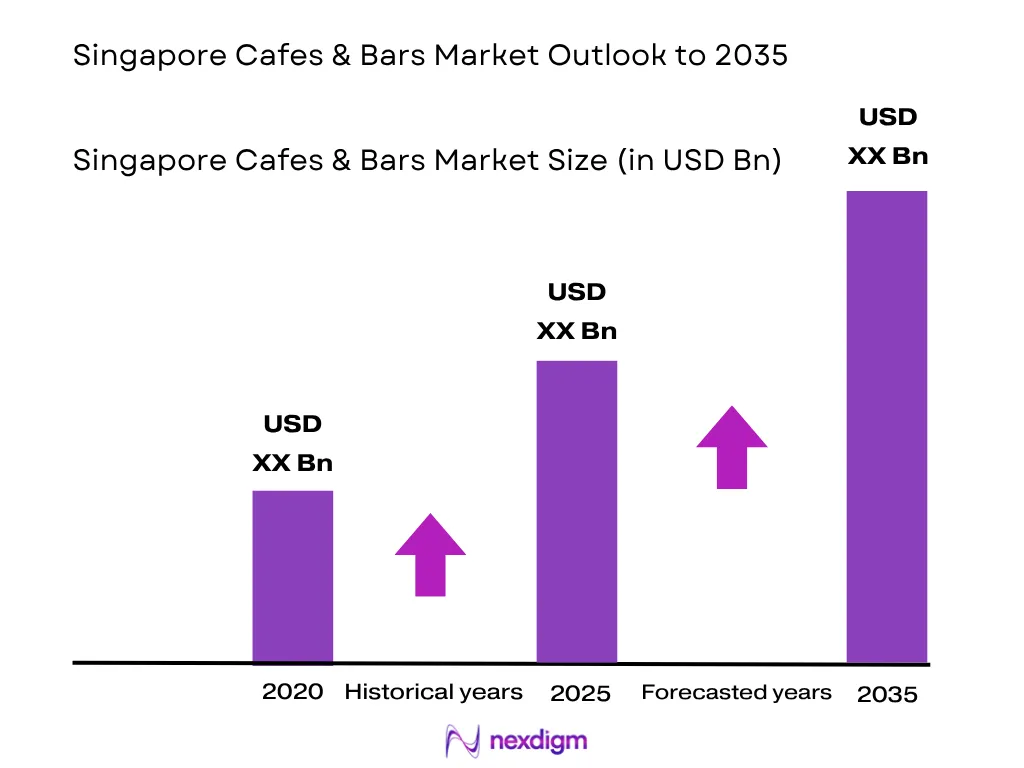
The Singapore Cafes & Bars Market is valued at USD ~ billion, compared with USD~ billion in the latest historical base, driven by tourist recovery, higher beverage-led out-of-home spending, premium coffee adoption, cocktail-led nightlife, and digital ordering. Cafés/bars are the second-largest consumer foodservice channel after street stalls/kiosks, while the wider foodservice sector totals USD ~ billion in the latest forecast base. The forecasted CAGR for the 2026–2035 planning period is 3.9%, using the latest Singapore cafés/bars channel forecast as the market-specific baseline.
Singapore’s café and bar demand is concentrated in CBD, Orchard Road, Marina Bay, Clarke Quay, Tanjong Pagar, Chinatown, Sentosa and Changi Airport because these districts combine office density, visitor flows, hotels, premium malls, nightlife clusters and higher spend occasions. The country recorded 16.5 million visitors and USD 23 billion in tourism receipts in the latest reported tourism base, while foodservice operates through around 30,000 retail food establishments, supporting high venue density in central and tourist-heavy zones.
Market Segmentation
By Outlet Type
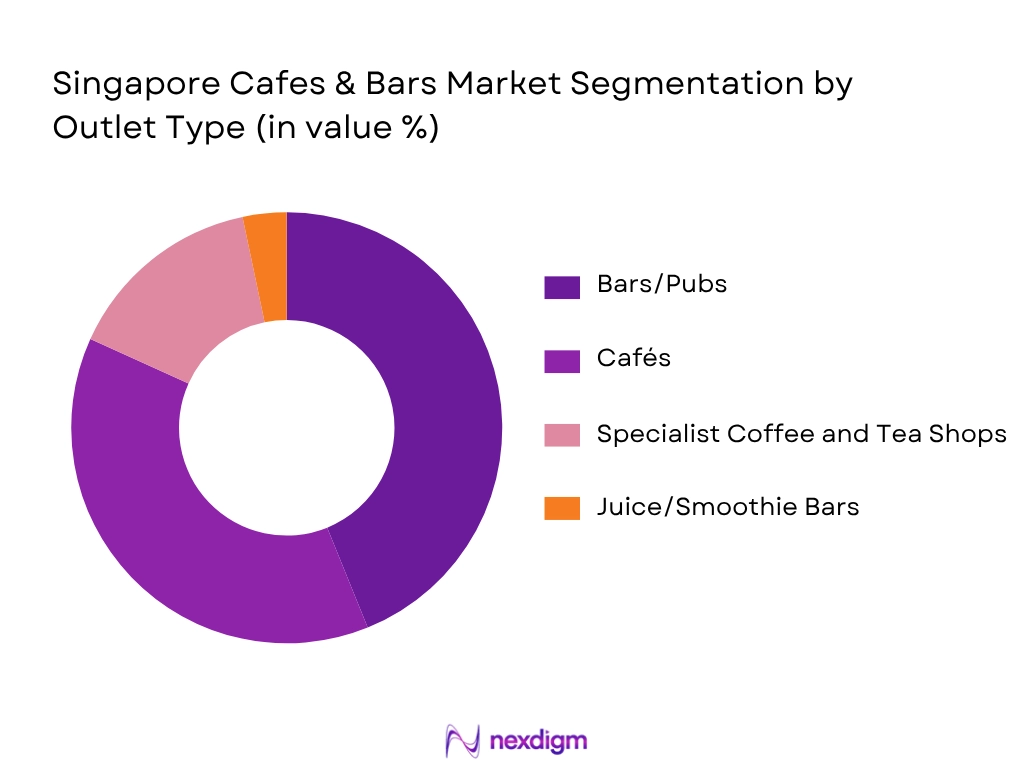
Singapore Cafes & Bars Market is segmented by outlet type into bars/pubs, cafés, specialist coffee and tea shops, and juice/smoothie bars. Bars/pubs dominate the outlet type segment because Singapore has a strong after-work drinking culture across CBD, Boat Quay, Clarke Quay, Tanjong Pagar and hotel-led nightlife corridors. This segment benefits from higher average bills than traditional cafés, premium cocktail demand, imported spirits consumption, craft beer adoption, and event-led corporate spending. Bars/pubs also gain from tourism-led evening traffic around Marina Bay, Sentosa and entertainment precincts. Cafés remain structurally important because they serve daily coffee, breakfast and brunch occasions, but bars/pubs command larger ticket sizes through cocktails, beer towers, wine bottles, spirits, food pairing and late-night dwell time. Specialist coffee and tea shops are growing through third-wave coffee, matcha and premium non-alcoholic beverages, but their revenue base remains smaller than mainstream cafés and bars/pubs.
By Ownership Model
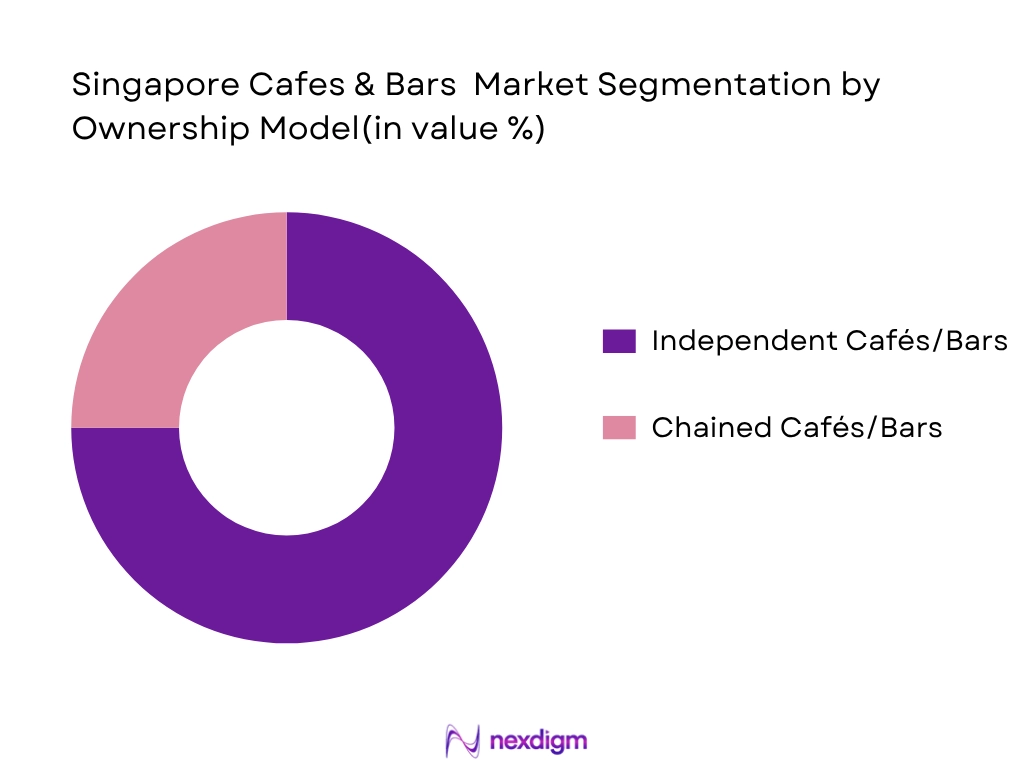
Singapore Cafes & Bars Market is segmented by ownership model into independent cafés/bars and chained cafés/bars. Independent cafés/bars dominate the ownership model segment because Singapore’s café and bar scene is strongly shaped by shophouse cafés, neighbourhood specialty coffee venues, independent cocktail bars, wine bars, craft beer pubs and chef/bar-owner-led concepts. These venues compete through differentiated menus, interiors, localised branding, signature drinks, brunch innovation and social media discovery rather than national scale alone. Independent operators are particularly visible in Tanjong Pagar, Chinatown, Kampong Glam, Joo Chiat, Dempsey and Holland Village. Chained operators retain strong positions in high-footfall malls, office corridors and transport nodes because they benefit from procurement scale, standardised menus, loyalty systems and faster rollout. However, the market’s premium and experience-led positioning gives independent operators a larger share, especially in destination bars and specialty cafés.
Competitive Landscape
The Singapore Cafes & Bars Market is fragmented but brand influence is concentrated around a mix of international coffee chains, local heritage coffee-and-toast chains, lifestyle café groups and specialist bar operators. Starbucks, Toast Box and Ya Kun anchor the mass café and daily beverage occasion, while Harry’s represents the scaled mainstream bar format. Jigger & Pony Group reflects Singapore’s premium cocktail leadership and has helped position the city as a regional bar destination.
| Player | Establishment Year | Headquarters | Primary Format | Market Positioning | Core Beverage Focus | Location Strategy | Digital / Customer Model | Market-Specific Strength |
| Starbucks Singapore | 1996 in Singapore | Singapore operations licensed to Maxim’s Caterers | ~ | ~ | ~ | ~ | ~ | ~ |
| Ya Kun Kaya Toast | 1944 | Singapore | ~ | ~ | ~ | ~ | ~ | ~ |
| Toast Box | 2005 | Singapore | ~ | ~ | ~ | ~ | ~ | ~ |
| Harry’s | 1992 | Singapore | ~ | ~ | ~ | ~ | ~ | ~ |
| Jigger & Pony Group | 2012 | Singapore | ~ | ~ | ~ | ~ | ~ | ~ |
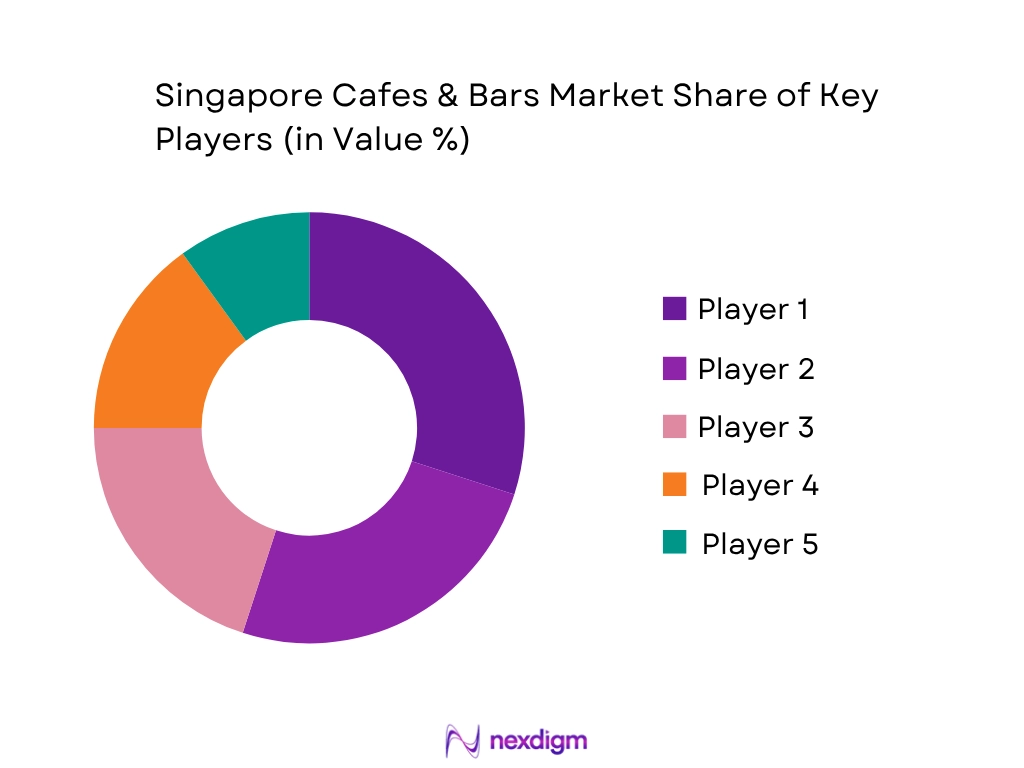
Singapore Cafes & Bars Market Analysis
Growth Drivers
Tourism Recovery
Tourism recovery is a direct growth driver for Singapore Cafes & Bars Market because cafés, cocktail bars, hotel lounges, rooftop bars and café-bars are strongly exposed to visitor spending in Marina Bay, Orchard, Sentosa, Chinatown, Clarke Quay, Tanjong Pagar and Changi Airport. Singapore recorded 16.5 million international visitor arrivals in 2024, while tourism receipts reached S$22.4 billion during January–September 2024; both indicators support higher footfall for premium cafés, hotel bars and experiential F&B venues. Mainland China, Indonesia and India generated 3.08 million, 2.49 million and 1.20 million arrivals respectively, creating a broad visitor base for coffee, brunch, late-night drinks and destination bar concepts. Changi Airport’s international seat capacity exceeded 41 million seats in 2024, improving inbound accessibility and supporting airport cafés, hotel bars and tourist-zone operators. In 2025, visitor arrivals further reached 16.9 million, with Mainland China, Indonesia, Malaysia, Australia and India contributing 3.1 million, 2.4 million, 1.3 million, 1.3 million and 1.2 million arrivals respectively. For cafés and bars, this matters because tourism demand is highly concentrated in high-spend districts where premium coffee, cocktails, wine, brunch, dessert cafés and hotel-led bar formats are more commercially viable than in purely residential locations. The recovery also supports event-driven peaks around concerts, Formula 1, MICE, integrated resorts and cruise activity, all of which increase evening beverage demand and social-dining occasions.
Premium Coffee Adoption
Premium coffee adoption in Singapore Cafes & Bars Market is supported by high-income urban consumers, strong services-sector activity and a sophisticated foodservice ecosystem. Singapore is described as a high-income city-state with a population of approximately 6 million in mid-2024, while IMF data shows Singapore’s GDP at US$659.57 billion and GDP per capita at US$107.76 thousand in 2026, indicating a consumer base capable of supporting specialty coffee, artisanal bakery cafés, matcha beverages and higher-quality café formats. Foodservice operators also benefit from Singapore’s import-dependent, globally connected food system: the Singapore Food Agency reported that Singapore imports more than 90 out of every 100 units of its food supply and had increased food supply sources to 187 countries/regions in 2024. This supports access to international coffee beans, dairy alternatives, bakery ingredients and premium beverage inputs. At the operating level, food and beverage services remained active in the wider services economy: SingStat reported total F&B sales value of S$1.6 billion in January 2026, with online F&B sales forming 22.1 units out of every 100 units of total F&B sales. These indicators support premium coffee adoption because specialty cafés rely on affluent, time-constrained, digitally reachable consumers who purchase coffee across breakfast, workday break, brunch and takeaway occasions. Premium adoption is also reinforced by Singapore’s dense office zones, mixed-use malls and travel corridors, where café formats can monetize repeated visits rather than only destination dining.
Market Challenges
High Rent
High rent remains a structural challenge for Singapore Cafes & Bars Market because operators compete for a limited stock of viable high-footfall premises in a compact city-state. The World Bank describes Singapore as an island city-state with approximately 6 million people in mid-2024, which intensifies competition for commercial locations serving office workers, tourists, residents and nightlife consumers. The pressure is visible in business churn: food and beverage services recorded 3,795 new business formations in 2024, but 3,048 cessations in the same year; in 2025, the sector recorded 4,103 formations and 3,074 cessations. This level of entry and exit shows that cafés and bars remain attractive but face difficult operating conditions once they enter the market. The challenge is most acute for coffee shops and bars in CBD, Orchard, Marina Bay, Tanjong Pagar, Clarke Quay, hotel corridors and prime malls because these locations are also targeted by restaurants, dessert chains, QSRs, bubble tea brands, convenience concepts and retail tenants. For cafés, rent pressure limits seating area, pushes operators toward smaller formats and increases dependence on high cup throughput, takeaway and delivery. For bars, it raises the need for stronger night-time sales, events, private bookings and premium beverage margins. High rent also makes white-space location selection more important, especially heartland malls, neighbourhood shophouses and mixed-use developments where operators can balance footfall with survivable occupancy commitments.
Manpower Shortage
Manpower shortage is a key operational challenge for Singapore Cafes & Bars Market because cafés and bars depend on baristas, service crew, bartenders, kitchen staff, outlet supervisors and part-time workers across long operating hours. MOM reported that resident employment in Food & Beverage Services declined by 2,100 in 2024, even while resident employment increased by 8,800 across the overall economy. This indicates that labour supply is moving toward higher-skilled sectors, making it harder for cafés and bars to attract and retain resident workers. Non-resident employment growth also slowed from 83,500 in 2023 to 35,700 in 2024, while the increase was mostly among Work Permit holders, with 39,400 added in 2024. The labour market remained tight, with 77,500 job vacancies in December 2024, up from 61,500 in September 2024, and 1.64 job vacancies for every unemployed person. This environment makes café and bar staffing difficult because the sector requires split shifts, weekend work, evening shifts, food safety compliance and customer-facing service consistency. Bars face additional difficulty because trained bartenders must manage cocktails, alcohol service rules, guest interaction, late-night operations and reservation peaks. Cafés face similar constraints around early-morning opening, high transaction throughput and consistent beverage preparation. As a result, operators are pushed toward self-ordering kiosks, QR ordering, simplified menus, central kitchens, cross-trained staff, part-time rostering and productivity tools, but these changes require disciplined implementation and do not fully remove service-labour dependency.
Opportunities
White Space Locations
White space locations represent a major opportunity for Singapore Cafes & Bars Market as operators expand beyond saturated premium clusters into heartland malls, residential town centres, transport nodes, airport retail, mixed-use precincts and neighbourhood shophouses. Business formation data supports continued operator interest: Food & Beverage Services recorded 3,795 new business formations in 2024 and 4,103 formations in 2025. Even after accounting for cessations of 3,048 in 2024 and 3,074 in 2025, new entry remained higher than exit, showing that operators continue to identify viable unmet demand. The opportunity is also supported by Singapore’s population base of 6.11 million in 2025 and 1.49 million resident households in 2025, which creates recurring demand for daily coffee, weekend brunch, dessert cafés and neighbourhood bars outside the core CBD. Tourism adds another layer: 2025 visitor arrivals reached 16.9 million, reinforcing demand in airport, hotel and integrated resort-adjacent locations, while not all café and bar expansion needs to be concentrated in Orchard, Marina Bay or Clarke Quay. For market participants, white-space opportunity lies in matching format to catchment: grab-and-go coffee near MRT flows, brunch cafés in family-heavy residential areas, wine/cocktail bars in affluent neighbourhoods, and hybrid café-bars in mixed-use precincts. These locations can reduce dependence on the most contested central rental zones while still capturing Singapore’s dense urban consumption patterns.
Premiumization
Premiumization is a future-facing opportunity for Singapore Cafes & Bars Market because the country’s income profile, visitor base and foodservice sophistication support higher-value beverage and experience-led formats. IMF data indicates Singapore’s GDP at US$659.57 billion and GDP per capita at US$107.76 thousand in 2026, creating a favourable base for specialty coffee, curated brunch cafés, cocktail bars, wine bars, omakase-style bar experiences, dessert cafés and hotel lounges. Tourism also reinforces premiumization: Singapore recorded 16.5 million visitor arrivals in 2024, and tourism receipts reached S$22.4 billion in January–September 2024, with Mainland China, Indonesia and Australia contributing S$3.58 billion, S$2.13 billion and S$1.44 billion respectively in tourism receipts, excluding sightseeing, entertainment and gaming. In 2025, tourism receipts for January–September reached S$23.9 billion, while Mainland China, Indonesia and Australia contributed S$3.68 billion, S$2.09 billion and S$1.54 billion respectively. This matters for cafés and bars because premium formats are most viable where consumers value ambience, service, signature beverages, branded interiors, cocktail craft, seasonal menus and social-media-ready experiences. Premiumization also aligns with Singapore’s global food and beverage positioning: cafés can upsell specialty beans, matcha, bakery, retail coffee and subscriptions, while bars can expand into low-ABV cocktails, tasting flights, private events and hotel partnerships. Current macro and tourism indicators therefore support premium value creation without relying on aggressive outlet expansion alone.
Future Outlook
The Singapore Cafes & Bars Market is expected to remain structurally attractive, supported by tourism recovery, high urban density, premium beverage consumption, specialty coffee adoption and cocktail-led nightlife. Growth will be shaped by rent and labour constraints, but operators with strong menu engineering, higher table turnover, digital loyalty and disciplined location strategy should outperform. The market will also benefit from airport, hotel, lifestyle mall and mixed-use development demand.
Premiumization will remain a major growth vector. Consumers are paying for better beans, better cocktails, curated interiors, unique desserts, branded merchandise, tasting menus and social-media-friendly experiences. However, the market will not grow evenly. Value formats and heritage kopi chains will remain relevant because Singapore consumers are price-sensitive and have many low-cost alternatives through hawker centres, food courts and kiosks.
Major Players
- Starbucks Singapore
- The Coffee Bean & Tea Leaf Singapore
- Luckin Coffee Singapore
- % Arabica Singapore
- Huggs Coffee
- Ya Kun Kaya Toast
- Toast Box
- Joe & Dough
- Tiong Bahru Bakery
- PS.Cafe
- Privé Group
- Harry’s
- Jigger & Pony Group
- The Lo & Behold Group
- 1-Group
Key Target Audience
- Café chains and specialty coffee operators
- Bar, pub and cocktail lounge operators
- Hotel, resort and integrated hospitality groups
- Foodservice distributors and beverage importers
- Commercial landlords, mall operators and mixed-use developers
- Investments and venture capitalist firms
- Food delivery, POS, loyalty and restaurant-tech providers
- Government and regulatory bodies (Singapore Food Agency, Singapore Tourism Board, Enterprise Singapore, Ministry of Trade and Industry, Urban Redevelopment Authority, Singapore Police Force Liquor Licensing Unit, Health Promotion Board)
Research Methodology
Step 1: Identification of Key Variables
The initial phase involves constructing an ecosystem map covering café chains, independent cafés, bars, pubs, specialty coffee shops, alcohol distributors, landlords, delivery platforms and regulators. The objective is to identify key demand and supply variables such as outlet count, average bill size, beverage mix, rental pressure, tourist footfall, licensing requirements and digital sales penetration.
Step 2: Market Analysis and Construction
The second phase compiles historical and forecast data for Singapore consumer foodservice, cafés/bars, bars/pubs, cafés, specialist coffee and tea shops, and ownership models. Market size is assessed through published channel sales, operator benchmarking, outlet-level revenue assumptions, transaction density, menu pricing and location-based demand mapping.
Step 3: Hypothesis Validation and Expert Consultation
Market hypotheses are validated through structured interviews with café owners, bar operators, beverage distributors, mall leasing teams, foodservice consultants, POS vendors and procurement managers. These discussions help refine assumptions on average spend, labour cost, rent-to-sales ratios, beverage margins, delivery contribution, weekday-weekend traffic and consumer price sensitivity.
Step 4: Research Synthesis and Final Output
The final phase triangulates secondary data, public sector statistics, industry reports, operator disclosures and primary interviews. The research output integrates bottom-up outlet economics with top-down foodservice channel sizing to produce a validated view of market size, segmentation, competitive positioning, growth drivers, operational constraints and investment opportunities.

- Executive Summary
- Research Methodology (Market Definitions and Assumptions, Café-Bar Boundary Mapping, Foodservice Sales Sizing Approach, Outlet Census Methodology, Alcohol-Licensed Venue Mapping, Third-Wave Café Tracking, Primary Interviews with Operators and Distributors, Menu Price Benchmarking, Top-Down TAM/SAM/SOM Approach, Bottom-Up Outlet Revenue Build-Up, Limitations and Forecast Assumptions)

- Definition and Scope
- Market Genesis and Evolution
- Timeline of Major Players
- Business Cycle and Seasonality
- Supply Chain and Value Chain Analysis
- Regulatory and Licensing Landscape
- Demand Ecosystem
- Pricing and Unit Economics Overview

- Growth Drivers (Tourism Recovery, Premium Coffee Adoption, Cocktail Culture, Office Footfall, Digital Ordering, Mall Redevelopment, Lifestyle Dining, Expat Demand)
- Market Challenges (High Rent, Manpower Shortage, Food Inflation, Alcohol Duties, Consumer Trade-Down, Outlet Closures, Margin Compression)
- Opportunities (White Space Locations, Premiumization, Experiential Menus, Corporate Events, Cross-Border Tourism, Retail Coffee Products)
- Trends (Third-Wave Coffee, Chinese Coffee Chains, Signature Cocktails, Sober-Curious Drinking, Matcha, Specialty Tea, Sustainable Sourcing, AI-POS Analytics)
- Government Regulation (Food Shop Licence, Liquor Licence, Public Entertainment Licence, Outdoor Seating, Food Hygiene Grade, Halal Certification, GST, Employment Rules)
- SWOT Analysis (Brand Strength, Location Density, Premium Menu Capability, Cost Exposure, Digital Reach, Tourist Dependence)
- Stakeholder Ecosystem (Operators, Landlords, Coffee Roasters, Alcohol Distributors, Bakery Suppliers, Delivery Platforms, POS Providers, Regulators, Tourism Bodies)
- Porter’s Five Forces (Supplier Power, Buyer Power, Threat of Substitutes, Threat of New Entrants, Competitive Rivalry)
- Competition Ecosystem (International Chains, Local Heritage Chains, Independent Specialty Cafés, Hospitality Groups, Bar Groups, Hotel Bars, New Chinese Entrants)

- By Value (2020-2025)
- By Transaction Volume / Bills (2020-2025)
- By Outlet Count (2020-2025)
- By Average Spend per Visit (2020-2025)
- By Coffee Cup and Alcoholic Beverage Servings (2020-2025)
- By Online Ordering and Delivery Sales Contribution (2020-2025)
- By Dine-In Sales Contribution (2020-2025)

- By Outlet Format (In Value%)
Specialty Coffee Shops
Chain Cafés
Local Kopi / Kaya Toast Café Concepts
Dessert and Bakery Cafés
Brunch and Lifestyle Cafés
Café-Bars / Day-to-Night Concepts
Cocktail Bars
Wine Bars
Craft Beer Bars and Pubs
Hotel and Rooftop Bars - By Revenue Stream (In Value%)
Coffee and Espresso-Based Beverages
Tea, Matcha and Non-Coffee Beverages
Bakery, Pastry and Desserts
Brunch, Light Meals and Bar Bites
Cocktails and Spirits
Beer, Draught Beer and Craft Beer
Wine, Champagne and Sake
Retail Coffee Beans, Capsules and Merchandise
Events, Private Dining and Corporate Bookings - By Price Positioning (In Value%)
Value / Mass Café Concepts
Mid-Market Café Chains
Premium Specialty Cafés
Luxury Café and Hotel Lounge Concepts
Mainstream Bars and Pubs
Premium Cocktail Bars
Ultra-Premium Destination Bars - By Location Cluster (In Value%)
CBD and Raffles Place
Orchard Road and Somerset
Marina Bay and Sentosa
Tanjong Pagar, Telok Ayer and Chinatown
Kampong Glam and Haji Lane
Holland Village, Dempsey and Bukit Timah
Heartland Malls and Residential Town Centres
Airport, Transit and Travel Retail Locations
Hotel and Integrated Resort Locations - By Service Model (In Value%)
Full-Service Dine-In
Counter-Service / Grab-and-Go
Takeaway-Led Kiosks
Delivery-Enabled Café Kitchens
Reservation-Led Bars
Walk-In Neighbourhood Bars
Event and Private Booking-Led Venues - By Customer Cohort (In Value%)
Working Professionals
Tourists and Business Travellers
Gen Z and Students
Millennials and Young Families
Expatriates
Affluent Consumers
Remote Workers and Freelancers
Nightlife and Cocktail Enthusiasts - By Operating Model (In Value%)
Company-Owned Chain Outlets
Franchise-Operated Outlets
Independent Single-Outlet Cafés
Multi-Brand Hospitality Groups
Hotel-Operated Bars
Mall-Based Café Networks
Cloud-Integrated Café Concepts - By Occasion and Daypart (In Value%)
Breakfast Coffee and Kaya Toast
Workday Coffee Break
Weekend Brunch
Afternoon Tea and Dessert
After-Work Drinks
Date-Night and Social Drinking
Corporate Networking and Events
Late-Night Bar Hopping

- Market Share of Major Players (By Value, Outlet Count, Transaction Volume, Café Sales, Bar Sales, Coffee Sales, Alcohol Sales)
- Market Share by Outlet Format (Specialty Coffee, Chain Café, Local Kopi Café, Bakery Café, Cocktail Bar, Pub, Wine Bar, Hotel Bar)
- Cross Comparison Parameters (Outlet Footprint by Trade Area, Average Ticket Size, Beverage Revenue Mix, Alcohol Licence and Operating Hours, Delivery/Takeaway Revenue Share, Table Turnover and Seat Density, Loyalty/CRM Ecosystem, Labour Productivity and Rent-to-Sales Ratio)
- Pricing Analysis (Coffee Cup Price, Kaya Set Price, Brunch Entrée Price, Pastry Price, Cocktail Price, Beer Pint Price, Wine Glass Price, Happy Hour Pricing, Service Charge and GST Impact)
- SWOT Analysis of Major Players (Brand Equity, Menu Differentiation, Location Strength, Cost Structure, Scalability, Digital Capability, Premiumization Readiness)
- Detailed Profiles of Major Companies
Starbucks Singapore
The Coffee Bean & Tea Leaf Singapore
Luckin Coffee Singapore
% Arabica Singapore
Huggs Coffee
Ya Kun Kaya Toast
Toast Box
Joe & Dough
Tiong Bahru Bakery
PS.Cafe
Privé Group
Harry’s
Jigger & Pony Group
The Lo & Behold Group
1-Group

- Demand and Utilization (Covers per Day, Cups per Outlet, Alcohol Servings, Seat Occupancy, Table Turnover, Delivery Orders)
- Purchasing Power and Budget Allocation (Average Ticket, Coffee Spend, Brunch Spend, Cocktail Spend, Corporate Entertainment Budget, Tourist Spend)
- Needs, Desires and Pain Points (Queue Time, Price Sensitivity, Seating Availability, Wi-Fi and Work-Friendly Space, Menu Novelty, Alcohol Pricing, Service Quality)
- Consumer Decision-Making Process (Location Convenience, Menu Discovery, Google Reviews, TikTok/Instagram Influence, Reservation Platforms, Loyalty Apps, Word-of-Mouth)
- Customer Cohort Matrix (Office Workers, Tourists, Expats, Students, Young Families, Affluent Cocktail Consumers, Remote Workers)

- By Value (2026-2035)
- By Transaction Volume / Bills (2026-2035)
- By Outlet Count (2026-2035)
- By Average Spend per Visit (2026-2035)
- By Coffee Cup and Alcoholic Beverage Servings (2026-2035)
- By Online Ordering and Delivery Sales Contribution (2026-2035)
- By Dine-In Sales Contribution (2026-2035)


 Request a Sample
 Ask for Customization
 Get a Quote
 Enquire Now