
 Download PDF
Market Overview
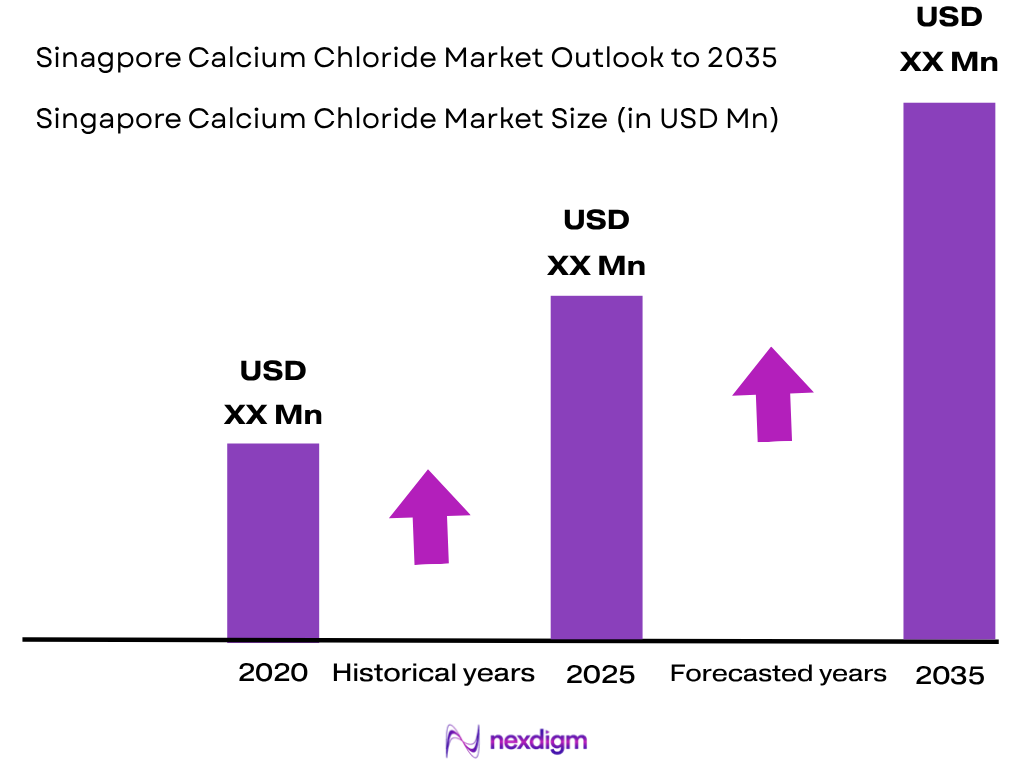
The Singapore Calcium Chloride Market is valued at approximately USD ~XX million, supported by demand from water treatment, petrochemical processing, marine operations, food manufacturing, refrigeration and industrial chemical applications. The market is influenced by Singapore’s position as a major regional chemical and logistics hub, with Jurong Island supporting extensive petrochemical and specialty chemical activity. Demand is further supported by calcium chloride requirements in brine systems, moisture control, industrial processing, construction chemicals and water-treatment operations.
The Singapore Calcium Chloride Market is concentrated around major industrial and logistics zones, particularly Jurong Island, Tuas and the western industrial corridor. Jurong Island hosts a large concentration of petroleum, petrochemical and chemical-processing facilities, creating demand for industrial chemicals and process inputs. Tuas supports manufacturing, water-treatment, logistics and chemical-storage activities, while Singapore’s port infrastructure facilitates imported calcium chloride distribution and regional re-export. These industrial clusters create a concentrated customer base for chemical distributors and bulk suppliers.
Market Segmentation
By Product Form
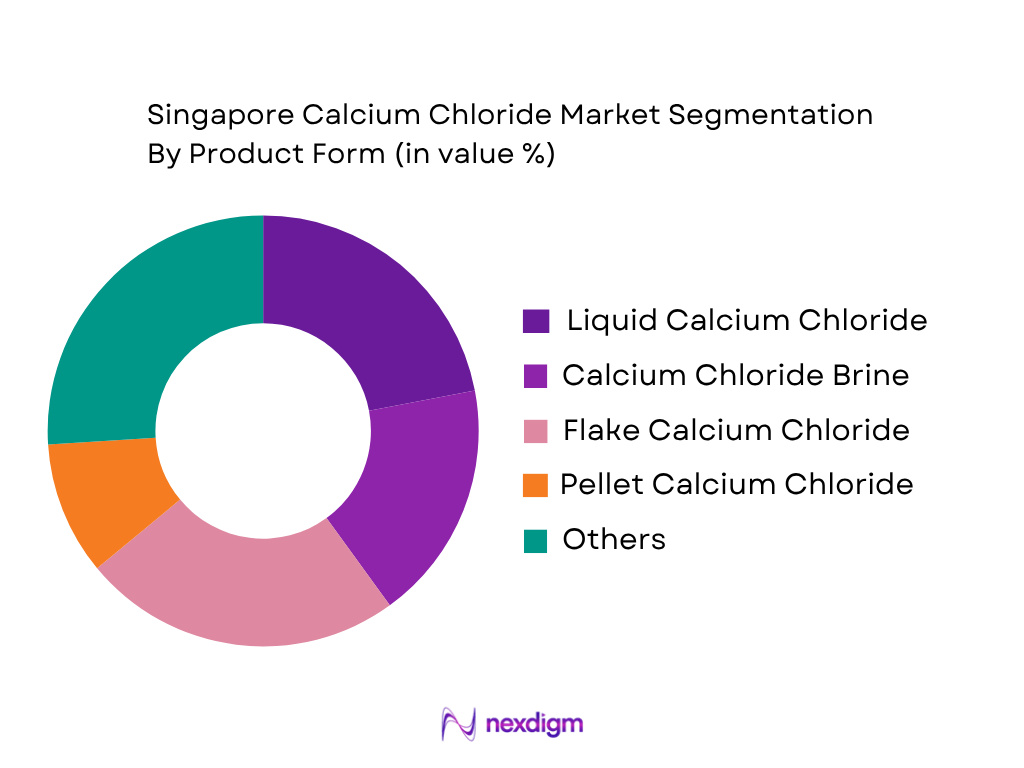
The Singapore Calcium Chloride Market is segmented by product form into liquid calcium chloride, calcium chloride brine, flake calcium chloride, pellet calcium chloride, granulated calcium chloride, briquette calcium chloride, anhydrous calcium chloride and powdered calcium chloride. Liquid calcium chloride and calcium chloride brine are expected to represent important product categories because of their applicability in industrial processing, water treatment, refrigeration and oilfield-related chemical systems. Flake and granulated calcium chloride are also widely applicable because they offer convenient storage, transportation and controlled dosing across industrial users. Product selection depends on concentration, purity, handling requirements and application-specific specifications. Singapore’s import-oriented chemical supply structure also makes packaging and logistics important purchasing considerations. Bulk liquid supply can support large industrial consumers, while bags, drums and IBC containers remain relevant for smaller-volume customers. High-purity and food-grade products can command specialized demand from food, pharmaceutical and technically controlled applications.
By Application
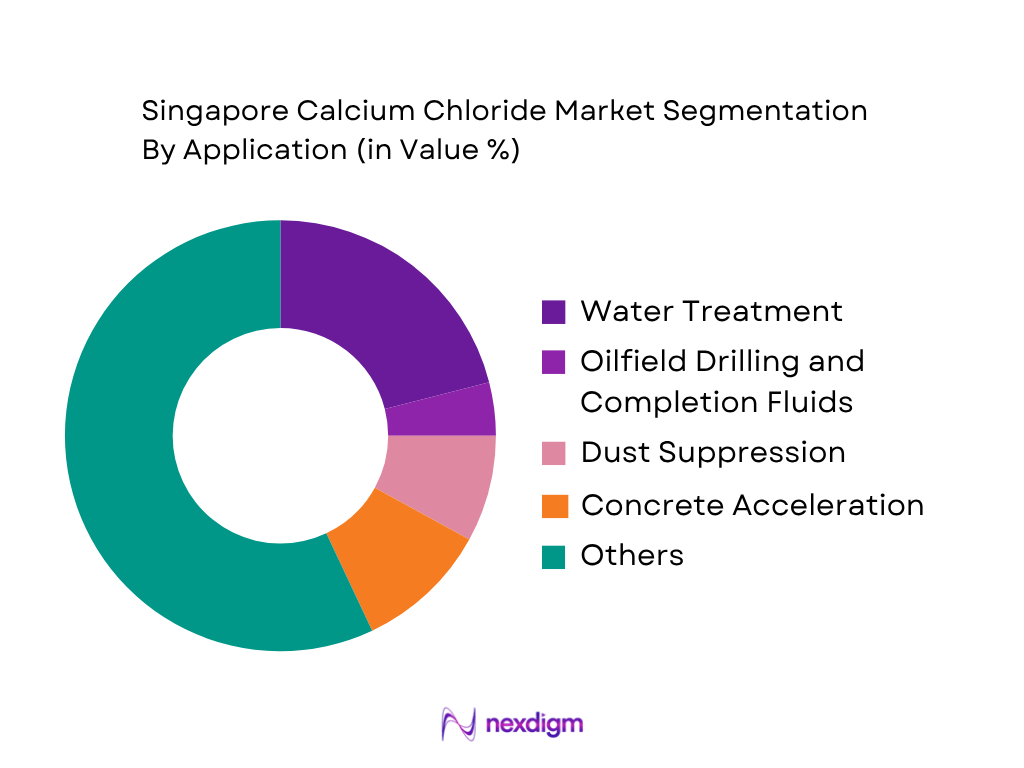
The Singapore Calcium Chloride Market is segmented by application into oilfield drilling and completion fluids, water treatment, dust suppression, concrete acceleration, refrigeration brine, food processing, chemical processing, marine applications, industrial drying and dehumidification, and mining and mineral processing. Water treatment and chemical processing represent significant demand areas because Singapore has a highly developed industrial and utility infrastructure requiring controlled chemical inputs. Refrigeration brine applications are supported by food processing, cold-chain logistics and temperature-controlled industrial operations. Chemical processing demand is linked to Singapore’s extensive petrochemical and specialty chemical ecosystem, particularly within Jurong Island. Food-grade calcium chloride can be used in food processing and manufacturing applications where controlled calcium-ion addition or processing functionality is required. Marine and port-related applications also provide a specialized demand base because of Singapore’s extensive maritime ecosystem. The dominance of industrial applications reflects the country’s manufacturing structure and the role of chemical distributors in supplying imported calcium chloride to multiple downstream industries.
Competitive Landscape
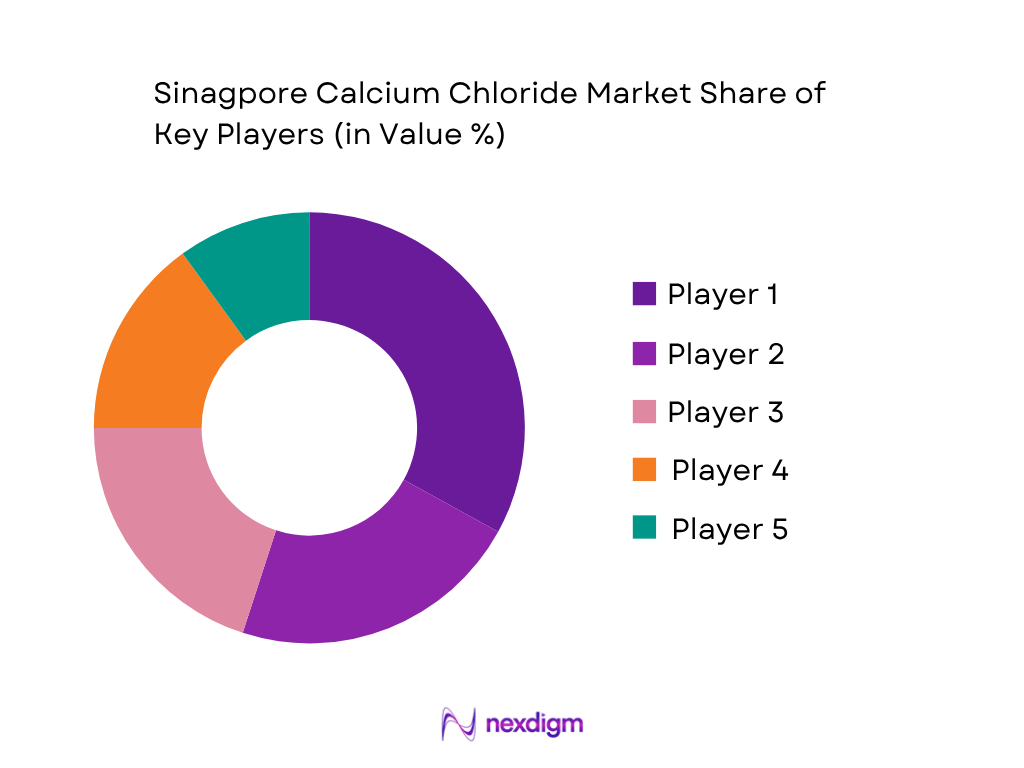
The Singapore Calcium Chloride Market comprises international chemical manufacturers, specialty chemical distributors, industrial chemical traders and regional supply companies. Competition is influenced by product availability, imported-grade portfolio breadth, technical specifications, packaging formats, bulk logistics and regional distribution capabilities. Companies with established chemical-storage infrastructure and access to Singapore’s port network can serve large industrial customers while also supplying Southeast Asian markets. Competitive differentiation is increasingly linked to reliable inventory, application support, high-purity grades, food-grade certification, flexible packaging and customized chemical supply programs.
| Company | Establishment Year | Headquarters | Product Portfolio | Supply Capability | Key Applications | Distribution Model | Regional Reach |
| Brenntag | 1874 | Essen, Germany | ~ | ~ | ~ | ~ | ~ |
| Univar Solutions | 1924 | Downers Grove, USA | ~ | ~ | ~ | ~ | ~ |
| OxyChem | 1906 | Dallas, USA | ~ | ~ | ~ | ~ | ~ |
| TETRA Technologies | 1981 | The Woodlands, USA | ~ | ~ | ~ | ~ | ~ |
| Solvay | 1863 | Brussels, Belgium | ~ | ~ | ~ | ~ | ~ |
Singapore Calcium Chloride Market Analysis
Growth Drivers
Chemical and Petrochemical Processing Activity
Singapore’s calcium chloride demand is closely linked to its large chemical-processing ecosystem, particularly Jurong Island, where more than 100 energy and chemical companies operate across refining, petrochemicals, specialty chemicals, utilities and logistics. Singapore’s manufacturing sector recorded S$429.584 billion in total output in 2024, while the chemicals cluster generated S$95.155 billion. The chemicals cluster also recorded S$86.244 billion in business costs, with materials accounting for 73.3% of those costs, highlighting the scale of industrial material consumption. Jurong Island has attracted more than S$50 billion in investments over the past three decades, supporting an integrated network of refineries, chemical plants, storage terminals and downstream processors. Calcium chloride is relevant to this ecosystem through moisture control, industrial processing, brine preparation, drying, water-treatment processes and selected chemical applications. Singapore’s overall GDP reached US$547.39 billion in 2024, while GDP growth was 4.4%, indicating continued economic activity supporting industrial demand. The country’s energy and chemicals sector employs more than 27,000 skilled workers, further strengthening its industrial operating base. Source: Singapore Economic Development Board; World Bank.
Oil and Gas Service Activity
Singapore’s position as a regional oil, gas and marine-services hub supports calcium chloride consumption through drilling-fluid, completion-brine, dehydration, processing and related industrial applications. The Economic Development Board reports that Singapore’s oilfield equipment and services segment generates more than S$5.13 billion in output, while the wider energy and chemicals ecosystem accounts for 20% of manufacturing output and employs more than 27,000 workers. Jurong Island hosts more than 100 global energy and chemicals companies, creating proximity between chemical suppliers, refineries, storage operators, engineering firms and oilfield-service providers. Singapore also maintains significant refining and petrochemical infrastructure despite having no domestic crude-oil reserves, making imported feedstocks and regional petroleum flows central to industrial operations. The country’s manufacturing sector generated S$429.584 billion of output in 2024, providing a substantial industrial base for specialty chemical consumption. World Bank data places Singapore’s 2024 GDP at US$547.39 billion, with GDP growth of 4.4%, reflecting continued economic activity. These conditions support demand for calcium chloride grades used where controlled-density brines, moisture management and industrial process performance are required. Source: Singapore Economic Development Board; World Bank.
Market Challenges
High Dependence on Imported Calcium Chloride
Singapore’s limited land area and highly specialized industrial structure constrain opportunities for large-scale domestic production of commodity inorganic chemicals, making imported calcium chloride an important part of supply. This creates exposure to international freight availability, regional production disruptions, shipping schedules and supplier concentration. The country’s broader food system illustrates this structural dependence: the Singapore Food Agency states that more than 90% of Singapore’s food supply is imported, while supply sources reached 187 countries and regions in 2024. The same trade-oriented structure applies across numerous industrial inputs, where Singapore functions as a processing, distribution and re-export hub rather than a large raw-material producer. Singapore’s manufacturing sector nevertheless generated S$429.584 billion of output in 2024, demonstrating the scale of industrial demand that must be supported by reliable imported inputs. The chemicals cluster alone recorded S$95.155 billion of output and S$86.244 billion in business costs. For calcium chloride distributors, maintaining sufficient inventory of liquid, flake, pellet and food-grade material is therefore important because supply interruptions can affect water treatment, chemical processing, food manufacturing and refrigeration applications. Source: Singapore Food Agency; Singapore Economic Development Board.
Storage and Moisture-Control Requirements
Calcium chloride’s hygroscopic characteristics create operational challenges for Singaporean distributors and industrial users because the humid tropical environment increases the importance of moisture-controlled storage, sealed packaging, appropriate handling systems and inventory protection. This is particularly relevant for solid forms such as flakes, pellets, granules and briquettes, where exposure to atmospheric moisture can cause caking, dissolution and deterioration of handling characteristics. Singapore’s industrial ecosystem adds further complexity because chemical products move through ports, storage terminals, warehouses and manufacturing facilities before reaching end users. The Singapore chemicals cluster recorded S$86.244 billion in business costs in 2024, with materials representing 73.3% of cluster costs, illustrating the importance of efficient material handling within chemical operations. Jurong Island alone hosts more than 100 energy and chemical companies and has attracted more than S$50 billion in investments, creating a sophisticated but demanding industrial logistics environment. Singapore’s GDP reached US$547.39 billion in 2024, while inflation was 2.4%, adding a stable macroeconomic backdrop but not eliminating operational requirements for specialized chemical storage. Source: Singapore Economic Development Board; World Bank.
Market Opportunities
Regional Calcium Chloride Distribution Hub
Singapore’s strategic location, advanced port infrastructure and concentration of chemical logistics assets create an opportunity to strengthen its role as a regional calcium chloride distribution and repackaging hub. Jurong Island integrates refining, petrochemicals, specialty chemicals, storage, utilities and logistics, while more than 100 energy and chemical companies operate within the ecosystem. Singapore’s wider manufacturing sector generated S$429.584 billion of output in 2024, and the chemicals cluster produced S$95.155 billion, providing a substantial industrial customer base alongside opportunities to serve neighboring Southeast Asian markets. Singapore’s position as a major maritime center also supports regional movement of bulk and packaged chemical products. The opportunity is particularly relevant for distributors that can maintain multiple grades, including liquid calcium chloride, brine, flakes, pellets and food-grade material, while providing controlled storage and reliable delivery. Singapore’s GDP of US$547.39 billion and 4.4% GDP growth in 2024 demonstrate the strength of the underlying business environment. Combining import capability with storage, repackaging, blending and regional distribution can therefore improve supply flexibility for industrial users across chemicals, water treatment, food processing, refrigeration and marine services. Source: Singapore Economic Development Board; World Bank.
Specialty and High-Purity Grades
Singapore’s advanced manufacturing base creates an opportunity for suppliers to move beyond commodity calcium chloride toward higher-purity, food-grade and application-specific products. The country’s biopharmaceutical facilities manufactured S$12.1 billion of products in 2024 and employed more than 9,000 skilled workers, demonstrating a substantial high-value manufacturing ecosystem with demanding quality and traceability requirements. Singapore also continues to attract pharmaceutical investment: Pfizer announced a S$1 billion expansion of its API manufacturing facility in 2024, while Sanofi inaugurated an approximately S$800 million manufacturing facility. These developments expand the addressable industrial environment for tightly specified process chemicals and supporting materials. The broader chemicals cluster generated S$95.155 billion in output in 2024, reinforcing the depth of Singapore’s specialty-chemical ecosystem. High-purity calcium chloride can serve selected pharmaceutical, food-processing, laboratory, water-treatment and specialized industrial applications where consistent composition and documented quality are important. The opportunity is therefore less dependent on commodity-volume production and more focused on specialized distribution, certification, packaging and technical support.
Future Outlook
Over the next decade, the Singapore Calcium Chloride Market is expected to develop alongside the country’s chemical-processing, water-treatment, food manufacturing, marine and logistics ecosystems. Demand is expected to remain connected to industrial chemical consumption, imported specialty grades and regional distribution activity. Increasing requirements for specification-controlled chemicals may support high-purity, food-grade and application-specific calcium chloride products. Regional chemical trading and re-export activity can further strengthen Singapore’s role as a distribution center for Southeast Asian customers. The forecast CAGR for the Singapore Calcium Chloride Market during 2026-2035 is approximately ~XX%.
Major Players
- Brenntag
- Univar Solutions
- OxyChem
- TETRA Technologies
- Solvay
- Nedmag
- K+S Minerals and Agriculture
- GKE Fair Chem
- Piaget Chemicals & Manufacturing
- Masda Chemicals
- Skychem
- Fisher Scientific
- Thermo Fisher Scientific
- Tiger Calcium Services
- Bischofit
Key Target Audience
- Calcium Chloride Manufacturers and Regional Chemical Producers
- Industrial Chemical Distributors and Trading Companies
- Oil and Gas and Oilfield Service Companies
- Petrochemical and Specialty Chemical Manufacturers
- Water Treatment and Industrial Utility Operators
- Food Processing and Cold-Chain Companies
- Investments and Venture Capitalist Firms
- Government and Regulatory Bodies (National Environment Agency, Singapore Economic Development Board, Enterprise Singapore)
Research Methodology
Step 1: Identification of Key Variables
The initial phase involves constructing a Singapore Calcium Chloride Market ecosystem map covering manufacturers, importers, distributors, industrial users and regulatory stakeholders. The assessment identifies product forms, grades, applications, supply channels, import dependencies and major end-use industries. Particular attention is given to Jurong Island, Tuas and Singapore’s port-centric chemical logistics ecosystem.
Step 2: Market Analysis and Construction
Historical market information is compiled through assessment of calcium chloride imports, industrial consumption, product applications and distribution channels. Demand is evaluated across water treatment, chemical processing, food manufacturing, refrigeration, marine operations and industrial applications. Product-form demand is subsequently mapped against customer requirements and supply structures to construct the market database.
Step 3: Hypothesis Validation and Expert Consultation
Market hypotheses are developed around demand drivers, application penetration, imported-product dependence and competitive positioning. These hypotheses are validated through discussions with chemical distributors, industrial users, procurement professionals and application specialists. Expert inputs are used to refine assumptions regarding product grades, packaging requirements, supply reliability and end-use consumption patterns.
Step 4: Research Synthesis and Final Output
The final stage integrates secondary research, industry-level information, supply-chain assessment and expert inputs into a consolidated Singapore Calcium Chloride Market analysis. Bottom-up consumption estimates are cross-checked against supply-side information and application requirements. The resulting framework supports segmentation analysis, competitive assessment, market forecasting and identification of future commercial opportunities.

- Executive Summary
- Research Methodology (Market Definition and Scope, Singapore Calcium Chloride Market Classification, Top-Down Market Sizing, Bottom-Up Demand Reconstruction, Import-Export Validation, End-Use Consumption Mapping, Distributor and Supplier Assessment, Primary Industry Interviews, Data Triangulation, Forecasting Framework, Limitations and Future Conclusions)

- Definition and Scope
- Singapore Calcium Chloride Industry Evolution
- Calcium Chloride Supply Ecosystem Analysis
- Singapore Calcium Chloride Value Chain Analysis
- Singapore Calcium Chloride Supply Chain Analysis

- Growth Drivers (Chemical and Petrochemical Processing Activity, Jurong Island Industrial Ecosystem, Oil and Gas Service Activity, Water Treatment Infrastructure, Food Manufacturing Base, Marine and Port Operations, Pharmaceutical Manufacturing, Refrigeration and Cold Chain Demand)
- Market Challenges (High Dependence on Imported Calcium Chloride, Limited Domestic Primary Production, International Freight Exposure, Storage and Moisture-Control Requirements, Product Grade Differentiation, Chemical Handling Compliance, Port and Logistics Costs, Competition from Alternative Chloride Chemicals)
- Market Opportunities (Regional Calcium Chloride Distribution Hub, Specialty and High-Purity Grades, Oilfield Completion Brines, Food Grade Applications, Water Treatment Chemicals, Marine Chemical Supply, Pharmaceutical and Healthcare Applications, Industrial Repackaging and Toll Blending)
- Market Trends (Regional Chemical Distribution, Bulk and IBC Supply, High-Purity Chemical Demand, Customized Chemical Blending, Digital Chemical Procurement, Sustainable Chemical Logistics, Port-Centric Chemical Storage, Integrated Chemical Supply Solutions)
- Regulatory and Standards Landscape (National Environment Agency Chemical Controls, Workplace Safety and Health Requirements, Singapore Standard Chemical Requirements, Hazardous Substance Licensing, Chemical Storage Regulations, Food Safety Requirements, Maritime Chemical Handling Requirements, Environmental Discharge Controls)
- SWOT Analysis
- Porter’s Five Forces Analysis
- PESTLE Analysis
- Stakeholder Ecosystem
- Competition Ecosystem

- By Market Value (2020-2025)
- By Consumption Volume (2020-2025)
- By Imported Calcium Chloride Volume (2020-2025)
- By Export and Re-Export Volume (2020-2025)
- By Liquid Calcium Chloride Consumption (2020-2025)

- By Product Form (In Value %)
Liquid Calcium Chloride
Calcium Chloride Brine
Flake Calcium Chlorid
Pellet Calcium Chloride
Granulated Calcium Chloride
Briquette Calcium Chloride
Anhydrous Calcium Chloride
Powdered Calcium Chloride - By Grade (In Value %)
Industrial Grade
Technical Grade
Food Grade
Pharmaceutical Grade
High-Purity Grade
Oilfield Grade - By Application (In Value %)
Oilfield Drilling and Completion Fluids
Water Treatment
Dust Suppression
Concrete Acceleration
Refrigeration Brine
Food Processing
Chemical Processing
Marine and Port Applications
Industrial Drying and Dehumidification
Mining and Mineral Processing - By End-Use Industry (In Value %)
Oil and Gas and Oilfield Services
Petrochemicals and Chemicals
Water and Wastewater Treatment
Food and Beverage Processing
Marine and Shipbuilding
Construction and Infrastructure
Refrigeration and Cold Chain
Pharmaceutical Manufacturing
Mining and Mineral Processing
Industrial Manufacturing - By Distribution Channel (In Value %)
Direct Manufacturer Supply
Chemical Distributors
Industrial Chemical Traders
Toll Blenders and Contract Manufacturers
Bulk Chemical Suppliers
Online and Laboratory Chemical Suppliers - By Packaging and Supply Mode (In Value %)
Bulk Tanker Supply
ISO Tank Supply
IBC Containers
Drums
25 kg Bags
Small-Pack Industrial Supply

- Market Share of Major Players (By Revenue, Volume, Product Form, Grade, Application, Distribution Channel, Customer Industry)
- Cross Comparison Parameters (Product Form Portfolio, Calcium Chloride Grade Breadth, Bulk and IBC Supply Capability, Import and Regional Distribution Network, Chemical Storage Capacity, Toll Blending and Repackaging Capability, Oilfield and Industrial Application Coverage, Food and High-Purity Grade Capability)
- SWOT Analysis of Major Players
- Detailed Profiles of Major Companies
GKE Fair Chem Pte Ltd
Piaget Chemicals & Manufacturing Pte Ltd
Masda Chemicals
Skychem Pte Ltd
Brenntag Singapore
Univar Solutions
OxyChem
TETRA Technologies
Solvay
Nedmag
Tiger Calcium Services
TETRA Technologies International
Bischofit
K+S Minerals and Agriculture
Fisher Scientific / Thermo Fisher Scientific

- Oilfield and Energy Services Procurement Assessment
- Petrochemical and Chemical Manufacturer Demand Assessment
- Water Treatment Customer Assessment
- Food and Beverage Manufacturer Assessment
- Marine and Shipyard Customer Assessment

- By Market Value (2026-2035)
- By Consumption Volume (2026-2035)
- By Imported Calcium Chloride Volume (2026-2035)
- By Export and Re-Export Volume (2026-2035)
- By Liquid Calcium Chloride Consumption (2026-2035)


 Request a Sample
 Ask for Customization
 Get a Quote
 Enquire Now