

 Download PDF
 Download PDF
Market Overview
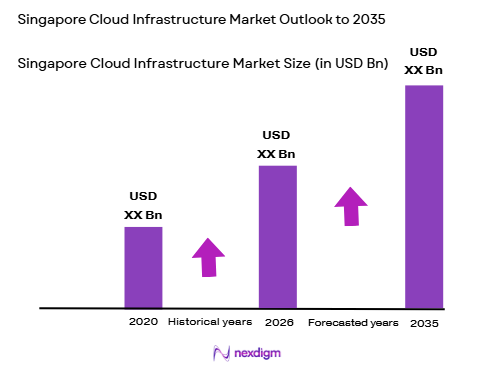
Based on a recent historical assessment, the Singapore Cloud Infrastructure market is valued at approximately USD ~ billion, driven by sustained enterprise cloud migration, hyperscale data center investments, and strong regional digital economy demand. Global cloud providers continue expanding compute, storage, and networking infrastructure in Singapore to serve Southeast Asia’s digital services growth. Government digitalization programs and rising adoption of AI, analytics, and SaaS platforms further accelerate infrastructure consumption across public and private sectors.
Singapore dominates regional cloud infrastructure deployment due to its concentration of hyperscale data centers in clusters such as Jurong, Woodlands, and Tuas, supported by robust power reliability and subsea cable connectivity. The country’s leadership is reinforced by presence of major global cloud platforms, advanced regulatory frameworks, and stable data governance regimes. Its role as a regional digital hub also stems from proximity to fast-growing Southeast Asian internet economies and strong enterprise technology adoption maturity.
Market Segmentation
By Service Type
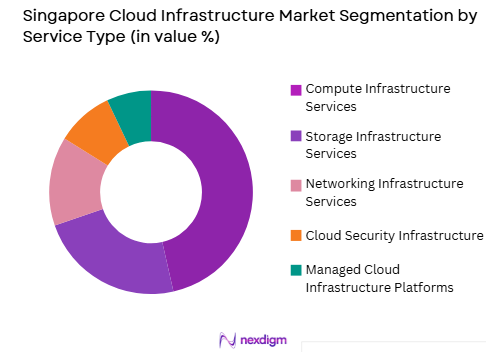
Singapore Cloud Infrastructure market is segmented by product type into compute infrastructure services, storage infrastructure services, networking infrastructure services, cloud security infrastructure, and managed cloud infrastructure platforms. Recently, compute infrastructure services has a dominant market share due to factors such as hyperscale data center expansion, enterprise workload migration, and high-performance computing demand. The concentration of cloud regions operated by major providers in Singapore drives sustained deployment of virtual machines, container platforms, and GPU-enabled compute clusters. Compared with storage or networking layers, compute infrastructure scales directly with application workloads and AI processing requirements, leading to higher consumption value. Rapid enterprise adoption of SaaS, analytics, and AI workloads further increases demand for scalable compute capacity. Public cloud providers continuously expand server capacity and availability zones in Singapore to serve regional digital services growth, reinforcing compute infrastructure’s dominant share within the cloud infrastructure market.
By Deployment Model
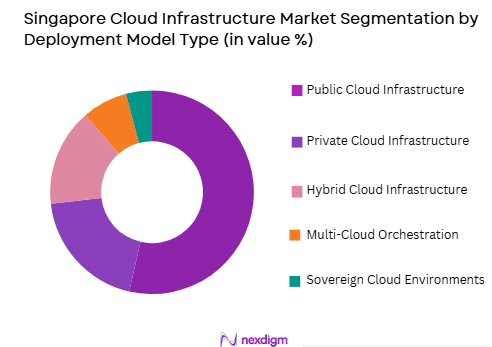
Singapore Cloud Infrastructure market is segmented by deployment model into public cloud infrastructure, private cloud infrastructure, hybrid cloud infrastructure, multi-cloud orchestration environments, and sovereign cloud environments. Recently, public cloud infrastructure has a dominant market share due to factors such as hyperscale provider presence, enterprise digital transformation programs, and scalable on-demand computing adoption. Singapore hosts multiple cloud regions from global providers, enabling enterprises to migrate workloads without latency or compliance barriers. Public cloud offers cost-efficient scaling, rapid deployment, and access to advanced services such as AI and analytics, making it preferred over private or sovereign environments. Hybrid and multi-cloud adoption is growing but still anchored on large public cloud capacity deployed locally. Continuous hyperscale data center expansion and enterprise SaaS adoption sustain public cloud infrastructure dominance in Singapore’s cloud infrastructure market.
Competitive Landscape
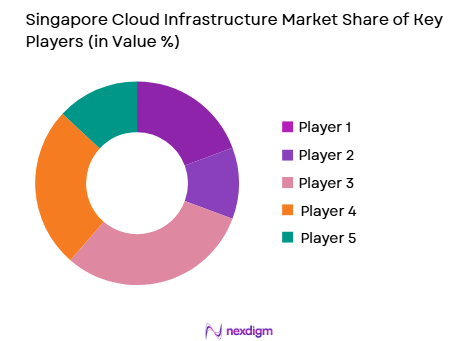
The Singapore Cloud Infrastructure market is highly concentrated, led by global hyperscale cloud providers and supported by colocation data center operators and regional cloud integrators. Major multinational cloud platforms dominate compute and platform infrastructure deployment through large-scale data center investments, while telecom and colocation firms provide interconnection and hosting ecosystems. Strong capital requirements and ecosystem lock-in create high barriers to entry, reinforcing incumbents’ market leadership.
| Company Name | Establishment Year | Headquarters | Technology Focus | Market Reach | Key Products | Revenue | Regional Cloud Regions |
| Amazon Web Services | 2006 | United States | ~ | ~ | ~ | ~ | ~ |
| Microsoft Azure | 2010 | United States | ~ | ~ | ~ | ~ | ~ |
| Google Cloud | 2008 | United States | ~ | ~ | ~ | ~ | ~ |
| Alibaba Cloud | 2009 | China | ~ | ~ | ~ | ~ | ~ |
| Equinix | 1998 | United States | ~ | ~ | ~ | ~ | ~ |
Singapore Cloud Infrastructure Market Analysis
Growth Drivers
Hyperscale Data Center Expansion and Regional Digital Hub Positioning
Singapore’s cloud infrastructure growth is fundamentally driven by large-scale hyperscale data center expansion undertaken by global cloud providers seeking to serve Southeast Asia’s rapidly expanding digital economy. The country’s strategic geographic position and advanced connectivity infrastructure make it an optimal regional cloud hub, prompting continuous investment in compute, storage, and networking capacity. Hyperscale facilities deployed in Singapore support enterprise workloads, digital platforms, fintech ecosystems, and content delivery networks across multiple countries, increasing infrastructure utilization intensity. As internet usage, e-commerce, and digital services adoption accelerate throughout Southeast Asia, cloud providers scale local infrastructure to meet latency and performance requirements. Singapore’s stable regulatory environment and strong data protection frameworks further attract multinational cloud investment compared with emerging regional markets. Availability of carrier-neutral colocation ecosystems enhances interconnection density, increasing the value of hyperscale deployments. Government facilitation of data center land allocation and digital infrastructure planning supports sustained facility expansion. Each new hyperscale campus multiplies demand for servers, storage arrays, networking fabrics, and power infrastructure, reinforcing cloud infrastructure growth. Regional enterprises prefer hosting critical workloads in Singapore due to reliability and connectivity advantages. Consequently, hyperscale expansion anchored in Singapore’s regional hub role remains the most influential structural driver of cloud infrastructure investment.
Enterprise Digital Transformation and Cloud-Native Application Adoption
Another major driver of Singapore cloud infrastructure demand is the accelerating enterprise shift toward digital transformation strategies and cloud-native application architectures across industries. Organizations in finance, logistics, healthcare, and government sectors increasingly migrate legacy IT workloads to scalable cloud platforms to improve agility, resilience, and cost efficiency. Cloud-native technologies such as microservices, containers, and serverless computing require elastic compute and storage infrastructure, driving consumption of hyperscale cloud resources. Singapore’s advanced enterprise technology maturity and digital policy initiatives encourage adoption of SaaS, analytics, and AI-driven applications hosted on cloud platforms. Regulatory acceptance of cloud deployment for sensitive sectors such as finance further expands infrastructure demand. Enterprises also adopt hybrid and multi-cloud architectures anchored on Singapore-based public cloud regions, increasing infrastructure utilization. Continuous digitalization of services including payments, e-government, and logistics platforms amplifies cloud workload growth. Startups and digital-native firms scale operations rapidly on cloud infrastructure, contributing incremental demand. Cloud adoption also reduces reliance on on-premise IT infrastructure, shifting capital expenditure toward cloud service consumption. As digital transformation becomes pervasive across Singapore’s economy, enterprise cloud workload migration sustains long-term growth in cloud infrastructure deployment.
Market Challenges
Power and Sustainability Constraints in Data Center Expansion
Singapore cloud infrastructure expansion faces structural challenges related to power availability and environmental sustainability constraints affecting data center development. Hyperscale cloud infrastructure facilities require extremely high and continuous electricity supply for computing equipment and cooling systems, placing pressure on national energy capacity. Singapore’s limited land and energy resources necessitate strict data center energy efficiency and sustainability regulations, constraining rapid hyperscale expansion. Authorities impose energy consumption standards and approval controls for new data center projects to manage carbon emissions and grid stability. Compliance with green building and energy efficiency requirements increases capital costs for cloud infrastructure developers. Cooling efficiency challenges in tropical climate conditions further elevate operational complexity and energy usage. Renewable energy sourcing for data centers is limited domestically, requiring cross-border green energy procurement strategies. These sustainability and energy constraints slow infrastructure deployment timelines despite strong demand. Hyperscale providers must invest heavily in efficiency technologies and innovative cooling solutions to secure expansion approvals. Consequently, power and sustainability limitations represent a significant structural challenge shaping Singapore’s cloud infrastructure growth trajectory.
Data Sovereignty and Regulatory Compliance Complexity
Singapore cloud infrastructure market also encounters challenges related to evolving data sovereignty expectations and regulatory compliance requirements across regional jurisdictions served by Singapore-based cloud platforms. Enterprises operating across Southeast Asia must comply with diverse national data localization laws, privacy frameworks, and cybersecurity regulations, complicating cloud deployment strategies. While Singapore provides strong governance and trust frameworks, some countries mandate local data storage, reducing reliance on centralized Singapore cloud regions. Compliance obligations such as financial data residency, healthcare data protection, and cross-border transfer controls increase complexity for cloud providers and enterprise users. Infrastructure architectures must incorporate multi-region replication, sovereign cloud configurations, and localized storage to meet regulatory needs. These adaptations increase infrastructure cost and operational overhead compared with centralized deployment models. Enterprises may adopt hybrid architectures with partial localization, reducing incremental demand for Singapore-based infrastructure. Continuous regulatory evolution also requires ongoing compliance investment by cloud providers. Although Singapore remains a trusted hub, regional data sovereignty fragmentation limits full consolidation of cloud workloads. Therefore, regulatory complexity and data localization trends present ongoing challenges for Singapore cloud infrastructure expansion.
Opportunities
AI and High-Performance Computing Cloud Infrastructure Expansion
Singapore cloud infrastructure market presents major opportunities through rapid growth in artificial intelligence and high-performance computing workloads requiring specialized cloud infrastructure. AI training, inference, and data analytics applications demand GPU clusters, high-speed networking fabrics, and high-capacity storage systems deployed in hyperscale environments. Singapore’s strong AI adoption across finance, logistics, and government sectors drives demand for AI-ready cloud infrastructure. Global cloud providers are expanding GPU-enabled data center capacity in Singapore to serve regional AI workloads. HPC workloads in scientific research, fintech modeling, and digital media processing further increase infrastructure intensity. AI-as-a-service platforms and generative AI applications hosted in Singapore amplify compute consumption. Enterprises prefer accessing advanced AI infrastructure through cloud rather than building on-premise HPC systems, increasing hyperscale deployment. Government AI initiatives and digital economy strategies support ecosystem growth. As AI workloads scale exponentially, infrastructure value per data center rises significantly. Singapore’s position as a regional AI innovation hub ensures sustained demand for specialized cloud infrastructure expansion.
Southeast Asia Digital Economy Growth and Cloud Regionalization
Another substantial opportunity for Singapore cloud infrastructure arises from accelerating digital economy expansion across Southeast Asia requiring regionalized cloud capacity anchored in Singapore. Rapid growth of e-commerce, fintech, streaming, and digital services platforms across neighboring countries increases demand for low-latency cloud infrastructure accessible from Singapore. Multinational digital firms deploy regional platforms in Singapore to serve multiple Southeast Asian markets efficiently. Enterprises in emerging economies lacking domestic hyperscale capacity rely on Singapore cloud regions for scalable infrastructure. Regional internet traffic growth drives content delivery, analytics, and platform hosting demand concentrated in Singapore. Cross-border digital trade agreements and connectivity investments strengthen Singapore’s role as a regional cloud gateway. Telecom and subsea cable expansion further enhances infrastructure attractiveness. Cloud providers expand availability zones in Singapore to meet regional redundancy and performance needs. As Southeast Asia digitalization accelerates, Singapore-based cloud infrastructure demand rises proportionally. Therefore, regional digital economy growth and cloud regionalization trends create sustained expansion opportunities for Singapore’s cloud infrastructure market.
Future Outlook
Over the next five years, Singapore Cloud Infrastructure market is expected to expand through continued hyperscale data center investments, AI-driven compute demand, and regional digital platform growth. Sustainability regulations will shape energy-efficient infrastructure design and green data center adoption. Enterprise multi-cloud and hybrid strategies will increase infrastructure complexity and orchestration demand. Singapore’s role as Southeast Asia’s trusted cloud hub will sustain long-term infrastructure deployment despite land and power constraints.
Major Players
- Amazon Web Services
- Microsoft Azure
- Google Cloud
- Alibaba Cloud
- Oracle Cloud
- IBM Cloud
- Equinix
- Digital Realty
- ST Telemedia Global Data Centres
- NTT Global Data Centers
- Singtel
- Huawei Cloud
- Tencent Cloud
- OVHcloud
- Salesforce
Key Target Audience
- Cloud service providers
- Hyperscale data center developers
- Enterprise IT infrastructure buyers
- Telecom network operators
- Colocation providers
- Investments and venture capitalist firms
- Government and regulatory bodies
- Digital platform companies
Research Methodology
Step 1: Identification of Key Variables
Key cloud infrastructure variables including hyperscale data center capacity, cloud service deployment, compute density, and regional workload demand were identified across Singapore’s digital infrastructure ecosystem. Data sources included cloud provider expansions, data center investments, and enterprise cloud adoption indicators.
Step 2: Market Analysis and Construction
Market size was constructed by aggregating cloud infrastructure spending across compute, storage, networking, and platform deployment components in Singapore. Segmentation shares were derived from service consumption patterns and hyperscale capacity distribution across deployment models.
Step 3: Hypothesis Validation and Expert Consultation
Market assumptions and infrastructure estimates were validated through consultations with cloud architects, data center operators, and regional digital infrastructure analysts. Cross-verification ensured alignment with actual hyperscale deployment and enterprise cloud adoption trends in Singapore.
Step 4: Research Synthesis and Final Output
Validated quantitative and qualitative insights were synthesized into market segmentation, competitive analysis, and forward outlook assessments. Final outputs integrated hyperscale investment trends, regulatory context, and regional digital demand dynamics shaping Singapore cloud infrastructure growth.

- Executive Summary
- Research Methodology (Definitions, Scope, Industry Assumptions, Market Sizing Approach, Primary & Secondary Research Framework, Data Collection & Verification Protocol, Analytic Models & Forecast Methodology, Limitations & Research Validity Checks)

- Market Definition and Scope
- Value Chain & Stakeholder Ecosystem
- Regulatory / Certification Landscape
- Sector Dynamics Affecting Demand
- Strategic Initiatives & Infrastructure Growth

- Growth Drivers
Rapid digital economy expansion and data localization demand in Singapore
Hyperscale and regional cloud hub investments by global cloud providers
Enterprise migration to hybrid and multi cloud architectures - Market Challenges
High data center land, energy, and cooling constraints in Singapore
Regulatory requirements on data residency and cybersecurity compliance
Talent shortages in advanced cloud and data center engineering - Market Opportunities
Development of sustainable and green cloud infrastructure facilities
Expansion of edge cloud to support AI, 5G, and low latency services
Growth of sovereign and regulated industry cloud platforms - Trends
Shift toward AI optimized cloud infrastructure and accelerated computing
Adoption of software defined and automated data center operations
Integration of cloud and edge for distributed digital services - Government regulations
Data protection and cloud security regulations under national frameworks
Energy efficiency and green data center policy requirements
Digital infrastructure and smart nation investment programs - SWOT analysis
- Porters five forces

- By Market Value, 2020-2025
- By Installed Units, 2020-2025
- By Average System Price, 2020-2025
- By System Complexity Tier, 2020-2025

- By System Type (In Value%)
Public Cloud Infrastructure
Private Cloud Infrastructure
Hybrid Cloud Infrastructure
Multi-Cloud Management Infrastructure
Edge Cloud Infrastructure - By Platform Type (In Value%)
Hyperscale Data Center Platforms
Enterprise Cloud Platforms
Telecom Cloud Platforms
Government Cloud Platforms
Edge and Distributed Cloud Platforms - By Fitment Type (In Value%)
Greenfield Data Center Deployments
Colocation Cloud Deployments
On-Premise Private Cloud Installations
Hybrid Integration Deployments
Edge Node Installations - By End User Segment (In Value%)
Large Enterprises
Small and Medium Enterprises
Government and Public Sector
Digital Native Companies
Telecommunications Providers - By Procurement Channel (In Value%)
Direct Cloud Service Provider Contracts
System Integrator Led Deployments
Managed Service Provider Procurement
Government Framework Agreements
Channel Partner and Reseller Procurement

- Market Share Analysis
- Cross Comparison Parameters (Service Portfolio Depth, Data Center Scale, AI Infrastructure Capability, Compliance Certifications, Regional Connectivity, Energy Efficiency Design, Hybrid Cloud Integration Capability, Edge Deployment Footprint, Industry Vertical Solutions, Managed Services Maturity)
- SWOT Analysis of Key Competitors
- Pricing & Procurement Analysis
- Key Players
Amazon Web Services
Microsoft Azure
Google Cloud
Alibaba Cloud
Tencent Cloud
Oracle Cloud
IBM Cloud
Equinix
Digital Realty
ST Telemedia Global Data Centres
Keppel Data Centres
Singtel
NTT Global Data Centers
GDS Holdings
EdgeConneX

- Enterprises adopting hybrid and multi cloud for resilience and compliance
- Government driving sovereign and secure cloud adoption
- Telecom operators integrating cloud with 5G and edge networks
- Digital native firms scaling AI and data intensive workloads on cloud

- Forecast Market Value, 2026-2035
- Forecast Installed Units, 2026-2035
- Price Forecast by System Tier, 2026-2035
- Future Demand by Platform, 2026-2035


 Request a Sample
 Ask for Customization
 Get a Quote
 Enquire Now