

 Download PDF
 Download PDF
Market Overview
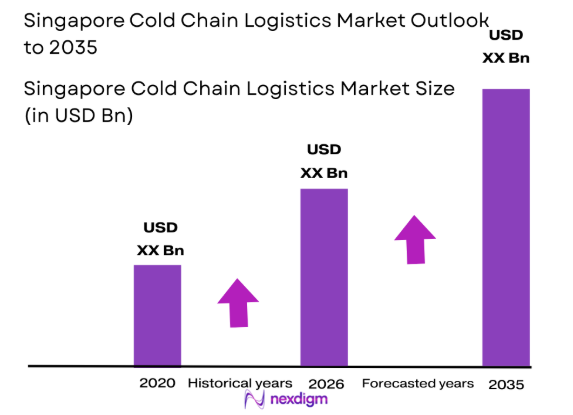
Based on a recent historical assessment, the Singapore Cold Chain Logistics Market generated approximately USD ~ billion in logistics service revenue, supported by high demand for temperature-controlled transportation and storage across pharmaceuticals, seafood exports, processed foods, and biomedical products. Data from Enterprise Singapore and the Singapore Economic Development Board indicates strong logistics throughput supported by Changi Air Cargo Hub and the Port of Singapore, both of which process millions of tons of perishable cargo and temperature-sensitive shipments annually.
Singapore serves as a strategic cold chain logistics hub within Southeast Asia due to its advanced port infrastructure, biomedical manufacturing ecosystem, and integrated logistics parks. The country hosts major pharmaceutical production facilities and large seafood import and re-export operations that require temperature-controlled logistics networks. Logistics activities are concentrated around Jurong, Tuas, and Changi logistics clusters, where cold storage facilities, air cargo terminals, and automated distribution centers support high-value perishable supply chains.
Market Segmentation
By Product Type
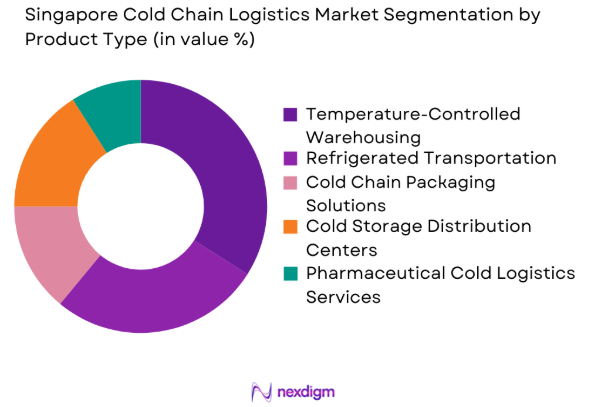
Singapore Cold Chain Logistics market is segmented by product type into temperature-controlled warehousing, refrigerated transportation, cold chain packaging solutions, cold storage distribution centers, and pharmaceutical cold logistics services. Recently, temperature-controlled warehousing has a dominant market share due to strong infrastructure investments and increasing storage demand for pharmaceuticals, frozen foods, and seafood exports. Singapore’s biomedical manufacturing industry requires validated cold storage facilities for vaccines and biologics distribution across Asia. Additionally, the country’s role as a transshipment hub encourages logistics providers to expand automated cold warehouses located near ports and airports. Large-scale cold storage capacity expansion across logistics parks such as Jurong Logistics Hub and Tuas Mega Port areas has strengthened warehousing demand. Growing e-commerce grocery delivery platforms also rely heavily on refrigerated fulfillment centers to support high-frequency delivery cycles across urban areas. Advanced automation systems, IoT temperature monitoring, and energy-efficient refrigeration technologies further enhance warehouse operations, enabling logistics companies to manage high-value temperature-sensitive cargo more efficiently.
By End-User Industry
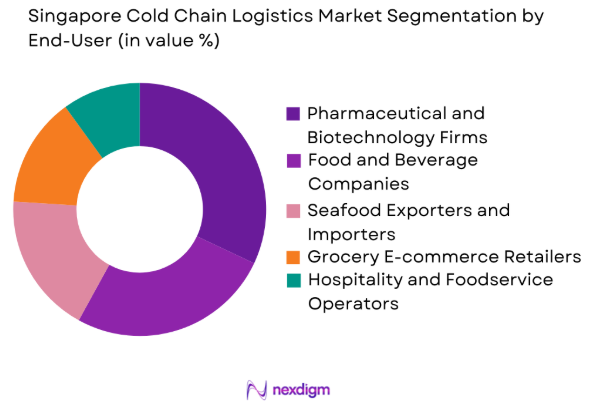
Singapore Cold Chain Logistics market is segmented by end-user industry into food and beverage companies, pharmaceutical and biotechnology firms, seafood exporters and importers, grocery e-commerce retailers, and hospitality and foodservice operators. Recently, pharmaceutical and biotechnology firms have a dominant market share due to Singapore’s strong biomedical manufacturing sector and increasing global demand for biologics, vaccines, and specialty pharmaceuticals requiring temperature-controlled distribution. Singapore hosts multiple global pharmaceutical production plants that rely on validated cold logistics systems to maintain strict quality and regulatory standards. Biopharmaceutical shipments frequently move through Changi Airport, which is equipped with specialized pharmaceutical logistics infrastructure including temperature-controlled cargo terminals. Logistics providers operating within the pharmaceutical cold chain must comply with Good Distribution Practice standards, ensuring high-precision temperature control during transportation and storage. The expansion of clinical research, biotechnology exports, and vaccine distribution programs across Asia further increases pharmaceutical cold chain logistics demand within Singapore’s logistics ecosystem.
Competitive Landscape
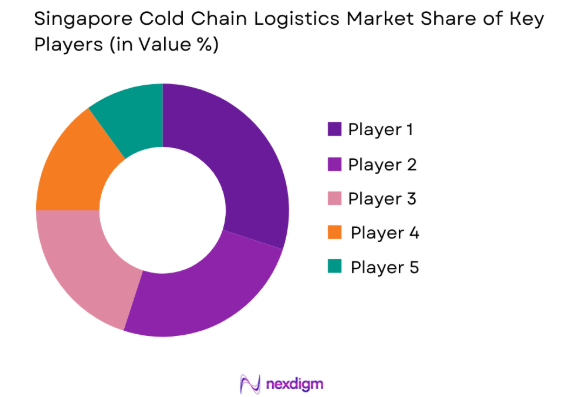
The Singapore Cold Chain Logistics Market is moderately consolidated with several global logistics providers operating alongside regional cold chain specialists. Large multinational companies dominate pharmaceutical logistics and integrated cold storage infrastructure, while regional providers focus on seafood, food distribution, and urban refrigerated transportation. Market competition is driven by warehouse automation, pharmaceutical compliance capabilities, and advanced temperature monitoring technologies. Companies continue investing in cold storage capacity expansion near ports and airports to strengthen regional distribution networks across Southeast Asia.
| Company Name | Establishment Year | Headquarters | Technology Focus | Market Reach | Key Products | Revenue | Cold Storage Capacity |
| DHL Supply Chain | 1969 | Germany | ~ | ~ | ~ | ~ | ~ |
| Lineage Logistics | 2012 | United States | ~ | ~ | ~ | ~ | ~ |
| Kuehne + Nagel | 1890 | Switzerland | ~ | ~ | ~ | ~ | ~ |
| DB Schenker | 1872 | Germany | ~ | ~ | ~ | ~ | ~ |
| YCH Group | 1955 | Singapore | ~ | ~ | ~ | ~ | ~ |
Singapore Cold Chain Logistics Market Analysis
Growth Drivers
Expansion of Singapore’s Biomedical Manufacturing and Vaccine Distribution Ecosystem
Singapore’s advanced biomedical manufacturing sector significantly strengthens demand for cold chain logistics across pharmaceutical supply chains. The country hosts multiple pharmaceutical production facilities manufacturing vaccines, biologics, and specialty medicines that require strict temperature-controlled transportation and storage during international distribution. Pharmaceutical companies depend on specialized cold logistics infrastructure including validated warehouses, insulated containers, and real-time monitoring systems to preserve product integrity. Singapore’s strategic location between major Asian markets allows manufacturers to use the country as a regional hub for temperature-sensitive pharmaceutical exports. Changi Airport operates dedicated pharmaceutical cargo facilities designed to handle biologics and clinical trial materials under controlled environments. Logistics providers continue expanding pharmaceutical-compliant cold storage infrastructure and automated temperature monitoring systems to support growing pharmaceutical distribution demand.
Rapid Growth of E-Commerce Grocery and Fresh Food Distribution Networks
The rapid growth of e-commerce grocery platforms across Singapore significantly increases demand for refrigerated transportation and urban cold storage facilities capable of supporting frequent delivery operations. Consumers increasingly purchase fresh produce, frozen foods, seafood, and ready-to-eat meals through digital grocery platforms that require reliable cold chain logistics networks to maintain product freshness during delivery. Retailers depend on temperature-controlled fulfillment centers located near residential areas to process online orders quickly and efficiently. Logistics companies invest in refrigerated vehicle fleets and warehouse automation technologies to support fast order fulfillment across urban regions. Singapore’s dense population and strong digital commerce adoption support grocery delivery growth. Rising demand for imported foods and frozen products further strengthens the need for refrigerated logistics infrastructure.
Market Challenges
High operational and energy costs remain a major challenge for temperature controlled logistics infrastructure
Refrigerated warehouses require advanced cooling systems to maintain stable temperatures for pharmaceuticals, seafood, and processed food products. Continuous operation of industrial refrigeration equipment significantly increases electricity consumption compared with conventional warehousing facilities. High industrial land and property costs also raise capital investment requirements for constructing large cold storage facilities near logistics hubs. Logistics providers must invest in energy-efficient refrigeration technologies to control operating expenses while meeting environmental sustainability goals. Reliable cold chain operations also require insulated containers, temperature sensors, and automated monitoring systems to prevent temperature fluctuations. Equipment maintenance, system upgrades, and pharmaceutical compliance requirements further increase operational costs.
Limited Land Availability for Large-Scale Cold Storage Expansion
Singapore’s geographic limitations create significant challenges for expanding large cold chain logistics infrastructure. Industrial land availability is limited, restricting construction of large cold storage warehouses required for pharmaceutical and food logistics operations. Logistics providers compete for space within designated logistics parks near ports and airports. High land prices increase capital investment needed to build refrigerated warehouses equipped with specialized cooling systems and automation technologies. As international trade and pharmaceutical exports grow, demand for temperature-controlled storage continues increasing while warehouse development space remains constrained. Developers increasingly construct high-rise automated cold storage facilities to maximize capacity within limited land areas. However, these advanced warehouses require substantial upfront investment and complex engineering design, which slows overall infrastructure expansion across Singapore’s logistics sector.
Opportunities
Expansion of Regional Vaccine and Biopharmaceutical Distribution Networks
Growing pharmaceutical manufacturing and biotechnology innovation across Asia creates strong opportunities for Singapore to strengthen its position as a regional vaccine and biopharmaceutical distribution hub. Pharmaceutical companies require reliable cold chain logistics systems capable of maintaining precise temperature conditions during international transportation. Singapore’s advanced airport cargo infrastructure and strong regulatory framework support efficient pharmaceutical distribution across Southeast Asia. Logistics providers are expanding pharmaceutical-grade cold warehouses, specialized temperature-controlled containers, and advanced monitoring technologies designed for biologics and vaccines. Rising global demand for specialty medicines and vaccines increases the need for validated cold chain logistics networks. Pharmaceutical manufacturers prefer distribution hubs with strict regulatory compliance, reliable infrastructure, and efficient customs procedures. These factors enable Singapore to support expanding regional pharmaceutical supply chains.
Development of Automated Smart Cold Storage Warehouses
Automation technologies create strong opportunities for logistics providers to improve efficiency and expand capacity within cold chain logistics facilities across Singapore. Automated storage and retrieval systems allow cold warehouses to handle large volumes of temperature-sensitive products while reducing labor requirements and minimizing operational errors. Robotics technology supports refrigerated warehouse operations by improving inventory management accuracy and energy efficiency. Automated cold storage facilities also help companies utilize vertical warehouse space more effectively, addressing land limitations within Singapore’s logistics sector. Smart sensors and Internet-of-Things monitoring systems continuously track temperature conditions across storage areas and transportation networks, ensuring compliance with pharmaceutical and food safety regulations. As global trade in temperature-sensitive goods expands, automated cold chain infrastructure becomes essential for efficient regional distribution.
Future Outlook
Singapore Cold Chain Logistics Market is expected to experience sustained expansion driven by increasing pharmaceutical production, growing international seafood trade, and rising demand for temperature-controlled food distribution across Southeast Asia. Advanced logistics infrastructure around Changi Airport and Tuas Port will continue supporting high-value cold chain cargo flows. Automation technologies and energy-efficient refrigeration systems are expected to transform cold storage operations. Government logistics policies and biomedical manufacturing investments will further strengthen Singapore’s position as a regional cold chain logistics hub.
Major Players
- DHL Supply Chain
- Lineage Logistics
- Kuehne + Nagel
- DB Schenker
- YCH Group
- CEVA Logistics
- Bollore Logistics
- Agility Logistics
- UPS Supply Chain Solutions
- Nippon Express
- CJ Logistics
- OOCL Logistics
- SATS Ltd
- Maersk Logistics & Services
- Cold Chain Hub Singapore
Key Target Audience
- Pharmaceutical manufacturing companies
- Food and beverage companies
- Seafood exporters and importers
- E-commerce grocery retailers
- Logistics and supply chain companies
- Investments and venture capitalist firms
- Government and regulatory bodies
- Cold storage infrastructure developers
Research Methodology
Step 1: Identification of Key Variables
The research begins with identifying core market variables including cold storage capacity, refrigerated transportation infrastructure, pharmaceutical logistics demand, and food supply chain requirements. Industry databases, government logistics statistics, and trade flow datasets are analyzed to determine market drivers influencing cold chain logistics demand across Singapore’s logistics ecosystem.
Step 2: Market Analysis and Construction
Primary and secondary research sources are combined to construct the market structure. Data from logistics associations, government trade statistics, biomedical manufacturing reports, and port throughput databases are analyzed to evaluate cold chain infrastructure capacity and logistics service demand.
Step 3: Hypothesis Validation and Expert Consultation
Industry experts including logistics operators, cold storage facility managers, and pharmaceutical distribution specialists are consulted to validate research findings. Their insights help confirm infrastructure capacity trends, logistics demand patterns, and regulatory compliance factors influencing the cold chain logistics market.
Step 4: Research Synthesis and Final Output
All validated data points are synthesized into a structured market analysis model. Insights related to supply chain infrastructure, technology adoption, and logistics investment trends are integrated into the final market report to provide comprehensive strategic analysis for industry stakeholders.

- Executive Summary
- Research Methodology (Definitions, Scope, Industry Assumptions, Market Sizing Approach, Primary & Secondary Research Framework, Data Collection & Verification Protocol, Analytic Models & Forecast Methodology, Limitations & Research Validity Checks)

- Market Definition and Scope
- Value Chain & Stakeholder Ecosystem
- Regulatory / Certification Landscape
- Sector Dynamics Affecting Demand
- Strategic Initiatives & Infrastructure Growth

- Growth Drivers
Rapid Expansion of Pharmaceutical and Biotech Distribution
Increasing Demand for Temperature Controlled Food Logistics
Strategic Position of Singapore as a Regional Logistics Hub - Market Challenges
High Operational Costs of Temperature Controlled Infrastructure
Energy Intensive Cold Storage Operations
Limited Land Availability for Logistics Infrastructure - Market Opportunities
Expansion of Vaccine and Biopharmaceutical Cold Chains
Growth of E Commerce Grocery and Fresh Food Delivery
Development of Automated Smart Cold Warehousing Facilities - Trends
Adoption of IoT Enabled Temperature Monitoring Systems
Automation in Cold Storage Warehousing Operations
Integration of Sustainable Refrigeration Technologies - Government Regulations
- SWOT Analysis of Key Competitors
- Porter’s Five Forces

- By Market Value, 2020-2025
- By Installed Units, 2020-2025
- By Average System Price, 2020-2025
- By System Complexity Tier, 2020-2025

- By System Type (In Value%)
Temperature Controlled Warehousing
Refrigerated Transportation Services
Cold Storage Distribution Centers
Pharmaceutical Cold Chain Logistics
Perishable Food Logistics Systems - By Platform Type (In Value%)
Port Based Cold Storage Facilities
Airport Integrated Cold Chain Hubs
Urban Distribution Cold Storage Centers
Cross Border Cold Logistics Platforms
Integrated Multi Modal Cold Logistics Networks - By Fitment Type (In Value%)
Standalone Cold Storage Facilities
Integrated Logistics Parks with Cold Storage
Automated Cold Chain Warehousing Systems
Mobile Refrigerated Container Units
Smart IoT Enabled Temperature Monitoring Systems - By End User Segment (In Value%)
Food and Beverage Companies
Pharmaceutical and Biotechnology Firms
E Commerce Grocery Retailers
Seafood Exporters and Importers
Foodservice and Hospitality Companies - By Procurement Channel (In Value%)
Direct Contract Logistics Agreements
Third Party Logistics Service Providers
Integrated Supply Chain Management Providers
E Commerce Fulfillment Logistics Providers
Government and Institutional Supply Contracts

- Market Share Analysis
- Cross Comparison Parameters (Cold Storage Capacity, Refrigerated Fleet Size, Geographic Coverage, Technology Integration, End User Industry Coverage)
- SWOT Analysis of Key Competitors
- Pricing & Procurement Analysis
- Key Players
DHL Supply Chain
DB Schenker
Kuehne + Nagel
CEVA Logistics
Agility Logistics
YCH Group
Lineage Logistics
Cold Chain Hub Singapore
SATS Ltd
Bollore Logistics
Maersk Logistics & Services
Nippon Express
UPS Supply Chain Solutions
CJ Logistics
OOCL Logistics

- Food exporters rely on advanced cold logistics to maintain product quality in international trade
- Pharmaceutical manufacturers require validated cold chain systems for biologics and vaccines
- E commerce grocery retailers depend on refrigerated logistics networks for rapid delivery
- Hospitality and foodservice sectors require consistent chilled and frozen product distribution

- Forecast Market Value, 2026-2035
- Forecast Installed Units, 2026-2035
- Price Forecast by System Tier, 2026-2035
- Future Demand by Platform, 2026-2035


 Request a Sample
 Ask for Customization
 Get a Quote
 Enquire Now