
 Download PDF
Market Overview
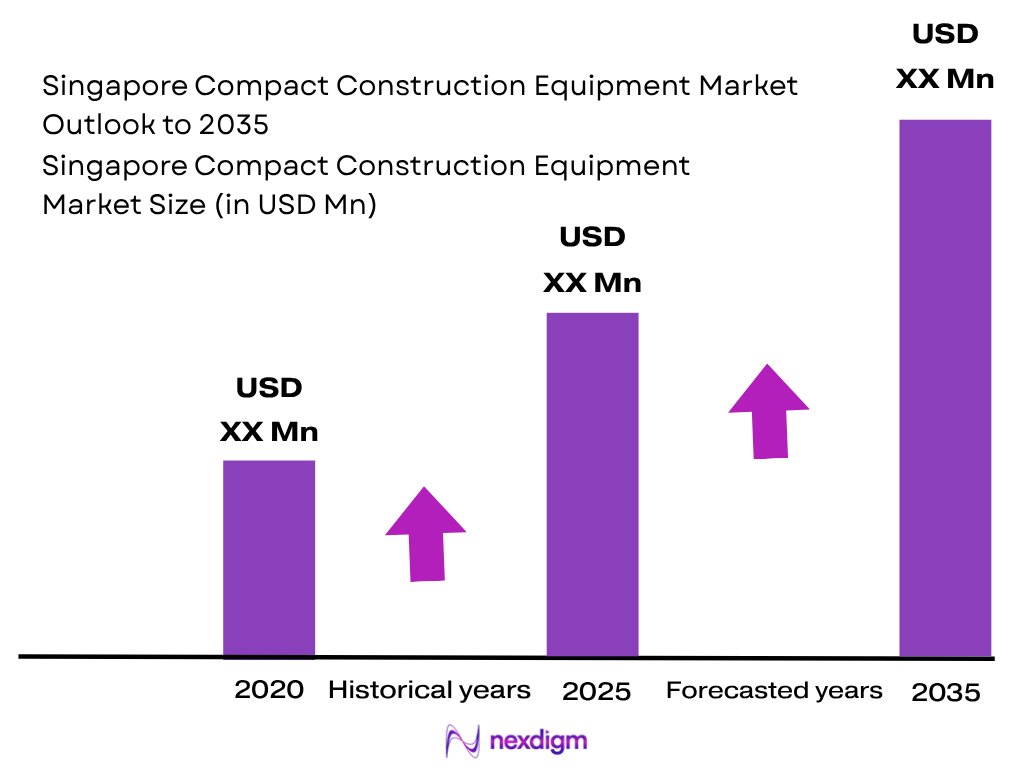
The Singapore Compact Construction Equipment Market is supported by a substantial construction ecosystem, with construction demand increasing from S$33.8 billion to S$44.2 billion across the latest two-year comparison, while construction output moved from S$34.8 billion to S$38.4 billion. The expansion creates requirements for excavation, trenching, loading, grading, compaction and material handling equipment. Compact machinery is particularly relevant where projects require maneuverability, transportability and lower site disruption. BCA also identifies productivity improvement and reduced manpower dependence as continuing priorities for the built environment sector.
Singapore’s equipment demand is concentrated around major construction and infrastructure corridors rather than being distributed across separate national markets. Jurong, Tuas, Changi, Woodlands, Punggol and the eastern corridor are particularly relevant because of infrastructure, industrial, logistics, airport and urban-development projects. The Cross Island Line extends across eastern, western and north-eastern corridors and will exceed 50 kilometres in total length, while its first phase covers 29 kilometres and 12 stations. Tuas Port is being developed toward a 65-million-TEU eventual capacity, while Changi Terminal 5 is planned to add capacity for approximately 50 million passengers annually. These projects create recurring requirements for compact excavation, utility, roadwork and site-preparation equipment.
Market Segmentation
By Equipment Type
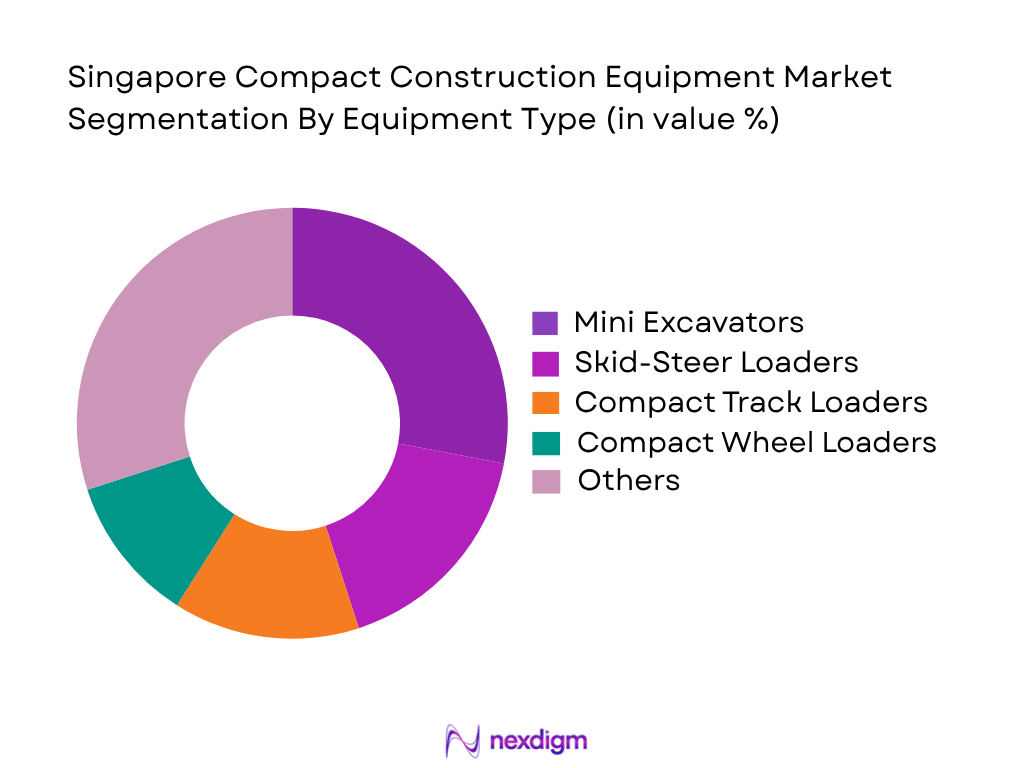
The Singapore Compact Construction Equipment Market is segmented into mini excavators, skid-steer loaders, compact track loaders, compact wheel loaders, compact backhoe loaders, mini loaders, compact rollers and small articulated loaders. Mini excavators are positioned as the leading equipment category because Singapore’s highly urbanized construction environment creates recurring requirements for machinery capable of working around existing buildings, roads, utilities and other infrastructure. Mini excavators combine digging capability with compact dimensions and can accommodate buckets, breakers, augers and other attachments. They therefore serve excavation, trenching, drainage, utility installation, landscaping and foundation preparation requirements. Skid-steer and compact track loaders provide complementary capabilities for loading, grading, demolition and material movement, while compact rollers address road and surface-compaction activities. Bobcat’s current product portfolio, for example, includes compact excavators, skid-steer loaders, compact track loaders, compact wheel loaders, mini track loaders and small articulated loaders, demonstrating the breadth of equipment configurations available to contractors.
By Application
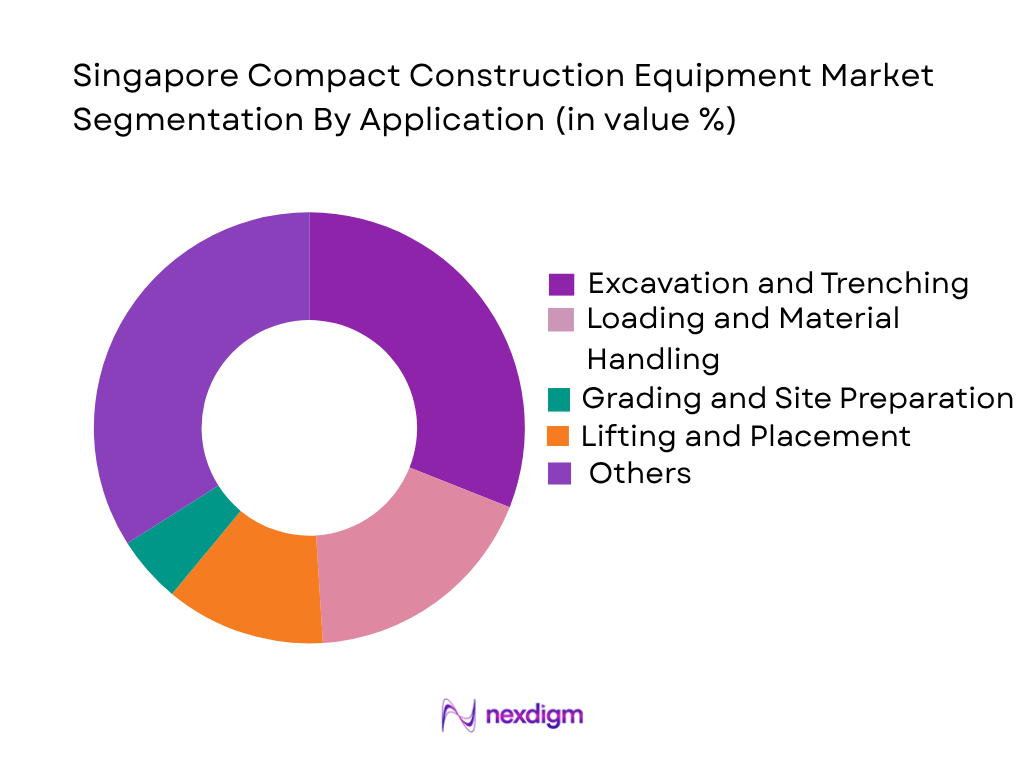
The Singapore Compact Construction Equipment Market is segmented into excavation and trenching, loading and material handling, grading and site preparation, lifting and placement, demolition, landscaping and grounds development, compaction, road construction and maintenance, utility installation and maintenance, and agricultural and land development. Excavation and trenching are positioned as the leading application because underground infrastructure, foundations, drainage, cable installation and utility works require equipment that can operate within restricted work zones. Compact excavators are suited to these requirements because they combine digging performance with maneuverability. Infrastructure projects such as the Cross Island Line reinforce demand for excavation and associated site works, while airport, port, industrial and public-housing projects create additional requirements for compact machines. The versatility of attachment-driven loaders also allows contractors to shift machines between excavation support, grading, loading, demolition and site-cleaning tasks, increasing the range of applications served by individual equipment units.
Competitive Landscape
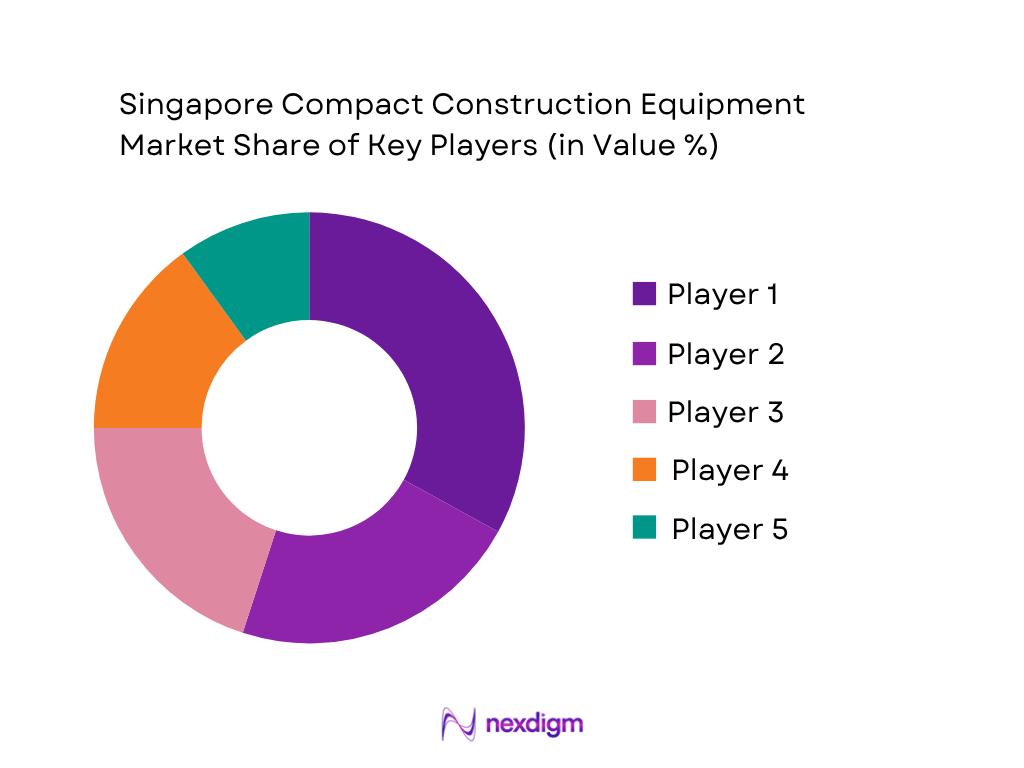
The Singapore Compact Construction Equipment Market includes global OEMs supported by regional distribution networks, authorized dealers and equipment-service providers. Competitive differentiation is based on compact equipment breadth, machine performance, attachment compatibility, electrification, telematics, dealer support and aftermarket capabilities. Caterpillar has an established Singapore dealer through Tractors Singapore Limited, while Bobcat offers a broad compact-equipment portfolio covering excavators, loaders and compact equipment categories. Volvo Construction Equipment also maintains a Singapore-facing product and service presence covering excavators, wheel loaders, compactors and electric machines.
| Company | Establishment Year | Headquarters | Compact Equipment Portfolio | Mini Excavator Capability | Loader Capability | Electric Equipment | Telematics / Digital | Singapore Support |
| Caterpillar Inc. | 1925 | Irving, Texas, USA | ~ | ~ | ~ | ~ | ~ | ~ |
| Bobcat Company | 1947 | West Fargo, North Dakota, USA | ~ | ~ | ~ | ~ | ~ | ~ |
| Komatsu Ltd. | 1921 | Tokyo, Japan | ~ | ~ | ~ | ~ | ~ | ~ |
| Volvo Construction Equipment | 1832* | Gothenburg, Sweden | ~ | ~ | ~ | ~ | ~ | ~ |
| JCB | 1945 | Rocester, United Kingdom | ~ | ~ | ~ | ~ | ~ | ~ |
Singapore Compact Construction Equipment Market Analysis
Growth Drivers
Infrastructure and Construction Project Pipeline
The Singapore Compact Construction Equipment Market is supported by sustained infrastructure and construction activity, creating recurring requirements for excavation, trenching, loading, grading, compaction and material handling equipment. The Building and Construction Authority recorded S$44.2 billion in total construction demand and S$38.4 billion in construction output in 2024, compared with S$33.8 billion and S$34.8 billion respectively in 2023. The International Monetary Fund reported Singapore’s nominal GDP at S$731.4 billion in 2024, while real GDP expanded 4.4%, compared with 1.8% in 2023. Major transport projects strengthen equipment requirements further. The Cross Island Line exceeds 50 kilometres, with Phase 1 covering 29 kilometres and 12 stations, while Phase 2 covers approximately 15 kilometres and 6 stations. Such projects require compact equipment for excavation, utility relocation, site preparation and maintenance in constrained urban environments. The BCA also expects construction demand to average S$39 billion–S$46 billion annually from 2026 to 2029, indicating a substantial project pipeline. These conditions support continuing equipment utilization across civil engineering, public infrastructure, residential development and industrial construction.
Urban Development and Demand for Maneuverable Equipment
Singapore’s dense built environment supports demand for compact construction equipment that can operate around existing buildings, utilities, roads and infrastructure with limited disruption. The Urban Redevelopment Authority recorded 10,617 private residential units completed in 2024, while approximately 35,305 uncompleted private residential units excluding executive condominiums had planning approvals at the end of the year. Singapore’s overall population was approximately 6.0 million, with IMF reporting nominal GDP of US$547.5 billion and GDP per capita of US$90,689 in 2024. Infrastructure development adds further equipment requirements: the Cross Island Line is planned at more than 50 kilometres, with Phase 1 spanning 29 kilometres and serving 12 stations. Changi Airport’s Terminal 5 is being developed within the 1,080-hectare Changi East development and its first phase is designed to handle approximately 50 million passenger movements annually. These construction environments require machines with compact operating footprints, transportability, attachment flexibility and precise maneuvering. Mini excavators, compact loaders and compact rollers can support localized excavation, landscaping, utility installation, road maintenance and site-preparation activities where larger equipment may face access constraints. The combination of residential development, transport infrastructure and airport expansion therefore creates multiple application environments for compact machinery.
Market Challenges
Construction Labor Constraints and Dependence on Foreign Workforce
The Singapore Compact Construction Equipment Market operates within a construction sector that remains dependent on a substantial foreign workforce, making productivity-enhancing equipment increasingly relevant while also creating operational constraints around manpower availability and equipment utilization. Singapore’s Ministry of Manpower recorded 456,800 Work Permit holders in Construction, Marine Shipyard and Process sectors at December 2024, compared with 441,100 at December 2023. Total foreign employment reached 1,576,500 in December 2024, compared with 1,525,500 in December 2023. The Ministry also reported that total employment increased by 45,500 during 2024, although the pace was slower than the 78,800 increase recorded in 2023. Construction accounted for the main concentration of additional non-resident employment during the fourth quarter. These labor conditions affect equipment demand because contractors need machines that improve productivity while requiring operators with appropriate technical capabilities. Compact equipment also requires maintenance personnel, attachment specialists and technicians capable of handling hydraulic, electronic and powertrain systems. Singapore’s IMF-reported nominal GDP of S$731.4 billion and real GDP growth of 4.4% in 2024 indicate a strong overall economic environment, but construction companies still face workforce-management requirements. Consequently, equipment adoption must be supported by operator training, maintenance capabilities and effective fleet management.
Exposure to External Economic Conditions and Equipment Supply Constraints
The Singapore Compact Construction Equipment Market remains exposed to international manufacturing, trade and financial conditions because Singapore is a highly open economy and many construction-equipment components and finished machines are sourced through global supply chains. The IMF reported that Singapore’s goods exports in 2024 were heavily concentrated in machinery and transport equipment, which accounted for 65.0% of non-oil goods exports, while China, Hong Kong SAR and Malaysia represented 14.0%, 11.0% and 10.4% respectively of gross goods exports. Singapore’s nominal GDP reached US$547.5 billion, while official reserves were US$371.4 billion in 2024. The IMF subsequently reported that Singapore’s economy faced increased trade-policy uncertainty, with real GDP contracting 0.6% quarter-on-quarter in the first quarter of 2025. For compact-equipment suppliers, external disruptions can affect availability of engines, hydraulic components, electronic controls, tires, tracks and replacement parts. Construction projects may also experience scheduling changes when procurement timelines shift. BCA specifically noted that project schedules and phasing can change because of an uncertain global economic climate. These factors create planning challenges for contractors and distributors that must balance equipment availability, project schedules and aftermarket requirements.
Market Opportunities
Infrastructure Modernization and Large-Scale Transport Development
The Singapore Compact Construction Equipment Market has opportunities in infrastructure modernization because large transportation and urban-development projects require equipment for repeated excavation, utility work, site preparation, road construction and maintenance. The Cross Island Line provides a substantial project environment: the full MRT line is planned at more than 50 kilometres, while Phase 1 covers 29 kilometres and 12 stations, and Phase 2 covers approximately 15 kilometres and 6 stations. The Punggol extension adds 7.3 kilometres and 4 stations. Changi Airport’s Terminal 5 is being developed on a 1,080-hectare site, with the first phase designed for approximately 50 million passenger movements annually. BCA recorded S$44.2 billion in construction demand and S$38.4 billion in construction output in 2024, while public-sector construction demand was a major contributor. The agency expects construction demand to remain at S$39 billion–S$46 billion per year from 2026 to 2029. These current project conditions create opportunities for compact excavators, loaders, rollers and attachment-based machinery that can operate efficiently in restricted corridors and active urban environments. Equipment suppliers can address this opportunity through compact dimensions, high maneuverability, low-emission configurations, telematics and specialized attachments designed for infrastructure contractors.
Residential, Industrial and Urban Redevelopment Applications
The Singapore Compact Construction Equipment Market has further opportunities across residential, industrial and urban redevelopment projects where contractors require flexible machinery for localized construction activities. URA recorded 10,617 private residential units completed in 2024, while 40,670 units, including executive condominiums, were in the pipeline with planning approvals at year-end. The Government also introduced 11,110 private residential units through the 2024 Government Land Sales programme, representing a continuing source of development activity. BCA recorded S$44.2 billion of construction demand during 2024, while private-sector demand contributed to residential, commercial and industrial development. Compact equipment can serve these projects through excavation, landscaping, material handling, grading, demolition and utility installation, particularly where works occur alongside completed buildings or within constrained plots. Singapore’s economic base further supports these applications, with IMF reporting S$731.4 billion in nominal GDP and 4.4% real GDP growth in 2024. The combination of active housing development, commercial redevelopment and industrial construction creates opportunities for equipment suppliers offering versatile machines, attachment systems, rental options and localized aftermarket support. Demand can extend beyond initial equipment sales into replacement parts, servicing, fleet monitoring and equipment rental as contractors seek flexible deployment across multiple project sites.
Future Outlook
The Singapore Compact Construction Equipment Market is expected to develop around continued infrastructure investment, urban redevelopment, industrial construction and contractor productivity requirements. BCA’s medium-term construction pipeline provides a substantial base for equipment utilization, while large projects such as Changi Terminal 5, Tuas Port and the Cross Island Line create recurring opportunities across excavation, loading, grading and utility applications.
The transition toward lower-emission machinery is another area of development. Singapore’s construction-productivity framework emphasizes labour-saving technologies and more efficient construction methods. BCA requires projects with gross floor area of 5,000 square metres or more to comply with minimum Buildable Design Scores and Constructability Scores, reinforcing the wider focus on construction productivity.
Major Players
- Caterpillar Inc.
- Bobcat Company
- Komatsu Ltd.
- Kobelco Construction Machinery Co., Ltd.
- Volvo Construction Equipment
- JCB
- Kubota Corporation
- Takeuchi Manufacturing
- Yanmar Compact Equipment
- Hitachi Construction Machinery
- Hyundai Construction Equipment
- SANY Group
- XCMG
- LiuGong
- Manitou Group
Key Target Audience
- Construction Equipment OEMs and Manufacturers
- Construction Contractors and Civil Engineering Companies
- Equipment Rental and Fleet Management Companies
- Infrastructure Developers and Project Contractors
- Industrial and Utility Construction Operators
- Investments and Venture Capitalist Firms
- Government and Regulatory Bodies (Building and Construction Authority, Land Transport Authority, National Environment Agency, Ministry of Manpower)
- Equipment Dealers, Distributors and Aftermarket Service Providers
Research Methodology
Step 1: Identification of Key Variables
The initial phase involves constructing an ecosystem map covering Singapore’s compact construction equipment manufacturers, distributors, rental companies, contractors, infrastructure developers and end users. The assessment identifies equipment categories, operating-weight classes, applications, purchasing channels, rental utilization and aftermarket requirements relevant to Singapore.
Step 2: Market Analysis and Construction
Historical and current market information is compiled through equipment-industry databases, government construction statistics, company disclosures and project-level information. Construction demand, project awards, equipment applications, fleet composition, dealer activity and rental requirements are evaluated to construct the market framework.
Step 3: Hypothesis Validation and Expert Consultation
Market hypotheses are validated through consultations with equipment distributors, construction contractors, rental operators, infrastructure contractors and technical specialists. Discussions focus on machine selection, equipment utilization, replacement cycles, attachment adoption, maintenance requirements and changing preferences between conventional and electric compact equipment.
Step 4: Research Synthesis and Final Output
The final stage integrates top-down construction activity analysis with bottom-up equipment-category assessment. Government project information and company-level evidence are cross-checked to validate the resulting market structure, segmentation, competitive landscape and future growth factors before finalizing the Singapore Compact Construction Equipment Market outlook.

- Executive Summary
- Research Methodology (Market Definition and Scope, Singapore Compact Construction Equipment Market Classification, Equipment Technology Mapping, Mini Excavator Assessment, Compact Excavator Evaluation, Skid-Steer Loader Analysis, Compact Track Loader Assessment, Compact Wheel Loader Evaluation, Compact Backhoe Loader Analysis, Compact Roller Assessment, Small Articulated Loader Evaluation, Operating Weight Classification, Rated Operating Capacity Assessment, Engine Power Analysis, Diesel Powertrain Assessment, Battery-Electric Equipment Evaluation, Hydraulic System Assessment, Attachment Compatibility Analysis, Machine Productivity Assessment, Telematics Integration Evaluation, Equipment Utilization Analysis, Rental Fleet Assessment, Dealer Network Mapping, Aftermarket Service Assessment, Import Dependency Assessment, Supply-Side Assessment, Demand-Side Assessment, Top-Down Market Sizing, Bottom-Up Market Sizing, Primary Industry Interviews, Data Triangulation, Forecasting Framework)

- Definition and Scope
- Singapore Compact Construction Equipment Industry Evolution and Development of Mini Excavators, Compact Excavators, Skid-Steer Loaders, Compact Track Loaders, Compact Wheel Loaders, Compact Backhoe Loaders, Compact Rollers, Small Articulated Loaders, Zero-Tail-Swing Excavators, High-Flow Hydraulic Equipment, Attachment-Based Compact Machines, Battery-Electric Compact Equipment, Telematics-Enabled Equipment, Grade-Control-Enabled Equipment, Operator-Assistance Technologies, Advanced Compact Equipment Technologies
- Compact Construction Equipment Value Chain Analysis
- Compact Construction Equipment Supply Chain Analysis
- Engine and Powertrain Suppliers, Hydraulic Component Manufacturers, Track and Tire Suppliers, Steel and Structural Component Suppliers, Battery and Electric Powertrain Suppliers, Attachment Manufacturers, Compact Equipment OEMs, Assembly and Distribution Facilities, Authorized Equipment Dealers, Independent Equipment Dealers, Equipment Rental Companies, Equipment Financing Providers, Used Equipment Dealers, Auction Platforms, General Contractors, Specialty Contractors, Utility Contractors, Landscaping Contractors, Municipalities, Industrial End Users

- Growth Drivers (Public Infrastructure Construction, Housing Development, Changi Airport Terminal 5 Development, Tuas Port Expansion, Cross Island MRT Development, Industrial Facility Construction, Urban Construction Requirements, Equipment Rental Adoption, Construction Productivity Requirements)
- Market Challenges (High Equipment Import Dependence, Limited Operating Space, Skilled Operator Constraints, Equipment Transportation Restrictions, High Equipment Ownership Costs, Maintenance and Parts Availability, Construction Site Access Constraints, Emission and Noise Requirements, Intense Equipment Utilization)
- Market Opportunities (Battery-Electric Compact Equipment, Rental Fleet Expansion, Compact Equipment for Urban Construction, Underground Utility Installation, Data Centre Construction, Port and Logistics Infrastructure, Smart Equipment and Telematics, Attachment-Based Equipment Utilization, Automated Machine Control, Low-Emission Construction Equipment)
- Market Trends (Mini Excavator Adoption, Zero-Tail-Swing Equipment, Battery-Electric Compact Machines, Telematics Integration, Machine-Control Technologies, High-Flow Hydraulic Systems, Attachment-Based Equipment, Predictive Maintenance, Fleet Digitization, Remote Equipment Monitoring)
- Government Regulations and Standards (BCA Built Environment Requirements, Workplace Safety and Health Requirements, NEA Environmental Requirements, Construction Equipment Emission Standards, Noise Control Requirements, Workplace Machinery Safety Requirements, Public Procurement Requirements, Green Building Requirements, Construction Productivity Standards)
- SWOT Analysis
- Porter’s Five Forces Analysis
- PESTLE Analysis
- Stakeholder Ecosystem
- Competition Ecosystem

- By Market Value (2020-2025)
- By New Equipment Unit Sales (2020-2025)
- By Installed Equipment Base (2020-2025)
- By Average Selling Price per Equipment Unit (2020-2025)
- By Mini Excavator Unit Sales (2020-2025)
- By Skid-Steer Loader Unit Sales (2020-2025)
- By Compact Track Loader Unit Sales (2020-2025)
- By Compact Wheel Loader Unit Sales (2020-2025)
- By Compact Roller Unit Sales (2020-2025)
- By Rental Fleet Equipment Purchases (2020-2025)
- By Attachment and Work-Tool Revenue (2020-2025)

- By Equipment Type (In Value %)
Mini Excavators
Skid-Steer Loaders
Compact Track Loaders
Compact Wheel Loaders
Compact Backhoe Loaders
Mini Loaders
Compact Rollers
Small Articulated Loaders - By Application (In Value %)
Excavation and Trenching
Loading and Material Handling
Grading and Site Preparation
Lifting and Placement
Demolition
Landscaping and Grounds Development
Compaction
Road Construction and Maintenance
Utility Installation and Maintenance
Agricultural and Land Development - By End-Use Industry (In Value %)
Residential Construction
Commercial Construction
Industrial Construction
Infrastructure and Civil Engineering
Utility Construction
Transportation Infrastructure
Landscaping and Grounds Maintenance
Municipal and Public Works
Marine and Port Infrastructure
Equipment Rental - By Region (In Value %)
Central Singapore
Western Singapore
Eastern Singapore
Northern Singapore
North-Eastern Singapore
Jurong
Tuas
Changi
Woodlands
Rest of Singapore

- Market Share of Major Players (By Singapore Revenue, Compact Equipment Unit Sales, Mini Excavator Portfolio, Skid-Steer Loader Portfolio, Compact Track Loader Portfolio, Compact Wheel Loader Portfolio, Manufacturing and Distribution Capability, Dealer Network Coverage, Rental Fleet Presence, Attachment Portfolio, Electric Equipment Capability, Telematics Capability, Aftermarket Support)
- Cross Comparison Parameters (Operating Weight and Transportability, Rated Operating Capacity and Lift Performance, Digging Depth and Breakout Force, Auxiliary Hydraulic Flow and Attachment Compatibility, Compact Equipment Product Portfolio Breadth, Battery-Electric Equipment Capability, Telematics and Machine-Control Capability, Dealer and Aftermarket Service Network Coverage)
- SWOT Analysis of Major Players
- Competitive Positioning Matrix
- Compact Construction Equipment Technology and Application Benchmarking
- Hydraulic System and Attachment Compatibility Assessment
- Equipment Productivity and Operational Performance Assessment
- Battery-Electric Compact Equipment and Charging Capability Assessment
- Rental Fleet and Equipment Utilization Assessment
- Singapore Distribution, Service and Aftermarket Capability Assessment
- Major Companies
Caterpillar Inc.
Bobcat Company
Komatsu Ltd.
Kobelco Construction Machinery Co., Ltd.
Volvo Construction Equipment
JCB
Kubota Corporation
Takeuchi Manufacturing
Yanmar Compact Equipment
Hitachi Construction Machinery
Hyundai Construction Equipment
SANY Group
XCMG
LiuGong
Manitou Group

- General Contractor Equipment Requirement Assessment
- Specialty Contractor Equipment Demand Analysis
- Residential Construction Equipment Requirement Assessment
- Infrastructure Contractor Application Assessment
- Utility Construction Equipment Requirement Assessment
- Landscaping Contractor Application Assessment
- Industrial Construction Equipment Assessment
- Equipment Rental Fleet Procurement Assessment
- Municipal and Public Works Equipment Assessment
- Equipment Performance Requirement Assessment (Operating Weight, Rated Operating Capacity, Digging Depth, Breakout Force, Auxiliary Hydraulic Flow, Lift Height, Transportability, Fuel Efficiency)

- By Market Value (2026-2035)
- By New Equipment Unit Sales (2026-2035)
- By Installed Equipment Base (2026-2035)
- By Average Selling Price per Equipment Unit (2026-2035)
- By Mini Excavator Unit Sales (2026-2035)
- By Skid-Steer Loader Unit Sales (2026-2035)
- By Compact Track Loader Unit Sales (2026-2035)
- By Compact Wheel Loader Unit Sales (2026-2035)
- By Electric Compact Equipment Unit Sales (2026-2035)
- By Rental Fleet Equipment Purchases (2026-2035)


 Request a Sample
 Ask for Customization
 Get a Quote
 Enquire Now