

 Download PDF
Market Overview
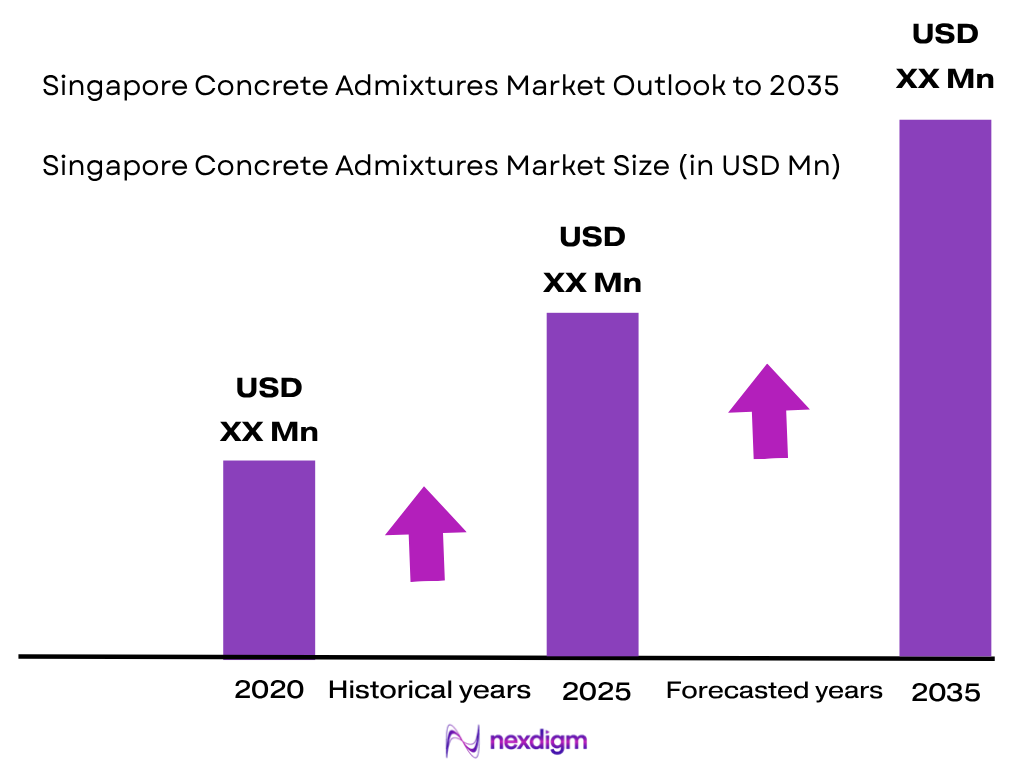
The Singapore Concrete Admixtures Market is valued at approximately ~USD XX million, supported by ready-mix concrete, public housing, infrastructure and high-performance construction. Construction demand increased from S$33.8 billion in the preceding reporting period to S$44.2 billion in the latest period. Public-sector projects, including housing, MRT works, institutional buildings and infrastructure, strengthened demand for PCE superplasticizers, retarders, viscosity modifiers, waterproofing admixtures and durability-enhancing concrete chemicals.
Singapore’s West, Central and East construction corridors dominate admixture consumption because they combine Tuas Port works, dense high-rise construction, public housing, underground rail development and Changi infrastructure. Tuas Port had 11 operational berths in the latest reporting period, while Phase 2 reclamation was approximately 75% completed. Across the country, major MRT, airport, housing and industrial developments generate demanding requirements for pumpable, low-permeability, marine-resistant and high-GGBS concrete.
Market Segmentation
By Admixture Type
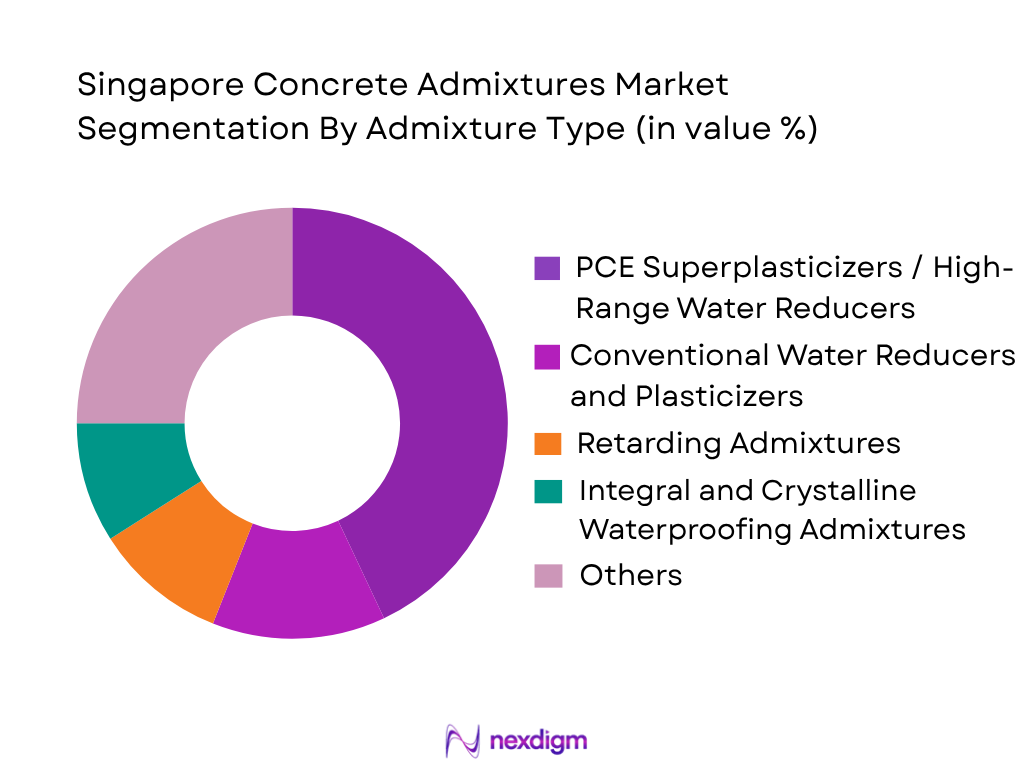
The Singapore Concrete Admixtures Market is segmented into high-range water reducers and superplasticizers, conventional water reducers, retarders, accelerators, viscosity-modifying admixtures, integral waterproofing admixtures, corrosion inhibitors and other specialty products. PCE-based high-range water reducers represent the dominant subsegment because Singapore’s construction environment relies extensively on ready-mix concrete, pumped high-rise concrete, precast components and sophisticated underground structures. These applications require high water reduction, extended slump retention, controlled rheology and compatibility with blended cement systems. Tropical temperatures and longer delivery times increase the importance of maintaining workability between batching and placement. High-GGBS and low-carbon concrete also require customized PCE formulations because binder composition directly affects adsorption and slump performance. Retarders remain important for mass pours and extended placement windows, while accelerators are concentrated in precast and sprayed-concrete applications. Waterproofing and corrosion-control admixtures gain additional relevance in basements, underground MRT infrastructure, marine structures and water-retaining construction.
By Application
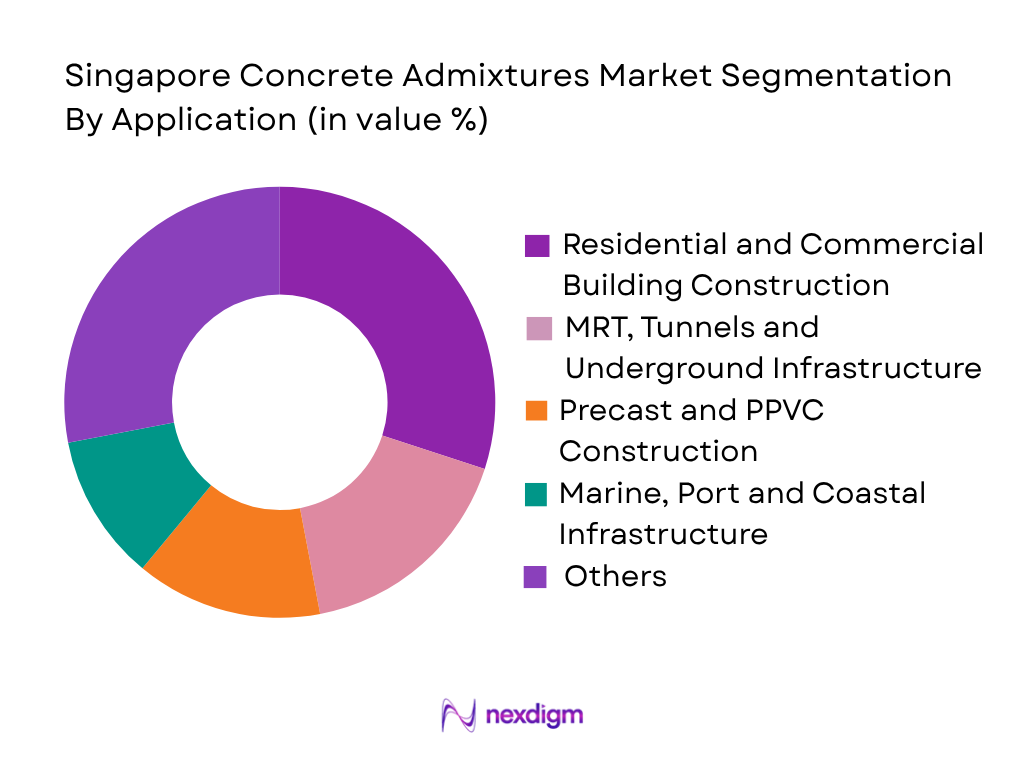
The Singapore Concrete Admixtures Market is segmented into building construction, ready-mix concrete, precast and PPVC, MRT and underground infrastructure, marine and port infrastructure, airports, industrial facilities, data centres and water infrastructure. Building and ready-mix applications represent the dominant demand pool because Singapore’s compact urban environment encourages centralized batching, high-rise pumping and industrialized construction methods. Public housing and private developments require consistent workability and pumpability, while PPVC and precast factories require high early strength, self-compacting behavior and short mould cycles. MRT projects increase demand for tunnel segments, diaphragm walls, mass concrete and shotcrete formulations. Marine projects create another high-specification segment because chloride exposure requires low-permeability, durable concrete. BCA recorded total construction demand of S$44.2 billion in the latest completed period, driven substantially by public institutional, public housing and private housing developments, reinforcing the diverse application base for concrete admixtures.
Competitive Landscape
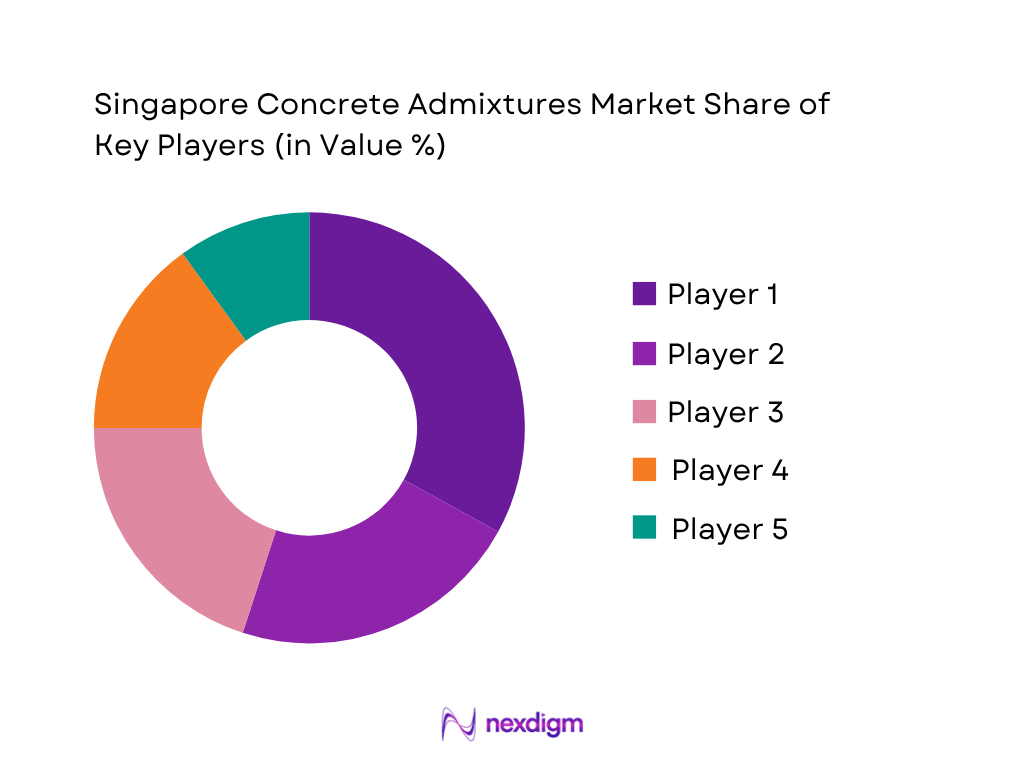
The Singapore Concrete Admixtures Market is characterized by multinational construction-chemical manufacturers supported by local technical, warehousing and distribution capabilities. Competition is centered on PCE formulation, extended slump retention, compatibility with high-GGBS binders, high-rise pumping, precast cycle optimization and technical service. Singapore’s relatively concentrated ready-mix and major-project ecosystem also makes laboratory support, rapid product adjustment and project references particularly important. Sika maintains a Singapore operation in Tuas and offers PCE and non-PCE superplasticizers, accelerators, retarders, viscosity modifiers and durability-related solutions.
| Major Player | Establishment Year | Headquarters | PCE / Superplasticizer Capability | Ready-Mix & Precast Coverage | High-GGBS / Low-Carbon Compatibility | MRT / Infrastructure Capability | Singapore Supply Presence | Technical & Laboratory Support |
| Sika | 1910 | Baar, Switzerland | ~ | ~ | ~ | ~ | ~ | ~ |
| Saint-Gobain Construction Chemicals / CHRYSO | 1942 CHRYSO roots | Courbevoie, France | ~ | ~ | ~ | ~ | ~ | ~ |
| Fosroc | 1972 | Dubai, UAE | ~ | ~ | ~ | ~ | ~ | ~ |
| Mapei | 1937 | Milan, Italy | ~ | ~ | ~ | ~ | ~ | ~ |
| MC-Bauchemie | 1961 | Bottrop, Germany | ~ | ~ | ~ | ~ | ~ | ~ |
Singapore Concrete Admixtures Market Analysis
Growth Drivers
Strong Public Construction and Housing Pipeline Supporting Admixture Consumption
Singapore’s Concrete Admixtures Market is supported by a large pipeline of public housing, transport and institutional construction that requires substantial volumes of ready-mix, pumped and precast concrete. The Building and Construction Authority recorded S$44.2 billion of construction demand and S$38.4 billion of construction output in 2024, providing a substantial project base for PCE superplasticizers, retarders, viscosity modifiers and waterproofing admixtures. Housing activity was particularly significant: the Housing & Development Board launched 21,225 new flats in 2024, comprising 19,637 BTO flats and 1,588 Sale of Balance Flats, while construction started on about 23,600 flats during FY2024. These projects require repeatable concrete quality, pumping performance and workability retention across dense urban sites and industrialized construction facilities. Singapore’s economic fundamentals provide additional support to this construction base. World Bank data record nominal GDP of USD547.39 billion in 2024 and GDP per capita of USD90,674.1. The combination of high-value construction contracts, large public-housing volumes and a high-income economic environment directly sustains demand for high-performance concrete admixtures optimized for Singapore’s ready-mix and precast construction model.
MRT, Port and High-Specification Infrastructure Increase Performance Requirements
Singapore’s transport and marine infrastructure is driving demand for concrete admixtures that provide extended slump retention, low permeability, controlled setting, chloride resistance and reliable high-strength development. The Maritime and Port Authority reported 11 operational berths at Tuas Port in 2024, while Phase 2 reclamation works were about 75% completed and another 7 berths were scheduled through subsequent development. The port handled infrastructure exposed to seawater and chloride conditions, making high-GGBS concrete, PCE superplasticizers and durability-enhancing admixtures particularly relevant. Construction activity also includes Cross Island Line works, Thomson-East Coast Line extension contracts, Woodlands Checkpoint infrastructure and other underground developments identified by the Building and Construction Authority as major project drivers. BCA recorded S$44.2 billion of total construction demand in 2024 and S$38.4 billion of certified construction output, indicating the scale of active concrete-intensive works. World Bank macroeconomic data place Singapore’s nominal GDP at USD547.39 billion in 2024 and GDP per capita at USD90,674.1. These conditions favor admixture suppliers with proven capabilities in tunnel concrete, marine durability, diaphragm walls, mass pours and long-distance ready-mix delivery.
Market Challenges
Dependence on Imported Chemical Feedstocks and Limited Domestic Production Space
Singapore’s Concrete Admixtures Market faces structural supply-chain exposure because the city-state has limited domestic raw-material resources and relies on imported polyether macromonomers, acrylic intermediates, specialty polymers, cementitious materials and other chemical inputs used in PCE and specialty admixture formulations. This dependence becomes more important when construction volumes are elevated. The Building and Construction Authority recorded S$44.2 billion of construction contracts awarded and S$38.4 billion of construction output in 2024, requiring suppliers to maintain sufficient inventories for large public housing, infrastructure and commercial projects. HDB alone commenced construction on approximately 23,600 flats during FY2024, increasing recurring demand for ready-mix and precast concrete chemicals. Singapore’s constrained industrial land also means chemical manufacturers must balance warehousing, blending and bulk-storage capacity carefully, particularly for products requiring local stock availability. The macroeconomic base is large relative to Singapore’s physical size: World Bank data record nominal GDP of USD547.39 billion in 2024 and GDP per capita of USD90,674.1. Consequently, admixture suppliers need regional sourcing, diversified raw-material procurement and strategically positioned local inventories to prevent imported feedstock disruptions from affecting project-specific concrete formulations and construction schedules.
High-GGBS Concrete and Tropical Placement Conditions Increase Formulation Complexity
Singapore’s widespread use of high-performance and blended-binder concrete creates technical challenges for admixture suppliers because PCE chemistry must remain compatible with varying cement, GGBS and supplementary cementitious material combinations. Tropical placement conditions can accelerate hydration and slump loss, while high-rise pumping, long ready-mix delivery cycles and underground construction require concrete to maintain rheology until final placement. BCA recorded S$38.4 billion of construction output in 2024, demonstrating the large volume of active work for which consistent concrete performance must be maintained. HDB launched 19,637 BTO flats in 2024, while the October sales exercise alone included 8,573 flats across 15 projects, illustrating the scale and geographic spread of standardized but high-quality concrete demand. Singapore also had major underground and marine projects requiring low-permeability and durability-focused mixes, adding further formulation complexity. World Bank data put nominal GDP at USD547.39 billion in 2024 and GDP per capita at USD90,674.1. For admixture manufacturers, this environment increases the importance of laboratory compatibility testing, site trials, dosage optimization and continuous technical support because a formulation performing reliably with one binder source may respond differently when cement fineness, sulphate balance or GGBS content changes.
Market Opportunities
Low-Carbon and High-GGBS Concrete Creates Scope for Advanced PCE Formulations
Singapore’s transition toward lower-carbon construction creates a future growth opportunity for advanced admixtures designed to maintain workability, early strength and durability in high-GGBS and reduced-clinker concrete. Current construction activity provides a strong application base: BCA recorded S$44.2 billion of construction demand and S$38.4 billion of construction output in 2024, while HDB launched 21,225 new flats during the same year. These projects create substantial concrete demand that can increasingly incorporate lower-carbon binder systems. Singapore’s Green Mark framework and sustainable-construction policies encourage greater use of supplementary cementitious materials, recycled concrete aggregate and alternative materials, increasing the need for PCE molecules tailored to non-conventional binder chemistry. The technical opportunity extends beyond water reduction: suppliers can develop products that improve dispersion, retain slump, reduce shrinkage and restore early strength in blended systems. Singapore’s macroeconomic capacity supports adoption of higher-performance construction technologies, with World Bank data recording nominal GDP of USD547.39 billion in 2024 and GDP per capita of USD90,674.1. These current conditions create future room for differentiated low-carbon admixture portfolios, concrete laboratory services and mix-optimization solutions targeted at public housing, infrastructure, precast and commercial construction.
Data Centres and Advanced Infrastructure Expand High-Specification Concrete Applications
Singapore’s expanding digital and advanced-infrastructure ecosystem creates a future opportunity for admixture suppliers serving high-strength, low-shrinkage, waterproof and highly durable concrete applications. The Infocomm Media Development Authority reported more than 1.4 gigawatts of operational data-centre capacity and over 70 cloud, enterprise and co-location data centres in 2024. Its Green Data Centre Roadmap also identified at least 300 megawatts of additional near-term capacity, establishing a significant pipeline for technically demanding buildings that require reliable foundations, floor systems, water-resistant structures and tightly controlled concrete performance. Data-centre growth complements major infrastructure activity: Singapore recorded S$44.2 billion of construction demand in 2024, while Tuas Port operated 11 berths and Phase 2 reclamation had reached about 75% completion. These projects broaden the addressable opportunity for PCE superplasticizers, shrinkage reducers, waterproofing admixtures, corrosion inhibitors and high-GGBS-compatible systems. World Bank data show Singapore’s nominal GDP at USD547.39 billion in 2024 and GDP per capita at USD90,674.1. Current digital-infrastructure capacity, port development and high construction output therefore support future growth for suppliers offering project-specific concrete chemistry backed by laboratory and field-engineering capabilities.
Future Outlook
The Singapore Concrete Admixtures Market is expected to expand at approximately ~X.X% CAGR during 2026-2035, driven by major public infrastructure, high-value buildings, low-carbon construction and growing requirements for high-performance concrete. Future demand will increasingly shift from standardized water reducers toward customized PCE systems, durability admixtures and solutions optimized for blended binders.
Singapore’s medium-term construction pipeline includes Changi Terminal 5, continued public housing, the Cross Island Line, Downtown Line Extension, healthcare developments, industrial estates and urban redevelopment projects. BCA expects these major project categories to continue supporting construction activity, creating recurring demand for high-specification concrete chemistry.
Major Players
- Sika Singapore Pte Ltd
- Saint-Gobain Construction Chemicals / CHRYSO Singapore
- GCP Applied Technologies Singapore
- Fosroc Singapore
- Mapei Far East Pte Ltd
- MC-Bauchemie Singapore
- Cemkrete Technologies Pte Ltd
- Buildmate Pte Ltd
- Davco Singapore
- LATICRETE South East Asia Pte Ltd
- Penetron Singapore
- Xypex Singapore
- Kryton International Singapore Distribution
- Euclid Chemical Regional Solutions
- Normet Singapore
Key Target Audience
- Concrete Admixture and Construction Chemical Manufacturers
- Ready-Mix Concrete Producers
- Precast and PPVC Manufacturers
- Main Contractors and Civil Engineering Contractors
- Property, Infrastructure and Data Centre Developers
- Investments and Venture Capitalist Firms
- Government and Regulatory Bodies (Building and Construction Authority, Land Transport Authority, Housing & Development Board, Maritime and Port Authority of Singapore, National Environment Agency)
- Cement, Binder and Supplementary Cementitious Material Suppliers
Research Methodology
Step 1: Identification of Key Variables
The initial phase involves constructing an ecosystem map covering concrete admixture manufacturers, ready-mix producers, precast and PPVC manufacturers, cement suppliers, contractors, infrastructure agencies and developers. Secondary research is used to identify PCE adoption, admixture dosage patterns, binder chemistry, high-GGBS usage and project-specific performance requirements. The key variables include concrete volume, chemistry mix, slump retention, application type and customer concentration.
Step 2: Market Analysis and Construction
Historical demand is analyzed across residential buildings, commercial construction, MRT projects, port infrastructure, airports, precast facilities and industrial developments. The top-down approach evaluates national construction activity and concrete-intensive project pipelines, while the bottom-up approach assesses admixture consumption by ready-mix producers, precast factories and major projects. Results are reconciled across chemistry type, application, product type and end-user categories.
Step 3: Hypothesis Validation and Expert Consultation
Market assumptions are validated through structured interviews and computer-assisted telephone interviews with ready-mix producers, admixture manufacturers, concrete technologists, precast operators, contractors and technical consultants. Interviews assess PCE dosage, slump-retention requirements, cement compatibility, GGBS performance, product qualification and procurement practices. These discussions distinguish high-performance project demand from conventional commodity admixture consumption.
Step 4: Research Synthesis and Final Output
The final stage triangulates supplier disclosures, government construction statistics, major project pipelines, technical standards and primary interviews. Demand is cross-checked against ready-mix production, infrastructure activity and precast requirements. Forecasting incorporates MRT expansion, public housing, Tuas and Changi projects, high-GGBS adoption, PPVC construction and low-carbon concrete requirements to establish the final Singapore Concrete Admixtures Market outlook.

- Executive Summary
- Research Methodology (Market Definitions and Assumptions, Singapore Concrete Admixtures Market Classification, Chemical Admixture Scope, Ready-Mix Concrete Assessment, Precast Concrete Assessment, PPVC Concrete Assessment, Site-Batched Concrete Assessment, Plasticizer Assessment, Superplasticizer Assessment, PCE-Based Admixture Assessment, SNF-Based Admixture Assessment, Retarding Admixture Assessment, Accelerating Admixture Assessment, Waterproofing Admixture Assessment, Crystalline Admixture Assessment, Corrosion-Inhibiting Admixture Assessment, Shrinkage-Reducing Admixture Assessment, Viscosity-Modifying Admixture Assessment, High-Performance Concrete Assessment, Self-Compacting Concrete Assessment, Pumped Concrete Assessment, High-GGBS Concrete Assessment, Marine Concrete Assessment, Underground Concrete Assessment, Low-Carbon Concrete Assessment, Slump-Retention Assessment)

- Definition and Scope
- Singapore Concrete Admixtures Industry Evolution and Development of Conventional Water Reducers, Lignosulphonate-Based Plasticizers, Sulphonated Naphthalene Formaldehyde Superplasticizers, Polycarboxylate Ether Superplasticizers, Extended Slump-Retention Admixtures, Retarding Admixtures, Accelerating Admixtures, Viscosity-Modifying Admixtures, Integral Waterproofing Admixtures, Crystalline Waterproofing Technologies, Corrosion-Inhibiting Admixtures, Shrinkage-Reducing Admixtures, High-Performance Concrete Technologies, Self-Compacting Concrete Technologies, High-GGBS Concrete Solutions, PPVC Concrete Technologies, Underground MRT Concrete Solutions, Marine Durability Technologies, Low-Carbon Concrete Admixtures
- Concrete Admixtures Value Chain Analysis
- Concrete Admixtures Supply Chain Analysis
- PCE Monomer Suppliers, Acrylic Polymer Suppliers, Lignosulphonate Suppliers, Naphthalene-Based Chemical Suppliers, Specialty Chemical Manufacturers, Concrete Admixture Manufacturers, Local Admixture Blending Facilities, Ready-Mix Concrete Producers, Precast Concrete Manufacturers, PPVC Manufacturers, Cement and Binder Suppliers, Construction Chemical Distributors, Main Contractors, Civil Engineering Contractors

- Growth Drivers (Public Housing Construction, MRT and Underground Infrastructure, Changi Airport Development, Tuas Port and Marine Infrastructure, High-Rise Construction, Data Centre Development, Ready-Mix Concrete Demand, Precast and PPVC Adoption, High-Performance Concrete Adoption, High-GGBS Concrete Usage, Green Building Requirements, Low-Carbon Concrete Adoption, Marine Durability Requirements)
- Market Challenges (Imported Raw Material Dependence, PCE Feedstock Dependence, Cement Chemistry Variability, High-GGBS Concrete Compatibility, Tropical Climate Effects on Slump Retention, Long Concrete Delivery Times, Limited Local Manufacturing Space, Ready-Mix Customer Concentration, Admixture-Cement Compatibility, Technical Qualification Requirements, Product Consistency, Construction Project Delays)
- Market Opportunities (PCE Superplasticizer Penetration, Low-Carbon Concrete Admixtures, High-GGBS Compatible Admixtures, Extended Slump-Retention Technologies, Precast and PPVC Admixtures, Alkali-Free Shotcrete Accelerators, Crystalline Waterproofing Admixtures, Corrosion Inhibitors, Marine Concrete Durability Solutions, MRT and Underground Concrete, Data Centre Construction, High-Rise Pumping Solutions, Regional Technical Hub Development)
- Market Trends (PCE-Based Water Reducers, Extended Slump-Retention Admixtures, High-GGBS Concrete, Cement Optimization, SCM-Compatible Admixtures, Low-Carbon Concrete, High Pumpability Concrete, Self-Compacting Concrete, Integral Waterproofing, Crystalline Technologies, Digital Concrete Monitoring, Automated Dosing, Customized Mix-Specific Admixtures, Locally Blended Polymer Systems)
- Government Regulations and Standards (Building and Construction Authority Concrete Requirements, Singapore Standard for Concrete, Ready-Mixed Concrete Certification Requirements, Green Mark Requirements, Structural Concrete Requirements, Green Cement and Supplementary Cementitious Material Requirements, Recycled Concrete Aggregate Requirements, Washed Copper Slag Requirements)
- SWOT Analysis
- Porter’s Five Forces Analysis
- PESTLE Analysis
- Stakeholder Ecosystem
- Concrete Admixtures Manufacturing and Construction Project Ecosystem

- By Market Value (2020-2025)
- By Admixture Consumption Volume (2020-2025)
- By Superplasticizer Consumption Volume (2020-2025)
- By PCE-Based Admixture Consumption (2020-2025)
- By Retarding Admixture Consumption (2020-2025)
- By Waterproofing Admixture Consumption (2020-2025)
- By Ready-Mix Concrete Admixture Consumption (2020-2025)
- By Precast and PPVC Admixture Consumption (2020-2025)
- By Infrastructure Concrete Admixture Consumption (2020-2025)
- By High-Rise Building Admixture Consumption (2020-2025)
- By Underground and MRT Concrete Admixture Consumption (2020-2025)
- By Marine Concrete Admixture Consumption (2020-2025)
- By Locally Blended Admixture Consumption (2020-2025)
- By Imported Admixture Consumption (2020-2025)

- By Admixture Type (In Value %)
Plasticizers and Water Reducers
High-Range Water Reducers and Superplasticizers
Retarding Admixtures
Accelerating Admixtures
Shotcrete Accelerators
Viscosity-Modifying Admixtures
Air-Entraining Admixtures
Integral Waterproofing Admixtures
Crystalline Waterproofing Admixtures
Corrosion-Inhibiting Admixtures
Shrinkage-Reducing Admixtures
Hydration-Control Admixtures
Anti-Washout Admixtures
Pumping Aids
Specialty Performance Admixtures - By Chemical Technology (In Value %)
Polycarboxylate Ether-Based Admixtures
Sulphonated Naphthalene Formaldehyde-Based Admixtures
Sulphonated Melamine Formaldehyde-Based Admixtures
Lignosulphonate-Based Admixtures
Acrylic Polymer-Based Admixtures
Polymer-Modified Hybrid Admixtures
Crystalline Reactive Chemicals
Hydrophobic Pore-Blocking Admixtures
Calcium Nitrate-Based Corrosion Inhibitors
Non-Chloride Accelerator Chemistries
Alkali-Free Accelerator Chemistries
Other Specialty Chemistries - By Application (In Value %)
Ready-Mix Concrete
Precast Concrete
PPVC Concrete
Prestressed Concrete
Site-Batched Concrete
Shotcrete and Sprayed Concrete
Piling Concrete
Raft Foundation Concrete
Mass Foundation Concrete
Pumped High-Rise Concrete
MRT and Underground Concrete
Tunnel Segment Concrete
Marine and Coastal Concrete
Water-Retaining Structures
Industrial Flooring Concrete
Data Centre Concrete - By Region (In Value %)
Central Region
East Region
North Region
North-East Region
West Region
Jurong and Tuas
Changi
Punggol and North-East Growth Areas
Greater Southern Waterfront and Southern Region
Other Singapore Construction Zones

- Market Share of Major Players (By Singapore Revenue, Admixture Consumption Volume, Superplasticizer Volume, PCE-Based Admixture Portfolio, Ready-Mix Concrete Exposure, Precast and PPVC Exposure, Infrastructure Project Exposure, MRT and Underground Project Portfolio, Marine Concrete Portfolio, Local Blending Capability, Local Inventory Availability, Technical Laboratory Capability, Bulk Delivery Network, Regional Distribution Coverage, Low-Carbon Concrete Capability)
- Cross Comparison Parameters (PCE Superplasticizer Portfolio Breadth, Tropical-Climate Slump-Retention Capability, Ready-Mix Precast and PPVC Customer Coverage, Singapore Stocking and Blending Capability, High-GGBS and Low-Carbon Concrete Compatibility, MRT Marine and Durability Admixture Capability, Technical Laboratory and Mix-Design Support, Bulk Delivery and Field-Service Network)
- SWOT Analysis of Major Players
- Competitive Positioning Matrix
- Major Companies
Sika Singapore Pte Ltd
Saint-Gobain Construction Chemicals / CHRYSO Singapore
GCP Applied Technologies Singapore
Fosroc Singapore
Mapei Far East Pte Ltd
MC-Bauchemie Singapore
Cemkrete Technologies Pte Ltd
Buildmate Pte Ltd
Davco Singapore
LATICRETE South East Asia Pte Ltd
Penetron Singapore
Xypex Singapore
Kryton International Singapore Distribution
Euclid Chemical Regional Solutions
Normet Singapore

- Ready-Mix Concrete Producer Requirement Assessment
- Precast Concrete Manufacturer Requirement Assessment
- PPVC Manufacturer Requirement Assessment
- Main Contractor Procurement Assessment
- High-Rise Building Concrete Requirement Assessment
- MRT and Underground Concrete Requirement Assessment
- Infrastructure Contractor Requirement Assessment
- Marine and Coastal Concrete Requirement Assessment
- Property Developer Concrete Specification Assessment
- Concrete Technology Consultant Requirement Assessment
- Low-Carbon Concrete Requirement Assessment
- High-GGBS Concrete Performance Requirement Assessment
- Superplasticizer Compatibility Assessment
- Technical Laboratory and Field Service Requirement Assessment

- By Market Value (2026-2035)
- By Admixture Consumption Volume (2026-2035)
- By Superplasticizer Consumption Volume (2026-2035)
- By PCE-Based Admixture Consumption (2026-2035)
- By Retarding Admixture Consumption (2026-2035)
- By Waterproofing Admixture Consumption (2026-2035)
- By Ready-Mix Concrete Admixture Consumption (2026-2035)
- By Precast and PPVC Admixture Consumption (2026-2035)
- By Infrastructure Concrete Admixture Consumption (2026-2035)
- By High-Rise Building Admixture Consumption (2026-2035)


 Request a Sample
 Ask for Customization
 Get a Quote
 Enquire Now
