
 Download PDF
Market Overview
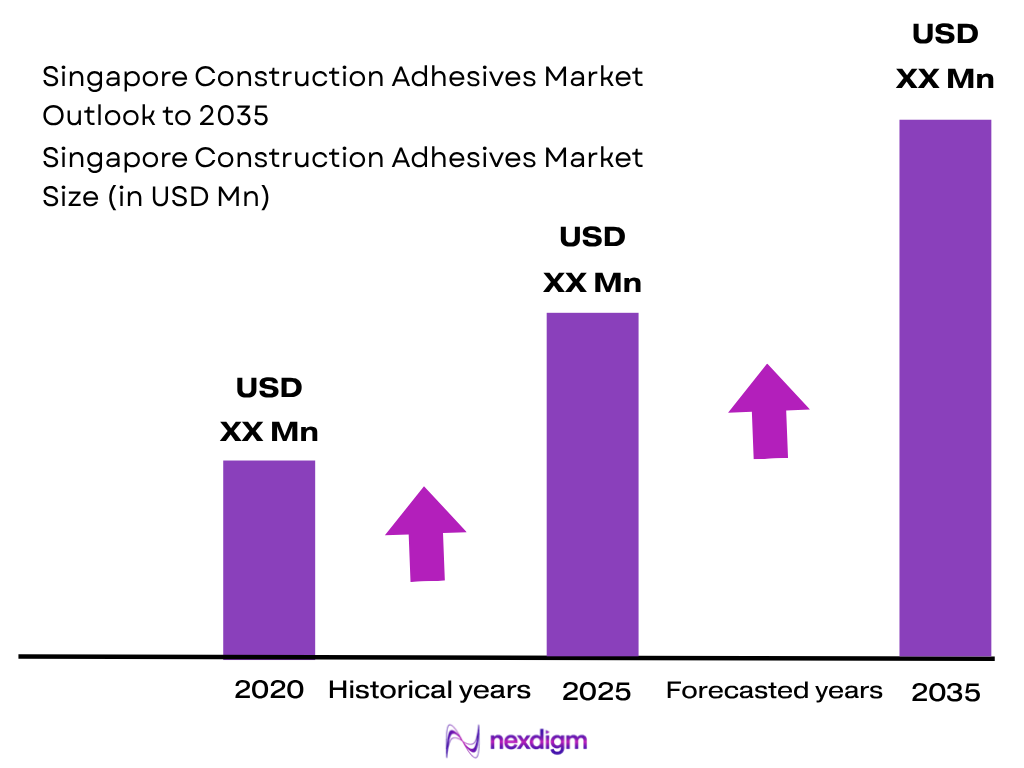
The Singapore Construction Adhesives Market is valued at approximately ~USD XX million, supported by public housing, commercial redevelopment, industrial construction and renovation activity. Total construction demand increased from S$33.8 billion to S$44.2 billion across the latest two annual observations, while construction output reached S$38.4 billion in the latest period. This activity sustains consumption of cementitious tile adhesives, flooring adhesives, epoxies, polyurethane systems and structural bonding products.
Central Singapore, Marina Bay, Jurong, Punggol, Changi, Tuas and mature HDB estates dominate construction-adhesive demand because they combine public housing, commercial fit-outs, industrial buildings, transport infrastructure and refurbishment. HDB completed more than 20,000 homes across 29 projects in the latest financial period after completing 21,393 flats across 23 projects in the preceding comparable cycle, creating recurring demand for tile-setting, flooring and renovation adhesives.
Market Segmentation
By Adhesive Type
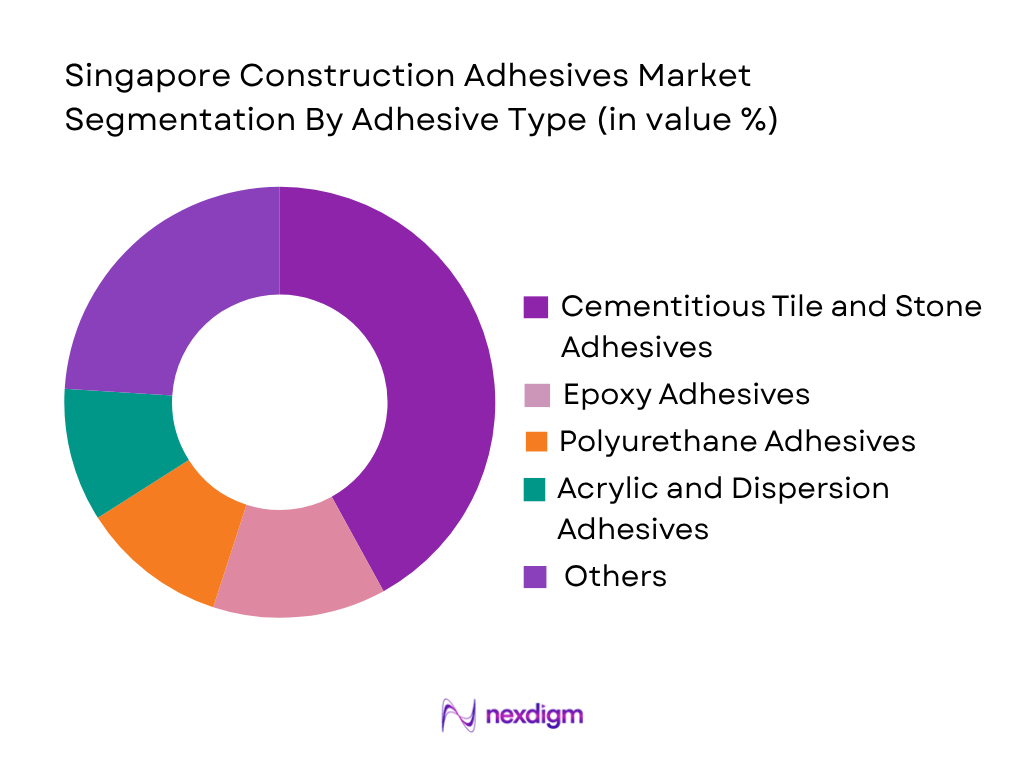
The Singapore Construction Adhesives Market is segmented into cementitious tile and stone adhesives, epoxy adhesives, polyurethane adhesives, acrylic and dispersion adhesives, flooring adhesives, structural bonding adhesives and hybrid polymer systems. Cementitious tile and stone adhesives hold the dominant market share because Singapore’s residential, commercial and institutional building stock generates continuous demand for ceramic, porcelain, natural-stone and large-format tile installation. Public housing remains particularly important: HDB launched 21,225 new flats in the latest full-year housing cycle, while renovation and upgrading activity continues across existing estates. Cementitious systems also benefit from compatibility with concrete and screed substrates that dominate Singapore buildings. Premium grades classified for improved adhesion, extended open time and deformability are increasingly required for porcelain and large-format tiles. Sika Singapore currently markets C2S1E and C2S2TE cementitious systems, while Mapei provides EN 12004-classified adhesives covering residential, commercial and infrastructure applications.
By Application
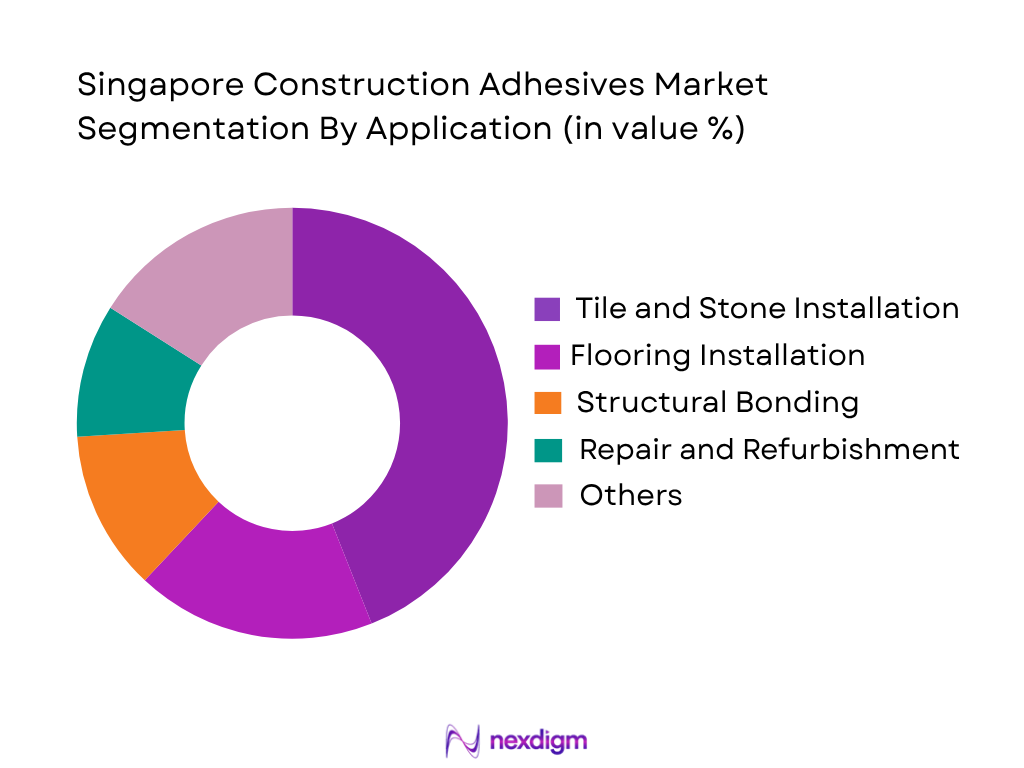
The Singapore Construction Adhesives Market is segmented into tile and stone installation, flooring, structural bonding, panel and façade bonding, insulation bonding, and repair and refurbishment. Tile and stone installation represents the dominant application segment because residential flats, hotels, retail assets, hospitals and transport facilities use extensive ceramic and stone finishes in bathrooms, kitchens, corridors, lobbies and external spaces. HDB’s continuing new-flat supply and estate upgrading create a recurring installation base, while asset-enhancement projects in commercial buildings add retrofit demand. Mapei’s local project references include Jewel Changi Airport, Marina Bay Sands, Singapore Sports Hub, Funan and Gardens by the Bay, showing that tile and flooring systems are used across multiple high-specification asset classes. Large-format porcelain and natural stone also increase adhesive performance requirements, particularly tensile adhesion, slip resistance and deformability.
Competitive Landscape
The Singapore Construction Adhesives Market is led by multinational construction-chemical and adhesive manufacturers with established specification networks, local distribution and technical-support capabilities. Sika, Mapei, ARDEX, Henkel and Bostik compete across cementitious adhesives, epoxy and polyurethane bonding, flooring systems, renovation products and green-certified solutions. Competitive differentiation depends on EN 12004 performance classification, large-format tile capability, low-VOC credentials, contractor training, project approvals and ability to support fast-track construction and refurbishment.
| Company | Establishment Year | Headquarters | Tile Adhesive Capability | Flooring Adhesive Capability | Structural Bonding Capability | Green / Low-VOC Portfolio | Technical Support | Singapore Presence |
| Sika | 1910 | Baar, Switzerland | ~ | ~ | ~ | ~ | ~ | ~ |
| Mapei | 1937 | Milan, Italy | ~ | ~ | ~ | ~ | ~ | ~ |
| ARDEX | 1949 | Witten, Germany | ~ | ~ | ~ | ~ | ~ | ~ |
| Henkel | 1876 | Düsseldorf, Germany | ~ | ~ | ~ | ~ | ~ | ~ |
| Bostik | 1889 | Colombes, France | ~ | ~ | ~ | ~ | ~ | ~ |
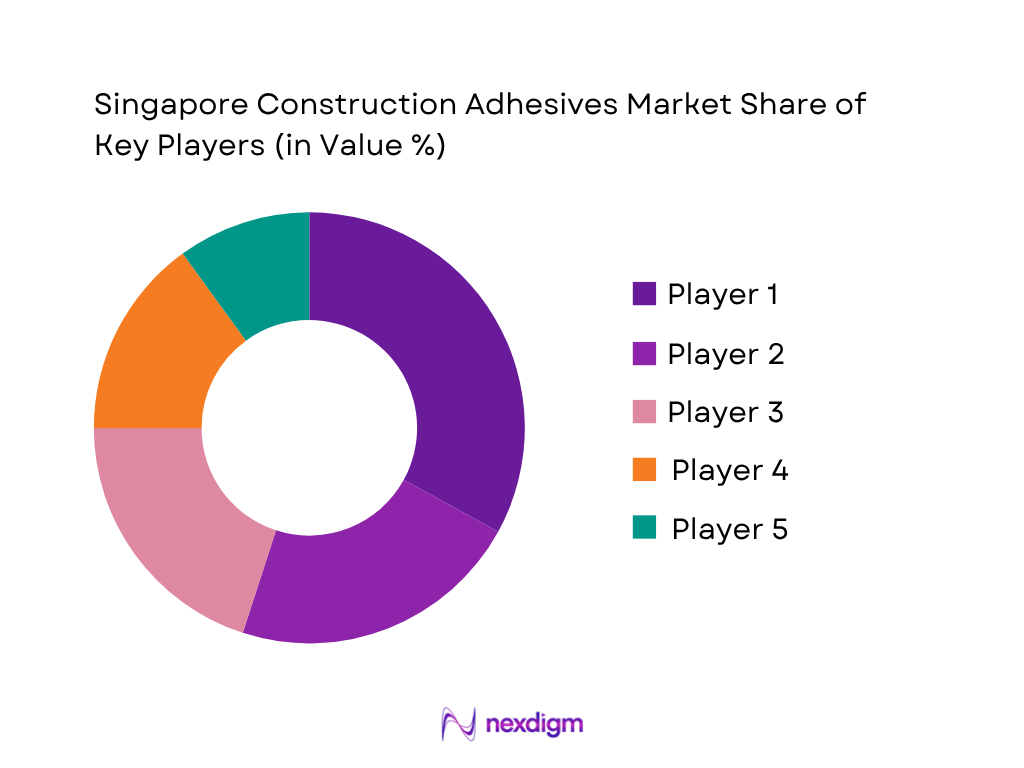
Singapore Construction Adhesives Market Analysis
Growth Drivers
Public Housing Construction and Large-Scale Residential Fit-Out Activity
Singapore’s public housing pipeline is a major growth driver for construction adhesives because every new residential project creates demand for tile fixing, resilient flooring, wet-area installation, skirting, panel bonding and interior finishing systems. HDB launched 21,225 new flats in 2024, including 19,637 Build-To-Order flats and 1,588 Sale of Balance Flats, while construction commenced on about 23,600 flats during FY2024. HDB also completed more than 20,000 homes across 29 projects during the same financial period. These volumes directly support consumption of cementitious tile adhesives, flexible C2-class products, rapid-setting systems and flooring adhesives used throughout kitchens, bathrooms, living spaces and common areas. The broader construction environment is equally supportive: Singapore recorded S$44.2 billion in construction demand and S$38.4 billion in construction output in 2024. World Bank data place Singapore’s GDP at USD 547.39 billion in 2024 and GDP per capita at USD 90,674.1, indicating strong economic capacity for sustained public housing and interior-finishing expenditure. This combination provides a recurring demand base for standardized and high-performance construction adhesive systems.
Commercial Redevelopment, Infrastructure and High-Specification Construction
Singapore’s construction pipeline is also driving adhesive consumption beyond housing, particularly across commercial redevelopment, institutional buildings, transport infrastructure and industrial facilities. Construction demand reached S$44.2 billion in 2024, while construction output reached S$38.4 billion, creating a substantial project base for flooring adhesives, structural epoxies, polyurethane systems, façade bonding and high-performance tile adhesives. Major active and committed developments include Changi Airport Terminal 5, Cross Island Line works, the Downtown Line Extension, Woodlands North Coast industrial development, hospitals and urban-rejuvenation projects. Capital formation reinforces the scale of this environment: construction and works accounted for S$63.22 billion of gross fixed capital formation in the preceding full-year base, including S$26.98 billion in residential buildings and S$25.30 billion in non-residential buildings. World Bank data show Singapore’s GDP at USD 547.39 billion in 2024 and GDP per capita at USD 90,674.1. These conditions support higher specification intensity, especially for large-format tiles, resilient commercial flooring, structural repair adhesives and fast-curing systems where bond strength, open time, deformability and project turnaround are critical.
Market Challenges
Imported Raw Material Dependence and Exposure to External Chemical Supply Chains
The Singapore Construction Adhesives Market faces a structural supply challenge because epoxy resins, polyurethane intermediates, acrylic polymers, redispersible polymer powders, cellulose ethers and specialty additives are largely sourced through international chemical supply chains. Singapore imported S$611.4 billion of merchandise in 2024, while total merchandise trade reached S$1.2859 trillion, reflecting the economy’s deep dependence on cross-border material flows. Imports expanded further to S$658.27 billion in 2025, increasing the scale of external sourcing exposure. For adhesive formulators, interruptions in resin, hardener, polymer-powder or performance-additive availability can affect local dry-mix production, imported finished-product inventories and consistency of project-approved formulations. Construction demand of S$44.2 billion in 2024 means this supply reliability is commercially important because tiling, flooring and fit-out contractors require approved products without substitutions during live projects. Singapore’s GDP stood at USD 547.39 billion in 2024, with GDP per capita of USD 90,674.1, supporting sophisticated construction demand but not eliminating dependence on imported chemistry. Manufacturers with regional sourcing, local warehousing and multiple qualified raw-material suppliers therefore have an operational advantage in maintaining continuity and specification compliance.
Installation Quality, Large-Format Tiles and Renovation Substrate Complexity
Singapore’s construction adhesive suppliers face a technical challenge from increasingly demanding installation conditions, particularly large-format porcelain tiles, existing tiled substrates, wet areas and fast-track renovation projects. HDB selected more than 53,000 flats for upgrading under the Home Improvement Programme in 2024, with more than S$742 million allocated for those works. At the same time, HDB launched 21,225 new flats, meaning adhesive suppliers must serve both new-build and retrofit environments with different substrate conditions. Renovation work can involve old screeds, existing tiles, moisture exposure and uneven surfaces, while new high-specification projects increasingly use low-porosity porcelain and heavier tiles requiring greater tensile adhesion, slip resistance and deformability. Incorrect product selection or insufficient substrate preparation can lead to debonding even where the adhesive chemistry itself is suitable. Singapore’s S$44.2 billion construction demand further increases the number of simultaneous projects requiring trained applicators and project-site support. World Bank data place 2024 GDP at USD 547.39 billion and GDP per capita at USD 90,674.1, underscoring the high-value built environment in which installation failures can carry significant remedial consequences.
Market Opportunities
Low-VOC, Flexible and High-Performance Adhesive Systems
Singapore’s green-building and high-specification construction environment creates a strong future opportunity for low-emission, flexible and advanced construction adhesive systems. Current demand already provides a substantial addressable base: construction contracts reached S$44.2 billion in 2024, while output reached S$38.4 billion, and HDB launched 21,225 new flats during the year. These projects increasingly require adhesives suited to indoor-air-quality standards, large-format tile installation, wet areas and accelerated project schedules. The opportunity is particularly strong for C2-class cementitious adhesives, S1 and S2 deformable systems, solvent-free epoxies, water-based flooring adhesives and rapid-setting formulations that reduce return-to-service time. Singapore’s renovation base also adds future potential, with more than 53,000 flats selected for Home Improvement Programme upgrading and more than S$742 million allocated to those works. World Bank data show Singapore’s 2024 GDP at USD 547.39 billion and GDP per capita at USD 90,674.1, supporting premium specification and lifecycle-focused construction decisions. Suppliers combining low-emission chemistry with certified performance, application training and project documentation are therefore positioned to capture increasing specification-driven demand.
Renovation, Asset Enhancement and Tile-over-Tile Adhesive Solutions
Singapore’s mature building stock creates a substantial future opportunity for construction adhesives designed for refurbishment, overlay installation and rapid occupied-space renovation. More than 53,000 HDB flats were selected for upgrading in 2024 under a programme backed by over S$742 million, while close to 370,000 households had already benefited from the Home Improvement Programme since its introduction. These current figures show a large installed housing base that will continue generating demand for tile-over-tile adhesives, rapid-setting mortars, resilient flooring adhesives and hybrid polymer bonding products. New residential supply adds another layer: 21,225 new flats were launched in 2024, while about 23,600 flats commenced construction during FY2024. Renovation systems that bond directly over sound existing finishes can reduce demolition, waste generation and project downtime, making them suitable for HDB, retail, hospitality and commercial asset-enhancement projects. Singapore’s economy provides a strong macroeconomic foundation for this transition, with USD 547.39 billion in GDP and USD 90,674.1 GDP per capita in 2024. The opportunity therefore extends from commodity tile adhesives toward higher-value rapid-cure, deformable and low-VOC renovation systems.
Future Outlook
The Singapore Construction Adhesives Market is projected to expand at approximately ~XX.X% CAGR during 2026–2035, supported by public housing, urban redevelopment, infrastructure, data-centre construction and sustained refurbishment activity. Growth is expected to shift toward flexible cementitious adhesives, large-format tile systems, rapid-setting products, low-VOC flooring adhesives and higher-performance epoxy and polyurethane systems.
BCA recorded preliminary construction demand of S$44.2 billion in the latest full annual period and expects medium-term annual construction demand of S$39 billion to S$46 billion across 2026–2029. The pipeline includes Changi Airport Terminal 5, Cross Island Line works, Downtown Line Extension, Woodlands North Coast industrial development, hospitals, public housing and commercial redevelopment. These developments should support both new-build and fit-out adhesive consumption.
Major Players
- Sika (Singapore) Pte Ltd
- Mapei Far East Pte Ltd
- ARDEX Singapore Pte Ltd
- Henkel Singapore Pte Ltd
- Bostik Singapore
- H.B. Fuller Singapore
- 3M Singapore
- Saint-Gobain Weber Singapore
- Fosroc Singapore
- Tremco CPG Singapore
- Soudal Singapore
- Wacker Chemicals South Asia
- Dow Singapore
- Nippon Paint Singapore
- ParexGroup Singapore / Davco Heritage Portfolio
Key Target Audience
- Construction Adhesive Manufacturers
- Tile, Stone and Flooring Material Distributors
- Tiling, Flooring and Interior Fit-Out Contractors
- General Contractors and Building Renovation Contractors
- Property Developers and Asset Owners
- Building Material Importers and Distributors
- Investments and Venture Capitalist Firms
- Government and Regulatory Bodies (Building and Construction Authority, Housing & Development Board, Singapore Green Building Council, Enterprise Singapore)
Research Methodology
Step 1: Identification of Key Variables
The initial phase constructs an ecosystem map covering adhesive manufacturers, raw-material suppliers, dry-mix producers, distributors, contractors, developers and specifiers. Key variables include adhesive consumption, installed area, chemistry, application, EN 12004 classification, renovation intensity, building type, imported product dependence, green certification and technical support capability.
Step 2: Market Analysis and Construction
Historical market development is assessed through top-down and bottom-up models. The top-down framework evaluates Singapore construction demand, public housing activity, commercial redevelopment and infrastructure spending. The bottom-up model assesses tile and flooring installation areas, adhesive consumption per square meter, product chemistry, project specifications and channel-level demand.
Step 3: Hypothesis Validation and Expert Consultation
Market hypotheses are validated through structured consultations with adhesive manufacturers, tiling contractors, flooring contractors, distributors, developers and technical specialists. Interviews assess cementitious versus resin technology, large-format tile adoption, flooring adhesive usage, low-VOC requirements, contractor preferences, specification practices and project-level technical requirements.
Step 4: Research Synthesis and Final Output
The final phase triangulates primary feedback with BCA construction data, HDB housing activity, supplier product portfolios and relevant performance standards. Top-down construction indicators are reconciled with bottom-up adhesive consumption estimates to develop market segmentation, competitive positioning, product trends, demand drivers and the final Singapore Construction Adhesives Market outlook.

- Executive Summary
- Research Methodology (Market Definitions and Assumptions, Singapore Construction Adhesives Market Classification, Cementitious Adhesive Scope, Dispersion Adhesive Scope, Reaction-Resin Adhesive Scope, Epoxy Adhesive Assessment, Polyurethane Adhesive Assessment, Acrylic Adhesive Assessment, Hybrid Polymer Adhesive Assessment, Tile and Stone Adhesive Assessment, Flooring Adhesive Assessment, Structural Bonding Adhesive Assessment, Façade Bonding Assessment, Panel Bonding Assessment, Insulation Adhesive Assessment, Wood Flooring Adhesive Assessment, Carpet and Resilient Flooring Adhesive Assessment, Repair and Refurbishment Adhesive Assessment, Large-Format Tile Installation Assessment, Wet-Area Installation Assessment, External Application Assessment, Tensile Adhesion Strength Assessment, Open-Time Assessment, Slip Resistance Assessment)

- Definition and Scope
- Singapore Construction Adhesives Industry Evolution and Development of Conventional Cement-Sand Fixing, Polymer-Modified Cementitious Adhesives, Flexible Cementitious Tile Adhesives, Rapid-Setting Adhesives, Large-Format Tile Adhesives, Ready-to-Use Dispersion Adhesives, Epoxy Reaction-Resin Adhesives, Polyurethane Adhesives, Structural Epoxy Bonding Systems, Flooring Adhesives, Wood Flooring Adhesives, Carpet Adhesives, Vinyl Flooring Adhesives, Façade Bonding Systems, Panel Adhesives, Insulation Adhesives, Low-VOC Adhesives, Green Building Certified Adhesives, Hybrid Polymer Bonding Systems, Fast-Track Renovation Adhesives
- Construction Adhesives Value Chain Analysis
- Construction Adhesives Supply Chain Analysis
- Cement and Mineral Binder Suppliers, Redispersible Polymer Powder Suppliers, Epoxy Resin Suppliers, Polyurethane Raw Material Suppliers, Acrylic Polymer Suppliers, Cellulose Ether Suppliers, Mineral Filler Suppliers, Adhesive Manufacturers, Local Dry-Mix Mortar Producers, Importers, Building Material Distributors, Tile and Stone Distributors, Flooring Distributors, Tiling Contractors, Flooring Contractors, Interior Fit-Out Contractors, Façade Contractors, Structural Repair Contractors, General Contractors

- Growth Drivers (Public Housing Construction, HDB Upgrading and Renovation, Private Residential Development, Commercial Fit-Out Activity, Data Centre Construction, Hospitality Refurbishment, MRT and Transport Infrastructure, Large-Format Tile Adoption, Premium Interior Finishes, Asset Enhancement Initiatives, Green Building Requirements, Building Maintenance and Refurbishment)
- Market Challenges (Imported Raw Material Dependency, Skilled Tiling Labour Constraints, Substrate Moisture Variation, Surface Preparation Quality, Tile Debonding Risk, Incorrect Adhesive Selection, Tropical Humidity, Short Construction Schedules, Adhesive Open-Time Management, Large-Format Tile Installation Complexity, Specification Compliance, Low-VOC Compliance, Contractor Application Consistency)
- Market Opportunities (C2S1 and C2S2 Flexible Tile Adhesives, Rapid-Setting Adhesives, Large-Format Tile Adhesives, Low-VOC Flooring Adhesives, Epoxy Structural Adhesives, Polyurethane Flooring Adhesives, Green Building Certified Adhesives, Tile-over-Tile Renovation Systems, Prefabricated Bathroom Adhesive Systems, Data Centre Flooring Adhesives, Façade Bonding Systems, Sustainable Recycled-Material Adhesives, Hybrid Polymer Adhesives)
- Market Trends (Flexible Cementitious Adhesives, Large-Format Tile Systems, Extended Open-Time Formulations, Rapid-Setting Adhesives, Low-VOC Formulations, Recycled-Material Adhesives, High-Deformability Adhesives, Epoxy Structural Bonding, Tile-over-Tile Renovation, Prefabricated Construction Bonding, Green Product Certification, Complete Installation-System Selling, Faster-Cure Technologies)
- Government Regulations and Standards (BCA Green Mark Requirements, Singapore Green Building Product Certification, Singapore Green Labelling Scheme, EN 12004 Tile Adhesive Classification, EN 12002 Deformability Requirements, ISO 13007 Tile Installation Standards, Low-VOC Emission Requirements, BCA Quality Mark Requirements, CONQUAS Workmanship Considerations, Indoor Environmental Quality Requirements, Building Control Requirements, Product Testing and Certification Requirements)
- SWOT Analysis
- Porter’s Five Forces Analysis
- PESTLE Analysis
- Stakeholder Ecosystem
- Construction Adhesives Manufacturing Distribution and Installation Ecosystem

- By Market Value (2020-2025)
- By Adhesive Consumption Volume (2020-2025)
- By Cementitious Adhesive Consumption Volume (2020-2025)
- By Epoxy Adhesive Consumption (2020-2025)
- By Polyurethane Adhesive Consumption (2020-2025)
- By Tile and Stone Adhesive Consumption (2020-2025)
- By Flooring Adhesive Consumption (2020-2025)
- By Structural Bonding Adhesive Consumption (2020-2025)
- By Residential Construction Adhesive Consumption (2020-2025)
- By Commercial Construction Adhesive Consumption (2020-2025)
- By Renovation and Refurbishment Adhesive Consumption (2020-2025)
By Locally Manufactured Adhesive Consumption (2020-2025)
By Imported Construction Adhesive Consumption (2020-2025)

- By Adhesive Type (In Value %)
Cementitious Tile and Stone Adhesives
Epoxy Adhesives
Polyurethane Adhesives
Acrylic Adhesives
Dispersion Adhesives
Polyvinyl Acetate Adhesives
Hybrid Polymer Adhesives
Synthetic Rubber Adhesives
Structural Bonding Adhesives
Flooring Adhesives
Panel and Insulation Adhesives
Rapid-Setting Adhesives
Flexible Tile Adhesives
Specialty Performance Adhesives - By Chemical Technology (In Value %)
Polymer-Modified Cementitious Adhesives
Epoxy Resin-Based Adhesives
Polyurethane-Based Adhesives
Acrylic Polymer-Based Adhesives
Styrene-Acrylic Dispersion Adhesives
Polyvinyl Acetate-Based Adhesives
Silane-Modified Polymer Adhesives
Hybrid Polymer Systems
Synthetic Rubber-Based Adhesives
Water-Based Adhesives
Solvent-Free Adhesive Systems
Other Specialty Chemistries - By Application (In Value %)
Ceramic Tile Installation
Porcelain Tile Installation
Large-Format Tile Installation
Natural Stone Installation
Mosaic Installation
Vinyl and Resilient Flooring
Carpet Installation
Wood and Parquet Flooring
Structural Concrete Bonding
Panel Bonding
Façade Bonding
Insulation Board Bonding
Wet-Area Installation
Swimming Pool Applications
Repair and Refurbishment Bonding
Tile-over-Tile Renovation - By Performance Requirement (In Value %)
High Tensile Adhesion Strength
Extended Open Time
Rapid Setting
Slip Resistance
S1 Deformability
S2 High Deformability
High Early Bond Strength
Moisture Resistance
Chemical Resistance
Thermal Shock Resistance
High Vertical Grab
Low Shrinkage
Low-VOC Performance
High-Traffic Resistance - By Source (In Value %)
Locally Manufactured Construction Adhesives
Locally Blended Dry-Mix Adhesives
Imported Finished Construction Adhesives
Imported Raw Materials with Local Formulation - By Construction Cluster (In Value %)
Central Business District
Marina Bay
Jurong Lake District
Punggol Digital District
Changi and Airport Corridor
Tuas Industrial Zone
Woodlands Regional Centre
One-North
Greater Southern Waterfront
Orchard and Central Area
Mature HDB Estates
New HDB Towns and Expansion Areas

- Market Share of Major Players (By Singapore Revenue, Adhesive Consumption Volume, Cementitious Adhesive Volume, Epoxy Adhesive Portfolio, Polyurethane Adhesive Portfolio, Tile and Stone Application Exposure, Flooring Application Exposure, Structural Bonding Exposure, Renovation Project Exposure, Local Manufacturing Capacity, Dry-Mix Blending Capability, Technical Laboratory Capability, Distributor Network, Specification Presence, Green-Certified Product Capability)
- Cross Comparison Parameters (Construction Adhesive Chemistry and Product Portfolio Breadth, EN 12004 and ISO 13007 Tile Adhesive Performance Capability, Large-Format Tile Flexible and Rapid-Setting Adhesive Capability, Structural Epoxy and Polyurethane Bonding Technology Capability, Low-VOC SGBP and Green Mark Compatible Product Portfolio, Singapore Manufacturing Warehousing and Distribution Capability, Contractor Technical Training and Project-Site Application Support, Residential Commercial Infrastructure and Refurbishment Project Reference Base)
- SWOT Analysis of Major Players
- Competitive Positioning Matrix
- Major Companies
Sika (Singapore) Pte Ltd
Mapei Far East Pte Ltd
ARDEX Singapore Pte Ltd
Henkel Singapore Pte Ltd
Bostik Singapore
H.B. Fuller Singapore
3M Singapore
Saint-Gobain Weber Singapore
Fosroc Singapore
Tremco CPG Singapore
Soudal Singapore
Wacker Chemicals South Asia
Dow Singapore
Nippon Paint Singapore
ParexGroup Singapore / Davco Heritage Portfolio

- Tiling Contractor Requirement Assessment
- Flooring Contractor Requirement Assessment
- General Contractor Procurement Assessment
- Interior Fit-Out Contractor Requirement Assessment
- Structural Repair Contractor Requirement Assessment
- Property Developer Adhesive Specification Assessment
- Architect and Interior Designer Specification Assessment
- Facility Manager Adhesive Requirement Assessment
- Renovation Contractor Requirement Assessment
- Large-Format Tile Installation Requirement Assessment
- Low-VOC Adhesive Requirement Assessment
- Technical Training and Project-Site Support Requirement Assessment

- By Market Value (2026-2035)
- By Adhesive Consumption Volume (2026-2035)
- By Cementitious Adhesive Consumption Volume (2026-2035)
- By Epoxy Adhesive Consumption (2026-2035)
- By Polyurethane Adhesive Consumption (2026-2035)
- By Tile and Stone Adhesive Consumption (2026-2035)
- By Flooring Adhesive Consumption (2026-2035)
- By Structural Bonding Adhesive Consumption (2026-2035)
- By Residential Construction Adhesive Consumption (2026-2035)
- By Commercial Construction Adhesive Consumption (2026-2035)
- By Renovation and Refurbishment Adhesive Consumption (2026-2035)
- By Locally Manufactured Adhesive Consumption (2026-2035)
- By Imported Construction Adhesive Consumption (2026-2035)


 Request a Sample
 Ask for Customization
 Get a Quote
 Enquire Now
