

 Download PDF
Market Overview
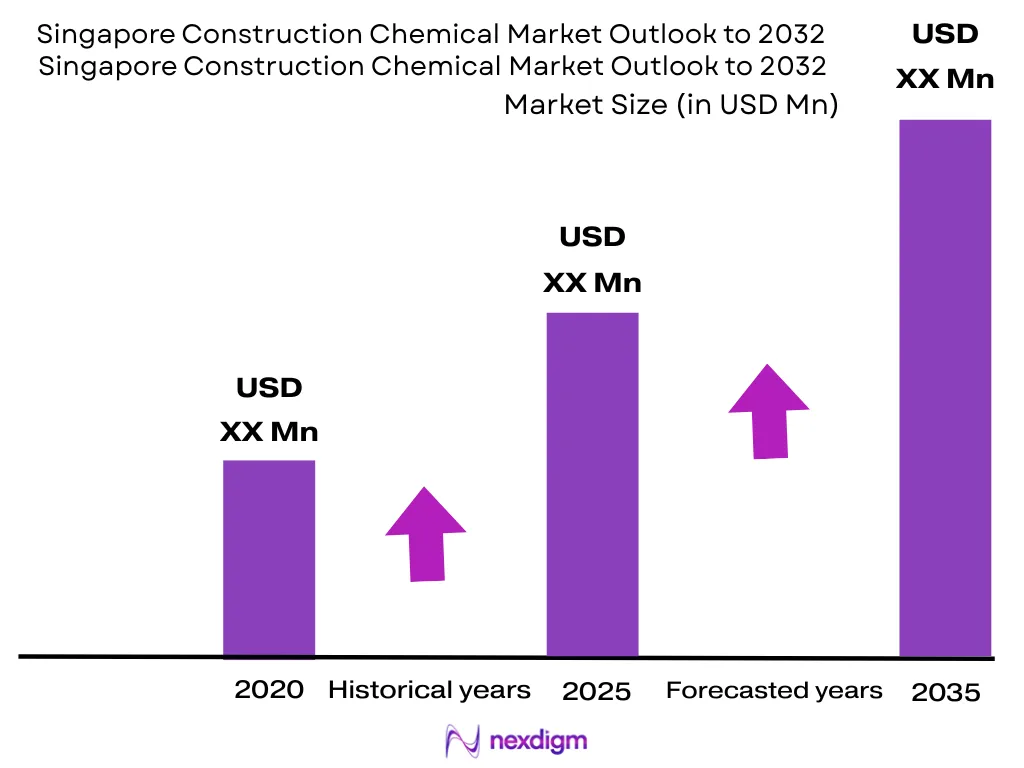
The Singapore Construction Chemicals Market was valued at approximately USD ~ million in 2024 based on industry analysis of construction chemical consumption across infrastructure, residential, commercial, industrial, and renovation projects. The market is primarily driven by sustained construction demand supported by the Building and Construction Authority (BCA), which reported construction demand of SGD 39.8 billion in 2023 and SGD 44.2 billion in 2024. Increasing adoption of high-performance concrete admixtures, waterproofing systems, repair materials, and sustainable construction solutions has further strengthened demand for construction chemicals across both new construction and asset enhancement projects.
Market Segmentation
By Product Type
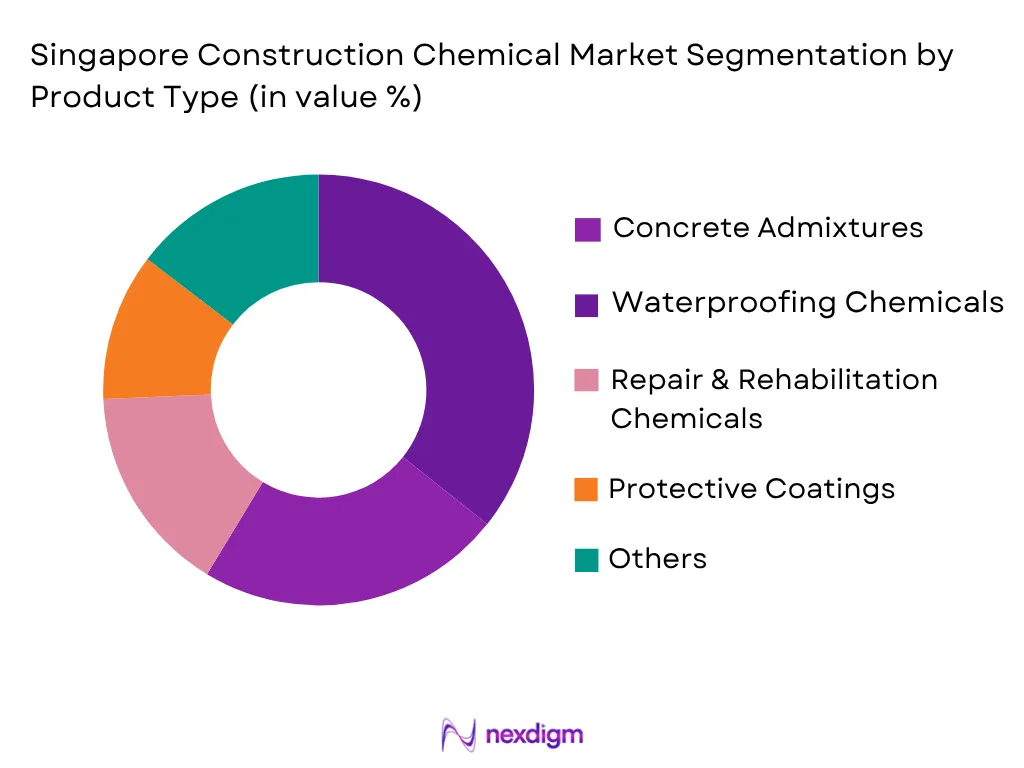
Concrete admixtures hold the dominant share in the Singapore Construction Chemicals Market. Their leadership stems from the country’s extensive use of ready-mix concrete in high-rise residential towers, commercial complexes, transportation infrastructure, and industrial developments. Contractors increasingly utilize admixtures to improve workability, compressive strength, durability, and construction efficiency while reducing water consumption. The widespread implementation of precast construction methods and Design for Manufacturing and Assembly (DfMA) initiatives further supports admixture demand. Additionally, infrastructure projects such as transit expansions, port developments, and public housing construction require specialized admixture formulations that enhance concrete performance under Singapore’s humid tropical climate conditions, reinforcing the segment’s dominant market position.
By End-Use Sector
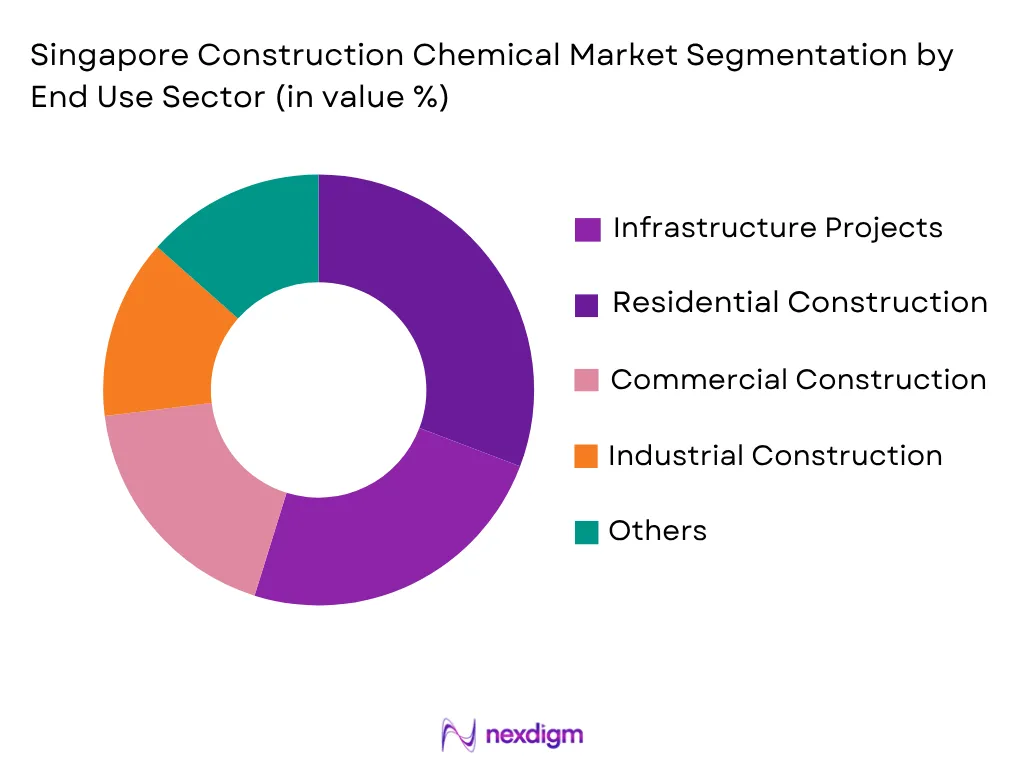
Infrastructure projects represent the largest end-use segment within the Singapore Construction Chemicals Market. Continuous investments in transportation networks, MRT expansions, airport developments, utilities, drainage systems, and port infrastructure create substantial demand for high-performance construction chemicals. These projects require advanced waterproofing systems, corrosion-resistant coatings, repair mortars, grouting solutions, and specialized concrete admixtures to ensure long-term durability and operational reliability. Singapore’s emphasis on infrastructure resilience and sustainability further promotes the adoption of innovative chemical solutions capable of extending asset life cycles while minimizing maintenance requirements. Large-scale public sector projects often specify stringent performance criteria, resulting in greater utilization of premium construction chemical products compared with conventional building applications.
Competitive Landscape
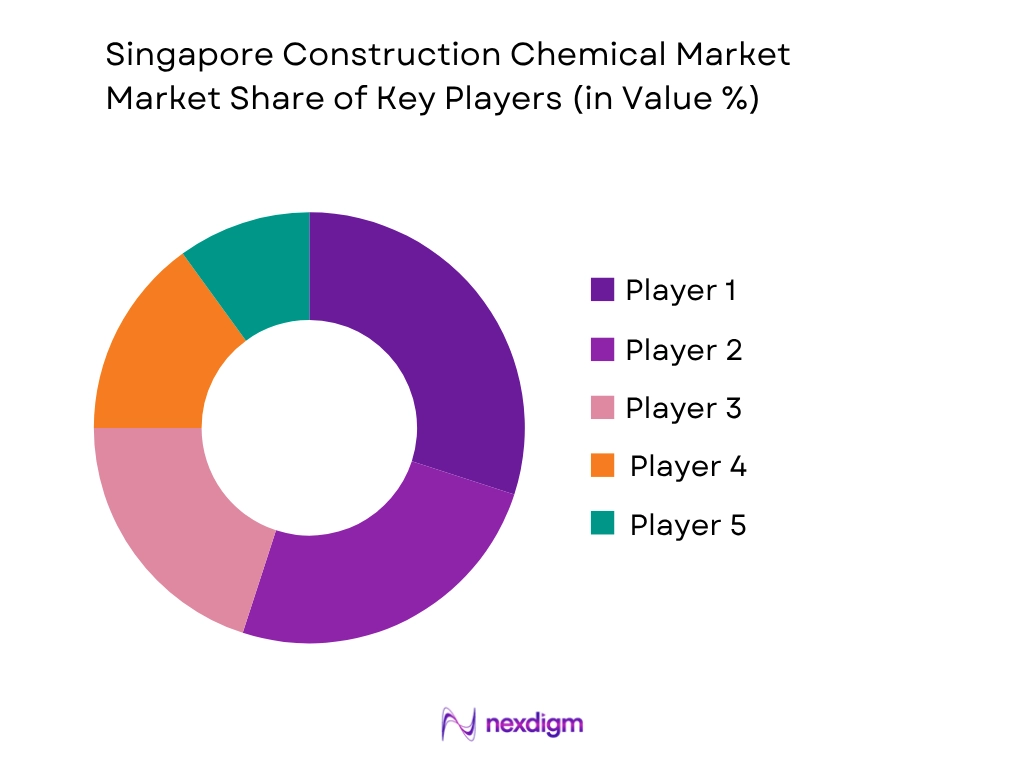
The Singapore Construction Chemicals Market is characterized by the presence of several multinational specialty chemical manufacturers and regional suppliers. Competition is primarily driven by product innovation, technical support capabilities, compliance with Green Mark standards, project specification approvals, and strong contractor relationships. Global companies maintain a significant presence through local distribution partnerships and technical service centers, while regional suppliers compete through pricing advantages and specialized product offerings. Market participants continue to focus on sustainable product development, low-carbon solutions, and performance-enhancing technologies to strengthen their positions in Singapore’s highly regulated construction environment.
| Company | Establishment Year | Headquarters | Product Portfolio Strength | Admixture Portfolio | Technical Support Network | Green Building Solutions | Infrastructure Project Presence | Distribution Reach |
| Sika AG | 1910 | ~ | ~ | ~ | ~ | ~ | ~ | ~ |
| Mapei S.p.A. | 1937 | ~ | ~ | ~ | ~ | ~ | ~ | ~ |
| Fosroc International | 1934 | ~ | ~ | ~ | ~ | ~ | ~ | ~ |
| Saint-Gobain Construction Chemicals | 1665 | ~ | ~ | ~ | ~ | ~ | ~ | ~ |
| Master Builders Solutions | 1909 | ~ | ~ | ~ | ~ | ~ | ~ | ~ |
Singapore Construction Chemical Market Analysis
Growth Drivers
Expansion of Infrastructure and Public Construction Projects
Singapore’s construction chemicals market is strongly supported by sustained infrastructure development and public-sector construction activity. According to the Building and Construction Authority (BCA), preliminary construction demand reached SGD 44.2 billion in 2024, significantly higher than SGD 34.2 billion in 2023, driven by institutional buildings, public housing projects, MRT-related developments, healthcare facilities, and industrial projects. The BCA further reported construction demand of SGD 50.5 billion in 2025, indicating continued project execution across transport, utility, and urban development sectors. Construction chemicals such as concrete admixtures, waterproofing systems, protective coatings, grouts, and sealants are essential materials in these projects due to Singapore’s stringent durability and lifecycle performance requirements. Major projects including Changi Airport Terminal 5, Tuas Port expansion, Downtown Line extension, and healthcare infrastructure developments continue to increase the utilization intensity of specialty construction chemicals. Singapore’s economy expanded by 4.0% in 2024, compared to 1.1% in 2023, providing additional support for investment in construction and built-environment activities. The combination of large-scale infrastructure investments, public housing expansion, and industrial development continues to generate strong demand for high-performance construction chemical products across multiple application categories.
Increasing Adoption of Sustainable and High-Performance Building Solutions
The growing emphasis on sustainable construction practices and lifecycle asset management is accelerating demand for advanced construction chemicals across Singapore. The Building and Construction Authority’s Green Mark certification framework continues to encourage developers and contractors to utilize durable, energy-efficient, and low-maintenance building materials. Singapore’s GDP per capita exceeded USD 90,000 in 2024, reflecting one of the highest-income economies globally and enabling investment in premium construction technologies and sustainable infrastructure solutions. The country’s population exceeded 6.1 million residents, creating continued demand for residential, commercial, healthcare, and transportation infrastructure that requires high-performance construction materials. Waterproofing chemicals, self-leveling flooring compounds, repair mortars, corrosion-resistant coatings, and low-VOC sealants are increasingly specified to improve building durability and reduce long-term maintenance costs. In addition, Singapore’s construction sector recorded 5.9% growth during the fourth quarter of 2024, according to Ministry of Trade and Industry data, largely supported by public construction activities. These developments encourage the use of specialized construction chemicals capable of enhancing structural lifespan, improving resource efficiency, and supporting green building compliance standards across new construction and rehabilitation projects.
Market Challenges
Dependence on Imported Raw Materials and Global Supply Chain Volatility
Singapore’s construction chemicals market remains heavily dependent on imported raw materials due to limited domestic manufacturing of chemical feedstocks and mineral inputs. The country’s highly trade-oriented economy makes construction chemical manufacturers vulnerable to fluctuations in global supply chains, shipping costs, and feedstock availability. Singapore’s GDP reached approximately USD 514 billion in 2024, while its economy remains deeply integrated into international trade networks, exposing construction-related industries to global disruptions. Many key inputs used in admixtures, waterproofing membranes, polyurethane systems, acrylic sealants, epoxy products, and specialty coatings are sourced from international suppliers. Continued expansion in construction demand, which increased from SGD 34.2 billion in 2023 to SGD 44.2 billion in 2024, places additional pressure on supply availability and procurement planning. The challenge becomes more significant as infrastructure projects increasingly require specialized products with stringent technical specifications. Delays in procurement or fluctuations in global chemical supply can directly affect project schedules and material availability. Manufacturers operating in Singapore must therefore maintain diversified sourcing strategies and inventory management systems to ensure uninterrupted supply to contractors and developers engaged in large-scale construction projects.
Labor Constraints and Technical Application Requirements
The effective use of construction chemicals often depends on skilled installation and application practices, creating operational challenges within Singapore’s labor-constrained construction environment. Products such as waterproofing membranes, protective coatings, flooring systems, repair mortars, sealants, and external insulation systems require specialized technical expertise to achieve intended performance outcomes. Singapore’s construction sector continues to experience high activity levels, with construction demand reaching SGD 50.5 billion in 2025 after achieving SGD 44.2 billion in 2024. This rapid project pipeline increases demand for technically trained workers capable of applying sophisticated construction chemical systems according to performance specifications. At the same time, major infrastructure projects including airport expansions, healthcare facilities, transportation networks, and industrial developments require increasingly complex material solutions. Singapore’s economy expanded by 4.8% in 2025, while ongoing construction activity continues to place pressure on workforce availability across specialized trades. Improper application of construction chemicals can result in waterproofing failures, durability issues, premature deterioration, and costly remediation works. As a result, manufacturers are required to invest heavily in technical support services, installer certification programs, and contractor training initiatives to ensure product performance standards are consistently achieved throughout project lifecycles.
Market Opportunities
Growth of Building Rehabilitation and Asset Life Extension Projects
Singapore possesses a mature built environment with a large stock of residential, commercial, transportation, and industrial assets that increasingly require maintenance, refurbishment, and lifecycle extension. The government’s continued focus on urban renewal and infrastructure resilience creates substantial opportunities for repair mortars, corrosion protection systems, waterproofing products, structural strengthening materials, and rehabilitation chemicals. Construction demand reached SGD 44.2 billion in 2024 and SGD 50.5 billion in 2025, demonstrating the scale of ongoing investment across both new construction and asset enhancement projects. Many existing buildings, transport assets, and industrial facilities require preventive maintenance to maintain operational efficiency and meet evolving sustainability standards. Singapore’s population of more than 6 million residents continues to place pressure on existing infrastructure assets, increasing the importance of maintenance and rehabilitation programs. Construction chemical suppliers offering advanced repair technologies, crack injection systems, protective coatings, and structural strengthening materials are well positioned to benefit from this trend. The increasing emphasis on lifecycle cost optimization further encourages asset owners to adopt premium rehabilitation products capable of extending service life and reducing long-term maintenance expenditures across public and private sector infrastructure.
Expansion of Green Building and Low-Carbon Construction Initiatives
Singapore’s commitment to sustainable urban development presents significant opportunities for construction chemical manufacturers focused on environmentally advanced products. Green Mark-certified developments increasingly require materials that contribute to energy efficiency, durability, indoor environmental quality, and reduced lifecycle environmental impact. Singapore’s economy generated approximately USD 514 billion in output during 2024, supporting continued investment in premium construction technologies and sustainable infrastructure. The country also recorded 4.0% GDP growth in 2024, while construction activity remained strong across residential, institutional, and infrastructure sectors. These conditions support growing demand for low-VOC sealants, environmentally friendly waterproofing systems, energy-efficient façade solutions, durable concrete admixtures, and recycled-content construction materials. Large-scale projects such as Tuas Port, Changi Airport developments, public housing expansion, and transportation infrastructure upgrades increasingly incorporate sustainability objectives into procurement frameworks. Construction chemical suppliers capable of aligning product portfolios with carbon reduction goals, resource efficiency requirements, and green building standards are expected to benefit from broader adoption across both government-funded and private-sector developments. The continued integration of sustainability principles into Singapore’s built environment creates a favorable long-term demand environment for innovative construction chemical technologies.
Future Outlook
The Singapore Construction Chemicals Market is expected to witness steady expansion over the forecast period, supported by sustained infrastructure investments, urban redevelopment activities, and increasing demand for durable and sustainable construction solutions. Government initiatives promoting green building practices and carbon reduction strategies are anticipated to accelerate the adoption of advanced construction chemical products. Growing refurbishment requirements for aging infrastructure and commercial assets will further strengthen market demand. In addition, technological advancements in admixtures, waterproofing systems, and repair materials are expected to enhance product performance and support long-term market growth.
Major Players
- Sika AG
- MBCC Group
- Mapei S.p.A.
- Fosroc International
- Saint-Gobain Construction Chemicals
- Master Builders Solutions
- Arkema Group
- Bostik
- Dow Inc.
- Chryso Group
- RPM International
- Wacker Chemie AG
- Pidilite Industries
- Henkel AG & Co. KGaA
- GCP Applied Technologies
Key Target Audience
- Construction Chemical Manufacturers
- Real Estate Developers and Property Owners
- Infrastructure Development Companies
- Ready-Mix Concrete Producers
- Precast Concrete Manufacturers
- Investments and Venture Capitalist Firms
- Government and Regulatory Bodies (Building and Construction Authority (BCA), Urban Redevelopment Authority (URA), Land Transport Authority (LTA), Housing & Development Board (HDB))
- Engineering, Procurement and Construction (EPC) Contractors
Research Methodology
Step 1: Identification of Key Variables
The initial phase involves constructing an ecosystem map encompassing all major stakeholders within the Singapore Construction Chemicals Market. Extensive secondary research is conducted through government publications, industry associations, company annual reports, trade databases, and construction sector statistics. The objective is to identify critical market variables influencing demand, supply, pricing, and technology adoption.
Step 2: Market Analysis and Construction
In this phase, historical market data is compiled and analyzed to estimate overall market performance. Construction spending trends, infrastructure investments, building completions, chemical consumption patterns, and product utilization rates are assessed. Revenue estimations are developed using both demand-side and supply-side methodologies to ensure data consistency and reliability.
Step 3: Hypothesis Validation and Expert Consultation
Market assumptions and preliminary findings are validated through structured interviews with industry participants including manufacturers, distributors, contractors, consultants, and project developers. These consultations provide operational insights, purchasing trends, competitive intelligence, and future market expectations that help refine market estimates and forecasts.
Step 4: Research Synthesis and Final Output
The final phase involves integrating primary and secondary research findings into a comprehensive market framework. Data triangulation techniques are applied to verify market estimates, segment shares, and growth projections. The resulting analysis provides a detailed assessment of market dynamics, competitive positioning, growth opportunities, and future industry outlook.

- Executive Summary
- Research Methodology (Market Definitions and Assumptions, Abbreviations, Market Sizing Approach, Top-Down Analysis, Bottom-Up Analysis, Demand-Side Assessment, Supply-Side Assessment, Construction Activity Mapping, Building Stock Analysis, Primary Industry Interviews, Data Triangulation, Forecasting Framework, Limitations and Future Conclusions)

- Definition and Scope
- Market Evolution and Industry Genesis
- Timeline of Major Industry Developments
- Construction Chemicals Value Chain Analysis
- Raw Material Supply Chain Analysis

- Growth Drivers (Expansion of Public Infrastructure Projects, BCA Green Mark Adoption, Rising Building Rehabilitation Activities, Growth in Data Center Construction, Increasing Demand for High-Performance Concrete Solutions)
- Market Challenges (Dependence on Imported Raw Materials, Volatility in Chemical Feedstock Prices, Skilled Applicator Shortages, Intense Competitive Pricing Pressure, Stringent Product Qualification Requirements)
- Market Opportunities (Low-Carbon Construction Materials, Expansion of Prefabricated Construction Methods, Marine Infrastructure Protection Solutions, Smart Infrastructure Development, Asset Life Extension and Rehabilitation Projects)
- Market Trends (Low-VOC Construction Chemical Formulations, Polycarboxylate-Based Admixture Adoption, Self-Healing Concrete Technologies, Green Mark-Compliant Product Development, Digital Construction and BIM Integration)
- Government Regulations (BCA Building Standards, Green Mark Certification Requirements, Workplace Safety and Health Regulations, Environmental Protection and Emissions Standards, Product Performance and Quality Compliance Requirements)
- PESTLE Analysis
- SWOT Analysis
- Porter’s Five Forces Analysis
- Industry Risk Assessment
- Stakeholder Ecosystem
- Competition Ecosystem

- By Market Value (2020-2025)
- By Volume Consumption (2020-2025)
- By Average Selling Price (2020-2025)

- By Product Type (In Value %)
Mortar
Tile Adhesive Mortar
Grout
Waterproofing Cement
Self-Levelling Flooring Cement
Rendering Mortar (Cement-Based)
Rendering Mortar (Gypsum-Based)
Monocouche Mortar Façade
Sealant
Epoxy Sealant
Silicone Sealant
Polyurethane (PU) Sealant
Acrylic Sealant
Thermoplastic/Elastomer Hybrid Sealant
Flooring Underlay
PE Foam Underlay
PU Foam Underlay
Adhesive
PU Adhesive
PVC Adhesive
Waterproofing Liquid
Liquid Applied Membrane (LAM) for Flooring
Liquid Applied Membrane (LAM) for Roofing
Waterproof Liquid Coating
Bitumen Membrane
Atactic Polypropylene (APP) Bitumen Membrane for Roofing
Styrene-Butadiene-Styrene (SBS) Bitumen Membrane for Foundations
Exterior Cladding (EIFS/ETICS)
Expanded Polystyrene Cladding (PB EIFS)
Extruded Polystyrene Cladding (PM EIFS) - By Distribution Channel (In Value %)
Direct Project Sales
Authorized Distributors
Construction Material Dealers
Specialist Applicator Networks
E-Procurement Platforms - By End User (In Value %)
Main Contractors
Specialty Applicators
Ready-Mix Concrete Producers
Precast Manufacturers
Government Infrastructure Agencies
Property Developers
Industrial Asset Owners - By Performance Requirement (In Value %)
High Durability Solutions
Fast-Track Construction Solutions
Sustainability-Oriented Solutions
Marine Grade Solutions
Heavy Industrial Solutions - By Construction Sector (In Value %)
Residential Buildings
Commercial Buildings
Industrial Facilities
Institutional Buildings
Data Centers
Transportation Infrastructure
Marine & Port Infrastructure
Utilities & Water Infrastructure

- Market Share of Major Players (By Value, Volume, Product Category, End-Use Sector, Distribution Model)
- Market Share by Construction Chemical Category
- Market Share by Infrastructure and Building Projects
- Cross Comparison Parameters (Concrete Admixture Portfolio Strength, Waterproofing System Portfolio, Green Mark-Compliant Product Range, Project Specification Wins, Ready-Mix Concrete Partnerships, Technical Service Capability, Repair & Rehabilitation Expertise, Marine Infrastructure Solution Capability)
- Competitive Benchmarking Matrix
- SWOT Analysis of Major Players
- Pricing Analysis by Product Category and Project Type
- Detailed Profiles of Major Companies
Sika AG
MBCC Group
Mapei S.p.A.
Fosroc International
Saint-Gobain
Arkema Group
Dow Inc.
RPM International
Bostik
Master Builders Solutions
GCP Applied Technologies
Chryso Group
Pidilite Industries
Henkel AG & Co. KGaA
Wacker Chemie AG

- Construction Chemicals Consumption Assessment (Consumption Intensity per Project Type, Chemical Usage per Cubic Meter of Concrete, Rehabilitation Material Utilization)
- Procurement and Tendering Analysis (Tender Specifications, Approved Vendor Requirements, Performance-Based Procurement)
- Budget Allocation Analysis (Chemical Cost Share, Lifecycle Cost Optimization, Sustainability Investments)
- Performance Requirement Assessment (Durability, Waterproofing Efficiency, Corrosion Resistance, Service Life Extension)
- Project Execution Challenges and Pain Point Analysis (Application Quality, Environmental Exposure, Maintenance Requirements, Project Delays)

- By Market Value (2026-2032)
- By Volume Consumption (2026-2032)
- By Average Selling Price (2026-2032)


 Request a Sample
 Ask for Customization
 Get a Quote
 Enquire Now