
 Download PDF
Market Overview
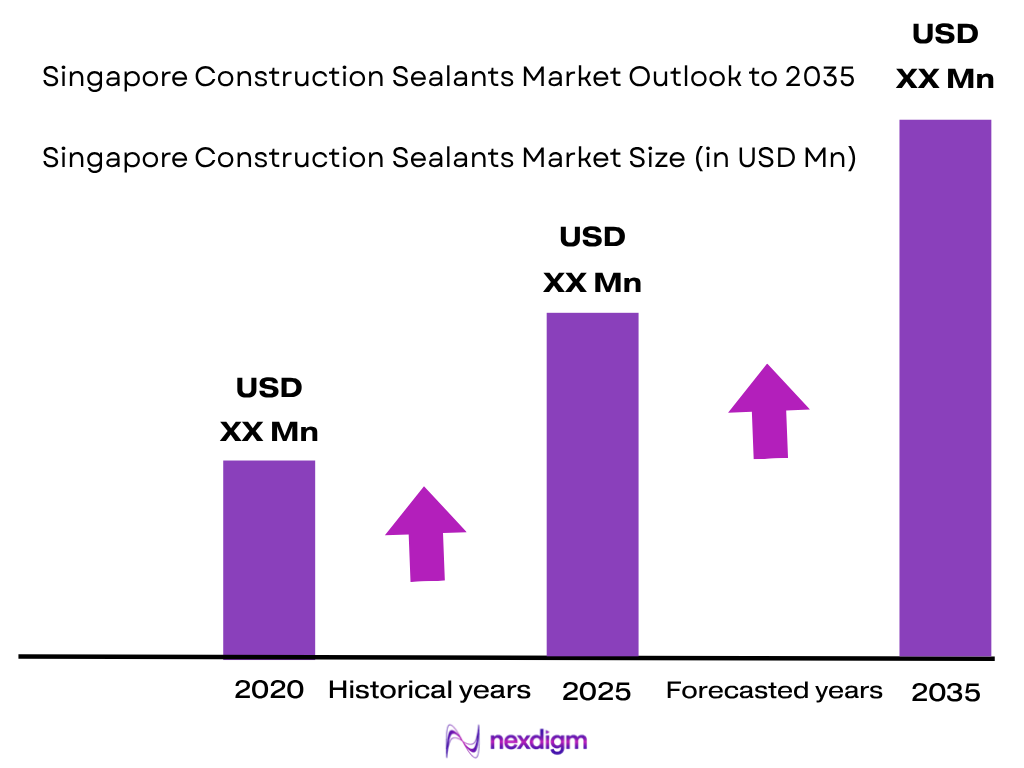
The Singapore Construction Sealants Market is valued at approximately USD ~XX million, based on the requested placeholder convention. Underlying construction activity provides a strong demand base: total construction demand increased from S$33.8 billion to S$44.2 billion, while certified construction output advanced from S$34.8 billion to S$38.4 billion across the two corresponding reporting periods. Sealant consumption is supported by residential development, institutional construction, infrastructure works, façade installation, waterproofing and building refurbishment.
Singapore’s Central Region, Jurong-Tuas industrial corridor, Woodlands and northern growth areas form important demand centres because of concentrated commercial property, industrial facilities, transport infrastructure and housing development. Housing expansion is particularly relevant: planned developments in Sembawang North and Woodlands North Coast comprise about 14,000 homes, including approximately 12,000 public-housing flats. Meanwhile, Singapore’s population increased from 5.918 million to 6.037 million, reinforcing long-term requirements for residential and supporting infrastructure.
Market Segmentation
By Resin Type
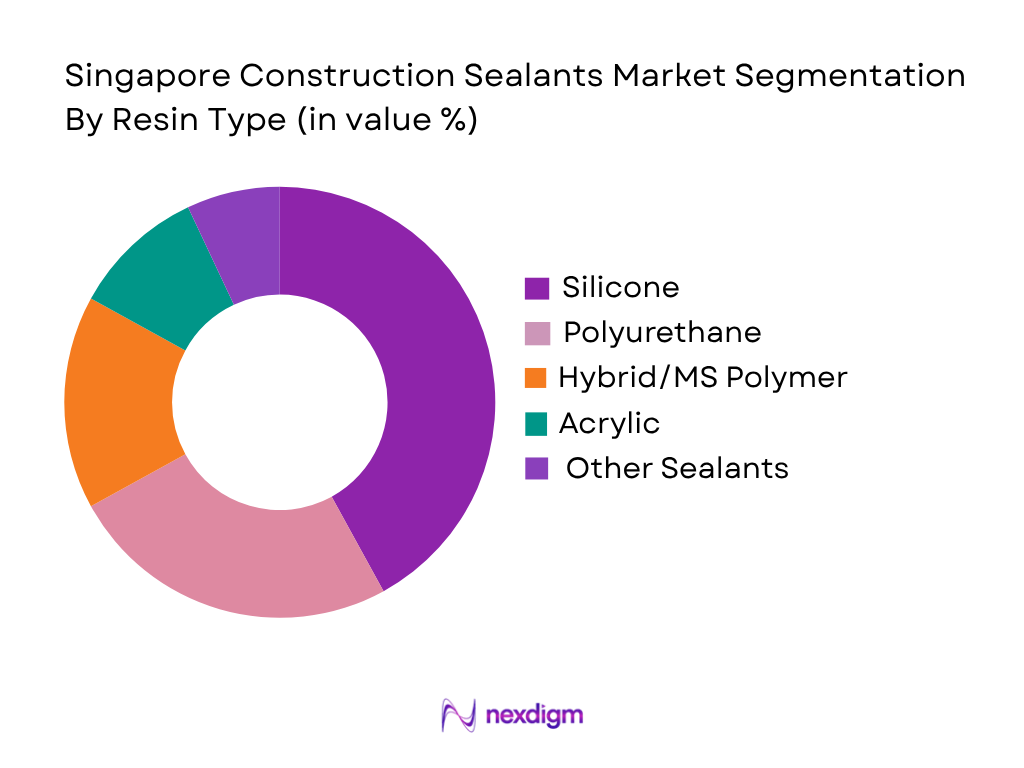
The Singapore Construction Sealants Market is segmented by resin type into silicone, polyurethane, hybrid/MS polymer, acrylic and other sealants. Silicone sealants hold the dominant position within this segmentation because Singapore’s dense high-rise building environment creates extensive demand for façade joints, curtain-wall systems, glazing and weatherproofing applications. Silicone products offer strong resistance to ultraviolet exposure, moisture and temperature changes, making them particularly suited to Singapore’s hot and humid climate. Their widespread specification in commercial towers and institutional buildings also supports their position. Dow, for example, offers Singapore Green Building Product-certified DOWSIL weatherproofing and structural-glazing products, while Sika markets several silicone systems specifically for curtain walls, cladding façades, natural stone and general building-envelope applications. These characteristics, combined with established contractor familiarity and compatibility with glass, aluminium and façade substrates, reinforce silicone’s leading role in the Singapore construction sealants market.
By Application
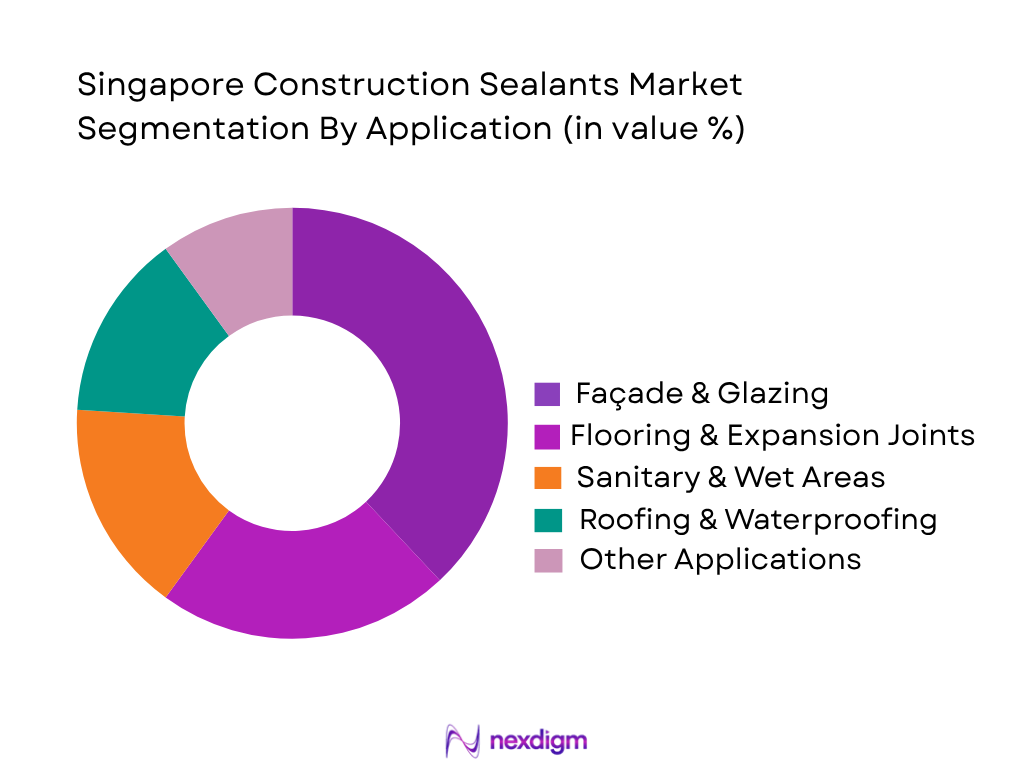
The Singapore Construction Sealants Market is segmented by application into façade and glazing, flooring and expansion joints, sanitary and wet-area applications, roofing and waterproofing, and other construction applications. Façade and glazing applications hold the dominant market share because Singapore has a substantial stock of high-rise commercial, residential and mixed-use buildings whose envelopes require durable weather seals, structural glazing systems and movement-joint protection. Building-envelope sealants perform critical functions by preventing air and water ingress while accommodating thermal movement between glass, metal and concrete components. Sika specifically lists façade elements, movement joints and exterior building applications among the uses for its construction sealants, while Dow offers products designed for weatherproofing and structural glazing. Continued redevelopment of commercial properties and large-scale mixed-use and institutional projects is therefore expected to maintain strong demand from the façade and glazing segment.
 Competitive Landscape
The Singapore Construction Sealants Market is characterized by competition among multinational construction-chemical and specialty-material companies with established regional distribution, technical-support capabilities and broad product portfolios. Sika, Dow, Henkel, 3M and H.B. Fuller represent prominent participants or adjacent sealant specialists capable of serving Singapore’s sophisticated building market. Competition increasingly centres on product durability, façade performance, low-emission formulations, green-building compliance, application efficiency and the ability to provide contractors and specifiers with technical support. Sika maintains a dedicated Singapore presence and locally markets sealing and bonding systems for residential, commercial and infrastructure construction.
| Company | Established | Headquarters | Key Sealant Technologies | Major Construction Applications | Representative Brands/Portfolio | Singapore/Regional Relevance | Distribution Approach | Sustainability / Technical Positioning |
| Sika AG | 1910 | Baar, Switzerland | ~ | ~ | ~ | ~ | ~ | ~ |
| Dow Inc. | 1897 | Midland, Michigan, USA | ~ | ~ | ~ | ~ | ~ | ~ |
| Henkel AG & Co. KGaA | 1876 | Düsseldorf, Germany | ~ | ~ | ~ | ~ | ~ | ~ |
| 3M Company | 1902 | St. Paul, Minnesota, USA | ~ | ~ | ~ | ~ | ~ | ~ |
| H.B. Fuller Company | 1887 | St. Paul, Minnesota, USA | ~ | ~ | ~ | ~ | ~ | ~ |
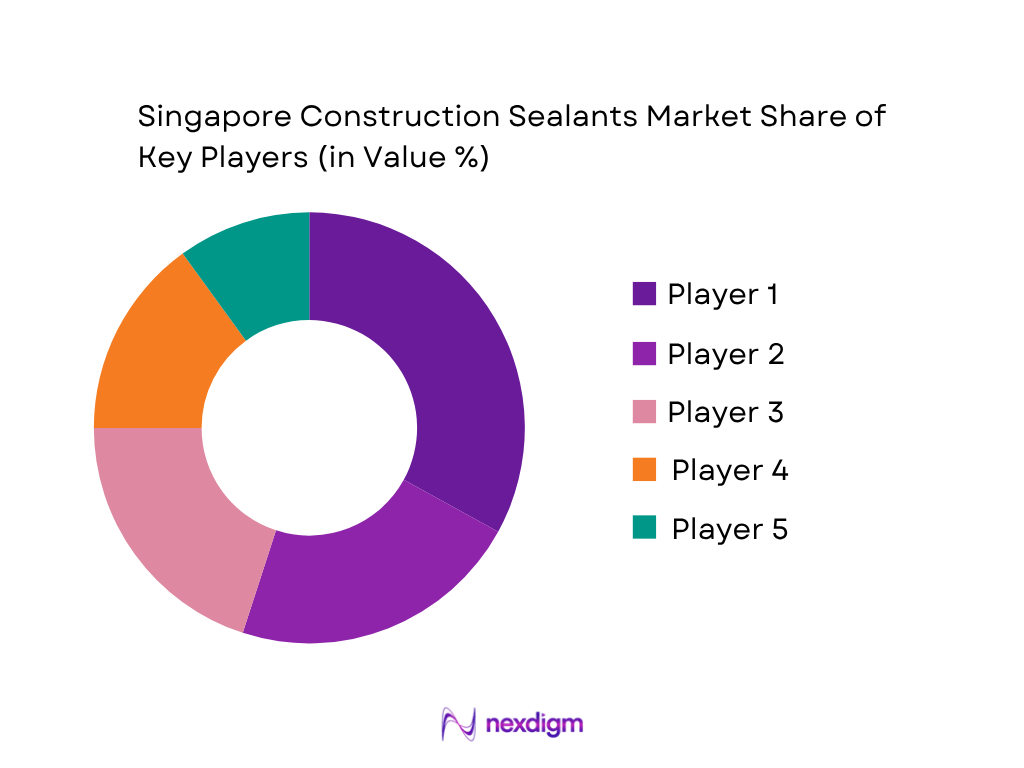
Singapore Construction Sealants Market Analysis
Growth Drivers
Strong Pipeline of Residential and Non-Residential Construction
Singapore’s sustained construction pipeline is a major demand driver for construction sealants used in façade joints, structural glazing, windows, sanitary areas, flooring joints, roofing and waterproofing systems. According to the Building and Construction Authority, total construction demand reached S$44.2 billion in 2024, while certified construction output reached S$38.4 billion, indicating a large volume of projects progressing through active construction stages. Residential activity is particularly relevant for sealant consumption: the Housing & Development Board launched 21,225 new flats in 2024, comprising 19,637 Build-To-Order flats and 1,588 Sale of Balance Flats. The October launch alone introduced 8,573 flats across 15 projects, creating recurring requirements for silicone, polyurethane and hybrid sealants across bathrooms, façades, precast joints and glazing interfaces. The macroeconomic environment also supports construction activity, with World Bank data placing Singapore’s 2024 GDP at US$547.39 billion, GDP per capita at US$90,674.1, and population at 6,036,860. This combination of substantial national economic output, dense urban development and continuing housing construction provides a broad application base for construction sealant suppliers serving Singapore’s residential and mixed-use building sectors.
Expanding Transport and Infrastructure Construction
Major transport infrastructure projects are creating sustained demand for high-performance construction sealants capable of handling movement, vibration, water ingress and challenging underground conditions. Singapore’s Land Transport Authority reported that Cross Island Line Phase 2 extends approximately 15 kilometres and includes 6 underground stations, while the broader Cross Island Line is planned as a fully underground network exceeding 50 kilometres. Construction of Phase 2 formally commenced in 2025, with the project complementing the 29-kilometre, 12-station Phase 1 already under construction. Infrastructure activity continued into 2026 when LTA awarded 2 civil contracts worth about S$735 million combined for the Downtown Line 2 Extension, covering underground stations, tunnels, bridges and connecting infrastructure. Such projects require sealants for concrete joints, tunnel interfaces, station façades, fire-rated penetrations and waterproof construction assemblies. The wider economy provides a strong foundation for this infrastructure pipeline: World Bank data recorded Singapore’s 2024 GDP at US$547.39 billion and population at 6,036,860. High-density urban infrastructure combined with rail expansion increases the volume of technically demanding environments where durable polyurethane, silicone and specialty elastic sealants are required throughout construction and subsequent maintenance cycles.
Market Challenges
Skilled Construction Labour and Application Quality Constraints
The Singapore Construction Sealants Market faces application-quality challenges because sealant performance depends heavily on joint preparation, substrate cleanliness, primer selection, bead dimensions and installer workmanship. This becomes increasingly important as Singapore’s construction workload expands across complex high-rise, infrastructure and underground projects. Ministry of Manpower data show that 456,800 Work Permit holders were employed across the construction, marine shipyard and process sectors at the end of 2024, increasing to 482,600 in 2025 and 490,700 by June 2026. The broader foreign workforce reached 1,576,500 in 2024 and 1,655,900 by June 2026, demonstrating Singapore’s substantial dependence on manpower resources across labour-intensive industries. At the same time, BCA recorded S$44.2 billion in construction demand and S$38.4 billion in construction output in 2024, increasing the volume of work requiring trained applicators and effective site supervision. World Bank data place Singapore’s 2024 GDP at US$547.39 billion and GDP per capita at US$90,674.1, reflecting an advanced economy where construction quality expectations are high. For sealant manufacturers and contractors, workforce capability therefore remains critical because incorrect installation can undermine otherwise high-performance façade, glazing, waterproofing and movement-joint systems.
Increasing Technical and Environmental Compliance Requirements
Construction sealant suppliers must address increasingly stringent building-performance, sustainability and maintainability requirements in Singapore, particularly when products are specified for façades, building envelopes and environmentally rated developments. The Building and Construction Authority implemented the second edition of Green Mark 2021 requirements for projects from 1 June 2024, with criteria covering energy performance, whole-life carbon, maintainability, resilience, health and building environmental performance. The updated residential maintainability framework also incorporated requirements affecting weatherproof materials and building components from 1 January 2024, increasing the need for suppliers to demonstrate technical compatibility and long-term durability. By March 2025, Singapore had 2,590 Green Mark-certified buildings, showing the scale of the national building stock operating within structured environmental-performance frameworks. The National Environment Agency also recorded approximately 700,000 tonnes of construction and demolition material recycled and 3,000 tonnes disposed in 2024, highlighting the strong policy environment around resource efficiency and construction waste. Singapore simultaneously supported a population of 6,036,860 and GDP of US$547.39 billion in 2024 according to the World Bank. These conditions raise documentation, testing and specification requirements for sealants while making compliance capabilities increasingly important in supplier selection.
Market Opportunities
Green Building and Building-Envelope Upgrade Opportunity
Singapore’s expanding green-building programme creates a significant opportunity for construction sealants designed for durable façades, airtight joints, weather-resistant glazing and long-life building envelopes. The Building and Construction Authority reported 2,590 Green Mark-certified buildings as of March 2025, compared with only 17 certified buildings when the programme began, demonstrating how sustainability considerations have become embedded across Singapore’s built environment. These certified buildings collectively deliver more than 4.2 billion kWh of annual energy savings, reflecting the scale of building-performance improvements being implemented across residential, commercial and institutional properties. Green Mark 2021 requirements applicable from 2024 specifically place greater emphasis on maintainability, resilience, whole-life carbon and healthier indoor environments, all of which can influence material specification and replacement decisions. Construction sealants with strong durability, low-emission formulations and compatibility with energy-efficient façade systems are consequently positioned to benefit from renovation and compliance-driven projects. This opportunity is supported by Singapore’s wider economic capacity: the World Bank recorded 2024 GDP of US$547.39 billion, GDP per capita of US$90,674.1, and a population of 6,036,860. These fundamentals support continued investment in maintaining and upgrading Singapore’s high-value building stock.
Mega Infrastructure and Urban Expansion Opportunity
Singapore’s pipeline of large transport, aviation and housing developments creates a long-term opportunity for suppliers of specialty construction sealants used in underground stations, tunnels, terminal buildings, glazing assemblies, concrete joints and weatherproofing systems. Changi Airport Terminal 5 entered construction in 2025, with its initial substructure works covering approximately 140 hectares and basement excavation extending to depths of up to 28 metres, illustrating the scale and technical complexity of the project. The Cross Island Line adds another substantial construction platform: Phase 2 covers 15 kilometres and 6 underground stations, while the complete line is planned to exceed 50 kilometres. Public housing provides an additional application channel. The Ministry of National Development reported that HDB delivered about 19,600 flats across 28 projects in 2025, while another 19,600 BTO flats were scheduled for launch in 2026. These simultaneous infrastructure and housing projects generate requirements for sealants across concrete movement joints, façade interfaces, windows, sanitary spaces, roofing and fire-rated building penetrations. The World Bank’s 2024 GDP figure of US$547.39 billion and population of 6,036,860 further demonstrate the economic and demographic base underpinning continued urban development and associated construction-material demand.
Future Outlook
The Singapore Construction Sealants Market is forecast to expand at approximately ~X.X% CAGR during 2026–2035. Growth will be supported by Singapore’s sustained construction pipeline, large infrastructure projects, housing development, refurbishment of ageing properties and progressively tighter building-performance requirements. Demand is also expected to shift toward higher-performance silicone, polyurethane and hybrid products offering longer service life, lower emissions and compatibility with modern façade systems.
Large projects will provide an important demand pipeline. BCA has identified developments such as Changi Airport Terminal 5, the Marina Bay Sands expansion, Cross Island Line works, Woodlands Checkpoint expansion, Tuas Port infrastructure, public housing, healthcare facilities and high-specification industrial buildings as contributors to medium-term construction activity.
Major Players
- Sika AG
- Dow Inc.
- Henkel AG & Co. KGaA
- 3M Company
- H.B. Fuller Company
- Bostik / Arkema Group
- MAPEI S.p.A.
- Tremco CPG
- Wacker Chemie AG
- Soudal Group
- Fosroc
- Saint-Gobain
- Pidilite Industries Limited
- Shin-Etsu Chemical Co., Ltd.
- Momentive Performance Materials
Key Target Audience
- Construction Sealant Manufacturers and Formulators
- Building Material Distributors and Importers
- Construction Contractors and Specialist Façade Contractors
- Real Estate Developers and Property Owners
- Architects, Façade Engineers and Building-Specification Professionals
- Infrastructure Developers and Engineering Procurement Contractors
- Investments and Venture Capitalist Firms
- Government and Regulatory Bodies (Building and Construction Authority [BCA], Housing & Development Board [HDB], Urban Redevelopment Authority [URA], Land Transport Authority [LTA] and National Environment Agency [NEA])
Research Methodology
Step 1: Identification of Key Variables
The first stage involves constructing the ecosystem of the Singapore Construction Sealants Market, including manufacturers, importers, distributors, contractors, developers and specification professionals. Secondary research is used to identify major demand variables such as construction activity, building type, resin technology, application, refurbishment requirements and regulatory standards.
Step 2: Market Analysis and Construction
Historical construction indicators, project pipelines, product availability and application patterns are assessed to construct the market model. Demand for silicone, polyurethane, hybrid and other sealants is evaluated across façade, glazing, flooring, sanitary, roofing and infrastructure applications, followed by a bottom-up reconciliation of product volumes and industry revenues.
Step 3: Hypothesis Validation and Expert Consultation
Initial hypotheses are validated through computer-assisted telephone interviews and structured discussions with manufacturers, distributors, façade contractors, construction-chemical specialists and project procurement professionals. These consultations help validate resin preferences, pricing patterns, distribution structures, application intensity and competitive positioning within Singapore.
Step 4: Research Synthesis and Final Output
Primary findings are triangulated against secondary sources, company product portfolios, government construction indicators and project-level information. Differences between top-down and bottom-up calculations are examined and reconciled before producing the final market sizing, segmentation, competitive assessment and long-term forecast for the Singapore Construction Sealants Market.

- Executive Summary
- Research Methodology (Market Definitions and Assumptions, Singapore Construction Sealants Market Classification, Silicone Sealant Scope, Polyurethane Sealant Assessment, Hybrid Polymer Sealant Assessment, Acrylic Sealant Assessment, Butyl Sealant Assessment, Polysulfide Sealant Assessment, Structural Glazing Sealant Assessment, Weatherseal Sealant Assessment, Window and Door Sealant Assessment, Concrete Joint Sealant Assessment, Traffic-Grade Sealant Assessment, Fire-Rated Sealant Assessment, Acoustic Sealant Assessment, Roofing Sealant Assessment, Building Envelope Assessment, ASTM C920 Assessment, ASTM C719 Movement Capability Assessment, ASTM C1184 Structural Silicone Assessment, ASTM C1248 Staining Assessment, ASTM C1401 Structural Sealant Glazing Assessment, BS EN 13022-2 Assessment, BS EN 15434 Assessment, ISO 11600 Assessment, Joint Movement Assessment, Substrate Compatibility Assessment, Tropical Humidity Exposure Assessment, UV Resistance Assessment, BCA Approved Document Assessment, Green Mark Assessment, Singapore Fire Code Assessment)

- Definition and Scope
- Singapore Construction Sealants Industry Evolution and Development of Acrylic Caulks, Butyl Sealants, Polysulfide Joint Sealants, One-Component Polyurethane Sealants, Two-Component Polyurethane Sealants, Acetoxy Silicone Sealants, Neutral-Cure Silicone Sealants, Structural Silicone Glazing Systems, Low-Modulus Weatherseal Silicones, Hybrid Polymer Sealants, Silyl-Modified Polymer Sealants, Firestop Sealants, Acoustic Sealants, Traffic-Grade Joint Sealants, Airport Pavement Sealants, Window and Door Sealants, Roofing Sealants, Sanitary Sealants, Façade Perimeter Sealants, Low-VOC Sealants, Non-Staining Natural Stone Sealants and High-Movement Curtain Wall Sealant Systems
- Construction Sealants Value Chain Analysis
- Construction Sealants Supply Chain Analysis
- Silicone Polymer Suppliers, Polyurethane Prepolymer Suppliers, Acrylic Polymer Suppliers, Polysulfide Polymer Suppliers, Silane-Modified Polymer Suppliers, Plasticizer Suppliers, Mineral Filler Suppliers, Catalyst Suppliers, Pigment Suppliers, Fire-Retardant Additive Suppliers, Packaging Suppliers, Construction Sealant Manufacturers, Regional Formulators, Cartridge and Sausage Filling Facilities, Importers, Building Product Distributors, Façade Contractors, Glazing Contractors, Firestop Contractors, Waterproofing Contractors, Infrastructure Contractors

- Growth Drivers (High-Rise Residential Construction, HDB Estate Upgrading, Commercial Office Development, Data Centre Construction, Airport Expansion, MRT and Rail Infrastructure, Curtain Wall and Glass Façade Penetration, Mixed-Use Development, Industrial and Logistics Construction, Building Envelope Modernization, Façade Refurbishment, Fire Safety Compliance, Tropical Weatherproofing Demand)
- Market Challenges (Imported Silicone and Polyurethane Feedstock Dependency, High Humidity Exposure, Intense UV Exposure, Façade Joint Movement, Sealant-Substrate Compatibility Failures, Natural Stone Staining Risk, Adhesion Failure, Incorrect Joint Geometry, Backer Rod Installation Errors, Skilled Applicator Availability, Firestop Certification Requirements, Specification Complexity, Moisture-Related Cure Variability)
- Market Opportunities (Structural Glazing Silicones, High-Movement Weatherproofing Sealants, Fire-Rated and Intumescent Sealants, Low-VOC Green Mark Compatible Sealants, Hybrid Polymer Sealants, Non-Staining Natural Stone Sealants, Airport and Transport Infrastructure Joint Sealants, Data Centre Firestop Sealants, HDB Façade Rehabilitation, Preformed Silicone Seals, Acoustic Sealants, High-Performance Window Perimeter Sealing, Local Warehousing and Technical Service Expansion)
- Market Trends (Neutral-Cure Silicone Adoption, Two-Part Structural Glazing Systems, High-Movement Class 50 Sealants, Low-Modulus Weatherseal Silicone, Hybrid SMP Technology, Faster Skin Formation, Tropical Climate Performance, Primerless Substrate Bonding, Non-Staining Façade Sealants, Low-VOC Formulations, Firestop System Integration, Preformed Silicone Joint Systems, Sausage Packaging, Digital Joint Calculators)
- Government Regulations and Standards (BCA Approved Document Structural Sealant Glazing Requirements, ASTM C1184 Structural Silicone Sealants, ASTM C1401 Structural Sealant Glazing Guidance, BS EN 13022-2 Structural Sealant Glazing, BS EN 15434 Structural and UV-Resistant Sealants, ASTM C920 Elastomeric Joint Sealants, ASTM C719 Cyclic Movement Testing, ASTM C1248 Staining of Porous Substrates, ISO 11600 Building Sealant Classification, Singapore Fire Code Requirements, BCA Green Mark 2021, Green Mark Version 7, Singapore Green Building Product Certification, Low-Emitting Material Requirements, Compatibility Adhesion and Staining Testing Requirements)
- SWOT Analysis
- Porter’s Five Forces Analysis
- PESTLE Analysis
- Stakeholder Ecosystem
- Construction Sealants Manufacturing and Project Ecosystem

- By Market Value (2020-2025)
- By Sealant Consumption Volume (2020-2025)
- By Silicone Sealant Consumption (2020-2025)
- By Polyurethane Sealant Consumption (2020-2025)
- By Hybrid Polymer Sealant Consumption (2020-2025)
- By Acrylic Sealant Consumption (2020-2025)
- By Building Envelope Sealant Consumption (2020-2025)
- By Window and Door Sealant Consumption (2020-2025)
- By Glazing and Façade Sealant Consumption (2020-2025)
- By Concrete and Movement Joint Sealant Consumption (2020-2025)
- By Infrastructure and Pavement Sealant Consumption (2020-2025)
- By Fire-Rated and Acoustic Sealant Consumption (2020-2025)
- By Residential Construction Sealant Consumption (2020-2025)

- By Sealant Chemistry (In Value %)
Silicone Sealants
Polyurethane Sealants
Hybrid Polymer and Silyl-Modified Polymer Sealants
Acrylic Sealants
Siliconized Acrylic Sealants
Butyl Sealants
Polysulfide Sealants
Polyether Sealants
Other Specialty Construction Sealants - By Product Type (In Value %)
One-Component Sealants
Two-Component Sealants
Non-Sag Gun-Grade Sealants
Self-Leveling Sealants
Pourable Joint Sealants
Structural Glazing Sealants
Weatherseal Sealants
Traffic-Grade Sealants
Fire-Rated Sealants
Acoustic Sealants
Window and Door Sealants
Roofing Sealants
Sanitary Sealants
Preformed Silicone Seals
Sealant Tapes and Butyl Tapes - By Application (In Value %)
Building Expansion and Movement Joints
Window and Door Perimeter Sealing
Curtain Wall Weathersealing
Structural Silicone Glazing
Insulating Glass Secondary Sealing
Precast Concrete Panel Joints
Façade Perimeter Joints
Natural Stone Joints
Roofing and Flashing Sealing
Concrete Floor and Podium Joints
Car Park Structure Joints
Airport Runway and Taxiway Joints
Bridge and Transport Infrastructure Joints
Firestopping
Acoustic Sealing
Interior Wet-Area and Sanitary Sealing - By Performance Requirement (In Value %)
High-Movement ±50 Sealants
Medium-Movement ±25 Sealants
Low-Movement Sealants
Low-Modulus Sealants
High-Modulus Sealants
Structural Glazing Performance
Non-Staining Performance
Traffic-Grade Performance
Water Immersion Resistance
Tropical Humidity Resistance
UV and Weathering Resistance
Fire Resistance
Acoustic Performance
Low-VOC Performance
Primerless Adhesion - By Planning Region (In Value %)
Central Region
East Region
North-East Region
North Region
West Region
Downtown Core
Marina Bay
Jurong Lake District
Changi
Paya Lebar
Woodlands Regional Centre
One-North
Tuas Industrial Area

- Market Share of Major Players (By Singapore Revenue, Sealant Consumption Volume, Silicone Sealant Portfolio, Polyurethane Sealant Portfolio, Hybrid Polymer Portfolio, Façade and Glazing Exposure, Structural Glazing Exposure, Firestop Sealant Exposure, Infrastructure Project Exposure, Data Centre Project Exposure, Singapore Warehousing and Technical Presence, Technical Laboratory Capability, Distributor Network, Specification Support, Major Project Coverage)
- Cross Comparison Parameters (Structural Glazing and Weatherproofing Silicone Portfolio Breadth, ASTM C920 ASTM C1184 and ISO 11600 Performance Capability, Firestop and Intumescent Sealant Certification Capability, Singapore Façade Glazing and High-Rise Project Reference Base, Tropical Humidity UV and Movement-Joint Performance Capability, Low-VOC Green Mark and SGBP Compatible Product Portfolio, Singapore Warehousing Distribution and Supply Network Reach, Façade Compatibility Testing Technical Training and Project-Site Support Capability)
- SWOT Analysis of Major Players
- Competitive Positioning Matrix
- Major Companies
Sika Singapore Pte Ltd
Dow Chemical Pacific (Singapore) Pte Ltd
Tremco CPG Singapore
Bostik Singapore / Arkema
MAPEI Far East Pte Ltd
Fosroc Singapore
Henkel Singapore
H.B. Fuller Singapore
3M Singapore
Wacker Chemicals (South Asia) Pte Ltd
Momentive Performance Materials
Soudal Singapore
Hilti Singapore
Saint-Gobain Construction Chemicals Singapore
Dulux / Selleys Singapore

- Glazing Contractor Requirement Assessment
- Façade Contractor Requirement Assessment
- Building Envelope Contractor Requirement Assessment
- Waterproofing Contractor Requirement Assessment
- General Contractor Procurement Assessment
- Concrete and Infrastructure Contractor Requirement Assessment
- Firestop Contractor Requirement Assessment
- Window and Door Installer Requirement Assessment
- Architect and Façade Consultant Specification Assessment
- Property Developer Requirement Assessment
- Facility Manager Sealant Replacement Requirement Assessment
- Technical Compatibility Testing and Field Support Requirement Assessment

- By Market Value (2026-2035)
- By Sealant Consumption Volume (2026-2035)
- By Silicone Sealant Consumption (2026-2035)
- By Polyurethane Sealant Consumption (2026-2035)
- By Hybrid Polymer Sealant Consumption (2026-2035)
- By Acrylic Sealant Consumption (2026-2035)
- By Building Envelope Sealant Consumption (2026-2035)
- By Window and Door Sealant Consumption (2026-2035)
- By Glazing and Façade Sealant Consumption (2026-2035)
- By Concrete and Movement Joint Sealant Consumption (2026-2035)
- By Infrastructure and Pavement Sealant Consumption (2026-2035)
- By Fire-Rated and Acoustic Sealant Consumption (2026-2035)
- By Residential Construction Sealant Consumption (2026-2035)


 Request a Sample
 Ask for Customization
 Get a Quote
 Enquire Now
