
 Download PDF
Market Overview
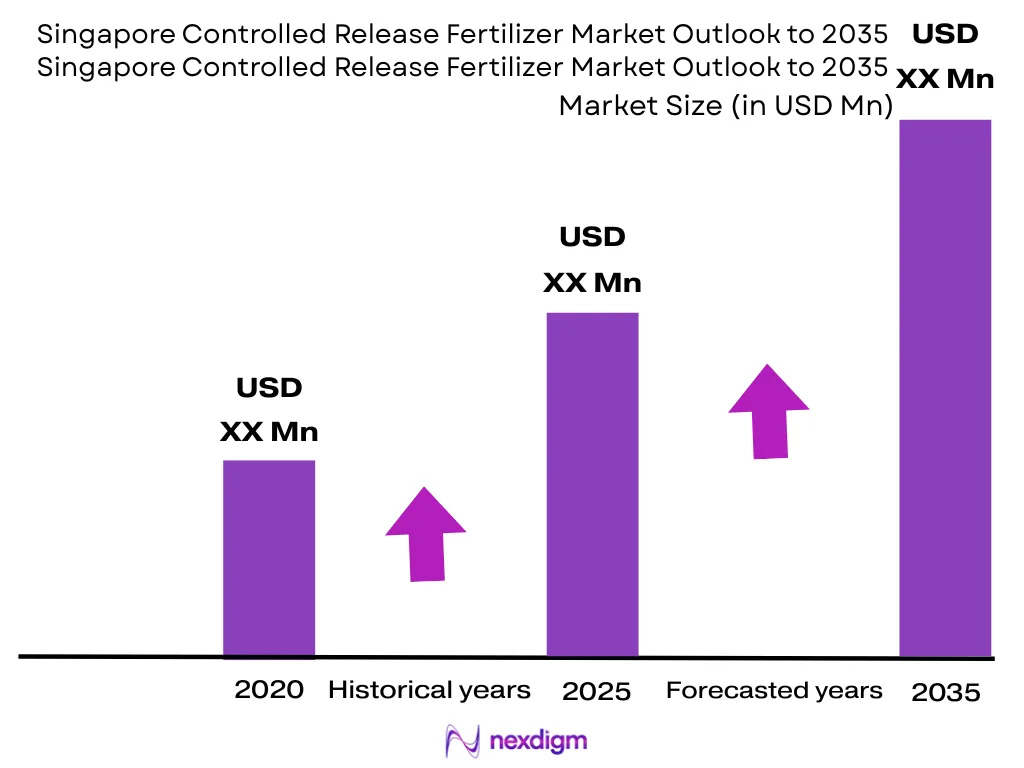
Singapore Controlled Release Fertilizer Market is valued at USD ~ Million, supported by the country’s increasing focus on food security, urban agriculture, and controlled-environment farming. According to the Singapore Food Agency (SFA), local farms produced approximately 4,100 tonnes of vegetables and over 15,000 tonnes of fish annually, while the nation continues pursuing its “30 by 30” food resilience strategy. Singapore’s agri-food imports exceeded SGD 20 billion, highlighting the need for efficient nutrient management systems. Controlled release fertilizers are increasingly utilized in vertical farms, hydroponic facilities, landscaping projects, and greenhouse cultivation due to their ability to improve nutrient-use efficiency and reduce fertilizer losses.
Market Segmentation
By Nutrient Type
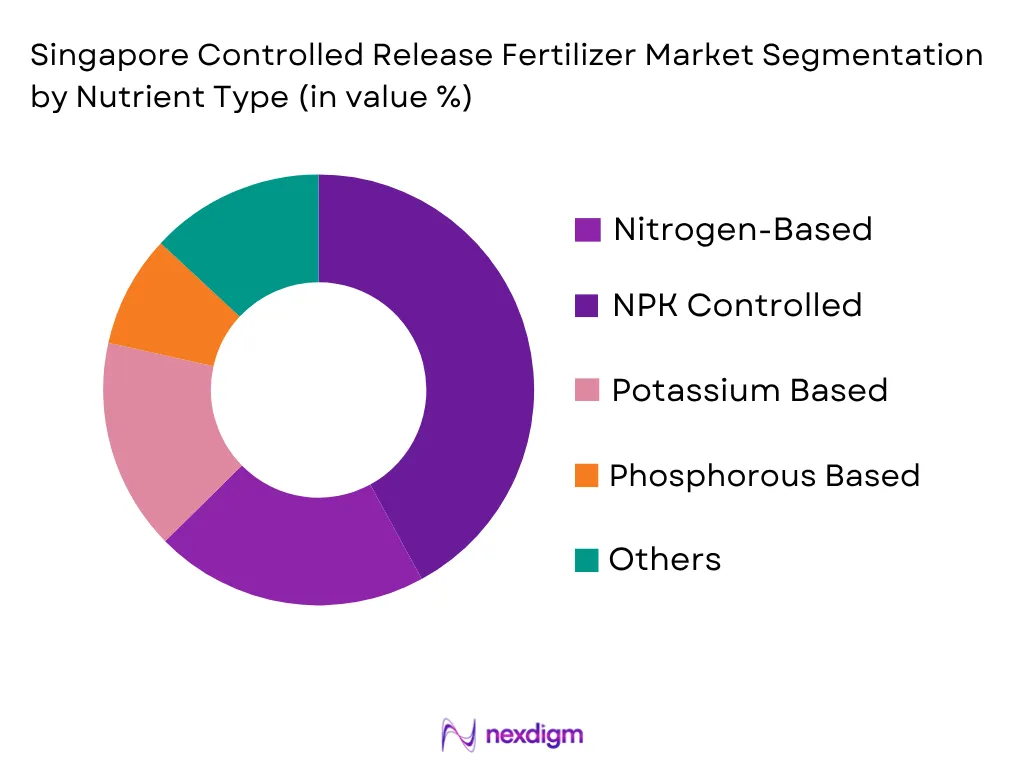
Nitrogen-Based Controlled Release Fertilizers dominate the Singapore Controlled Release Fertilizer Market under nutrient type segmentation. Their leadership is primarily attributed to the significant cultivation of leafy vegetables, herbs, and high-turnover crops within Singapore’s vertical farming and controlled-environment agriculture systems. Nitrogen is the most critical nutrient for vegetative growth, chlorophyll formation, and biomass development, making it essential for crops such as lettuce, spinach, kale, and Asian leafy greens commonly produced in urban farms. Controlled release nitrogen formulations provide a steady nutrient supply, reducing nutrient losses while improving crop quality and production efficiency. Commercial growers increasingly prefer these fertilizers due to their compatibility with precision nutrient management systems and reduced labor requirements. Additionally, landscaping applications, turf management projects, and public green spaces utilize nitrogen-based controlled release fertilizers extensively to maintain healthy plant growth and aesthetic quality, further strengthening the segment’s dominance in the Singapore market.
By Crop Type
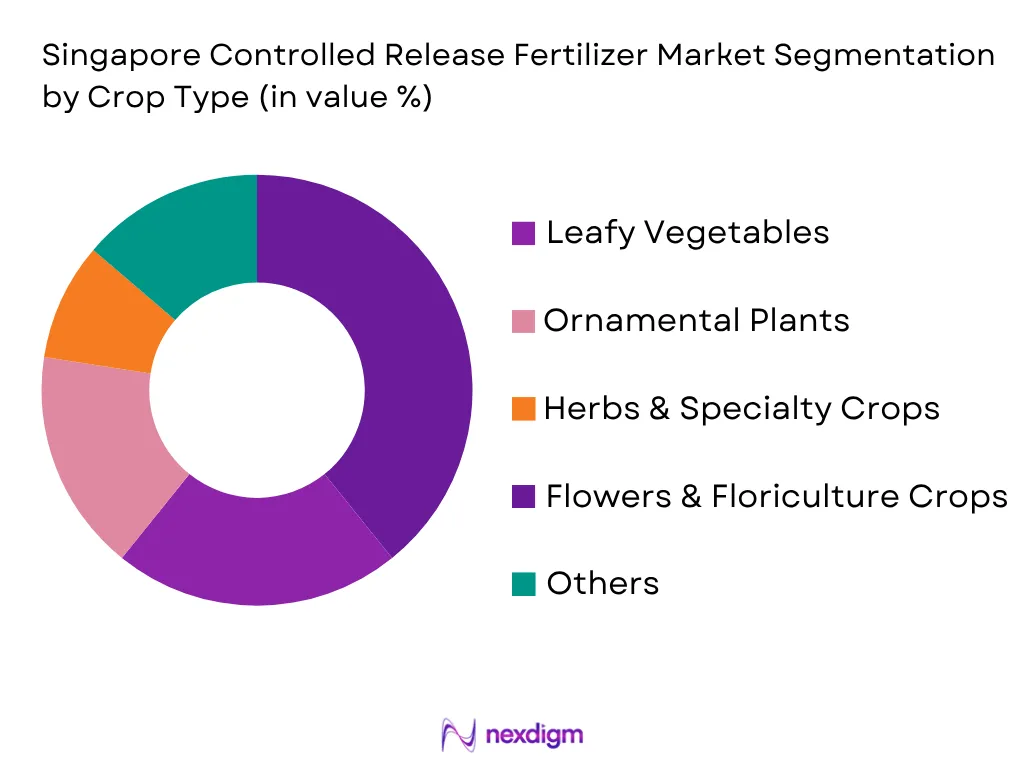
Leafy Vegetables dominate the Singapore Controlled Release Fertilizer Market by crop type due to the country’s strong focus on food security and urban agriculture initiatives. Singapore’s controlled-environment farms primarily cultivate leafy greens because of their short growth cycles, high productivity per square meter, and suitability for vertical farming systems. Crops such as lettuce, bok choy, kailan, spinach, and other Asian vegetables are widely grown in hydroponic and indoor farming facilities where nutrient efficiency is critical. Controlled release fertilizers support consistent nutrient availability, enabling growers to achieve higher yields and better crop uniformity while minimizing nutrient runoff. The demand for locally produced fresh vegetables has further encouraged investment in advanced cultivation technologies and specialty fertilizers. Since leafy vegetables account for a substantial share of Singapore’s domestic agricultural production, they represent the largest end-use crop segment for controlled release fertilizers, reinforcing their dominant position within the market.
Competitive Landscape
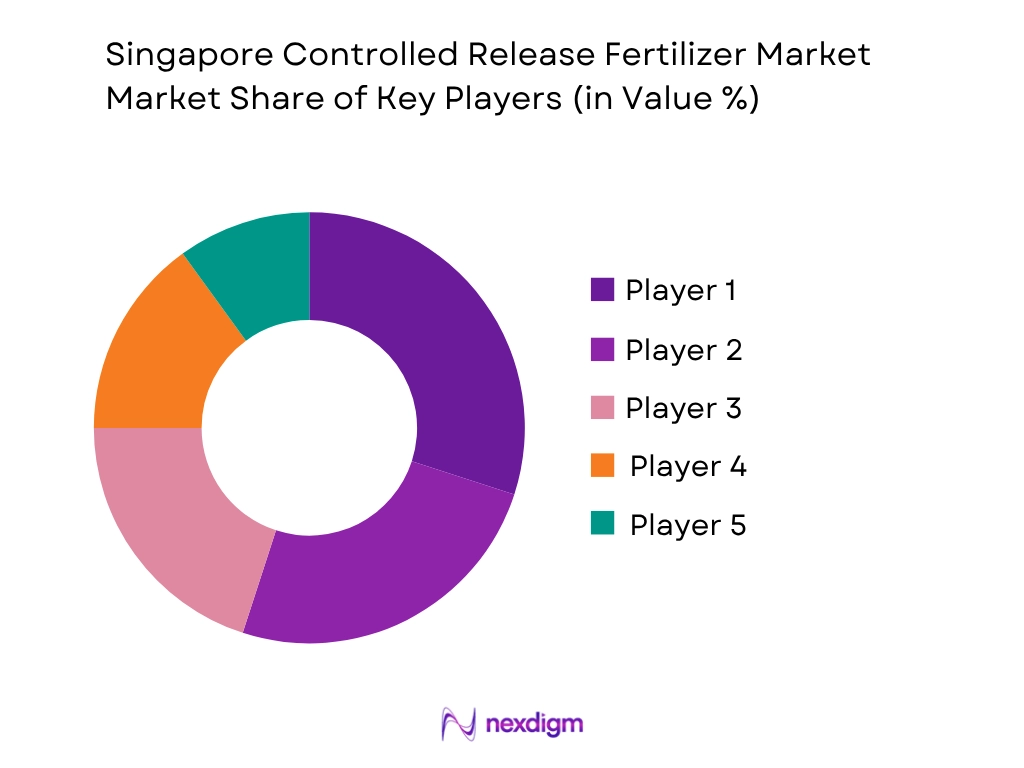
The Singapore Controlled Release Fertilizer Market is characterized by the presence of leading international specialty fertilizer manufacturers and regional distributors. The market remains moderately consolidated, with global companies leveraging advanced coating technologies, strong research capabilities, and established supply chains to maintain competitive positions. Companies focus on innovation, sustainable nutrient management, crop-specific formulations, and strategic partnerships with urban farming operators to strengthen their market presence.
| Company | Establishment Year | Headquarters | CRF Portfolio | Coating Technology Capability | Production Presence in Singapore | Crop Focus | Distribution Strength | Sustainability Focus |
| ICL Group | 1968 | ~ | ~ | ~ | ~ | ~ | ~ | ~ |
| Yara International | 1905 | ~ | ~ | ~ | ~ | ~ | ~ | ~ |
| Haifa Group | 1966 | ~ | ~ | ~ | ~ | ~ | ~ | ~ |
| COMPO EXPERT | 1956 | ~ | ~ | ~ | ~ | ~ | ~ | ~ |
| Nutrien Ltd. | 2018 | ~ | ~ | ~ | ~ | ~ | ~ | ~ |
Singapore Controlled Release Fertilizer Market Analysis
Growth Drivers
Expansion of Controlled Environment Agriculture and Urban Farming
Singapore’s controlled release fertilizer market is strongly supported by the rapid expansion of controlled environment agriculture (CEA) and urban farming initiatives. According to the Singapore Food Agency (SFA), Singapore produced approximately 4,100 tonnes of vegetables and over 15,000 tonnes of fish annually through local farming systems, with a significant share originating from technology-enabled farms. The country’s food imports exceeded SGD 20 billion, highlighting the strategic importance of increasing local production efficiency. Singapore’s GDP exceeded USD 530 billion according to IMF estimates, while GDP per capita remained above USD 90,000, enabling substantial investments into agri-tech infrastructure. Controlled release fertilizers are increasingly utilized in vertical farms because they reduce nutrient losses and improve crop productivity within highly controlled cultivation systems. Additionally, Singapore’s total population surpassed 6 million residents, creating sustained demand for fresh produce and encouraging investments in intensive farming methods. The limited agricultural land area of approximately 730 square kilometers necessitates high-yield production systems, making nutrient-efficient fertilizers critical. As urban farming facilities continue expanding under food resilience initiatives, demand for controlled release fertilizers is increasing because they support precise nutrient management, lower application frequency, and improved resource utilization in modern agricultural environments.
Increasing Government Focus on Food Security and Resource Efficiency
The Singapore government’s emphasis on strengthening food resilience and reducing reliance on imported food products is a major growth driver for the controlled release fertilizer market. Singapore imports more than 90% of its food requirements, creating a strategic need to maximize domestic agricultural productivity. According to the Singapore Food Agency, local farms are tasked with increasing food production through high-efficiency cultivation technologies. Singapore’s gross national income per capita exceeded USD 80,000 according to World Bank data, supporting substantial public and private investments in advanced agricultural inputs. Controlled release fertilizers align closely with national sustainability objectives because they improve nutrient-use efficiency and reduce nutrient runoff into surrounding ecosystems. The country’s total merchandise imports exceeded USD 500 billion, reflecting strong dependence on external supply chains and reinforcing the need for enhanced domestic production capabilities. Furthermore, Singapore’s labor force exceeds 3.8 million individuals, while limited land availability requires highly productive farming systems rather than extensive cultivation. Controlled release fertilizers help optimize nutrient delivery within vertical farms, hydroponic systems, and greenhouse facilities, enabling growers to achieve higher productivity per square meter. These structural economic and agricultural factors continue to support increasing adoption of advanced fertilizer technologies across Singapore’s agri-food sector.
Market Challenges
Limited Agricultural Land and Small Domestic Farming Base
A significant challenge for the Singapore controlled release fertilizer market is the country’s extremely limited agricultural land availability. Singapore’s total land area remains approximately 730 square kilometers, making it one of the most land-constrained countries globally. According to the World Bank, urban population accounts for nearly the entire resident population, leaving minimal space for conventional agricultural activities. The domestic farming sector remains relatively small compared to neighboring agricultural economies, limiting the volume of fertilizer consumption. Although Singapore’s GDP exceeded USD 530 billion, agriculture contributes only a very small fraction of national economic output due to structural land constraints. Controlled release fertilizer suppliers therefore face challenges in achieving large-scale demand within the domestic market. The majority of agricultural production is concentrated within specialized vertical farms, rooftop farms, hydroponic facilities, and research-oriented cultivation systems. Furthermore, Singapore’s population density exceeds 8,000 people per square kilometer, intensifying competition for land between residential, industrial, commercial, and agricultural uses. As a result, market expansion is constrained by the limited number of commercial farming operations available to consume fertilizer products, making demand growth highly dependent on technological adoption rather than expansion of cultivated acreage.
Dependence on Imported Agricultural Inputs and Specialty Fertilizers
Singapore’s controlled release fertilizer market faces challenges arising from heavy dependence on imported agricultural inputs and specialty nutrient products. Singapore has limited domestic fertilizer manufacturing capacity and relies extensively on imports from countries including China, Israel, Germany, Japan, and the Netherlands. According to Singapore trade statistics, total merchandise imports exceed USD 500 billion annually, demonstrating the economy’s dependence on international supply chains. Controlled release fertilizers often require advanced polymer coatings, specialty nutrient formulations, and proprietary technologies that are sourced internationally. Global disruptions affecting logistics networks, shipping routes, or raw material availability can therefore impact supply continuity. Singapore’s external trade-to-GDP ratio remains among the highest globally, reflecting substantial exposure to international market conditions. Additionally, the country’s agricultural sector remains relatively small, reducing economies of scale available to fertilizer distributors and importers. Specialty fertilizers generally require technical support, storage capabilities, and product customization for controlled-environment agriculture applications. Consequently, market participants must manage complex supply chains while maintaining product availability for a relatively niche customer base. This dependence on imported technologies and products continues to represent a structural challenge for the controlled release fertilizer market in Singapore.
Market Opportunities
Expansion of Vertical Farming Infrastructure and High-Tech Agriculture
The continued expansion of vertical farming infrastructure presents a substantial opportunity for the Singapore controlled release fertilizer market. Singapore’s food security strategy encourages the deployment of advanced cultivation technologies capable of maximizing output from limited land resources. The country’s population exceeds 6 million residents, while domestic agricultural land remains highly restricted, creating demand for high-yield farming systems. Vertical farms utilize controlled environments that require precise nutrient management to optimize crop performance. Controlled release fertilizers provide a significant advantage by delivering nutrients gradually and consistently, improving nutrient uptake while minimizing waste. Singapore’s GDP per capita exceeding USD 90,000 supports investments in technology-intensive agricultural operations, including automated nutrient delivery systems and climate-controlled cultivation facilities. Furthermore, Singapore serves as a regional innovation hub, attracting agri-tech companies focused on precision agriculture and sustainable food production. The increasing deployment of hydroponic systems, indoor farms, and urban agriculture projects creates favorable conditions for advanced fertilizer technologies. Since controlled release fertilizers align closely with productivity and sustainability objectives, their adoption is expected to strengthen as additional controlled-environment farming projects become operational across the country.
Growing Demand for Sustainable Nutrient Management Solutions
Sustainability objectives across Singapore’s agricultural and environmental sectors create significant opportunities for controlled release fertilizer adoption. Singapore’s Green Plan 2030 emphasizes resource efficiency, environmental sustainability, and resilient food systems. Controlled release fertilizers support these objectives by reducing nutrient losses and improving nutrient-use efficiency compared to conventional fertilizer applications. Singapore’s waste management and environmental policies increasingly encourage technologies that optimize resource utilization and minimize environmental impact. The country’s GDP exceeded USD 530 billion while maintaining strong investment in sustainability-related infrastructure and innovation. Controlled release fertilizers help reduce fertilizer runoff, lower application frequency, and improve nutrient management within urban agricultural settings. Singapore’s highly urbanized landscape places increased importance on environmentally responsible farming practices, particularly within rooftop farms, community gardens, and controlled-environment agriculture facilities located near residential areas. Additionally, growing consumer demand for sustainably produced food supports investments in agricultural technologies that improve environmental performance. These factors collectively create favorable conditions for the expansion of controlled release fertilizer products designed to support sustainable crop production and efficient nutrient management within Singapore’s evolving agricultural ecosystem.
Future Outlook
The Singapore Controlled Release Fertilizer Market is expected to witness significant growth over the forecast period due to increasing adoption of controlled-environment agriculture, expansion of vertical farming infrastructure, and rising focus on sustainable nutrient management practices. Government initiatives supporting food resilience and local agricultural production are expected to create favorable conditions for specialty fertilizer adoption. Technological advancements in biodegradable coatings, precision nutrient delivery systems, and smart agriculture solutions are likely to accelerate market development. Growing demand for high-quality crop yields and efficient resource utilization will further strengthen the role of controlled release fertilizers across commercial farming and landscaping applications.
Major Players
- ICL Group
- Nutrien Ltd.
- Yara International
- COMPO EXPERT
- Haifa Group
- The Scotts Miracle-Gro Company
- SQM
- Koch Agronomic Services
- J.R. Simplot Company
- Coromandel International
- Kingenta Ecological Engineering Group
- Shandong Jinzhengda Ecological Engineering
- Everris International
- Behn Meyer
- AGROFERT Group
Key Target Audience
- Singapore Food Agency (SFA)
- National Parks Board (NParks)
- Ministry of Sustainability and the Environment (MSE)
- Investments and Venture Capitalist Firms
- Controlled Environment Agriculture Operators
- Vertical Farming Companies
- Fertilizer Manufacturers and Distributors
- Landscaping and Turf Management Companies
Research Methodology
Step 1: Identification of Key Variables
The initial phase involves constructing an ecosystem map encompassing all major stakeholders within the Singapore Controlled Release Fertilizer Market. Extensive secondary research is conducted through government publications, agricultural databases, trade statistics, company reports, and industry associations. The objective is to identify key market variables influencing supply, demand, pricing, technology adoption, and competitive dynamics.
Step 2: Market Analysis and Construction
Historical market information is compiled and analyzed to evaluate fertilizer consumption trends, import dependence, distribution structures, and end-user adoption patterns. Demand-side and supply-side assessments are integrated to establish market sizing estimates. Product segmentation and application-level analysis are also conducted to determine revenue contribution across key categories.
Step 3: Hypothesis Validation and Expert Consultation
Market assumptions and preliminary findings are validated through interviews with fertilizer distributors, controlled-environment agriculture operators, agronomists, landscaping professionals, and industry executives. These consultations provide operational insights, technology adoption trends, and market intelligence that support refinement of market estimates and segmentation analysis.
Step 4: Research Synthesis and Final Output
The final stage involves triangulating primary and secondary research findings to develop comprehensive market conclusions. Information obtained from manufacturers, distributors, government agencies, and commercial end users is integrated to ensure robust market sizing, competitive benchmarking, and forecasting. This process enhances the reliability and accuracy of the final Singapore Controlled Release Fertilizer Market assessment.

- Executive Summary
- Research Methodology (Market Definitions and Assumptions, Abbreviations, Market Sizing Approach, Top-Down Analysis, Bottom-Up Analysis, Demand-Side Assessment, Supply-Side Assessment, Fertilizer Trade Flow Assessment, Primary Industry Interviews, Distributor and Agronomist Interviews, Data Triangulation, Forecasting Framework, Limitations and Future Conclusions)

- Definition and Scope
- Market Evolution and Industry Genesis
- Timeline of Major Industry Developments
- Singapore Agriculture and Urban Farming Ecosystem Overview
- Controlled Release Fertilizer Technology Landscape

- Growth Drivers (Growth of Vertical Farming Infrastructure, Expansion of Controlled Environment Agriculture, Rising Demand for Nutrient Use Efficiency, Government Support for Food Security Initiatives, Increasing High-Value Crop Cultivation)
- Market Challenges (Limited Agricultural Land Availability, High Dependence on Imported Fertilizer Inputs, Premium Pricing Compared to Conventional Fertilizers, Limited Large-Scale Field Crop Cultivation, Regulatory Compliance Requirements)
- Market Opportunities (Expansion of Indoor Farming Facilities, Adoption of Sustainable Nutrient Management Solutions, Development of Biodegradable Coating Technologies, Growth in Premium Horticulture Segment, Smart Farming Integration)
- Market Trends (Precision Nutrient Delivery Systems, Biodegradable Coating Innovations, Smart Fertigation Integration, Data-Driven Nutrient Management, Customized Crop-Specific Fertilizer Formulations)
- Government Regulations (Fertilizer Import Regulations, Environmental Protection Standards, Urban Farming Support Policies, Sustainable Agriculture Initiatives, Nutrient Management Compliance Framework)
- PESTLE Analysis
- SWOT Analysis
- Porter’s Five Forces Analysis
- Industry Risk Assessment
- Stakeholder Ecosystem
- Competition Ecosystem

- By Market Value (2020-2025)
- By Volume Consumption (2020-2025)
- By Average Selling Price (2020-2025)

- By Nutrient Type (In Value %)
Nitrogen-Based Controlled Release Fertilizers
Phosphorus-Based Controlled Release Fertilizers
Potassium-Based Controlled Release Fertilizers
Multi-Nutrient Controlled Release Fertilizers
Specialty Micronutrient Formulations - By Distribution Channel (In Value %)
Direct Sales to Commercial Growers
Agricultural Input Distributors
Landscaping Supply Companies
E-Commerce Platforms
Specialty Horticulture Stores
Government Procurement Programs - By End User (In Value %)
Commercial Urban Farms
Vertical Farming Operators
Landscaping Contractors
Municipal Authorities
Golf Course Operators
Research Institutes
Home Gardening Consumers - By Crop Type (In Value %)
Leafy Vegetables
Fruits and Exotic Crops
Ornamental Plants
Flowers and Floriculture Crops
Herbs and Specialty Crops
Hydroponic Crops - By Application (In Value %)
Urban Farming
Vertical Farming
Greenhouse Cultivation
Landscaping and Turf Management
Public Parks and Recreational Areas
Golf Courses
Horticulture and Floriculture
Research Institutions and Controlled Environment Agriculture

- Market Share of Major Players (By Value, Volume, Nutrient Type, Crop Segment, Coating Technology)
- Cross Comparison Parameters (Product Portfolio Breadth, Controlled Release Fertilizer SKU Count, Nutrient Release Duration Range, Coating Technology Portfolio, Specialty Crop Focus, Urban Farming Partnerships, Distribution Network Reach, Sustainability and Biodegradable Product Portfolio)
- SWOT Analysis of Major Players
- Pricing Analysis by Product Category and Nutrient Composition
- Detailed Profiles of Major Companies
ICL Group
Nutrien Ltd.
Yara International
COMPO EXPERT
Haifa Group
The Scotts Miracle-Gro Company
SQM
Koch Agronomic Services
J.R. Simplot Company
Coromandel International
Kingenta Ecological Engineering Group
Shandong Jinzhengda Ecological Engineering
Everris International
Behn Meyer
AGROFERT Group

- Fertilizer Consumption Pattern Assessment
- Nutrient Management Practices
- Purchasing Criteria Analysis
- Input Cost Optimization Behavior
- Sustainability Adoption Assessment
- Precision Agriculture Readiness Assessment

- By Market Value (2026-2035)
- By Volume Consumption (2026-2035)
- By Average Selling Price (2026-2035)


 Request a Sample
 Ask for Customization
 Get a Quote
 Enquire Now