
 Download PDF
Market Overview
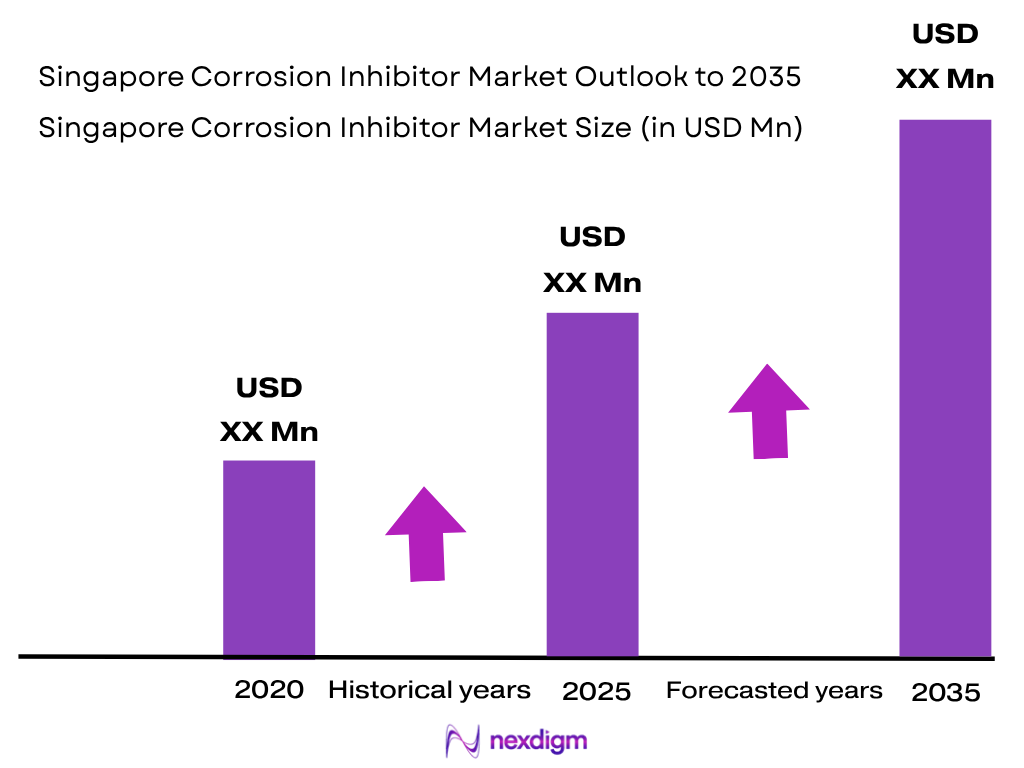
The Singapore Corrosion Inhibitor Market is valued at approximately USD ~X.X million on the latest full-year basis, supported by refining, petrochemicals, semiconductor utilities, cooling systems and marine operations. Singapore’s manufacturing output increased from S$410.87 billion to S$429.58 billion, while chemical manufacturing generated S$95.16 billion of output in the latest period. Jurong Island also hosts more than 100 energy and chemical companies connected through over 100 km of pipelines, sustaining recurring corrosion-control requirements.
Jurong Island, Tuas and the Marina Bay industrial-commercial corridor dominate demand within the Singapore Corrosion Inhibitor Market. Jurong Island concentrates refining, cracking, specialty chemicals, storage and utility systems, while Singapore’s port vessel-arrival tonnage increased from 3.09 billion GT to 3.11 billion GT between the preceding and latest full years. Marina Bay and other cooling clusters add significant chilled-water treatment demand, with SP Group reporting 206,000 refrigeration tons of operating and secured district-cooling capacity.
Market Segmentation
By Product Chemistry
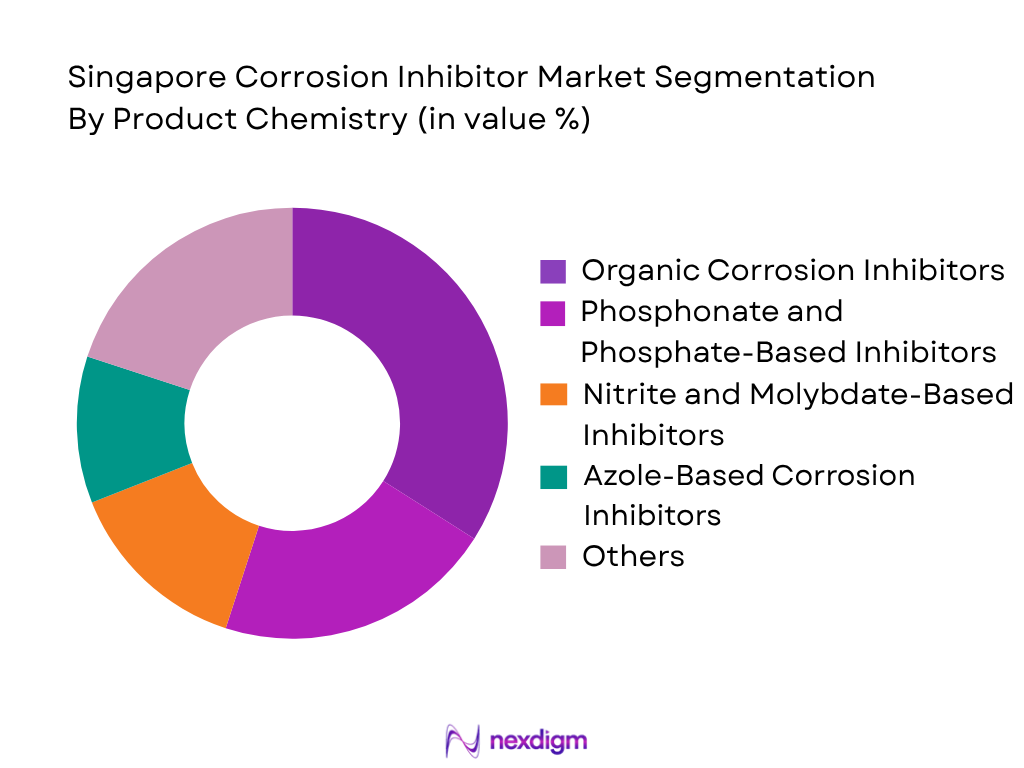
The Singapore Corrosion Inhibitor Market is segmented into organic corrosion inhibitors, phosphonate and phosphate inhibitors, nitrite and molybdate inhibitors, azole-based inhibitors, silicate and inorganic inhibitors, and other multifunctional formulations. Organic corrosion inhibitors hold the dominant share because Singapore has a large concentration of refinery, petrochemical, boiler, condensate and complex industrial cooling applications that require film-forming and adsorption-based protection. Amine and polyamine formulations are particularly suited to steam-condensate systems and process-industry environments, while organic multifunctional products can combine corrosion inhibition with scale control and dispersancy. Jurong Island’s integrated chemical complex strengthens this position because operators require tailored treatment programs for heat exchangers, cooling towers, boilers and process water rather than standardized commodity treatment. The growing use of recycled water further encourages advanced formulations capable of handling variable chloride, conductivity and alkalinity while maintaining protection across carbon steel, copper alloys and mixed metallurgy. PUB confirms that NEWater is extensively supplied to wafer fabrication, petrochemical, power-generation and commercial cooling users.
By End-Use Industry
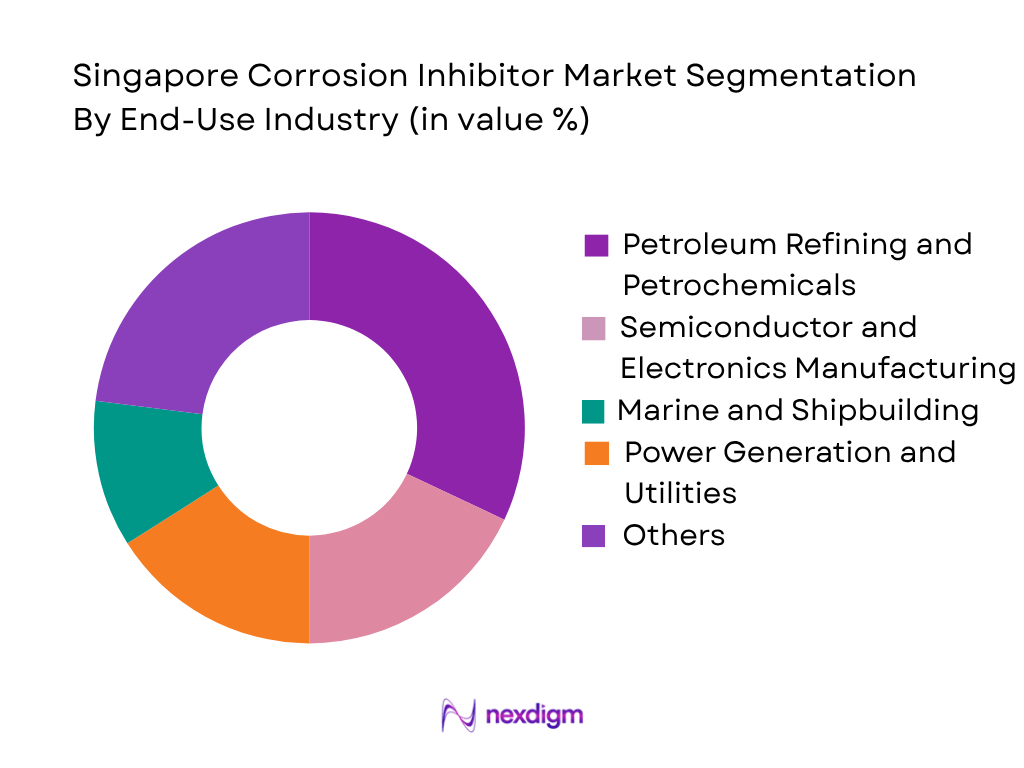
The Singapore Corrosion Inhibitor Market is segmented into petroleum refining and petrochemicals, semiconductor and electronics manufacturing, marine and shipbuilding, power and utilities, district cooling and commercial HVAC, and other industrial applications. Petroleum refining and petrochemicals represent the dominant segment because Jurong Island contains Singapore’s densest concentration of process equipment requiring continuous corrosion management across cooling-water networks, boilers, steam-condensate systems, heat exchangers, storage infrastructure and refinery process units. The island hosts more than 100 global energy and chemical companies and over 100 km of interconnected pipelines, creating a concentrated installed asset base. Singapore’s chemicals cluster generated S$95.16 billion of manufacturing output, demonstrating the scale of process-intensive operations behind chemical-treatment consumption. Semiconductor manufacturing is another important demand pool because NEWater is supplied extensively to wafer-fabrication plants, while Singapore’s maritime sector drives specialized closed-loop engine, boiler and heat-exchanger treatment demand.
Competitive Landscape
The Singapore Corrosion Inhibitor Market combines multinational industrial water-treatment suppliers, refinery and process-chemical specialists, marine chemical companies and Singapore-based formulation and distribution businesses. Competitive differentiation is centered on NEWater-compatible chemistry, phosphate-free treatment capability, film-forming technology, corrosion monitoring, automated dosing, laboratory support and rapid technical service. Singapore’s role as a regional specialty-chemical manufacturing and logistics hub further favors suppliers capable of integrating local inventory, application engineering and regional distribution with sophisticated treatment programs.
| Company | Establishment Year | Headquarters | Core Corrosion Inhibitor Capability | Refinery & Petrochemical Exposure | Cooling & Boiler Capability | NEWater / Recycled-Water Relevance | Digital Monitoring Capability | Singapore / Regional Presence |
| Nalco Water / Ecolab | 1923 | St. Paul, USA | ~ | ~ | ~ | ~ | ~ | ~ |
| Baker Hughes | 1907 | Houston, USA | ~ | ~ | ~ | ~ | ~ | ~ |
| Kurita | 1949 | Tokyo, Japan | ~ | ~ | ~ | ~ | ~ | ~ |
| Veolia Water Technologies | 1853 | Paris, France | ~ | ~ | ~ | ~ | ~ | ~ |
| Solenis | 2014 | Wilmington, USA | ~ | ~ | ~ | ~ | ~ | ~ |
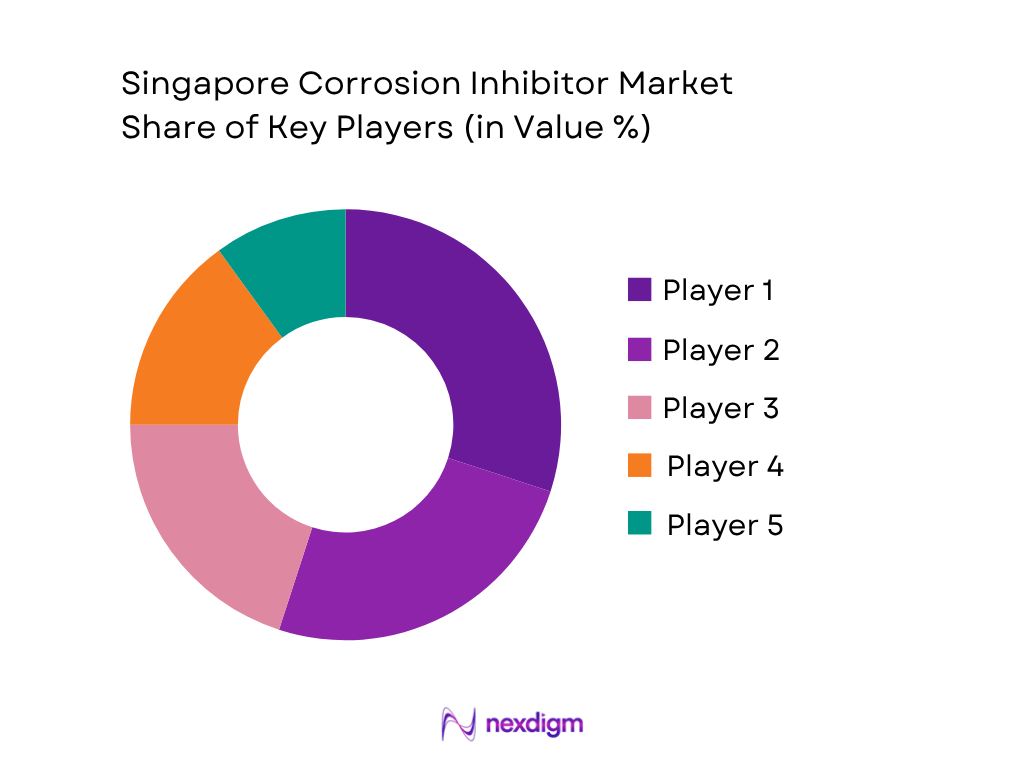
Singapore Corrosion Inhibitor Market Analysis
Growth Drivers
Large Refining, Petrochemical and Process-Industry Installed Base
Singapore’s integrated refining and chemical-manufacturing ecosystem creates recurring demand for corrosion inhibitors across cooling-water circuits, boilers, condensate systems, heat exchangers, storage infrastructure and process utilities. Jurong Island accommodates more than 100 energy and chemical companies and has attracted more than S$50 billion of cumulative investment, establishing one of Asia’s most concentrated process-industry clusters. Singapore’s chemical manufacturing output reached S$95.155 billion in 2024, while chemical manufacturing generated S$17.512 billion in value added. The wider manufacturing sector produced S$116.595 billion in value added, demonstrating the scale of industrial assets requiring reliability-oriented water and process treatment. Energy-intensive operations further reinforce inhibitor consumption: Singapore generated 60 TWh of electricity in 2024, while industrial users consumed approximately 23 TWh. Direct industrial natural-gas consumption reached 56,160 TJ, reflecting the extensive installed base of thermal and process equipment where boiler, condensate and cooling-water protection is important. At the macroeconomic level, World Bank data place Singapore’s 2024 GDP at USD 547.39 billion and GDP per capita at USD 90,674.1, supporting sophisticated industrial maintenance and asset-protection expenditure.
Extensive Industrial Water Reuse, Cooling and Marine Infrastructure
Singapore’s dependence on highly managed industrial water systems is another direct growth driver for corrosion inhibitors, particularly formulations used in cooling towers, closed loops, heat exchangers, semiconductor utilities and marine systems. PUB reported in 2024 that NEWater was supplied to more than 850 non-domestic customers, including wafer-fabrication plants, petrochemical refineries, power stations and commercial facilities, with 5 NEWater factories then forming part of the national supply system. This creates a broad installed base requiring controlled corrosion, scale and microbiological management. District cooling adds further treatment intensity: SP Group reported 206,000 refrigeration tons of operational and secured district-cooling capacity in its 2023/2024 reporting period. Marine infrastructure is equally significant. Singapore recorded 3.11 billion gross tons of vessel arrivals in 2024, up from 3.09 billion gross tons in 2023, while cargo throughput reached 622.67 million tonnes and container throughput reached 41.12 million TEUs. These activities support demand for engine-cooling, boiler, condensate and equipment-preservation inhibitors. World Bank data recorded Singapore’s 2024 GDP at USD 547.39 billion, providing a macroeconomic base for high-reliability industrial and maritime infrastructure.
Market Challenges
Complex Water Chemistry and High Reliability Requirements Across Industrial Systems
Singapore corrosion-inhibitor suppliers face demanding technical conditions because customers increasingly operate recycled-water, mixed-metal and high-reliability cooling systems where a treatment program must simultaneously control corrosion, scaling and deposition without compromising production. PUB reported more than 850 non-domestic NEWater customers in 2024, spanning wafer fabrication, petrochemical refining, power generation and commercial cooling. Semiconductor applications are particularly sensitive because interruption or contamination in utility systems can affect high-value production, requiring tight control of inhibitor residuals, conductivity and compatibility with stainless steel, carbon steel and copper-bearing components. Power infrastructure presents similar performance requirements. Singapore generated 60 TWh of electricity in 2024 from approximately 123 TWh of energy inputs, while installed electricity-generation capacity stood at 12,445 MW. Combined-cycle, co-generation and tri-generation facilities represented 10,115 MW of that capacity, indicating a substantial installed base of heat-recovery, steam and cooling equipment requiring disciplined water chemistry. SP Group also operated or secured 206,000 RT of district-cooling capacity. With World Bank reporting Singapore’s 2024 GDP at USD 547.39 billion, production interruptions occur within a high-value economy, increasing qualification and performance expectations placed on corrosion-inhibitor suppliers.
Dependence on Imported Feedstocks and Exposure to Global Chemical Supply Chains
Singapore’s corrosion-inhibitor industry operates within a sophisticated chemical hub, but manufacturers and formulators remain exposed to externally sourced hydrocarbon feedstocks and specialty chemical intermediates because the country has limited indigenous natural resources. This creates supply-chain sensitivity for amines, phosphonates, azoles, molybdates, specialty polymers, solvents and other active ingredients used in technically demanding inhibitor formulations. The dependency is visible in Singapore’s wider energy system: total natural-gas supply reached 453,040 TJ in 2024, while gross natural-gas imports reached 456,759 TJ. Of this supply, 393,748 TJ was consumed for electricity generation and another 62,723 TJ was consumed directly by end users. The energy and chemicals sector therefore functions through globally connected feedstock and logistics systems, making supply continuity important for local chemical formulators. At the same time, Jurong Island hosts more than 100 global energy and chemical companies, intensifying competition for qualified materials, storage, logistics and specialist technical capabilities. Singapore’s chemical manufacturing output stood at S$95.155 billion in 2024, demonstrating the industrial scale exposed to these supply networks. World Bank data recorded national GDP at USD 547.39 billion in 2024, reinforcing the economic importance of maintaining resilient chemical supply chains.
Market Opportunities
Advanced Corrosion Treatment for NEWater, Semiconductors and Recycled-Water Systems
Singapore’s expanding dependence on reclaimed industrial water creates a strong future opportunity for corrosion inhibitors designed specifically for recycled-water cooling, semiconductor utilities and high-efficiency closed-loop systems. PUB reported more than 850 non-domestic NEWater customers in 2024, including wafer-fabrication facilities, petrochemical refineries, power stations and commercial premises. Singapore also operated 5 NEWater factories at that point, confirming that high-grade reclaimed water is already embedded in industrial operations. Additional infrastructure strengthens the opportunity: PUB’s Tuas NEWater Factory project includes 25 million gallons per day of production capacity, while the planned new Changi facility is intended to replace older capacity with a larger system. For inhibitor suppliers, this established water-reuse infrastructure creates room for lower-phosphorus formulations, azole-based yellow-metal protection, molybdate programs, film-forming chemistry and multifunctional corrosion-scale inhibitors tailored to recycled-water chemistry. Singapore’s semiconductor ecosystem further supports high-specification treatment demand; EDB recorded S$181.166 billion of electronics manufacturing output in 2024. World Bank data place Singapore’s 2024 GDP at USD 547.39 billion and GDP per capita at USD 90,674.1, providing a strong economic foundation for technologically advanced water-management solutions rather than basic commodity chemical treatment.
District Cooling, Data Centers and High-Efficiency Thermal Systems Create New Application Pools
Expansion of centralized cooling and high-density digital infrastructure provides a future growth avenue for Singapore corrosion-inhibitor suppliers because these assets contain extensive chilled-water networks, heat exchangers, cooling towers and mixed-metal components that depend on controlled water chemistry. SP Group reported Singapore district-cooling capacity of 206,000 refrigeration tons in its 2023/2024 reporting period. By March 2026, its Singapore footprint had increased to 230,870 RT, including an industrial district-cooling installation at STMicroelectronics with capacity of up to 36,000 RT and a separate high-efficiency chiller system of 3,200 RT at the company’s Toa Payoh site. SP also reported an approximately 17,150 RT brownfield distributed-cooling project for the HarbourFront precinct. These current installations establish an expanding equipment base suited to corrosion inhibitors optimized for closed loops, copper alloys, carbon steel and high-cycle cooling operation. Singapore’s broader electricity system generated 60 TWh in 2024, while commerce and services consumed about 23 TWh, showing the scale of electrically intensive commercial infrastructure. World Bank data record 2024 GDP at USD 547.39 billion, supporting continued adoption of reliability-focused, digitally monitored corrosion-control programs for mission-critical cooling assets.
Future Outlook
The Singapore Corrosion Inhibitor Market is forecast to expand at approximately ~X.X% CAGR during 2026-2035, driven by increasing industrial water reuse, high-value chemical manufacturing, semiconductor utility requirements, maritime activity and more sophisticated district-cooling systems. Future demand is expected to move toward low-phosphorus chemistry, film-forming amines, multifunctional treatments and sensor-supported dosing.
Singapore’s emphasis on water resilience should strengthen corrosion-treatment opportunities associated with recycled-water systems. PUB currently supplies NEWater to more than 850 non-domestic customers, including wafer fabrication plants, petrochemical refineries, power stations and commercial premises, creating a broad installed customer base for water-chemistry management. The industrial cooling opportunity is also becoming more technologically intensive. SP Group reported 206,000 RT of operational and secured district-cooling capacity, while the STMicroelectronics industrial district-cooling system has installed capacity of up to 36,000 RT. Larger centralized water loops increase the importance of corrosion monitoring, mixed-metal protection and precise chemical dosing.
Major Players
- Nalco Water / Ecolab Singapore
- Baker Hughes Singapore
- Kurita Singapore
- Veolia Water Technologies Singapore
- Solenis
- Clariant Oil Services
- Italmatch Chemicals
- FINEAMIN Singapore
- Apex Chemicals Singapore
- SENDACHEM
- Dew Treat
- GKE Fair Chem
- Goldcrest International / Norchem
- Drew Marine
- DeCaIon
Key Target Audience
- Corrosion Inhibitor and Industrial Water-Treatment Chemical Manufacturers
- Refinery, Petrochemical and Specialty Chemical Operators
- Semiconductor and Electronics Manufacturing Companies
- Marine, Shipping and Shipyard Operators
- Data Center, District Cooling and Facility Infrastructure Operators
- Investments and Venture Capitalist Firms
- Private Equity Firms and Strategic Industrial Investors
- Government and Regulatory Bodies (PUB Singapore, National Environment Agency, Economic Development Board, Maritime and Port Authority of Singapore, JTC Corporation, Ministry of Trade and Industry)
Research Methodology
Step 1: Identification of Key Variables
The initial phase involves developing an ecosystem map for the Singapore Corrosion Inhibitor Market covering chemical manufacturers, formulators, distributors, industrial water-treatment providers, refinery operators, semiconductor manufacturers, shipyards and cooling-system operators. Research identifies critical variables including cooling-water throughput, boiler installed base, NEWater consumption, chemical dosage, corrosion environment, metallurgy, process severity, industrial output and local formulation capability.
Step 2: Market Analysis and Construction
Historical demand is assessed through combined top-down and bottom-up market-sizing models. The top-down assessment maps corrosion-inhibitor consumption across refining, petrochemicals, electronics manufacturing, marine systems, utilities, district cooling and general industry. Bottom-up calculations evaluate supplier revenues, treatment contracts, product volumes, average dosage, equipment populations, application frequency, imports and locally blended chemical volumes to establish market structure and segment-level demand.
Step 3: Hypothesis Validation and Expert Consultation
Market hypotheses are validated through structured interviews with water-treatment specialists, corrosion engineers, refinery personnel, chemical suppliers, semiconductor utility engineers, marine-treatment providers and industrial procurement teams. These discussions validate chemistry selection, dosing practices, phosphorus-reduction trends, NEWater compatibility, customer qualification requirements, monitoring technologies, local sourcing, replacement behavior and competitive positioning within Singapore’s technically demanding industrial applications.
Step 4: Research Synthesis and Final Output
The final phase triangulates primary interviews against government industrial statistics, water-system information, maritime activity, manufacturing output, company disclosures and supplier-level evidence. Top-down application demand is reconciled with bottom-up company and chemical-consumption estimates. The synthesis produces a validated view of market size, segmentation, supplier positioning, growth drivers, constraints, technology trends and future opportunities across the Singapore Corrosion Inhibitor Market.

- Executive Summary
- Research Methodology (Market Definition and Scope, Singapore Corrosion Inhibitor Market Classification, Industrial Cooling Water Corrosion Inhibitor Demand Assessment, Boiler and Steam System Corrosion Control Mapping, Refinery and Petrochemical Corrosion Inhibitor Demand Assessment, Marine and Shipboard Corrosion Inhibitor Consumption Mapping, Semiconductor Utility Water Treatment Assessment, Domestic Chemical Formulation and Blending Capacity Assessment, Import Dependency Analysis, Amine Phosphonate Azole Nitrite Molybdate and Organic Corrosion Inhibitor Raw Material Assessment, Chemical Dosing Injection and Monitoring Technology Mapping)

- Definition and Scope
- Singapore Corrosion Inhibitor Industry Evolution and Development of Industrial Cooling Water Corrosion Control, Boiler Water Treatment, Refinery and Petrochemical Corrosion Inhibition, Marine Corrosion Protection and Engineered Water Treatment Ecosystem
- Organic Corrosion Inhibitor, Inorganic Corrosion Inhibitor, Film-Forming Amine, Phosphonate, Nitrite, Molybdate, Azole, Silicate and Vapor-Phase Corrosion Inhibitor Industry Structure
- Singapore Corrosion Inhibitor Value Chain Analysis
- Singapore Corrosion Inhibitor Supply Chain Analysis
- Specialty Chemical Feedstock Supplier, Active Ingredient Producer, Chemical Formulator, Local Blender, Water Treatment Service Provider, Marine Chemical Supplier, Distributor, Engineering Contractor, Corrosion Monitoring Provider and Industrial End-User Ecosystem Analysis
- Corrosion Inhibitor Integration Across Petroleum Refining, Petrochemicals, Specialty Chemicals, Power Generation, NEWater-Based Industrial Systems, Semiconductor Manufacturing, District Cooling, Data Centers, Marine, Shipyards and General Manufacturing Applications

- Growth Drivers (Large Jurong Island Refinery and Petrochemical Installed Base, High Industrial Cooling Water Treatment Intensity, Extensive NEWater Utilization Across Industrial Facilities, Boiler and Steam System Corrosion Control Requirements, Semiconductor Manufacturing Utility Water Demand, Marine and Shipboard Cooling System Requirements, Expansion of Data Center Cooling Infrastructure)
- Market Challenges (Dependence on Imported Specialty Active Ingredients, Chemical Compatibility Requirements with NEWater and Recycled Water, Stringent Industrial Effluent Discharge Requirements, High Chloride and Conductivity Operating Conditions, Complex Mixed-Metallurgy Cooling Systems, Competition from Chemical-Free Water Treatment Technologies, Customer Demand for Lower-Phosphorus Treatment Programs)
- Market Opportunities (Phosphorus-Free Cooling Water Corrosion Inhibitors, Film-Forming Amine Boiler Programs, NEWater-Compatible Corrosion Control Formulations, Semiconductor Utility Water Treatment, Data Center Closed-Loop Corrosion Protection, Marine Engine Cooling Water Inhibitors, Smart Chemical Dosing Systems, Predictive Corrosion Monitoring)
- Market Trends (Organic Corrosion Inhibitor Adoption, Film-Forming Amine Technology, Phosphate-Free Cooling Water Programs, Automated Chemical Feed Systems, Sensor-Based Corrosion Monitoring, Multifunctional Scale and Corrosion Chemistry, NEWater-Compatible Treatment Programs, Low-Toxicity Formulations, Solid Chemical Treatment Systems, Remote Water Chemistry Monitoring)
- Regulatory and Standards Landscape (PUB Trade Effluent Requirements, Sewerage and Drainage Regulations, National Environment Agency Chemical Handling Requirements, Workplace Safety and Health Requirements, Maritime Chemical Handling Requirements, Singapore Standard Water System Requirements, ISO Corrosion Testing Standards, AMPP Corrosion Control Practices, Boiler and Pressure System Requirements, Industrial Wastewater Discharge Compliance)
- SWOT Analysis
- Porter’s Five Forces Analysis
- PESTLE Analysis
- Stakeholder Ecosystem
- Competition Ecosystem

- By Market Value (2020-2025)
- By Corrosion Inhibitor Consumption Volume (2020-2025)
- By Industrial Cooling Water Corrosion Inhibitor Consumption Volume (2020-2025)
- By Boiler and Steam System Corrosion Inhibitor Consumption Volume (2020-2025)
- By Refinery and Petrochemical Corrosion Inhibitor Consumption Volume (2020-2025)
- By Marine and Shipboard Corrosion Inhibitor Consumption Volume (2020-2025)
- By Domestic Corrosion Inhibitor Formulation and Blending Volume (2020-2025)
- By Corrosion Inhibitor Import Value (2020-2025)
- By Average Selling Price (2020-2025)

- By Product Chemistry (In Value %)
Organic Corrosion Inhibitors
Inorganic Corrosion Inhibitors
Amine-Based Corrosion Inhibitors
Film-Forming Amine and Polyamine Inhibitors
Phosphate-Based Corrosion Inhibitors
Phosphonate-Based Corrosion Inhibitors
Nitrite-Based Corrosion Inhibitors
Molybdate-Based Corrosion Inhibitors
Silicate-Based Corrosion Inhibitors
Zinc-Based Corrosion Inhibitors
Azole-Based Copper and Yellow-Metal Inhibitors
Carboxylate-Based Corrosion Inhibitors
Volatile and Vapor-Phase Corrosion Inhibitors
Multifunctional Corrosion and Scale Inhibitors - By Corrosion Inhibition Mechanism (In Value %)
Anodic Corrosion Inhibitors
Cathodic Corrosion Inhibitors
Mixed Corrosion Inhibitors
Film-Forming Corrosion Inhibitors
Passivating Corrosion Inhibitors
Neutralizing Corrosion Inhibitors
Oxygen-Scavenging Corrosion Control Systems
Adsorption-Based Organic Corrosion Inhibitors
Vapor-Phase Corrosion Inhibitors
Combined Corrosion and Scale Inhibitors - By Application System (In Value %)
Open Recirculating Cooling Towers
Closed Cooling Water Loops
Chilled Water Systems
Industrial Heat Exchangers
Boilers and Feedwater Systems
Steam and Condensate Networks
Refinery Process Units
Petrochemical Process Systems
Chemical Manufacturing Utilities
NEWater-Fed Industrial Cooling Systems
Marine Diesel Engine Cooling Systems
Shipboard Boilers
Seawater-Cooled Heat Exchangers
Data Center Cooling Systems
Metal Storage and Equipment Preservation Systems - By End-Use Industry (In Value %)
Petroleum Refining
Petrochemicals and Specialty Chemicals
Power Generation
Semiconductor and Electronics Manufacturing
Marine and Shipping
Shipbuilding and Repair
Industrial Water Treatment
Commercial and District Cooling
Data Centers
Pharmaceutical and Biotechnology Manufacturing
Food and Beverage Processing
Metalworking and Precision Engineering
Waste-to-Energy Facilities
General Manufacturing - By Treatment Method (In Value %)
Continuous Chemical Dosing
Automated Demand-Based Dosing
Batch Treatment
Closed-Loop Initial Charge Treatment
Boiler Feedwater Dosing
Condensate-Line Treatment
Passivation Treatment
Lay-Up and Preservation Treatment
Marine Engine Cooling Water Dosing
Vapor-Phase Equipment Preservation

- Market Share of Major Players (By Singapore Revenue, Corrosion Inhibitor Sales Volume, Industrial Cooling Water Corrosion Inhibitor Sales Volume, Boiler Treatment Sales Volume, Refinery and Petrochemical Exposure, Marine Corrosion Treatment Exposure, Singapore Manufacturing and Distribution Footprint, Technical Service and Digital Monitoring Coverage)
- Cross Comparison Parameters (Singapore Corrosion Inhibitor Revenue, Cooling Water-Boiler-Marine Corrosion Inhibitor Portfolio Breadth, NEWater and Recycled Water Chemistry Capability, Jurong-Tuas Manufacturing and Chemical Blending Capability, Refinery-Petrochemical-Semiconductor Customer Exposure, Phosphate-Free Film-Forming and Advanced Chemistry Capability, Digital Dosing Corrosion Monitoring and Automation Capability, Singapore Laboratory Technical Service and Field-Support Coverage)
- SWOT Analysis of Major Players
- Competitive Positioning Matrix
- Corrosion Inhibitor Product and Chemistry Portfolio Benchmarking
- Pricing and Corrosion Inhibitor Category Benchmarking
- Chemical Formulation, Blending and Corrosion Monitoring Technology Assessment
- End-Use Industry and Critical Corrosion Application Exposure Assessment
- Domestic Formulation Versus Imported Corrosion Inhibitor Supply Positioning
- Detailed Profiles of Major Companies
Nalco Water / Ecolab Singapore
Baker Hughes Singapore
Kurita Singapore
Veolia Water Technologies Singapore
Solenis
Clariant Oil Services
Italmatch Chemicals
FINEAMIN Singapore
Apex Chemicals Singapore
SENDACHEM
Dew Treat
GKE Fair Chem
Goldcrest International / Norchem
Drew Marine
DeCaIon

- Jurong Island Refinery Corrosion Inhibitor Procurement Assessment
- Petrochemical and Specialty Chemical Plant Corrosion Control Requirement Analysis
- Semiconductor Manufacturer Cooling and Utility Water Treatment Assessment
- Power Generation Boiler and Cooling Water Corrosion Inhibitor Assessment
- Marine Fleet and Shipyard Corrosion Treatment Requirement Analysis
- Data Center Cooling System Corrosion Control Assessment
- District Cooling Operator Chemical Treatment Requirement Analysis
- Industrial Manufacturing Cooling and Boiler Treatment Assessment
- Water Treatment Contractor Chemical Procurement Analysis
- Facility Management and Engineering Contractor Corrosion Control Assessment

- By Market Value (2026-2035)
- By Corrosion Inhibitor Consumption Volume (2026-2035)
- By Industrial Cooling Water Corrosion Inhibitor Consumption Volume (2026-2035)
- By Boiler and Steam System Corrosion Inhibitor Consumption Volume (2026-2035)
- By Refinery and Petrochemical Corrosion Inhibitor Consumption Volume (2026-2035)
- By Marine and Shipboard Corrosion Inhibitor Consumption Volume (2026-2035)
- By Domestic Corrosion Inhibitor Formulation and Blending Volume (2026-2035)
- By Corrosion Inhibitor Import Value (2026-2035)
- By Average Selling Price (2026-2035)


 Request a Sample
 Ask for Customization
 Get a Quote
 Enquire Now