
 Download PDF
Market Overview
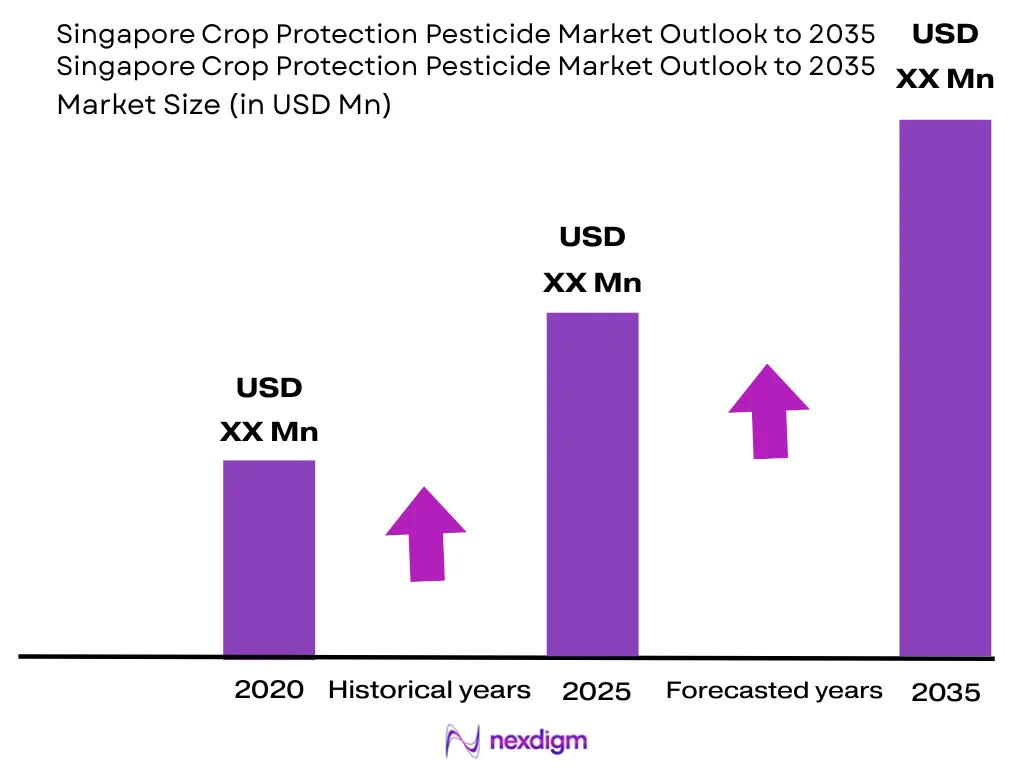
Singapore Crop Protection Pesticides Market occupies a distinctive position within the global agrochemical landscape, valued at USD ~ Million based on a comprehensive assessment of pesticide procurement, distribution, and consumption across the city-state’s highly specialized agricultural production systems. The market is shaped by Singapore’s unique dual role as a regional agrochemical trading and distribution hub for Southeast Asia, alongside its domestic agriculture sector which is intensively focused on high-technology controlled environment farming, vertical agriculture, and urban food production under the government’s 30 by 30 food security strategy. According to the Singapore Food Agency and the Singapore Economic Development Board, the domestic production sector spans a limited but highly productive land area of approximately 1% of total national territory, with licensed farms producing leafy vegetables, fruiting vegetables, herbs, eggs, fish, and mushrooms for domestic consumption. The country’s tropical equatorial climate, year-round pest and disease pressure in both outdoor and indoor growing environments, stringent food safety residue standards, and strong government investment in agrifood technology innovation continue to define pesticide demand patterns across Singapore’s uniquely modern agricultural sector.
Market Segmentation
By Product Type
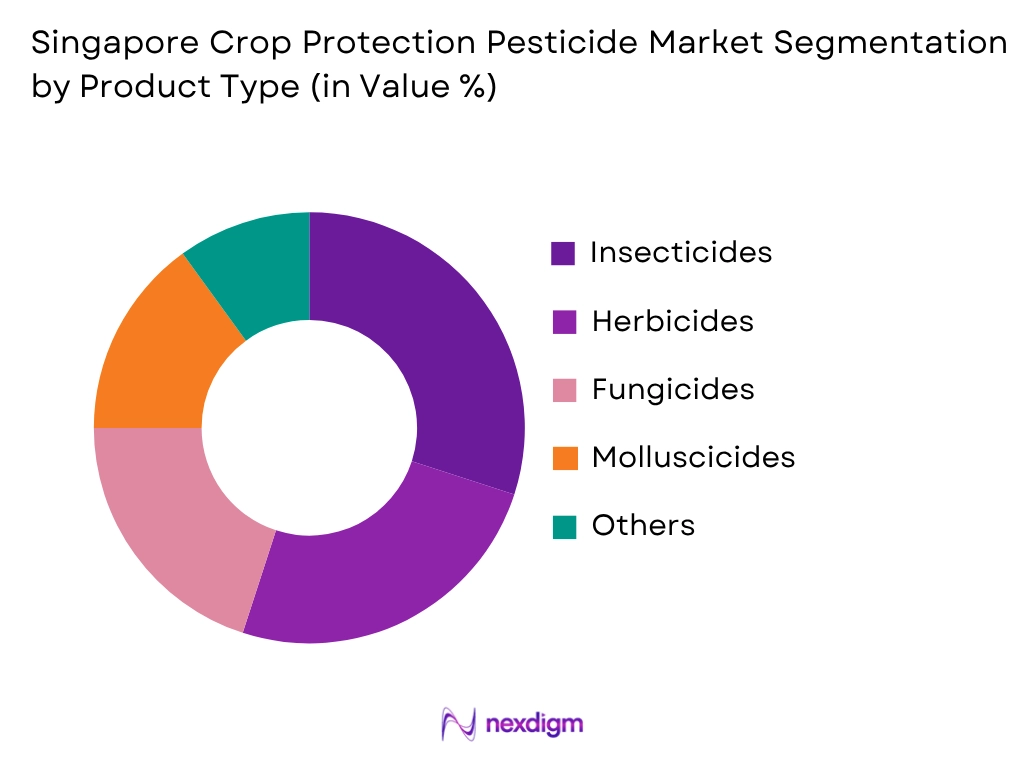
The insecticides segment dominates the Singapore Crop Protection Pesticides Market due to the country’s year-round tropical equatorial climate that sustains continuous populations of whitefly, aphids, thrips, spider mites, fungus gnats, and leafminer species across both outdoor vegetable farms and controlled environment growing facilities. Singapore’s high ambient temperatures, humidity, and absence of a seasonal cold period that would naturally suppress insect populations create persistent insect management challenges that require routine insecticide programs across all vegetable production systems. The rapid expansion of indoor vertical farms and greenhouse facilities, while offering greater environmental control than open-field agriculture, still faces significant pressure from thrips, fungus gnats, and spider mites that establish within closed growing systems and spread rapidly through air handling infrastructure and plant propagation material. Ornamental and landscape management across Singapore’s extensive public greenery, parks, roadside vegetation, golf courses, and commercial developments generates substantial demand for insecticides targeting tropical insect pests including scale insects, mealybugs, and leaf-chewing caterpillars. Biological insecticides, including Bacillus thuringiensis-based products, insect growth regulators, and predatory mite releases, are increasingly incorporated into integrated pest management programs within Singapore’s technology-forward farming community. Continuous innovation in selective, low-residue, and short pre-harvest interval insecticide formulations reflects the premium placed on food safety compliance and residue minimization within Singapore’s highly regulated and consumer-conscious food production environment.
By Crop Type
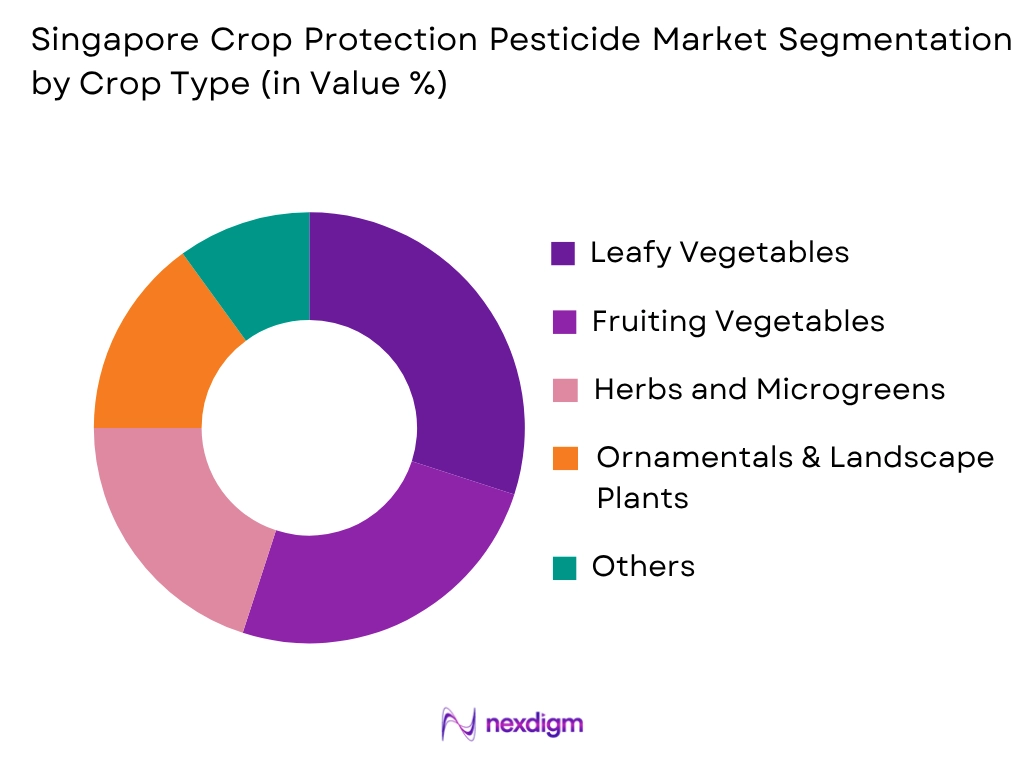
Leafy vegetables account for the largest share of pesticide consumption within Singapore’s domestic agricultural production sector owing to their dominance among locally licensed vegetable farms, high production frequency with multiple harvests per year, year-round susceptibility to tropical insect and fungal disease pressure, and central importance to the government’s 30 by 30 domestic food production target. Locally produced leafy vegetables including kai lan, xiao bai cai, bayam, kangkong, and lettuce varieties are grown across licensed vegetable farms in Lim Chu Kang, Murai, and Sungei Tengah, as well as within multi-storey vertical farm facilities in industrial zones, requiring consistent crop protection against whitefly, aphids, caterpillars, and damping-off fungal pathogens throughout intensive production cycles. The commercial importance of leafy vegetable freshness and visual quality to Singapore consumers and food service buyers creates strong commercial incentives for consistent pest and disease management to minimize cosmetic damage and post-harvest deterioration. High planting density, rapid crop turnover periods of 20 to 45 days depending on variety, and intensive year-round production schedules compress pest management windows and increase the frequency of crop protection interventions required per production cycle. Singapore’s Food Agency maximum residue limit enforcement and active market surveillance programs create strong compliance pressure on vegetable producers to select registered, low-residue pesticide products and observe mandatory pre-harvest intervals, reinforcing the role of approved crop protection products within leafy vegetable production.
Competitive Landscape
The Singapore Crop Protection Pesticides Market is characterized by the strong presence of multinational agrochemical companies operating regional Asia Pacific headquarters, distribution centers, and regulatory affairs offices within the city-state, alongside specialized distributors and biological product companies serving the domestic licensed farming sector. Singapore’s strategic position as a regional commercial, logistics, and regulatory hub for Southeast Asia makes it a critical base of operations for companies managing product registration, supply chain coordination, and technical support across ASEAN markets. Syngenta Asia Pacific, Bayer Crop Science, BASF Asia Pacific, and Certis Biologicals maintain significant regional operations in Singapore that include both domestic market supply and broader regional distribution management. The domestic pesticide market itself is relatively compact in volume terms but highly sophisticated in product profile, with strong demand for biological insecticides, low-residue fungicides, systemic insecticides with short pre-harvest intervals, and biopesticide formulations suited to controlled environment agriculture. Competition increasingly focuses on sustainable, food-safety-compliant crop protection solutions, integrated pest management technical support, digital pest monitoring platforms, and biological product innovation aligned with Singapore Food Agency registration standards and the 30 by 30 food security agenda.
| Company | Establishment Year | Headquarters | Product Portfolio | Biological Products
|
Manufacturing Presence | Major Crop Focus | Distribution Network | R&D Focus |
| Bayer Crop Science | 1863 | ~ | ~ | ~ | ~ | ~ | ~ | ~ |
| Syngenta Asia Pacific | 2000 | ~ | ~ | ~ | ~ | ~ | ~ | ~ |
| Certis Biologicals | 2001 | ~ | ~ | ~ | ~ | ~ | ~ | ~ |
| Kenso Corporation | 1979 | ~ | ~ | ~ | ~ | ~ | ~ | ~ |
| UPL Limited | 1969 | ~ | ~ | ~ | ~ | ~ | ~ | ~ |
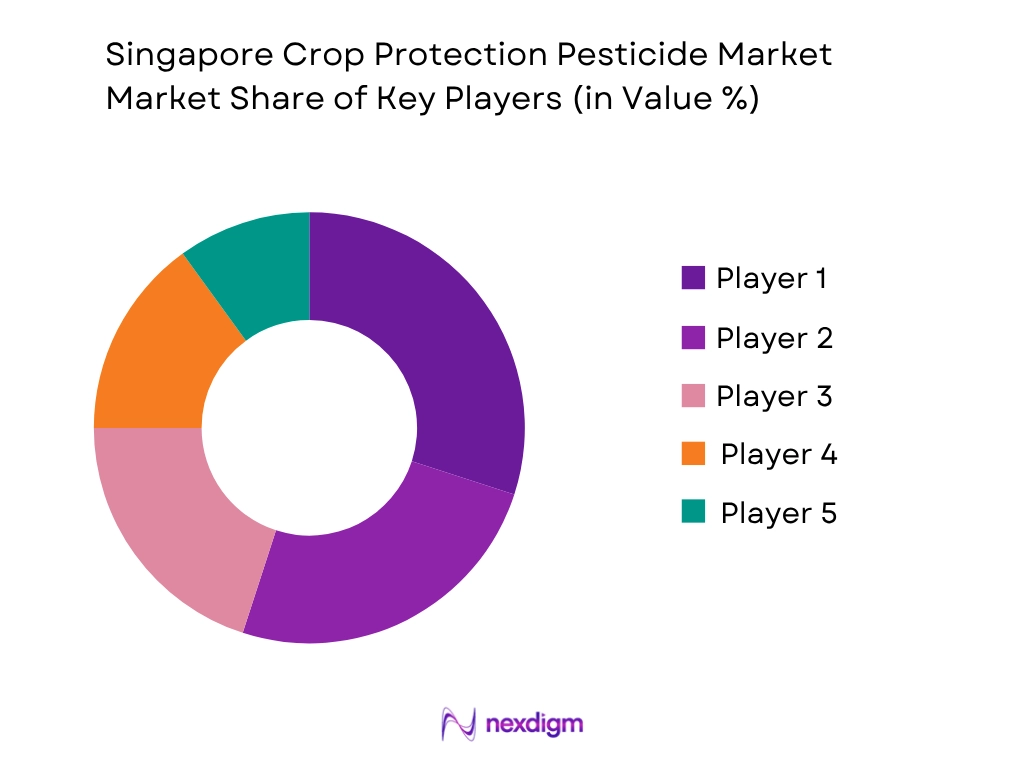
Singapore Crop Protection Pesticide Market Analysis
Growth Drivers
Singapore 30 by 30 Food Security Strategy and Domestic Production Expansion
Singapore’s ambitious 30 by 30 food security strategy, which targets producing 30% of the nation’s nutritional needs domestically by 2030, serves as the primary structural growth driver for the Crop Protection Pesticides Market by directly incentivizing expansion of licensed agricultural production capacity and investment in high-technology farming systems that require consistent crop protection programs. The Singapore Food Agency administers a comprehensive suite of funding mechanisms including the Agri-Food Cluster Transformation Fund, the Agriculture Productivity Fund, and the Singapore Food Story Research and Development Programme, collectively channeling hundreds of millions of Singapore dollars into farm productivity improvement, indoor growing infrastructure, and agricultural technology adoption across licensed vegetable, egg, fish, and mushroom producers. Expansion of vertical farming facilities within industrial buildings in Jurong, Tuas, and Tampines, as well as the development of the new Lim Chu Kang Masterplan agrifood zone targeting high-technology aquaculture and vegetable production, is increasing the total cultivated production area under intensive management and creating demand for specialized crop protection products suited to controlled environment growing systems. Government co-investment in agrifood technology companies through Temasek Holdings, Enterprise Singapore, and the Economic Development Board is attracting regional and global agricultural biotechnology and biological crop protection companies to establish operations in Singapore, broadening the range of innovative pest management solutions available to local farmers. Rising domestic food production ambitions combined with Singapore’s premium on food safety, environmental sustainability, and agricultural technology innovation create a structurally favorable long-term environment for quality crop protection product demand across the city-state’s expanding agrifood sector.
Singapore as a Regional Agrochemical Distribution and Regulatory Hub
Singapore’s unrivalled position as Southeast Asia’s premier trading, logistics, and regulatory services hub generates significant agrochemical market activity beyond its limited domestic farming sector, as multinational crop protection companies use Singapore as a strategic base for managing product registration dossiers, regional supply chain coordination, technical regulatory affairs, and commercial operations across ASEAN’s rapidly growing agricultural markets. The city-state’s world-class port infrastructure at Jurong Port and the Port of Singapore Authority terminals, modern temperature-controlled warehousing facilities, highly efficient customs clearance procedures, and pro-business regulatory environment make it an ideal transhipment and distribution center for agrochemical products moving between global manufacturing facilities and Southeast Asian end markets in Indonesia, Vietnam, Thailand, Malaysia, and the Philippines. Syngenta, Bayer, BASF, Corteva, FMC, and UPL all maintain significant Asia Pacific regional headquarters, regulatory affairs teams, and distribution operations in Singapore that generate substantial pesticide import, storage, repackaging, and re-export activity contributing to the overall market value. The Agri-Food and Veterinary Authority’s successor Singapore Food Agency maintains a rigorous but internationally harmonized pesticide registration framework that provides regulatory credibility for product registrations that companies then leverage across other ASEAN jurisdictions. Singapore’s bilateral free trade agreements, intellectual property protection framework, and transparent rule-of-law commercial environment further reinforce its attractiveness as a regional agrochemical hub, supporting market activity well beyond the scale that domestic agricultural production alone would generate.
Market Challenges
Extremely Limited Agricultural Land and High Operational Costs
Singapore’s fundamental land scarcity constraint, with total national territory of approximately 733 square kilometers and agricultural land comprising less than 1% of that area, represents an inherent structural ceiling on domestic crop production volume and consequently limits the scale of pesticide consumption generated by domestic farming activity relative to regional agricultural economies with vastly larger cultivated areas. Licensed vegetable farm land in Singapore is concentrated primarily within the Lim Chu Kang agricultural zone and scattered urban farm sites, with total licensed vegetable farm area of approximately 300 hectares, a fraction of the cultivated areas in neighboring Malaysia, Indonesia, or Thailand that generate orders of magnitude greater pesticide demand volumes. High land rental costs, premium industrial building lease rates for vertical farm operators, elevated labor costs reflecting Singapore’s tight employment market, and expensive utilities including electricity for climate-controlled growing environments collectively make Singapore’s farming operations among the most expensive in the Asia Pacific region. These structural cost pressures squeeze farm operational margins and constrain pesticide budget allocations, incentivizing farmers to minimize input costs through biological alternatives, precision micro-dosing application technologies, and integrated pest management approaches that reduce chemical pesticide dependency. Competition for agricultural land from higher-value industrial, commercial, and residential development uses means that domestic production area is unlikely to expand substantially beyond current and planned licensed zones, placing a practical ceiling on pesticide volume growth from domestic farming activity regardless of technology adoption or yield improvement trends.
Stringent Regulatory Standards and Consumer Demand for Residue-Free Produce
Singapore’s highly stringent pesticide regulatory framework administered by the Singapore Food Agency, combined with exceptionally well-informed consumer demand for safe, residue-free fresh produce, creates significant compliance obligations for pesticide manufacturers, importers, and farming operators that limit the range of registrable products and increase the cost of market entry for new active ingredients and formulations. The Singapore Food Agency enforces maximum residue limits aligned with Codex Alimentarius standards and applies active market surveillance through routine sampling of fresh vegetables at wholesale markets, supermarkets, and farm gate, creating strong deterrent pressure on producers against unauthorized pesticide use or pre-harvest interval violations. Consumer awareness of food safety issues is exceptionally high in Singapore relative to most regional markets, with a well-educated, health-conscious urban population willing to pay premium prices for certified safe, locally grown, or organically produced vegetables that carry verifiable low-residue credentials. This consumer environment incentivizes vegetable farmers to shift progressively toward biological crop protection products, biopesticides, and integrated pest management systems that minimize chemical residue risks, constraining growth of conventional synthetic pesticide segments while creating opportunities for biological and low-residue product categories. New active ingredient registrations require comprehensive toxicological and environmental dossier submissions that are costly and time-consuming for manufacturers seeking to expand their Singapore-registered product portfolios, particularly for niche horticultural crops grown across the city-state’s specialized production systems.
Market Opportunities
Expansion of Biological and Low-Residue Crop Protection Solutions
Singapore’s combination of premium food safety standards, technology-forward farming community, strong government support for sustainable agriculture, and sophisticated consumer preferences creates an exceptionally favorable market environment for biological crop protection products, biopesticides, and low-residue synthetic formulations that address the unique pest management requirements of controlled environment and vertical farming systems. The rapid expansion of indoor vertical farms operated by companies including Sustenir Agriculture, Archisen, and VertiVegies, alongside established greenhouse vegetable producers in Lim Chu Kang, creates growing demand for biological insecticides including Bacillus thuringiensis, Beauveria bassiana, and Trichoderma-based fungicides that deliver effective pest management without compromising strict pre-harvest interval requirements or food safety certification programs. Singapore’s role as the regional headquarters for Certis Biologicals, one of Asia Pacific’s leading biological crop protection companies, reflects the city-state’s strategic importance as a center for biopesticide innovation, registration, and distribution across ASEAN markets where regulatory harmonization is progressively broadening the market for approved biological products. International biological crop protection companies including Koppert Biological Systems, BioBee, and Andermatt Biocontrol are expanding their Singapore presence to leverage the country’s regulatory infrastructure, logistics capabilities, and connections to regional agrifood innovation networks. Government funding through the Singapore Food Agency’s Agri-Food Cluster Transformation Fund actively supports adoption of biological integrated pest management systems among licensed vegetable producers, reducing the cost barrier for transitioning from conventional to biological crop protection programs and accelerating market development for sustainable pest management solutions.
Growth of AgriTech Innovation and Precision Pest Management
Singapore’s internationally recognized position as a global smart city and innovation hub, combined with substantial government investment in agrifood technology research through institutions including the Singapore-MIT Alliance for Research and Technology, Nanyang Technological University’s food science programs, and the Agency for Science Technology and Research, creates unique opportunities for precision pest management technology development and commercialization that can both serve the domestic market and be scaled across the broader Asia Pacific region. Advanced sensor networks, computer vision pest detection systems, IoT-enabled environmental monitoring platforms, and AI-powered disease forecasting applications are being developed and piloted within Singapore’s licensed vertical farms and greenhouse facilities, enabling real-time pest population monitoring that can trigger targeted micro-dose pesticide applications at economically justified thresholds rather than calendar-based spray schedules. Singapore’s StartupSG and Enterprise Singapore programs actively fund agrifood technology companies developing precision crop protection solutions, digital pest advisory platforms, and autonomous spraying robots suited to the confined growing environments of vertical farms and greenhouse facilities. The city-state’s dense concentration of food technology venture capital, corporate innovation programs from regional agrifood companies including Wilmar International, Olam International, and Golden Agri-Resources, and proximity to major Southeast Asian agricultural markets creates a commercially attractive environment for precision pest management technology companies seeking to develop, validate, and scale innovative solutions. Regional agricultural markets in Indonesia, Vietnam, Thailand, and the Philippines present enormous export opportunities for Singapore-developed and Singapore-validated precision crop protection technologies, with the city-state’s reputation for technological excellence and food safety regulatory rigor providing a credible market entry credential for innovations entering these rapidly modernizing agricultural economies.
Future Outlook
The Singapore Crop Protection Pesticides Market is expected to experience steady evolution over the forecast period, shaped primarily by continued expansion of licensed domestic food production under the 30 by 30 strategy, increasing adoption of biological and low-residue crop protection products within controlled environment agriculture systems, and Singapore’s sustained role as a regional agrochemical distribution and regulatory hub for Southeast Asia. Sustainable agricultural practices, biological crop protection innovation, and digital precision pest management platforms are expected to progressively redefine the product mix and competitive landscape within the domestic market. Regulatory modernization through Singapore Food Agency framework updates and regional ASEAN pesticide harmonization initiatives are anticipated to streamline product registration processes and broaden the range of approved biological and conventional products available to licensed producers. Furthermore, continued investment in vertical farming, aquaponic systems, and high-technology greenhouse production under the Lim Chu Kang Masterplan, coupled with increasing institutional and corporate interest in Singapore as a regional agrifood innovation hub, will support long-term market development across the city-state’s uniquely specialized agricultural production environment.
Major Players
- Syngenta Asia Pacific
- Bayer Crop Science
- BASF Asia Pacific
- UPL Limited
- FMC Corporation Asia Pacific
- Corteva Agriscience
- Nufarm Asia
- Sumitomo Chemical Asia
- ADAMA Agricultural Solutions
- Certis Biologicals
- Kenso Corporation
- Crop Care Australasia
- Westrade Group
- Pan Asia Pacific Agri-Sciences
- Rainbow Agro
Key Target Audience
- Crop Protection Product Manufacturers and Regional Asia Pacific Distributors
- Licensed Vegetable Farm Operators and Vertical Farming Companies
- Commercial Greenhouse and Controlled Environment Agriculture Enterprises
- Agrochemical Importers, Distributors and Specialty Retail Outlets
- Biological Crop Protection and Biopesticide Manufacturers
- Investments and Venture Capitalist Firms Active in AgriFood Technology
- Government and Regulatory Bodies (Singapore Food Agency, National Parks Board, NEA, Enterprise Singapore, Economic Development Board)
- Precision Agriculture, AgriTech and Smart Farming Solution Providers
Research Methodology
Step 1: Identification of Key Variables
The initial phase involves constructing an ecosystem map covering pesticide manufacturers, active ingredient suppliers, regional distributors, licensed farm operators, government agencies, agrifood technology companies, and research institutions within the Singapore Crop Protection Pesticides Market. Extensive secondary research using public databases, company reports, agricultural statistics, Singapore Food Agency records, and proprietary industry sources is undertaken to identify the variables influencing market performance.
Step 2: Market Analysis and Construction
Historical information relating to pesticide imports, re-exports, domestic consumption, licensed farm production area, pesticide procurement volumes, application intensity, pricing trends, and farmer purchasing behavior is compiled and analyzed. Market revenues are estimated through both supply-side import and distribution analysis and demand-side crop-wise pesticide consumption, ensuring comprehensive market sizing and segmentation across domestic and hub-related market activity.
Step 3: Hypothesis Validation and Expert Consultation
Market assumptions are validated through structured interviews with pesticide manufacturers, regional distributors, licensed farm operators, agrifood technology companies, Singapore Food Agency officials, agronomists, and investment professionals active in the Singapore agrifood sector. In-depth executive interviews and industry working group consultations provide operational insights that strengthen the accuracy of market estimates and competitive assessments.
Step 4: Research Synthesis and Final Output
The final phase integrates insights from primary interviews with secondary research findings using bottom-up and top-down estimation techniques. Cross-validation ensures consistency across market segments, competitive analysis, pricing benchmarks, and future projections, resulting in a comprehensive and reliable assessment of the Singapore Crop Protection Pesticides Market.

- Executive Summary
- Research Methodology (Market Definitions and Assumptions, Abbreviations, Market Sizing Approach, Top-Down Analysis, Bottom-Up Analysis, Demand-Side Assessment, Supply-Side Assessment, Primary Industry Interviews, Channel Partner Validation, Distributor-Level Assessment, Data Triangulation, Forecasting Framework, Limitations and Future Conclusions)

- Definition and Scope
- Market Evolution and Industry Genesis
- Timeline of Major Industry Developments
- Singapore Crop Protection Industry Value Chain Analysis
- Crop Protection Pesticides Supply Chain Analysis

- Growth Drivers (Expansion of Indoor and Vertical Farming, Rising Demand for Food Safety and Residue Compliance, Singapore 30 by 30 Food Security Initiative, Growth in Controlled Environment Agriculture, Rising Demand for High-Value Horticultural Produce, Expansion of AgriTech Research and Innovation, Adoption of Biological and Low-Residue Crop Protection Solutions)
- Market Challenges (Extremely Limited Agricultural Land, High Regulatory Standards for Pesticide Registration, Import Dependency for Active Ingredients, Resistance Management in Closed Growing Environments, High Operational Costs, Consumer Demand for Pesticide-Free Produce)
- Market Opportunities (Bio-Based and Low-Residue Crop Protection Products, Precision Micro-Dosing Technologies, Controlled Environment Agriculture Integration, Digital Pest Monitoring Platforms, Sustainable Integrated Pest Management, Biopesticide Innovation for Vertical Farms)
- Market Trends (Shift Towards Biologicals and Biopesticides, IPM Adoption in Controlled Environment Agriculture, Smart Sensor-Based Pest Detection, Low-Volume High-Efficiency Formulations, Sustainable Certification and Residue Compliance, AI-Based Pest Forecasting, Regional Distribution Hub Role)
- Government Regulations (Singapore Food Agency Registration Framework, National Parks Board Pesticide Guidelines, NEA Environmental Regulations, Maximum Residue Limits, Good Agricultural Practices for Vegetables, Integrated Pest Management Guidelines, Traceability and Food Safety Requirements)
- PESTLE Analysis
- SWOT Analysis
- Porter’s Five Forces Analysis
- Stakeholder Ecosystem
- Competition Ecosystem

- By Market Value (2020-2025)
- By Volume Consumption (2020-2025)
- By Average Selling Price (2020-2025)

- By Product Type (In Value %)
Herbicides
Insecticides
Fungicides
Seed Treatment Chemicals
Plant Growth Regulators
Biological Crop Protection
Products
Nematicides
Molluscicides
Rodenticides
Adjuvants and Spray Additives
- By Chemical Origin (In Value %)
Synthetic Crop Protection Products
Biological Crop Protection Products
Botanical Pesticides
Microbial Pesticides
Biochemical Pesticides
- By Active Ingredient Class (In Value %)
Glyphosate-Based Products
Glufosinate-Based Products
2,4-D Products
Atrazine Products
Pyrethroids
Neonicotinoids
Organophosphates
Triazoles
Strobilurins
SDHI Fungicides
Diamides
Copper-Based Products
Sulfonylureas - By Crop Type (In Value %)
Leafy Vegetables
Fruiting Vegetables
Herbs and Microgreens
Ornamentals and Landscape Plants
Hydroponic and Indoor Crops
Aquaponic System Crops
Edible Mushrooms
Rooftop and Vertical Farm Produce
Community Garden Crops
Turfgrass and Amenity Greenery
Container and Potted Crops
Research and Experimental Crops - By Region (In Value %)
Central Region
North Region
Northeast Region
East Region
West Region

- Market Share of Major Players (By Value, Volume, Product Type, Crop Type, Biological Products, Distribution Network)
- Cross Comparison Parameters (Registered Active Ingredients Portfolio, Biological Product Portfolio, Distribution Network Strength, Regional Hub Operations in Singapore, R&D Pipeline for New Molecules, Seed Treatment Portfolio Strength, Digital Agriculture & Precision Farming Solutions, Crop Coverage Across Singapore’s Key Horticultural Systems)
- SWOT Analysis of Major Players
- Pricing Analysis by Active Ingredient, Formulation Type and Crop Segment
- Product Portfolio Benchmarking
- Detailed Profiles of Major Companies
Syngenta Asia Pacific
Bayer Crop Science
BASF Asia Pacific
UPL Limited
FMC Corporation Asia Pacific
Corteva Agriscience
Nufarm Asia
Sumitomo Chemical Asia
ADAMA Agricultural Solutions
Certis Biologicals
Kenso Corporation
Crop Care Australasia
Westrade Group
Pan Asia Pacific Agri-Sciences
Rainbow Agro

- Crop Protection Product Consumption Analysis (Application Frequency, Seasonal Usage, Crop-Wise Consumption Intensity, Pest Pressure)
- Farmer Demographic Analysis (Farm Size, Technology Adoption Level, Commercial vs Research Orientation, Controlled Environment vs Open Field Farming)
- Input Spending Analysis
- Purchase Decision Parameters
- Brand Loyalty Assessment

- By Market Value (2026-2035)
- By Volume Consumption (2026-2035)
- By Average Selling Price (2026-2035)


 Request a Sample
 Ask for Customization
 Get a Quote
 Enquire Now