
 Download PDF
Market Overview
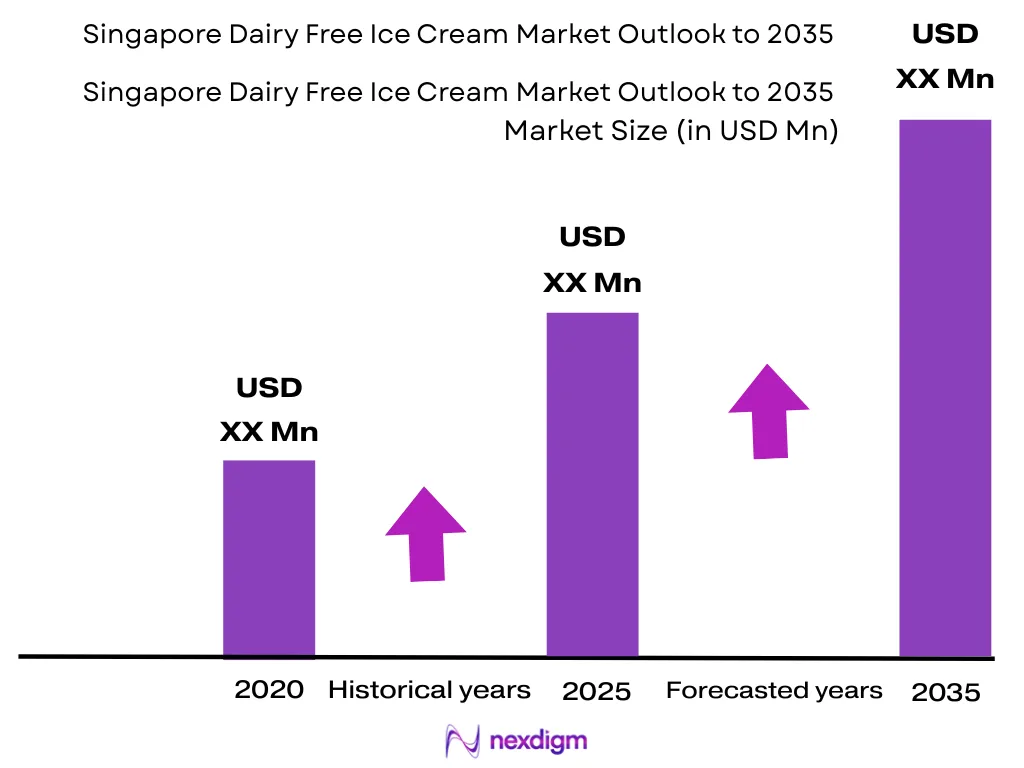
The Singapore Dairy Free Ice Cream Market was valued at approximately USD ~ Million in 2024, compared to USD ~ Million in 2023, based on historical industry analysis and retail sales tracking. The market is primarily driven by increasing consumer adoption of plant-based diets, rising lactose intolerance prevalence across Asian populations, and growing demand for premium frozen desserts. Singapore recorded a resident population of 5.92 million in 2024 compared to 5.64 million in 2023, while food and beverage retail sales continued expanding through modern retail and e-commerce channels. The presence of premium grocery chains, strong cold-chain infrastructure, and increasing launches of oat-based, almond-based, and coconut-based frozen desserts further support market expansion. Rising health-conscious consumption and clean-label product preferences have accelerated demand for dairy alternatives across retail and foodservice channels.
Market Segmentation
By Base Ingredient Type
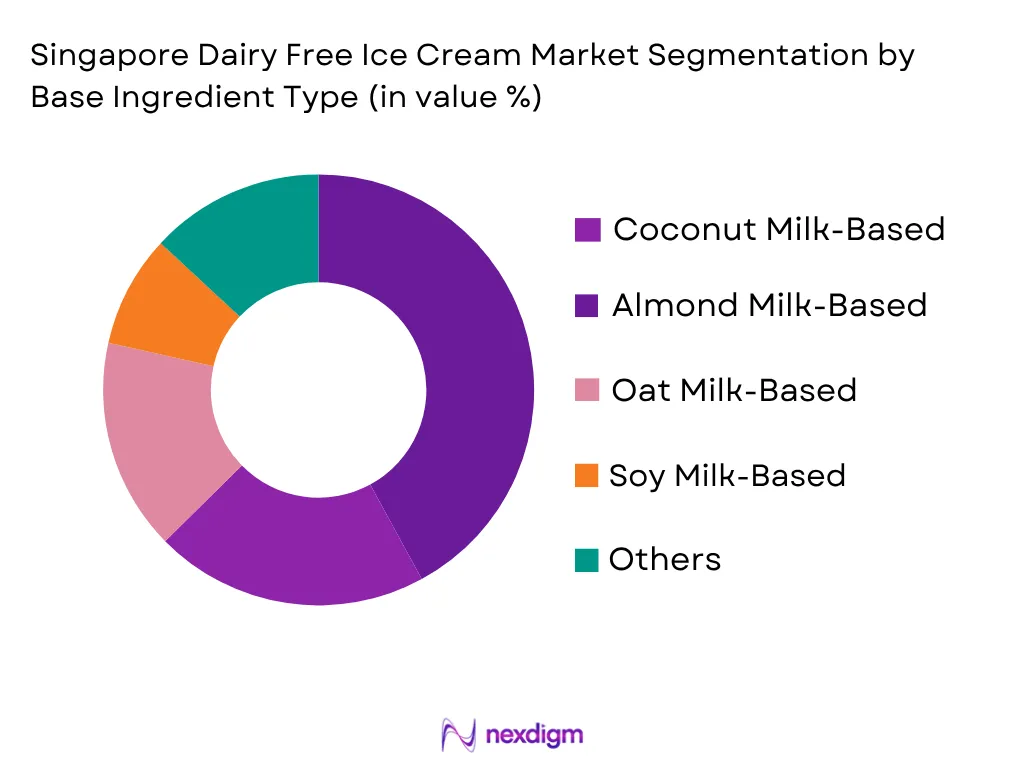
Singapore Dairy Free Ice Cream Market is segmented by base ingredient type into coconut-based, oat-based, almond-based, soy-based, cashew-based, and mixed plant-based dairy free ice creams. Recently, coconut-based dairy free ice cream has emerged as the dominant segment. Its leadership is supported by strong consumer familiarity with coconut-derived products across Southeast Asia, superior creamy texture compared to several alternative bases, and compatibility with tropical flavor profiles favored in Singapore. Coconut milk also delivers a richer mouthfeel that closely resembles traditional dairy ice cream, making it appealing to flexitarian consumers who are transitioning away from conventional dairy products. Premium brands increasingly utilize coconut bases due to their versatility in supporting indulgent, clean-label, and vegan formulations. The segment additionally benefits from broad retail availability, foodservice adoption, and strong acceptance among lactose-intolerant consumers seeking dairy alternatives without compromising taste or texture.
By Distribution Channel
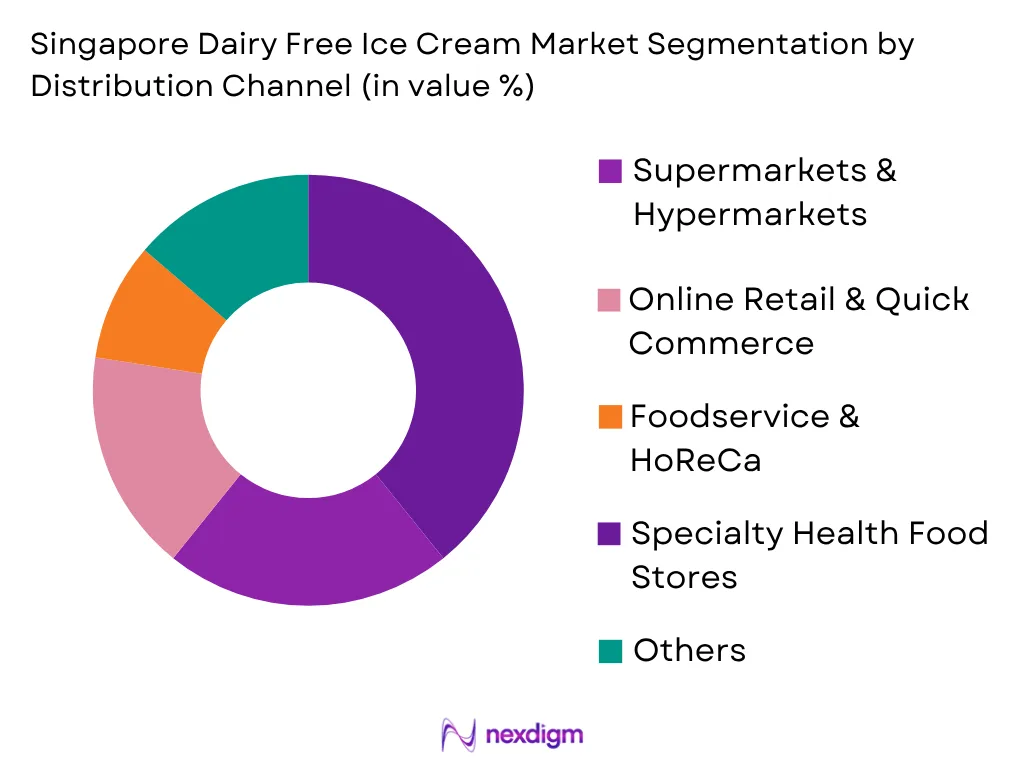
Singapore Dairy Free Ice Cream Market is segmented by distribution channel into supermarkets and hypermarkets, convenience stores, specialty health food stores, online retail and quick commerce, direct-to-consumer channels, and foodservice establishments. Supermarkets and hypermarkets currently dominate the market owing to their extensive frozen food infrastructure, wide product assortment, and ability to showcase both international and local dairy-free brands. Leading grocery chains provide consumers with easy access to premium vegan frozen desserts while offering promotional visibility and product sampling opportunities. The segment also benefits from consumers’ preference to purchase frozen products through channels that guarantee product integrity and cold-chain reliability. Premium supermarkets particularly attract health-conscious consumers seeking organic, clean-label, and plant-based frozen desserts. Furthermore, strategic shelf placements alongside conventional premium ice cream brands have improved category visibility and accelerated consumer trial rates, supporting the segment’s leading position within the Singapore market.
Competitive Landscape
The Singapore Dairy Free Ice Cream Market is characterized by the presence of both global plant-based food manufacturers and regional specialty frozen dessert brands. Competition is centered on flavor innovation, ingredient quality, plant-base diversification, sustainability initiatives, and premium brand positioning. International brands leverage established distribution networks, while local brands differentiate through artisanal offerings and region-specific flavors.
| Company | Establishment Year | Headquarters | Plant-Based Base Portfolio | Dairy-Free SKU Count | Distribution Reach | Premium Product Portfolio | Vegan Certification | Packaging Sustainability |
| Ben & Jerry’s | 1978 | ~ | ~ | ~ | ~ | ~ | ~ | ~ |
| Oatly | 1994 | ~ | ~ | ~ | ~ | ~ | ~ | ~ |
| Magnum Vegan | 1989 | ~ | ~ | ~ | ~ | ~ | ~ | ~ |
| Kind Kones | 2017 | ~ | ~ | ~ | ~ | ~ | ~ | ~ |
| The Ice Cream & Cookie Co. | 2012 | ~ | ~ | ~ | ~ | ~ | ~ | ~ |
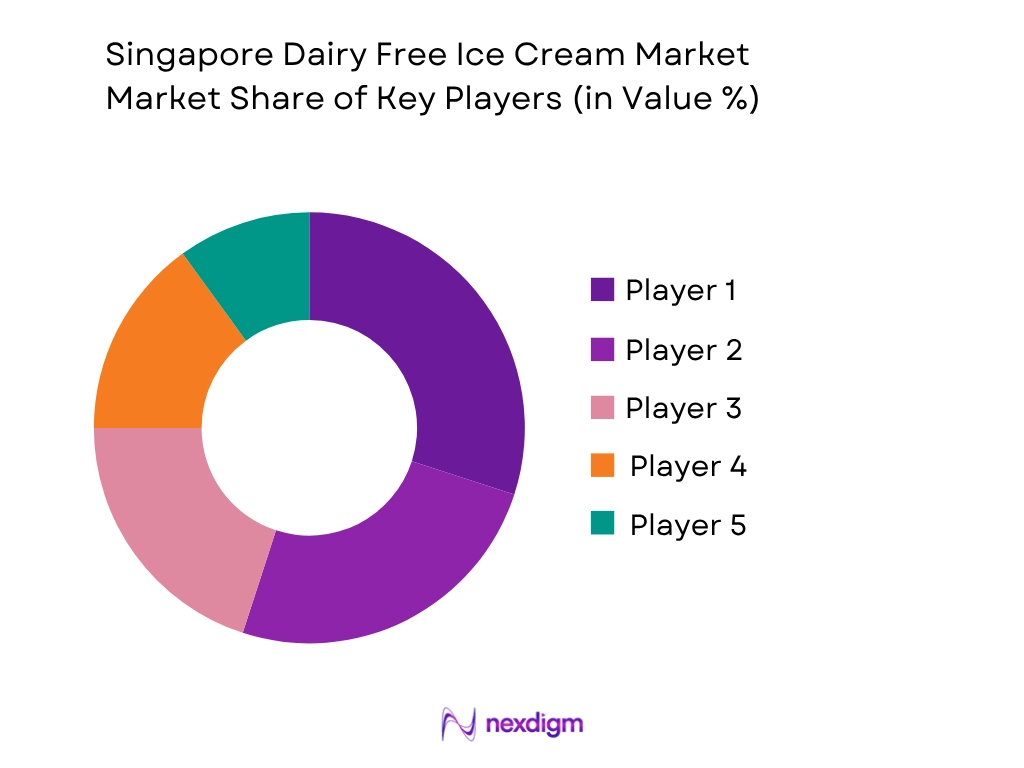
Singapore Dairy Free Ice Cream Market Analysis
Growth Drivers
Health and Wellness-Oriented Consumer Spending
Singapore’s dairy free ice cream market is benefiting from the country’s strong consumer purchasing power and increasing expenditure on health-oriented food products. According to the Singapore Department of Statistics, nominal GDP exceeded SGD 673 billion, while GDP per capita remained above USD 84,000, placing Singapore among the highest-income economies globally. Household expenditure on food and non-alcoholic beverages continued to represent a major component of consumer spending, supporting premium food categories such as plant-based frozen desserts. The Ministry of Health reported that chronic health conditions including diabetes and obesity remain key public health priorities, encouraging consumers to seek lower-lactose, plant-based, and clean-label alternatives. Singapore’s resident population exceeded 6.0 million, creating a large urban consumer base with exposure to global food trends. The country’s urbanized environment, advanced cold-chain logistics, and concentration of premium retail outlets such as FairPrice Finest, Cold Storage, and Little Farms improve accessibility to dairy free ice cream products. Additionally, Singapore’s position as a regional food innovation hub has attracted multinational plant-based food companies launching oat-based, almond-based, coconut-based, and soy-based frozen desserts. These factors collectively strengthen consumer demand and support sustained category expansion within the dairy free ice cream market.
Expansion of Modern Retail and E-Commerce Ecosystem
The growth of Singapore’s modern retail infrastructure and digital commerce ecosystem continues to accelerate dairy free ice cream consumption. The Infocomm Media Development Authority reported that internet penetration remained above 5.6 million users, while digital payment adoption and online grocery purchasing continued to expand across households. Singapore’s retail trade sector generated more than SGD 40 billion in annual sales, supported by a dense network of supermarkets, convenience stores, specialty health retailers, and quick-commerce platforms. Dairy free ice cream brands increasingly utilize online channels including RedMart, FairPrice Online, Amazon Fresh, and food delivery platforms to reach consumers seeking specialty frozen products. Singapore’s logistics infrastructure, ranked among the world’s most efficient, supports reliable temperature-controlled transportation for frozen foods. Changi Airport and the Port of Singapore handled substantial trade volumes, facilitating imports of plant-based ingredients such as almonds, oats, coconut derivatives, and specialty vegan formulations. Furthermore, the city-state’s compact geography enables same-day and next-day grocery delivery services, encouraging impulse purchases of premium frozen desserts. The combination of digital commerce growth, strong logistics capabilities, and extensive premium retail coverage has become a significant demand driver for the dairy free ice cream segment.
Market Challenges
Dependence on Imported Ingredients and Food Supply Vulnerability
One of the key challenges facing Singapore’s dairy free ice cream market is its heavy dependence on imported agricultural inputs and finished food products. The Singapore Food Agency has consistently highlighted that more than 90% of the nation’s food supply is imported from over 170 countries and regions. Dairy free ice cream manufacturers rely heavily on imported almonds, oats, cashews, coconut derivatives, natural sweeteners, and specialty stabilizers, exposing the sector to international supply chain disruptions. Singapore’s merchandise imports exceeded SGD 600 billion, reflecting the country’s reliance on global trade flows. Geopolitical tensions, shipping delays, climate-related agricultural disruptions, and fluctuations in raw material availability can affect ingredient procurement for plant-based frozen dessert producers. Since Singapore possesses limited agricultural land and domestic raw material production, manufacturers have restricted ability to substitute imported ingredients locally. Furthermore, maintaining uninterrupted cold-chain storage throughout importation, warehousing, and retail distribution adds operational complexity. The combination of external supply dependence and limited domestic agricultural production presents a structural challenge for dairy free ice cream brands seeking stable sourcing, consistent product availability, and long-term supply resilience within Singapore.
Intense Competition from Conventional Premium Ice Cream Categories
Despite growing interest in plant-based foods, dairy free ice cream continues to face intense competition from established premium dairy ice cream brands. Singapore’s food retail market is characterized by high product availability, extensive international brand presence, and sophisticated consumer preferences. Consumers can choose from a broad range of imported and locally distributed premium frozen desserts, including traditional dairy ice creams offered by multinational brands. Singapore’s resident population of over 6.0 million creates a competitive retail environment where shelf space within supermarkets and convenience stores remains highly contested. Dairy free products frequently compete for freezer placement alongside premium dairy brands that possess stronger historical brand recognition and larger marketing budgets. Additionally, many consumers still perceive dairy-based ice cream as offering superior texture and flavor consistency. The challenge is amplified by Singapore’s mature retail sector, where product differentiation is critical for success. While plant-based frozen desserts appeal to vegan, lactose-intolerant, and health-conscious consumers, convincing mainstream consumers to switch from conventional premium ice cream remains difficult. This competitive landscape creates ongoing challenges for category expansion and customer acquisition within the dairy free ice cream market.
Market Opportunities
Growing Demand for Premium Plant-Based and Functional Foods
Singapore’s position as a premium food consumption market creates significant opportunities for dairy free ice cream manufacturers. The country’s GDP per capita exceeding USD 84,000 supports strong discretionary spending on health-oriented and premium food products. Consumer interest in functional nutrition, clean-label foods, and alternative proteins continues to expand across urban households. Government initiatives promoting healthier lifestyles have increased awareness of nutritional choices, encouraging experimentation with plant-based products. Dairy free ice cream brands have opportunities to develop formulations containing added protein, probiotics, reduced sugar content, natural ingredients, and fortified nutrients. Singapore’s advanced retail ecosystem enables rapid commercialization of innovative products targeting affluent consumers seeking wellness-focused indulgence. Premium grocery retailers, specialty organic stores, and upscale foodservice establishments actively stock innovative plant-based offerings. The country’s role as a regional launchpad for new food concepts also attracts investment into alternative food innovation. As consumers increasingly seek products that combine indulgence with perceived health benefits, manufacturers introducing functional and premium dairy free ice cream variants are well positioned to capture future category demand and strengthen market penetration.
Expansion Through Foodservice, Tourism, and Experiential Retail Channels
Singapore welcomed more than 16 million international visitor arrivals, reinforcing its position as one of Asia’s leading tourism and hospitality destinations. The strong recovery of tourism, coupled with the presence of thousands of restaurants, cafés, hotels, and dessert outlets, creates significant opportunities for dairy free ice cream suppliers. The foodservice industry increasingly incorporates plant-based menu options to cater to international visitors, vegan consumers, and customers with dietary restrictions. Singapore’s hospitality sector includes luxury hotels, integrated resorts, airport dining facilities, and premium restaurant concepts that actively seek differentiated dessert offerings. Dairy free ice cream brands can expand beyond retail by partnering with cafés, dessert chains, bakeries, and quick-service restaurants. Experiential retail formats such as artisanal ice cream parlors and specialty vegan cafés are also gaining traction among younger consumers seeking unique dining experiences. Furthermore, Singapore’s reputation as a regional culinary destination encourages experimentation with innovative flavors inspired by local and international cuisines. These factors provide a strong platform for dairy free ice cream manufacturers to diversify sales channels and expand brand visibility across the broader foodservice ecosystem.
Future Outlook
The Singapore Dairy Free Ice Cream Market is expected to witness substantial growth during the forecast period. Expansion will be supported by increasing plant-based food consumption, rising health awareness, growing lactose intolerance management, and continuous product innovation. The development of premium oat-based and coconut-based formulations, broader retail penetration, and increasing quick-commerce adoption are expected to strengthen category visibility. Foodservice operators and cafés are also likely to expand dairy-free dessert offerings to meet evolving consumer preferences.
Major Players
- Oatly
- Ben & Jerry’s
- Magnum Vegan
- Häagen-Dazs Plant-Based
- Alpro
- Kind Kones
- So Good
- The Ice Cream & Cookie Co.
- Coconut Bliss
- Eclipse Foods
- Cado
- Booja-Booja
- Tofutti
- Perfect Day
- Overrun Singapore
Key Target Audience
- Dairy Free Ice Cream Manufacturers
- Plant-Based Ingredient Suppliers
- Frozen Dessert Brands
- Retail Chains and Supermarket Operators
- Foodservice and HoReCa Operators
- Investments and Venture Capitalist Firms
- Government and Regulatory Bodies (Singapore Food Agency, Enterprise Singapore)
- E-Commerce and Quick Commerce Platforms
Research Methodology
Step 1: Identification of Key Variables
The initial phase involves mapping all stakeholders operating within the Singapore Dairy Free Ice Cream Market ecosystem. Extensive secondary research is conducted using company reports, trade publications, retail databases, government statistics, and food industry publications. The objective is to identify critical market variables influencing demand, supply, pricing, innovation, and distribution.
Step 2: Market Analysis and Construction
Historical industry information is compiled and evaluated to understand category penetration, retail availability, distribution intensity, and consumer purchasing behavior. Market sizing is developed using both top-down and bottom-up methodologies while analyzing demand across product categories and sales channels.
Step 3: Hypothesis Validation and Expert Consultation
Research assumptions are validated through structured interviews with manufacturers, distributors, retailers, ingredient suppliers, and foodservice operators. Insights collected through these consultations help refine market assumptions, competitive positioning, and future demand outlook.
Step 4: Research Synthesis and Final Output
The final stage combines primary and secondary findings into a consolidated market framework. Data triangulation techniques are used to validate results and generate reliable forecasts regarding product demand, consumer preferences, competitive dynamics, and growth opportunities within the Singapore Dairy Free Ice Cream Market.

- Executive Summary
- Research Methodology (Market Definitions and Assumptions, Abbreviations, Market Sizing Approach, Top-Down Analysis, Bottom-Up Analysis, Demand-Side Assessment, Supply-Side Assessment, Primary Industry Interviews, Data Triangulation, Forecasting Framework, Limitations and Future Conclusions)

- Definition and Scope
- Market Evolution and Industry Genesis
- Timeline of Major Industry Developments
- Dairy Free Frozen Dessert Value Chain Analysis
- Supply Chain and Cold Chain Infrastructure Assessment

- Growth Drivers (Rising Lactose Intolerance Awareness, Expansion of Vegan Population, Premium Frozen Dessert Consumption, Growth of Modern Retail, Increasing Health-Conscious Spending)
- Market Challenges (High Dependence on Imported Ingredients, Premium Product Pricing, Limited Local Manufacturing Scale, Cold Chain Cost Pressures, Competition from Conventional Ice Cream)
- Market Opportunities (Functional Dairy Free Ice Cream, Clean Label Formulations, Sugar-Free and Protein-Enriched Variants, Foodservice Penetration, Expansion of Quick Commerce Channels)
- Market Trends (Oat-Based Product Adoption, Premiumization of Frozen Desserts, Sustainable Packaging Adoption, Asian-Inspired Flavor Innovation, Plant-Based Product Bundling)
- Government Regulations (Singapore Food Agency Standards, Import Food Regulations, Product Labeling Requirements, Nutritional Disclosure Standards, Food Safety Compliance)
- SWOT Analysis
- Porter’s Five Forces Analysis
- PESTLE Analysis
- Stakeholder Ecosystem
- Competition Ecosystem

- By Market Value (2020-2025)
- By Volume Consumption (2020-2025)
- By Average Selling Price (2020-2025)

- By Base Ingredient Type (In Value %)
Coconut-Based Dairy Free Ice Cream
Oat-Based Dairy Free Ice Cream
Almond-Based Dairy Free Ice Cream
Soy-Based Dairy Free Ice Cream
Cashew-Based Dairy Free Ice Cream
Mixed Plant-Based Dairy Free Ice Cream - By Flavor Type (In Value %)
Chocolate
Vanilla
Fruit-Based Flavors
Caramel and Coffee
Nuts and Specialty Flavors
Seasonal and Limited-Edition Flavors - By Distribution Channel (In Value %)
Supermarkets and Hypermarkets
Convenience Stores
Specialty Health Food Stores
Online Retail and Quick Commerce
Direct-to-Consumer Brand Websites
Foodservice and HoReCa Channels - By Region (In Value %)
Central Singapore
East Region
North Region
North-East Region
West Region - By Packaging Format (In Value %)
Tubs
Single-Serve Cups
Ice Cream Bars
Family Packs
Multi-Pack Formats

- Market Share of Major Players (By Value, Volume, Product Category, Distribution Channel)
- Cross Comparison Parameters (Product Portfolio Breadth, Number of Dairy Free SKUs, Plant Base Diversification, Flavor Innovation Capability, Distribution Reach Across Retail Chains, E-Commerce Presence, Sustainable Packaging Adoption, Premium Product Positioning)
- SWOT Analysis of Major Players
- Pricing Analysis by SKU, Pack Size and Distribution Channel
- Detailed Profiles of Major Companies
Ben & Jerry’s
Magnum Vegan
Oatly
So Good
Alpro
Kind Kones
Overrun Singapore
The Ice Cream & Cookie Co.
Häagen-Dazs Plant-Based
Cado
Booja-Booja
Tofutti
Coconut Bliss
Eclipse Foods
Perfect Day

- Consumption Frequency Analysis (Household Penetration, Consumption Occasions, Seasonal Demand Patterns)
- Demographic Analysis (Age Group, Income Segment, Lifestyle Preferences, Dietary Choices)
- Consumer Spending Analysis
- Premium versus Mass Market Preference Analysis
- Brand Awareness and Loyalty Assessment

- By Market Value (2026-2035)
- By Volume Consumption (2026-2035)
- By Average Selling Price (2026-2035)


 Request a Sample
 Ask for Customization
 Get a Quote
 Enquire Now