

 Download PDF
Market Overview
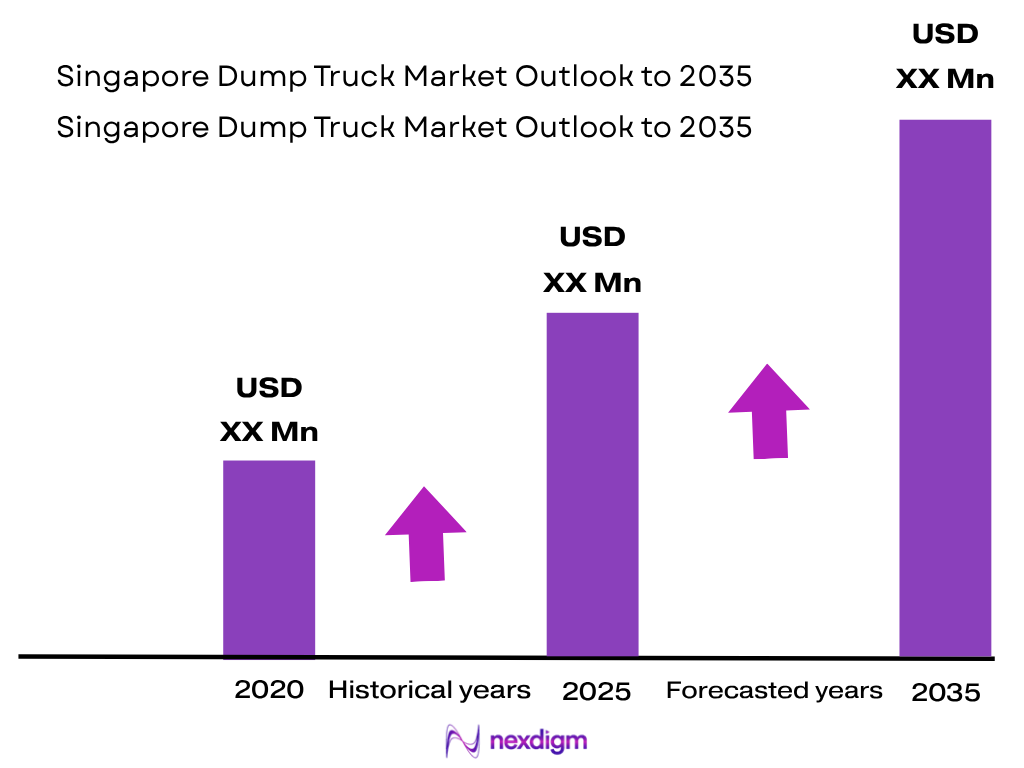
The Singapore Dump Truck Market is valued at approximately ~USD XX million, based on historical market assessment, with demand supported by civil engineering, excavation, public housing, infrastructure and construction-material transport. Singapore’s construction demand increased from S$33.8 billion to S$44.2 billion across the latest two annual periods, while the registered tipper population increased from 4,180 vehicles to 4,423 vehicles. The expansion of active tipper fleets alongside higher construction contract awards underpins demand for heavy-duty road tippers and earthmoving trucks.
Tuas-Jurong, Changi, Jurong Lake District, the Cross Island Line corridor and major HDB development areas dominate Singapore Dump Truck Market activity because they concentrate large-scale excavation, civil works, reclamation and building construction. Cross Island Line contracts include approximately S$530 million for Turf City, S$590 million for Jurong Lake District and S$480 million for Maju station works. These project clusters require sustained transportation of excavated soil, aggregates, backfill, concrete-related materials and construction debris.
Market Segmentation
By Dump Truck Type
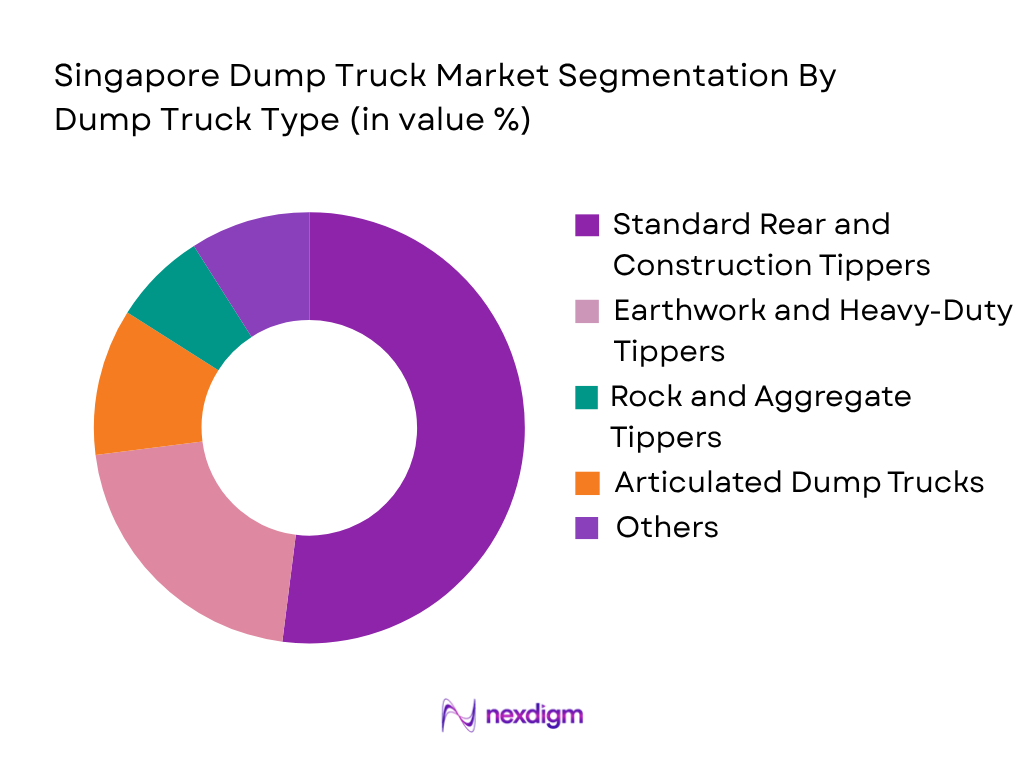
The Singapore Dump Truck Market is segmented into standard rear tippers, earthwork and heavy-construction tippers, rock and aggregate tippers, articulated dump trucks, rigid off-highway dump trucks and specialized dump trucks. Standard rear and construction tippers hold the dominant position because Singapore’s market is primarily an urban, road-connected construction environment rather than a large open-pit mining economy. Registered tippers numbered 4,423 units, with the largest concentration occurring in the 26,001–32,000 kg maximum laden weight category, which contained 3,912 tippers. This fleet structure strongly favors road-going heavy tippers suitable for excavation, civil engineering and construction-material movement. Hino’s Singapore portfolio, for example, includes a 28-ton GVW 6×4 tipper, while Scania has supplied local earthworks fleets with P-series tipper configurations. Articulated and rigid off-highway dump trucks remain important for major reclamation, earthmoving and specialized work sites, but their restricted road utility limits their addressable application base relative to registered heavy construction tippers.
By Application Type
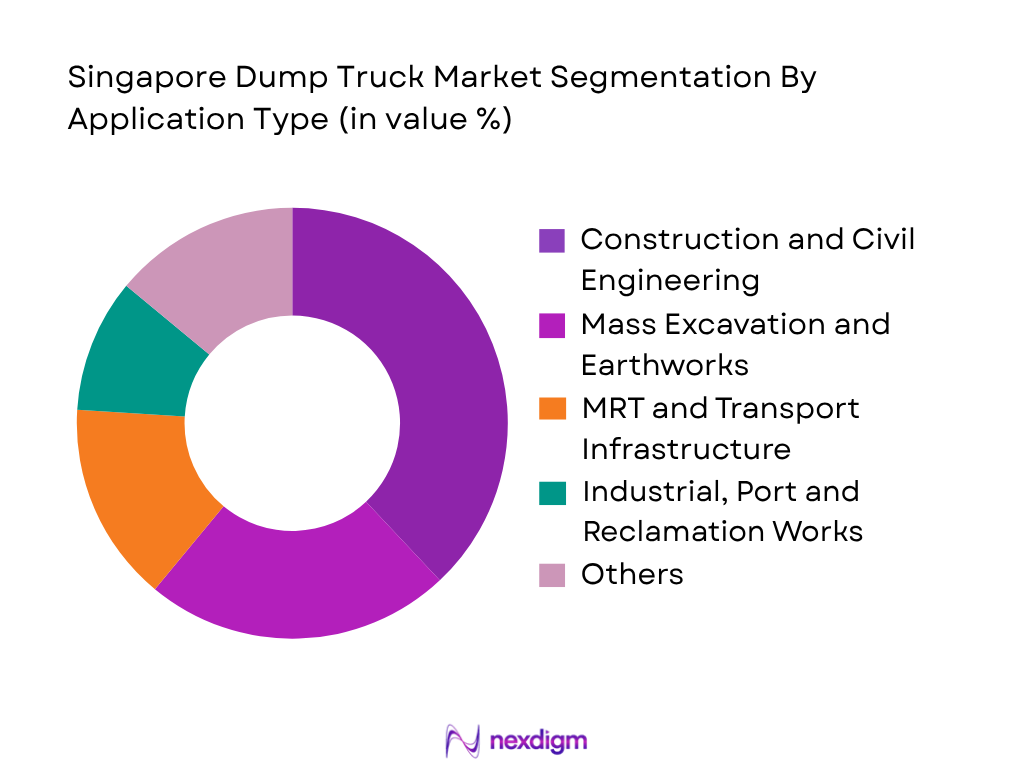
The Singapore Dump Truck Market is segmented into mass excavation and earthworks, MRT and civil engineering, public housing and building construction, road and drainage works, industrial and port development, demolition and construction-waste transportation, and other applications. Construction and civil engineering represent the dominant application because Singapore recorded S$44.2 billion of construction demand and approximately S$38.4 billion of construction output. Major transport projects also create concentrated earthmoving requirements: the Cross Island Line Jurong Lake District station contract was approximately S$590 million, Turf City station and tunnels approximately S$530 million, Maju station approximately S$480 million, and the West Coast–Jurong Lake District tunnel contract approximately S$242 million. These underground projects require excavation, disposal, aggregate delivery and backfill movements that favor high-utilization tipper fleets. Public housing, Tuas Port works, airport development, industrial projects and drainage improvements create additional recurring demand, making construction-linked transportation the primary utilization base for Singapore’s dump-truck fleet.
Competitive Landscape
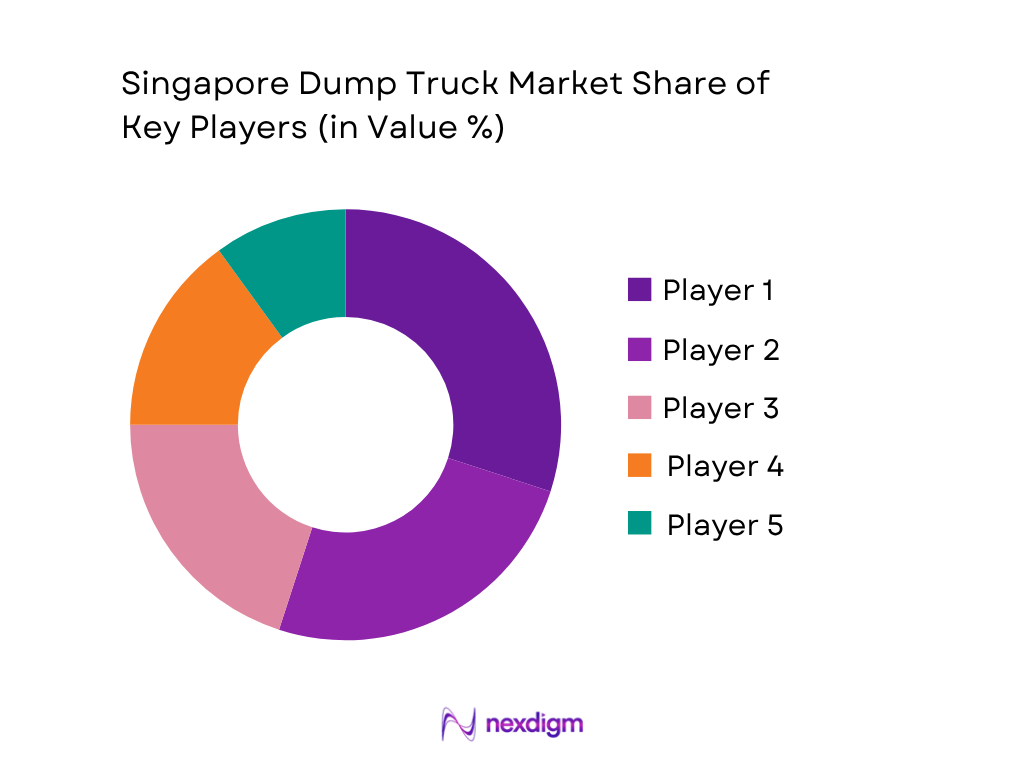
The Singapore Dump Truck Market combines Japanese and European heavy-commercial-vehicle suppliers with specialized off-highway equipment manufacturers. Hino, Volvo Trucks, Scania, Isuzu and Mitsubishi FUSO compete for road-going construction and contractor fleets, while Caterpillar, Komatsu, Volvo Construction Equipment and SANY address specialized off-highway earthmoving applications. Competition is shaped less by manufacturing footprint within Singapore and more by maximum laden weight coverage, 6×4 and 8×4 availability, drivetrain durability, body-builder compatibility, authorized workshop access, parts availability and fleet uptime support. Hino currently lists a 28-ton 6×4 tipper, while Volvo FMX covers construction, mining and quarry transport and offers diesel and electric drivetrains.
| Major Player | Establishment Year | Headquarters | Singapore Tipper Focus | GVW / Heavy-Load Capability | Construction Suitability | Transmission Capability | Electrification Readiness | Local Fleet / Service Position |
| Hino Motors | 1942 | Hino, Tokyo, Japan | ~ | ~ | ~ | ~ | ~ | ~ |
| Volvo Trucks | 1928 | Gothenburg, Sweden | ~ | ~ | ~ | ~ | ~ | ~ |
| Scania | 1891 | Södertälje, Sweden | ~ | ~ | ~ | ~ | ~ | ~ |
| Isuzu Motors | 1916 | Yokohama, Japan | ~ | ~ | ~ | ~ | ~ | ~ |
| Mitsubishi FUSO | 2003 | Kawasaki, Japan | ~ | ~ | ~ | ~ | ~ | ~ |
Singapore Dump Truck Market Analysis
Growth Drivers
Strong Construction and Civil Engineering Activity Supporting Tipper Fleet Utilization
Singapore’s sustained construction workload is a direct growth driver for the Singapore Dump Truck Market because civil engineering, building excavation, earthworks, foundation works and material movement require continuous deployment of road-going tippers. The Building and Construction Authority recorded S$44.2 billion of construction demand in 2024, comprising S$25.9 billion from the public sector and S$18.3 billion from the private sector, while construction output reached S$38.4 billion. Preliminary construction demand subsequently reached S$50.5 billion in 2025 and construction output reached S$41.7 billion, indicating a larger volume of projects progressing through Singapore’s built-environment pipeline. Material movement is equally substantial: BCA recorded 1,765.60 thousand tonnes of granite, 454.02 thousand tonnes of bulk cement and 1,205.30 thousand cubic metres of ready-mixed concrete in June 2025 alone. LTA recorded 4,423 registered tippers at the end of 2024, demonstrating the sizeable dedicated fleet serving this workload. The World Bank placed Singapore’s 2024 GDP at USD 547.39 billion and GDP per capita at USD 90,674.1, supporting the capital-intensive infrastructure and construction ecosystem that sustains tipper utilization.
Major MRT and Infrastructure Projects Creating Concentrated Earthmoving Demand
Large transport and underground civil-engineering projects are strengthening demand for dump trucks because these developments generate excavation spoil, backfill requirements, aggregates, crushed material and construction debris that must be moved between constrained worksites and approved receiving locations. The Land Transport Authority awarded the Cross Island Line Turf City station and tunnel contract at approximately S$530 million in May 2024, followed by the Jurong Lake District station and tunnel contract at approximately S$590 million in July 2024. The Maju station and tunnel contract awarded in January 2024 was approximately S$480 million. These three contracts alone represent S$1.60 billion of major underground civil works, excluding other Cross Island Line packages, road projects and infrastructure construction. BCA recorded S$6.8 billion of public civil-engineering construction demand during 2024, alongside total construction demand of S$44.2 billion. The active tipper population stood at 4,423 vehicles, showing the established haulage base available for infrastructure contractors. Singapore’s 2024 GDP was USD 547.39 billion, with GDP per capita of USD 90,674.1 according to the World Bank, providing the economic capacity to support major rail, airport, port and urban-infrastructure investment requiring heavy construction transport.
Market Challenges
Dense Road Environment and Concentration of Heavy Tippers Creating Operating Complexity
Singapore’s compact and heavily utilized road environment creates a market-specific challenge for dump truck fleets because construction tippers must operate alongside a large passenger and commercial vehicle population while accessing constrained urban worksites. The Land Transport Authority recorded 1,007,094 motor vehicles at the end of 2024, including 167,057 goods and other vehicles. Within the goods-vehicle fleet, 4,423 units were registered as tippers, and 3,912 tippers were concentrated in the 26,001–32,000 kg maximum laden weight category. The same LTA statistics recorded 16,723 Very Heavy Goods Vehicles and 31,492 Heavy Goods Vehicles excluding specified tax-exempt categories. These numbers illustrate the substantial volume of high-mass commercial equipment sharing Singapore’s road infrastructure and construction access points. Heavy tipper operators therefore need careful route planning, turning-space management, braking capability, worksite scheduling and driver coordination, particularly around MRT projects and dense building sites. The broader operating environment is supported by Singapore’s USD 547.39 billion GDP and USD 90,674.1 GDP per capita in 2024, according to the World Bank, but the intensity of development within a compact urban transport system creates higher operational complexity for dump-truck contractors.
Statutory Vehicle Lifespan and Heavy-Vehicle Fleet Renewal Requirements
Singapore’s regulated commercial-vehicle lifecycle creates a distinct challenge for the Singapore Dump Truck Market because fleet operators must coordinate vehicle replacement with statutory lifespan requirements while maintaining enough capacity for high-utilization construction contracts. The Land Transport Authority specifies a 20-year statutory lifespan for goods vehicles, after which the vehicle cannot continue renewing its Certificate of Entitlement. At the end of 2024, Singapore had 143,209 non-tax-exempt goods and other vehicles, including 4,423 tippers. The wider road-going fleet contained 31,492 Heavy Goods Vehicles and 16,723 Very Heavy Goods Vehicles, demonstrating the scale of assets progressively passing through replacement cycles. By the end of 2025, the Heavy Goods Vehicle population had increased to 32,718 vehicles, while Very Heavy Goods Vehicles reached 17,539 vehicles, even as total non-tax-exempt goods and other vehicles declined to 142,696 units. Dump-truck fleet owners therefore need to align replacements with project workload, body-builder availability, registration processes, drivetrain requirements and workshop capacity without disrupting active earthmoving contracts. Singapore’s 2024 GDP of USD 547.39 billion and GDP per capita of USD 90,674.1, reported by the World Bank, support continued construction activity, making timely fleet renewal operationally important.
Market Opportunities
Electric Heavy Dump Truck and Construction Fleet Electrification Opportunity
Singapore’s heavy-vehicle electrification framework creates a future opportunity for electric construction tippers and related heavy-duty fleet technologies, particularly for operators with predictable routes between depots, worksites and material-handling locations. The Land Transport Authority stated in 2025 that Singapore had approximately 52,000 heavy vehicles. LTA had already approved 4 sandbox trials in 2024 covering battery charging, battery swapping and mobile charging technologies for electric heavy goods vehicles. One PSA trial includes 6 electric terminal prime movers and 2 electric Inter Gateway Hauliers, while a separate Tuas battery-swapping project was designed to support up to 10 electric heavy goods vehicles. From 2026, Singapore’s electric-heavy-vehicle charging framework supports the first 500 qualifying private heavy-vehicle chargers, with each charger required to have at least 50 kW of power. In March 2026, Singapore also introduced the SS 722 charging standard with provisions covering battery swapping and mobile charging for electric heavy goods vehicles. These developments provide a foundation for construction-fleet electrification where duty cycles are technically suitable. The World Bank recorded Singapore’s 2024 GDP at USD 547.39 billion and GDP per capita at USD 90,674.1, supporting investment in advanced commercial-vehicle technology and charging infrastructure.
Higher-Capacity Tippers and Fleet Technology for Expanding Construction Workloads
Future opportunity in the Singapore Dump Truck Market is increasingly concentrated in high-productivity heavy tippers equipped with automated drivetrains, payload monitoring, fleet telematics and safety technologies because the construction workload is rising while road and worksite space remain constrained. The Building and Construction Authority recorded S$44.2 billion of construction demand and S$38.4 billion of construction output in 2024. Preliminary demand subsequently reached S$50.5 billion and output S$41.7 billion in 2025. LTA recorded 4,423 tippers at the end of 2024, of which 3,912 units were in the 26,001–32,000 kg maximum laden weight category, indicating strong existing preference for substantial road-going payload configurations. The wider Very Heavy Goods Vehicle population increased from 16,723 units in 2024 to 17,539 units in 2025, while Heavy Goods Vehicles increased from 31,492 to 32,718 units. This expanding heavy-vehicle base creates scope for onboard axle-load measurement, remote diagnostics, driver monitoring, automated manual transmissions and predictive maintenance systems that improve fleet availability. Singapore’s 2024 GDP of USD 547.39 billion and GDP per capita of USD 90,674.1, according to the World Bank, provide a strong macroeconomic base for continued fleet modernization.
Future Outlook
The Singapore Dump Truck Market is forecast to expand at approximately ~X.X% CAGR during 2026–2035, supported by public infrastructure, housing construction, transport projects and long-term fleet replacement. Demand is expected to remain concentrated in road-going heavy tippers because Singapore’s dense urban environment requires equipment that can move efficiently between construction sites and disposal or material-processing locations. Vehicle productivity, legal maximum laden weight, driver safety, emissions performance and fleet uptime will increasingly shape purchasing decisions.
Heavy construction activity provides a visible operating base for these fleets. Actual construction demand reached S$44.2 billion, and construction output was approximately S$38.4 billion. Subsequent construction demand reached S$50.5 billion, showing the scale of projects flowing through Singapore’s built-environment sector. Changi Airport Terminal 5, public housing, Cross Island Line works, Tuas Port, healthcare facilities and industrial developments form part of this activity pipeline.
Major Players
- Hino Motors, Ltd. – Hino 700 Series / 6×4 Tipper Trucks / Heavy Construction Applications
- Mitsubishi FUSO Truck and Bus Corporation – Fighter and Super Great / Heavy Commercial Tipper Platforms
- Isuzu Motors Limited – Forward and GIGA Heavy Commercial Chassis / Construction Tipper Applications
- UD Trucks Corporation – Quon Heavy-Duty Trucks / Construction and Earthwork Applications
- Volvo Trucks – FMX Heavy Construction Tippers / Earthmoving and Infrastructure Applications
- Scania AB – P-Series and XT Construction Tippers / Earthworks and Infrastructure Applications
- Mercedes-Benz Trucks – Arocs Heavy Construction Truck Platforms / Tipper Applications
- MAN Truck & Bus SE – TGS Construction Trucks / Heavy-Duty Tipper Applications
- DAF Trucks N.V. – Construction-Oriented Heavy Truck Platforms / Tipper Applications
- SINOTRUK – HOWO 6×4 and 8×4 Tipper Trucks / Construction Applications
- Shaanxi Automobile Group – SHACMAN Heavy-Duty Trucks / Tipper Applications
- Caterpillar Inc. – Off-Highway Dump Trucks / Heavy Earthmoving Applications
- Komatsu Ltd. – Rigid Dump Trucks / Off-Highway Earthmoving Applications
- Volvo Construction Equipment – Articulated Haulers / Reclamation and Earthworks Applications
- SANY Heavy Industry Co., Ltd. – Off-Highway Dump Trucks / Construction and Earthmoving Applications
Key Target Audience
- Dump Truck and Heavy Commercial Vehicle Manufacturers
- Construction and Off-Highway Equipment Manufacturers
- Earthworks and Civil Engineering Contractors
- Infrastructure and Public Works Contractors
- Heavy Commercial Vehicle Distributors and Body Builders
- Fleet Operators, Equipment Rental and Leasing Companies
- Investments and Venture Capitalist Firms
- Government and Regulatory Bodies (Land Transport Authority, Building and Construction Authority, National Environment Agency, Ministry of Manpower, Ministry of Transport, Public Utilities Board)
Research Methodology
Step 1: Identification of Key Variables
The initial phase involves constructing an ecosystem map encompassing heavy-truck OEMs, authorized distributors, body builders, earthworks contractors, infrastructure companies, rental operators and repair workshops participating in the Singapore Dump Truck Market. Critical variables include maximum laden weight, payload, axle configuration, truck population, construction activity, earthmoving intensity, replacement cycles and regulatory requirements.
Step 2: Market Analysis and Construction
Historical market analysis combines registered tipper populations with construction and civil-engineering demand, vehicle-weight categories and equipment replacement patterns. Bottom-up assessment measures fleets by truck type, weight class, application and customer category, while the top-down framework assesses the construction pipeline, infrastructure activity and overall commercial-vehicle ecosystem to establish a consistent market structure.
Step 3: Hypothesis Validation and Expert Consultation
Market hypotheses are validated through structured CATIs and consultations with commercial-vehicle distributors, construction contractors, earthworks companies, body builders, equipment operators and fleet-service specialists. These interactions assess fleet sizes, replacement behaviour, preferred payload configurations, drivetrain selection, utilization intensity, repair requirements and supplier-selection factors to corroborate findings derived from secondary research.
Step 4: Research Synthesis and Final Output
The final stage triangulates primary inputs with Land Transport Authority vehicle statistics, Building and Construction Authority construction indicators and infrastructure-project information. Fleet-based bottom-up calculations are reconciled with supply-side truck portfolios and construction demand. This process generates the final market sizing, segmentation framework, competitive landscape, customer assessment and outlook for the Singapore Dump Truck Market.

- Executive Summary
- Research Methodology (Market Definition and Scope, Singapore Dump Truck and Tipper Taxonomy, On-Road Tipper and Off-Highway Dump Truck Classification, Heavy Goods Vehicle and Very Heavy Goods Vehicle Mapping, Maximum Laden Weight Assessment, GVW and Payload Capacity Mapping, Axle Configuration Assessment, Dump Body Configuration Assessment, Construction and Earthworks Application Mapping, Registered Goods Vehicle Fleet Assessment, New Dump Truck Registration Assessment, Vehicle Deregistration and Replacement Cycle Analysis, Contractor Fleet Mapping, Authorized Distributor and Workshop Assessment, Market Sizing Framework)

- Definition and Scope
- Singapore Dump Truck and Tipper Industry Evolution and Construction Fleet Development
- Dump Truck Chassis, Body-Building and Hydraulic Integration Process
- Dump Truck Value Chain Analysis
- Singapore Dump Truck Supply Chain Analysis
- Engine, Transmission, Axle, Suspension, PTO, Hydraulic Hoist and Tipper Body Ecosystem Analysis
- Singapore Commercial Vehicle Import, Registration and Body-Upfitting Footprint Assessment
- OEM, Authorized Distributor, Earthworks Contractor, Rental Fleet and Workshop Framework

- Growth Drivers (Strong Construction Contract Pipeline, Cross Island Line Civil Works, Changi Airport Infrastructure Development, Tuas Port Development, Public Housing Construction, Road and Drainage Works, Industrial Development, High Earthmoving Requirement)
- Market Challenges (Limited Urban Road Space, Very Heavy Vehicle Operating Constraints, COE-Linked Fleet Procurement, Twenty-Year Goods Vehicle Lifespan, Class 4 Driver Availability, Covered-Load Compliance, Construction Site Access Restrictions, High Fleet Uptime Requirements)
- Market Opportunities (Electric Construction Tippers, High-Payload 6×4 and 8×4 Tippers, Automated Manual Transmission Adoption, Connected Fleet Management, Onboard Load Monitoring, Construction Waste Haulage, Long-Term Fleet Maintenance Contracts, Contractor Fleet Renewal)
- Market Trends (Euro VI Heavy Truck Adoption, Chinese Heavy Truck Brand Expansion, Automated Transmission Adoption, Contractor-Owned Tipper Fleets, Fleet Telematics, Camera-Based Safety Systems, Electric Commercial Vehicle Trials, Lightweight Tipper Bodies)
- Regulatory and Standards Landscape (Land Transport Authority Goods Vehicle Registration, Heavy Goods Vehicle Classification, Very Heavy Goods Vehicle Classification, Maximum Laden Weight Requirements, Vehicle Approval Code Framework, Certificate of Entitlement Requirements, Twenty-Year Goods Vehicle Lifespan, Periodic Vehicle Inspection, National Environment Agency Covered-Load Requirements, Earth Control Measures, Ministry of Manpower Heavy-Truck Driver Requirements)
- SWOT Analysis
- Porter’s Five Forces Analysis
- PESTLE Analysis
- Stakeholder Ecosystem
- Competition Ecosystem

- By Market Value (2020-2025)
- By New Dump Truck and Tipper Registrations (2020-2025)
- By Active Dump Truck Fleet (2020-2025)
- By On-Road Tipper Units (2020-2025)
- By Very Heavy Dump Truck Units (2020-2025)
- By Off-Highway and Engineering Plant Units (2020-2025)

- By Dump Truck Type (In Value %)
Standard Rear Tippers
Earthwork Tippers
Heavy-Duty Construction Tippers
Rock and Aggregate Tippers
Demolition and Debris Tippers
High-Sided Material Tippers
Articulated Dump Trucks
Rigid Off-Highway Dump Trucks
Specialized Dump Trucks - By Maximum Laden Weight and Payload Capacity (In Value %)
3,501–7,500 kg MLW
7,501–12,000 kg MLW
12,001–16,000 kg MLW
Above 16,000 kg MLW
16–24 Ton GVW
24–28 Ton GVW
28–34 Ton GVW
Above 34 Ton GVW
Off-Highway Rated Payload Classes - By Application Type (In Value %)
Mass Excavation and Earthworks
MRT Station and Tunnel Construction
Road and Highway Improvement Works
Public Housing Construction
Commercial and Mixed-Use Construction
Industrial and Data Centre Development
Tuas Port and Reclamation Works
Airport Infrastructure Development
Drainage and Utility Construction
Demolition and Construction Waste Transportation
Sand, Granite and Aggregate Transportation
Ready-Mix and Building Material Logistics
Site Formation and Backfilling
Municipal and Public Works - By Powertrain Type (In Value %)
Diesel Manual Transmission Dump Trucks
Diesel Automated Manual Transmission Dump Trucks
Diesel Automatic Transmission Dump Trucks
Euro VI Heavy-Duty Tippers
Battery Electric Dump Trucks
Battery Electric Construction Trucks
Hybrid and Electrified Heavy Trucks
Alternative-Fuel Heavy Trucks
Off-Highway Diesel-Electric Haulers - By Sales Channel (In Value %)
Large Contractor Direct Procurement
Earthworks Contractor-Owned Fleets
Infrastructure Contractor Fleets
Authorized Heavy Truck Distributors
Commercial Vehicle Dealer Sales
Rental Fleet Procurement
Operating Lease and Finance Lease
Used Dump Truck Dealers
Vehicle Auction and Fleet Disposal Channels
Body Builder and Chassis Integration Channels - By Operating Corridor (In Value %)
Tuas and Jurong Industrial Corridor
Changi and Airport Development Corridor
Woodlands and Northern Gateway Corridor
Jurong Lake District
Punggol and Northeast Development Corridor
Central and North-South Corridor
Cross Island Line Construction Corridor
Islandwide HDB Development Sites
Other Urban Construction Locations

- Market Share of Major Players (By Revenue, New Registrations, Dump Truck Type, Maximum Laden Weight, Axle Configuration, Application, Distributor Channel, Fleet Customer Type)
- Cross Comparison Parameters (On-Road Tipper and Heavy Construction Truck Portfolio Breadth, Singapore HGV and VHGV Maximum Laden Weight Coverage, 4×2-6×4-8×4 Axle and Tipper Configuration Capability, Earthworks MRT Road Construction and Reclamation Application Coverage, Euro VI Automated Transmission and Electric-Truck Technology Capability, Singapore Authorized Distributor Workshop Parts and Mobile-Service Network Strength, Telematics Driver-Safety Payload-Monitoring and Fleet-Uptime Capability, COE Fleet-Replacement Body-Upfitting and Local Contractor Support Strength)
- SWOT Analysis of Major Players
- Pricing and Distribution Network Benchmarking
- Detailed Profiles of Major Companies
Hino Motors, Ltd. – Hino 700 Series / 6×4 Tipper Trucks / Heavy Construction Applications
Mitsubishi FUSO Truck and Bus Corporation – Fighter and Super Great / Heavy Commercial Tipper Platforms
Isuzu Motors Limited – Forward and GIGA Heavy Commercial Chassis / Construction Tipper Applications
UD Trucks Corporation – Quon Heavy-Duty Trucks / Construction and Earthwork Applications
Volvo Trucks – FMX Heavy Construction Tippers / Earthmoving and Infrastructure Applications
Scania AB – P-Series and XT Construction Tippers / Earthworks and Infrastructure Applications
Mercedes-Benz Trucks – Arocs Heavy Construction Truck Platforms / Tipper Applications
MAN Truck & Bus SE – TGS Construction Trucks / Heavy-Duty Tipper Applications
DAF Trucks N.V. – CF and Construction-Oriented Heavy Truck Platforms / Tipper Applications
SINOTRUK – HOWO TX 6×4 and 8×4 Tipper Trucks / Construction and Infrastructure Applications
Shaanxi Automobile Group – SHACMAN Heavy-Duty Trucks / Construction and Tipper Applications
Caterpillar Inc. – Off-Highway Dump Trucks / Heavy Earthmoving and Specialized Construction Applications
Komatsu Ltd. – Rigid Dump Trucks / Heavy Earthmoving and Off-Highway Applications
Volvo Construction Equipment – Articulated Haulers / Reclamation, Earthworks and Heavy Construction Applications
SANY Heavy Industry Co., Ltd. – Off-Highway and Heavy-Duty Dump Trucks / Construction and Earthmoving Applications

- Dump Truck Fleet Buyer Segmentation
- Earthworks and Civil Engineering Contractor Procurement Behaviour
- Dump Truck OEM and Distributor Selection Criteria
- Fleet Buyer and Operator Pain Points
- Maximum Laden Weight, Axle Configuration and Powertrain Adoption Assessment
- Fleet Replacement, Leasing and Repurchase Behaviour

- By Market Value (2026-2035)
- By New Dump Truck and Tipper Registrations (2026-2035)
- By Active Dump Truck Fleet (2026-2035)
- By On-Road Tipper Units (2026-2035)
- By Very Heavy Dump Truck Units (2026-2035)
- By Off-Highway and Engineering Plant Units (2026-2035)


 Request a Sample
 Ask for Customization
 Get a Quote
 Enquire Now