

 Download PDF
Market Overview
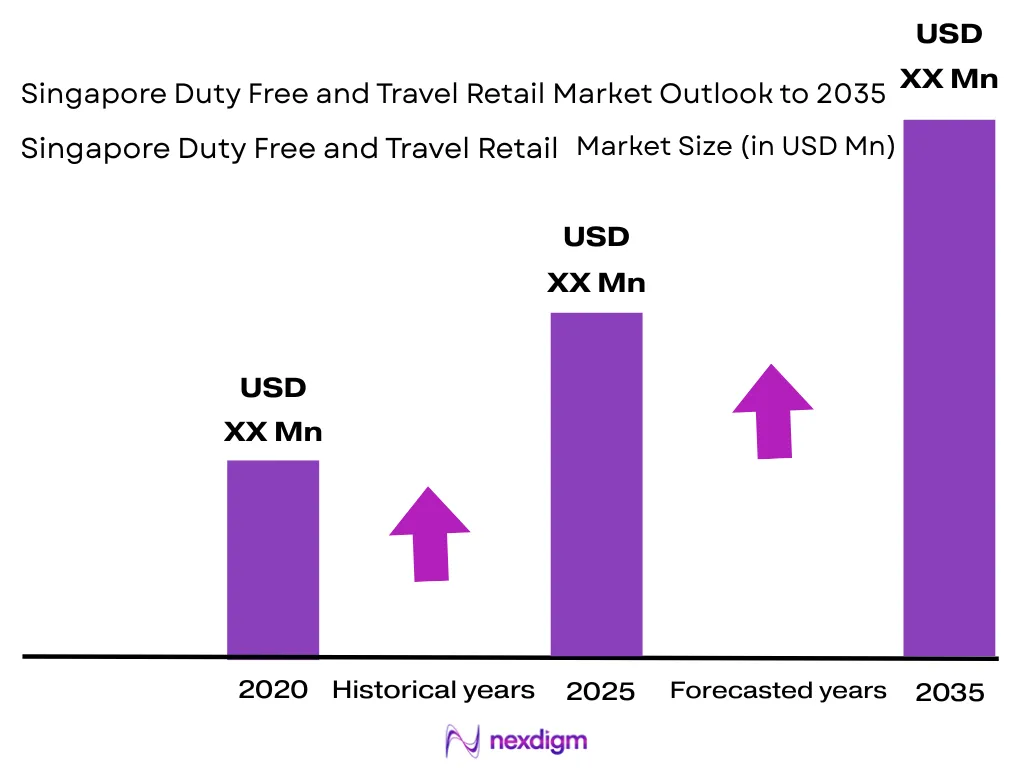
The Singapore Duty Free and Travel Retail Market is valued at ~ million, based on a five-year historical assessment, and is forecasted to grow at 7.1% CAGR through the long-term outlook period. Demand is driven by Changi Airport passenger traffic rising from ~ million to ~ million, tourism receipts reaching SGD 22.4 billion from January to September, and concession sales improving alongside luxury, liquor, tobacco, perfumes and cosmetics purchases.
Singapore’s duty free and travel retail activity is concentrated around Changi Airport, Jewel Changi Airport, Marina Bay, Orchard Road, Sentosa and cruise-terminal corridors because these hubs combine air arrivals, transfer traffic, luxury malls, hotel clusters, cruise passengers and GST-refund-linked tourist shopping. Changi handled 366,000 aircraft movements, while international visitor arrivals reached 16.5 million, with Mainland China, Indonesia, India, Australia and Malaysia forming the strongest source markets for travel retail demand.
Market Segmentation
By Product Category
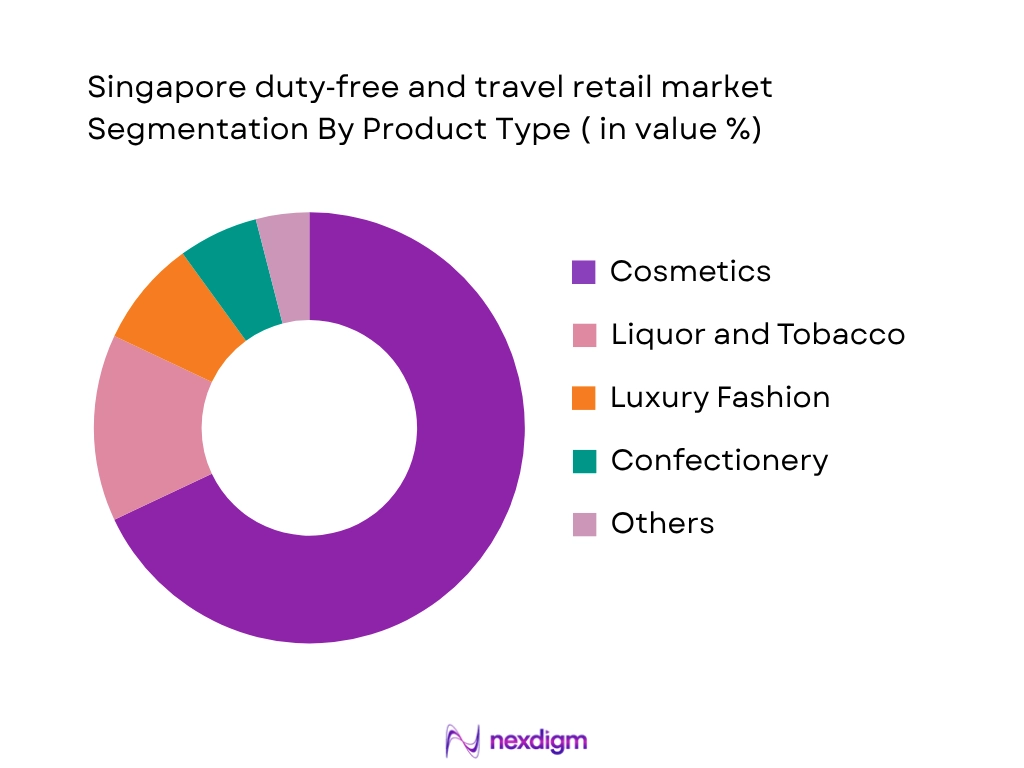
Singapore Duty Free and Travel Retail Market is segmented by product category into beauty, perfumes and cosmetics; liquor and tobacco; luxury fashion, watches and jewellery; confectionery and food gifts; electronics and travel gadgets; and convenience, wellness and travel essentials. Recently, beauty, perfumes and cosmetics have a dominant market share in Singapore under product category, due to the depth of prestige skincare, fragrance testing, travel-exclusive packs and duty-free beauty counters at Changi. The Shilla Duty Free operates cosmetics and perfumes stores across all four Changi terminals, offering beauty brands and travel-retail-exclusive products, which strengthens category leadership. Beauty purchases benefit from repeat replenishment, gifting, impulse sampling and high conversion among China, India, Indonesia, Japan and South Korea travellers. Liquor and tobacco remain major sales drivers, but tobacco is restricted for inbound concessions, while beauty has wider traveller eligibility and broader gifting appeal.
By Distribution Channel
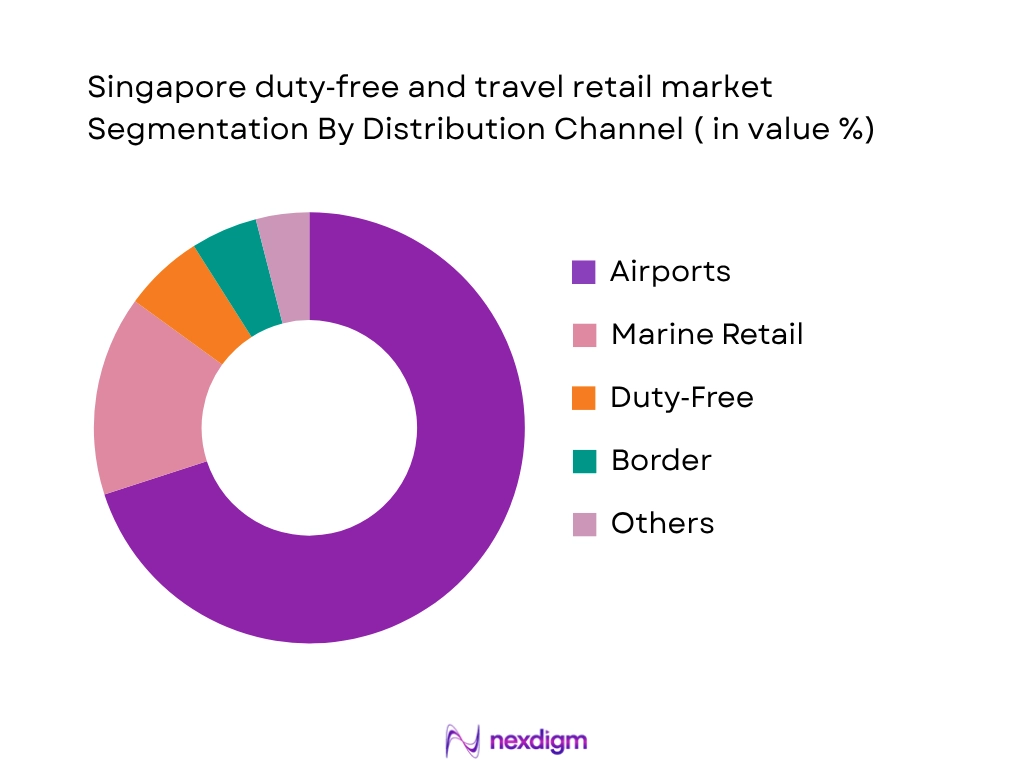
Under distribution channels, Singapore’s travel retail market comprises airport retail, cruise & marine retail, downtown duty‑free, border/other travel hubs, and online pre‑order with pickup options. Airport retail dominates in 2024 with the largest share of duty‑free sales, primarily driven by Singapore Changi Airport’s global transit traffic, high passenger volumes, and premium retail environment that encourages spend per passenger. Changi accounts for over 70% of travel retail sales due to world‑class infrastructure, retail mix, and exclusive brand partnerships that attract international passengers. Cruise & marine retail is the next leading channel, supported by Singapore’s position as a major regional cruise hub, while downtown and other channels remain smaller but strategic complements to airport retail offerings.
Competitive Landscape
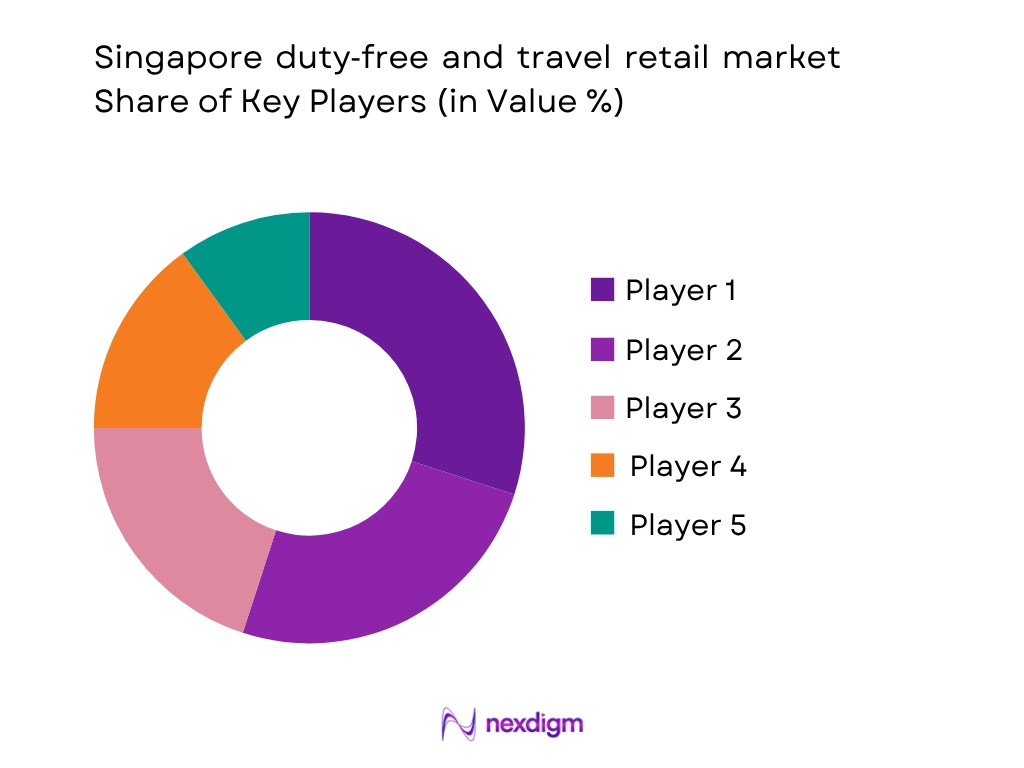
The Singapore Duty Free and Travel Retail Market is concentrated around Changi Airport’s concession ecosystem, where Lotte Duty Free, The Shilla Duty Free, DFS Group, Dufry/Avolta and Lagardère Travel Retail are key international operators. Competition is shaped by concession rights, terminal footprint, brand portfolio, luxury category access, online pre-order capability and passenger conversion. Changi Airport Group influences the market through concession awards, terminal retail planning, Jewel integration, digital commerce and passenger-experience-led retail activation.
| Company | Establishment Year | Headquarters | Core Singapore Category | Terminal / Location Presence | Digital Capability | Traveller Cohort Focus | Market-Specific Strength | Competitive Position |
| Lotte Duty Free | 1980 | Seoul, South Korea | ~ | ~ | ~ | ~ | ~ | ~ |
| The Shilla Duty Free | 1986 | Seoul, South Korea | ~ | ~ | ~ | ~ | ~ | ~ |
| DFS Group | 1960 | Hong Kong | ~ | ~ | ~ | ~ | ~ | ~ |
| Dufry / Avolta | 1865 / 2023 rebrand | Basel, Switzerland | ~ | ~ | ~ | ~ | ~ | ~ |
| Lagardère Travel Retail | 1852 group origin | Paris, France | ~ | ~ | ~ | ~ | ~ | ~ |
Singapore Duty Free and Travel Retail Market
Growth Drivers
Passenger Traffic Recovery at Changi Airport Supporting Airside Retail Conversion
Singapore Duty Free and Travel Retail Market is supported by strong air-passenger flow through Changi Airport, which directly increases exposure for perfumes, cosmetics, liquor, confectionery, watches, jewellery, travel essentials and click-and-collect purchases. Changi Airport recorded 69.98 million passenger movements and 374,000 commercial aircraft movements in 2025, while January-April 2026 already recorded 23.3 million passenger movements and 126,000 commercial aircraft movements. The macro base is also strong: World Bank reported Singapore GDP at USD 547.39 billion and GDP per capita at USD 90,674.1 in 2024. This supports premium airport retail categories because passenger recovery is paired with high domestic purchasing capacity and a globally connected hub economy.
Tourism Receipts and Source-Market Diversity Supporting Luxury, Beauty and Gifting Purchases
Singapore’s travel retail is driven by inbound tourism, especially beauty, fragrance, food gifts, premium alcohol, luxury accessories and Singapore-origin souvenirs. STB reported 16.5 million international visitor arrivals in 2024, while tourism receipts reached SGD 22.4 billion from January to September 2024. In 2025, visitor arrivals reached 16.9 million, led by Mainland China with 3.1 million, Indonesia with 2.4 million, Malaysia with 1.3 million, Australia with 1.3 million, and India with 1.2 million. These source markets are important for Changi retail because they create different baskets: China for beauty and luxury, Indonesia for gifting, India for liquor and family shopping, and Australia for long-haul travel retail. World Bank’s 2024 GDP per capita of USD 90,674.1 supports premium positioning.
Market Challenges
Duty-Free Concession Rules Limiting Tobacco and Inbound Liquor Conversion
Singapore Duty Free and Travel Retail Market faces regulatory limitations because concessions are not uniform across categories and traveller routes. Singapore Customs states that duty-free concessions are granted only on liquor for personal consumption, there is no duty-free concession for travellers arriving from Malaysia, and cigarettes and tobacco products receive no duty-free concession and no GST import relief. GST import relief is capped at S$500 for travellers away 48 hours or more and S$100 for travellers away less than 48 hours, excluding liquor and tobacco. This limits inbound conversion for tobacco and creates passenger education needs. IMF also reported Singapore’s current account surplus at 17.5 of GDP in 2024, reflecting strong cross-border flows but not removing category-level compliance friction.
High Dependence on International Travel Cycles and Source-Market Volatility
Travel retail demand is highly exposed to changes in air capacity, visitor arrivals, geopolitical disruption and nationality mix. Changi handled 69.98 million passenger movements in 2025, but January-April 2026 recorded 23.3 million, showing continued dependence on monthly route performance and travel seasonality. STB’s 2025 source-market data shows concentration in Mainland China with 3.1 million visitors, Indonesia with 2.4 million, and India with 1.2 million, making beauty, liquor and gifting sales sensitive to travel patterns from a small set of major markets. Singapore’s macro position is resilient, with World Bank GDP of USD 547.39 billion in 2024, but airport concessionaires still face demand risk when flight routes, transit traffic or visitor spending patterns shift.
Market Opportunities
Omnichannel Airport Retail Expansion Through Pre-Order, Click-and-Collect and Freight-Backed Fulfilment
Singapore has a clear opportunity to expand airport e-commerce, pre-order, click-and-collect, and travel-linked fulfilment because passenger traffic and logistics capacity remain strong. Changi recorded 23.3 million passenger movements from January-April 2026, alongside 706,000 tonnes of airfreight movements during the same period. This supports airport retail models where travellers browse before departure, reserve beauty or liquor products, and collect at terminal stores. The macro environment also supports digital and premium retail investment: World Bank reported Singapore GDP at USD 547.39 billion and GDP per capita at USD 90,674.1 in 2024. Retailers can use this base to deepen iShopChangi integration, flight-linked promotions, inventory visibility and loyalty-linked fulfilment without depending only on walk-in terminal traffic.
Premium Destination Retail Growth Through Tourism Receipts and Local-Gifting Categories
Singapore Duty Free and Travel Retail Market has future growth potential in premium local gifting, beauty, wellness, confectionery, tea, souvenirs and destination-led products because tourism spending remains strong. STB reported 2025 visitor arrivals of 16.9 million, with tourism receipts from January to September 2025 putting full-year performance on track to exceed S$29.0 billion to S$30.5 billion. Mainland China, Indonesia and Australia were the top tourism-receipt markets, contributing S$3.68 billion, S$2.09 billion and S$1.54 billion, respectively. This supports airport-exclusive gift packs, Singapore-origin brands, premium food souvenirs and wellness products at Changi, Jewel and cruise-linked retail zones. World Bank’s 2024 GDP per capita of USD 90,674.1 further supports premium local-brand positioning and high-service retail concepts.
Future Outlook
The Singapore Duty Free and Travel Retail Market is expected to grow steadily as Changi Airport passenger traffic, international visitor arrivals, transfer traffic, cruise activity and premium travel spending continue to recover. Growth will be driven by beauty, fragrances, luxury fashion, watches, premium liquor, food gifting, airport e-commerce and experiential retail. Retailers will increasingly combine airside stores with pre-order, click-and-collect, loyalty data, flight-linked promotions and traveller nationality targeting.
Major Players
- Lotte Duty Free
- The Shilla Duty Free
- DFS Group
- Dufry / Avolta
- iShopChangi
- Changi Airport Group Retail
- Lagardère Travel Retail
- WHSmith
- 7-Eleven Singapore Travel Retail
- Guardian Health and Beauty
- Charles & Keith
- TWG Tea
- Bengawan Solo
- Eu Yan Sang
- Apple Premium Reseller / Electronics Retailers
Key Target Audience
- Duty-free concessionaires and travel retail operators
- Airport retail landlords and terminal commercial teams
- Luxury, beauty, liquor and tobacco brand owners
- Airport e-commerce platforms and click-and-collect operators
- Cruise terminal retailers and ferry terminal operators
- Payment providers, loyalty platforms and travel retail technology firms
- Investments and venture capitalist firms
- Government and regulatory bodies
Research Methodology
Step 1: Identification of Key Variables
The initial phase involves constructing an ecosystem map encompassing all major stakeholders within the Singapore Duty Free and Travel Retail Market. This includes airport operators, concessionaires, luxury brands, beauty brands, liquor suppliers, cruise retail operators, customs authorities, payment providers and traveller cohorts. The objective is to identify key variables such as passenger traffic, category mix, retail format, GST relief, duty-free concessions and terminal sales density.
Step 2: Market Analysis and Construction
In this phase, historical data is compiled and analyzed for the Singapore Duty Free and Travel Retail Market. This includes passenger movement, visitor arrivals, tourism receipts, concession sales trends, terminal retail structure, airport e-commerce performance and source-market composition. Market estimates are validated through top-down market sizing and bottom-up mapping of product categories, retail formats, operators and passenger segments.
Step 3: Hypothesis Validation and Expert Consultation
Market hypotheses are developed and validated through computer-assisted telephone interviews with travel retail operators, airport commercial managers, beauty category heads, liquor brand managers, luxury retailers, cruise retail stakeholders and airport e-commerce specialists. These consultations provide operational insights into basket size, conversion rate, concession economics, category demand and traveller nationality preferences.
Step 4: Research Synthesis and Final Output
The final phase involves synthesizing secondary data, operator benchmarking, concession mapping, regulatory review and stakeholder interviews. Direct engagement with retailers and brand partners is used to validate product categories, traveller cohorts, competitive positioning and future growth channels. The output provides a structured market assessment covering size, segmentation, competition, future outlook, target audiences and strategic recommendations.

- Executive Summary
- Research Methodology (Market definitions and assumptions, abbreviations, duty-free and duty-paid scope, airside and landside retail classification, airport terminal mapping, cruise terminal mapping, downtown travel retail scope, concession revenue triangulation, passenger traffic normalization, spend-per-passenger modelling, category-level basket analysis, mystery shopping audit, retailer and brand interviews, airport concession benchmarking, limitations and future conclusions)

- Definition and Scope
- Overview Genesis
- Timeline of Major Players
- Business Cycle
- Supply Chain and Value Chain Analysis

- Growth Drivers (International visitor arrivals, Changi passenger traffic, airport-wide concession sales, tourism receipts, regional flight connectivity, premium brand mix, cruise recovery)
- Market Challenges (GST and duty-free allowance complexity, tobacco restriction, high concession cost, labour intensity, airport rent pressure, passenger dwell-time competition)
- Opportunities (Luxury travel retail, airport e-commerce, cruise retail, destination souvenirs, omnichannel loyalty, experiential brand zones)
- Market Trends (Premiumization, click-and-collect, local gifting, experiential stores, passenger data analytics, luxury boutique expansion)
- Government Regulation (Singapore Customs rules, GST relief, duty-free concession, alcohol allowance, tobacco restrictions, prohibited and controlled goods, passenger declaration)
- SWOT Analysis
- Stakeholder Ecosystem
- Porter’s Five Forces
- Competition Ecosystem

- By Retail Sales Value (2020-2025)
- By Gross Merchandise Value (2020-2025)
- By Average Basket Size (2020-2025)

- By Product Category (In Value %)
Beauty, Fragrances and Cosmetics
Liquor and Spirits
Tobacco and Reduced-Risk Nicotine Products
Luxury Fashion, Leather Goods and Accessories
Watches and Jewellery - By Retail Format (In Value %)
Core Duty-Free Stores
Mono-Brand Luxury Boutiques
Multi-Brand Specialty Stores
Convenience and Travel Essentials Stores
Pop-Up and Experiential Retail Stores - By Traveller Type (In Value %)
Departing Singapore Residents
Arriving Singapore Residents
International Tourists
Transfer and Transit Passengers
Business Travellers - By Location (In Value %)
Changi Airport Terminal 1
Changi Airport Terminal 2
Changi Airport Terminal 3
Changi Airport Terminal 4
Jewel Changi Airport

- Market Share of Major Players (Retail sales value, concession sales value, terminal footprint, product category contribution, online sales share)
- Cross Comparison Parameters (Changi terminal footprint, product category specialization, concession contract strength, luxury brand portfolio, omnichannel and iShopChangi integration, passenger conversion capability, travel-exclusive SKU depth, Customs and GST compliance capability)
- SWOT Analysis of Major Players (Concession strength, brand access, digital capability, operating cost exposure, category dependence, traveller nationality exposure)
- Pricing Analysis Basis SKUs (Premium whisky, cognac, fragrance, skincare, lipstick, handbag, watch, chocolate gift pack, electronics accessory)
- Detailed Profiles of Major Companies
Lotte Duty Free
The Shilla Duty Free
DFS Group
Dufry / Avolta
iShopChangi
Changi Airport Group Retail
Lagardère Travel Retail
WHSmith
Eleven Singapore Travel Retail
Guardian Health and Beauty
Charles & Keith
TWG Tea
Bengawan Solo
Eu Yan Sang
Apple Premium Reseller / Electronics Retailers

- International Tourist Buyer Analysis
- Departing Resident Buyer Analysis
- Arriving Resident Buyer Analysis
- Transfer and Transit Passenger Analysis
- Business Traveller Analysis

- By Retail Sales Value (2026-2035)
- By Gross Merchandise Value (2026-2035)
- By Average Basket Size (2026-2035)


 Request a Sample
 Ask for Customization
 Get a Quote
 Enquire Now