
 Download PDF
Market Overview
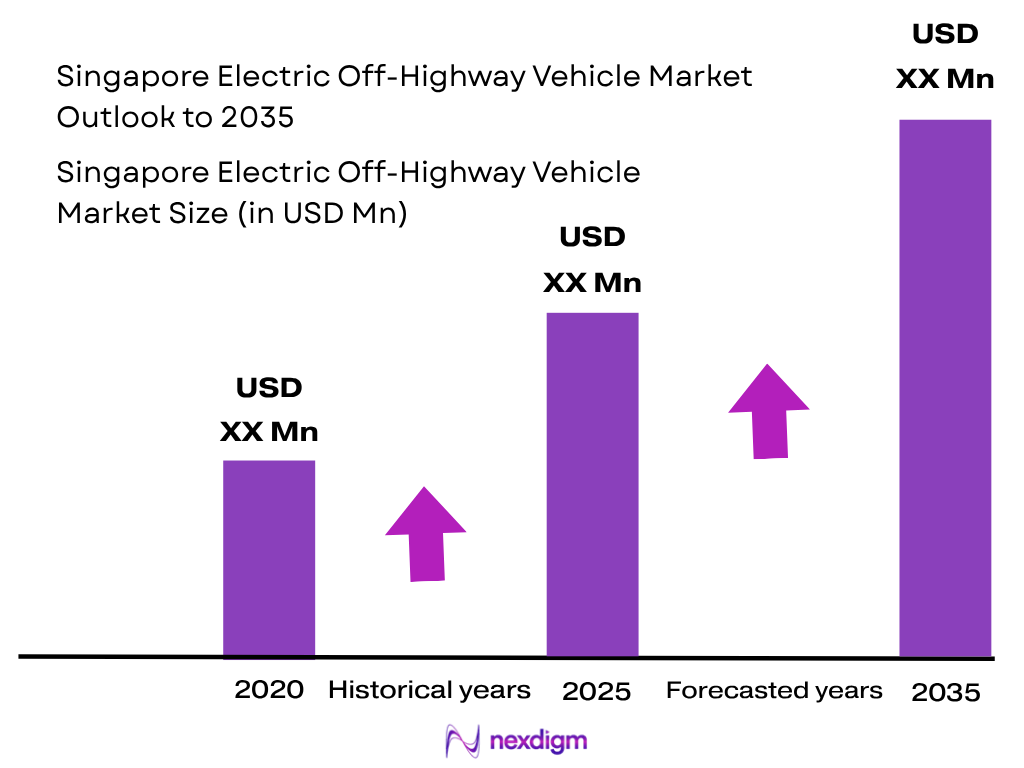
The Singapore Electric Off-Highway Vehicle Market is supported by the country’s large manufacturing, logistics, port and warehouse ecosystem. Singapore’s GDP at current market prices reached S$731.4 billion, while gross fixed capital formation reached S$160.2 billion. Manufacturing output was S$413.0 billion, with 9,858 manufacturing establishments and 352,361 workers, providing a substantial industrial base for material-handling equipment and electrically powered industrial vehicles. Manufacturing also expanded by 4.3 during the period, while construction grew by 4.4 in the fourth quarter.
The market is additionally influenced by Singapore’s role as a global maritime and aviation hub. Tuas Port incorporates electrified AGVs and automated yard cranes, with operations managed remotely from the Tuas Port Control Centre. PSA is also working with technology partners on scalable AGV and automation solutions and plans to use private 5G connectivity for AGVs and automated cranes.
Market Segmentation
By Vehicle Type
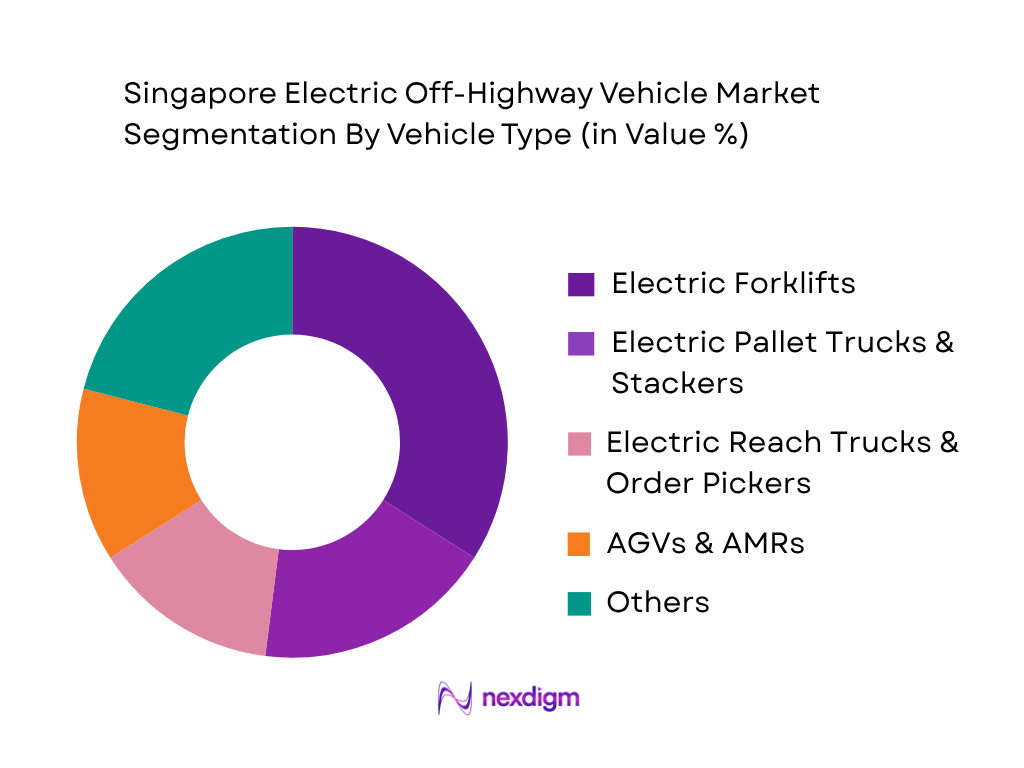
The market is segmented into electric forklifts, electric pallet trucks and stackers, electric reach trucks and order pickers, AGVs and AMRs, electric terminal tractors and cargo tractors, electric construction equipment, and other specialized electric off-highway vehicles. Electric forklifts represent the leading equipment category because they address a wide range of indoor and outdoor material-handling requirements across manufacturing, logistics, warehousing, food processing and industrial operations. Singapore’s substantial manufacturing base provides a large installed application environment, while the transition toward cleaner industrial operations favors battery-electric equipment. Jungheinrich Singapore, for example, offers electric forklifts from compact three-wheel models through equipment capable of handling loads up to 5 tonnes, alongside lithium-ion technology and automated logistics solutions.
By Application
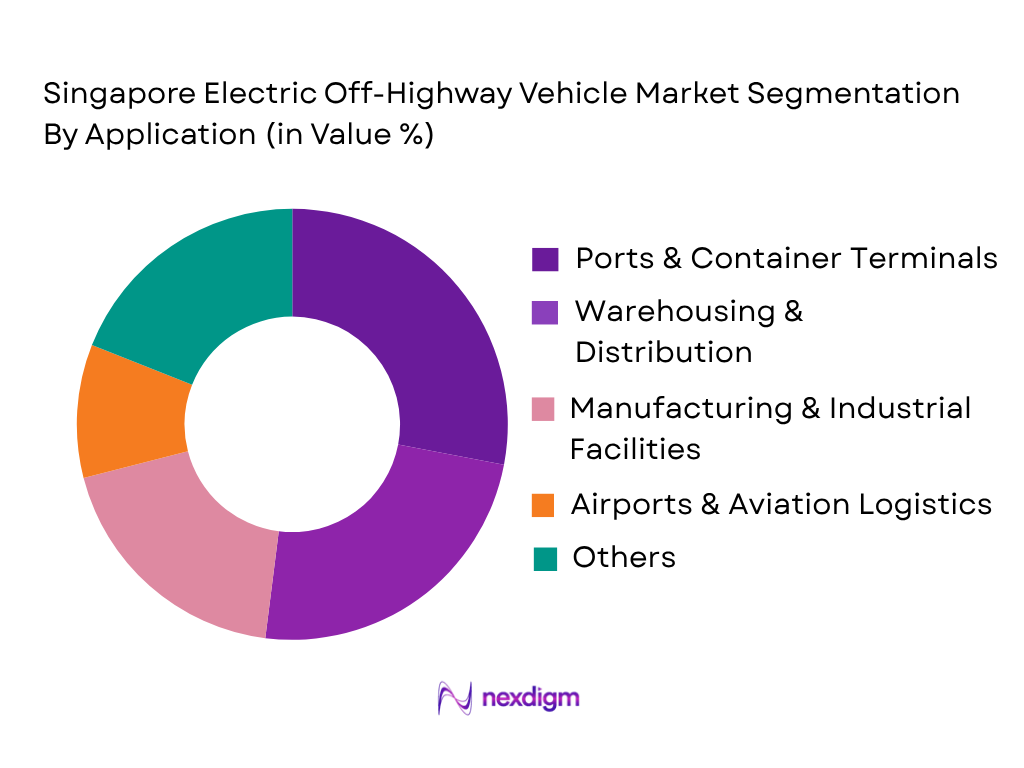
The market is segmented into ports and container terminals, airports and aviation logistics, warehousing and distribution, manufacturing and industrial facilities, construction and infrastructure, logistics and e-commerce fulfilment, municipal and environmental services, and other specialized applications. Ports and container terminals represent the leading application because Singapore’s maritime infrastructure is among the country’s most technology-intensive operating environments. Tuas Port’s use of electrified AGVs, automated cranes, private 5G and remote operations creates direct demand for electric off-highway vehicles while simultaneously establishing an ecosystem for autonomous fleet management. MPA states that electrified equipment including quay cranes, yard cranes and AGVs is being deployed at Tuas Port, making port operations a central pathway for industrial electrification.
Competitive Landscape
Singapore’s electric off-highway vehicle market is characterized by a combination of global material-handling manufacturers, Asian electric-equipment specialists, automation providers and equipment distributors. Competition is increasingly shifting from individual vehicle specifications toward integrated solutions encompassing lithium-ion batteries, charging systems, fleet-management software, autonomous operation, maintenance and warehouse automation. Jungheinrich, Mitsubishi Logisnext and BYD already demonstrate established Singapore-facing electric-equipment offerings, while the port ecosystem creates additional opportunities for suppliers capable of combining electrification with automation.
| Company | Est. | Headquarters | Key Electric Equipment | Battery Technology | Automation Capability | Singapore Market Presence | Aftermarket Capability |
| Toyota Industries / Toyota Material Handling | 1926 | Kariya, Japan | ~ | ~ | ~ | ~ | ~ |
| KION Group | 2006 | Frankfurt, Germany | ~ | ~ | ~ | ~ | ~ |
| Jungheinrich | 1953 | Hamburg, Germany | ~ | ~ | ~ | ~ | ~ |
| Mitsubishi Logisnext | 1937 | Kyoto, Japan | ~ | ~ | ~ | ~ | ~ |
| BYD | 1995 | Shenzhen, China | ~ | ~ | ~ | ~ | ~ |
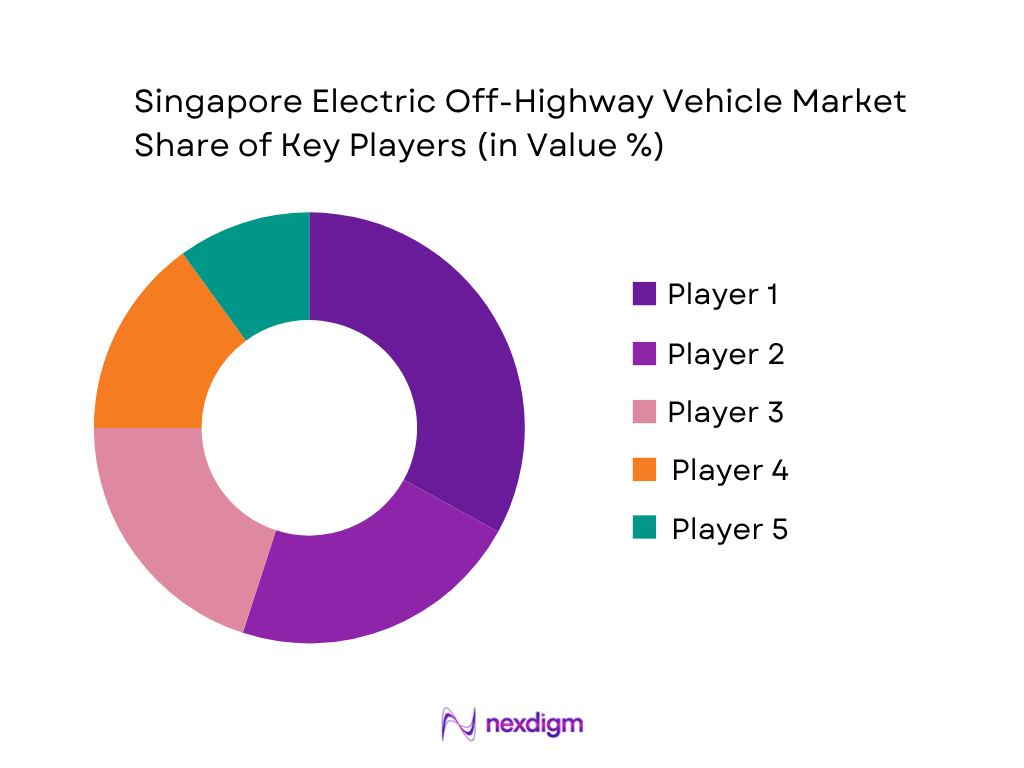
Singapore Electric Off-Highway Vehicle Market Analysis
Growth Drivers
Port Electrification & Automation
Singapore’s port and industrial ecosystem is creating a particularly strong operating base for electric off-highway vehicles because electrification is being implemented alongside automation rather than as a standalone equipment replacement programme. Singapore handled 622.67 million tonnes of port cargo and 41.12 million TEUs of containers in 2024, compared with 592.01 million tonnes and 39.0 million TEUs in 2023, respectively. Around 90% of container throughput is transshipment, supporting intensive yard and terminal movements that can be served by electric AGVs, terminal tractors and automated material-handling equipment. Tuas Port is specifically being developed around electrified AGVs and automated yard cranes, creating a direct use case for battery-electric off-highway vehicles. Changi Airport handled 67.7 million passenger movements, 366,000 aircraft movements and 1.99 million tonnes of airfreight in 2024, providing another high-utilization environment for electric baggage tractors, cargo tractors and forklifts. Singapore’s Green Plan requires all new airside light vehicles, forklifts and tractors at Changi Airport to be electric from 2025, strengthening replacement-led demand. Construction provides a further equipment channel: BCA recorded S$44.2 billion in preliminary construction demand in 2024, while projected construction demand reached S$47–53 billion for 2025. These port, airport, construction and logistics activities create recurring requirements for electric forklifts, AGVs, terminal tractors and specialized off-highway equipment.
Warehouse Automation, Industrial Decarbonization, Green Building Requirements, Fleet Modernization
Singapore’s industrial investment pipeline is strengthening the underlying requirement for electric material-handling and mobile industrial equipment. Manufacturing establishments numbered 9,858 in 2024 and employed 352,361 workers, while manufacturing output reached approximately S$413.04 billion. The industrial base is increasingly concentrated in electronics, semiconductors, biomedical manufacturing, precision engineering, aerospace and specialty chemicals, all of which require controlled material movement within factories, warehouses and production campuses. EDB recorded S$13.45 billion in fixed-asset investment commitments in 2024, including S$11.1 billion in manufacturing-related commitments; electronics alone accounted for S$7.665 billion, while biomedical manufacturing received S$2.216 billion. These investments create new production floors, cleanroom environments, warehouses and internal logistics routes where electric forklifts, AGVs and autonomous mobile robots can replace combustion-powered equipment. The decarbonization requirement is reinforced by Singapore’s Green Plan target to green 80% of buildings by gross floor area by 2030, alongside a target for 80% of new buildings to meet the Super Low Energy standard. For electric equipment operators, this creates a stronger business case for low-emission indoor fleets, energy monitoring and automated charging. Electricity infrastructure is also capable of supporting industrial electrification: Singapore generated approximately 60 TWh of electricity in 2024, while industrial users consumed approximately 23 TWh. The combination of advanced manufacturing investment, green-building requirements, warehouse automation and fleet replacement therefore supports sustained adoption of electric forklifts, AGVs, AMRs and other battery-powered off-highway equipment.
Market Challenges
High Upfront Costs & Battery Constraints
Singapore’s compact operating environment creates specific constraints for electric off-highway vehicle deployment, particularly where fleets operate continuously across ports, airports and industrial facilities. Battery-electric equipment must deliver sufficient runtime without disrupting high-frequency duty cycles, while charging infrastructure must fit within constrained industrial and logistics sites. The scale of port activity illustrates the operational intensity: Singapore processed 41.12 million TEUs and 622.67 million tonnes of cargo in 2024, creating equipment requirements that cannot tolerate extended charging downtime. Similarly, Changi Airport processed 1.99 million tonnes of airfreight and 366,000 aircraft movements, requiring ground-support vehicles to maintain predictable availability across tightly scheduled operating windows. Charging infrastructure therefore needs to accommodate shift patterns, depot space, electrical connections and opportunity-charging requirements. Singapore’s electricity system generated 60 TWh in 2024 and recorded a peak-demand increase of 184 MW compared with the preceding year, demonstrating the importance of managing additional electrical loads as industrial equipment becomes electrified. Generation capacity stood at 12,445 MW at the end of 2024, providing substantial system capacity but not necessarily eliminating site-level constraints involving transformers, switchgear, distribution connections and charging locations. Battery performance can also be affected by high utilization, repeated charging cycles and heavy loads, while larger terminal tractors and construction equipment require considerably more energy than conventional warehouse forklifts. Specialist technicians are consequently needed for battery diagnostics, power electronics, high-voltage systems and software-enabled equipment. These requirements can extend procurement evaluation and deployment timelines, particularly for operators converting entire fleets rather than replacing individual units.
Imported Equipment Dependence, Specialist Maintenance Capability, Heavy-Duty Duty Cycles, Battery Runtime, Charging Infrastructure
Singapore’s dependence on international equipment supply chains presents another challenge because much of the electric off-highway vehicle ecosystem—including traction batteries, power electronics, motors, charging systems, automation hardware and specialized components—is sourced through multinational manufacturing networks. This makes equipment availability, replacement-part logistics and technical support important considerations for operators seeking high fleet uptime. The country’s manufacturing ecosystem nevertheless provides a substantial local customer base: manufacturing output reached S$413.04 billion in 2024 across 9,858 establishments, with 352,361 workers, while fixed-asset investment commitments reached S$13.45 billion. As new semiconductor, biomedical, aerospace and precision-engineering facilities come online, demand is likely to favor technically sophisticated equipment that can integrate with automated production environments rather than basic stand-alone vehicles. However, the same customers often require validated equipment, cybersecurity controls, machine integration, battery monitoring and predictable service response, increasing the technical burden on suppliers. Port operations are even more demanding. Singapore’s 41.12 million TEUs of container throughput and 622.67 million tonnes of cargo require equipment capable of continuous operation, while Tuas Port’s electrified AGVs demonstrate that battery systems must operate within highly automated workflows. Charging infrastructure must therefore be designed around equipment availability rather than simply vehicle charging capacity. Singapore’s grid reliability provides a strong foundation—customers experienced only 0.006 interruptions and an average interruption duration of 0.26 minutes in 2024—but individual facilities still need adequate electrical distribution and charging capacity. Consequently, suppliers must combine equipment, batteries, charging, software, maintenance and spare-parts support into integrated propositions.
Market Opportunities
Electric AGVs & Terminal Tractors
Singapore’s existing infrastructure provides a strong platform for expanding electric off-highway equipment from individual vehicle deployments into integrated fleet solutions. Port operations offer the clearest immediate application: Singapore handled 41.12 million TEUs in 2024, and Tuas Port incorporates electrified AGVs and automated yard cranes, providing a live environment for electric autonomous material movement. Airport operations provide another defined pathway because Changi Airport processed 67.7 million passenger movements, 366,000 aircraft movements and 1.99 million tonnes of airfreight in 2024, while the national Green Plan requires new airside forklifts and tractors to be electric. This supports opportunities for electric baggage tractors, cargo tractors, charging systems and battery-management platforms. Warehouse automation can also expand alongside Singapore’s advanced manufacturing ecosystem. Manufacturing output reached S$413.04 billion across 9,858 establishments, while EDB recorded S$7.665 billion of 2024 electronics fixed-asset investment commitments and S$2.216 billion in biomedical manufacturing commitments. Such facilities can use electric forklifts, AMRs, AGVs and autonomous pallet-moving systems within controlled indoor environments. Construction provides an additional pathway: preliminary construction demand reached S$44.2 billion in 2024, with projects involving Tuas Port, Changi Terminal 5, MRT infrastructure, industrial buildings and public developments. These applications create opportunities for electric compact construction equipment, mobile charging and equipment-as-a-service models. Suppliers can differentiate through battery leasing, remote diagnostics, fleet software, predictive maintenance and charging-as-a-service rather than relying solely on vehicle sales.
Electric AGVs, Port Electrification, Warehouse Automation, Mobile Charging, Battery Leasing, Equipment-as-a-Service
The strongest longer-term opportunity is the integration of electric vehicles with autonomous operations, charging infrastructure and digital fleet-management systems across Singapore’s concentrated industrial clusters. Tuas Port provides an established reference point because electrified AGVs are already integrated with automated container-handling operations, while Singapore’s overall port processed 41.12 million TEUs and 622.67 million tonnes of cargo in 2024. This creates an addressable environment for electric terminal tractors, AGVs, autonomous yard vehicles, battery-management platforms and high-availability charging systems. The airport sector adds another defined transition pathway: Changi’s 1.99 million tonnes of airfreight and 366,000 aircraft movements in 2024 create intensive ground-support requirements, while the Green Plan’s electric-equipment requirement creates a continuing replacement opportunity. Industrial investment is similarly favorable. EDB recorded S$13.45 billion of fixed-asset investment commitments in 2024, including S$11.1 billion in manufacturing, with electronics receiving S$7.665 billion and biomedical manufacturing S$2.216 billion. These investments can generate demand for autonomous forklifts, AMRs, electric pallet equipment and integrated warehouse systems. Energy-management services represent an additional opportunity because Singapore generated 60 TWh of electricity in 2024, while industrial and commerce/services users each consumed approximately 23 TWh. Mobile charging can address facilities where permanent charging capacity is difficult to install, while battery leasing can reduce technology-obsolescence exposure for fleet operators. Equipment-as-a-service can further combine vehicles, batteries, charging, maintenance and software into an uptime-based offering, particularly for ports, airports, warehouses and multi-shift industrial fleets.
Future Outlook
The Singapore Electric Off-Highway Vehicle Market is expected to move from conventional electric material-handling equipment toward integrated electrification, automation and digital fleet-management solutions. Port modernization, airport electrification, manufacturing investment and warehouse automation should provide multiple adoption pathways. Singapore’s policy environment is particularly supportive: the Green Plan targets 60,000 EV charging points by 2030, while the cleaner-energy vehicle agenda targets all vehicles operating on cleaner energy by 2040. The aviation target specifically requires new airside light vehicles, forklifts and tractors at Changi Airport to be electric.
Tuas Port is likely to remain an important technology-development centre because electrified AGVs, automated cranes, private 5G and remote operations are being integrated into the port’s operating architecture. (Ministry of Comm & Info) The market’s next stage should therefore emphasize lithium-ion and LFP batteries, opportunity charging, autonomous forklifts, AGVs/AMRs, predictive maintenance, telematics, fleet optimization, energy-management systems and integrated charging infrastructure rather than simple replacement of diesel equipment with battery-powered equivalents.
Major Players
- Toyota Material Handling
- KION Group
- Jungheinrich
- Mitsubishi Logisnext
- BYD
- Hyster-Yale Materials Handling
- Komatsu
- Caterpillar
- Volvo Construction Equipment
- JCB
- Doosan Bobcat
- Kalmar
- SANY
- Hangcha Group
- EP Equipment
Key Target Audience
- Port operators and terminal equipment procurement teams
- Airport ground-support equipment operators and procurement departments
- Warehouse and distribution-centre operators
- Manufacturing and industrial equipment procurement teams
- Logistics and e-commerce fulfilment companies
- Equipment rental, leasing and fleet-management companies
- Investments and venture capitalist firms
- Government and regulatory bodies (Ministry of Transport, Maritime and Port Authority of Singapore, Economic Development Board, Enterprise Singapore, National Environment Agency)
Research Methodology
Step 1: Identification of Key Variables
The research begins by mapping Singapore’s electric off-highway vehicle ecosystem across ports, airports, warehouses, manufacturing facilities, construction sites and logistics operations. Vehicle categories, fleet applications, electrification levels, battery technologies, charging requirements and automation intensity are established as core market variables.
Step 2: Market Analysis and Construction
Historical market information is compiled from official Singapore government statistics, industry databases, company disclosures, port and airport information, vehicle and equipment registrations where available, and manufacturer-level operating information. Bottom-up calculations assess equipment deployments by application, while top-down analysis validates the overall market structure.
Step 3: Demand-Side and Supply-Side Assessment
Demand is assessed through equipment utilization, fleet replacement requirements, operating environments, electrification mandates, warehouse automation and port modernization. Supply-side analysis evaluates manufacturers, distributors, equipment portfolios, battery systems, charging infrastructure, service networks and automation capabilities.
Step 4: Hypothesis Validation and Expert Consultation
Market hypotheses are tested against information from equipment manufacturers, distributors, port and airport operators, logistics companies, warehouse operators, construction businesses and industrial users. Expert consultations are used to validate equipment adoption patterns, purchasing criteria, replacement cycles and technology preferences.
Step 5: Research Synthesis and Final Output
The final analysis triangulates demand-side, supply-side and macroeconomic evidence to produce market estimates, segmentation shares, competitive positioning and future adoption scenarios. Particular emphasis is placed on Singapore-specific applications such as Tuas Port AGVs, Changi airside electrification and automated warehouse operations.

- Executive Summary
- Research Methodology (Market Definition, Electric Off-Highway Vehicle Taxonomy, Equipment-Level Scope, Top-Down Market Sizing, Bottom-Up Unit Validation, Fleet-Level Demand Mapping, OEM and Dealer Interviews, End-User Assessment, Secondary Data Analysis, Data Triangulation, Adoption-Curve Modelling, Forecasting Framework, Scenario Analysis, Assumptions and Limitations)

- Definition and Scope
- Evolution of Electric Off-Highway Equipment in Singapore
- Singapore Off-Highway Equipment Ecosystem
- Electric Off-Highway Vehicle Value Chain
- Singapore Built Environment Equipment Landscape
- Tuas Port Electrification and Automated Equipment Landscape

- Growth Drivers (Tuas Port Electrification, Port Automation, Changi Airport Electrification, Construction Demand, Warehouse Automation, Industrial Decarbonization, Green Building Requirements, Fleet Modernization)
- Market Challenges (High Upfront Equipment Requirements, Battery Runtime, Charging Infrastructure, Limited Operating Space, Grid Capacity, Heavy-Duty Duty Cycles, Specialist Maintenance Capability, Imported Equipment Dependence)
- Market Opportunities (Electric AGVs, Electric Terminal Tractors, Electric Forklifts, Electric Construction Equipment, Airport Electrification, Warehouse Automation, Mobile Charging, Battery Leasing, Equipment-as-a-Service)
- Emerging Technology Trends (LFP Batteries, High-Voltage Platforms, Fast Charging, Electric Hydraulics, Regenerative Braking, Battery Swapping, Thermal Management, Modular Battery Packs)
- Government and Regulatory Framework (Singapore Green Plan 2030, Energy Efficiency Grant, Enterprise Financing Scheme–Green, Electric Vehicles Charging Act, SS 722, Green Mark, Built Environment Sustainability)
- Porter’s Five Forces Analysis
- PESTLE Analysis

- By Market Value (2020-2025)
- By Unit Sales (2020-2025)
- By Average Selling Value (2020-2025)
- By Equipment Type (2020-2025)
- By Application (2020-2025)
- By Propulsion Technology (2020-2025)

- By Equipment Type (in value %)
Electric Forklifts
Electric Reach Trucks
Electric Pallet Trucks
Electric Automated Guided Vehicles
Electric Yard Trucks
Electric Terminal Tractors
Electric Yard Cranes
Electric Quay Cranes - By Application (in value %)
Ports and Container Terminals
Airports and Aviation Ground Operations
Construction and Infrastructure
Warehousing and Distribution
Manufacturing and Industrial Facilities
Data Centres
E-Commerce Fulfilment
Waste Management and Recycling
Municipal and Landscaping Operations
Agriculture and Urban Horticulture - By Propulsion Technology (in value %)
Battery Electric
Hybrid Electric
Plug-in Hybrid Electric
Hydrogen Fuel Cell
Hydrogen Internal Combustion
Other Alternative Powertrains - By Battery Capacity (in value%)
Below 20 kWh
20–50 kWh
51–100 kWh
101–250 kWh
251–500 kWh
Above 500 kWh - By Power Output (in value %)
Below 20 kW
20–50 kW
51–100 kW
101–200 kW
201–400 kW
Above 400 kW - By Operating Weight (in value %)
Below 2 Tons
2–5 Tons
5–10 Tons
10–20 Tons
20–40 Tons
Above 40 Tons

- Market Share of Major Players (By Revenue, Unit Sales, Equipment Type, Application, Propulsion Technology, Battery Capacity, End User and Operating Environment)
- Cross Comparison Parameters (Electric Equipment Portfolio Breadth, Electric Model Count, Battery Capacity Range, Maximum Operating Power, Operating Runtime, Charging Technology Capability, Singapore Dealer and Service Network Coverage, Telematics and Autonomous Technology Capability)
- SWOT Analysis of Major Players
- Detailed Profiles of Major Companies
Caterpillar
Komatsu
Volvo Construction Equipment
JCB
Hitachi Construction Machinery
Liebherr
SANY
XCMG
Hyundai Construction Equipment
Bobcat
Toyota Material Handling
Mitsubishi Logisnext
Jungheinrich
KION Group
BYD

- End-User Demand Assessment
- Port and Terminal Operator Requirements
- Airport Ground Support Equipment Buyers
- Construction Contractor Purchase Behaviour
- Warehouse and Distribution Centre Demand
- Manufacturing and Industrial Buyer Requirements
- Logistics and E-Commerce Fleet Requirements

- By Market Value (2026-2035)
- By Unit Sales (2026-2035)
- By Average Selling Value (2026-2035)
- By Equipment Type (2026-2035)
- By Application (2026-2035)
- By Propulsion Technology (2026-2035)


 Request a Sample
 Ask for Customization
 Get a Quote
 Enquire Now