
 Download PDF
Market Overview
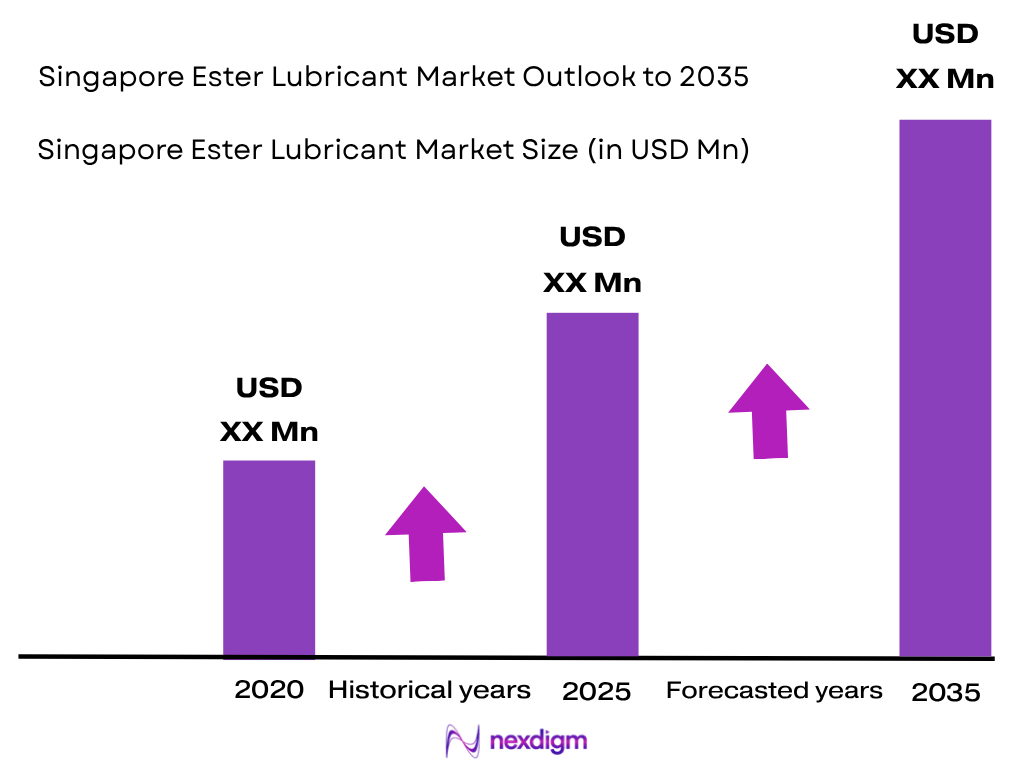
The Singapore Ester Lubricant Market is valued at ~USD XX million in 2024 and is supported by demand from high-performance industrial lubrication applications, marine operations, aerospace maintenance, precision manufacturing and environmentally acceptable lubricant requirements. Singapore recorded a GDP of approximately USD 501 billion in 2023 and maintained strong industrial activity supported by manufacturing, transport and services sectors. The country’s manufacturing output includes advanced electronics, aerospace engineering and chemical processing industries, which require specialty lubricants with high thermal stability, low volatility and superior lubrication efficiency.
Singapore’s ester lubricant demand is concentrated around industrial clusters including Jurong Island, Tuas, Changi and the central industrial corridors due to their concentration of petrochemical facilities, marine activities, aerospace maintenance operations and advanced manufacturing plants. Jurong Island hosts more than 100 chemical and energy companies, creating demand for specialty fluids and high-performance lubrication solutions. Singapore handled approximately 591 million tonnes of port cargo throughput in 2023, strengthening requirements for marine lubricants, ship maintenance fluids and environmentally acceptable lubrication technologies across maritime operations.
Market Segmentation
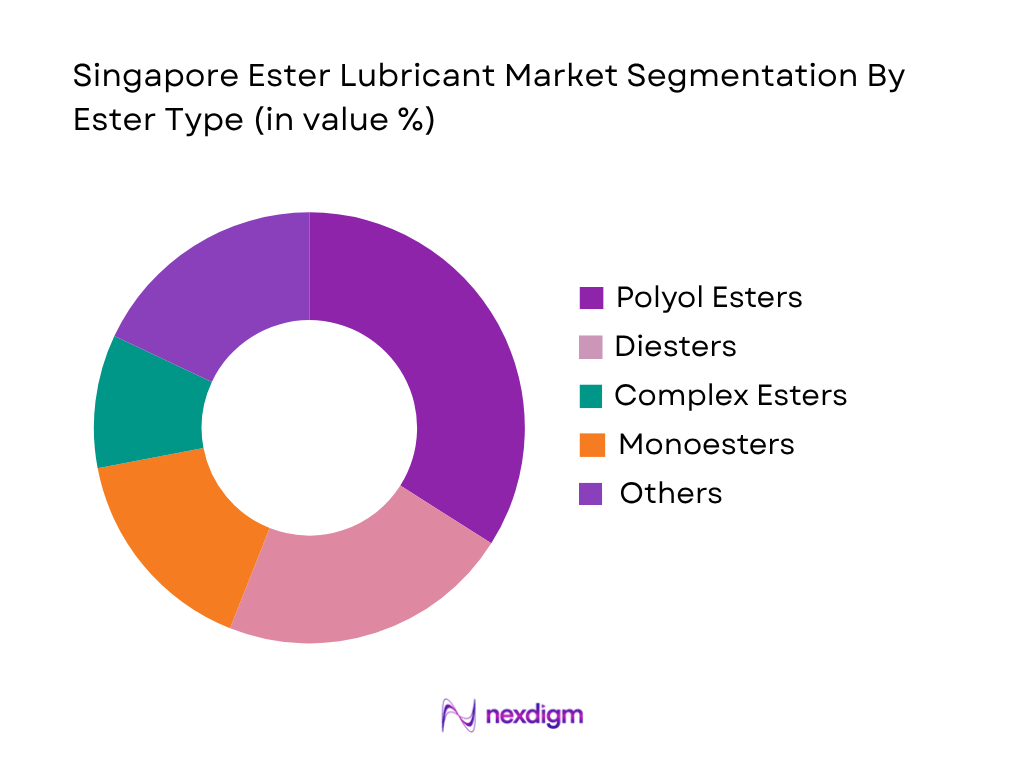
By Ester Type
Singapore Ester Lubricant Market is segmented by ester type into monoesters, diesters, polyol esters, complex esters, trimellitate esters, phosphate esters, neopolyol esters and other specialty esters. Polyol esters represent a dominant segment due to their superior oxidation stability, wide operating temperature range and compatibility with demanding applications such as aerospace lubricants, compressor oils, refrigeration systems and industrial equipment. Singapore’s aerospace maintenance industry and high-value manufacturing ecosystem require lubricants capable of maintaining performance under extreme operating conditions. The country recorded approximately SGD 77 billion in manufacturing output from electronics, precision engineering and chemical industries in recent years, supporting demand for advanced lubricant formulations. Polyol esters are preferred where extended service intervals, low volatility and high thermal resistance are required.
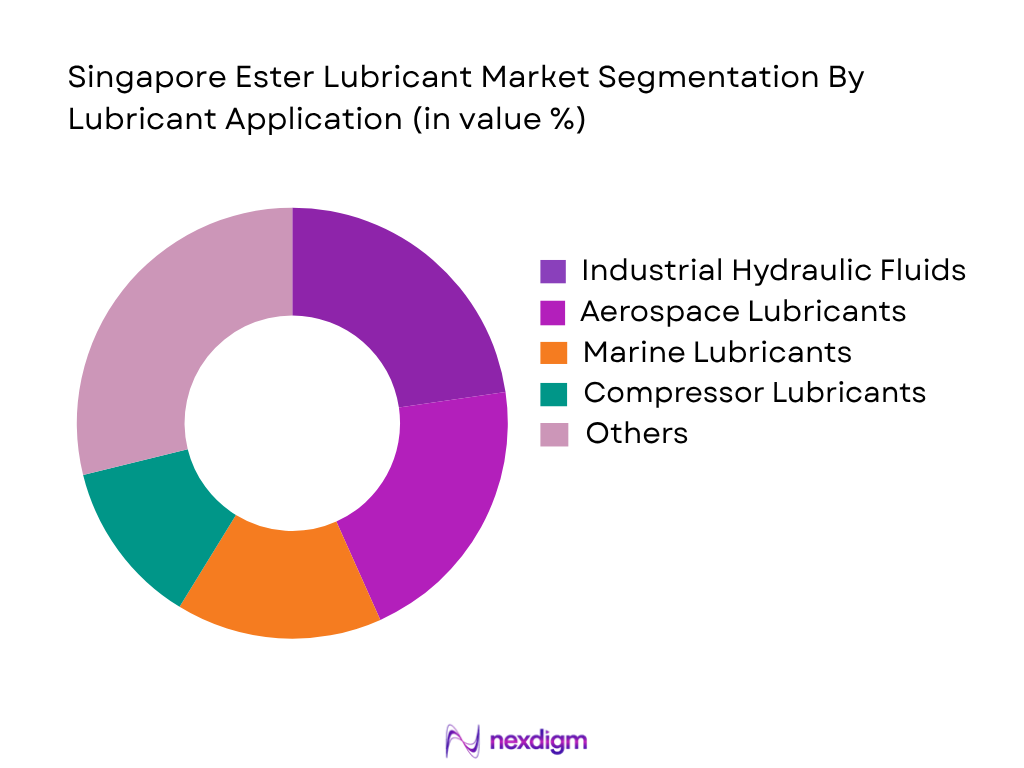
By Lubricant Application
Singapore Ester Lubricant Market is segmented by lubricant application into engine oils, transmission and gear lubricants, hydraulic fluids, compressor lubricants, turbine lubricants, metalworking fluids, greases, aerospace lubricants, marine lubricants and refrigeration lubricants. Industrial hydraulic fluids and aerospace lubricants represent major application areas due to Singapore’s advanced manufacturing base, aviation maintenance capabilities and marine ecosystem. Singapore is one of the world’s leading aviation maintenance hubs, with Changi Airport handling more than 58 million passenger movements in 2023, supporting demand for aviation-grade lubricants. Additionally, the country’s maritime sector operates one of the world’s busiest ports, requiring specialized lubrication solutions for vessels, cranes, engines and heavy equipment.
Competitive Landscape
The Singapore Ester Lubricant Market consists of global specialty chemical manufacturers, lubricant producers and base-stock suppliers serving aerospace, marine, industrial and automotive applications. The competitive environment is influenced by product performance, ester chemistry expertise, technical support capability, supply chain presence and OEM qualification requirements. Major companies compete through specialty ester portfolios, environmentally acceptable lubricant solutions and customized formulations for industrial applications.
| Company | Establishment Year | Headquarters | Ester Technology Portfolio | Major Application Areas | Singapore Market Presence | Product Focus | Distribution Capability | Technical Support |
| ExxonMobil Corporation | 1870 | USA | ~ | ~ | ~ | ~ | ~ | ~ |
| BASF SE | 1865 | Germany | ~ | ~ | ~ | ~ | ~ | ~ |
| Croda International Plc | 1925 | UK | ~ | ~ | ~ | ~ | ~ | ~ |
| Cargill Incorporated | 1865 | USA | ~ | ~ | ~ | ~ | ~ | ~ |
| LANXESS AG | 2004 | Germany | ~ | ~ | ~ | ~ | ~ | ~ |
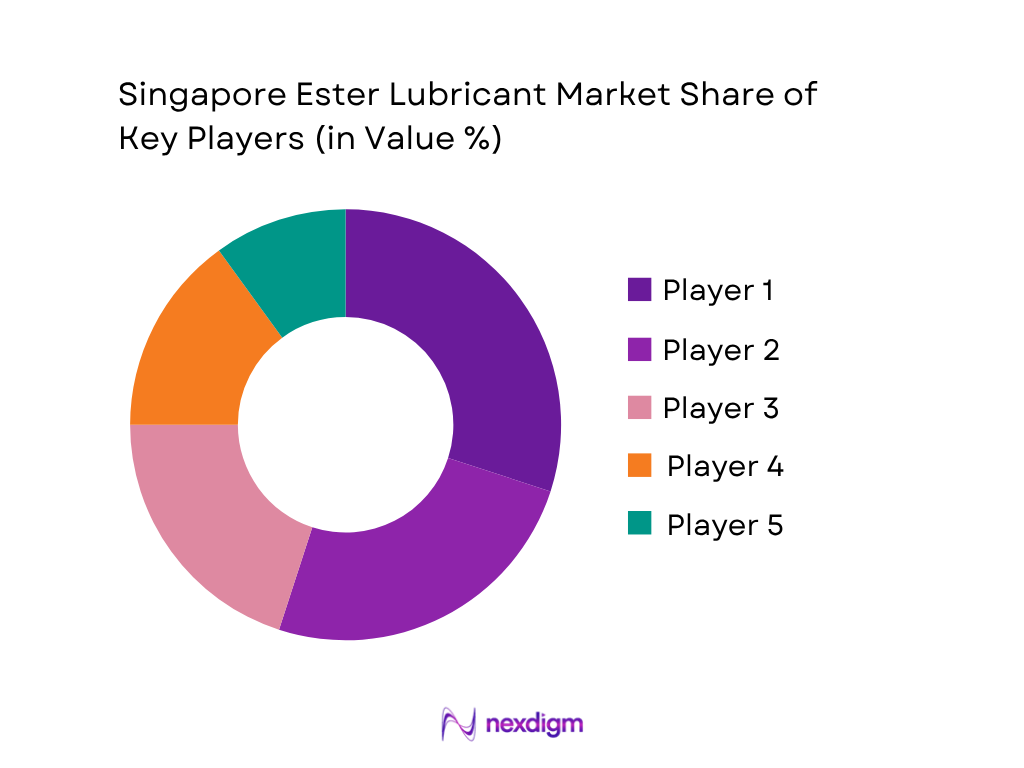
Singapore Ester Lubricant Market Analysis
Growth Drivers
Increasing Demand from Aerospace and Advanced Manufacturing Applications
The Singapore Ester Lubricant Market is supported by increasing requirements for high-performance lubrication solutions across aerospace maintenance, precision engineering, semiconductor manufacturing and advanced industrial equipment applications. Ester lubricants are preferred in these sectors due to their high thermal stability, oxidation resistance, low volatility and ability to perform under extreme operating conditions. Singapore’s aerospace ecosystem continues to support specialty lubricant consumption, with the country recording approximately 58 million passenger movements at Changi Airport in 2023, increasing aircraft maintenance and overhaul activities requiring aviation-grade lubricants. The manufacturing sector also remains a critical demand contributor, with manufacturing accounting for approximately 17% of Singapore’s GDP according to economic data published by government authorities. The country’s precision engineering industry supports more than 2,700 companies involved in machinery, automation and component manufacturing, creating demand for advanced hydraulic fluids, compressor oils and metalworking lubricants. Ester-based lubricants are increasingly integrated into industrial applications where equipment reliability, longer operating cycles and reduced maintenance requirements are essential. The expansion of high-value manufacturing activities, including electronics and aerospace component production, continues to create opportunities for specialty ester lubricant suppliers in Singapore’s industrial ecosystem.
Expansion of Marine Operations and Environmentally Acceptable Lubricant Adoption
The Singapore Ester Lubricant Market benefits from the country’s position as one of the world’s largest maritime hubs, where marine equipment, port machinery and vessel operations require reliable lubrication technologies. Ester lubricants are increasingly used in marine applications due to their biodegradability characteristics, high lubricity and suitability for environmentally sensitive operations. Singapore handled approximately 591 million tonnes of cargo throughput and more than 39 million twenty-foot equivalent units of container throughput in 2023, demonstrating the scale of maritime activity requiring continuous maintenance of engines, propulsion systems, hydraulic equipment and port machinery. The maritime sector contributes significantly to Singapore’s economy, supported by more than 5,000 maritime-related establishments operating across shipping, logistics, marine engineering and offshore services. Growth in vessel maintenance, ship repair activities and port automation is increasing demand for advanced lubricants capable of reducing equipment wear and improving operational efficiency. Additionally, global environmental requirements are encouraging marine operators to adopt environmentally acceptable lubricants for applications involving hydraulic systems, stern tubes and deck machinery. This transition is supporting ester lubricant adoption in marine and industrial applications across Singapore.
Market Challenges
High Cost and Complex Manufacturing Requirements of Specialty Ester Lubricants
The Singapore Ester Lubricant Market faces challenges due to the complex manufacturing processes required for producing specialty ester formulations with specific performance characteristics. Ester lubricants require carefully selected feedstocks, advanced chemical processing and extensive compatibility testing to achieve properties such as thermal stability, oxidation resistance and low-temperature performance. Singapore relies significantly on imported chemical feedstocks and specialty raw materials, increasing exposure to international supply chain fluctuations. The country imported approximately SGD 250 billion worth of goods in 2023, reflecting its dependence on global trade networks for industrial materials and chemicals. Specialty ester formulations also require technical validation before adoption in aerospace, marine and industrial equipment applications, as users require compliance with OEM specifications and operational standards. Compared with conventional mineral-based lubricants, ester-based products generally involve higher formulation complexity due to their chemical structure and performance requirements. This creates barriers for smaller lubricant suppliers entering the market and increases the importance of technical expertise, application testing and long-term customer relationships. The requirement for specialized production capabilities remains a key challenge affecting wider adoption across price-sensitive applications.
Competition from Alternative Synthetic Lubricant Technologies
The Singapore Ester Lubricant Market experiences competition from alternative synthetic lubricant technologies, including polyalphaolefin-based lubricants and other advanced synthetic base oils that serve similar industrial applications. Ester lubricants compete based on performance advantages such as biodegradability, high temperature capability and excellent lubricity, but adoption decisions are often influenced by equipment compatibility, operating requirements and total lifecycle costs. Singapore’s industrial sector includes diverse users across manufacturing, marine, logistics and energy industries, where lubricant selection depends on application-specific requirements. The country’s industrial production environment includes more than 7,000 manufacturing establishments, increasing competition among different lubricant technologies. In sectors where environmental requirements are less stringent, conventional synthetic alternatives may continue to remain preferred due to established supply chains and existing equipment compatibility. Additionally, industrial users require extensive testing before switching lubricant formulations because changes in lubricant chemistry can impact machinery performance, maintenance schedules and warranty conditions. The presence of multiple lubricant technologies creates a competitive environment where ester lubricant suppliers must differentiate through technical support, customized formulations and application-specific solutions.
Market Opportunities
Growth of Bio-Based and Environmentally Sustainable Lubrication Solutions
The Singapore Ester Lubricant Market has significant opportunities from increasing demand for sustainable lubricant technologies across marine, industrial and government-supported environmental initiatives. Ester lubricants derived from renewable feedstocks are gaining attention because they provide improved biodegradability and reduced environmental impact compared with conventional petroleum-based lubricants. Singapore has implemented sustainability initiatives targeting industrial efficiency and carbon reduction, creating opportunities for environmentally acceptable lubricant adoption. The country’s Green Plan 2030 focuses on reducing emissions and improving resource efficiency across multiple economic sectors, supporting industries seeking cleaner technologies. Singapore’s maritime sector, which recorded approximately 591 million tonnes of cargo throughput in 2023, represents a major opportunity area for biodegradable hydraulic fluids and marine lubricants. Industrial users operating near environmentally sensitive areas are increasingly evaluating lubricants that reduce ecological risks while maintaining equipment performance. Ester lubricant suppliers can benefit by developing renewable ester formulations for marine systems, hydraulic equipment, food-processing machinery and industrial applications requiring environmentally responsible solutions. The combination of sustainability regulations, corporate environmental objectives and industrial modernization is expected to support future adoption of bio-based ester lubricants in Singapore.
Increasing Adoption in Electric Mobility and High-Efficiency Industrial Equipment
The Singapore Ester Lubricant Market is expected to benefit from increasing demand for specialized lubrication solutions in electric mobility, advanced machinery and energy-efficient industrial equipment. Ester lubricants are relevant for applications requiring thermal management, electrical compatibility and high-performance operation, including electric vehicle components, cooling systems and precision industrial equipment. Singapore registered more than 80,000 electric vehicles and hybrid vehicles by 2024, supported by government initiatives promoting cleaner transportation technologies. The country is also expanding charging infrastructure, with thousands of charging points installed nationwide to support electrification. Beyond automotive applications, Singapore’s industrial automation sector continues to increase demand for lubricants that support high-speed machinery, robotics and precision manufacturing equipment. The manufacturing industry contributes approximately SGD 100 billion annually to Singapore’s economy, creating a strong base for advanced lubrication solutions. Ester lubricants can address requirements related to reduced friction, improved thermal performance and longer equipment operating life. As industries continue adopting automation, electrification and energy-efficient technologies, suppliers offering customized ester lubricant solutions have opportunities to expand across automotive, industrial and advanced engineering applications.
Future Outlook
The Singapore Ester Lubricant Market is expected to witness continued development driven by increasing adoption of high-performance lubricants across aerospace, marine, industrial manufacturing and environmentally sensitive applications. Demand will be supported by Singapore’s position as a regional hub for aviation maintenance, maritime operations and advanced manufacturing. Growing emphasis on energy efficiency, equipment reliability and sustainable lubrication technologies will encourage adoption of synthetic and bio-based ester formulations. Expansion of precision industries and industrial automation will further increase requirements for specialty lubricants with improved thermal stability, oxidation resistance and longer operating life.
Major Players
- ExxonMobil Corporation
- BASF SE
- Croda International Plc
- Cargill Incorporated
- LANXESS AG
- The Lubrizol Corporation
- Afton Chemical Corporation
- Evonik Industries AG
- Shell PLC
- Chevron Corporation
- Fuchs SE
- TotalEnergies Lubricants
- Quaker Houghton
- NYCO
- Emery Oleochemicals
Key Target Audience
- Ester lubricant manufacturers and specialty chemical producers
- Lubricant blending companies and formulation companies
- Aerospace maintenance organizations and aviation lubricant suppliers
- Marine operators and ship management companies
- Industrial equipment manufacturers and OEMs
- Investments and venture capitalist firms
- Government and regulatory bodies (National Environment Agency Singapore, Maritime and Port Authority of Singapore, Economic Development Board Singapore)
- Petrochemical and manufacturing companies operating in Singapore
Research Methodology
Step 1: Identification of Key Variables
The initial phase involves developing a comprehensive ecosystem map covering ester lubricant manufacturers, raw material suppliers, lubricant blenders, industrial users, aerospace operators and marine companies operating within Singapore. Secondary research is conducted through industry databases, government publications and technical resources to identify critical variables influencing ester lubricant demand, supply dynamics and application trends.
Step 2: Market Analysis and Construction
This phase focuses on analyzing historical market information related to ester lubricant consumption, application penetration, industrial demand patterns and supply chain structures. Assessment includes evaluation of ester base-stock utilization, end-use industries, import dependency, distribution networks and product adoption across industrial, marine and aerospace sectors.
Step 3: Hypothesis Validation and Expert Consultation
Market assumptions are validated through discussions with industry participants including lubricant manufacturers, chemical suppliers, industrial users and technical specialists. These interactions provide insights into formulation requirements, procurement behavior, product qualification processes and future demand trends within Singapore’s lubricant ecosystem.
Step 4: Research Synthesis and Final Output
The final stage integrates findings from primary and secondary research to develop a comprehensive assessment of the Singapore Ester Lubricant Market. Data validation is performed through cross-checking supply-side information, demand-side indicators, industrial activity trends and application-level requirements to ensure accuracy and reliability.

- Executive Summary
- Research Methodology (Market Definition and Scope, Singapore Ester Lubricant Market Classification, Ester Base Stock Mapping, Ester Chemistry Assessment, Ester Molecular Structure Assessment, Monoester and Diester Evaluation, Polyol Ester Assessment, Complex Ester Assessment, Trimellitate Ester Assessment, Synthetic and Bio-Based Ester Assessment, Viscosity Grade Mapping, Performance Property Assessment, Application-Level Demand Analysis, End-Use Industry Assessment, Lubricant Formulation Mapping, Base Oil Supply Assessment, Import and Export Trade Analysis, Raw Material Supply Assessment, Demand-Side Assessment, Supply-Side Assessment, Top-Down Market Sizing, Bottom-Up Market Sizing, Primary Industry Interviews, Data Triangulation, Forecasting Framework, Market Share Validation, Limitations and Future Conclusions)

- Definition and Scope
- Singapore Ester Lubricant Industry Evolution and Development of Synthetic Base Oil Technology, High-Performance Lubricant Formulation, Marine Lubrication, Aerospace Lubrication, Semiconductor Manufacturing Lubricants, Industrial Fluid Applications and Bio-Based Lubricant Technologies
- Ester Lubricant Value Chain Analysis
- Ester Lubricant Supply Chain Analysis
- Fatty Acid and Alcohol Feedstock Suppliers, Petrochemical Feedstock Suppliers, Ester Base Stock Manufacturers, Specialty Ester Producers, Lubricant Additive Manufacturers, Lubricant Blenders, Industrial Lubricant Manufacturers, Marine Lubricant Suppliers, Aerospace Lubricant Suppliers, Semiconductor Equipment Lubricant Suppliers, Distributors, Industrial OEMs and End-Use Industries
- Ester Lubricant Integration Across Marine Engine Oils, Hydraulic Fluids, Compressor Oils, Turbine Lubricants, Semiconductor Manufacturing Equipment Lubricants, Precision Engineering Lubricants, Metalworking Fluids, Greases, Aerospace Lubricants, Refrigeration Lubricants and Environmentally Acceptable Lubricants

- Growth Drivers (Expansion of Marine and Maritime Industry, Semiconductor Manufacturing Growth, Increasing Demand for High-Performance Synthetic Lubricants, Aerospace Maintenance Expansion, Industrial Automation Adoption, Precision Engineering Development, Demand for Low-Volatility Lubricants, Environmentally Acceptable Lubricant Adoption, High-Temperature Equipment Lubrication Requirements)
- Market Challenges (Dependence on Imported Ester Base Stocks, Specialty Ester Feedstock Availability, Complex Ester Manufacturing Requirements, Formulation Compatibility Constraints, Competition from PAO and Other Synthetic Base Stocks, Hydrolytic Stability Challenges, High Performance Testing Requirements, Supply Chain Disruptions)
- Market Opportunities (Bio-Based Ester Expansion, Marine Environmentally Acceptable Lubricants, Semiconductor Manufacturing Lubrication Applications, Aerospace and Turbine Lubricants, Environmentally Acceptable Hydraulic Fluids, High-Temperature Industrial Lubricants, Advanced Metalworking Fluids, Food-Grade Lubricants, Renewable Feedstock-Based Esters)
- Market Trends (Shift Toward Synthetic Base Stocks, Bio-Based Lubricant Development, Low-Volatility Ester Formulations, High-Temperature Performance Enhancement, Electrification-Driven Lubricant Development, Environmentally Acceptable Lubricants, Advanced Metalworking Fluids, Specialty Aerospace Lubricants, Longer Drain Intervals, High-Performance Ester-PAO Blending)
- Government Regulations and Standards (National Environment Agency Requirements, Maritime and Port Authority of Singapore Regulations, Civil Aviation Authority of Singapore Requirements, Workplace Safety and Health Regulations, Singapore Standards Lubricant Requirements, International Maritime Organization Regulations, ASTM Testing Standards, ISO Lubricant Quality Standards, Chemical Management Requirements)
- SWOT Analysis
- Porter’s Five Forces Analysis
- PESTLE Analysis
- Stakeholder Ecosystem
- Competition Ecosystem

- By Market Value (2020-2025)
- By Market Volume (2020-2025)
- By Ester Base Stock Consumption Volume (2020-2025)
- By Synthetic Ester Consumption Volume (2020-2025)
- By Bio-Based Ester Consumption Volume (2020-2025)
- By Monoester Consumption Volume (2020-2025)
- By Diester Consumption Volume (2020-2025)
- By Polyol Ester Consumption Volume (2020-2025)

- By Ester Type (In Value %)
Monoesters
Diesters
Polyol Esters
Complex Esters
Trimellitate Esters
Phosphate Esters
Neopolyol Esters
Other Specialty Esters - By Base Stock Origin (In Value %)
Petrochemical-Based Esters
Oleochemical-Based Esters
Bio-Based Esters
Renewable Feedstock-Based Esters
Blended Ester Base Stocks - By Lubricant Application (In Value %)
Marine Lubricants
Hydraulic Fluids
Compressor Lubricants
Turbine Lubricants
Aerospace Lubricants
Semiconductor Equipment Lubricants
Metalworking Fluids
Gear Lubricants
Refrigeration Lubricants
Specialty Industrial Lubricants - By End-Use Industry (In Value %)
Marine and Shipping
Aerospace and Aviation
Semiconductor Manufacturing
Industrial Manufacturing
Precision Engineering
Oil and Gas Services
Power Generation
Food and Beverage Processing
Chemical Manufacturing
Pharmaceutical Manufacturing - By Distribution Channel (In Value %)
Direct Industrial Sales
Marine Lubricant Suppliers
Aviation Lubricant Distributors
Specialty Chemical Distributors
Industrial Supply Networks
OEM Procurement Channels
Authorized Lubricant Distributors
Online Industrial Platforms - By Region (In Value %)
Central Region
East Region
West Region
North Region
Jurong Industrial Area
Tuas Industrial Area
Changi Aviation Cluster

- Market Share of Major Players (By Singapore Revenue, Ester Base Stock Sales Volume, Ester Chemistry Portfolio, Production Capacity, Synthetic Ester Portfolio, Bio-Based Ester Portfolio, Marine Application Exposure, Semiconductor Application Coverage, Aerospace Application Coverage, Industrial Application Coverage, Distribution Network Coverage, Regional Presence, OEM Customer Coverage, Technical Service Capability)
- Cross Comparison Parameters (Ester Lubricant Revenue, Ester Chemistry Portfolio Breadth, Polyol Ester Technology Coverage, Marine Lubricant Capability, Semiconductor Lubrication Coverage, Aerospace Lubricant Capability, Bio-Based Ester Portfolio Breadth, Singapore Distribution Network Reach)
- SWOT Analysis of Major Players
- Competitive Positioning Matrix
- Ester Base Stock Product Portfolio and Application Benchmarking
- Industrial Ester Lubricant and Metalworking Fluid Assessment
- Bio-Based and Environmentally Acceptable Ester Technology Assessment
- Detailed Profiles of Major Companies
ExxonMobil Corporation
BASF Corporation
Croda Inc.
Emery Oleochemicals
LANXESS Corporation
The Lubrizol Corporation
Cargill, Incorporated
Afton Chemical Corporation
Vantage Performance Materials
Zschimmer & Schwarz Lubricant Components
Quaker Houghton
NYCO
Valtris Specialty Chemicals
Lubriplate Lubricants Company
PMC Biogenix, Inc.

- Marine Fleet Operator Ester Lubricant Requirement Assessment
- Shipyard Lubricant Procurement Analysis
- Aerospace and Aircraft Maintenance Lubricant Procurement Assessment
- Semiconductor Manufacturing Lubrication Requirement Analysis
- Industrial Machinery Lubricant Requirement Analysis
- Precision Engineering Equipment Lubrication Assessment
- Power Generation Lubricant Procurement Analysis
- Food Processing Lubricant Procurement Assessment
- Chemical Manufacturing Lubricant Requirement Analysis
- Pharmaceutical Manufacturing Lubrication Assessment
- Compressor and Turbine Lubricant Requirement Assessment
- Lubricant Blender Ester Base Stock Procurement Analysis
- Industrial OEM Ester Lubricant Qualification Assessment

- By Market Value (2026-2035)
- By Market Volume (2026-2035)
- By Ester Base Stock Consumption Volume (2026-2035)
- By Synthetic Ester Consumption Volume (2026-2035)
- By Bio-Based Ester Consumption Volume (2026-2035)
- By Monoester Consumption Volume (2026-2035)
- By Diester Consumption Volume (2026-2035)
- By Polyol Ester Consumption Volume (2026-2035)


 Request a Sample
 Ask for Customization
 Get a Quote
 Enquire Now