

 Download PDF
 Download PDF
Market Overview
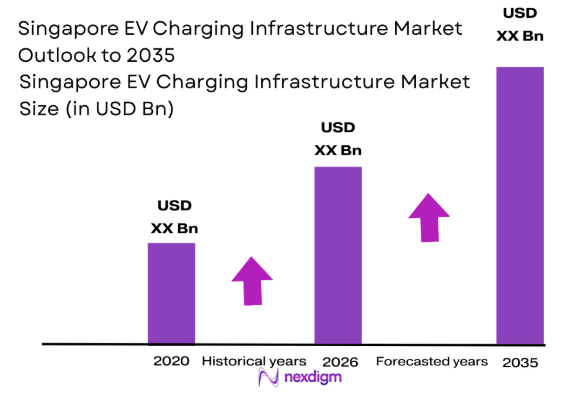
The Singapore EV charging infrastructure market has seen significant growth, driven by the increasing adoption of electric vehicles (EVs) and the government’s commitment to supporting the transition to greener mobility solutions. The market is expected to reach USD ~ billion in market value, propelled by initiatives aimed at expanding the EV charging network and enhancing the accessibility of charging stations. Factors such as rising environmental awareness and improvements in charging technology further fuel the demand for robust infrastructure.
Singapore’s dominance in the EV charging infrastructure market is attributed to its proactive governmental policies, urban planning, and robust investment in renewable energy. The country’s strategic location as a global business hub also plays a key role in shaping the infrastructure landscape. Singapore’s urban density and high-income levels ensure that EV adoption remains on track, with widespread support for EV-related infrastructure. Additionally, collaborations between public and private sectors are bolstering infrastructure development, making the country a leader in the region’s EV transition.
Market Segmentation
By Product Type
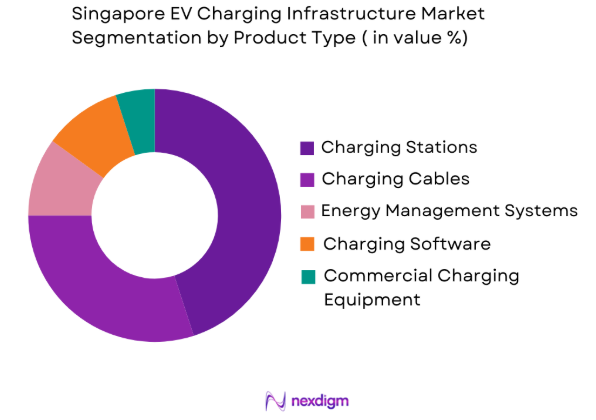
The Singapore EV charging infrastructure market is segmented by product type into charging stations, charging cables, energy management systems, and charging software. Recently, charging stations have held a dominant market share due to the rising number of electric vehicles on the road and the government’s focus on increasing infrastructure availability. The availability of fast-charging options and the growing preference for convenient and efficient charging solutions contribute to the widespread adoption of charging stations.
By Platform Type
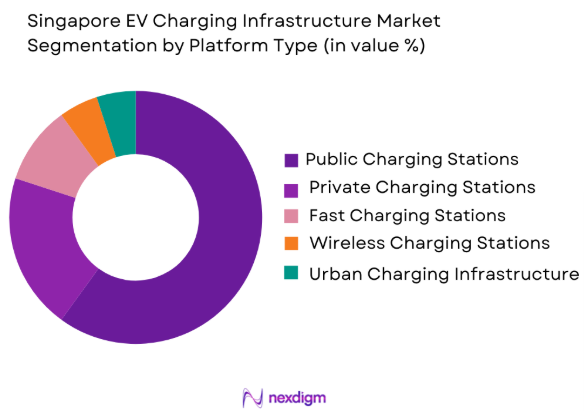
The market is segmented into public and private charging stations, with public charging stations leading due to government initiatives that focus on building public EV charging networks. These stations are seen as critical to ensuring the convenience of EV ownership, especially for city dwellers who may not have access to home charging solutions. Public infrastructure investment ensures widespread availability and accessibility, a major factor in driving market growth.
Competitive Landscape
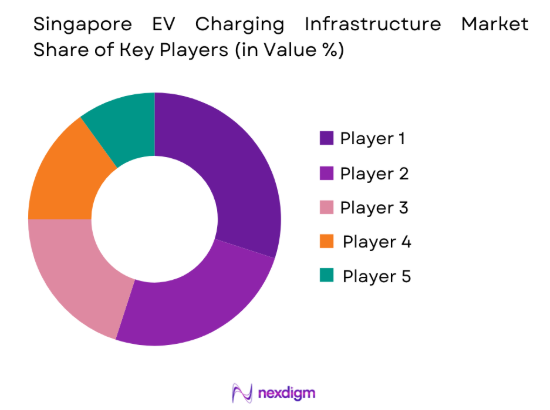
The Singapore EV charging infrastructure market is highly competitive, with both local and international players vying for dominance in the growing market. Major players are consolidating their positions by expanding their service offerings and forming strategic alliances. Companies are investing heavily in R&D to develop more efficient charging solutions and leveraging government incentives to accelerate infrastructure development. The market also benefits from favorable regulatory policies aimed at promoting sustainable energy and reducing carbon footprints.
| Company Name | Establishment Year | Headquarters | Technology Focus | Market Reach | Key Products | Revenue (USD) | Additional Parameter |
| Shell | 1907 | Netherlands | ~ | ~ | ~ | ~ | ~ |
| Tesla | 2003 | USA | ~ | ~ | ~ | ~ | ~ |
| Siemens | 1847 | Germany | ~ | ~ | ~ | ~ | ~ |
| Engie | 2008 | France | ~ | ~ | ~ | ~ | ~ |
| ChargePoint | 2007 | USA | ~ | ~ | ~ | ~ | ~ |
Singapore EV Charging Infrastructure Market Analysis
Growth Drivers
Government Support for EV Adoption
Government policies that support electric vehicle adoption, including incentives, tax rebates for buyers, and subsidies for charging infrastructure, are significantly driving market growth. These policies are part of the government’s broader commitment to reducing carbon emissions and meeting sustainability targets, which has accelerated the transition to electric vehicles. Additionally, collaborations between the government and private sectors to develop an extensive charging network are improving accessibility for consumers. The continued push for green technologies, supported by favorable regulatory frameworks, ensures a favorable environment for the market. As these policies evolve, they will further promote EV adoption and infrastructure expansion, sustaining market growth in the years ahead.
Technological Advancements in Charging Infrastructure
Technological innovation in the EV charging sector plays a key role in driving market growth. Ongoing advancements in faster and more efficient charging solutions, such as ultra-fast charging stations and wireless charging technology, have enhanced the user experience and boosted EV adoption. Additionally, improvements in energy management systems are optimizing the entire charging process, enabling seamless integration with renewable energy sources. These technological developments make charging more efficient, reliable, and convenient for users, supporting the expansion of charging networks. As these innovations continue to evolve, they will further enhance the accessibility of charging infrastructure, making EV ownership more practical and attractive to consumers.
Market Challenges
High Installation Costs
A major challenge in the market is the high cost of installing EV charging infrastructure. The initial investment, which includes the cost of land, installation of charging points, and integration with the energy grid, represents a significant financial barrier. Many private sector stakeholders struggle to absorb these high upfront costs, even with government subsidies in place. Despite these incentives, the overall financial burden still limits the rapid deployment of new charging stations. This delay in infrastructure development may hinder the widespread adoption of electric vehicles, slowing the market’s growth and limiting the accessibility of charging options for consumers. Addressing this cost issue will be crucial to advancing EV infrastructure.
Infrastructure Compatibility Issues
Another challenge facing the market is the lack of standardization in charging infrastructure. With various EV manufacturers using different charging standards, compatibility issues arise across charging stations. Consumers often encounter difficulties locating stations that support their specific EV models, hindering their charging experience. The absence of uniformity in charging connectors and communication protocols disrupts the seamless operation of charging networks, creating inconvenience for users. To support the widespread adoption of electric vehicles, it is crucial to address these compatibility issues. Achieving standardization across the charging infrastructure would enhance the user experience, increase accessibility, and ultimately accelerate the transition to EVs.
Opportunities
Expansion of Fast Charging Networks
The increasing demand for faster charging solutions offers a significant growth opportunity in the market. Fast-charging stations, capable of charging EVs much quicker than standard stations, are gaining popularity among consumers seeking convenience and efficiency. The rise of ultra-fast charging infrastructure, such as supercharging stations, is meeting the need for rapid, reliable, and efficient charging. As consumers prioritize shorter wait times, this shift creates an attractive market opportunity for both new entrants and established players to expand their presence. By investing in fast-charging solutions, companies can enhance customer satisfaction, capitalize on growing demand, and secure a competitive edge in the evolving EV landscape.
Integration with Renewable Energy
As the global shift towards renewable energy accelerates, integrating EV charging infrastructure with solar and wind energy presents a major opportunity. Using renewable sources to power charging stations helps reduce carbon emissions and reliance on fossil fuels, contributing to a more sustainable and eco-friendly charging process. This approach aligns with the growing demand for green technologies and supports governmental efforts to transition to a low-carbon economy. By incorporating renewable energy into EV charging networks, companies not only contribute to environmental sustainability but also strengthen their competitive position in the market. This integration offers both ecological and economic benefits, attracting environmentally conscious consumers and businesses committed to sustainable practices.
Future Outlook
The future outlook for the EV charging infrastructure market remains positive, with continued growth driven by technological advancements, government policies, and an increasing demand for electric vehicles. Over the next few years, there will be a strong push to expand the charging network, particularly in urban areas, to ensure EVs are more accessible to the public. The shift towards faster charging stations, integration with renewable energy sources, and further development of smart grids will enhance the charging infrastructure. These factors, coupled with the government’s ongoing support, are expected to drive the market to new heights.
Major Players
- Shell
- Tesla
- Siemens
- Engie
- ChargePoint
- ABB
- Schneider Electric
- BMW Group
- Greenlots
- Ionity
- E.ON
- Volkswagen Group
- Mercedes-Benz
- NIO
- Ford
Key Target Audience
- Investments and venture capitalist firms
- Government and regulatory bodies
- Automotive manufacturers
- Charging station developers
- EV consumers
- Electric vehicle manufacturers
- Real estate developers
- Energy companies
Research Methodology
Step 1: Identification of Key Variables
The first step involves identifying the key market variables that influence the growth and development of the EV charging infrastructure market, such as market size, adoption rates, regulatory policies, and technological advancements.
Step 2: Market Analysis and Construction
Market data is gathered from various sources, including industry reports, government publications, and primary research with market players. This data is then used to construct the market analysis, ensuring a comprehensive understanding of market trends and dynamics.
Step 3: Hypothesis Validation and Expert Consultation
Hypotheses are developed based on market trends and growth drivers. These hypotheses are validated by consulting with industry experts, stakeholders, and key players to refine market projections and ensure accuracy.
Step 4: Research Synthesis and Final Output
The final stage involves synthesizing all collected data, analysis, and insights to produce a comprehensive market report. This report includes detailed findings on the market size, segmentation, dynamics, competitive landscape, and future outlook.

- Executive Summary
- Research Methodology (Definitions, Scope, Industry Assumptions, Market Sizing Approach, Primary & Secondary Research Framework, Data Collection & Verification Protocol, Analytic Models & Forecast Methodology, Limitations & Research Validity Checks)

- Market Definition and Scope
- Value Chain & Stakeholder Ecosystem
- Regulatory / Certification Landscape
- Sector Dynamics Affecting Demand
- Strategic Initiatives & Infrastructure Growth

- Growth Drivers
Government Incentives for EV Adoption
Increased Adoption of Electric Vehicles
Advancements in Charging Technology - Market Challenges
High Installation Costs
Infrastructure Incompatibility
Limited Grid Capacity - Market Opportunities
Expansion of Fast Charging Networks
Public-Private Partnerships for Infrastructure Development
Integration with Renewable Energy Sources - Trends
Rise in Demand for Fast Charging Solutions
Development of Wireless Charging Technologies
Advancements in Energy Storage for EV Charging - Government Regulations
- SWOT Analysis of Key Competitors
- Porter’s Five Forces

- By Market Value, 2020-2025
- By Installed Units, 2020-2025
- By Average System Price, 2020-2025
- By System Complexity Tier, 2020-2025

- By System Type (In Value%)
Charging Stations
Charging Cables
Charging Software
Energy Management Systems
Charging Equipment for Commercial Applications - By Platform Type (In Value%)
Public Charging Stations
Private Charging Stations
Fast Charging Stations
Wireless Charging Stations
Urban Charging Infrastructure - By Fitment Type (In Value%)
Retrofit Systems
New Installations
Modular Solutions
Integrated Solutions
Custom-Built Installations - By End User Segment (In Value%)
Government & Public Sector
Private Fleet Operators
Automotive OEMs
Commercial Charging Network Providers
Residential Users - By Procurement Channel (In Value%)
Direct Procurement
Public Procurement Tenders
OEM Partnerships
Online Bidding Platforms
Third-Party Distributors

- Market Share Analysis
- Cross Comparison Parameters (System Type, Platform Type, Procurement Channel, End User Segment, Fitment Type, Charging Technology, Geographic Region, Government Incentives, Grid Infrastructure, Consumer Demand)
- SWOT Analysis of Key Competitors
- Pricing & Procurement Analysis
- Key Players
Shell
Tesla
ABB
Siemens
Engie
ChargePoint
BMW
Schneider Electric
Siemens
Porsche
Greenlots
E.ON
Ionity
Ford
Cenex

- Growing Demand from Fleet Operators
- Increase in Residential EV Charging Installations
- Role of Government Agencies in Infrastructure Development
- Rising Consumer Adoption of EVs

- Forecast Market Value, 2026-2035
- Forecast Installed Units, 2026-2035
- Price Forecast by System Tier, 2026-2035
- Future Demand by Platform, 2026-2035


 Request a Sample
 Ask for Customization
 Get a Quote
 Enquire Now