
 Download PDF
Market Overview
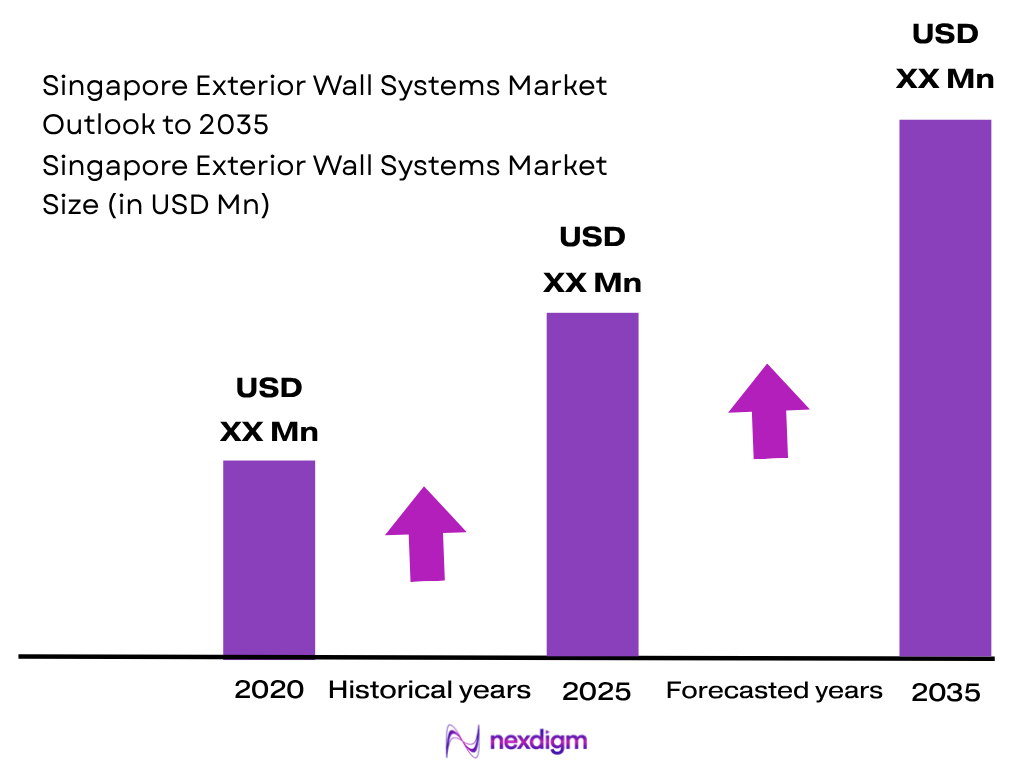
The Singapore Exterior Wall Systems Market is supported by a substantial construction pipeline spanning residential, commercial, institutional, hospitality and infrastructure projects. Singapore’s total construction demand increased from S$33.8 billion to S$44.2 billion across the latest reported periods, providing a broad base for facade, curtain-wall, glazing, cladding and building-envelope requirements. Public-sector construction remained particularly important, supported by housing and infrastructure programs, while private-sector activity included residential developments, commercial redevelopment, mixed-use properties and industrial facilities. Building and Construction Authority
Singapore’s exterior wall systems demand is concentrated around major development corridors and high-density urban districts where high-rise residential, commercial, hospitality and institutional buildings require engineered building envelopes. The residential pipeline provides a recurring requirement for facade systems, with 40,670 private residential and executive condominium units having planning approvals at the end of the latest reported period. Commercial development also supports demand, with approximately 909,000 sq m of office space and 545,000 sq m of retail space in the pipeline.
Market Segmentation
By System Type
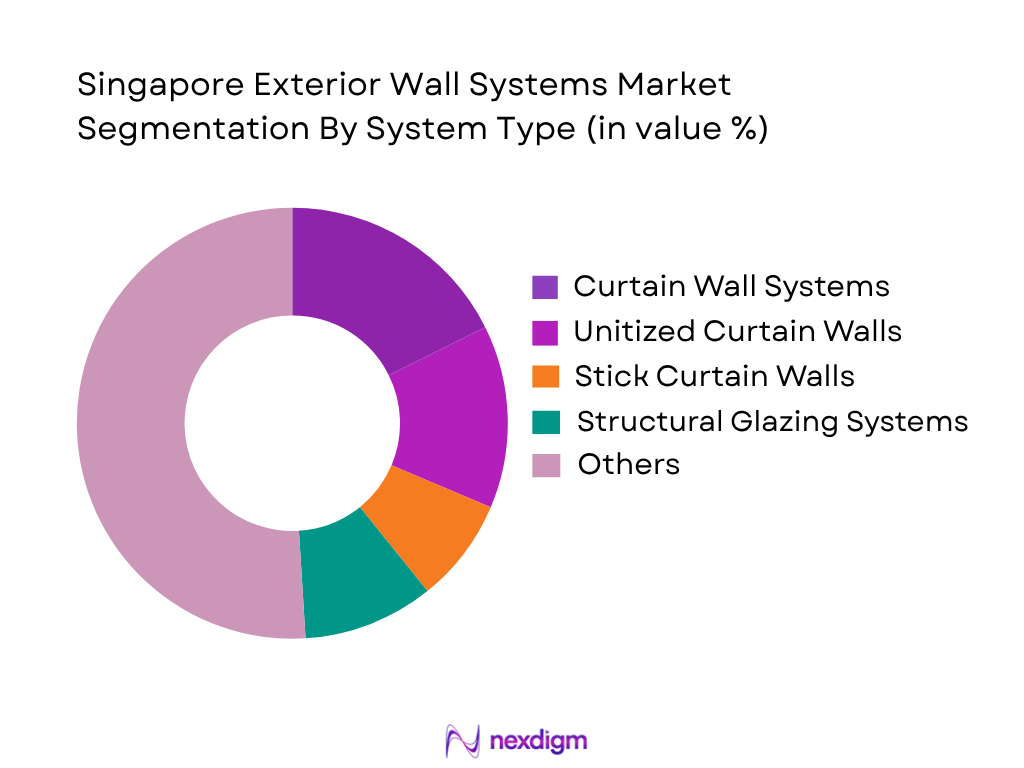
The Singapore Exterior Wall Systems Market is segmented by system type into curtain wall systems, unitized curtain walls, stick curtain walls, structural glazing systems, semi-unitized facade systems, aluminium cladding systems, aluminium composite panel cladding, metal cladding systems, stone cladding systems, rainscreen and ventilated facade systems, insulated exterior wall systems, and precast and GRC exterior wall systems. Unitized curtain walls are expected to represent the leading sub-segment because Singapore’s high-density construction environment places strong emphasis on installation productivity, quality control and reduced site labor requirements. Factory-assembled facade modules can be manufactured under controlled conditions and installed floor by floor, making them suitable for high-rise residential, commercial, hospitality and institutional developments. The importance of curtain-wall systems is also reinforced by Singapore’s specialist contractor framework, where BCA maintains a dedicated CR16 Curtain Walls workhead. The current BCA directory identifies hundreds of registered CR16 contractors across different grades, indicating an established specialist installation ecosystem. Unitized systems also support improved coordination with architectural glass, aluminium framing, thermal insulation and weather-sealing requirements.
By Building Type
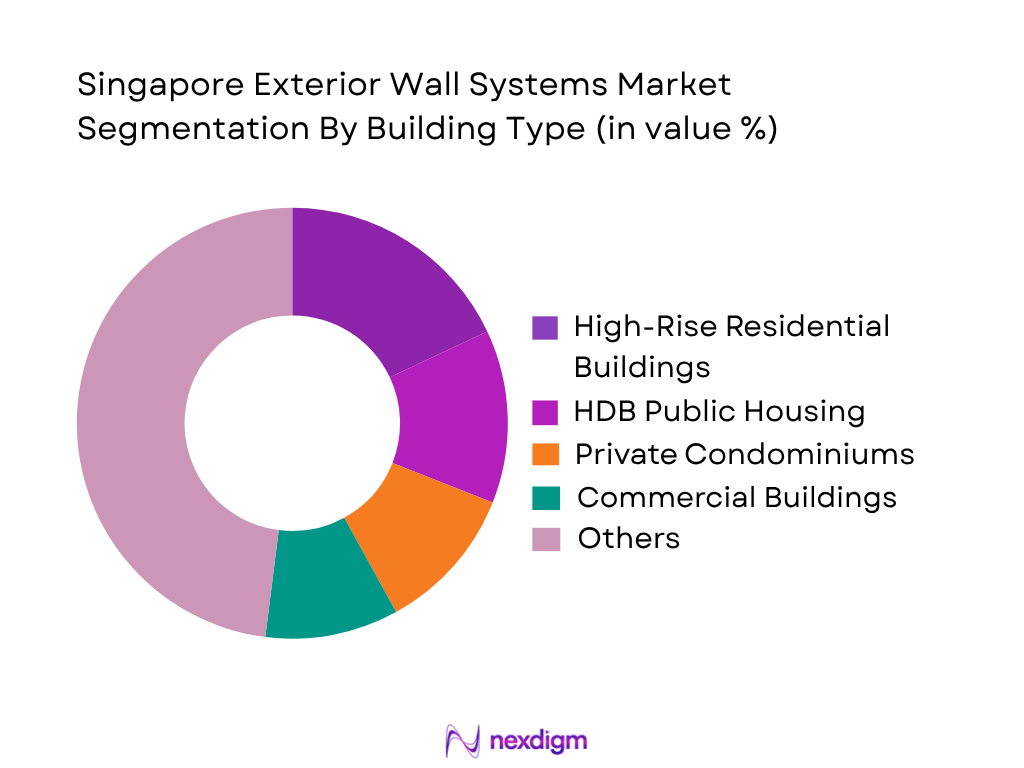
The Singapore Exterior Wall Systems Market is segmented by building type into high-rise residential buildings, HDB public housing, private condominiums, commercial buildings, office buildings, retail and shopping centres, hotels and hospitality buildings, healthcare facilities, educational buildings, industrial and logistics buildings, data centres, airports and transportation buildings, government and institutional buildings, and mixed-use developments. High-rise residential buildings are expected to represent the leading sub-segment because Singapore’s compact urban structure and vertical development model generate sustained requirements for curtain walls, windows, balconies, aluminium cladding, architectural glazing and other facade assemblies. Residential development is supported by both public and private housing programs. The government introduced 11,110 private residential units through the 2024 Government Land Sales programme, the highest annual supply introduced through the programme since 2013. At the end of 2024, the pipeline contained 40,670 private residential and executive condominium units with planning approvals, providing a substantial future construction base for exterior-envelope contractors and material suppliers.
Competitive Landscape
The Singapore Exterior Wall Systems Market comprises specialist facade contractors, aluminium and glazing fabricators, international facade-engineering groups and integrated building-envelope providers. Competition is shaped by CR16 registration, high-rise project execution capability, unitized and stick curtain-wall expertise, aluminium fabrication, architectural glazing, cladding capabilities and the ability to provide design, fabrication and installation under a coordinated delivery model. BCA’s CR16 directory provides evidence of a broad specialist contractor ecosystem, while companies such as Jangho, Mero, Nam Lee, Modern Building Materials and Sunjet maintain documented facade-related capabilities.
| Company | Establishment | Headquarters | Curtain Wall Capability | Cladding Capability | CR16 Capability | Fabrication / Manufacturing | Project Capability | Integrated Services |
| Jangho Curtain Wall Singapore | 2007 | Singapore | ~ | ~ | ~ | ~ | ~ | ~ |
| Mero Asia Pacific | 1988 | Singapore / Asia Pacific | ~ | ~ | ~ | ~ | ~ | ~ |
| Nam Lee Pressed Metal | 2005* | Singapore | ~ | ~ | ~ | ~ | ~ | ~ |
| Modern Building Materials | 1986 | Singapore | ~ | ~ | ~ | ~ | ~ | ~ |
| Sunjet Aluminium International | 1988 | Singapore | ~ | ~ | ~ | ~ | ~ | ~ |
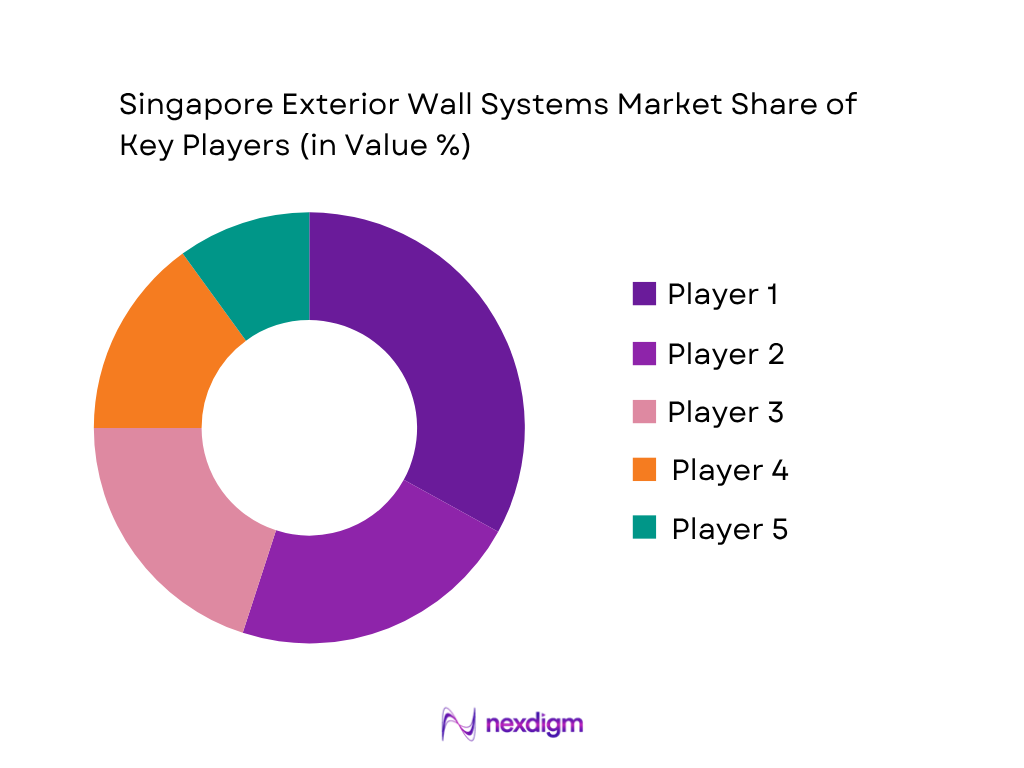
Singapore Exterior Wall Systems Market Analysis
Growth Drivers
Construction and Infrastructure Expansion
Singapore Exterior Wall Systems Market is supported by a broad construction pipeline spanning public housing, commercial redevelopment, healthcare, education, transport and industrial projects. The Building and Construction Authority recorded S$44.2 billion in total construction demand in 2024, compared with S$33.8 billion in 2023, while construction output reached S$38.4 billion. The 2025 construction-demand outlook was placed at S$47 billion–S$53 billion, providing continued opportunities for curtain walls, architectural glazing, aluminium cladding, insulated facade systems and other building-envelope solutions. BCA also expects construction demand to average S$39 billion–S$46 billion annually from 2026 to 2029, supported by Changi Airport Terminal 5, MRT extensions, public housing, healthcare facilities, industrial estates and commercial redevelopment. These projects require exterior-envelope systems capable of meeting structural, thermal, acoustic, fire and weather-resistance requirements. The residential pipeline further strengthens the demand base, with 40,670 private residential and executive condominium units having planning approval at the end of 2024. The combination of public infrastructure and high-density private development therefore creates recurring project opportunities for facade contractors, aluminium fabricators, glazing specialists and system suppliers. Building and Construction Authority
High-Density Residential and Commercial Development
High-density urban development is a major structural driver for Singapore Exterior Wall Systems Market because residential towers, offices, retail assets and mixed-use developments require extensive facade coverage and specialized building-envelope components. URA reported 909,000 sq m of gross floor area of office space in the development pipeline at the end of 2024 and approximately 545,000 sq m of retail space. The residential pipeline contained 35,305 uncompleted private residential units excluding executive condominiums, while the combined pipeline including ECs reached 40,670 units. These projects support demand for unitized curtain walls, stick curtain walls, architectural glazing, aluminium windows, cladding panels, sun-shading elements and waterproofing interfaces. Singapore’s compact land availability also encourages vertical development, increasing the importance of systems that can be prefabricated, transported efficiently and installed rapidly at height. The country’s construction industry is simultaneously transitioning toward higher productivity and greater digital coordination, strengthening the relevance of factory-fabricated facade assemblies. BCA’s medium-term construction outlook includes public housing, commercial redevelopment, MRT infrastructure and high-specification industrial facilities, creating multiple building categories for exterior-wall suppliers. Consequently, sustained vertical construction activity provides a diversified demand base across residential, commercial, retail and institutional projects. Urban Redevelopment Authority (URA)
Market Challenges
Specialist Labour and Installation Requirements
Singapore Exterior Wall Systems Market faces challenges associated with the specialized labor, engineering coordination and installation expertise required for complex facade systems. Curtain walls, structural glazing, aluminium cladding and rainscreen assemblies require coordinated activities spanning design, fabrication, testing, transportation, access systems and installation. Singapore’s construction industry is also subject to productivity pressures and workforce constraints, making efficient prefabrication increasingly important. The Building and Construction Authority recorded S$38.4 billion of construction output in 2024, demonstrating the scale of construction activity that requires coordinated delivery across numerous specialist trades. At the same time, the industry is implementing digital transformation through CORENET X to improve coordination and regulatory submissions. Facade contractors must therefore manage engineering documentation, shop drawings, structural calculations, material approvals and site installation within increasingly integrated project workflows. Complex high-rise facades amplify these requirements because installation sequencing, lifting logistics, weatherproofing and quality control must be coordinated across multiple building levels. The challenge is particularly relevant for smaller contractors that need specialist equipment and experienced installation personnel. Companies operating in the exterior-wall segment must consequently combine facade engineering, fabrication and installation capabilities while maintaining compliance with Singapore’s building-control requirements. Building and Construction Authority
Building-Envelope Performance and Compliance Requirements
Singapore Exterior Wall Systems Market faces increasing technical requirements related to energy efficiency, building performance and regulatory compliance. Exterior wall assemblies must address thermal transfer, solar heat gain, air infiltration, water penetration, fire performance and long-term durability, particularly in Singapore’s hot and humid environment. The Building and Construction Authority’s Green Building Masterplan targets 80% of buildings to be green by 2030, 80% of new developments to achieve the Super Low Energy standard from 2030, and an 80% improvement in energy efficiency from 2005 for best-in-class buildings. BCA has also introduced the Mandatory Energy Improvement regime for energy-intensive existing buildings, increasing the importance of energy-performance considerations beyond new construction. Green Mark requirements can influence specifications for glazing, shading, insulation and facade design, while government-land-sale developments face higher Green Mark standards. These requirements create additional engineering and documentation obligations for exterior-wall suppliers because facade performance increasingly needs to be demonstrated rather than evaluated solely on appearance. BCA’s Green Mark framework also places greater emphasis on actual building performance and verification. As a result, suppliers may need advanced glazing, thermally improved aluminium systems, insulated assemblies and solar-control solutions, while contractors must maintain testing and documentation capabilities throughout project delivery. Building and Construction Authority
Market Opportunities
Energy-Efficient Facades and High-Performance Glazing
Singapore Exterior Wall Systems Market has an opportunity to expand through high-performance facade technologies that support building energy-efficiency objectives. BCA’s Green Building Masterplan provides a clear policy framework for improving building performance, while Green Mark standards increasingly emphasize energy efficiency and operational outcomes. Green Mark buildings collectively save more than 4.2 billion kWh of energy annually, according to BCA, demonstrating the scale of energy-performance considerations across the building stock. The development of high-performance glazing, low-emissivity glass, thermally improved aluminium frames, insulated facade assemblies, external shading and ventilated facade systems can help address solar heat gain and cooling requirements. This creates opportunities for suppliers able to integrate architectural appearance with measurable envelope performance. The opportunity extends beyond new construction because Singapore is also introducing requirements for energy-intensive existing buildings under the Mandatory Energy Improvement regime. Retrofit activity can therefore create additional demand for facade refurbishment, glazing replacement, solar-control systems and envelope improvements. The combination of new-build Green Mark requirements and existing-building energy-performance measures broadens the addressable application base. Suppliers with tested facade systems, integrated engineering capabilities and experience with Green Mark documentation can address requirements from developers, building owners, architects and main contractors seeking improved building-envelope performance. Building and Construction Authority
Data Centres, Infrastructure and Specialized Building Envelopes
Singapore Exterior Wall Systems Market has opportunities in specialized developments where facade performance, durability and energy efficiency are critical. BCA identifies high-specification industrial buildings, Changi Airport Terminal 5, healthcare facilities, MRT projects, Tuas Port and other major infrastructure developments among contributors to the construction pipeline. The government also maintains a dedicated Green Mark for Data Centres scheme covering energy performance, carbon efficiency, sustainable operations and digital innovation. These developments create requirements beyond conventional facade aesthetics, including high-performance glazing, insulated wall systems, durable metal cladding, controlled solar exposure and carefully engineered interfaces between the building envelope and mechanical systems. Singapore’s 2025 construction-demand projection of S$47 billion–S$53 billion and BCA’s medium-term expectation of S$39 billion–S$46 billion annually from 2026 to 2029 indicate a continuing project base for specialized building-envelope applications. Data centres can be particularly relevant because their operational energy requirements make thermal and solar-control characteristics important during design. Infrastructure assets such as airports and transportation facilities can similarly require robust, weather-resistant facade assemblies capable of handling high occupancy and long operating periods. This creates room for manufacturers and contractors to develop specialized exterior-wall solutions for data centres, airports, healthcare facilities, industrial buildings and major infrastructure projects.
Future Outlook
Over the next decade, the Singapore Exterior Wall Systems Market is expected to remain closely linked with high-density construction, public housing, commercial redevelopment and infrastructure investment. Demand will increasingly emphasize thermal performance, solar control, weather resistance, fire performance and sustainable building-envelope design. Unitized facade systems, high-performance glazing, prefabrication and digitally coordinated facade engineering are positioned to become increasingly relevant as project schedules and building-performance requirements become more demanding. Singapore’s construction pipeline and Green Mark framework provide structural support for higher-performance exterior wall solutions. Building and Construction Authority
Major Players
- Jangho Curtain Wall Singapore Pte. Ltd.
- Mero Asia Pacific Pte. Ltd.
- Nam Lee Pressed Metal Pte. Ltd.
- Modern Building Materials Pte. Ltd.
- Sunjet Aluminium International Pte. Ltd.
- AGL Facade Systems
- Bond Building Products Pte. Ltd.
- Citiwall Pte. Ltd.
- Diamond Glass Enterprise Pte. Ltd.
- EPS Facade Pte. Ltd.
- Hacely (Singapore) Pte. Ltd.
- Alfrench Facade Pte. Ltd.
- Allglass Services (S) Pte. Ltd.
- Min Hawk Aluminium Pte. Ltd.
- WW Facade Pte. Ltd.
Key Target Audience
- Real Estate Developers and Property Development Companies
- Main Contractors and Design-and-Build Contractors
- Facade Contractors and Specialist Building-Envelope Contractors
- Architectural Aluminium, Glass and Cladding Manufacturers
- Building Material Distributors and Facade Component Suppliers
- Investments and Venture Capitalist Firms
- Government and Regulatory Bodies (Building and Construction Authority, Urban Redevelopment Authority, Housing & Development Board, Singapore Civil Defence Force)
- Facility Management and Building Asset Management Companies
Research Methodology
Step 1: Identification of Key Variables
The initial phase involves constructing a Singapore Exterior Wall Systems Market ecosystem map covering developers, architects, facade contractors, material suppliers, manufacturers, distributors and regulators. The assessment identifies system-specific variables including curtain-wall area, cladding area, glazing requirements, building type, facade materials, project pipeline and installation activity.
Step 2: Market Analysis and Construction
Historical market information is compiled using construction-contract data, building approvals, project pipelines, facade system deployment and supplier-level operating information. The analysis separates residential, commercial, institutional, industrial, hospitality and infrastructure demand to construct a bottom-up market framework.
Step 3: Hypothesis Validation and Expert Consultation
Market hypotheses are validated through consultations with facade contractors, aluminium fabricators, glazing specialists, developers, architects and building-envelope professionals. Interviews focus on system selection, project specifications, procurement structures, installation practices, material requirements and changing performance expectations.
Step 4: Research Synthesis and Final Output
The final stage triangulates project-level demand, supplier information, construction statistics and specialist-industry inputs. The resulting assessment is cross-checked across system type, material, building type and application to establish a consistent market model and develop the forecast framework.

- Executive Summary
- Research Methodology (Market Definitions and Assumptions, Singapore Exterior Wall Systems Market Classification, Building-Envelope Scope, Facade System Mapping, Curtain Wall Assessment, Unitized Facade Assessment, Stick Curtain Wall Assessment, Structural Glazing Assessment, Aluminium Cladding Assessment, ACP and Metal Composite Panel Assessment, Rainscreen Facade Assessment, Ventilated Facade Assessment, Insulated Wall System Assessment, Architectural Glass Assessment, Aluminium Profile Assessment, GRC and Precast Facade Assessment, Thermal Performance Assessment, Solar Control Assessment, Fire Performance Assessment, Wind-Load Assessment, Water-Tightness Assessment, Acoustic Performance Assessment, Green Mark Compliance Assessment, BCA CR16 Contractor Assessment, Supply-Side Assessment, Demand-Side Assessment, Top-Down Market Sizing, Bottom-Up Market Sizing, Primary Industry Interviews, Construction Project Pipeline Assessment, Data Triangulation, Forecasting Framework)

- Definition and Scope
- Singapore Building-Envelope Industry Evolution and Development of Curtain Wall Systems, Unitized Facades, Stick Curtain Walls, Structural Glazing, Aluminium Cladding, ACP Cladding, Glass Facades, Stone Cladding, GRC and Precast Facades, Rainscreen Systems, Insulated Exterior Wall Systems, Ventilated Facades, High-Performance Glazing, Solar-Control Facades, Prefabricated Facade Systems, Modular Facade Components, Green Building Envelope Technologies
- Exterior Wall Systems Value Chain Analysis
- Exterior Wall Systems Supply Chain Analysis
- Aluminium Extrusion Suppliers, Architectural Glass Manufacturers, ACP Manufacturers, GRC and Precast Manufacturers, Insulation Material Suppliers, Sealant and Adhesive Suppliers, Steel and Structural Component Suppliers, Curtain Wall System Providers, Facade Engineering Companies, Facade Contractors, BCA-Registered CR16 Contractors, Fabrication Facilities, Installation Contractors, Main Contractors, Real Estate Developers, Architects, Building Consultants, Building Material Distributors, Building Testing and Certification Providers, Facility Management Companies

- Growth Drivers (Public Housing Development, Commercial Building Redevelopment, MRT and Transportation Infrastructure, Changi Airport Development, Data Centre Construction, Hospitality Expansion, Green Mark Requirements, High-Density Urban Development, Building Energy-Efficiency Upgrades, Urban Redevelopment, Facade Refurbishment Demand)
- Market Challenges (Limited Land Availability, High Construction Labour Costs, Specialist Facade Installer Requirements, Imported Material Dependency, Tight Construction Schedules, Complex High-Rise Installation, BCA Compliance Requirements, Weather Exposure During Installation, Supply-Chain Disruptions, Facade Maintenance Requirements)
- Market Opportunities (Unitized Curtain Wall Adoption, High-Performance Glazing, Energy-Efficient Facade Retrofits, Green Mark-Oriented Facade Systems, Data Centre Facades, Prefabricated Facade Components, Modular Construction)
- Market Trends (Unitized Facade Adoption, Low-E and Solar-Control Glazing, Thermally Broken Aluminium Systems, Prefabricated Facade Assemblies, Rainscreen Cladding, Lightweight Building Envelopes, Green Mark Integration, BIM-Based Facade Coordination, Digital Facade Fabrication, Building Envelope Performance Optimization, Smart Facade Systems, High-Durability Coatings)
- Government Regulations and Standards (BCA Building Control Regulations, BCA Approved Document, BCA CR16 Curtain-Wall Registration Requirements, Singapore Green Mark Certification Scheme, SCDF Fire Safety Requirements, SS 489 Glazing Safety Requirements, Structural Design Requirements)
- SWOT Analysis
- Porter’s Five Forces Analysis
- PESTLE Analysis
- Stakeholder Ecosystem
- Construction and Facade Project Ecosystem

- By Market Value (2020-2025)
- By Exterior Wall Systems Installation Area (2020-2025)
- By Curtain Wall Installation Area (2020-2025)
- By Unitized Curtain Wall Installation Area (2020-2025)
- By Cladding Installation Area (2020-2025)
- By Architectural Glass Installation Area (2020-2025)
- By Aluminium Facade Installation Volume (2020-2025)
- By Rainscreen Facade Installation Area (2020-2025)
- By Insulated Wall System Installation Area (2020-2025)
- By Residential Exterior Wall System Installation Area (2020-2025)
- By Commercial Exterior Wall System Installation Area (2020-2025)
- By Public-Sector Exterior Wall System Installation Area (2020-2025)

- By System Type (In Value %)
Curtain Wall Systems
Unitized Curtain Walls
Stick Curtain Walls
Structural Glazing Systems
Semi-Unitized Facade Systems
Aluminium Cladding Systems
Aluminium Composite Panel Cladding
Metal Cladding Systems
Stone and Natural Stone Cladding Systems
Rainscreen and Ventilated Facade Systems
Insulated Exterior Wall Systems
Precast and GRC Exterior Wall Systems - By Material Type (In Value %)
Aluminium
Architectural Glass
Aluminium Composite Panels
Steel
Natural Stone
Ceramic and Terracotta
GRC and Precast Concrete
Insulation Materials
Sealants and Adhesives
Other Facade Materials - By Application (In Value %)
New Building Construction
Facade Replacement and Refurbishment
Building Recladding
Thermal Performance Upgrades
Glazing Replacement
Aluminium Facade Upgrades
Architectural Feature Facades
Modular and Prefabricated Construction
Green Building and Energy-Efficiency Upgrades
Facade Repair and Maintenance - By Building Type (In Value %)
High-Rise Residential Buildings
HDB Public Housing
Private Condominiums
Commercial Buildings
Office Buildings
Retail and Shopping Centres
Hotels and Hospitality Buildings
Healthcare Facilities
Educational Buildings
Industrial and Logistics Buildings
Data Centres
Airports and Transportation Buildings
Government and Institutional Buildings
Mixed-Use Developments - By Region (In Value %)
Central Region
East Region
North Region
North-East Region
West Region
Downtown Core
Orchard
Marina Bay
Jurong
Changi
Rest of Singapore

- Market Share of Major Players (By Singapore Revenue, Facade Project Value, Curtain Wall Installation Capacity, Unitized Facade Capacity, Aluminium Fabrication Capacity, Architectural Glass Processing Capacity, Cladding Portfolio, High-Rise Project Portfolio, BCA CR16 Contractor Capability, Regional Project Coverage, Green Mark Capability, Facade Engineering Capability, Installation Capacity, Aftermarket and Maintenance Support)
- Cross Comparison Parameters (Curtain Wall System Portfolio Breadth, Unitized Facade Manufacturing Capability, Architectural Glass Processing Capability, Aluminium Fabrication Capacity, BCA CR16 Contractor Capability, High-Performance Glazing Capability, Green Mark and Energy-Efficiency Compliance Capability, High-Rise Facade Project Execution Capability)
- SWOT Analysis of Major Players
- Competitive Positioning Matrix
- Exterior Wall Systems Technology and Performance Benchmarking
- Major Companies
AGL Facade Systems
Bond Building Products
Citiwall Pte. Ltd.
Jangho Curtain Wall Singapore Pte. Ltd.
Mero Asia Pacific Pte. Ltd.
Nam Lee Pressed Metal Pte. Ltd.
Sunjet Aluminium International Pte. Ltd.
Min Hock Aluminium Pte. Ltd.
Diamond Glass Enterprise Pte. Ltd.
EPS Facade Pte. Ltd.
Modern Building Materials Pte. Ltd.
Hacely (Singapore) Pte. Ltd.
Allglass Services (S) Pte. Ltd.
SEELE (S) Pte. Ltd.
Alfrench Facade Pte. Ltd.

- Real Estate Developer Facade Requirement Assessment
- Main Contractor Procurement Assessment
- Facade Contractor Project Requirement Analysis
- Architect and Design Specification Assessment
- HDB Public Housing Facade Requirement Assessment
- Commercial Building Envelope Requirement Assessment
- Residential High-Rise Facade Requirement Assessment
- Hospitality Facade Requirement Assessment
- Data Centre Facade Requirement Assessment
- Infrastructure and Transportation Facade Assessment

- By Market Value (2026-2035)
- By Exterior Wall Systems Installation Area (2026-2035)
- By Curtain Wall Installation Area (2026-2035)
- By Unitized Curtain Wall Installation Area (2026-2035)
- By Cladding Installation Area (2026-2035)
- By Architectural Glass Installation Area (2026-2035)
- By Aluminium Facade Installation Volume (2026-2035)
- By Rainscreen Facade Installation Area (2026-2035)
- By Insulated Wall System Installation Area (2026-2035)
- By Residential Exterior Wall System Installation Area (2026-2035)
- By Commercial Exterior Wall System Installation Area (2026-2035)
- By Public-Sector Exterior Wall System Installation Area (2026-2035)


 Request a Sample
 Ask for Customization
 Get a Quote
 Enquire Now