
 Download PDF
Market Overview
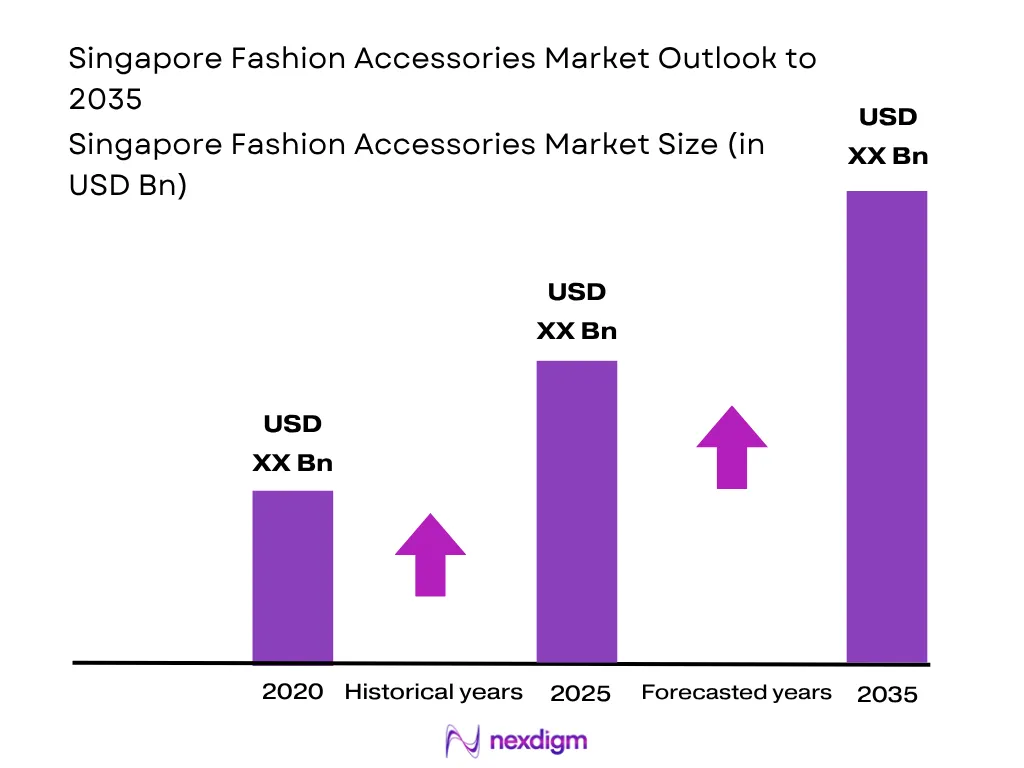
The Singapore fashion accessories market is valued at USD ~ billion, according to Nexdigm market research data for 2025. This figure reflects robust retail demand across key categories such as handbags, jewellery, watches, eyewear, and small accessories, driven by rising consumer purchasing power and increased discretionary spending post‑pandemic. Premiumisation trends are significant, with higher priced luxury accessories contributing disproportionately to total value due to sustained demand among affluent consumers.
The market features dominant activity in premium retail centres like Orchard Road, Marina Bay Sands, and Changi Airport Duty‑Free, which attract both affluent residents and international tourists drawn by Singapore’s luxury retail positioning, low tax base, and superior retail infrastructure. These hubs provide concentrated footfall, experiential luxury retail, and strong brand presence that drive category leadership in jewellery, high‑end handbags, and watches.
Market Segmentation
By Product Type
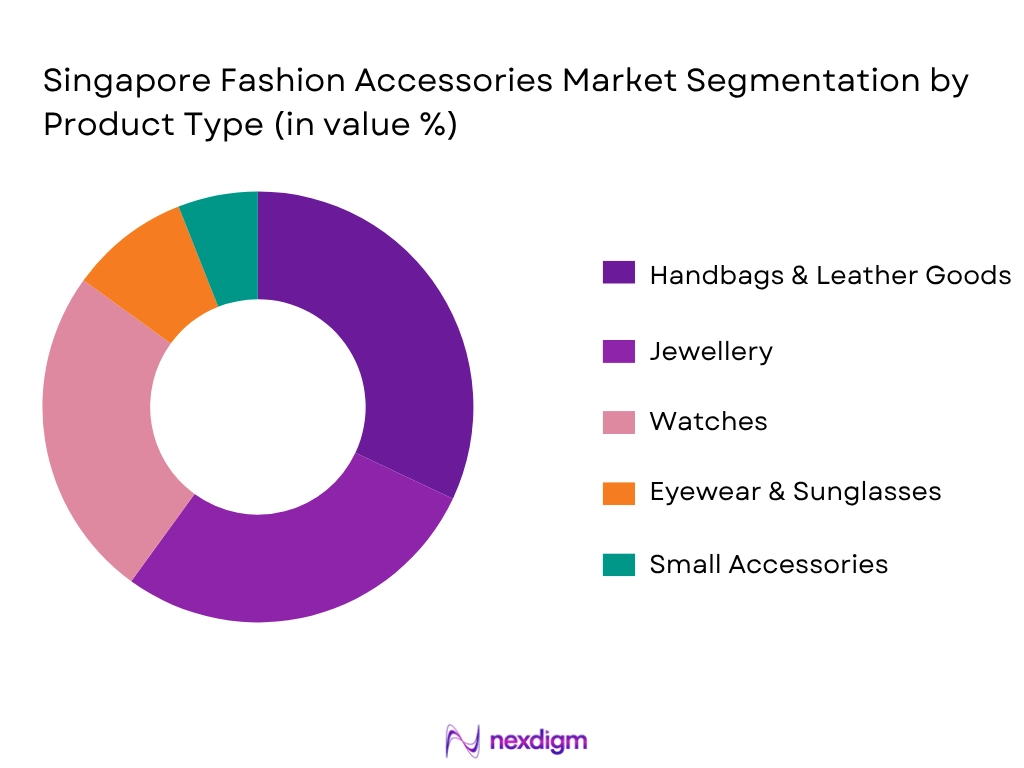
By product category, handbags and leather goods command the largest share of the Singapore fashion accessories market, driven by both luxury and premium mass segments. Handbags are perceived as status symbols, especially in affluent consumer circles, and benefit from high average selling prices, strong brand equity, and frequent travel‑related purchases by tourists. Jewellery and watches remain strong contributors to market value due to their high unit prices and consistent demand among both local and visiting luxury buyers. Eyewear and smaller accessories have steady demand, particularly among younger demographics and fashion‑forward consumers, but constitute a smaller proportion of overall value due to lower average prices. Luxury watch brands also leverage prestige and heritage appeal, sustaining high‑margin sales that bolster the value of the category. Continuous innovation and seasonal collections further support demand across these product categories.
By Sales Channel
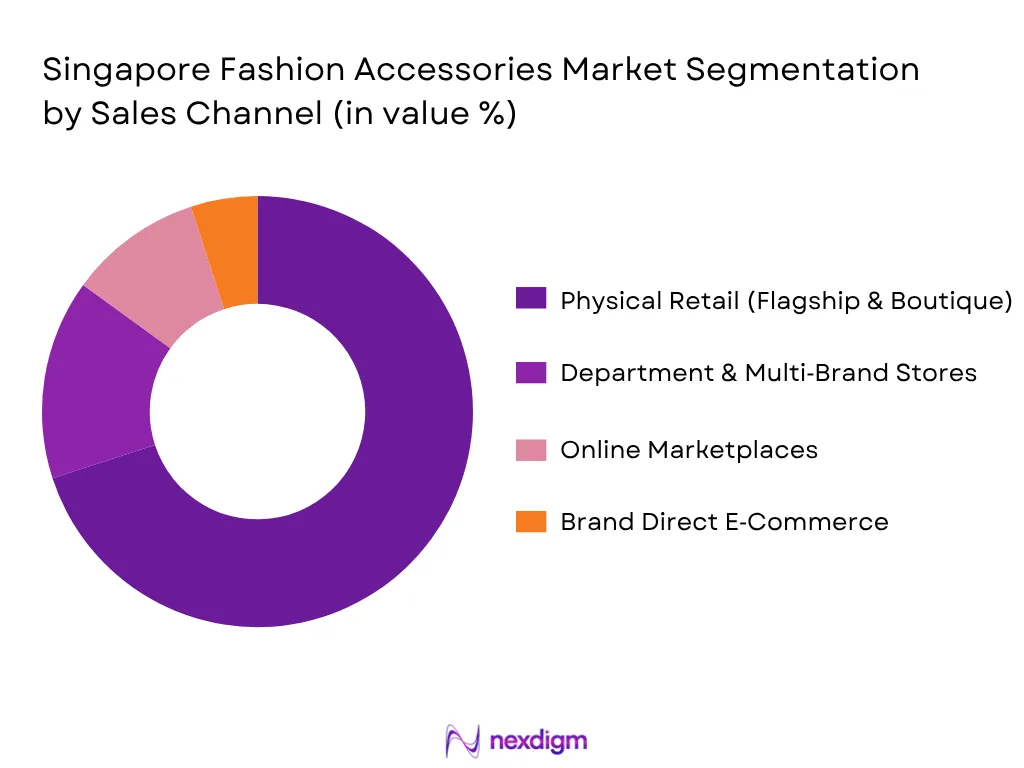
By sales channel breakdown, physical retail retains dominance in the Singapore market, accounting for the majority of fashion accessories sales (e.g., luxury boutiques, flagship stores, and premium malls). Singapore’s affluent shopper base highly values in‑person experiences, such as tactile product engagement, personalised fittings, and premium concierge services, which sustains high footfall in traditional retail spaces. Department stores and multi‑brand outlets also contribute significant share, offering broad brand assortments and driving discoverability. Meanwhile, e‑commerce channels, although smaller in overall share, are rapidly growing as digital adoption increases and omnichannel logistics improve convenience for tech‑savvy consumers. Luxury brands are gradually expanding their direct digital presence, enhancing online sales potential through curated experiences and enhanced digital marketing strategies.
Competitive Landscape
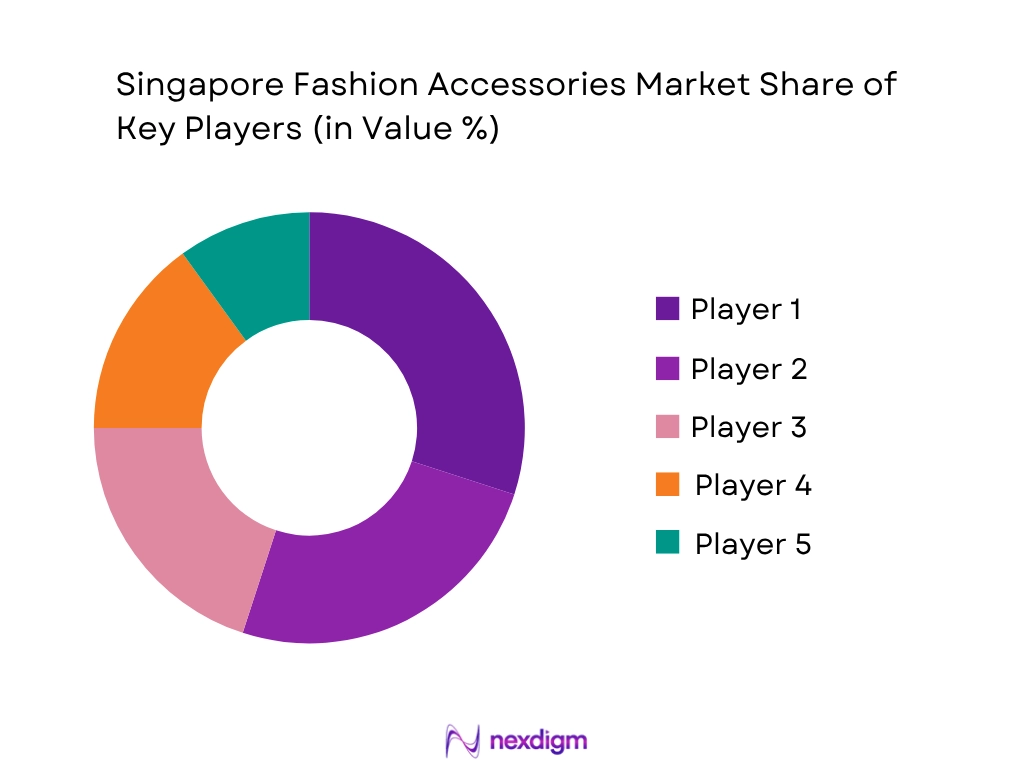
The Singapore fashion accessories market exhibits concentrated competitive dynamics among global luxury houses and key regional players. High end categories such as jewellery and watches are dominated by established brands with longstanding heritage and premium pricing power, while handbags and lifestyle accessories feature a mix of global luxury, international premium, and regionally successful brands. Key global players dominate due to strong brand equity, extensive retail footprint in premium zones, exclusive collections, and high average selling prices, reflecting the luxury and premium positioning of the market.
| Company | Est. Year | Headquarters | Channel Presence | Price Tier Focus | Flagship Locations | E‑Commerce Penetration | SKU Portfolio Breadth | Local Marketing Engagement |
| Hermès Singapore (Retail) Pte Ltd | 1837 | France | ~ | ~ | ~ | ~ | ~ | ~ |
| Rolex Singapore Pte Ltd | 1905 | Switzerland | ~ | ~ | ~ | ~ | ~ | ~ |
| Charles & Keith | 1996 | Singapore | ~ | ~ | ~ | ~ | ~ | ~ |
| Gucci Singapore | 1921 | Italy | ~ | ~ | ~ | ~ | ~ | ~ |
| Tiffany & Co Singapore | 1837 | USA | ~ | ~ | ~ | ~ | ~ | ~ |
Singapore Fashion Accessories Market Analysis
Growth Drivers
Premiumisation
Premiumisation in Singapore’s fashion accessories market reflects a substantive shift in consumer spending towards higher‑end products. This trend is underpinned by robust discretionary expenditure and tourism‑driven retail demand. Tourism receipts, which include shopping, reached an estimated SGD 22.4 billion in the first nine months of 2024 and are projected to surpass prior records by year‑end as Singapore welcomed 16.5 million international visitors in 2024, up over 20 percent from the previous year. These figures indicate strong inflows of high‑spending visitors with a preference for premium and luxury retail experiences, including fashion accessories. Singapore’s comprehensive global connectivity and lifestyle appeal enhance its attractiveness as a luxury shopping destination, which benefits premium accessory categories such as designer handbags, luxury watches, and fine jewellery. The steady rise in tourist arrivals underpins elevated discretionary expenditure on premium products that contribute disproportionately to total retail spend. The direct evidence of growing tourism spending, particularly in the shopping category, substantiates that premiumisation is not a speculative trend but a measurable factor supporting premium retail demand in Singapore. The sustained volume and value of tourist spending ensure that high‑end fashion accessories remain a key growth vector in retail portfolios.
Affluent Consumer Spend
Affluent consumer spending is a critical driver of the Singapore fashion accessories market, supported by strong national consumption and global visitor contributions to retail demand. Singapore’s final consumption expenditure, which captures household and broader consumer spending on goods and services, stood at 42.08 percent of GDP in 2024, according to World Bank national accounts data, signaling sustained household expenditure capacity amid strong economic conditions. Continued economic growth, with real GDP expansion averaging above trend in recent quarters, reinforces purchasing power within the resident population and affluent segments. International tourism further amplifies this dynamic: in 2024, Singapore tourism receipts were estimated at around SGD 29.8 billion, a post‑pandemic high that includes a significant component of shopping expenditure by international visitors who often purchase fashion and luxury accessories during their visits. With international arrival figures at around 16.5 million in 2024, the inflow of affluent tourists directly contributes to elevated discretionary spending levels at retail locations, especially in high‑end districts such as Orchard Road and Marina Bay Sands. These macroeconomic indicators demonstrate that both resident consumption and tourist spending are aligned to boost demand for fashion accessories at higher price points, illustrating that affluent consumer spend is a genuine, measurable driver of market growth.
Market Challenges
High Retail Operating Costs
High operating costs in Singapore’s retail environment act as a meaningful restraint for fashion accessories retailers, particularly for brands targeting premium segments. Retail rental rates in key shopping districts have remained elevated, with average monthly prime retail rents island‑wide reported at around SGD 27.40 per square foot in the second quarter of 2024, reflecting sustained demand for prime retail locations despite broader economic headwinds. Landlords benefit from limited supply and strong occupier interest, particularly from luxury and lifestyle brands targeting international tourists and affluent local consumers. However, these high retail rents directly impact operating margins and profitability for retailers. In addition to rent, labour and utility costs contribute to the overall operating expenditure, placing pressure on retailers to maintain higher price points to cover overheads. Singapore’s retail sector experienced a contraction in overall retail sales volume in 2024, with non‑motor vehicle sales volume, including watches and jewellery, declining, indicating that higher costs may be suppressing consumer purchase volumes within discretionary categories. The combination of elevated rental costs, competition for premium retail space, and ongoing operational expenses makes the retail environment more challenging for both established players and new entrants in the fashion accessories category. These cost pressures necessitate careful margin management and operational optimization among retailers, making high operating costs a structural restraint on market expansion.
Competitive Pricing Pressure from E‑Tailers
E‑tailers intensify pricing competition in Singapore’s fashion accessories market, exerting downward pressure on traditional retail pricing and challenging brick‑and‑mortar retailers’ margins. While physical stores hold value for high‑end experiential purchases, digital platforms expand reach and convenience, particularly for younger, price‑sensitive consumers. The omnipresence of international e‑commerce platforms offering competitive pricing, flash promotions, and frequent digital discounting increases market fragmentation, compelling traditional retailers to adapt pricing strategies to remain competitive. Although Singapore’s retail vacancy rates remain low in prime locations, indicating resilient demand, there has been observable growth in alternative shopping formats and digital penetration in retail loyalty and engagement. Advanced loyalty and real‑time engagement models are increasingly employed to retain consumers and drive repeat purchases through digital channels, reflecting the competitive pressures online marketplaces exert on pricing dynamics. In a digitally mature market where consumers engage deeply with multiple retail touchpoints, e‑tailers that leverage personalised promotions and integrated loyalty programs challenge traditional retailers’ pricing power. These dynamics introduce complexity into retail strategies, requiring greater digital investment and pricing agility to counterbalance the influence of online competition within the fashion accessories segment.
Opportunities
Travel Retail
Travel retail presents a significant opportunity in the Singapore fashion accessories market, bolstered by the recovery and expansion of international visitor arrivals and tourism receipts. Singapore welcomed 16.5 million international visitors in 2024, a strong rebound from pandemic era lows, with visitor spending reaching record levels in tourism receipts. While tourism expenditure is distributed across various categories, shopping remains a meaningful component of retail receipts, supported by duty‑free zones and premium retail districts frequented by travellers. The influx from top spending markets such as Mainland China, Indonesia, and Australia whose contributions to tourism receipts were measured in billions of Singapore dollars creates sustained demand for fashion accessories, particularly premium and luxury items typically purchased by international tourists. Singapore’s strategic position as a global aviation hub, with international seat capacity reaching over 41 million seats in 2024 further amplifies the travel retail opportunity, offering high footfall to airport retail and downtown shopping destinations. Travel retail consumers often prioritise unique, exclusive, or limited‑edition products, making fashion accessories a key category for capturing incremental spend. This environment creates a fertile ground for retailers and brands to expand travel retail assortments, enhance product visibility in duty‑free formats, and tailor high‑impact merchandising strategies that align with global tourism flows. The scale of international visitor traffic and its associated retail spend underlines travel retail’s importance as an opportunity rather than a speculative future trend.
Omnichannel Loyalty
Omnichannel loyalty initiatives represent a substantial opportunity for enhancing consumer engagement and retention in the Singapore fashion accessories market. In a digitally sophisticated retail environment with internet penetration and smartphone use among the highest in the region, retailers are transitioning from traditional point‑based loyalty models to real‑time, behaviour‑driven loyalty systems that unify physical and digital touchpoints. Retailers are increasingly leveraging personalised rewards, behaviour tracking, and integrated loyalty engagements that foster deeper customer interactions across channels. Advanced loyalty models reward multiple types of customer behaviour beyond purchase volume, such as in‑store visits, digital interactions, and mobile engagements, which are particularly effective in Singapore’s tech‑savvy consumer base. While direct market size figures for loyalty programs are not disclosed, industry commentary highlights that consumers often enroll in multiple loyalty schemes, indicative of strong engagement potential. This shift toward omnichannel loyalty aligns with broader Asia‑Pacific trends where loyalty spend and engagement are becoming integral to retaining consumers in competitive retail markets. For fashion accessories, omnichannel loyalty can differentiate retailers by enhancing personalised experiences, driving repeat purchases, and strengthening long‑term customer relationships particularly in a market where physical retail remains influential but digital convenience continues to grow.
Future Outlook
The Singapore fashion accessories market is poised for steady long‑term growth, supported by a combination of rising consumer affluence, tourism recovery, and digital retail expansion. Continued premiumisation will fuel demand for high‑end handbags, luxury jewellery, and prestige watches, while omnichannel retail strategies and enhanced digital experiences will broaden market reach. Retail hubs will continue attracting global brands seeking regional visibility, and younger consumer cohorts will drive trend‑led demand. Sustainability and experiential retail formats will increasingly shape future market evolution.
Major Players
- Hermès Singapore (Retail) Pte Ltd
- Rolex Singapore Pte Ltd
- Charles & Keith
- Gucci Singapore
- Tiffany & Co Singapore
- Louis Vuitton Singapore
- Prada Singapore
- Michael Kors Singapore
- Lovisa Singapore
- Swarovski Singapore
- Coach Singapore
- Longchamp Singapore
- Daniel Wellington Singapore
- Cartier Singapore
- Bvlgari Singapore
Key Target Audience
- Luxury & High‑Net‑Worth Individual Retail Investors
- Fashion & Lifestyle Retail Chain Corporates
- Brand Expansion & Franchise Investors
- Private Equity & Investments and Venture Capitalist Firms (fashion & retail segment)
- Government and Regulatory Bodies (Singapore Tourism Board)
- Duty‑Free & Airport Retail Operators
- Omni‑Channel Retail Technology Providers
- Retail Real Estate Developers
Research Methodology
Step 1: Identification of Key Variables
The initial phase involves defining market scope, segment boundaries, and accessory categories, supported by comprehensive desk research using global consumer spending databases, retail industry platforms, and primary market reports. Key variables affecting demand, including consumer behaviour, pricing tiers, and distribution channels, are mapped comprehensively.
Step 2: Market Analysis and Construction
In this phase, historical and current retail revenue data across fashion accessory categories are compiled. Channel penetration, SKU pricing, and regional retail performance are analysed to build a robust bottom‑up construction of total market value and sales volume.
Step 3: Hypothesis Validation and Expert Consultation
Market assumptions are validated through interviews with industry stakeholders including retail managers, brand representatives, and distribution partners operating in Singapore. These consultations refine demand drivers, competitive dynamics, and consumer preferences.
Step 4: Research Synthesis and Final Output
The final phase integrates secondary data with insights from expert consults, cross‑verified against industry databases to produce validated market sizing, segmentation analysis, forecast projections, and competitive mapping for Singapore’s fashion accessories market.

- Executive Summary
- Research Methodology Market Definitions & Scope, Abbreviations & Conventions, Data Sources & Triangulation Methods, Bottom‑Up Revenue Reconstruction (Channel + Category + SKU), Primary Research & Key Stakeholder Interviews (Retailers, Distributors, Brand HQ), Limitations and Future Research Directives

- Market Definition & Classification
- Market Genesis and Evolution
- Retail Market Life Cycle (Maturity Indicators)
- Fashion Ecosystem Value Chain Analysis
- Distribution Infrastructure Mapping
- Consumer Spend Dynamics (Local vs Tourist Spend Share)

- Growth Drivers (Premiumisation, Affluent Consumer Spend, Tourism‑Led Luxury Purchases, Digital Adoption & Mobile Commerce, Social Influencer, Digital Brand Discovery)
- Market Restraints (High Retail Operating Costs, Competitive Pricing Pressure from E‑Tailers, Currency & Import Tariff Impact)
- Opportunities (Social commerce scale, branded affordable accessories, men’s accessories, sustainable materials, travel retail, omnichannel loyalty)
- Trend Analysis (Sustainability & Ethical Materials Demand, Omnichannel Personalisation, Local Designer & Indie Brand Momentum, Second‑hand & Resale Fashion Accessory Platforms)
- Regulatory & Compliance Landscape (GST and Duty Structure Impact, Product Quality & Labelling Standards, Import / Re‑Export Trade Policies)
- SWOT Analysis (Brand equity, omnichannel reach, counterfeit risk, marketplace acceleration)
- Stakeholder Ecosystem (Designers, importers, manufacturers, wholesalers, marketplace sellers, mall operators, influencers, logistics providers, payment providers)
- Porter’s Five Forces (Supplier power, buyer power, threat of substitutes, threat of new entrants, competitive rivalry)
- PESTLE Analysis (Consumer spending, foreign retail policy, digital payments, cultural gifting, sustainability pressure, IP enforcement)
- Unit Economics and Margin Stack (Gross margin, marketplace commission, return loss, inventory carrying cost, discount depth, last-mile delivery cost)
- Pricing and SKU Architecture (Entry SKU, core SKU, premium SKU, bundle pricing, limited-edition pricing, gold-linked price volatility)

- By Value (2020-2025)
- By Volume (2020-2025)
- By E‑commerce vs Offline Sales Share (2020-2025)
- By Market Growth Momentum (2020-2025)

- By Product Category (In Value %)
Handbags & Leather Goods
Jewellery
Watches
Eyewear & Sunglasses
Small Accessories
Wallets & Travel Goods - By Material Type (In Value %)
Leather
Precious Metals
Fabric & Textile Accessories
Plastic / Acrylic / Resin
Hybrid / Mixed Materials - By End‑User Demographic (In Value %)
Women
Men
Unisex
Gen Z vs Millennials vs Affluent Professionals
High‑Net‑Worth Individuals (HNWI) Spend Profile - By Price Tier (In Value %)
Mass / Fast Fashion
Mid‑range Premium
Accessible Luxury
Luxury & Ultra‑Luxury - By Sales Channel (In Value %)
Bricks‑and‑Mortar Retail (Flagship & Boutique)
Department & Multi‑Brand Stores
Online Marketplaces & Mobile Commerce
Brand Direct E‑Commerce
Duty‑Free / Travel Retail - By Geographic & Retail Zone (In Value %)
Orchard Road District
Marina Bay & CBD Premium Retail
Shopper Belt (Tanjong Pagar / Chinatown)
Suburban Malls
Duty‑Free & Airport Retail

- Market Share of Major Players (Value share, volume share, GMV share, store-network share, online visibility share, Product Category, Channel, Price Tier)
- Cross‑Comparison Parameters (Brand Positioning Tier (Luxury/Mid/Mass), Retail Footprint Count & Flagship Location Density, Pricing Architecture (SKU Average Price Levels), E‑Commerce Penetration (% Digital Revenue), SKU Assortment Breadth & Depth, Distribution Channel Coverage, Marketing Spend & Digital Engagement Index, Exclusive Collections / Limited Editions & Brand Equity Signals)
- SWOT Analysis of Major Players (Brand strength, category specialization, retail reach, online execution, product innovation, pricing risk)
- Pricing Analysis Basis SKUs for Major Players (Handbag SKUs, jewelry SKUs, watch SKUs, eyewear SKUs, wallet SKUs, belt SKUs, hair accessory SKUs)
- Marketing and Brand Positioning Benchmarking (KOL usage, livestream frequency, TikTok content strategy, festival campaigns, loyalty programs)
- Detailed Profiles of Major Companies
Hermès Singapore (Retail) Pte Ltd
Rolex Singapore Pte Ltd
Charles & Keith
Tumi Singapore
Coach Singapore
Tiffany & Co Singapore
Gucci Singapore
Louis Vuitton Singapore
Prada Singapore
Michael Kors Singapore
Lovisa Singapore
Longchamp Singapore
Swarovski Singapore
Daniel Wellington Singapore
Pandora Singapore

- Demand and Usage Analysis (Daily wear, workplace use, occasion wear, travel use, gifting use)
- Purchasing Power and Budget Allocation (ASP tolerance, basket value, instalment use, discount sensitivity)
- Needs, Desires and Pain Point Analysis (Design freshness, durability, authenticity, warranty, size-fit comfort, return convenience)
- Decision-Making Process (Influencer discovery, marketplace reviews, brand trust, peer validation, store trial)
- Customer Journey Mapping (Awareness, consideration, try-on, purchase, delivery, after-sales, repeat purchase)
- Brand Loyalty and Switching Behavior (Price promotion, new collections, celebrity collaboration, marketplace ranking)
- Online Buyer Persona Analysis (TikTok-first shopper, Shopee value buyer, luxury browser, wedding jewelry buyer)
- Offline Buyer Persona Analysis (Mall shopper, jewelry-store family buyer, premium boutique consumer, tourist buyer)

- By Value (2026-2035)
- By Volume (2026-2035)
- By E‑commerce vs Offline Sales Share (2026-2035)
- By Market Growth Momentum (2026-2035)


 Request a Sample
 Ask for Customization
 Get a Quote
 Enquire Now