
 Download PDF
Market Overview
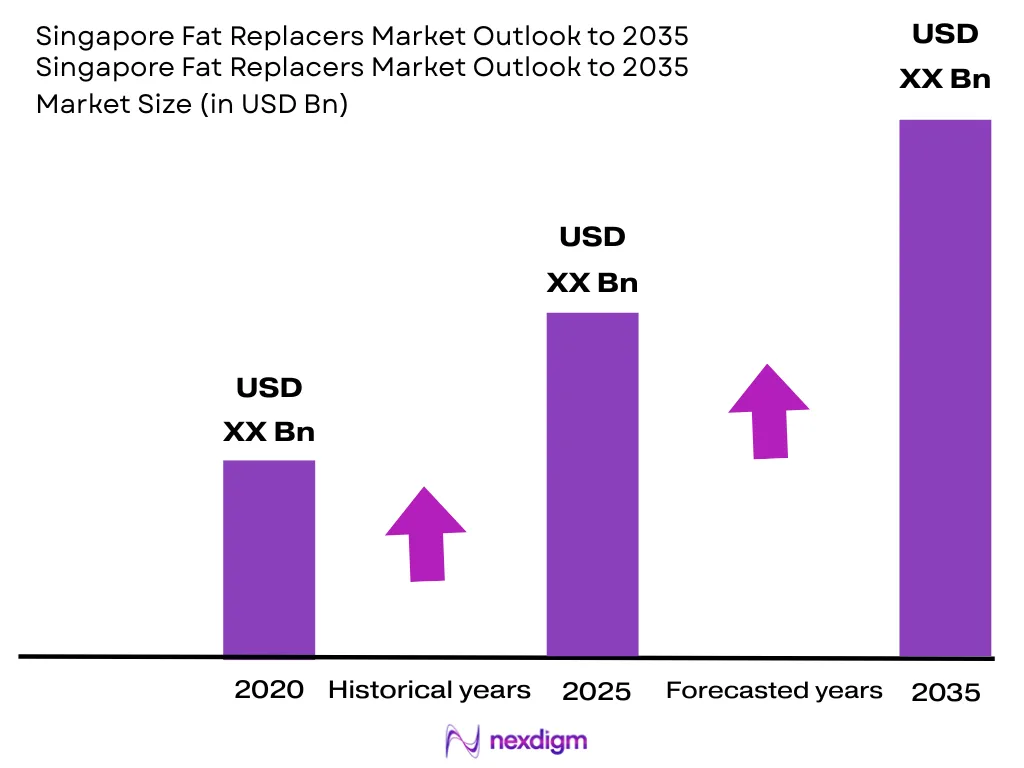
The Singapore Fat Replacers Market was valued at USD ~ Billion in 2024 and is projected to expand at a CAGR of ~% during the 2026–2035 forecast period. According to data published by the Singapore Food Agency (SFA), the Health Promotion Board (HPB), and Enterprise Singapore (ESG), Singapore’s food manufacturing and ingredient sector continues to grow as a result of rising health and wellness awareness among consumers, the government’s Nutri-Grade labelling mandate, the Healthier Choice Symbol (HCS) programme, and the country’s expanding role as a regional agri-food innovation hub. Fat replacers, encompassing carbohydrate-based, protein-based, lipid-based, and novel functional ingredients used to partially or fully substitute fat content in food formulations while maintaining sensory and textural attributes, are experiencing growing demand from Singapore-based food manufacturers, contract food producers, alternative protein companies, and foodservice operators reformulating products to meet nutritional targets, regulatory requirements, and premium health-oriented consumer preferences. Singapore’s position as one of Asia’s most advanced food technology and ingredient innovation ecosystems, anchored by the Agency for Science, Technology and Research (A*STAR), the Singapore Institute of Food and Biotechnology Innovation (SIFBI), and a vibrant agri-food startup community, further reinforces the country’s importance as a fat replacer application development and regional ingredient distribution hub.
Market Segmentation
By Source
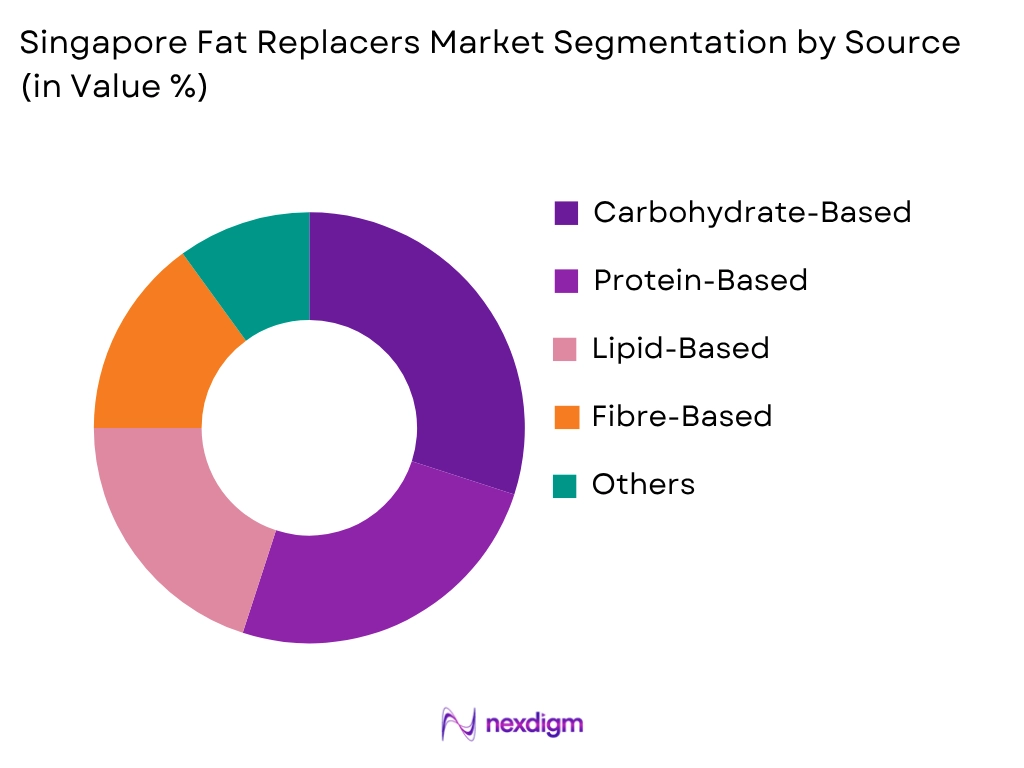
Carbohydrate-based fat replacers represent the largest segment of the Singapore Fat Replacers Market owing to their wide application versatility, established regulatory acceptance, cost competitiveness relative to protein and novel lipid-based alternatives, and strong commercial availability from global ingredient suppliers with APAC headquarters or distribution presence in Singapore. Carbohydrate-based fat replacers, including modified starches, inulin, pectin, cellulose derivatives, beta-glucan, resistant starch, and hydrocolloid systems such as guar gum, xanthan gum, and carrageenan, are widely used across bakery, dairy, sauces, dressings, and meat reformulation applications in Singapore’s food manufacturing sector. Singapore’s leading food manufacturers and contract packers, supplying both the domestic market and regional ASEAN export markets, have actively adopted carbohydrate-based fat replacer systems to achieve SFA-compliant reduced-fat and low-saturated-fat nutritional claims, Nutri-Grade compliance in beverages and packaged food, and Healthier Choice Symbol eligibility across product categories. Protein-based fat replacers, including whey protein concentrates, soy protein isolates, pea protein, and novel microalgae-derived proteins, represent the fastest-growing segment driven by Singapore’s rapidly expanding plant-based and alternative protein food sector, with companies such as Next Gen Foods, Tindle, and numerous agri-food startups incorporating protein-based fat replacement systems into their product formulations. Continuous investments in application laboratory capabilities, food scientist technical support teams, and clean-label reformulation expertise by leading ingredient suppliers have further strengthened the adoption of carbohydrate-based fat replacers as the foundational reformulation tool across Singapore’s food manufacturing and innovation ecosystem.
By Distribution Channel
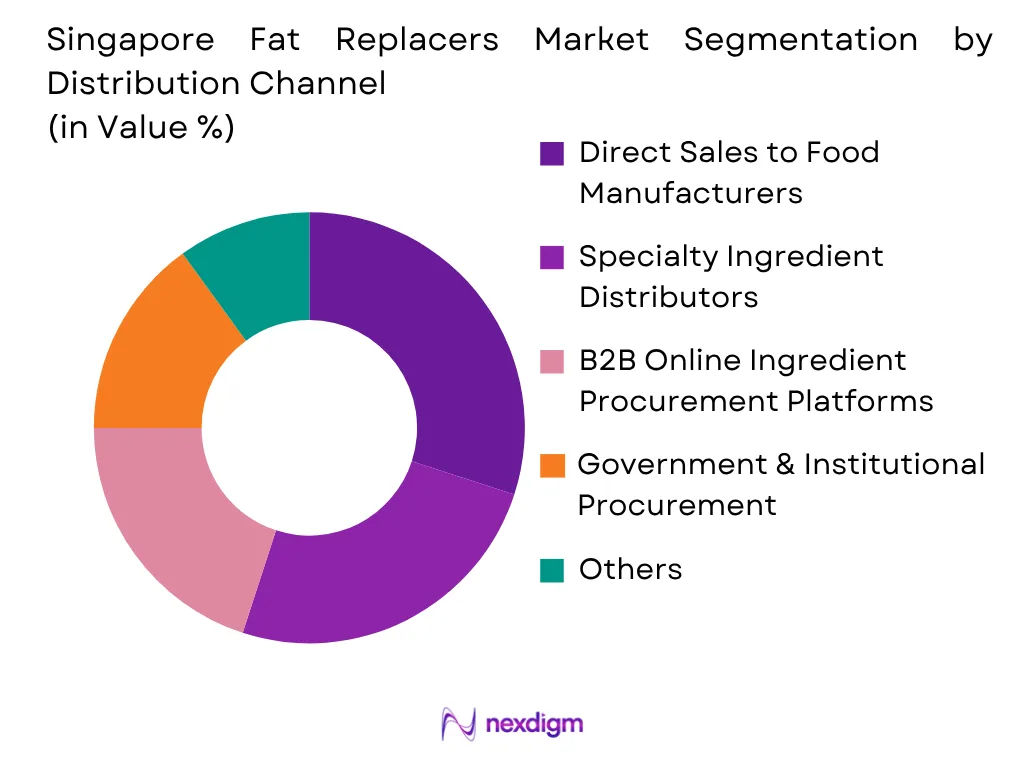
Direct sales to food manufacturers represent the dominant distribution channel for fat replacers in Singapore, as food ingredient companies typically engage clients through dedicated technical sales teams, food scientist application support, and direct long-term supply agreements that ensure ingredient consistency, regulatory documentation compliance, and ongoing reformulation collaboration. Leading global ingredient companies including Ingredion, Kerry, Tate & Lyle, Corbion, and Cargill maintain Singapore-based APAC headquarters or regional offices with dedicated food application laboratories and technical sales forces that work directly with food manufacturers, agri-food startups, and contract food producers on formulation development, scale-up support, and regulatory navigation. Specialty ingredient distributors play a complementary role in the Singapore fat replacer market, serving smaller food manufacturers, artisan producers, and emerging agri-food companies that require flexible ordering quantities, blended ingredient solutions, and distributor-managed regulatory documentation. B2B online ingredient procurement platforms are growing in adoption among Singapore’s food manufacturing sector, particularly for repeat commodity-grade ingredient purchases, enabling procurement managers to compare specifications, request samples, and place orders digitally. Singapore’s Food Innovation and Resource Centre (FIRC) and Enterprise Singapore’s food industry development programmes facilitate access to ingredient suppliers and application support for SME food companies undertaking reformulation projects under the Healthier Choice Symbol or Nutri-Grade compliance framework, creating an additional facilitated channel connecting ingredient suppliers with reformulating food businesses.
Competitive Landscape
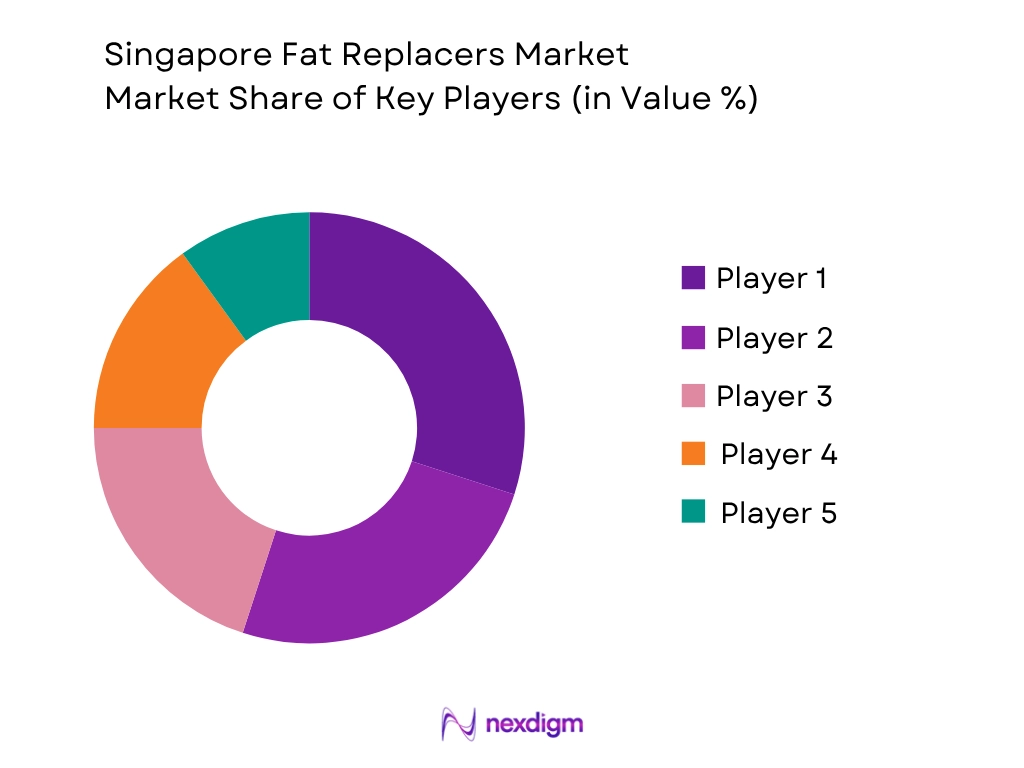
The Singapore Fat Replacers Market is served primarily by multinational specialty food ingredient companies that maintain APAC regional headquarters, innovation centres, or dedicated commercial operations in Singapore, leveraging the city-state’s strategic location, world-class logistics infrastructure, regulatory credibility, and proximity to the broader ASEAN food manufacturing market. Global ingredient leaders including Ingredion, Kerry Group, Tate & Lyle, Corbion, CP Kelco, Cargill Specialty Ingredients, DSM-Firmenich, Roquette, and IFF compete through broad fat replacer product portfolios, application laboratory capabilities, food scientist technical support, clean-label and functional ingredient innovation pipelines, and the ability to provide regionally harmonised regulatory documentation for ASEAN market entry. Competition is intensifying as food reformulation demand accelerates under Singapore’s Nutri-Grade labelling scheme and regional ASEAN clean-label trends, driving increased investment in application development resources, novel ingredient launches, and strategic partnerships with Singapore’s agri-food innovation ecosystem.
| Company | Establishment Year | Headquarters | Primary Fat Replacer Portfolio | Key Application Industries
|
Manufacturing Presence | R&D Capability | Distribution Network | Clean Label Solutions |
| Ingredion Singapore | 1906 | ~ | ~ | ~ | ~ | ~ | ~ | ~ |
| Kerry Group Singapore | 1972 | ~ | ~ | ~ | ~ | ~ | ~ | ~ |
| Tate & Lyle Singapore | 1921 | ~ | ~ | ~ | ~ | ~ | ~ | ~ |
| Corbion Singapore | 1919 | ~ | ~ | ~ | ~ | ~ | ~ | ~ |
| CP Kelco Singapore | 1920 | ~ | ~ | ~ | ~ | ~ | ~ | ~ |
Singapore Confectionary Market Analysis
Growth Drivers
Nutri-Grade Labelling Scheme and Healthier Choice Programme Driving Reformulation Demand
The Government of Singapore’s Nutri-Grade labelling scheme and the Health Promotion Board’s Healthier Choice Symbol (HCS) programme continue to be the most direct policy-driven growth catalysts for the Singapore Fat Replacers Market, compelling food manufacturers and foodservice operators to actively reformulate products to achieve lower fat, lower saturated fat, and improved nutritional profiles. The Nutri-Grade scheme, implemented by the Singapore Food Agency (SFA) and the Health Promotion Board (HPB), requires mandatory front-of-pack nutritional grade labelling for pre-packaged beverages and has been progressively expanded across additional food categories, creating regulatory pressure on manufacturers to achieve higher nutritional grades through ingredient reformulation, including fat reduction and fat quality improvement strategies. According to the HPB, Singapore continues to grapple with a high prevalence of obesity, diabetes, and cardiovascular disease among its resident population of over 4 million people, reinforcing the government’s commitment to food reformulation as a public health intervention strategy. The World Bank estimated Singapore’s GDP at approximately USD 501 billion in 2024, reflecting one of the highest per capita income levels in Asia and a consumer base that is both health-literate and willing to pay premium prices for products with superior nutritional profiles and clean-label credentials. The International Monetary Fund (IMF) projected continued GDP growth for Singapore supported by advanced manufacturing, financial services, and technology sectors, sustaining high household food expenditure and institutional food procurement. Food manufacturers seeking Healthier Choice Symbol eligibility must meet HPB-specified nutrient thresholds across fat, saturated fat, sodium, and sugar content, directly incentivising the adoption of fat replacer ingredients across bakery, dairy, snacks, sauces, and processed meat categories and driving sustained commercial demand for carbohydrate-based, protein-based, and functional fat replacer systems from Singapore’s ingredient supplier base.
Singapore’s Agri-Food Innovation Ecosystem and Plant-Based Food Sector Expansion
Singapore’s world-class agri-food innovation ecosystem, anchored by substantial government investment in food technology research, a vibrant agri-food startup community, and the country’s 30 by 30 food security strategy, continues to generate strong and growing demand for fat replacer ingredients as food technology companies reformulate and develop next-generation food products. According to Enterprise Singapore (ESG), the Singapore Food Story R&D Programme has committed over SGD 144 million toward advancing sustainable food production and food innovation, encompassing research into alternative proteins, novel food ingredients, and functional food systems that frequently require advanced fat replacer technologies to achieve target nutritional profiles and consumer-acceptable sensory characteristics. The Agency for Science, Technology and Research (A*STAR) and the Singapore Institute of Food and Biotechnology Innovation (SIFBI) conduct active research programmes in food ingredient functionality, fat structuring, emulsion technology, and texture modification that directly support the development and adoption of novel fat replacer systems within Singapore’s food manufacturing sector. Singapore’s rapidly expanding plant-based food sector, encompassing companies such as Next Gen Foods (TiNDLE), Umami Bioworks, Ants Innovate, and numerous other agri-food startups, requires sophisticated fat replacer ingredient systems to replicate the textural, flavour-carrying, and mouthfeel attributes of animal-derived fats in plant-based meat, dairy, and seafood analogues. The Economic Development Board (EDB) has consistently attracted global food ingredient companies to establish APAC innovation centres and application laboratories in Singapore, reinforcing the city-state’s role as the primary regional hub for fat replacer application development, technical services, and ingredient commercialisation targeting the broader ASEAN food manufacturing market of over 680 million consumers.
Market Challenges
Small Domestic Market Size, Import Dependency and High Formulation Complexity
The Singapore Fat Replacers Market faces inherent structural constraints arising from the city-state’s small domestic population and near-total reliance on imported food ingredients, which limit the scale of locally addressable demand and expose manufacturers and ingredient buyers to global supply chain and pricing volatility. According to the Singapore Department of Statistics (DOS), Singapore’s resident population of approximately 4 million people represents a comparatively small domestic food manufacturing market relative to regional peers such as Indonesia, Vietnam, and Thailand, meaning that the commercial scale of fat replacer ingredient demand at the domestic level is limited and most ingredient suppliers serving Singapore do so primarily as part of broader ASEAN regional distribution strategies rather than in pursuit of purely domestic market scale. Singapore imports the substantial majority of its food ingredient requirements, including specialty starches, hydrocolloids, emulsifiers, protein concentrates, and novel functional ingredients, from manufacturing sources across Europe, North America, and Asia, creating dependency on global supply chains that are subject to disruptions, freight cost inflation, and lead time variability. Fat replacer formulation also presents significant technical complexity, as achieving commercially acceptable taste, texture, mouthfeel, and shelf stability in reduced-fat food products requires deep food science expertise, extensive application testing, and often iterative reformulation cycles that demand investment in application laboratory infrastructure and food scientist capabilities that not all Singapore food manufacturers possess internally. Consumer acceptance of reduced-fat products remains a persistent challenge, as the mouthfeel, flavour delivery, and satiety attributes of natural fats are difficult to fully replicate with available fat replacer systems, particularly in premium food applications where sensory performance is a primary purchase driver.
High Cost of Novel Fat Replacers and Regulatory Complexity for Functional Ingredients
Premium and novel fat replacer ingredients, including structured lipids, precision fermentation-derived lipid systems, microencapsulated fat mimetics, and novel functional fibres, carry significantly higher price points than conventional commodity-grade carbohydrate or protein fat replacers, creating cost barriers to adoption for smaller food manufacturers and price-sensitive foodservice operators in Singapore. According to the Singapore Food Agency (SFA), novel food ingredients including those produced through precision fermentation, cell cultivation, or advanced enzymatic modification are subject to the SFA’s Novel Food Safety Assessment framework, which requires comprehensive safety dossier submission, scientific review, and formal approval prior to commercial use in Singapore, a process that can extend over 12 to 24 months and carries substantial regulatory compliance costs for ingredient suppliers seeking to commercialise new fat replacer technologies in the Singapore market. The regulatory landscape for functional food ingredients and health claims in Singapore requires careful navigation of SFA food regulations, HPB Healthier Choice Symbol nutrient criteria, and ASEAN harmonised food standards under the ASEAN Food Safety Network framework, as food manufacturers using fat replacers to reformulate products must ensure that both the ingredient and the finished product comply with applicable labelling, compositional, and additive use standards across each target market. Small and medium-sized food companies in Singapore’s manufacturing sector often lack the dedicated regulatory affairs expertise required to efficiently navigate these multi-framework compliance requirements, creating a dependency on ingredient supplier technical support teams for regulatory guidance that increases procurement preference for large multinational suppliers with established SFA compliance track records and comprehensive regulatory documentation capabilities.
Market Opportunities
Precision Fermentation-Derived Fat Replacers and Novel Functional Ingredient Innovation
Singapore’s globally recognised regulatory first-mover advantage in novel food approval, combined with its world-class food biotechnology research infrastructure, positions the country as a leading commercialisation hub for next-generation precision fermentation-derived fat replacers and functional lipid systems. The Singapore Food Agency’s Novel Food Safety Assessment framework, which approved cell-cultivated chicken for commercial sale in 2020, is among the most progressive novel food regulatory frameworks globally, enabling companies developing precision fermentation-derived lipids, structured fat systems, and microalgae-based fat replacers to pursue commercial approval in Singapore as a gateway to broader ASEAN and global market entry. According to the Agency for Science, Technology and Research (A*STAR), Singapore’s Biotransformation Innovation Platform and SIFBI are actively developing precision fermentation capabilities for food ingredient production, including novel lipid systems and fat structuring proteins that have direct applications as next-generation fat replacers in plant-based foods, dairy alternatives, and functional nutrition products. Companies including TurtleTree, which is producing lactoferrin and bioactive dairy proteins through precision fermentation in Singapore, and Ants Innovate, focused on insect-derived functional lipids, represent early-stage examples of Singapore-based novel ingredient developers whose technologies have direct fat replacer application potential. Growing global and regional demand for clean-label, sustainably produced, and nutritionally superior fat replacer ingredients, combined with the ASEAN food market’s rapid expansion, provides Singapore-based novel ingredient companies with a compelling commercialisation opportunity. Ingredient companies and food technology startups investing in precision fermentation-derived lipid systems, functional fibre fat replacers, and AI-assisted food reformulation platforms are well positioned to capture premium revenue as Singapore continues to lead Asian regulatory and commercial innovation in novel food ingredients through 2035.
Regional ASEAN Export of Reformulated Products and Ingredient Distribution Hub Development
Singapore’s strategic position as Southeast Asia’s premier food innovation, regulatory, and logistics hub presents a significant long-term growth opportunity for fat replacer ingredient suppliers and reformulated food manufacturers seeking to develop and scale products targeting the broader ASEAN regional market of over 680 million consumers. Enterprise Singapore (ESG) actively promotes Singapore as the preferred ASEAN regional headquarters location for global food ingredient companies, supporting them in using Singapore as an application development, regulatory navigation, and product commercialisation base for market entry across Indonesia, Vietnam, Thailand, the Philippines, Malaysia, and Myanmar. The ASEAN Free Trade Area (AFTA) and Singapore’s bilateral free trade agreements with major food ingredient producing nations, including the European Union, the United States, Australia, and Japan, provide preferential frameworks for importing specialty fat replacer ingredients into Singapore and re-exporting reformulated finished products across ASEAN with competitive landed costs. Growing health and wellness consumer awareness across ASEAN, driven by rising urbanisation, expanding middle-class populations, and increasing prevalence of diet-related non-communicable diseases, is accelerating demand for reduced-fat, low-saturated-fat, and functionally enhanced food products across the region, creating a substantial addressable market for Singapore-developed reformulated products incorporating advanced fat replacer systems. Food manufacturers and ingredient companies that invest in Singapore-based application development, regional regulatory harmonisation expertise, and scalable ASEAN distribution infrastructure will be well positioned to capture the compounding growth in health-oriented food demand across one of the world’s most dynamic consumer markets through 2035.
Future Outlook
The Singapore Fat Replacers Market is expected to witness steady and sustained growth throughout the forecast period, supported by the government’s progressive nutritional labelling and food reformulation policies, Singapore’s expanding role as an APAC agri-food innovation hub, rising consumer demand for health-oriented and clean-label food products, and the rapid growth of the plant-based and alternative protein food sector requiring sophisticated fat replacement systems. Ingredient companies are increasingly investing in Singapore-based application laboratories, food scientist technical sales capabilities, novel ingredient regulatory approvals, and ASEAN regional distribution infrastructure. Growing adoption of precision fermentation-derived fat replacers, functional fibre systems, and AI-assisted food reformulation tools, combined with the progressive expansion of Nutri-Grade and Healthier Choice Symbol compliance requirements across food categories, will further stimulate ingredient innovation and reformulation investment. Continued investments in agri-food R&D, novel food regulatory frameworks, and regional ASEAN export market development will strengthen the long-term growth trajectory of the Singapore Fat Replacers Market through 2035.
Major Players
- Ingredion Singapore
- Kerry Group Singapore
- Corbion Singapore
- Tate & Lyle Singapore
- CP Kelco Singapore
- Cargill Specialty Ingredients Singapore
- DSM-Firmenich Singapore
- IFF (International Flavors & Fragrances) Singapore
- Roquette Asia Pacific (Singapore)
- Glanbia Nutritionals Singapore
- FrieslandCampina Ingredients Singapore
- Lonza Singapore (Nutrition Division)
- Beneo Asia Pacific (Singapore)
- Fiberstar Asia (Singapore)
- TIC Gums Singapore
Key Target Audience
- Food & Beverage Manufacturers and Product Developers
- Alternative Protein and Plant-Based Food Companies
- Nutraceutical and Functional Food Producers
- Contract Food Manufacturers and Co-Packers
- Foodservice Operators and HoReCa Chains
- Investments and Venture Capitalist Firms
- Government and Regulatory Bodies (Singapore Food Agency (SFA), Health Promotion Board (HPB), Agency for Science Technology and Research (A*STAR), Singapore Institute of Food and Biotechnology Innovation (SIFBI), Enterprise Singapore (ESG))
- Food Ingredient Distributors and Specialty Chemical Traders
- Agri-Food Technology Startups and Innovation Ecosystem Participants
Research Methodology
Step 1: Identification of Key Variables
The research begins by identifying the major stakeholders across the Singapore Fat Replacers value chain, including ingredient manufacturers, importers, specialty distributors, food manufacturers, agri-food startups, foodservice operators, research institutions, and regulatory bodies. Extensive secondary research is conducted using SFA publications, HPB nutrition policy documents, A*STAR research outputs, Enterprise Singapore industry reports, company product catalogues, and proprietary ingredient market databases to establish the key variables influencing market performance.
Step 2: Market Analysis and Construction
Historical market information is compiled and evaluated to estimate overall market size, ingredient consumption volumes, pricing trends, application penetration by food category, and revenue generation across major fat replacer types. Both demand-side indicators (food manufacturer reformulation activity, Nutri-Grade compliance investment, plant-based product launch volumes) and supply-side indicators (ingredient import volumes, supplier product portfolio depth, distribution network coverage) are analysed using bottom-up and top-down approaches to construct a comprehensive market model.
Step 3: Hypothesis Validation and Expert Consultation
Preliminary market estimates and assumptions are validated through Computer Assisted Telephone Interviews (CATIs) and structured discussions with food ingredient company commercial and technical directors, food manufacturer procurement and R&D managers, food scientist consultants, agri-food startup founders, and regulatory affairs specialists. These consultations provide critical insights into reformulation trends, ingredient adoption barriers, pricing dynamics, novel ingredient regulatory timelines, and emerging application development priorities.
Step 4: Research Synthesis and Final Output
The final stage integrates primary research findings with secondary data to develop a comprehensive market assessment covering ingredient type segments, application categories, end-user profiles, competitive landscape, and future growth opportunities. Multiple validation techniques, including cross-verification with SFA import data, food product launch databases, and ingredient supplier sales data, are employed to ensure the consistency and credibility of the final market report.

- Executive Summary
- Research Methodology (Market Definitions and Assumptions, Abbreviations, Market Taxonomy, Market Sizing Approach, Top-Down Analysis, Bottom-Up Analysis, Demand-Side Assessment, Supply-Side Assessment, Primary Industry Interviews, Secondary Research Validation, Data Triangulation, Forecasting Framework, Limitations and Future Conclusions)

- Definition and Scope
- Market Evolution and Industry Genesis
- Timeline of Major Industry Developments
- Fat Replacer Industry Value Chain Analysis
- Supply Chain Analysis

- Growth Drivers (Rising Health & Wellness Consciousness, Government Healthier Choice Programme and Nutri-Grade Labelling, 30 by 30 Food Innovation Ecosystem, Growth of Plant-Based and Alternative Protein Foods Requiring Fat Reformulation, Expanding Functional and Nutraceutical Food Sector, Singapore as APAC R&D and Ingredient Innovation Hub, Foodservice Reformulation Demand, Premium Low-Fat and Reduced-Calorie Product Launches)
- Market Challenges (Small Domestic Market Size and Import Dependency for Ingredients, High Formulation Complexity and Technical Expertise Requirements, Consumer Taste and Texture Acceptance of Reduced-Fat Products, High Cost of Novel and Premium Fat Replacers, Regulatory Complexity Across Novel Food and Functional Ingredient Approvals, Limited Local Manufacturing of Fat Replacer Ingredients, Competition from Imported Finished Low-Fat Products)
- Market Opportunities (Nutri-Grade Compliance-Driven Reformulation, Novel Protein and Plant-Based Fat Replacer Innovation, Functional Fibre and Prebiotic Fat Replacers, Cell-Cultivated and Precision Fermentation-Derived Fat Replacers, Clinical Nutrition and Medical Food Applications, Regional ASEAN Export of Reformulated Products, Agri-Food Tech Startup Ecosystem, Clean-Label and Organic Fat Replacer Development)
- Market Trends (Clean-Label Ingredient Demand, Plant-Based Reformulation, Precision Fermentation-Derived Lipids, High-Fibre Functional Fat Replacers, Reduced-Saturated Fat Product Development, AI-Assisted Food Formulation, Microencapsulation Technology, Structured Lipid Innovation, Sustainable Ingredient Sourcing)
- Government Regulations and Policies (Singapore Food Agency (SFA) Novel Food Assessment Framework, Nutri-Grade Labelling Scheme (2022), Healthier Choice Symbol (HCS) Programme by Health Promotion Board (HPB), Food Regulations under the Sale of Food Act, Permitted Additives and Functional Ingredient Standards, Allergen Labelling Requirements, Import Accreditation Standards for Food Ingredients)
- Nutritional Policy and Public Health Analysis (Dietary Fat Reduction Targets, Saturated Fat and Trans Fat Reduction Initiatives, Singapore Dietary Guidelines, National Nutrition Survey Findings, Health Promotion Board Nutrition Programmes)
- Raw Material and Import Supply Analysis (Key Ingredient Import Sources, Hydrocolloid Supply Chains, Specialty Starch Availability, Protein Ingredient Imports, Emulsifier Supply)
- Food Reformulation Landscape Analysis (Categories Undergoing Active Reformulation, Clean-Label Transition, Fat Reduction Targets by Category, Reformulation Investment Trends)
- Innovation and R&D Ecosystem Analysis (A*STAR Food Research Programmes, Singapore Institute of Food and Biotechnology Innovation (SIFBI), NUS Food Science Research, AgriFood Cluster Enterprise Ecosystem)
- SWOT Analysis
- Porter’s Five Forces Analysis
- PESTLE Analysis
- Stakeholder Ecosystem
- Competition Ecosystem

- By Market Value (2020-2025)
- By Volume Consumption (2020-2025)
- By Average Selling Price (2020-2025)

- By Source (In Value %)
Carbohydrate-Based Fat Replacers (Starches, Fibres, Gums & Hydrocolloids)
Protein-Based Fat Replacers (Whey, Soy, Pea & Novel Proteins)
Lipid-Based Fat Replacers (Structured Lipids, Emulsifiers & Fat Mimetics)
Combination / Hybrid Fat Replacers
Novel & Functional Fat Replacers (Inulin, Resistant Starch, Beta-Glucan) - By Application (In Value %)
Bakery & Confectionery
Dairy & Frozen Desserts
Meat & Meat Analogues
Sauces, Dressings & Condiments
Snacks & Savoury Products
Beverages & Functional Drinks
Infant & Clinical Nutrition
Foodservice & HoReCa Formulations - By End User (In Value %)
Food & Beverage Manufacturers
Foodservice Operators & HoReCa
Nutraceutical & Functional Food Producers
Clinical & Medical Nutrition Companies
Food Technology Startups & Agri-Food Innovators
Contract Food Manufacturers & Co-Packers - By Distribution Channel (In Value %)
Direct Sales to Food Manufacturers
Specialty Ingredient Distributors
B2B Online Ingredient Procurement Platforms
Government & Institutional Procurement
Trade Shows, Demos & Technical Sales - By Pricing Segment (In Value %)
Economy & Commodity-Grade Fat Replacers
Mid-Range Functional Fat Replacers
Premium & Clean-Label Fat Replacers
Speciality & Novel Functional Ingredients

- Market Share Analysis (By Value, Product Type, Application Segment, End-User Category)
- Cross Comparison Parameters (Product Portfolio Breadth Across Fat Replacer Types, Application Coverage, APAC Regional Distribution Capability, R&D and Application Laboratory Investment in Singapore, Clean-Label and Organic Portfolio Strength, Novel and Functional Ingredient Depth, SFA and International Regulatory Compliance, Technical Sales and Food Scientist Support Capability)
- SWOT Analysis of Major Players
- Pricing Analysis (By Ingredient Type, Source, Application, Functionality Level, Volume Tier)
- Detailed Profiles of Major Companies
Ingredion Singapore
Kerry Group Singapore
Corbion Singapore
Tate & Lyle Singapore
CP Kelco Singapore
Cargill Specialty Ingredients Singapore
DSM-Firmenich Singapore
IFF (International Flavors & Fragrances) Singapore
Roquette Asia Pacific (Singapore)
Glanbia Nutritionals Singapore
FrieslandCampina Ingredients Singapore
Lonza Singapore (Nutrition Division)
Beneo Asia Pacific (Singapore)
Fiberstar Asia (Singapore)
TIC Gums Singapore

- Procurement Pattern Analysis (B2B Ingredient Procurement Frequency, Direct vs Distributor Sourcing, Reformulation Project-Based vs Ongoing Purchasing, Tender vs Negotiated Contracts)
- End-User Demand Analysis (Food Manufacturer Requirements, Foodservice Reformulation Needs, Nutraceutical Producer Preferences, Clinical Nutrition Specifications)
- Budget and Expenditure Analysis by Application Segment
- Premium vs Economy Ingredient Preference Analysis
- Clean-Label and Sustainability Certification Preference
- Technical Support and Application Development Service Preference
- Product Attribute Preference Analysis (Functionality, Taste and Texture Neutrality, Clean Label Status, Certifications, Price, Regulatory Compliance, Solubility and Processing Compatibility)
- Technology Adoption in Food Reformulation
- Online vs Traditional Ingredient Sourcing Behaviour
- Buyer Pain Point Analysis
- Supplier Switching and Loyalty Behaviour

- By Market Value (2026-2035)
- By Volume Consumption (2026-2035)
- By Average Selling Price (2026-2035)


 Request a Sample
 Ask for Customization
 Get a Quote
 Enquire Now