
 Download PDF
Market Overview
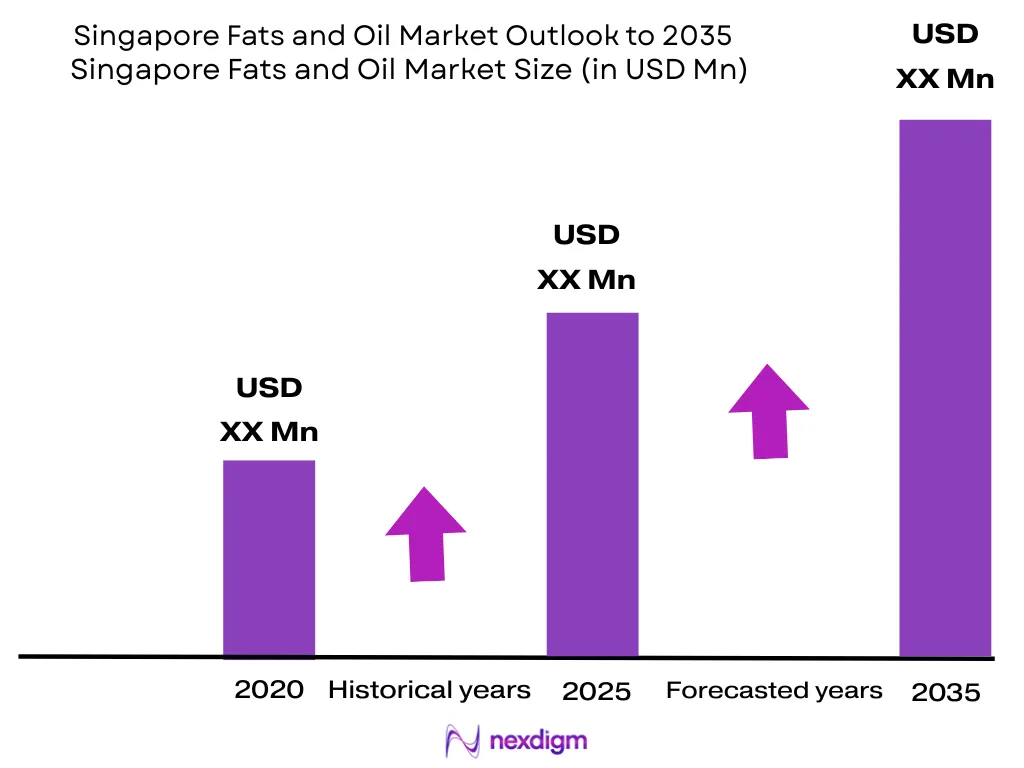
The Singapore Fats and Oil Market is valued at USD ~ million, with forecasted growth expected at ~ % CAGR for the forecast period. The market is driven by edible oil imports, palm-based oil availability, foodservice consumption, bakery fats, specialty fats, and oleochemical demand. Singapore imported USD 162 million of palm oil in 2024, while its foodservice industry recorded USD 9.4 billion in sales in 2023, supporting bulk frying oil and institutional fat demand. Singapore’s market is concentrated around Singapore city-state consumption clusters, Tuas, Jurong, Woodlands, and regional supply links with Malaysia and Indonesia. Tuas and Jurong dominate due to tank storage, logistics, food manufacturing and industrial ingredient activity, while Malaysia and Indonesia dominate external supply because Singapore lacks domestic oilseed production. In 2023, Malaysia exported 7.49 million kg and Indonesia exported 5.69 million kg of crude palm oil to Singapore, reinforcing proximity-led import dependence.
Market Segmentation
By Product Type
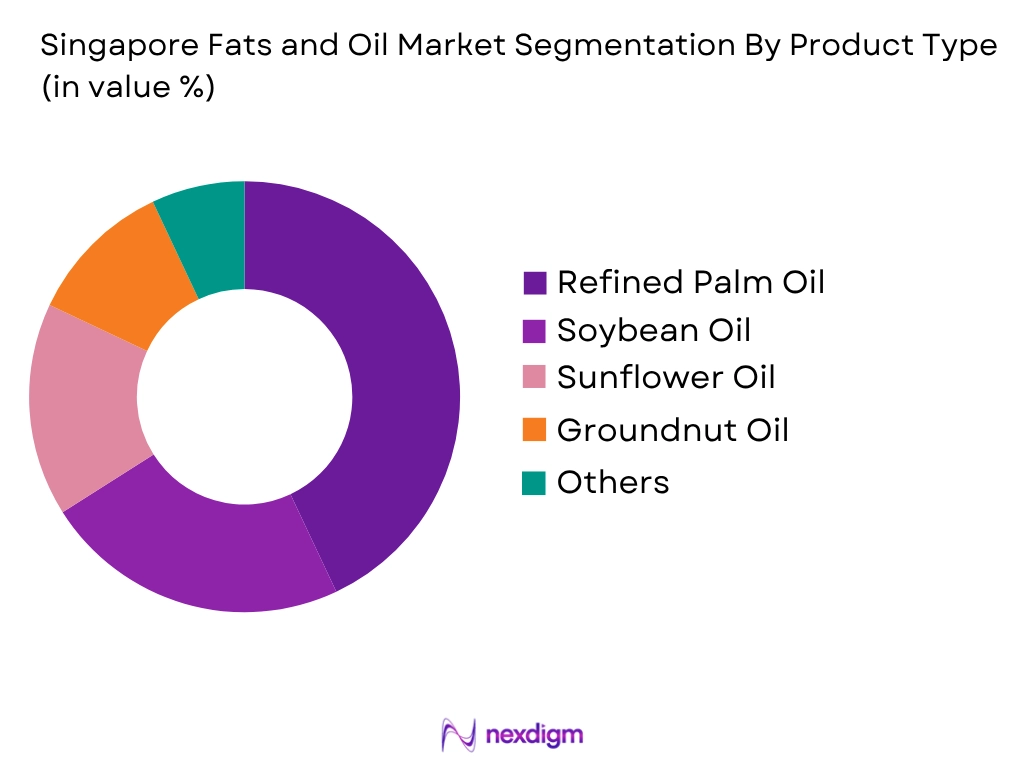
Singapore Fats and Oil Market is segmented by product type into palm olein and refined palm oil, soybean oil, sunflower oil, canola oil, coconut oil, olive oil, margarine, shortening, specialty fats and other edible oils. Palm olein and refined palm oil dominate the market because they are highly suitable for deep frying, Asian cuisine, quick-service restaurants, hawker kitchens, bakery shortening and food manufacturing. Singapore’s geographic proximity to Malaysia and Indonesia ensures regular access to palm-based feedstock, lower freight exposure compared to soft oils, and strong availability through integrated palm oil groups. Palm oil’s high heat stability, neutral flavor profile, lower price point and availability in jerry cans, drums, flexitanks and bulk tanker formats make it the preferred oil for foodservice distributors and industrial buyers.
By Application
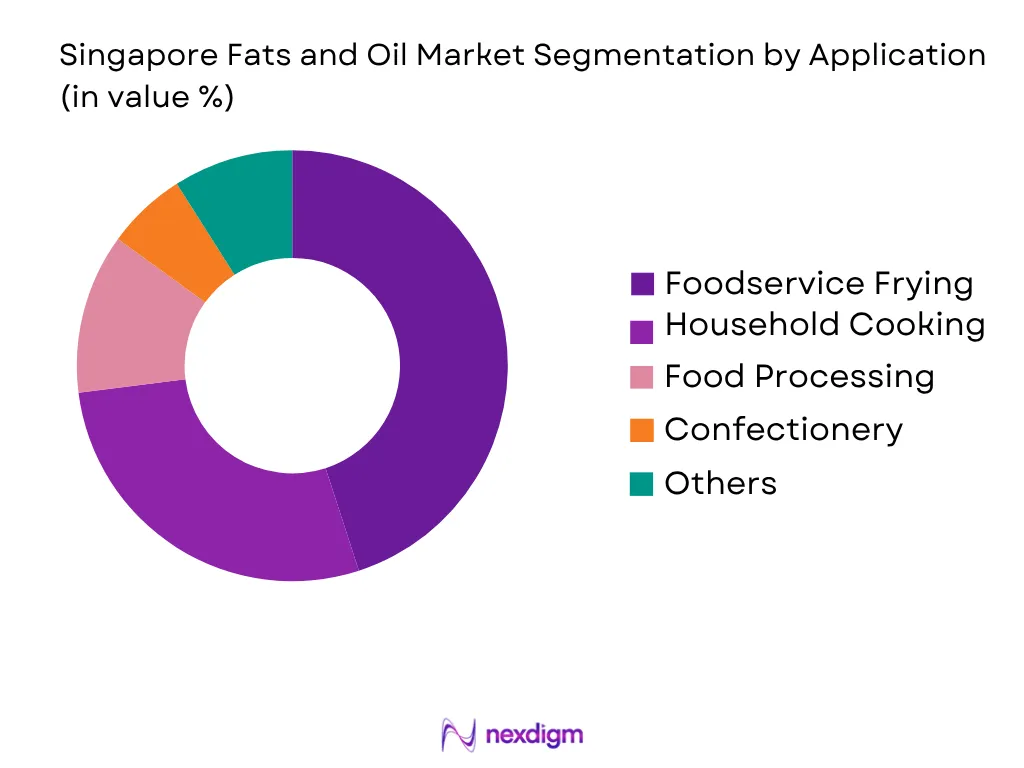
Singapore Fats and Oil Market is segmented by application into HoReCa and foodservice frying, household cooking, food processing, bakery and confectionery, oleochemicals, industrial uses, retail premium oils, repacking and re-export. HoReCa and foodservice frying dominate the application mix because Singapore has a dense restaurant, hawker, hotel, catering and quick-service food ecosystem. SFA data indicates that Singapore had 53,912 licensed retail and non-retail food establishments at the end of 2024, creating high-volume recurring demand for stable frying oils, especially palm olein and blended vegetable oils. Bulk pack requirements, frequent frying oil turnover, delivery reliability and cost per frying cycle make foodservice buyers structurally important to the oils and fats category.
Competitive Landscape
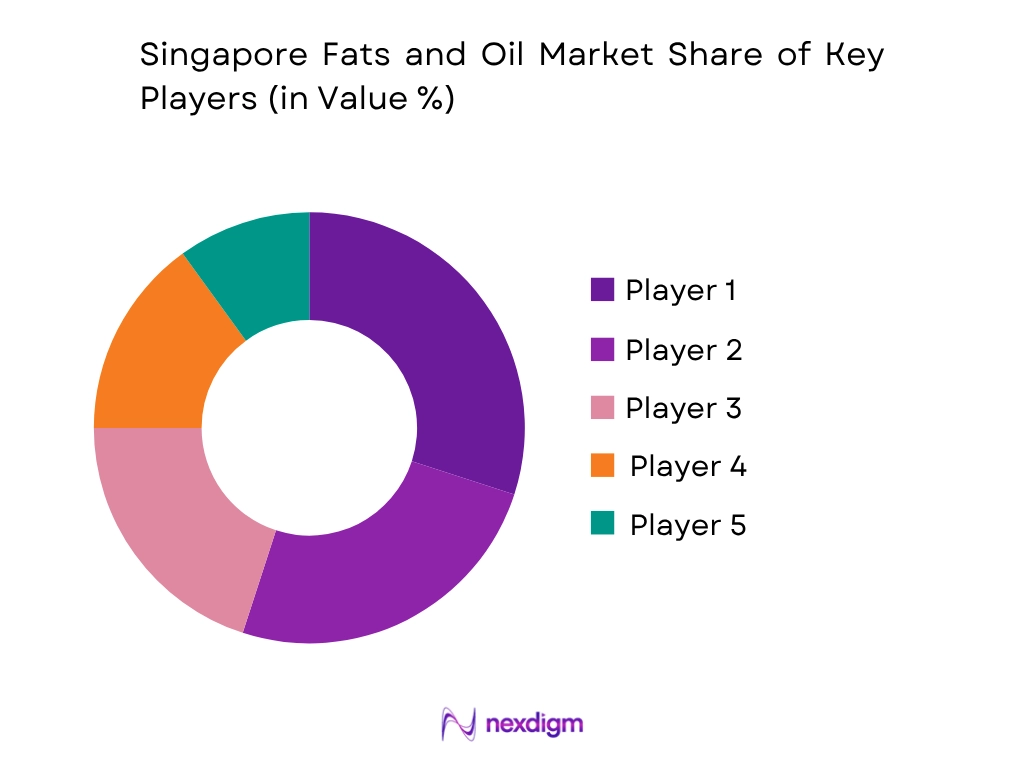
The Singapore Fats and Oil Market is led by integrated agribusiness groups, palm oil majors, specialty fats manufacturers, importers, FMCG edible oil companies and foodservice oil suppliers. The market is relatively concentrated at the upstream and bulk-import level because scale, tank storage, feedstock procurement, refining links, sustainability documentation and logistics capability are critical. Retail and foodservice distribution remain more fragmented, with branded edible oils competing against private label, imported premium oils and B2B bulk suppliers.
| Company | Establishment Year | Headquarters | Core Product Focus | Singapore Market Role | Palm Integration | Foodservice/B2B Strength | Sustainability Positioning | Channel Coverage |
| Wilmar International | 1991 | Singapore | ~ | ~ | ~ | ~ | ~ | ~ |
| Golden Agri-Resources | 1996 | Singapore | ~ | ~ | ~ | ~ | ~ | ~ |
| Musim Mas Group | 1932 | Singapore | ~ | ~ | ~ | ~ | ~ | ~ |
| Mewah International | 1950s | Singapore | ~ | ~ | ~ | ~ | ~ | ~ |
| Lam Soon Singapore | 1930s | Singapore | ~ | ~ | ~ | ~ | ~ | ~ |
Singapore Fats and Oil Market Analysis
Growth Drivers
Urbanized foodservice demand and high-density retail consumption
Singapore’s fully urban consumption base creates concentrated, repeat demand for cooking oils, frying oils, margarine, shortening and specialty fats across hawker centres, restaurants, cafes, caterers, central kitchens and supermarkets. The World Bank describes Singapore as a city-state with a population of approximately 6 million as of mid-2024, while World Bank urban population data classifies Singapore as an entirely urban economy. This supports short replenishment cycles for edible oils because consumer food demand is concentrated in a compact geography rather than dispersed rural markets. Singapore Food Agency data reported 2,529 non-retail food establishments, 23,589 food shops, 14,134 food stalls, 717 supermarkets and 12,943 NEA hawker stalls in 2024, creating a large institutional base for palm olein, blended vegetable oils and foodservice fats. These establishments generate recurring demand for high-stability frying oils, bulk jerry cans, drums and packaged retail oils used in domestic cooking and commercial kitchens.
Industrial food manufacturing and ingredient-processing base
Singapore’s fats and oil market is supported by a sizeable food, beverage and tobacco manufacturing base that uses edible oils and fats as functional ingredients in bakery, confectionery, snacks, sauces, ready meals, instant noodles, dairy alternatives and industrial food preparations. Singapore Department of Statistics data shows food, beverage and tobacco manufacturing output at S$16,742.9 million in 2024, compared with S$12,626.0 million in 2023, indicating a stronger processing base for oil-dependent formulations. This matters for fats and oils because industrial buyers do not purchase only generic cooking oils; they require refined palm olein, lauric oils, shortening, margarine, non-hydrogenated fats, specialty fats and soft oils with defined melting behaviour, oxidative stability and shelf-life performance. Singapore also functions as a trading and logistics hub, with the World Bank noting that the country handles more than 30 million TEUs annually through its transshipment ecosystem. This logistics position supports imported oil handling, repacking, regional redistribution and B2B ingredient supply.
Market Challenges
Import dependency and exposure to external supply concentration
Singapore’s fats and oil market is structurally dependent on external supply because the country has minimal agricultural land and no meaningful domestic oilseed base. SFA’s food statistics show that local farms supplied 34 units of hen shell egg consumption, 3 units of vegetable consumption and 6 units of seafood consumption out of total consumption categories in 2024, but edible oil crops are not identified as a domestic production pillar. This means cooking oils, palm fractions, soft oils, specialty fats and lauric oils must be secured through importers, traders, integrated agribusiness groups and regional supply chains. WITS/UN Comtrade data shows Singapore imported US$202,524.13 thousand of palm oil and its fractions under HS 1511 in 2023, while 2024 crude palm oil imports under HS 151110 were recorded at US$8.86 thousand and 5,990 kg across reported origins. The challenge for buyers is not only availability, but documentation, origin reliability, storage planning and substitution risk between palm, soybean, sunflower and canola oils.
Regulatory compliance burden for edible fats, oils and food manufacturers
Singapore’s edible fats and oils suppliers operate under strict food safety, ingredient and labelling requirements, which increases the operational burden on importers, packers, foodservice distributors and food manufacturers. Singapore Food Regulations define edible fats and oils as commonly recognised wholesome foodstuffs and set a peroxide value limit of 10 milliequivalents of peroxide oxygen per kg of fat or oil, alongside copper limits of 0.1 ppm for refined fats and oils and 0.4 ppm for virgin or cold-pressed fats and oils. Compliance is particularly important for frying oils, specialty bakery fats and prepacked edible oils because oxidation, rancidity and trace metal contamination affect product acceptability. In addition, SFA’s SAFE framework began Phase 1 on 19 January 2026 and applies to food establishments that process or prepare food for public sale, including caterers, central kitchens and food manufacturing premises. This intensifies quality documentation, food safety systems and supplier verification expectations across the oil procurement chain.
Market Opportunities
PHO-free, low-trans-fat and application-specific specialty fats
Singapore’s regulatory environment creates opportunities for suppliers of non-hydrogenated, low-trans-fat and application-specific fat systems used in bakery, confectionery, snacks, spreads and processed foods. The Health Promotion Board states that partially hydrogenated oils, the main source of artificial trans fat, have been banned as an ingredient in all foods sold in Singapore, including fats, oils and pre-packaged foods, whether imported or locally manufactured. The Ministry of Health also noted that the PHO ban replaced the former 2% trans fat limit for fats and oils, and that average daily trans fat intake among Singaporeans declined from 2.1 grams in 2010 to 1.0 gram in 2018. For the current market, this supports demand for palm-based specialty fats, interesterified fats, bakery shortenings, margarine systems and frying oils that help manufacturers meet regulatory and sensory requirements without partially hydrogenated inputs. Companies able to provide formulation support, halal documentation and stable melting profiles are positioned to gain from this compliance-led shift.
Food safety-led B2B supply, traceability and premium bulk servicing
Singapore’s large licensed food establishment base creates a future-facing opportunity for oil suppliers that can combine consistent frying performance with traceability, documentation and food-safety support. SFA data shows 53,912 licensed food establishments in 2024 when non-retail food establishments, food shops, food stalls, supermarkets and NEA hawker stalls are combined, indicating a broad customer universe for commercial cooking oils, used-oil handling guidance, quality checks and regular distributor servicing. SFA’s 2024 guidance on reusing cooking oils advises operators to replace oil frequently, avoid unstable oils rich in polyunsaturated fats for high-temperature cooking, and discard oil when it changes colour, develops unusual odour, smokes or foams. This creates opportunities for suppliers offering high-stability palm olein blends, fryer-management education, scheduled deliveries, bulk packaging, product documentation and oil performance differentiation. As SAFE grading expands across food establishments, buyers are likely to prioritise oil suppliers that reduce operational risk and support documented kitchen compliance.
Future Outlook
The Singapore Fats and Oil Market is expected to grow steadily, supported by stable foodservice demand, expansion of central kitchens, premiumization in retail oils, and ongoing demand for specialty fats in bakery, confectionery and processed foods. Future growth will be shaped by price volatility in crude palm oil and soft oils, but Singapore’s role as a trading, repacking and ingredient supply hub will remain strategically important.
Sustainability will become a stronger differentiator as buyers request RSPO-certified palm oil, traceability to mill, supplier ESG documentation and deforestation-free procurement evidence. Regulatory compliance will also influence formulation strategy, especially as Singapore restricts partially hydrogenated oils and requires nutrition information panels for prepacked edible fats and oils. Foodservice and food manufacturing buyers will increasingly demand oils with better frying stability, longer turnover cycles, clean-label claims, halal documentation and consistent sensory performance. Retail demand will shift toward canola, sunflower, olive, coconut, blended vegetable oils and cholesterol-free or trans-fat-free positioning, while mass-market cooking oils will remain highly price-sensitive.
Major Players
- Wilmar International Limited
- Golden Agri-Resources
- Musim Mas Group
- Mewah International Inc.
- Lam Soon Singapore
- Ngo Chew Hong Edible Oil Pte Ltd
- Soon Soon Oilmills Singapore Pte Ltd
- Cargill Asia Pacific
- Bunge Asia
- Louis Dreyfus Company Singapore
- Fuji Oil Asia Pte Ltd
- AAK Singapore
- Olam Group
- Sime Darby Oils
- ADM Asia-Pacific Trading
Key Target Audience
- Edible oil importers and bulk oil traders
- Foodservice distributors and HoReCa procurement teams
- Packaged food manufacturers and central kitchen operators
- Bakery, confectionery and snack manufacturing companies
- Specialty fats and oleochemical manufacturers
- Retail chains, supermarket groups and private label edible oil buyers
- Investments and venture capitalist firms
- Government and regulatory bodies (Singapore Food Agency, Health Promotion Board, Ministry of Health, Enterprise Singapore, Singapore Customs)
Research Methodology
Step 1: Identification of Key Variables
The initial phase involves constructing an ecosystem map covering importers, refiners, traders, packers, foodservice distributors, retail chains, bakery users, industrial fat buyers and oleochemical producers in the Singapore Fats and Oil Market. This step is supported by desk research using food regulations, trade data, company filings, product catalogues and channel-level information. The objective is to define critical market variables such as product type, application, pack size, import origin, price tier and certification status.
Step 2: Market Analysis and Construction
In this phase, historical market information is compiled across edible oil imports, palm oil trade, retail SKU pricing, foodservice demand, industrial consumption and re-export flows. The top-down approach assesses macro indicators such as foodservice sales, food establishment count and trade inflows, while the bottom-up approach evaluates SKU-level retail prices, bulk pack movement and supplier-level distribution patterns. This ensures that value and volume estimates are built from both demand-side and supply-side logic.
Step 3: Hypothesis Validation and Expert Consultation
Market hypotheses are validated through structured interviews with oil importers, HoReCa distributors, food manufacturers, bakery ingredient suppliers, specialty fat producers, retail category managers and logistics providers. These consultations help verify oil usage patterns, palm olein dominance, bulk contract structures, product substitution, pricing behavior and buyer certification requirements. Expert validation also supports segmentation refinement across product type and application.
Step 4: Research Synthesis and Final Output
The final phase integrates secondary research, trade data, regulatory checks, company benchmarking, expert inputs and channel-level validation into a single market model. The output includes market size, segment shares, competitive mapping, future growth outlook and strategic recommendations. Data triangulation is applied across import statistics, foodservice indicators, retail pricing and supplier feedback to improve consistency and reduce estimation bias.

- Executive Summary
- Research Methodology (Market Definitions and Assumptions, Edible Oils and Industrial Fats Scope, HS Code Mapping, Primary Research Interviews, Distributor Checks, Retail Shelf Audits, Foodservice Procurement Checks, Import-Export Data Triangulation, Top-Down Market Sizing, Bottom-Up SKU-Level Sizing, Consumption Conversion Ratios, Price Benchmarking, Forecasting Framework, Limitations and Future Conclusions)

- Definition and Scope
- Market Evolution and Industry Genesis
- Role of Singapore as Regional Trading, Re-Export and Blending Hub
- Business Cycle Analysis
- Supply Chain and Value Chain Analysis

- Growth Drivers (Palm Oil Supply Proximity from Malaysia and Indonesia, Strong HoReCa Demand, High Urban Foodservice Density, Growth of Central Kitchens, Expansion of Processed Food Manufacturing, Demand for Bakery and Confectionery Fats, Re-Export and Trading Hub Advantage, Rising Premium Oil Consumption, Sustainable Palm Oil Procurement Commitments)
- Market Challenges (Crude Palm Oil Price Volatility, Palm Kernel Oil Price Volatility, Import Dependence, Freight and Tank Storage Cost Fluctuations, Tight Retail Margin Structure, Food Safety Compliance Costs, Sustainability Traceability Pressure, Competition from Private Labels, Limited Domestic Oilseed Production)
- Market Opportunities (RSPO and Traceable Palm Oil, Low-Trans-Fat and PHO-Free Reformulation, Specialty Fats for Bakery and Confectionery, Health-Oriented Oils, Premium Olive and Avocado Oil Demand, Foodservice Bulk Oil Contracts, Private Label Cooking Oil Expansion, B2B Ingredient Innovation, Sustainable Packaging, Digital B2B Procurement)
- Market Trends (Shift from Generic Cooking Oil to Application-Specific Blends, Premiumization in Retail Edible Oils, Palm Olein Dominance in Frying Applications, Growth of Non-Palm Alternatives, Clean Label Fat Systems, Halal-Certified Ingredient Procurement, Traceability and NDPE Compliance, Bulk Packaging Optimization, Price-Led Retail Promotions)
- SWOT Analysis
- Porter’s Five Forces Analysis
- PESTLE Analysis

- By Market Value (2020-2025)
- By Consumption Volume (2020-2025)
- By Import Volume (2020-2025)

- By Product Type (In Value %)
Palm Olein
Refined Palm Oil
Palm Kernel Oil
Soybean Oil
Sunflower Oil - By Source (In Value %)
Palm-Based Oils
Oilseed-Based Oils
Coconut-Based Oils
Olive-Based Oils
Animal-Based Fats - By Distribution Channel (In Value %)
Supermarkets and Hypermarkets
Convenience Stores
Wet Markets and Traditional Retail
Online Grocery Platforms
Foodservice Distributors
B2B Bulk Traders, Industrial Ingredient Suppliers, Private Label Channels) - By Import Origin (In Value %)
Malaysia
Indonesia
Thailand
China
Australia

- Market Share of Major Players (By Value, Volume, Product Type, Application, Distribution Channel, Import-Origin Coverage, Retail SKU Presence, B2B Bulk Supply)
- Cross Comparison Parameters (Refining and Fractionation Capacity, Palm-Based Product Portfolio Depth, Specialty Fats and Oleochemical Integration, Import-Origin Diversification, Foodservice Bulk Distribution Reach, Retail SKU and Pack Size Coverage, RSPO/NDPE Traceability Strength, Exposure to CPO/PKO/Soybean Oil Price Volatility)
- SWOT Analysis of Major Players
- Detailed Profiles of Major Companies
Wilmar International Limited
Golden Agri-Resources
Musim Mas Group
Mewah International Inc.
Lam Soon Singapore
Ngo Chew Hong Edible Oil Pte Ltd
Soon Soon Oilmills Singapore Pte Ltd
Cargill Asia Pacific
Bunge Asia
Louis Dreyfus Company Singapore
Fuji Oil Asia Pte Ltd
AAK Singapore
Olam Group
Sime Darby Oils
ADM Asia-Pacific Trading

- Household Consumer Analysis
- Foodservice Buyer Analysis
- Food Processing Buyer Analysis
- Bakery and Confectionery Buyer Analysis
- Industrial and Oleochemical Buyer Analysis
- Purchase Decision-Making Process

- By Market Value (2026-2035)
- By Consumption Volume (2026-2035)
- By Import Volume (2026-2035)


 Request a Sample
 Ask for Customization
 Get a Quote
 Enquire Now