
 Download PDF
Market Overview
The Singapore fertilizer market occupies a uniquely specialized position within the global agricultural input landscape, shaped almost entirely by the city-state’s highly ambitious 30×30 food production goal, its world-leading investment in high-technology vertical and indoor farming, and its strategic role as a regional agri-food innovation and trading hub for Southeast Asia. Singapore cultivates a very limited area of approximately 1,000 hectares of agricultural land — a fraction of what any comparable economy would possess — yet it hosts some of the most technologically advanced and capital-intensive controlled-environment farming operations in the world. Fertilizer demand in Singapore is therefore almost entirely driven by the requirements of vertical farms, greenhouse systems, aquaponic facilities, rooftop farms, and research institutions, all of which depend on precision-grade water-soluble fertilizers, hydroponic nutrient solutions, and specialty micronutrient formulations rather than conventional granular or bulk fertilizers. Singapore imports all of its fertilizer requirements with no domestic production, making supply chain reliability, product quality, and technical agronomic support the primary competitive differentiators within this sophisticated and highly specialized market.
Market Segmentation
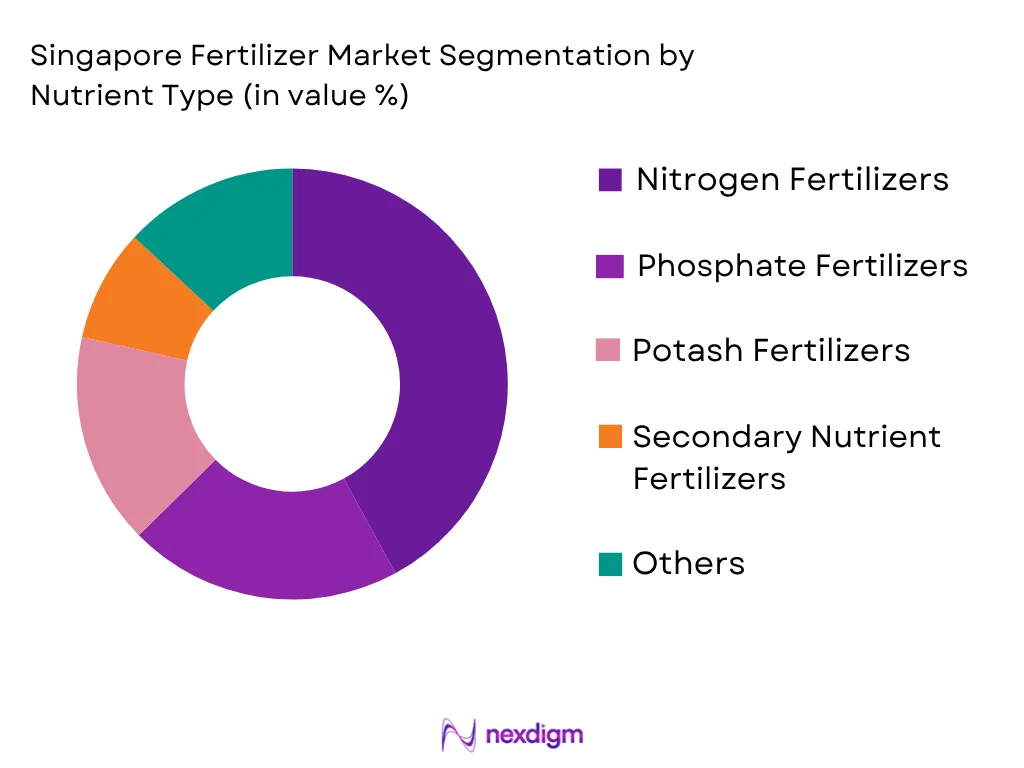
By Nutrient Type
Specialty and water-soluble fertilizers dominate the Singapore fertilizer market due to the overwhelming prevalence of controlled-environment agriculture, hydroponic systems, and precision fertigation platforms across the city-state’s commercial and institutional farming operations. Conventional granular fertilizers represent a minor share of consumption, limited largely to soil-based community gardens, ornamental landscaping, and open-field vegetable farms. Singapore’s vertical farms, greenhouse facilities, and aquaponic systems require highly purified, fully water-soluble nutrient formulations with precisely calibrated nitrogen, phosphorus, potassium, calcium, magnesium, and micronutrient ratios that can be delivered through automated dosing systems and recirculating hydroponic channels. Nitrogen remains the single most consumed macronutrient by volume, but the premium segment is defined by complete nutrient solution packages and crop-specific specialty blends that represent significantly higher value per kilogram than conventional nitrogen fertilizers. Growing adoption of biological nutrient inputs, biostimulants, and organic-certified fertilizers within Singapore’s premium urban farming segment is further expanding the specialty fertilizer category.
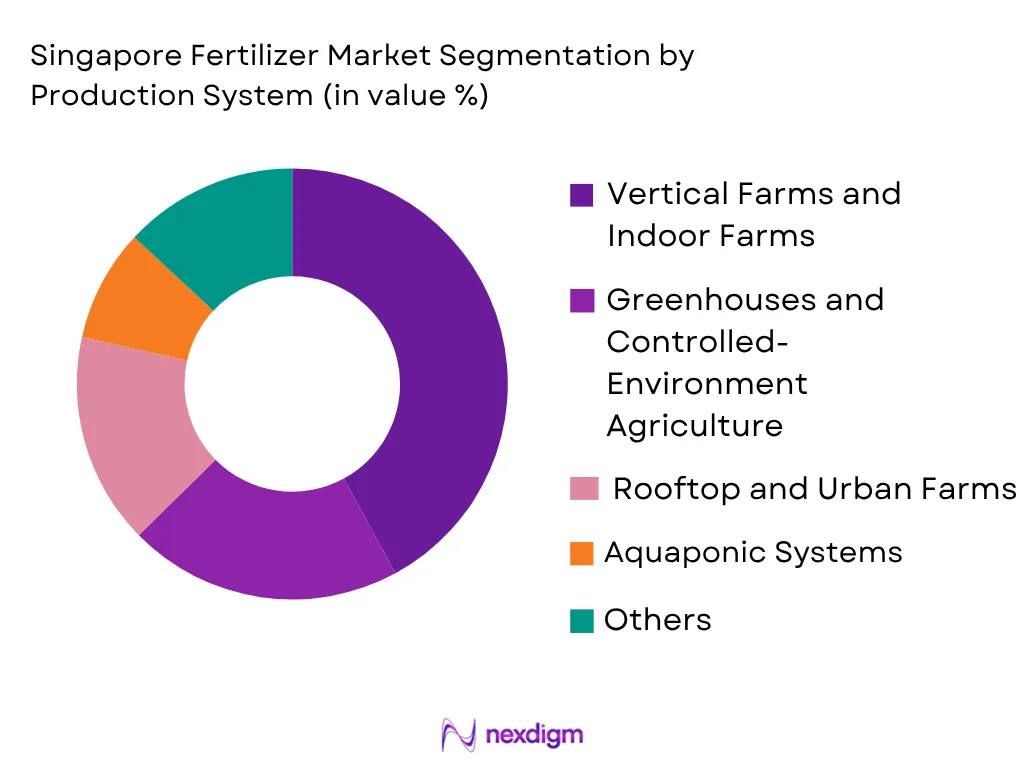
By Production System
Vertical farms and indoor farming facilities represent the dominant production system within the Singapore fertilizer market, reflecting the city-state’s strategic investment in land-efficient, high-output controlled-environment agriculture as the foundation of its 30×30 food production goal. Singapore hosts a growing number of commercial vertical farming companies including Sky Greens, Sustenir Agriculture, GroGrace, and Commonwealth Greens, which operate multi-story growing systems producing leafy vegetables, herbs, and microgreens for the domestic retail and food service market. These facilities rely entirely on hydroponic nutrient delivery systems and recirculating fertigation platforms, creating consistent year-round demand for high-purity water-soluble fertilizers and complete nutrient solutions. The Singapore Food Agency has designated land at Lim Chu Kang as a high-tech agri-food zone for next-generation farming facilities, further anchoring vertical and controlled-environment production as the primary agricultural model. As the number and scale of commercial vertical farming operations expand toward the 30×30 targets, demand for precision-grade specialty fertilizers within this segment is expected to grow substantially over the forecast period.
Competitive Landscape
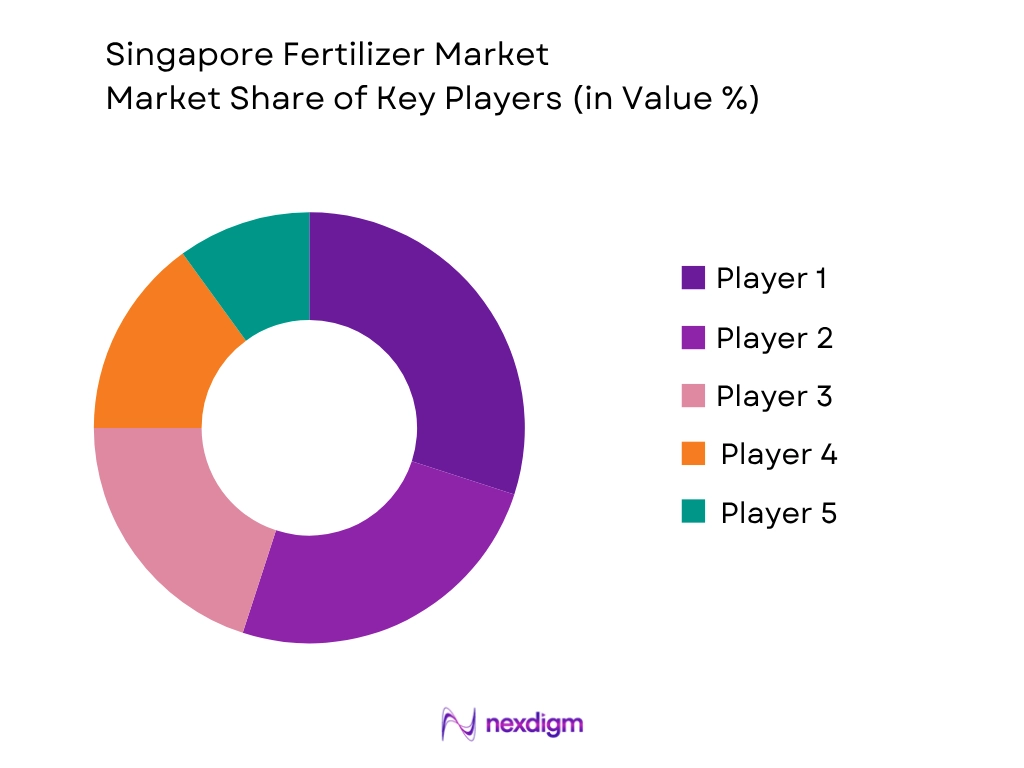
The Singapore fertilizer market is characterized by a highly specialized and relatively compact competitive landscape dominated by international specialty fertilizer and crop nutrition companies that import and distribute premium water-soluble fertilizers, hydroponic nutrient solutions, and biological inputs to sophisticated farm operators and research institutions. The absence of domestic fertilizer production means all participants are importers or distributors, competing primarily on product quality, technical agronomic expertise, supply chain reliability, and the ability to provide customized nutrient programs tailored to specific vertical farming, hydroponic, and controlled-environment production systems. Multinational companies with strong specialty fertilizer portfolios and dedicated technical support teams hold a significant advantage in this knowledge-intensive market. Singapore’s role as a regional trading hub also enables several distributors to serve agricultural customers across Southeast Asia alongside the domestic market, supporting broader business viability beyond Singapore’s limited domestic scale.
| Company | Establishment Year | Headquarters | Product Portfolio | Production & Blending Facilities
|
Import Infrastructure | Distribution Reach | Specialty Fertilizer Portfolio | Agronomic Support Network |
| Yara Singapore | 1905 | ~ | ~ | ~ | ~ | ~ | ~ | ~ |
| ICL Specialty Fertilizers Singapore | 1968 | ~ | ~ | ~ | ~ | ~ | ~ | ~ |
| Haifa Group Singapore | 1966 | ~ | ~ | ~ | ~ | ~ | ~ | ~ |
| Compo Expert Asia Pacific | 1956 | ~ | ~ | ~ | ~ | ~ | ~ | ~ |
| Koppert Biological Systems Singapore | 1967 | ~ | ~ | ~ | ~ | ~ | ~ | ~ |
Singapore Fertilizer Market Analysis
Growth Drivers
30×30 Food Production Goal and Singapore Food Agency Investment Programs
The Singapore fertilizer market is fundamentally driven by the Singapore Food Agency’s (SFA) national 30×30 goal, which targets the domestic production of 30% of Singapore’s nutritional needs by 2030, up from less than 10% currently. This ambitious policy commitment has catalyzed substantial public and private investment in high-technology farming infrastructure, research and development, and agri-food innovation across the city-state. According to the SFA, Singapore allocated SGD 60 million through the Agriculture Productivity Fund and the Singapore Food Story R&D Programme to support agri-food technology development and farm productivity enhancement. The government’s Agri-Food Cluster Transformation (ACT) Fund provides grants for capital-intensive farm upgrades, precision agriculture technologies, and advanced nutrient management systems. Temasek Holdings and other Singapore-based institutional investors have channeled significant capital into vertical farming companies and agri-food technology startups both domestically and regionally, reinforcing the city-state’s position as a global agri-food innovation hub. Singapore’s GDP per capita exceeded USD 88,000 in 2024 according to the World Bank, supporting high agricultural technology investment and consumer willingness to pay premium prices for locally produced food. These policy and investment commitments directly translate into consistent and growing demand for precision-grade specialty fertilizers, hydroponic nutrient solutions, and biological crop nutrition inputs across Singapore’s rapidly expanding high-technology farming sector.
Rapid Expansion of Vertical Farming and Controlled-Environment Agriculture
The rapid scaling of commercial vertical farming and controlled-environment agriculture is the most important structural driver of fertilizer demand growth in Singapore. According to the SFA’s annual agri-food industry reports, the number of licensed farms in Singapore has grown steadily, with a pronounced shift toward multi-story indoor farms, climate-controlled greenhouse facilities, and aquaponic production systems that maximize output per unit of land area. Commercial vertical farming companies including Sky Greens, Sustenir Agriculture, Artisan Green, and GroGrace have expanded production capacity for leafy vegetables, herbs, microgreens, and fruiting crops using nutrient film technique (NFT), deep water culture (DWC), and substrate-based systems that require continuous supply of precisely formulated water-soluble fertilizers. The Singapore government’s designation of the Lim Chu Kang agri-food zone for redevelopment into a cluster of high-tech farming facilities is expected to increase total indoor farming capacity significantly by 2030. Research institutions including Nanyang Technological University, the National University of Singapore, and the Singapore Institute of Technology are active in crop nutrition research, developing novel fertilizer formulations and precision dosing technologies suited to tropical urban farming conditions. This sustained expansion of technology-intensive farming systems creates consistent and growing demand for specialty fertilizer products, replacing any potential decline in conventional agricultural input consumption with high-value precision nutrition solutions.
Market Challenges
Severe Land Scarcity and High Urban Production Costs
The most fundamental structural challenge facing the Singapore fertilizer market is the city-state’s acute land scarcity, which constrains the total scale of domestic agricultural production and therefore limits the overall volume of fertilizer that can be consumed domestically. Singapore’s total land area of approximately 733 square kilometers is among the smallest of any independent nation globally, and agricultural land accounts for less than 1% of the total, competing intensely with residential, industrial, commercial, and infrastructure uses. The Urban Redevelopment Authority’s land allocation framework prioritizes housing, logistics, manufacturing, and strategic infrastructure over agricultural development, restricting the maximum possible expansion of farm area even under the 30×30 policy goal. High real estate costs mean that vertical and indoor farms in Singapore bear some of the highest capital and operating costs per square meter of any comparable farming operation globally, significantly increasing the total cost of producing domestically grown food. These cost pressures translate into limited purchasing volumes for fertilizer suppliers, making it challenging to achieve economies of scale in product sourcing, storage, and distribution. The concentration of demand within a very small number of high-technology commercial farms means that the loss of any individual farm customer can have a disproportionate impact on fertilizer sales volumes, creating revenue concentration risk for distributors operating in this compact market.
Complete Import Dependence and Supply Chain Vulnerability
Singapore’s complete absence of domestic fertilizer production and raw material resources creates significant supply chain vulnerability and price exposure within the fertilizer market. The city-state imports 100% of its fertilizer requirements from international suppliers, with major sourcing origins including the Netherlands, Israel, Norway, Japan, China, and other regional and global producers. This total import dependency means that global fertilizer price volatility, shipping disruptions, port congestion, and geopolitical supply chain risks directly and immediately impact product availability and cost within Singapore. The global fertilizer price spikes of 2021 and 2022 driven by natural gas price surges and geopolitical disruptions following the Russia-Ukraine conflict demonstrated the vulnerability of import-dependent markets to sudden and severe input cost increases. Singapore’s port infrastructure at Tanjong Pagar and Jurong is highly efficient and globally competitive, mitigating some logistics risk, but the city-state’s limited warehousing capacity for bulk agricultural inputs constrains inventory buffering. Additionally, the small volume of fertilizer imported relative to Singapore’s overall trade flows means that Singapore-specific fertilizer procurement commands limited pricing leverage with international suppliers. Developing diversified supplier relationships, maintaining adequate safety stock, and managing currency exposure on fertilizer import contracts remain ongoing operational challenges for distributors and farm operators across the Singapore fertilizer market.
Market Opportunities
Regional Agri-Food Hub and Specialty Fertilizer Export Opportunity
Singapore’s world-class logistics infrastructure, transparent regulatory environment, advanced financial services sector, and strategic geographic position at the center of Southeast Asia create a significant opportunity to develop the city-state as a regional hub for specialty fertilizer distribution, agri-food technology commercialization, and crop nutrition innovation serving the broader ASEAN agricultural market. Southeast Asia represents one of the fastest-growing agricultural input markets globally, with Indonesia, Vietnam, Thailand, the Philippines, and Malaysia all expanding commercial agriculture, horticulture, and protected farming rapidly. International specialty fertilizer companies including Yara, ICL, Haifa Group, and Compo Expert already use their Singapore operations as regional headquarters and distribution platforms for Southeast Asian markets, leveraging Singapore’s free trade agreements, efficient port connectivity, and skilled workforce. According to Enterprise Singapore, the agri-food sector is identified as a strategic growth cluster, with government support available for companies scaling regional distribution and export operations from Singapore. The development of novel crop nutrition technologies within Singapore’s research institutions and agri-food startups also presents opportunities to commercialize intellectual property and innovative products for export across the region. Positioning Singapore as a center for specialty fertilizer innovation, quality assurance, and regional distribution reinforces long-term market viability beyond the constraints of the city-state’s limited domestic agricultural scale.
Circular Economy Nutrient Recovery and Sustainable Fertilizer Innovation
Singapore’s national commitment to sustainability, circular economy principles, and the Singapore Green Plan 2030 is creating meaningful opportunities for innovative nutrient recovery, waste-derived fertilizer, and sustainable crop nutrition solutions within the city-state’s agricultural sector. Singapore generates significant volumes of food waste, horticultural waste, and organic residues from its food processing, hospitality, and retail sectors. The National Environment Agency’s Zero Waste Masterplan targets a 30% reduction in waste sent to Semakau Landfill by 2030, creating policy momentum for composting, anaerobic digestion, and nutrient recovery systems that can produce organic and organomineral fertilizer products for use in local farms. Research programs at Nanyang Technological University and the National University of Singapore are actively developing technologies for recovering phosphorus, nitrogen, and micronutrients from wastewater, food processing sludge, and organic waste streams, with potential application in Singapore’s urban farming sector. The SFA’s Towards Zero Food Waste program supports farm-level composting and organic nutrient recycling initiatives. Additionally, consumer demand for organically certified and sustainably produced local food is increasing, creating commercial incentives for urban farms to adopt biological fertilizers, compost-based nutrient inputs, and organic-certified growing programs. These sustainability trends position circular and biological nutrient solutions as a growing and strategically aligned opportunity within the Singapore fertilizer market over the forecast period.
Future Outlook
The Singapore fertilizer market is expected to witness steady and quality-driven growth over the forecast period, underpinned by the continued expansion of high-technology vertical farming, the progression of the 30×30 food production goal, and increasing government and private sector investment in agri-food innovation. Demand will remain concentrated in premium specialty fertilizers, hydroponic nutrient solutions, and biological inputs that serve the city-state’s uniquely technology-intensive agricultural ecosystem. Singapore’s role as a regional agri-food hub for Southeast Asia will further support the activities of international specialty fertilizer companies operating distribution and innovation platforms from the city-state. Continued investment in circular nutrient recovery, sustainable farming practices, and AI-driven precision nutrition management is likely to reinforce Singapore’s position as a global reference market for advanced crop nutrition technologies through 2035.
Major Players
- Yara Singapore
- ICL Specialty Fertilizers Singapore
- Haifa Group Singapore
- Compo Expert Asia Pacific
- Koppert Biological Systems Singapore
- Bayer CropScience Singapore
- Syngenta Singapore
- Omya Asia Pacific (Calcium and Micronutrients)
- Sun Agro Singapore
- GreenPower Agri Singapore
- Evonik Nutrition and Care Singapore
- Timac Agro Singapore
- Everris (ICL Growing Solutions)
- SBA Dutch Plantin Singapore
- Hydro-Gardens Singapore
Key Target Audience
- Specialty Fertilizer Importers and Distributors
- Commercial Vertical Farming and Indoor Farming Operators
- Greenhouse and Controlled-Environment Agriculture Companies
- Agri-Food Technology Startups and Innovators
- Investments and Venture Capitalist Firms
- Government and Regulatory Bodies (Singapore Food Agency, Enterprise Singapore, Economic Development Board, National Environment Agency, Agri-Food and Veterinary Authority)
- Research Institutions and Universities (NTU, NUS, Singapore Institute of Technology)
- Precision Agriculture and Agri-Fintech Technology Providers
Research Methodology
Step 1: Identification of Key Variables
The initial phase involves constructing an ecosystem map encompassing all major stakeholders within the Singapore Fertilizer Market. Extensive secondary research is conducted through industry publications, government databases, company annual reports, trade associations, and agricultural statistics. The objective is to identify critical variables influencing fertilizer demand, supply, pricing, imports, and production system requirements.
Step 2: Market Analysis and Construction
This phase focuses on gathering and analyzing historical information regarding fertilizer import volumes, nutrient consumption by production system, cultivation area, and agri-food output. Market revenues are estimated through analysis of fertilizer import values, average selling prices, and nutrient demand trends across vertical farming, greenhouse, and aquaponic production systems. Both supply-side and demand-side assessments are incorporated to develop comprehensive market estimates.
Step 3: Hypothesis Validation and Expert Consultation
Preliminary findings and market assumptions are validated through structured interviews with fertilizer importers, distributors, vertical farming operators, agronomists, and industry specialists. These consultations provide valuable insights into purchasing patterns, nutrient formulation preferences, production system economics, and future market developments.
Step 4: Research Synthesis and Final Output
The final stage integrates findings obtained from primary and secondary research. Data triangulation techniques are applied to ensure consistency and reliability across all market estimates. The resulting report provides a comprehensive assessment of market structure, competitive dynamics, growth opportunities, and long-term industry outlook for the Singapore Fertilizer Market.

- Executive Summary
- Research Methodology (Market Definitions and Assumptions, Abbreviations, Market Sizing Approach, Top-Down Analysis, Bottom-Up Analysis, Fertilizer Demand Assessment by Cultivation Area, Nutrient Consumption Analysis, Import-Export Assessment, Primary Industry Interviews, Data Triangulation, Forecasting Framework, Limitations and Future Conclusions)

- Definition and Scope
- Market Evolution and Industry Genesis
- Timeline of Major Industry Developments
- Singapore Agricultural Production Ecosystem
- Fertilizer Industry Value Chain Analysis

- Growth Drivers (Expansion of Local Food Production under 30×30 Goal, Rising Adoption of High-Tech Vertical and Indoor Farming, Government Agri-Food Sector Investment and Grant Programs, Growing Demand for Specialty and Water-Soluble Fertilizers, Increasing Consumer Preference for Locally Grown Produce, Rapid Innovation in Controlled-Environment Agriculture Technologies)
- Market Challenges (Severe Land Scarcity and High Real Estate Costs, Complete Dependence on Imported Fertilizer Products, Small Domestic Agricultural Scale Limiting Market Volume, High Cost of Agricultural Production in an Urban Economy, Competition from Regional Low-Cost Food Imports)
- Market Opportunities (Specialty Fertilizer Innovation for High-Tech Farms, Biofertilizer and Sustainable Input Adoption, Circular Economy Nutrient Recovery Solutions, Regional Agri-Food Hub and Export Opportunity, Growth in Research and Development of Novel Crop Nutrition Technologies)
- Market Trends (Dominance of Water-Soluble and Hydroponic Nutrient Formulations, Integration of Artificial Intelligence in Nutrient Management, Customized Crop-Specific Nutrient Solutions, Carbon-Neutral Fertilizer Sourcing, Expansion of Biological and Organic Inputs in Urban Farms)
- Government Regulations (Singapore Food Agency Regulatory Framework, Agri-Food and Veterinary Authority Standards, Environmental Protection and Management Act Requirements, National Environment Agency Guidelines, Import and Biosafety Regulations)
- Import Dependency Assessment (Complete Import Reliance Profile, Key Sourcing Countries, Supply Chain Resilience Assessment, Supplier Diversification Strategy)
- Raw Material Analysis (No Domestic Raw Material Production, Import Origin Analysis, Price Sensitivity to Global Commodity Markets, Logistics and Storage Constraints)
- Fertilizer Consumption Intensity Analysis (Kg per Cultivation Area, Nutrient Use Efficiency in Controlled Environments, Crop-Wise Consumption, Production System Application Rates)
- Price Trend Analysis (Specialty Water-Soluble Fertilizer Prices, Hydroponic Nutrient Solution Prices, Organic Fertilizer Prices, Conventional Granular Fertilizer Prices)
- Supply-Demand Gap Analysis (Import Volumes, Inventory Management, Storage Infrastructure, Demand Forecasting)
- SWOT Analysis
- Porter’s Five Forces Analysis
- PESTLE Analysis
- Stakeholder Ecosystem
- Competition Ecosystem

- By Market Value (2020-2025)
- By Production Volume (2020-2025)
- By Average Selling Price (2020-2025)

- By Nutrient Type (In Value %)
Nitrogen Fertilizers
Phosphate Fertilizers
Potash Fertilizers
Secondary Nutrient Fertilizers
Micronutrient Fertilizers
Specialty and Customized Fertilizers - By Application Method (In Value %)
Fertigation
Foliar Application
Substrate and Growing Media Application
Hydroponic Nutrient Solution Delivery
Precision and Automated Application - By Crop and Production Type (In Value %)
Leafy Vegetables
Fruiting Vegetables
Herbs and Microgreens
Edible Fish and Aquaponic Crops
Tropical Fruits
Orchids and Ornamental Plants
Turf and Landscaping
Research and Institutional Cultivation
Others - By Production System (In Value %)
Vertical Farms and Indoor Farms
Greenhouses and Controlled-Environment Agriculture
Rooftop and Urban Farms
Aquaponic Systems
Open-Field and Soil-Based Cultivation
Community Gardens and Allotments - By Distribution Channel (In Value %)
Specialty Agricultural Input Retailers
Direct Sales by Importers and Manufacturers
Distributors and Wholesalers
Online and Digital Platforms
Government-Linked Agricultural Entities

- Market Share Analysis of Major Players (By Value, By Volume, By Production System, By Crop Type)
- Market Concentration Analysis
- Cross Comparison Parameters (Product Portfolio Diversity, Water-Soluble Fertilizer Range, Hydroponic Nutrient Solution Capability, Technical Support and Advisory Services, Import and Logistics Infrastructure, Digital Platform Integration, Sustainability Credentials, Research and Development Investment)
- SWOT Analysis of Major Players
- Pricing Analysis by Product Type and Formulation
- Detailed Profiles of Major Companies
Yara Singapore
ICL Specialty Fertilizers Singapore
Haifa Group Singapore
Compo Expert Asia Pacific
Koppert Biological Systems Singapore
Bayer CropScience Singapore
Syngenta Singapore
Omya Asia Pacific (Calcium and Micronutrients)
Sun Agro Singapore
GreenPower Agri Singapore
Evonik Nutrition and Care Singapore
Timac Agro Singapore
Everris (ICL Growing Solutions)
SBA Dutch Plantin Singapore
Hydro-Gardens Singapore

- Crop Nutrient Consumption Assessment (Cultivation Area, Yield Targets, Nutrient Removal Rates, Fertilizer Intensity by Production System)
- Farm Size Analysis (Small Urban and Rooftop Farms, Medium Commercial Indoor Farms, Large Integrated Vertical Farming Facilities)
- Purchasing Power Analysis (Farm Revenue Models, Grant Access, Operational Cost Allocation)
- Seasonal Demand Assessment (Year-Round Production Cycles, Crop Rotation Patterns, Procurement Schedules)
- Farmer and Farm Operator Purchasing Behavior (Brand Preference, Nutrient Formulation Preference, Technical Support Requirements)
- Precision Agriculture Adoption Analysis (IoT Sensor Integration, Automated Dosing Systems, AI-Driven Nutrient Management)
- Sustainability Adoption Analysis (Carbon Footprint Reduction, Circular Nutrient Recovery, Organic Certification Trends)
- Pain Point Analysis (Input Costs, Supply Chain Reliability, Product Range, Technical Agronomic Support, Regulatory Compliance)
- Purchase Decision-Making Process

- By Market Value (2026-2035)
- By Production Volume (2026-2035)
- By Average Selling Price (2026-2035)


 Request a Sample
 Ask for Customization
 Get a Quote
 Enquire Now