
 Download PDF
Market Overview
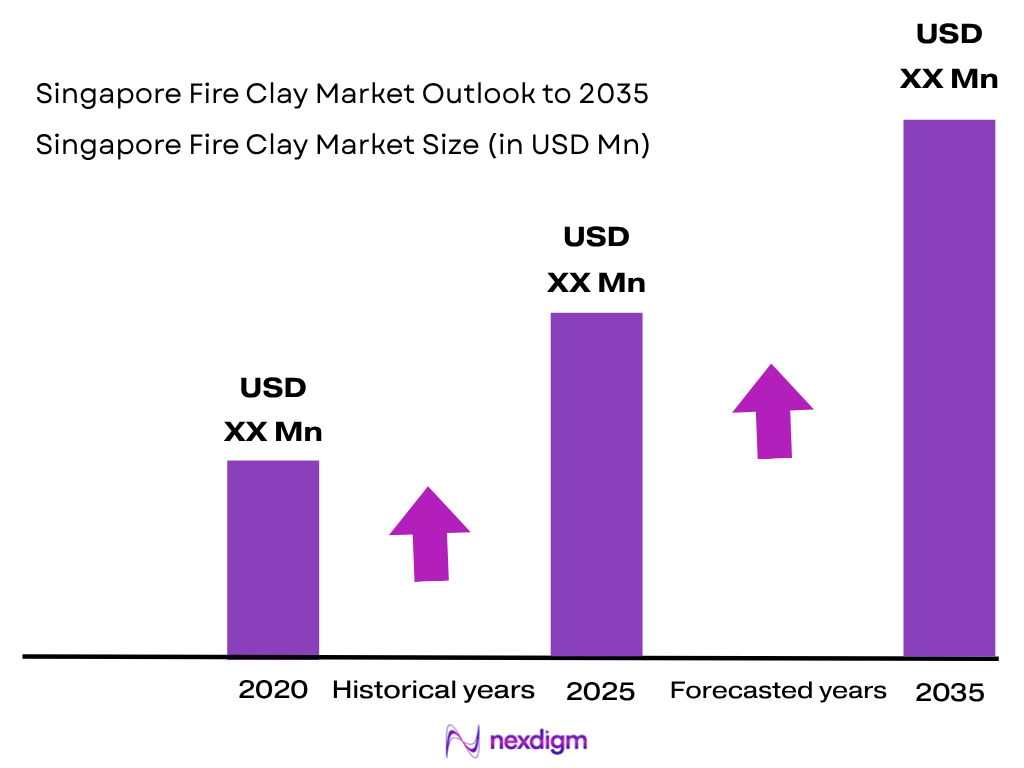
The Singapore Fire Clay Market is valued at approximately USD ~ million, supported primarily by imported refractory-grade material used in petrochemical, refining, marine, boiler, incineration and industrial thermal applications. Singapore’s fire-clay imports increased from 289,214 kg valued at USD 152,750 to 373,620 kg valued at USD 166,850 across the two latest comparable annual trade periods. The country’s lack of significant domestic fire-clay mining makes international sourcing and refractory-material distribution fundamental to market development.
Jurong Island and the Jurong-Tuas industrial corridor dominate Singapore Fire Clay Market demand because they concentrate refining, petrochemicals, specialty chemicals, utilities, marine engineering and other high-temperature industrial operations. Jurong Island contains more than 100 global energy and chemical companies, while the wider ecosystem supports more than 27,000 jobs. The island has attracted over S$50 billion in investments, creating a substantial installed base of process heaters, furnaces, boilers and thermal-processing equipment requiring refractory maintenance.
Market Segmentation
By Product Grade
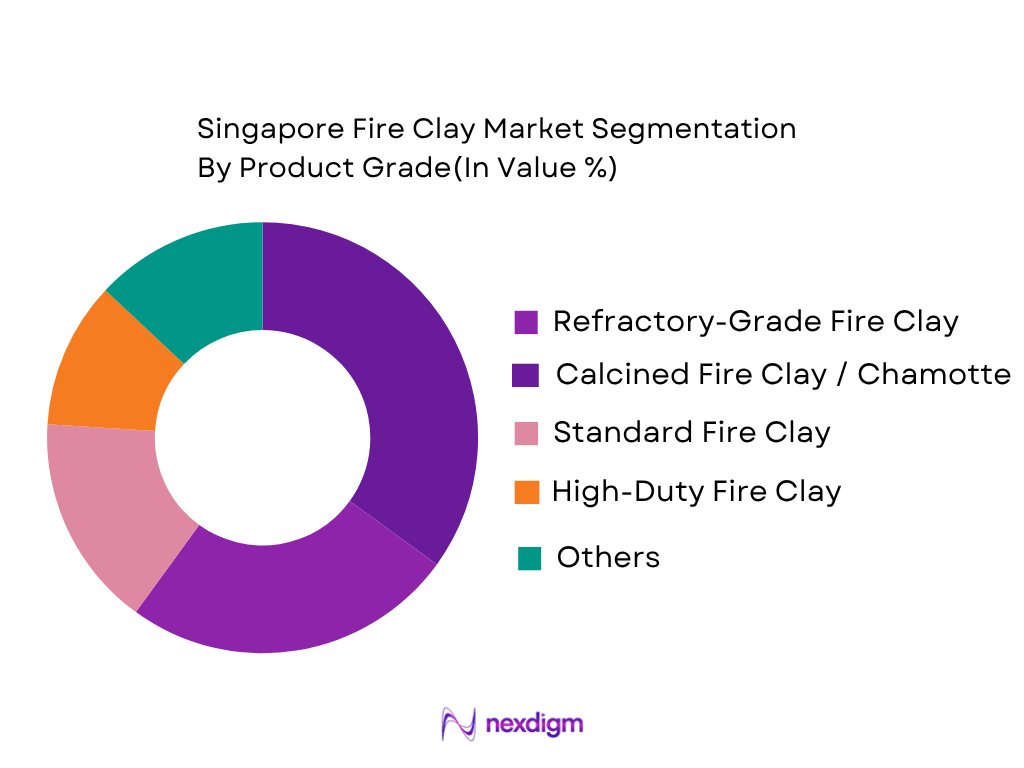
The Singapore Fire Clay Market is segmented by product grade into refractory-grade fire clay, calcined fire clay/chamotte, standard fire clay, high-duty fire clay, flint clay and binding clay. Refractory-grade fire clay holds the dominant modeled market share because Singapore’s demand is predominantly industrial rather than mining- or construction-led. The material feeds aluminosilicate refractory systems used in boilers, process heaters, incinerators, furnaces and related thermal equipment. Singapore’s industrial structure reinforces this demand orientation: Jurong Island hosts more than 100 energy and chemicals companies operating an integrated mix of refining, olefins production, chemicals manufacturing, utilities and supporting services. Singapore also imported 373,620 kg of raw fire clay in the latest reported period, compared with 289,214 kg previously. Refractory-grade materials are particularly relevant because industrial buyers prioritize refractoriness, thermal stability, alumina-silica composition, controlled impurities and consistent performance rather than general-purpose clay characteristics.
By End-Use Industry
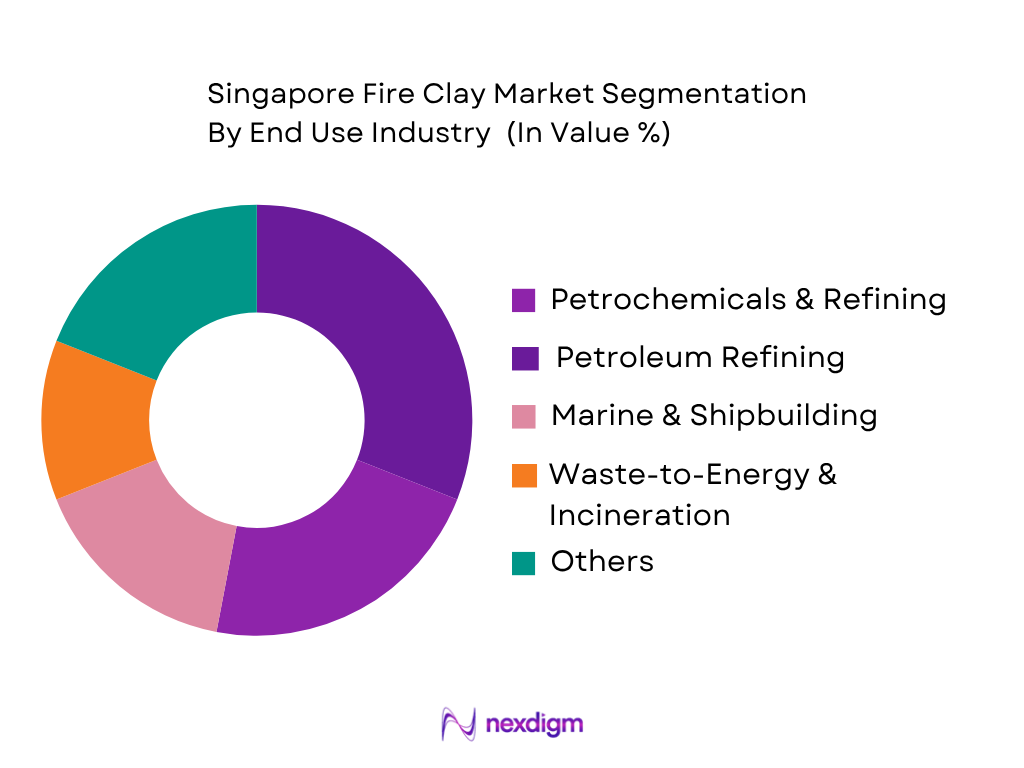
The Singapore Fire Clay Market is segmented into petrochemicals and chemicals, petroleum refining, marine and shipbuilding, waste-to-energy and incineration, power and industrial boilers, metal processing and foundries, and other thermal-processing industries. Petrochemicals and chemicals hold the dominant modeled market share because Singapore has one of Asia’s most concentrated energy-and-chemicals ecosystems. Jurong Island covers approximately 3,000 hectares and houses more than 100 companies, providing an extensive installed base of high-temperature processing equipment. Fire-clay-containing refractories can be used in selected furnace, boiler, heater, chimney and backup-lining applications, depending on operating temperature and chemical exposure. The marine and boiler segment is also relevant: Singapore-based PE-TECH reports more than 10 years of refractory-solution experience in boiler and marine industries and supplies castables, plastics, mortars, firebricks and insulation firebricks. This reinforces Singapore’s demand profile as a maintenance-intensive refractory market rather than a primary fire-clay-producing economy.
Competitive Landscape
The Singapore Fire Clay Market operates within a broader refractory ecosystem consisting of global refractory manufacturers, regional suppliers, Singapore-based distributors and refractory engineering companies. Competition is shaped less by domestic mineral ownership and more by product availability, refractory engineering expertise, local inventory, rapid maintenance support and access to petrochemical, refining, marine and boiler customers. Singapore-based PE-TECH, for example, supplies castables, plastics, mortar, ceramic-fiber products, firebricks and insulation firebricks while maintaining operations in Singapore and Malaysia.
| Major Player | Establishment Year | Headquarters | Fire Clay/Aluminosilicate Relevance | Shaped Refractories | Monolithic Capability | Petrochemical/Industrial Coverage | Marine/Boiler Relevance |
| RHI Magnesita | 2017* | Vienna, Austria | ~ | ~ | ~ | ~ | ~ |
| Calderys / HWI | 2005* | Paris, France | ~ | ~ | ~ | ~ | ~ |
| Vesuvius | 1704* | London, UK | ~ | ~ | ~ | ~ | ~ |
| Morgan Advanced Materials | 1856 | Windsor, UK | ~ | ~ | ~ | ~ | ~ |
| PE-TECH Pte. Ltd. | ~ | Singapore | ~ | ~ | ~ | ~ | ~ |
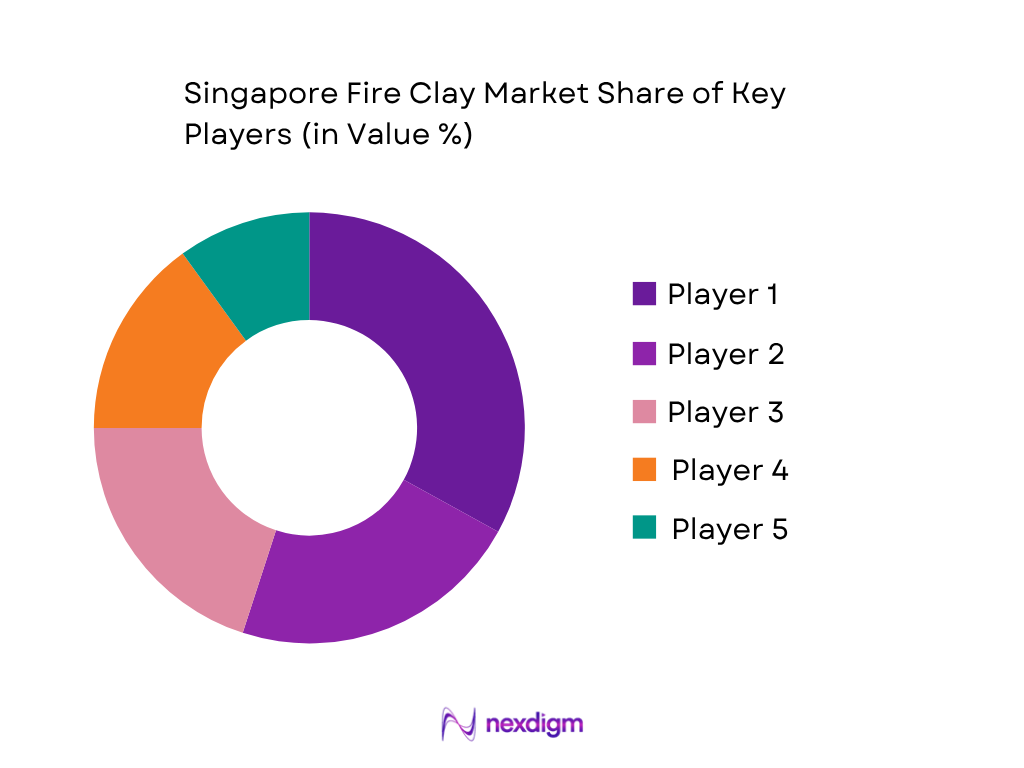
Singapore Fire Clay Market Analysis
Growth Drivers
Petrochemical, Refining and High-Temperature Industrial Maintenance
Singapore’s fire clay demand is supported by its dense petrochemical, refining, marine and high-temperature processing ecosystem, where refractory linings are required to protect furnaces, process heaters, boilers and other thermally exposed equipment. Jurong Island accommodates more than 100 energy and chemicals companies across approximately 3,000 hectares, creating a concentrated installed base for refractory maintenance and periodic relining. Singapore’s nominal GDP reached USD 547.5 billion in 2024, while GDP per capita stood at USD 90,689, reflecting the scale and capital intensity of the industrial economy. Chemical products remained one of Singapore’s principal merchandise-export categories, reinforcing the importance of chemical-processing infrastructure. Fire-clay trade provides direct evidence of material demand: Singapore imported 373,620 kg of fire clay in 2024, including 301,200 kg from Pakistan, 65,250 kg from China, 5,450 kg from Australia, and 1,000 kg from the United States. These physical volumes demonstrate continuing procurement of fire clay alongside finished refractory products. Recurrent shutdowns, furnace repairs, boiler maintenance and refractory replacement therefore create an ongoing consumption channel for refractory-grade clay, chamotte, firebrick and aluminosilicate lining materials.
Expansion of Manufacturing and Industrial Processing Activity
Singapore’s manufacturing-led economic structure provides another demand driver for fire clay and downstream refractory products because high-temperature manufacturing installations require materials capable of tolerating thermal cycling and sustained operating temperatures. The country generated USD 547.5 billion in nominal GDP in 2024, compared with USD 501.4 billion in 2023, according to the IMF, while the population reached approximately 6.0 million. Gross capital formation increased substantially during 2024, supporting investment in productive assets and industrial infrastructure. The physical fire-clay supply chain expanded alongside this industrial environment: imports reached 373,620 kg in 2024, with material sourced from at least 8 identified overseas origins, including Pakistan, China, Australia, the United States, Japan, South Korea and Spain. Singapore also functions as a regional materials hub; Malaysia imported 26,550 kg of fire clay from Singapore in 2024, demonstrating that domestic distributors can serve both local industrial customers and neighboring markets. This industrial and logistical ecosystem supports refractory demand beyond raw clay alone, encompassing firebricks, mortars, castables, insulation products and calcined aluminosilicate materials used during maintenance and replacement cycles across processing facilities.
Market Challenges
Heavy Dependence on Imported Fire Clay and Supply Consistency
Singapore has no material domestic fire-clay mining base, making the industry structurally dependent on overseas mineral deposits, processing facilities and international logistics. World Bank WITS trade data show that Singapore imported 373,620 kg of fire clay in 2024. Pakistan supplied 301,200 kg, China supplied 65,250 kg, Australia supplied 5,450 kg, the United States supplied 1,000 kg, Japan supplied 450 kg, Other Asia supplied 170 kg, South Korea supplied 50 kg, and Spain supplied 50 kg. This geographically dispersed procurement base creates technical challenges because refractory users require consistent alumina, silica, iron-oxide and alkali characteristics across production batches. The concentration of physical supply is particularly relevant because Pakistan alone accounted for more than 300,000 kg of Singapore-reported imports. At the macroeconomic level, Singapore operated a USD 547.5 billion economy with approximately 6.0 million residents in 2024, but its small land area and absence of commercial fire-clay deposits constrain upstream localization. Consequently, local refractory suppliers must emphasize incoming-material testing, inventory buffers, multiple-source qualification and standardized specifications to ensure that imported fire clay and chamotte meet demanding petrochemical, boiler, marine and industrial thermal applications.
Substitution by Higher-Performance Refractory Materials
Traditional fire-clay refractories face increasing technical competition from high-alumina, basic, silicon-carbide, insulating and advanced monolithic refractory systems in Singapore’s demanding industrial installations. This is particularly relevant because the country’s refractory consumption is concentrated in sophisticated refining, chemicals, marine, waste-treatment and industrial facilities rather than lower-temperature traditional industries. The relatively modest direct raw-material flow illustrates this specialized demand structure: Singapore imported 373,620 kg of fire clay in 2024, whereas neighboring Malaysia imported 1,559,740 kg during the same period. Globally, China exported 732,857,000 kg of fire clay and Ukraine exported 1,393,360,000 kg, demonstrating the substantially larger raw-material supply bases available internationally. Singapore’s USD 547.5 billion nominal GDP and USD 90,689 GDP per capita in 2024 also reflect a high-value industrial economy where operators can prioritize refractory performance, service life and process compatibility over basic material availability. Fire-clay suppliers therefore face pressure to demonstrate controlled mineralogy, thermal-shock resistance, refractoriness and compatibility with application-specific conditions. Standard fire clay can consequently lose applications where higher operating temperatures, corrosive environments or severe thermal cycling require technically more advanced refractory compositions.
Market Opportunities
Regional Refractory Processing, Distribution and Value-Added Fire Clay Hub
Singapore’s limited mineral resources create an opportunity to develop the fire clay industry around processing, inventory management, formulation, distribution and refractory engineering rather than domestic extraction. The country imported 373,620 kg of fire clay in 2024, drawing supplies from multiple countries and providing an established physical raw-material channel that could support further value addition through grading, blending, precast refractory shapes, mortars and specialized monolithic formulations. Singapore also already participates in regional redistribution: Malaysia imported 26,550 kg of fire clay from Singapore in 2024. The broader Southeast Asian demand base strengthens this opportunity, with Malaysia importing 1,559,740 kg and Thailand importing 1,310,500 kg of fire clay during 2024. Singapore’s macroeconomic platform is also substantial, with nominal GDP of USD 547.5 billion, a population of approximately 6.0 million, and GDP per capita of USD 90,689 in 2024. These conditions support investment in technically sophisticated industrial-material operations. Future development can therefore center on bonded warehousing, refractory-grade material qualification, customized blending, rapid-delivery inventories and ASEAN distribution, enabling Singapore-based suppliers to capture more value between overseas fire-clay producers and regional high-temperature industrial customers.
Refractory Recycling and Secondary Raw Material Development
Refractory recycling offers a forward-looking opportunity for Singapore’s fire clay ecosystem because the country combines limited domestic mineral availability with a concentrated base of industrial installations generating spent refractory materials during maintenance and shutdown cycles. Singapore imported 373,620 kg of virgin fire clay in 2024, while its industrial economy generated USD 547.5 billion in nominal GDP and supported a population of approximately 6.0 million. Jurong Island alone hosts more than 100 energy and chemical companies, providing a concentrated environment in which spent firebricks, aluminosilicate linings and refractory demolition material can potentially be collected, sorted and processed where technical specifications permit reuse. The opportunity is particularly relevant because international primary supply is concentrated in large producing economies: China exported 732,857,000 kg of fire clay in 2024, while Ukraine exported 1,393,360,000 kg and the United States exported 146,756,000 kg. Developing secondary refractory feedstocks could reduce dependence on virgin imported minerals for suitable lower-risk applications while creating local processing activity. Future suppliers can focus on refractory sorting, crushing, contaminant removal, particle-size classification and incorporation of qualified recycled material into selected fire-clay bricks, mortars, repair products and monolithic formulations.
Future Outlook
The Singapore Fire Clay Market is expected to expand at a placeholder CAGR of approximately ~% during the forecast period, supported by recurring refractory maintenance requirements across energy, chemicals, marine, industrial boilers and waste-to-energy infrastructure. Growth is expected to depend more heavily on refractory replacement cycles, specialized material imports and higher-value technical services than on domestic mineral extraction. Singapore’s existing industrial infrastructure provides a durable demand platform. Jurong Island contains more than 100 global companies and continues transitioning toward specialty chemicals, sustainable materials, circular feedstocks and lower-carbon industrial processes. Existing refining and chemical facilities will continue requiring thermal protection during maintenance cycles even as process configurations evolve.
Major Players
- RHI Magnesita
- Calderys / HarbisonWalker International
- Vesuvius
- Refratechnik Group
- Krosaki Harima Corporation
- Shinagawa Refractories
- Morgan Advanced Materials
- Saint-Gobain
- Allied Mineral Products
- IFGL Refractories
- INTOCAST
- Resco Products
- Steuler Group
- Plibrico
- PE-TECH Pte. Ltd.
Key Target Audience
- Fire Clay, Chamotte and Refractory Raw Material Suppliers
- Refractory Brick and Monolithic Refractory Manufacturers
- Petrochemical, Chemical and Refining Companies
- Marine, Shipbuilding and Offshore Engineering Companies
- Waste-to-Energy and Industrial Boiler Operators
- Industrial Mineral Importers and Refractory Distributors
- Investments and Venture Capitalist Firms
- Government and Regulatory Bodies (Economic Development Board Singapore, JTC Corporation, National Environment Agency, Ministry of Trade and Industry, Singapore Customs, Maritime and Port Authority of Singapore)
Research Methodology
Step 1: Identification of Key Variables
The initial phase involves constructing the complete Singapore Fire Clay Market ecosystem, covering international fire-clay producers, exporters, Singapore importers, refractory manufacturers, distributors, engineering contractors and industrial consumers. Key variables include import volume, alumina-silica composition, refractory grade, calcined-clay consumption, firebrick demand, castable usage, industrial maintenance cycles, local inventory availability and end-use requirements across petrochemicals, refining, marine and waste-to-energy applications.
Step 2: Market Analysis and Construction
Historical market construction combines Singapore’s fire-clay imports with downstream refractory-material flows and industrial demand indicators. The top-down analysis begins with refractory-intensive industries and identifies the addressable fire-clay and aluminosilicate component, while the bottom-up analysis examines raw fire clay, chamotte, firebricks, mortars, castables and other relevant refractory products distributed to identified customer groups.
Step 3: Hypothesis Validation and Expert Consultation
Market hypotheses are validated through interviews with refractory suppliers, importers, industrial-material distributors, refractory engineers, maintenance contractors and procurement personnel serving Singapore’s petrochemical, refining, marine and thermal-processing industries. Consultations assess material specifications, procurement frequency, replacement cycles, country-of-origin preferences, inventory requirements, alumina levels, refractoriness, supplier qualification and the substitution of traditional fire-clay refractories with higher-performance alternatives.
Step 4: Research Synthesis and Final Output
The final phase triangulates customs statistics, industrial infrastructure information, company portfolios, application-level refractory requirements and primary-industry inputs. Raw fire-clay trade is separated from finished refractory products to prevent double counting. Market estimates are subsequently structured by grade, processing form, refractory application, end-use industry and distribution model, providing an integrated assessment of Singapore’s import-dependent fire-clay and aluminosilicate refractory ecosystem.

- Executive Summary
- Research Methodology (Market Definition and Scope, Fire Clay Classification Framework, Refractory Clay versus Fire Clay Delineation, Alumina Content Mapping, Silica Content Assessment, Mineralogical Composition Analysis, Refractoriness Assessment, Plasticity Evaluation, Particle Size Distribution Mapping, Fired Shrinkage Assessment, Porosity Analysis, Bulk Density Assessment, Pyrometric Cone Equivalent Evaluation, Import Flow Mapping, Country-of-Origin Assessment, Refractory Raw Material Consumption Analysis, Fire Clay Consumption Modeling, Refractory Product Manufacturing Assessment, Firebrick Demand Mapping, Chamotte and Calcined Clay Assessment, Petrochemical and Refining Demand Mapping, Marine and Shipyard Demand Assessment, Boiler and Incinerator Demand Assessment, Metal Processing Demand Mapping, Supply-Side Assessment, Demand-Side Assessment, Top-Down Market Sizing, Bottom-Up Market Sizing, Primary Industry Interviews, Data Triangulation, Forecasting Framework)

- Definition and Scope
- Singapore Fire Clay Industry Evolution
- Fire Clay Industry Value Chain Analysis
- Fire Clay Supply Chain Analysis

- Growth Drivers (Jurong Island Petrochemical and Chemical Manufacturing Base, Refinery Furnace Maintenance Requirements, Marine and Shipyard Refractory Demand, Industrial Boiler Maintenance, Waste-to-Energy Incinerator Refractory Consumption, High-Temperature Equipment Relining Cycles, Regional Refractory Trading Activity, Expansion of Specialty Chemical Manufacturing)
- Market Challenges (Absence of Significant Domestic Fire Clay Mining, High Import Dependency, Volatility in International Freight and Logistics, Raw Material Quality Consistency Requirements, Competition from High-Alumina and Basic Refractories, Limited Domestic Fire Clay Processing, Industrial Decarbonization and Process Transformation, Customer Qualification Requirements, Small Domestic Heavy-Metallurgical Demand Base)
- Market Opportunities (Regional Fire Clay Distribution Hub Development, Refractory Raw Material Stocking and Warehousing, Calcined Fire Clay and Chamotte Trading, Petrochemical Furnace Maintenance Solutions, Marine Boiler Refractory Applications, Waste-to-Energy Refractory Solutions, High-Performance Monolithic Refractories, Refractory Recycling and Secondary Raw Materials, ASEAN Re-Export Opportunities, Digital Refractory Inspection and Predictive Maintenance)
- Market Trends (Shift toward Monolithic Refractories, Increasing Use of Precast Refractory Shapes, Higher-Performance Aluminosilicate Formulations, Growth of Maintenance-Oriented Refractory Services, Refractory Recycling, Longer Campaign-Life Materials, Low-Cement and Ultra-Low-Cement Castables, Integrated Supply-and-Installation Contracts)
- Government Regulations and Standards (Workplace Safety and Health Requirements, Fire and Explosion Prevention Requirements, Hazardous Substance Management, Industrial Workplace Exposure Controls, Environmental Protection Requirements, Industrial Waste Management Requirements, Maritime Safety Requirements, Import and Customs Compliance)
- SWOT Analysis
- Porter’s Five Forces Analysis
- PESTLE Analysis
- Stakeholder Ecosystem
- Competition Ecosystem

- By Market Value (2020-2025)
- By Fire Clay Consumption Volume (2020-2025)
- By Fire Clay Import Volume (2020-2025)
- By Refractory-Grade Fire Clay Consumption (2020-2025)
- By Calcined Fire Clay and Chamotte Consumption (2020-2025)
- By Fire Clay-Based Refractory Consumption (2020-2025)

- By Fire Clay Grade (In Value %)
Standard Fire Clay
Refractory-Grade Fire Clay
High-Duty Fire Clay
Flint Clay
Binding Clay
Calcined Fire Clay / Chamotte - By Processing Form (In Value %)
Raw Fire Clay
Crushed and Sized Fire Clay
Dried and Milled Fire Clay
Beneficiated Fire Clay
Calcined Fire Clay
Chamotte / Grog
Prepared Refractory Clay Blends - By Refractory Product Application (In Value %)
Fire Clay Bricks
Insulating Firebricks
Refractory Castables
Refractory Mortars
Plastic Refractories
Ramming Mixes
Gunning and Repair Mixes
Precast Refractory Shapes - By End-Use Industry (In Value %)
Petrochemicals and Chemicals
Petroleum Refining
Marine and Shipbuilding
Waste-to-Energy and Incineration
Metal Processing and Foundries
Power and Industrial Boilers
Glass and Ceramics
Other High-Temperature Industrial Processes - By Thermal Equipment Application (In Value %)
Process Heaters
Cracking Furnaces
Reformers and Reactors
Industrial Boilers
Marine Boilers
Incinerators
Industrial Furnaces
Kilns
Chimneys and Flue Systems - By Supply Source (In Value %)
China
Pakistan
Australia
United States
Japan
Other Asian Countries
Europe
Other Countries

- Market Share of Major Players (By Singapore Refractory Revenue, Fire Clay and Aluminosilicate Portfolio, Firebrick Portfolio, Monolithic Refractory Portfolio, Petrochemical Application Coverage, Refinery Application Coverage, Marine and Boiler Application Coverage, Waste-to-Energy Capability, Singapore Inventory Presence, ASEAN Distribution Network, Technical Support, Engineering Capability, Installation Services, Regional Project Portfolio)
- Cross Comparison Parameters (Fire Clay and Aluminosilicate Product Portfolio, Alumina and Impurity Control Capability, Firebrick and Insulating Firebrick Range, Monolithic Castable and Mortar Capability, Petrochemical-Refinery-Marine Application Coverage, Singapore Stocking and ASEAN Distribution Capability, Refractory Engineering and Installation Support, Maximum Service Temperature and Thermal Performance)
- SWOT Analysis of Major Players
- Detailed Profiles of Major Companies
RHI Magnesita
Calderys / HarbisonWalker International
Vesuvius
Refratechnik Group
Krosaki Harima Corporation
Shinagawa Refractories
Morgan Advanced Materials
Saint-Gobain
Allied Mineral Products
IFGL Refractories
INTOCAST
Resco Products
Steuler Group
Plibrico
PE-TECH Pte. Ltd.

- Raw Material Procurement Assessment
- Petrochemical and Chemical Industry Requirement Assessment
- Petroleum Refining Demand Assessment
- Marine and Shipyard Demand Assessment
- Waste-to-Energy and Incineration Demand Assessment
- Industrial Boiler Requirement Assessment
- Metal Processing and Foundry Demand Assessment

- By Market Value (2026-2035)
- By Fire Clay Consumption Volume (2026-2035)
- By Fire Clay Import Volume (2026-2035)
- By Refractory-Grade Fire Clay Consumption (2026-2035)
- By Calcined Fire Clay and Chamotte Consumption (2026-2035)
- By Fire Clay-Based Refractory Consumption (2026-2035)


 Request a Sample
 Ask for Customization
 Get a Quote
 Enquire Now