
 Download PDF
Market Overview
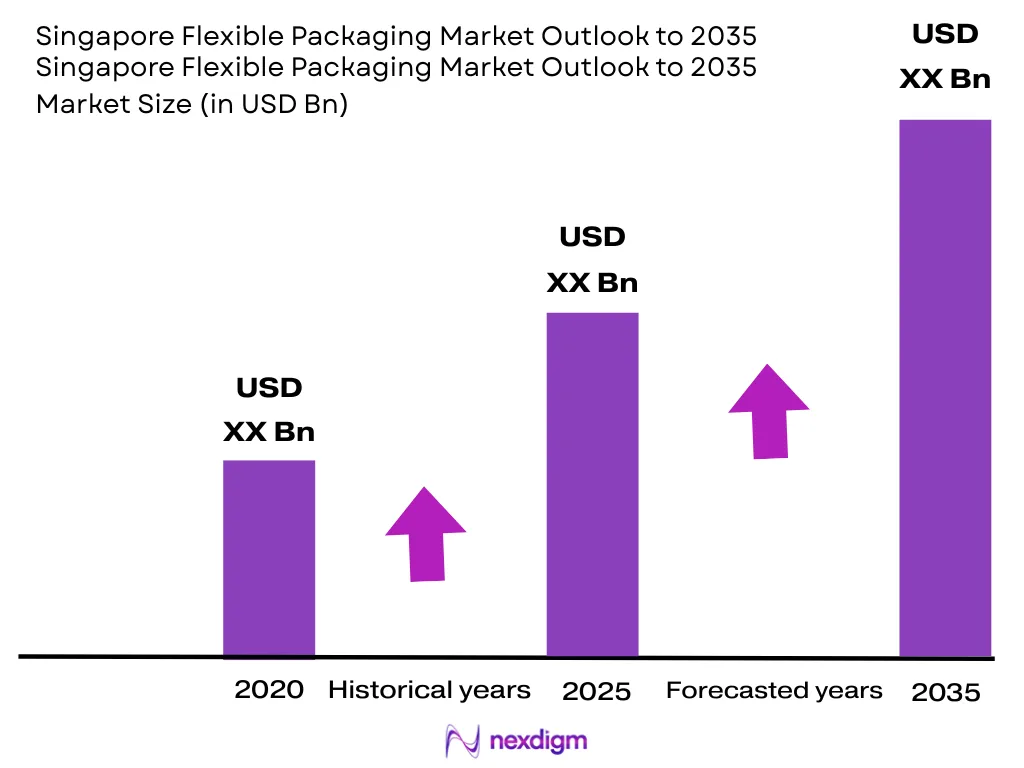
The Singapore Flexible Packaging Market was valued at USD ~ Billion in 2024 and is anticipated to expand at a CAGR of ~% during 2026–2035. The market is primarily driven by rising food & beverage and e-commerce demand, sustained growth in personal care and pharmaceutical applications, and an accelerating regulatory push toward sustainable and recyclable packaging formats under Singapore’s Resource Sustainability Act. The wider Southeast Asia flexible packaging market, of which Singapore forms a developed, innovation-oriented node, was valued at USD ~ billion in 2025 and is projected to reach USD ~ billion by 2030, growing at a CAGR of 4.79%, driven by rapid urbanization, rising disposable incomes, and the region’s booming e-commerce sector. Singapore’s National Environment Agency (NEA) has operated a Mandatory Packaging Reporting (MPR) framework since July 2020, requiring companies with annual turnover above S$10 million to report detailed packaging data and submit reduction plans, laying the regulatory foundation for a broader Extended Producer Responsibility (EPR) scheme and an April 2026 Beverage Container Return Scheme that are reshaping packaging design and material choices across the country.
Market Segmentation
By Material
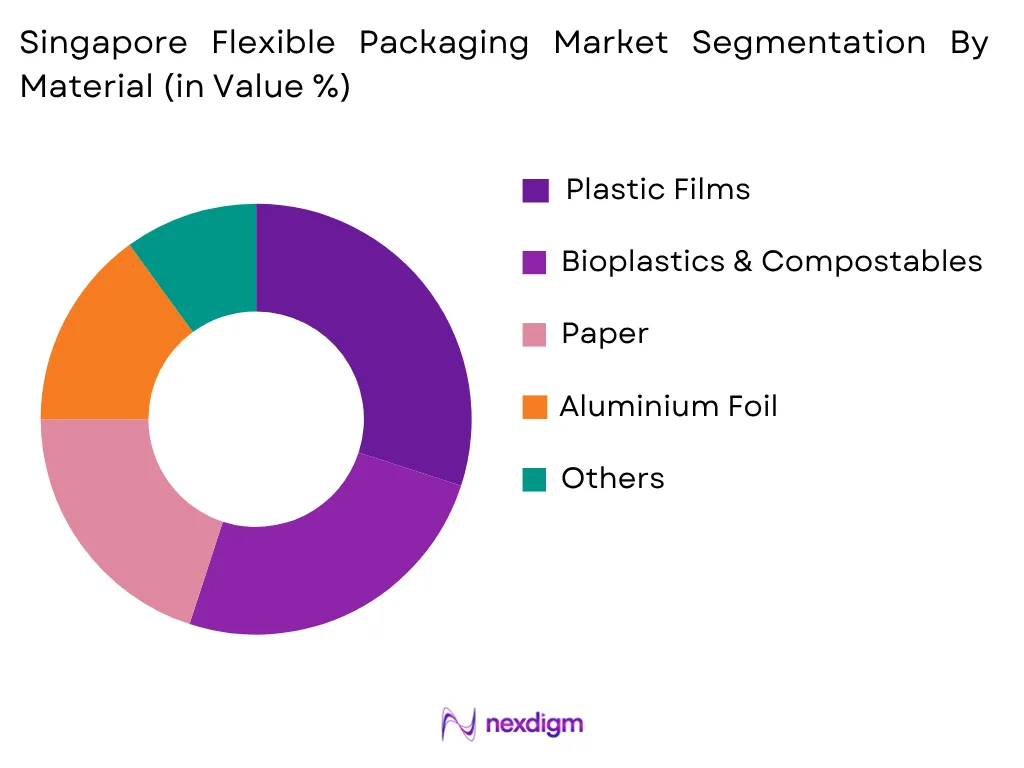
Plastic Films (PE, PP, BOPP) continue to hold the largest share of the Singapore Flexible Packaging Market, reflecting their versatility, cost efficiency, and superior barrier performance across food, personal care, and pharmaceutical applications. However, Bioplastics & Compostable Films represent the fastest-growing material category, propelled directly by NEA’s regulatory agenda; with Singapore’s overall plastic recycling rate reported at just 4% in recent years and the country’s sole landfill at Pulau Semakau expected to reach capacity by around 2035, both regulators and brand owners are under mounting pressure to shift toward more sustainable material choices. Multi-Layer Laminates remain essential for high-barrier applications such as retort pouches and medical packaging, a specialty in which Singapore-based converters such as Paxxus and Jackway Convertor have built particular technical expertise, while Aluminum Foil and Paper-Based Flexible Packaging serve more specialized barrier and recyclability-focused niches respectively.
By Application
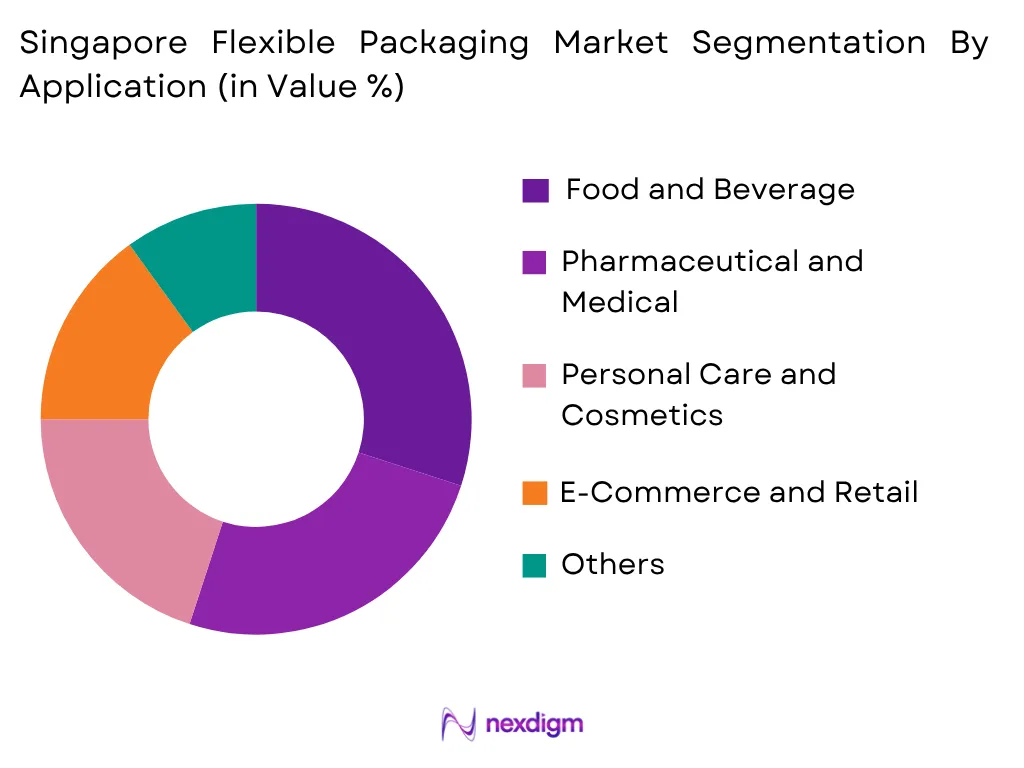
Food & Beverage represents the largest application segment in the Singapore Flexible Packaging Market, consistent with regional patterns in which food and beverage packaging is expected to grow at the fastest rate across Southeast Asia’s flexible packaging industry. Singapore-based converters such as Brentapac, which caters primarily to the food industry with laminated bags, spouted pouches, and vacuum packaging, and Aegis Packaging, which has built its brand specifically around food safety and environmentally friendly flexible packaging, illustrate the concentration of local manufacturing capability around this segment. E-Commerce & Retail represents a fast-growing application area, mirroring the broader Southeast Asian trend in which e-commerce growth, exemplified by double-digit annual expansion across regional markets, is accelerating demand for protective, lightweight flexible packaging formats suited to shipping and last-mile delivery. Personal Care & Cosmetics and Pharmaceuticals & Healthcare applications continue to grow steadily, supported by Singapore’s position as a regional hub for pharmaceutical distribution and premium consumer goods manufacturing.
Competitive Landscape
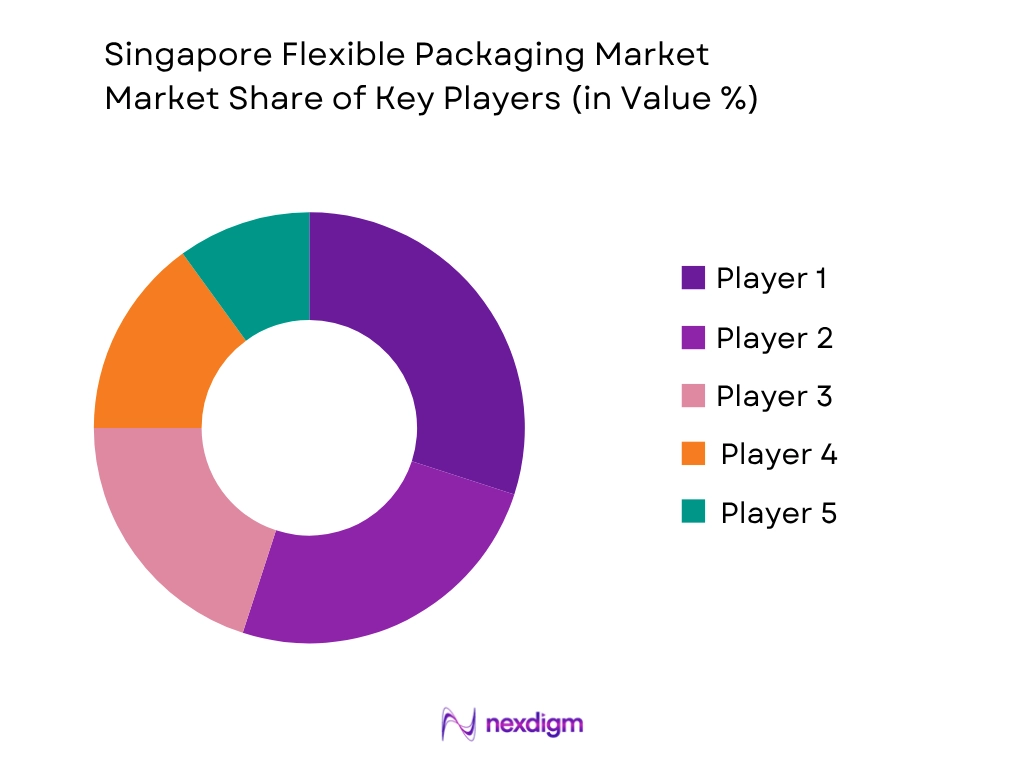
The Singapore Flexible Packaging Market is fragmented, comprising a cluster of specialized domestic converters alongside regional and global packaging majors serving the market through distribution and manufacturing partnerships. Tobe Packaging Industries, operating since 1987 from Woodlands, and Jackway Convertor, established in 1996 in Tuas, represent Singapore’s longer-standing flexible packaging manufacturers, each offering multilayer laminated bags, pouches, and specialty formats such as thermal-resilient retort pouches. More recently established players, including Brentapac, founded in 2000, and Aegis Packaging, founded in 2018, have built focused positions serving the food manufacturing sector, with Aegis in particular emphasizing food safety and environmentally friendly packaging design in line with NEA’s sustainability agenda. NES Packaging, incorporated in 2014, and medical-packaging specialist Paxxus round out Singapore’s base of specialized converters, while global majors such as Amcor, Constantia Flexibles, Sealed Air, Sonoco, Mondi, and Huhtamaki, alongside regional players such as Dynapack Asia and Scientex Berhad, serve multinational brand owners operating in Singapore through regional manufacturing and distribution networks spanning Malaysia, Indonesia, Thailand, and Vietnam. Competitive dynamics are increasingly shaped by the ability to deliver NEA-compliant, recyclable, or compostable packaging formats ahead of Singapore’s full EPR implementation.
| Company | Establishment Year | Headquarters | Primary Product Portfolio | Flexible Packaging Portfolio
|
Manufacturing Presence | Major End-Use Industries | Key Strategic Focus | Certifications & Compliance |
| Tobe Packaging Industries | 1987 | ~ | ~ | ~ | ~ | ~ | ~ | ~ |
| Jackway Convertor | 1996 | ~ | ~ | ~ | ~ | ~ | ~ | ~ |
| Brentapac | 2000 | ~ | ~ | ~ | ~ | ~ | ~ | ~ |
| NES Packaging | 2014 | ~ | ~ | ~ | ~ | ~ | ~ | ~ |
| Aegis Packaging | 2018 | ~ | ~ | ~ | ~ | ~ | ~ | ~ |
Singapore Flexible Packaging Market Analysis
Growth Drivers
Rising E-Commerce and Food & Beverage Demand
The Singapore flexible packaging market is benefiting from sustained growth in food & beverage consumption and the region’s booming e-commerce sector, which increasingly relies on lightweight, protective flexible formats for shipping and last-mile delivery. The wider Southeast Asia flexible packaging market, within which Singapore operates as a developed and innovation-oriented hub, was valued at USD 22.216 billion in 2025 and is projected to grow at a CAGR of 4.79% to reach USD 28.067 billion by 2030, with food and beverage identified as the fastest-growing end-use category. Singapore’s role as a regional headquarters location for multinational food, beverage, and consumer goods companies continues to concentrate demand for premium flexible packaging formats, including retort pouches, spouted pouches, and high-barrier laminates, in which local converters such as Jackway Convertor and Paxxus have built specialized technical capability serving both domestic and export-oriented multinational customers.
Regulatory-Driven Shift Toward Sustainable and Recyclable Packaging
Singapore’s National Environment Agency has progressively tightened its packaging regulatory framework since the Resource Sustainability Act came into force in October 2019, beginning with Mandatory Packaging Reporting in July 2020 for companies with annual turnover exceeding S$10 million. This framework is now evolving toward a full Extended Producer Responsibility scheme, with a Beverage Container Return Scheme set to commence in April 2026 as its first phase, introducing deposit refund mechanisms for plastic and metal beverage containers. With Singapore’s overall national recycling rate targeted to reach 70% by 2030 under the Sustainable Singapore Blueprint, and with only a small fraction of the country’s plastic waste currently being recycled, brand owners and converters face mounting pressure to redesign packaging toward mono-material, recyclable, or compostable structures, creating sustained demand for next-generation flexible packaging materials and technical redesign services.
Market Challenges
Low Domestic Recycling Rate and Limited Infrastructure for Multi-Material Films
Singapore’s plastic recycling rate has remained persistently low, with reporting indicating that only around 4% of the country’s plastic waste was recycled in a recent year, reflecting both high contamination rates in unsorted recycling bins and a broader lack of domestic recycling infrastructure capable of processing multi-material flexible films. Singapore’s sole landfill site at Pulau Semakau is expected to reach capacity by approximately 2035, adding urgency to the push for improved recycling outcomes but also underscoring the scale of the infrastructure gap that flexible packaging, often composed of multiple bonded material layers that are difficult to separate and recycle, must contend with. This creates a structural tension between the continued cost and performance advantages of multi-layer laminate structures and the regulatory and consumer pressure to shift toward mono-material, more readily recyclable formats.
Complex and Evolving Multi-Phase Regulatory Compliance Burden
Singapore’s packaging regulatory framework is becoming progressively more complex as it evolves from voluntary industry agreements toward mandatory reporting and, ultimately, full Extended Producer Responsibility. Companies obligated under the Mandatory Packaging Reporting scheme must annually report packaging data categorized across plastic, paper, metal, and glass material pillars, alongside a detailed 3R (reduce, reuse, recycle) plan with measurable targets, with penalties of up to S$20,000 for non-compliance. The forthcoming Beverage Container Return Scheme, launching in April 2026, introduces an additional layer of deposit-refund compliance obligations specifically for beverage producers. For flexible packaging converters and their brand-owner customers, particularly smaller domestic firms without dedicated sustainability or regulatory affairs teams, keeping pace with this evolving, multi-phase compliance landscape represents a material and growing operational burden.
Market Opportunities
Growth in Recyclable Mono-Material and Compostable Packaging
Singapore’s regulatory trajectory toward eco-modulated EPR fees, which reward producers for using more recyclable or reusable packaging formats, is creating a clear commercial incentive for converters to develop and commercialize mono-material recyclable and compostable flexible packaging structures. Domestic converters such as Aegis Packaging, which has already built its brand around food safety and environmentally friendly packaging, are well positioned to capture this shift, as are larger regional and global players investing in recyclable film technology for the Southeast Asian market. As food-grade recycled content regulation matures across ASEAN, creating economies of scale and greater investment confidence in high-quality recycling infrastructure, Singapore-based converters that develop early expertise in recyclable and compostable film design stand to capture premium positioning with multinational brand owners seeking to meet both Singapore-specific and broader regional sustainability commitments.
Regional Export Hub for ASEAN Flexible Packaging Innovation
Singapore’s status as a regional headquarters and innovation hub, combined with its relatively advanced and fast-evolving packaging regulatory framework, positions domestic converters and multinational packaging companies operating from Singapore to develop compliance-ready packaging solutions ahead of regulatory curves in neighboring ASEAN markets. Vietnam and the Philippines have already implemented mandatory, legally binding EPR schemes for packaging, while Malaysia, Thailand, and Indonesia continue to develop comprehensive mandatory systems of their own, suggesting that packaging solutions and technical expertise proven in Singapore’s relatively mature regulatory environment carry strong potential for regional replication. Regional manufacturing networks such as Dynapack Asia’s more than 30 manufacturing sites spanning Indonesia, China, Malaysia, Thailand, Singapore, and Vietnam illustrate the kind of regional scaling opportunity available to Singapore-linked packaging innovators as ASEAN-wide demand for compliant, sustainable flexible packaging continues to grow.
Future Outlook
The Singapore Flexible Packaging Market is expected to witness sustained expansion over the forecast period, supported by continued growth in food & beverage and e-commerce demand, progressive tightening of NEA’s packaging regulatory framework through full Extended Producer Responsibility implementation, and rising brand-owner investment in recyclable and compostable packaging formats. The April 2026 launch of the Beverage Container Return Scheme and Singapore’s 2030 recycling rate target will further accelerate demand for redesigned, compliance-ready packaging across the beverage and broader food sector. The market is also likely to benefit from Singapore’s position as a regional innovation and distribution hub, as domestic converters and multinational packaging companies operating from Singapore develop sustainable packaging solutions for deployment across the wider ASEAN region as neighboring markets advance their own EPR frameworks.
Major Players
- Tobe Packaging Industries
- Jackway Convertor
- Brentapac
- NES Packaging
- Aegis Packaging
- Paxxus
- Dynapack Asia
- Amcor plc
- Constantia Flexibles Group
- Sealed Air Corporation
- Sonoco Products Company
- Mondi Group
- Huhtamaki
- Scientex Berhad
- Rengo Co., Ltd.
Key Target Audience
- Flexible Packaging Manufacturers and Converters
- Food & Beverage Processing Companies
- Personal Care and Pharmaceutical Manufacturers
- Retailers and E-Commerce Operators
- Brand Owners and Consumer Goods Companies
- Investment and Venture Capitalist Firms
- Government and Regulatory Bodies (National Environment Agency – NEA, Singapore Manufacturing Federation – SMF)
- Raw Material Suppliers and Resin Distributors
Research Methodology
Step 1: Identification of Key Variables
The research process begins with identifying the complete ecosystem of the Singapore Flexible Packaging Market, including raw material and resin suppliers, packaging converters, brand owners, retailers, and regulatory authorities. Extensive secondary research is conducted using company reports, government publications, trade associations, customs statistics, industry journals, and proprietary databases to determine the variables influencing market demand, pricing, production, consumption, and technological developments.
Step 2: Market Analysis and Construction
Historical market information is collected and analyzed to estimate market size, import volumes, application-wise demand, and pricing trends. A combination of top-down and bottom-up approaches is used to estimate market revenues and validate segment-level performance. Consumption patterns across food & beverage, personal care, pharmaceutical, e-commerce, and industrial applications are evaluated to establish an accurate representation of the industry.
Step 3: Hypothesis Validation and Expert Consultation
The preliminary findings are validated through Computer-Assisted Telephone Interviews (CATIs) and structured discussions with packaging converters, procurement managers, sustainability officers, regulatory experts, and senior executives operating within the Singapore packaging industry. These interviews help verify market assumptions, competitive developments, technology adoption trends, pricing dynamics, and future investment opportunities while refining the overall market estimates.
Step 4: Research Synthesis and Final Output
The final stage integrates insights obtained from primary interviews with quantitative information collected through secondary sources. Data triangulation techniques are applied to reconcile differences between supply-side and demand-side estimates, ensuring robust market forecasting. The report is then reviewed through multiple quality assurance checkpoints to deliver a comprehensive analysis covering market size, segmentation, competitive landscape, future outlook, and strategic recommendations for industry stakeholders.

- Executive Summary
- Research Methodology (Market Definitions and Assumptions, Abbreviations, Market Sizing Approach, Top-Down Analysis, Bottom-Up Analysis, Demand-Side Assessment, Supply-Side Assessment, Primary Industry Interviews, Secondary Research Validation, Data Triangulation, Forecasting Framework, Limitations and Future Conclusions)

- Definition and Scope
- Market Evolution and Industry Genesis
- Timeline of Major Industry Developments
- Flexible Packaging Industry Value Chain Analysis
- Supply Chain Analysis

- Growth Drivers (E-Commerce and Food & Beverage Demand Growth, Regulatory-Driven Shift Toward Sustainable Packaging, Rising Demand for Convenience Packaging, Growth in Personal Care and Pharmaceutical Applications, Regional ASEAN Trade Hub Positioning, Advances in Printing and Barrier Technology)
- Market Challenges (Low Domestic Plastic Recycling Rate, Limited Recycling Infrastructure for Multi-Material Films, Complex and Evolving Multi-Phase Regulatory Compliance, High Land and Operating Costs, Import Dependency for Raw Resin Feedstocks, Landfill Capacity Constraints)
- Market Opportunities (Growth in Recyclable Mono-Material and Compostable Packaging, Regional Export Hub for ASEAN Flexible Packaging Innovation, Food-Grade Recycled Content Development, Eco-Modulated Fee-Driven Design Innovation, Public-Private Circular Economy Partnerships, Premium Barrier and Retort Pouch Innovation)
- Market Trends (Shift Toward Mono-Material Recyclable Structures, Rise of Compostable and Bio-Based Films, Lightweighting and Source Reduction, Digital Printing Adoption for Short-Run Packaging, Beverage Container Return Scheme Compliance Packaging, Growing Use of QR Code Consumer Transparency Features)
- Government Regulations (NEA Mandatory Packaging Reporting (MPR), Resource Sustainability Act 2019, Extended Producer Responsibility (EPR) Framework, Beverage Container Return Scheme, Zero Waste Masterplan, Sustainable Singapore Blueprint Recycling Targets)
- Import and Export Analysis (Trade Volume, Major Import Source Countries, Re-Export Trade Flows, HS Code Analysis, Trade Balance)
- Raw Material Availability Analysis (Imported Polyethylene and Polypropylene Resins, Aluminum Foil Feedstock, Paper and Pulp-Based Substrates, Bioplastic and Compostable Film Feedstocks, Regional Petrochemical Supply Chain Access)
- Technology Landscape (Barrier Film Technology, Flexographic and Rotogravure Printing, Digital Printing Systems, Recyclable Mono-Material Structures, Compostable Film Development)
- Sustainability Assessment (Mono-Material Recyclability, Carbon Footprint Reduction, Compostable and Bio-Based Film Adoption, Post-Consumer Recycled Content Integration, Circular Economy Alignment)
- PESTLE Analysis
- SWOT Analysis
- Porter’s Five Forces Analysis
- Stakeholder Ecosystem
- Competition Ecosystem

- By Market Value (2020-2025)
- By Volume Consumption (2020-2025)
- By Average Selling Price (2020-2025)

- By Material (In Value %)
Plastic Films (PE, PP, BOPP)
Aluminum Foil
Paper-Based Flexible Packaging
Bioplastics & Compostable Films
Multi-Layer Laminates - By Product Type (In Value %)
Pouches
Bags
Films & Wraps
Rollstock
Sachets - By Application (In Value %)
Food & Beverage
Personal Care & Cosmetics
Pharmaceuticals & Healthcare
Household & Industrial
E-Commerce & Retail - By End User (In Value %)
Food & Beverage Manufacturers
Personal Care & Cosmetics Manufacturers
Pharmaceutical & Healthcare Companies
Retailers & E-Commerce Operators
Industrial & Household Product Manufacturers - By Region (In Value %)
Central Region
East Region
West Region
North Region
North-East Region

- Market Share of Major Players (By Value, Volume, Material Type, Application Industry, Product Category)
- Cross Comparison Parameters (Barrier Film Portfolio Breadth, Recyclable/Compostable Portfolio, Printing Technology Capability, Application Technical Support Capability, Manufacturing Capacity, Regulatory Compliance & Certifications, Customer Base, Innovation & New Product Launch Frequency)
- SWOT Analysis of Major Players
- Pricing Analysis by Product Category and SKU
- Production Capacity Analysis
- Manufacturing Footprint Analysis
- Distribution Network Analysis
- Innovation Benchmarking
- Detailed Profiles of Major Companies
Tobe Packaging Industries
Jackway Convertor
Brentapac
NES Packaging
Aegis Packaging
Paxxus
Dynapack Asia
Amcor plc
Constantia Flexibles Group
Sealed Air Corporation
Sonoco Products Company
Mondi Group
Huhtamaki
Scientex Berhad
Rengo Co., Ltd.

- Consumption Pattern Analysis (Industrial Usage, Batch Size, Application Penetration, Seasonal Demand, Reformulation Activity)
- Purchasing Criteria (Barrier Performance, Regulatory Compliance, Cost Efficiency, Recyclability, Print Quality, Shelf Life Extension)
- Procurement and Supplier Selection Analysis
- Sustainable and Recyclable Packaging Adoption Assessment
- Premium vs Standard-Grade Packaging Demand
- Product Attribute Preference Analysis (Barrier Properties, Seal Integrity, Print Clarity, Recyclability, Material Consistency, Shelf Appeal)
- Sustainability & ESG Influence on Procurement Decisions
- Pain Point Analysis
- Decision-Making Process

- By Market Value (2026-2035)
- By Volume Consumption (2026-2035)
- By Average Selling Price (2026-2035)


 Request a Sample
 Ask for Customization
 Get a Quote
 Enquire Now