
 Download PDF
Market Overview
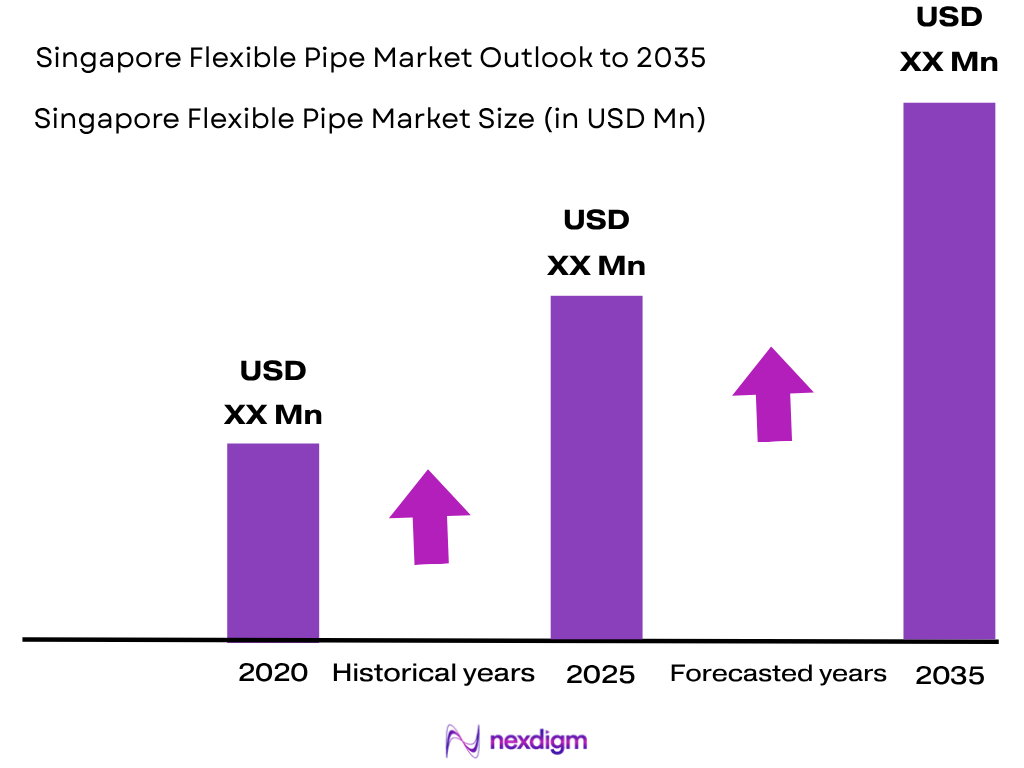
The Singapore Flexible Pipe Market is valued at USD ~XX million in 2024, based on analysis of offshore energy infrastructure, marine applications, industrial fluid transfer, and replacement demand for aging pipeline systems. The market is supported by Singapore’s role as a regional oil and gas hub, with the country handling more than 500 million tonnes of cargo annually through its port ecosystem and maintaining one of the world’s largest bunkering networks. Demand is primarily driven by offshore services, petrochemical facilities, and marine engineering activities requiring corrosion-resistant and lightweight pipeline solutions.
Singapore’s flexible pipe demand is concentrated around major industrial and maritime zones, particularly Jurong Island, Tuas, and the Singapore Port area, due to their concentration of refining, petrochemical, offshore engineering, and marine activities. Jurong Island hosts more than 100 chemical, energy, and refining companies, making it a key consumer location for advanced piping systems. The country’s strategic position as a Southeast Asian energy trading hub and its extensive marine infrastructure support continuous demand for flexible pipe solutions across offshore support, industrial processing, and energy transition applications.
Market Segmentation
By Application
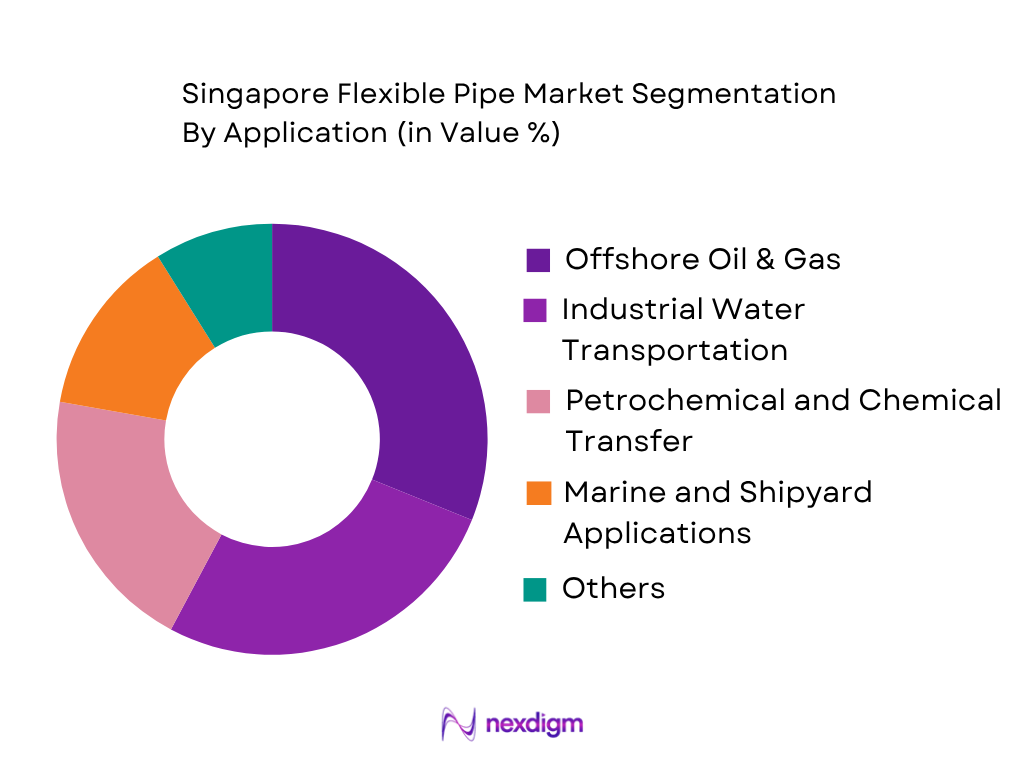
Singapore Flexible Pipe Market is segmented into offshore oil & gas, industrial water transportation, petrochemical and chemical transfer, marine and shipyard applications, and renewable energy infrastructure. The offshore oil & gas segment accounts for the leading market share due to Singapore’s established offshore engineering ecosystem, subsea service capabilities, and proximity to major Southeast Asian hydrocarbon-producing regions. Flexible pipes are widely used in offshore flowlines, risers, and fluid transfer systems because of their corrosion resistance, installation flexibility, and ability to withstand complex marine conditions. Singapore’s position as a regional offshore fabrication and maintenance centre further supports adoption. Industrial water transportation and petrochemical applications also contribute significantly due to the presence of Jurong Island’s chemical manufacturing facilities and extensive industrial utility networks.
By Material Type
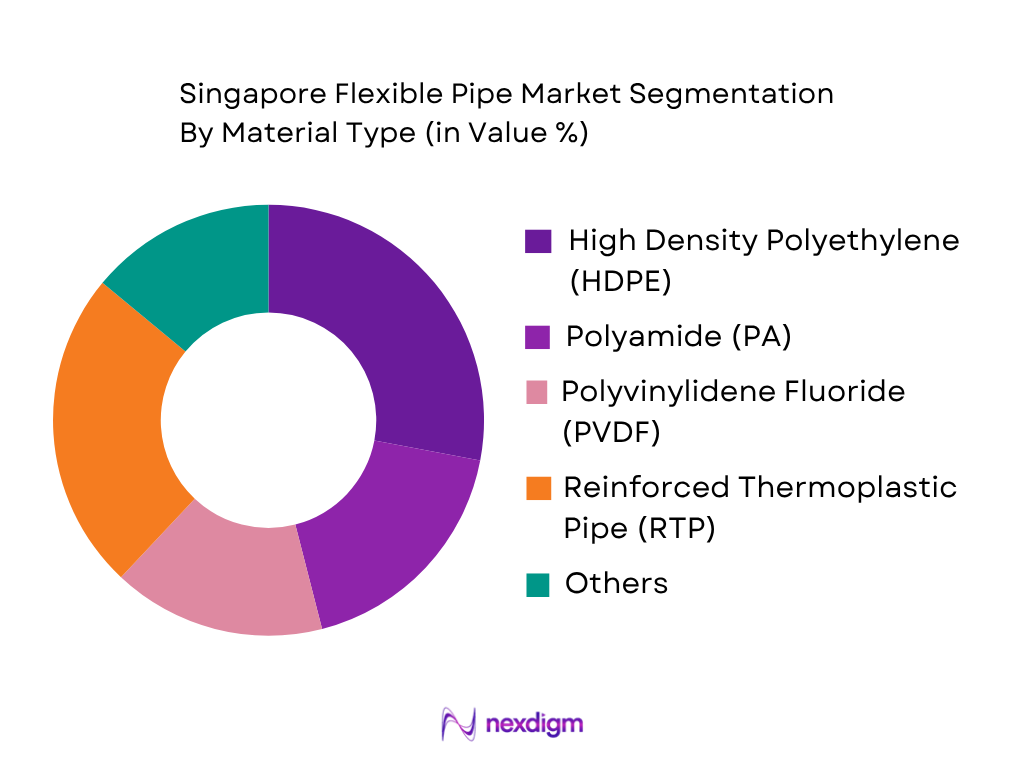
Singapore Flexible Pipe Market is segmented into HDPE, RTP, PA, PVDF, and composite flexible pipes. High Density Polyethylene (HDPE) holds the dominant position due to its extensive use in industrial water transportation, marine utilities, and corrosion-resistant piping applications. HDPE pipes are preferred because of their lightweight structure, chemical resistance, and suitability for humid tropical environments. The material is widely adopted in industrial facilities where durability and low maintenance requirements are important factors. Reinforced Thermoplastic Pipe (RTP) is gaining adoption in higher-pressure applications, particularly in offshore and energy-related projects, due to its improved mechanical strength compared with conventional polymer pipes. PVDF and PA materials are used for specialized chemical and hydrocarbon applications requiring enhanced temperature and chemical resistance.
Competitive Landscape
The Singapore Flexible Pipe Market consists of international manufacturers, offshore engineering companies, and specialized pipeline solution providers. The market structure is influenced by global flexible pipe technology suppliers due to the high technical requirements associated with offshore and subsea applications. Major companies compete through material innovation, engineering capabilities, qualification standards, installation expertise, and long-term maintenance support.
| Company | Establishment Year | Headquarters | Major Products | Key Application Areas | Material Expertise | Offshore Capability | Regional Presence | Engineering Services |
| TechnipFMC | 1958 | United Kingdom | ~ | ~ | ~ | ~ | ~ | ~ |
| Baker Hughes | 1987 | United States | ~ | ~ | ~ | ~ | ~ | ~ |
| Prysmian Group | 1879 | Italy | ~ | ~ | ~ | ~ | ~ | ~ |
| NOV | 1862 | United States | ~ | ~ | ~ | ~ | ~ | ~ |
| Trelleborg | 1905 | Sweden | ~ | ~ | ~ | ~ | ~ | ~ |
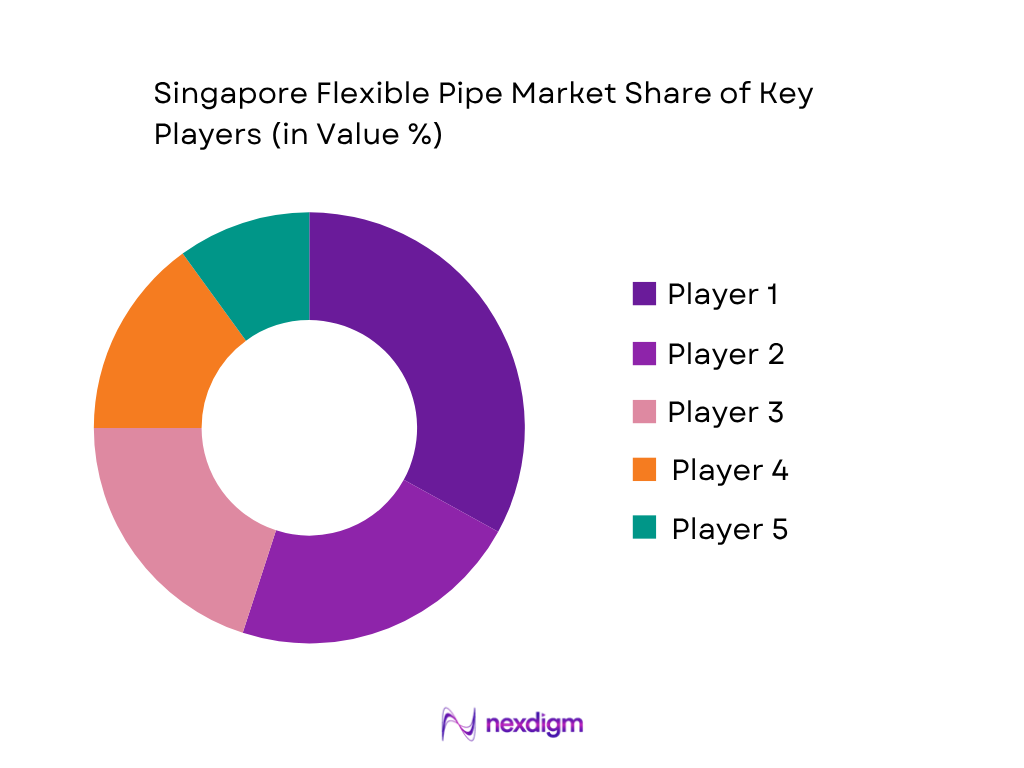
Singapore Flexible Pipe Market Analysis
Growth Drivers
Expansion of Singapore Offshore Engineering Hub
Singapore’s established offshore engineering ecosystem is a major factor supporting flexible pipe demand, as the country remains a key centre for offshore fabrication, repair, and marine engineering services in Southeast Asia. The maritime sector contributes significantly to Singapore’s economy, with the Maritime and Port Authority of Singapore reporting more than 140,000 vessel calls annually and the port handling over 600 million tonnes of cargo. The presence of major offshore yards in Tuas and Jurong Island supports demand for flexible risers, flowlines, and fluid transfer systems used in offshore projects. Singapore also maintains one of the world’s largest ship repair and conversion clusters, supporting FPSO modification and offshore asset maintenance activities. Flexible pipes are increasingly preferred in these applications due to their ability to accommodate vessel movement, reduce installation complexity, and withstand marine operating conditions. The country’s offshore engineering capabilities, combined with its regional project connectivity, continue to create demand for advanced flexible pipeline technologies.
Increasing FPSO and Floating Production Activities
The increasing deployment and maintenance of floating production systems across Southeast Asia supports flexible pipe adoption in Singapore’s offshore ecosystem. FPSO units require flexible risers and flowlines for subsea production, fluid transfer, and connection systems due to their ability to handle dynamic movement between floating vessels and seabed infrastructure. Singapore remains a major FPSO conversion and offshore service location, supported by extensive marine fabrication facilities. According to national energy statistics, Singapore’s refinery throughput remains among the highest globally, with refining capacity exceeding 1.3 million barrels per day, creating demand for reliable offshore supply infrastructure. Regional offshore developments in countries such as Indonesia, Malaysia, and Vietnam require specialised engineering support, where Singapore-based companies provide fabrication, maintenance, and logistics services. Flexible pipes support these activities by offering corrosion resistance, reduced installation requirements, and improved operational flexibility compared with rigid pipeline systems.
Market Challenges
High Dependence on Imported Flexible Pipe Technologies
Singapore’s flexible pipe market faces challenges due to dependence on imported advanced technologies and specialised manufacturing capabilities. High-performance flexible pipes used in offshore applications require advanced polymer layers, reinforcement materials, and specialised manufacturing processes that are concentrated among global suppliers. Singapore imports a significant portion of industrial materials and energy-related equipment due to limited domestic raw material availability. The country’s manufacturing sector accounted for approximately 20% of GDP, according to government economic statistics, but advanced composite pipeline production remains limited compared with conventional industrial manufacturing. Offshore operators require internationally certified flexible pipe systems that meet strict pressure, temperature, and fatigue performance standards. This dependence increases procurement complexity, technology transfer limitations, and supply chain exposure. Local companies generally participate through engineering, installation, and maintenance services rather than large-scale flexible pipe manufacturing, creating a reliance on international technology providers.
High Qualification Standards for Offshore Applications
Strict technical qualification requirements represent a major challenge for flexible pipe adoption in Singapore’s offshore sector. Offshore flexible pipes must comply with demanding standards related to pressure resistance, fatigue performance, corrosion protection, and long-term operational reliability. Singapore’s offshore industry operates within a highly regulated maritime environment, requiring equipment used in marine applications to satisfy safety and environmental requirements. The country’s maritime sector includes more than 5,000 maritime establishments, creating a competitive environment where engineering quality and compliance are critical factors. Flexible pipe systems require extensive testing before deployment in subsea and floating production applications, including material validation and operational performance assessments. These qualification requirements increase project timelines and technical barriers, particularly for new suppliers entering the market. Companies must invest significantly in engineering capabilities, certification processes, and specialised testing facilities to compete in Singapore’s offshore infrastructure ecosystem.
Market Opportunities
Regional Subsea Project Support Hub Development
Singapore’s position as a regional offshore engineering and logistics hub creates opportunities for flexible pipe suppliers supporting subsea developments across Southeast Asia. The country’s strategic location near major offshore producing regions allows engineering companies to provide installation, maintenance, and supply chain services for regional projects. Singapore’s port infrastructure includes more than 200 shipping lines connecting to over 600 ports worldwide, strengthening its role as an offshore service centre. Increasing subsea activities in neighbouring markets such as Indonesia, Malaysia, and Vietnam require specialised pipeline solutions, including flexible risers, jumpers, and flowlines. Flexible pipe technology offers advantages for these projects because of reduced installation time, improved resistance to marine conditions, and suitability for complex seabed environments. Local partnerships between international technology providers and Singapore-based marine engineering companies can support market expansion by combining advanced manufacturing expertise with regional project execution capabilities.
Offshore Energy Infrastructure Expansion
Expansion of offshore energy infrastructure and emerging marine energy projects creates new opportunities for flexible pipeline technologies in Singapore. The country is developing strategies to strengthen energy security while supporting lower-carbon infrastructure, including LNG development, offshore renewable solutions, and carbon management systems. Singapore’s LNG terminal has an annual handling capacity of approximately 11 million tonnes, supporting demand for advanced marine energy infrastructure. Flexible pipe systems can support floating LNG applications, marine transfer systems, and offshore energy facilities requiring reliable fluid transportation solutions. Additionally, Singapore’s offshore engineering capabilities position the country to participate in regional offshore wind and subsea infrastructure development. Flexible pipeline technologies can also contribute to future hydrogen and carbon capture projects where corrosion-resistant and lightweight transportation systems are required. These applications provide opportunities for technology providers to develop specialised solutions for evolving offshore energy requirements.
Future Outlook
Over the forecast period, the Singapore Flexible Pipe Market is expected to experience steady development due to continued offshore maintenance activities, expansion of marine infrastructure, and increasing demand for corrosion-resistant pipeline technologies. Growth will be supported by industrial modernization, energy transition projects, and adoption of advanced thermoplastic and composite materials. The increasing focus on reducing maintenance requirements and improving operational efficiency will encourage industries to replace traditional rigid pipeline systems with flexible alternatives.
Major Players
- TechnipFMC
- Baker Hughes
- Prysmian Group
- NOV
- Trelleborg
- Magma Global
- Strohm
- Airborne Oil & Gas
- FlexSteel Pipeline Technologies
- Shawcor
- Vallourec
- Halliburton
- Schlumberger
- Parker Hannifin
- ContiTech
Key Target Audience
- Oil and gas exploration and production companies
- Offshore engineering and marine construction companies
- Petrochemical and refining companies
- Shipbuilding and offshore fabrication companies
- Industrial water management companies
- Investments and venture capitalist firms
- Government and regulatory bodies (Energy Market Authority Singapore, Maritime and Port Authority of Singapore, Economic Development Board Singapore)
- Renewable energy infrastructure developers
Research Methodology
Step 1: Identification of Key Variables
The initial phase involves developing a comprehensive ecosystem map covering flexible pipe manufacturers, offshore operators, marine engineering companies, industrial users, and regulatory stakeholders. Secondary research is conducted to identify demand factors, application segments, material trends, and supply chain characteristics influencing the Singapore Flexible Pipe Market.
Step 2: Market Analysis and Construction
Historical market information is analysed through application-wise demand assessment, material consumption patterns, offshore infrastructure development trends, and industrial pipeline requirements. Market estimation incorporates supply-side evaluation, end-user demand analysis, and project pipeline assessment to determine market dynamics.
Step 3: Hypothesis Validation and Expert Consultation
Market assumptions are validated through discussions with industry professionals including offshore engineers, procurement specialists, pipeline manufacturers, and marine infrastructure stakeholders. These consultations provide operational insights regarding technology adoption, material preferences, and application requirements.
Step 4: Research Synthesis and Final Output
The final stage combines primary and secondary findings to develop a validated market assessment. Data points related to product categories, application segments, competitive positioning, and future industry developments are integrated to provide a comprehensive Singapore Flexible Pipe Market outlook.

- Executive Summary
- Research Methodology (Market Definitions and Assumptions, Flexible Pipe Classification Framework, Offshore and Marine Pipeline Demand Assessment, Subsea Infrastructure Mapping, Oil and Gas Application Analysis, Maritime and Port Infrastructure Assessment, Industrial Fluid Transfer Evaluation, Composite and Thermoplastic Pipe Technology Assessment, Import Dependency Analysis, Supply Chain Mapping, Demand-Side Assessment, Supply-Side Assessment, Primary Industry Interviews, Data Triangulation, Forecasting Framework, Limitations and Future Conclusions)

- Definition and Scope
- Singapore Flexible Pipe Industry Evolution
- Flexible Pipe Technology Evolution
- Singapore Flexible Pipe Value Chain Analysis
- Singapore Flexible Pipe Supply Chain Analysis

- Growth Drivers (Expansion of Singapore Offshore Engineering Hub, Increasing FPSO and Floating Production Activities, Growth of Marine and Shipyard Infrastructure, Rising LNG Infrastructure Requirements, Petrochemical Industry Expansion, Increasing Offshore Asset Maintenance Demand, Industrial Water Infrastructure Development, Adoption of Lightweight Corrosion Resistant Pipeline Systems)
- Market Challenges (High Dependence on Imported Flexible Pipe Technologies, Limited Domestic Flexible Pipe Manufacturing Capacity, High Qualification Standards for Offshore Applications, Complex Marine Installation Requirements, High Technology and Material Costs, Competition from Conventional Steel Pipeline Systems, Limited Local Raw Material Production)
- Market Opportunities (Regional Subsea Project Support Hub Development, Offshore Energy Infrastructure Expansion, Floating LNG Infrastructure Applications, Offshore Wind Cable Protection Systems, Reinforced Thermoplastic Pipe Adoption, Marine Pipeline Rehabilitation Projects, Hydrogen and Carbon Capture Infrastructure Development, Local Flexible Pipe Technology Partnerships)
- Market Trends (Increasing Thermoplastic Composite Pipe Adoption, Growth of Digital Pipeline Monitoring, Advanced Polymer Material Development, Offshore Asset Life Extension Programs, Sustainable Pipeline Material Adoption, Regional Export-Oriented Engineering Services, Automation in Pipeline Inspection, Lightweight Pipeline Technology Adoption)
- Government Regulations and Industry Standards (Maritime and Port Authority Singapore Regulations, Energy Market Authority Standards, Workplace Safety and Health Requirements, Environmental Protection Regulations, Offshore Engineering Safety Standards, Marine Pollution Prevention Requirements, International Maritime Organization Compliance)
- SWOT Analysis
- Porter’s Five Forces Analysis
- PESTLE Analysis
- Stakeholder Ecosystem
- Competition Ecosystem

- By Market Value (2020-2025)
- By Flexible Pipe Consumption Volume (2020-2025)
- By Offshore Oil & Gas Flexible Pipe Consumption Volume (2020-2025)
- By Marine and Shipyard Flexible Pipe Consumption Volume (2020-2025)
- By Petrochemical Flexible Pipe Consumption Volume (2020-2025)

- By Application Type (In Value %)
Offshore Oil & GasSubsea Flowlines
Flexible Risers
Offshore Production Systems
Floating Production Storage and Offloading (FPSO) Connections
Marine Oil Transfer Systems
Onshore Oil & Gas
Refinery Fluid Transfer Systems
Petrochemical Processing Systems
Industrial Water Transportation
Cooling Water Systems
Process Water Pipelines
Desalination Infrastructure
Mining and Industrial Fluid Transfer
Chemical Transportation
Industrial Slurry Transfer
Wastewater Transportation
Renewable Energy Infrastructure
Offshore Wind Cable Protection
Floating Renewable Energy Systems
Marine Energy Infrastructure - By Material Type (In Value %)
High Density Polyethylene (HDPE)
Polyamide (PA)
Polyvinylidene Fluoride (PVDF)
Reinforced Thermoplastic Pipe (RTP)
Thermoplastic Composite Pipe (TCP)
Composite Flexible Pipe
Metal Reinforced Flexible Pipe - By Product Structure Type (In Value %)
Unbonded Flexible Pipe
Bonded Flexible Pipe
Flexible Jumpers
Flexible Risers
Flexible Flowlines
Thermoplastic Composite Pipes - By End-Use Industry (In Value %)
Oil & Gas Exploration and Production
LNG and Gas Processing
Petrochemical Manufacturing
Marine and Shipbuilding
Offshore Engineering Services
Industrial Manufacturing
Water Infrastructure
Renewable Energy - By Pressure Rating (In Value %)
Low Pressure Flexible Pipes
Medium Pressure Flexible Pipes
High Pressure Flexible Pipes
High Temperature High Pressure (HTHP) Flexible Pipes

- Market Share of Major Players (By Singapore Revenue, Flexible Pipe Sales Volume, Offshore Application Exposure, Marine Infrastructure Exposure, Product Technology, Import and Distribution Network, Engineering Support Capability, Regional Project Coverage)
- Cross Comparison Parameters (Flexible Pipe Product Portfolio Breadth, Offshore Flexible Pipe Technology Capability, Thermoplastic Composite Pipe Capability, FPSO and Subsea Project Experience, Singapore Marine Engineering Network, Regional Asia-Pacific Project Coverage, Pipeline Installation and Maintenance Capability, Digital Monitoring and Inspection Technology)
- SWOT Analysis of Major Players
- Detailed Profiles of Major Companies
TechnipFMC
Baker Hughes
NOV
Strohm
Airborne Oil & Gas
Subsea 7
Saipem
Oceaneering International
Parker Hannifin
Magma Global
Prysmian Group
FlexSteel Pipeline Technologies
ContiTech
Petrofac
Halliburton

- Offshore Oil & Gas Operator Flexible Pipe Procurement Assessment
- FPSO Operator Pipeline Requirement Analysis
- LNG Terminal Flexible Pipeline Requirement Assessment
- Petrochemical Plant Fluid Transfer System Analysis
- Marine Shipyard Flexible Pipe Demand Assessment
- Offshore Engineering Contractor Procurement Analysis

- By Market Value (2026-2035)
- By Flexible Pipe Consumption Volume (2026-2035)
- By Offshore Oil & Gas Flexible Pipe Consumption Volume (2026-2035)
- By Marine and Shipyard Flexible Pipe Consumption Volume (2026-2035)
- By Petrochemical Flexible Pipe Consumption Volume (2026-2035)


 Request a Sample
 Ask for Customization
 Get a Quote
 Enquire Now