
 Download PDF
Market Overview
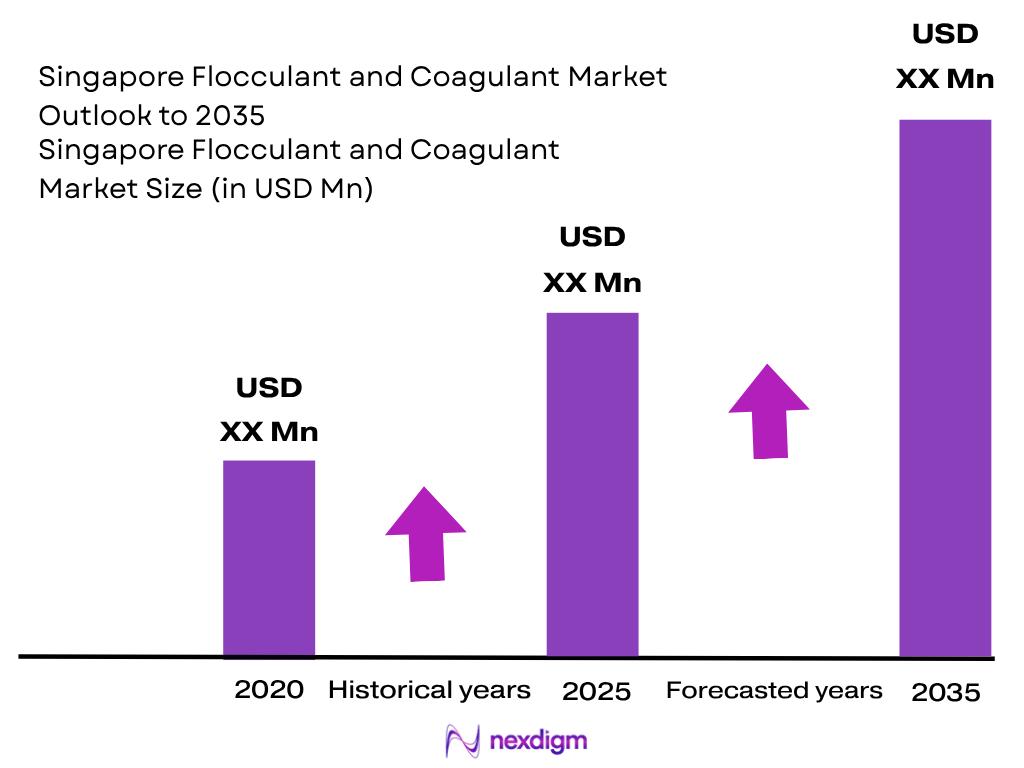
The Singapore Flocculant and Coagulant Market is estimated at ~USD X million in 2024, compared with ~USD X million in 2023, with demand supported by Singapore’s highly engineered water-reclamation and industrial-water infrastructure. PUB states that national water demand is approximately 440 million gallons per day, while demand is expected to nearly double by 2065. Singapore’s GDP reached USD 547.39 billion and GDP per capita reached USD 90,674 in 2024, providing a substantial industrial and infrastructure base for advanced water-treatment chemicals.
Singapore is a city-state, so market concentration is closely connected with industrial and water-treatment clusters rather than separate regional markets. The Tuas, Jurong Island, Changi and western industrial corridors are particularly relevant because of their concentration of manufacturing, petrochemical, semiconductor and water-reclamation activities. PUB reports that the Changi Water Reclamation Plant currently has 224 million gallons per day of treatment capacity and is undergoing further expansion, while a new Tuas NEWater Factory is planned with 75 million gallons per day capacity.
Market Segmentation
By Product Type
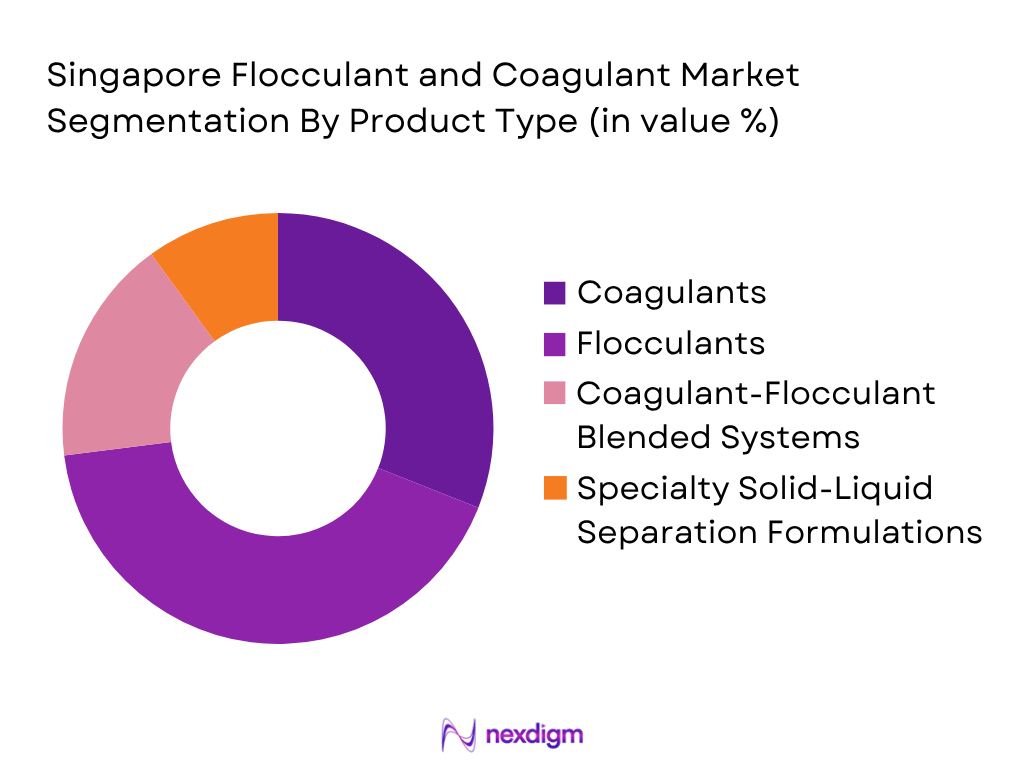
The Singapore Flocculant and Coagulant Market is segmented by product type into flocculants, coagulants, coagulant-flocculant blended systems and specialty solid-liquid separation formulations. Coagulants and flocculants together constitute the core chemical-treatment categories, because Singapore’s water infrastructure requires reliable clarification and solids separation across municipal, industrial and reclaimed-water applications. Demand is supported by the country’s integrated water-management model, which combines used-water collection, biological treatment, advanced purification, desalination and water reuse. PUB identifies industrial wastewater as a key treatment stream because its volume and characteristics vary according to the source, requiring appropriate treatment processes before reuse or discharge. Water-intensive sectors such as wafer fabrication, electronics and biomedical manufacturing are particularly relevant: PUB’s recycling requirements apply to new projects consuming at least 60,000 m³ of water annually, while front-end wafer fabrication projects are subject to a minimum 50% water-recycling requirement. These conditions create recurring demand for chemical solutions that support clarification, filtration, sludge management and upstream membrane protection.
By Water Treatment Application
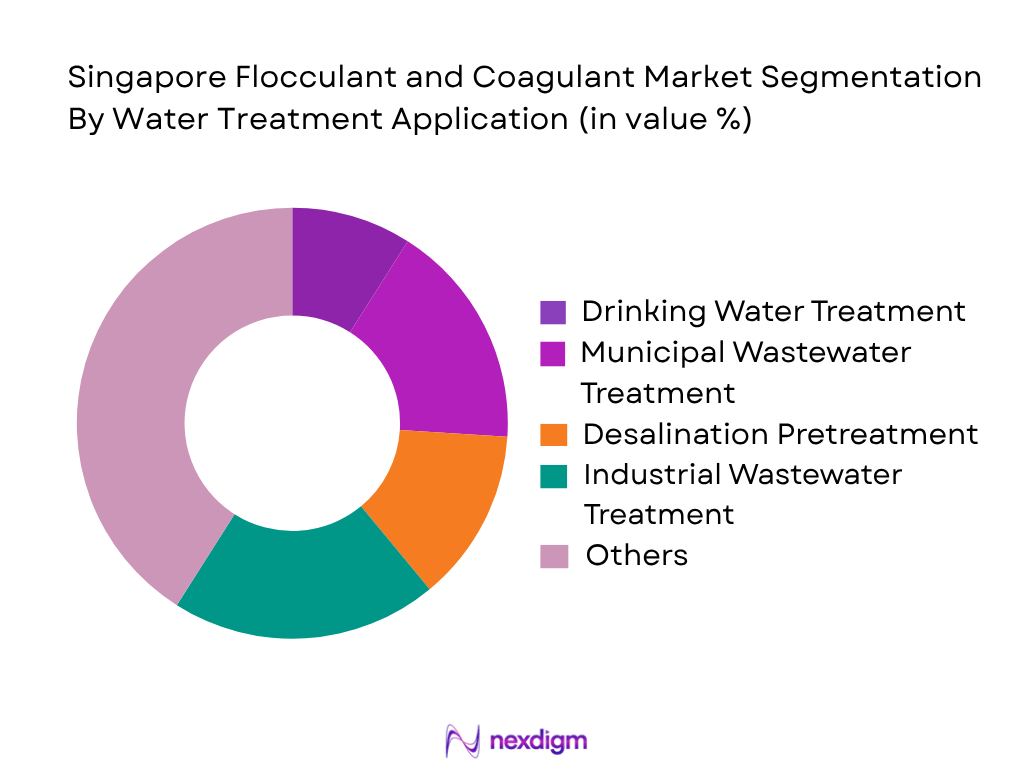
The Singapore Flocculant and Coagulant Market is segmented by water treatment application into drinking water treatment, municipal wastewater treatment, desalination pretreatment, industrial wastewater treatment, produced water treatment, cooling water treatment, boiler water treatment, water reuse and recycling, and sludge treatment. Water reuse and recycling and industrial wastewater treatment represent structurally important demand areas because Singapore’s water strategy increasingly emphasizes resource recovery and circular water management. PUB reports current national water demand of approximately 440 million gallons per day, while non-domestic demand is expected to become increasingly important. New projects in wafer fabrication, electronics and biomedical manufacturing are required to implement specified recycling measures, strengthening demand for treatment chemicals used before reuse. Singapore also operates an integrated system of local catchment water, imported water, NEWater and desalinated water. Changi WRP’s capacity of 224 million gallons per day, together with its planned expansion of up to 96 million gallons per day, demonstrates the scale of used-water treatment infrastructure requiring chemical treatment processes.
Competitive Landscape
The Singapore Flocculant and Coagulant Market includes global water-treatment chemical manufacturers and integrated water-technology companies serving municipal utilities, industrial manufacturers and specialty treatment applications. Companies such as Kemira, SNF, Ecolab, Solenis and BASF have broad international portfolios covering polymer flocculants, inorganic and organic coagulants, process-water treatment and sludge-management solutions. Singapore’s specialized industrial base also creates opportunities for suppliers capable of providing technical formulation, dosing optimization and application engineering rather than commodity chemicals alone.
| Company | Establishment Year | Headquarters | Flocculant Portfolio | Coagulant Portfolio | Industrial Water Capability | Municipal Water Capability | Sludge Treatment Capability | Singapore/Application Coverage |
| Kemira Oyj | 1920 | Helsinki, Finland | ~ | ~ | ~ | ~ | ~ | ~ |
| SNF Group | 1978 | Andrézieux, France | ~ | ~ | ~ | ~ | ~ | ~ |
| Ecolab Inc. | 1923 | Saint Paul, USA | ~ | ~ | ~ | ~ | ~ | ~ |
| Solenis LLC | 1907 | Wilmington, USA | ~ | ~ | ~ | ~ | ~ | ~ |
| BASF SE | 1865 | Ludwigshafen, Germany | ~ | ~ | ~ | ~ | ~ | ~ |
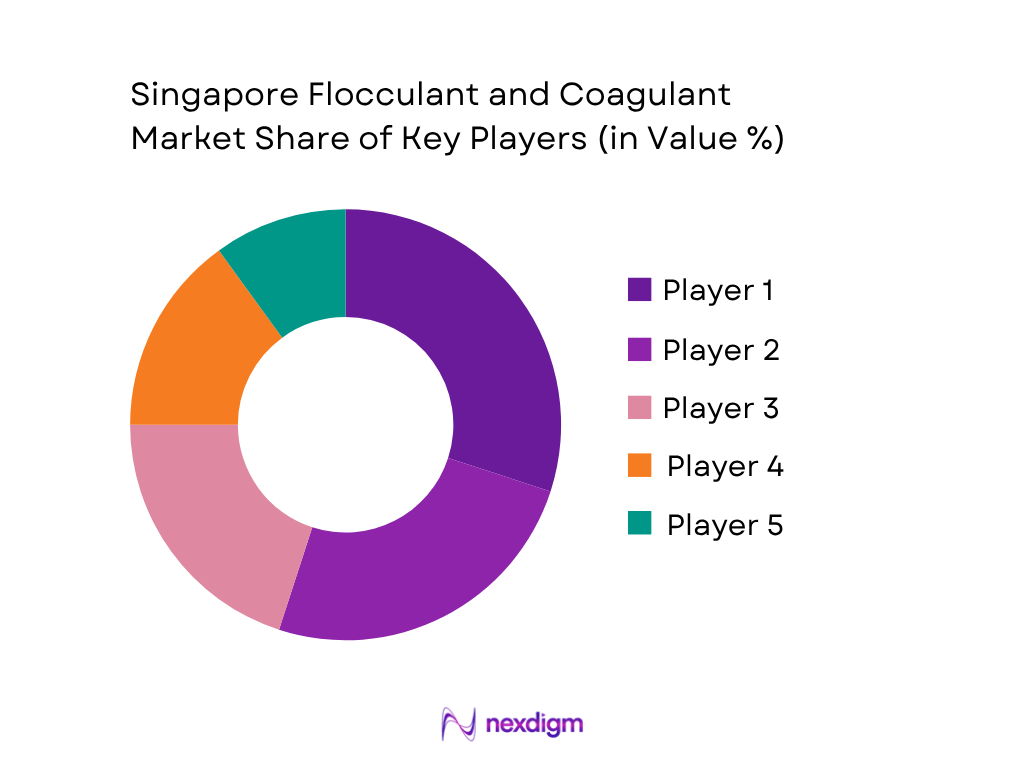
Singapore Flocculant and Coagulant Market Analysis
Growth Drivers
Expansion of Water Reuse, Recycling and Industrial Water Treatment
The Singapore Flocculant and Coagulant Market is supported by the country’s integrated water-reuse strategy and growing treatment requirements of water-intensive industries. Singapore uses about 440 million gallons of water per day, while total demand could almost double by 2065, with the non-domestic sector expected to become the larger source of demand. Singapore’s 2024 GDP was USD 547.39 billion, while GDP per capita reached USD 90,674.1 and population reached 6.04 million. PUB introduced mandatory recycling requirements for new qualifying wafer-fabrication, electronics and biomedical projects consuming at least 60,000 m³ of water annually. Front-end wafer-fabrication plants must achieve a minimum 50% recycling rate. Existing wafer-fabrication facilities recorded a median recycling rate of 43% when the requirements were introduced. These conditions increase the need for coagulation, flocculation, clarification, filtration and sludge-treatment chemicals, particularly where wastewater streams must be conditioned before recycling or advanced membrane treatment. The country’s 100% access to safely managed sanitation services further reflects the maturity of its water-management infrastructure. Industrial wastewater from semiconductor, electronics, biomedical, pharmaceutical and chemical facilities also requires application-specific treatment chemistry, creating continued demand for specialized flocculants and coagulants capable of handling different solids loads and wastewater compositions.
Growth of Advanced Water-Reclamation and Desalination Infrastructure
Singapore’s continued investment in used-water reclamation, NEWater and desalination creates a structural demand base for flocculants and coagulants used in solids removal, clarification, pretreatment and sludge management. National water demand is approximately 440 million gallons per day, while future demand is expected to nearly double. The Changi Water Reclamation Plant has treatment capacity of 224 million gallons per day, with its third expansion phase designed to add up to 96 million gallons per day. Singapore is also developing the Tuas NEWater Factory with a planned production capacity of 75 million gallons per day, strengthening advanced water-reuse infrastructure. The country’s 100% electricity access and 100% safely managed sanitation coverage demonstrate the developed utility infrastructure supporting these systems. Singapore’s economy expanded by 4.4% in 2024, providing a strong economic base for continued investment in industrial and municipal water infrastructure. As water-reclamation capacity expands, treatment plants require consistent chemical conditioning of incoming wastewater, supporting demand for inorganic coagulants, synthetic polymer flocculants and specialized formulations designed for high-throughput clarification, membrane protection and sludge separation.
Market Challenges
High Treatment Complexity and Dependence on Energy-Intensive Water Systems
The Singapore Flocculant and Coagulant Market faces a structural challenge arising from the country’s dependence on sophisticated and energy-intensive water-treatment systems. Singapore manages approximately 440 million gallons of water demand per day, and demand is expected to nearly double by 2065. As reliance on NEWater and desalination increases, treatment plants must maintain stable clarification and filtration performance while controlling chemical consumption, sludge generation and downstream membrane loading. Singapore’s water system currently has a carbon footprint of approximately 279 kilotonnes of CO₂-equivalent, which could rise toward 1,000 kilotonnes of CO₂-equivalent as demand increases and more energy-intensive water sources are required. Industrial treatment chemistry must also accommodate different wastewater compositions from semiconductor, electronics, biomedical, pharmaceutical and petrochemical operations. Wafer fabrication, electronics, biomedical and pharmaceutical industries collectively account for approximately 20% of non-domestic water demand. Consequently, suppliers need formulations that achieve reliable solids separation under changing feed-water conditions without compromising membrane systems or increasing residual sludge burdens. This creates technical requirements around polymer selection, dosing optimization, charge density, molecular weight and compatibility with downstream treatment processes.
Strict Water-Quality Requirements and Limited Scope for Treatment Failure
The Singapore Flocculant and Coagulant Market operates within a highly regulated water-management environment where treatment performance, discharge quality and process reliability are critical. Singapore’s mandatory water-recycling framework applies to qualifying new industrial projects consuming at least 60,000 m³ of water annually, while front-end wafer-fabrication facilities must achieve at least 50% recycling. These requirements increase the technical expectations placed on coagulants and flocculants because treatment chemistry must support consistent removal of suspended solids and contaminants before filtration, membrane separation or reuse. Singapore’s economic environment further reinforces the importance of industrial continuity, with 2024 GDP of USD 547.39 billion and GDP per capita of USD 90,674.1. Consumer-price inflation stood at 2.4 in 2024, increasing attention to operating efficiency and procurement optimization. PUB’s water-delivery network extends to approximately 6,600 km of pipelines and serves around 1.7 million customers, illustrating the scale of the national water system. For chemical suppliers, the challenge is therefore not simply supplying standard products but consistently meeting application-specific treatment requirements, maintaining dosing precision and supporting operators in achieving stable performance across municipal and industrial systems.
Market Opportunities
Expansion of Industrial Water Recycling and Specialty Treatment Formulations
The Singapore Flocculant and Coagulant Market has an opportunity to expand through specialty formulations designed for semiconductor, electronics, biomedical and pharmaceutical wastewater recycling. Singapore’s regulatory framework requires new qualifying industrial projects consuming at least 60,000 m³ of water annually to implement specified water-recycling measures, while front-end wafer-fabrication plants must achieve at least 50% recycling. Wafer fabrication, electronics, biomedical and pharmaceutical facilities account for approximately 20% of current non-domestic water demand. This creates opportunities for higher-performance flocculants and coagulants capable of handling variable industrial wastewater streams while supporting downstream membrane and filtration processes. Singapore’s 2024 GDP reached USD 547.39 billion, GDP per capita reached USD 90,674.1 and population reached approximately 6.04 million. Industrial users increasingly require formulations optimized for low residuals, improved solids capture, reduced sludge loading and compatibility with water-reuse systems. The opportunity is therefore centered on application-specific chemistry rather than commodity-volume expansion alone. Suppliers with technical service capabilities, dosing optimization and customized polymer selection can address the increasingly sophisticated requirements of Singapore’s advanced manufacturing wastewater systems.
Development of High-Efficiency Treatment Solutions for NEWater and Used-Water Infrastructure
Expansion of Singapore’s water-reclamation infrastructure creates opportunities for suppliers of advanced coagulation, flocculation and sludge-treatment technologies. National water demand is approximately 440 million gallons per day, with demand expected to nearly double by 2065. The Changi Water Reclamation Plant has an existing capacity of 224 million gallons per day, while its third expansion phase is expected to increase capacity by up to 96 million gallons per day. The Tuas NEWater Factory has a planned capacity of 75 million gallons per day, strengthening the country’s advanced water-reuse system. These facilities require reliable pretreatment and solids-separation processes to protect downstream purification systems and manage sludge efficiently. Singapore has 100% safely managed sanitation coverage and 100% electricity access, supporting continued operation of advanced treatment infrastructure. PUB has also established a 2045 net-zero emissions target for its water operations, increasing the relevance of treatment technologies that improve process efficiency and reduce resource intensity. This creates opportunities for low-dose, high-performance formulations, automated dosing systems, process-monitoring solutions and chemistry designed specifically for advanced water-reclamation and sludge-management operations.
Future Outlook
Over the next decade, the Singapore Flocculant and Coagulant Market is expected to remain closely linked to water reuse, industrial wastewater treatment, desalination, sludge processing and advanced water-reclamation infrastructure. The country’s limited natural water resources make treatment efficiency strategically important, while industrial sectors require increasingly sophisticated water-management systems. PUB is expanding water-reclamation infrastructure, including the Changi Water Reclamation Plant, and is developing additional NEWater capacity. The combination of industrial water recycling requirements, advanced manufacturing activity and long-term water-security planning is expected to support demand for higher-performance coagulation and flocculation technologies.
Major Players
- Kemira Oyj
- SNF Group
- Ecolab Inc.
- Solenis LLC
- BASF SE
- SUEZ
- Veolia Water Technologies
- Kurita Water Industries Ltd.
- Solvay
- Feralco AB
- Buckman Laboratories
- Nouryon
- IXOM
- GEO Specialty Chemicals
- Aries Chemical
Key Target Audience
- Water Treatment Chemical Manufacturers
- Industrial Water Treatment Operators
- Municipal Water and Wastewater Utilities
- Semiconductor and Electronics Manufacturers
- Petrochemical and Refining Companies
- Investments and Venture Capitalist Firms
- Government and Regulatory Bodies (PUB, National Environment Agency)
- Engineering, Procurement and Water Infrastructure Companies
Research Methodology
Step 1: Identification of Key Variables
The initial phase involves mapping the Singapore water-treatment ecosystem, including PUB, municipal water infrastructure, industrial water users, chemical suppliers, distributors and treatment-service providers. The assessment identifies demand variables such as treated-water volumes, wastewater generation, recycling requirements, desalination activity, industrial production and sludge-treatment requirements.
Step 2: Market Analysis and Construction
Historical market information is compiled through analysis of product categories, chemical consumption, application demand, imports, exports, industrial water use and treatment infrastructure. Bottom-up assessment evaluates chemical requirements across municipal wastewater, industrial wastewater, desalination, water reuse and sludge-treatment applications, while top-down analysis validates the overall market framework.
Step 3: Hypothesis Validation and Expert Consultation
Market hypotheses are validated through discussions with water-treatment chemical suppliers, treatment-plant operators, industrial water users, distributors and technical specialists. Interviews focus on formulation requirements, dosing practices, procurement structures, application-specific chemistry, customer qualification requirements and technology adoption.
Step 4: Research Synthesis and Final Output
The final stage integrates secondary research, infrastructure data, company information, trade statistics and industry inputs. Findings are triangulated across product type, treatment application and end-use industry to establish a consistent market structure and identify the factors influencing future demand for flocculants and coagulants in Singapore.

- Executive Summary
- Research Methodology (Market Definition and Scope, Singapore Flocculant and Coagulant Market Classification, Flocculant and Coagulant Product Mapping, Chemistry-Level Assessment, Polymer-Level Assessment, Charge-Type Assessment, Form-Level Assessment, Application-Level Demand Analysis, End-Use Industry Assessment, Water Treatment Process Mapping, Desalination and Membrane Pretreatment Assessment, Domestic Water Infrastructure Assessment, Wastewater Treatment Infrastructure Assessment, Industrial Effluent Assessment, Import and Export Trade Analysis, Raw Material Supply Assessment, Municipal Demand Assessment)

- Definition and Scope
- Singapore Flocculant and Coagulant Industry Evolution and Development of Municipal Water Treatment, NEWater Infrastructure, Desalination Capacity, Industrial Wastewater Treatment and Advanced Solid-Liquid Separation Technologies
- Flocculant and Coagulant Value Chain Analysis
- Flocculant and Coagulant Supply Chain Analysis
- Chemical Feedstock Suppliers, Polymer Manufacturers, Coagulant Manufacturers, Flocculant Formulators, Water Treatment Chemical Suppliers, Distributors, PUB Water Treatment Facilities, Wastewater Treatment Operators, Desalination Companies, Industrial Water Users, Engineering and EPC Companies, Semiconductor Manufacturers, Pharmaceutical Manufacturers, Petrochemical Companies

- Growth Drivers (NEWater Expansion, Desalination Infrastructure Development, Industrial Water Demand, Semiconductor Manufacturing Expansion, Pharmaceutical Manufacturing Growth, Industrial Wastewater Treatment Requirements, Water Reuse and Recycling, Sludge Management Requirements, Demand for High-Efficiency Solid-Liquid Separation)
- Market Challenges (Limited Domestic Chemical Feedstock Availability, Dependence on Imported Specialty Chemicals, Raw Material Price Volatility, Stringent Water Quality Requirements, Limited Land Availability for Infrastructure Expansion, Complex Industrial Wastewater Chemistry, High Product Qualification Requirements, Supply Chain Disruptions, Skilled Technical Workforce Requirements)
- Market Opportunities (NEWater Treatment Expansion, Advanced Desalination Pretreatment, Semiconductor Wastewater Treatment, Pharmaceutical Effluent Treatment, Industrial Water Recycling, Specialty Polymer Flocculants, Low-Residual Coagulant Technologies, Automated Chemical Dosing, Digital Water Treatment Monitoring)
Market Trends (Advanced Polymer Flocculants, NEWater Process Optimization, Desalination Pretreatment Technologies, Water Reuse Technologies, Advanced Sludge Dewatering, Automated Chemical Dosing, Digital Water Treatment Monitoring, Specialty Industrial Wastewater Formulations, Sustainable Flocculant Development, Online Process Monitoring) - Government Regulations and Standards (PUB Water Quality Requirements, Singapore Environmental Protection and Management Regulations, Trade Effluent Discharge Requirements, Sewerage and Drainage Requirements, National Environment Agency Environmental Requirements, Workplace Safety and Health Requirements, Hazardous Substances Controls, Industrial Wastewater Discharge Standards, Chemical Product Safety and Handling Requirements)
- SWOT Analysis
- Porter’s Five Forces Analysis
- PESTLE Analysis
- Stakeholder Ecosystem
- Competition Ecosystem

- By Market Value (2020-2025)
- By Market Volume (2020-2025)
- By Flocculant Consumption Volume (2020-2025)
- By Coagulant Consumption Volume (2020-2025)
- By Organic Flocculant Consumption Volume (2020-2025)
- By Inorganic Coagulant Consumption Volume (2020-2025)
- By Domestic Production Volume (2020-2025)
- By Import Volume (2020-2025)
- By Export Volume (2020-2025)
- By Average Selling Price (2020-2025)

- By Product Type (In Value %)
Flocculants
Coagulants
Coagulant-Flocculant Blended Systems
Specialty Solid-Liquid Separation Formulations - By Application Type (In Value %)
Coagulation
Flocculation
Clarification
Sedimentation
Sludge Thickening
Sludge Dewatering
Dissolved Air Flotation
Membrane Pretreatment
Solid-Liquid Separation
Water Recycling and Reuse - By End-Use Industry (In Value %)
Municipal Water and Wastewater Treatment
Semiconductor and Electronics Manufacturing
Pharmaceutical Manufacturing
Petrochemical and Chemical Manufacturing
Marine and Port Activities
Power Generation
Food and Beverage
Precision Manufacturing
Construction
Other Industrial Applications - By Water Treatment Application (In Value %)
Drinking Water Treatment
Municipal Wastewater Treatment
NEWater Treatment
Desalination Pretreatment
Industrial Wastewater Treatment
Process Water Treatment
Cooling Water Treatment
Water Reuse and Recycling
Sludge Treatment - By Distribution Channel (In Value %)
Direct Industrial Sales
Direct Municipal Utility Sales
Authorized Water Treatment Distributors
Specialty Chemical Distributors
Water Treatment Service Companies
Engineering and EPC Procurement
Industrial Supply Networks
Online Industrial Platforms

- Market Share of Major Players (By Singapore Revenue, Flocculant Sales Volume, Coagulant Sales Volume, Product Chemistry Portfolio, Polymer Production Capacity, NEWater Application Exposure, Desalination Application Coverage, Industrial Customer Coverage, Municipal Customer Coverage, Distribution Network Coverage, Regional Presence, Water Treatment Application Coverage, Technical Service Capability)
- Cross Comparison Parameters (Flocculant and Coagulant Revenue, Organic and Inorganic Product Portfolio Breadth, Polyacrylamide Technology Coverage, NEWater Treatment Capability, Desalination Pretreatment Capability, Industrial Wastewater Treatment Coverage, Sludge Dewatering Technology Capability, Singapore Distribution Network Reach)
- SWOT Analysis of Major Players
- Competitive Positioning Matrix
- Detailed Profiles of Major Companies
SNF
Ecolab / Nalco Water
Kemira
Solenis
BASF
SUEZ
Veolia Water Technologies
Kurita Water Industries
Buckman
Feralco
LANXESS
Dow
Metito
Chemtrade Logistics
USALCO


 Request a Sample
 Ask for Customization
 Get a Quote
 Enquire Now