

 Download PDF
Market Overview
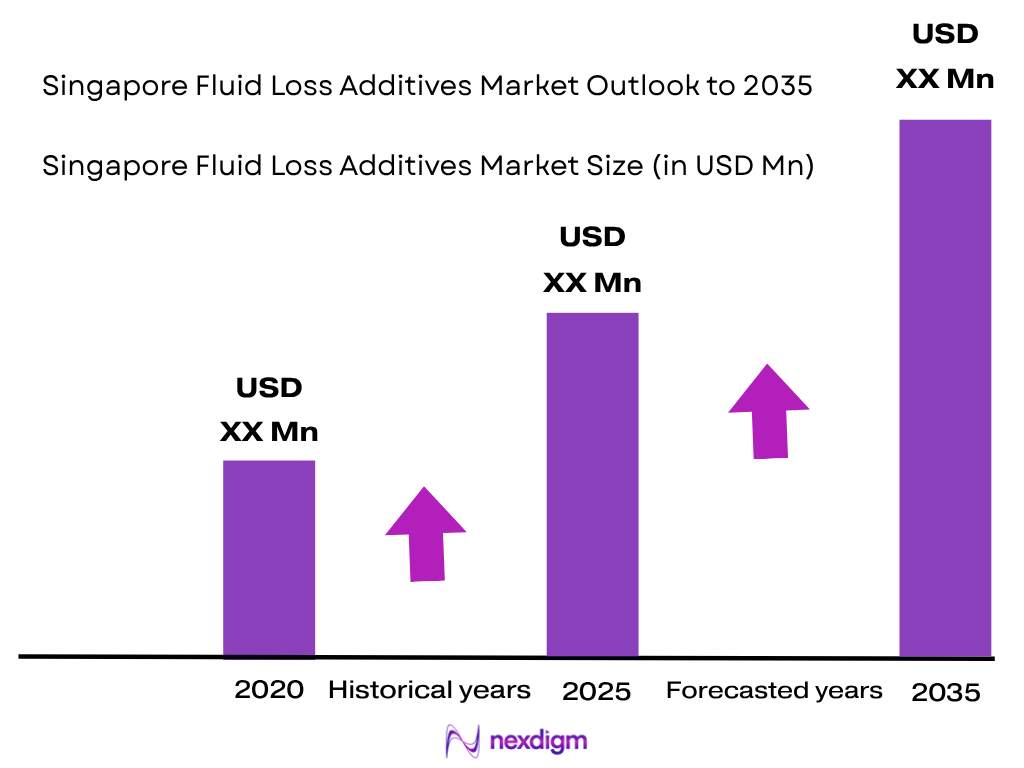
The Singapore Fluid Loss Additives Market is valued at approximately ~USD XX million, supported by Singapore’s role as an Asian specialty-chemicals and offshore-services hub rather than large domestic drilling activity. Nominal GDP increased from USD501.4 billion in the preceding annual period to USD547.5 billion in the latest period. Singapore’s energy and chemicals ecosystem has attracted more than S$60 billion of investment and supports over 27,000 skilled workers, strengthening regional oilfield chemical sourcing, formulation, storage and distribution.
Jurong Island and the wider western industrial corridor dominate Singapore Fluid Loss Additives activity because they concentrate chemical manufacturing, storage, blending, marine logistics and regional distribution infrastructure. Jurong Island hosts more than 100 chemical value-chain companies and has attracted over S$50 billion in investment. Singapore increasingly serves Malaysia, Indonesia, Brunei, Thailand and Vietnam, where offshore drilling creates end-use demand, while Singapore functions as the procurement, warehousing, technical-support and re-export hub for these operations.
Market Segmentation
By Product Chemistry
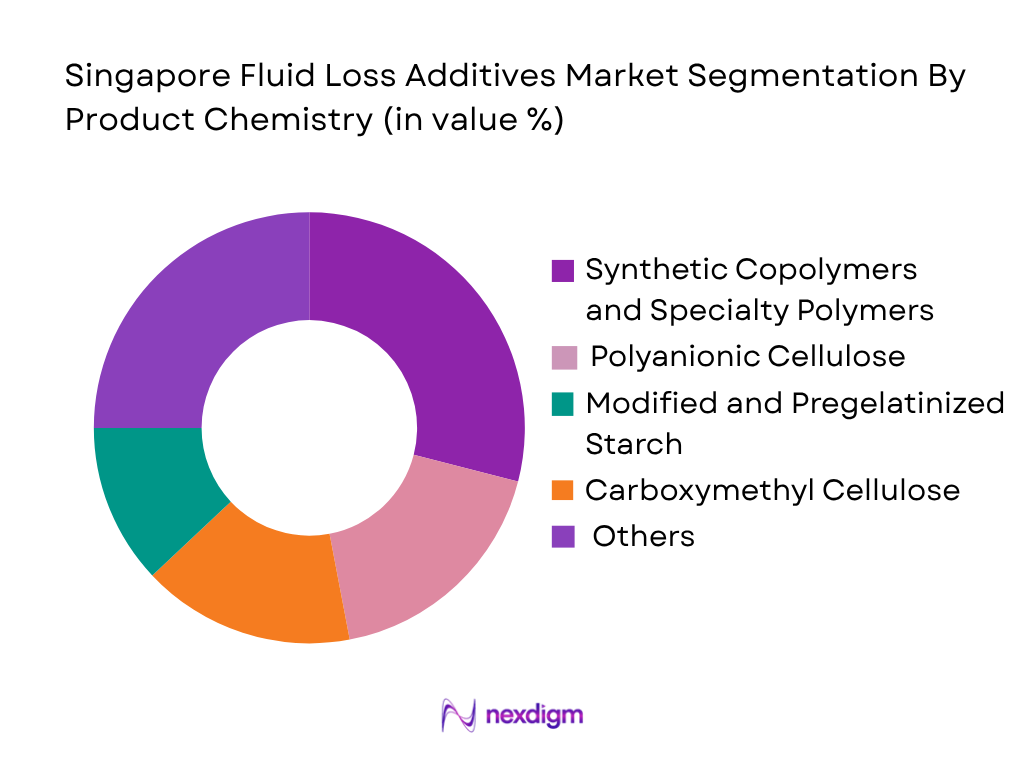
The Singapore Fluid Loss Additives Market is segmented into polyanionic cellulose, carboxymethyl cellulose, modified starch, synthetic copolymers, AMPS-based polymers, polyacrylates, lignite derivatives, latex systems and other specialty formulations. Synthetic polymers are considered the dominant value segment because Southeast Asian offshore wells increasingly require fluid-loss control under elevated temperature, salinity and pressure conditions that can exceed the performance range of conventional starch or cellulose products. Synthetic chemistries can be engineered for improved thermal stability, brine tolerance and compatibility with sophisticated water-based, reservoir drill-in and cement systems. Singapore’s importance as a regional chemical hub also favors higher-performance formulations because suppliers can import specialty polymer feedstocks, conduct formulation or blending, and distribute finished products to multiple offshore basins. Conventional PAC, CMC and starch products remain important in lower-temperature water-based systems due to their broad operational familiarity and filtration performance. However, HPHT and deepwater applications increasingly strengthen the position of synthetic copolymers and specialized temperature-resistant polymers in value terms.
By Fluid System
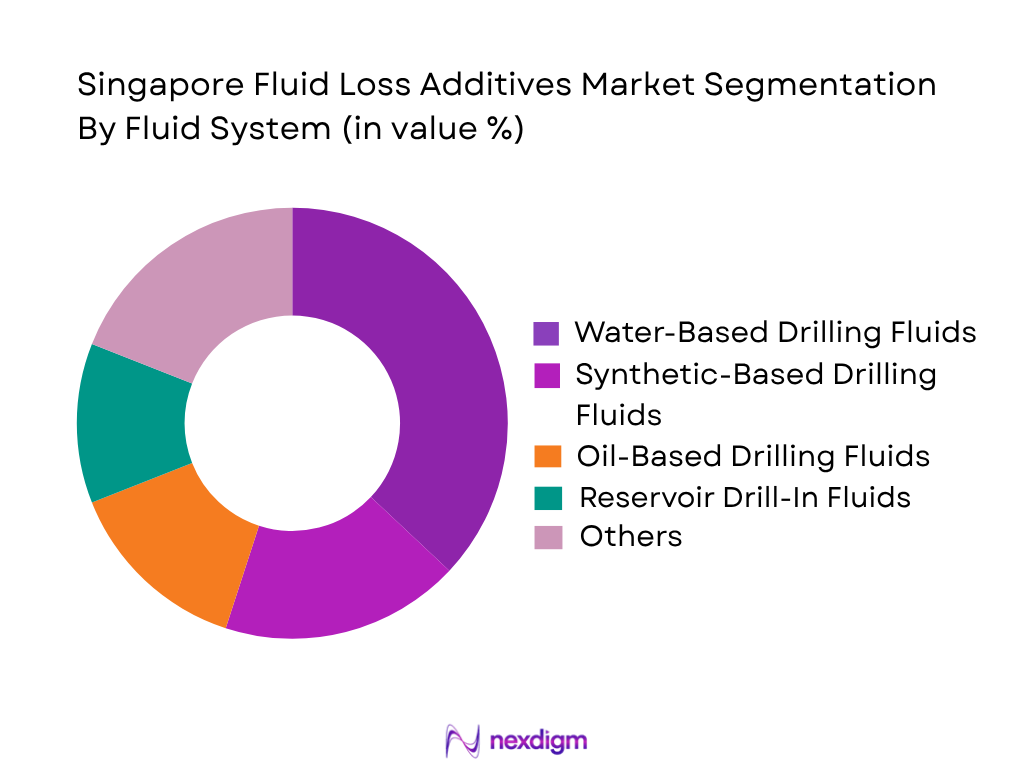
The Singapore Fluid Loss Additives Market is segmented by fluid system into water-based drilling fluids, oil-based fluids, synthetic-based systems, reservoir drill-in fluids, completion and workover fluids, and cement slurries. Water-based drilling fluids are considered the dominant segment because they are used across a broad range of conventional and offshore drilling applications and consume established filtration-control chemistries such as PAC, CMC, starch derivatives and synthetic polymers. Environmental considerations are also supporting development of high-performance water-based systems capable of replacing nonaqueous fluids in selected applications. Nevertheless, synthetic-based and reservoir drill-in systems represent strategically important segments because offshore operators increasingly encounter extended-reach, depleted reservoir and high-temperature conditions requiring tighter filtration control and improved formation protection. Halliburton and Newpark both market specialized reservoir and high-performance drilling-fluid technologies for complex well environments, demonstrating the growing technical sophistication of fluid systems. Singapore’s regional supply infrastructure enables these additives to be stocked, blended and dispatched to Southeast Asian offshore projects based on individual well requirements.
Competitive Landscape
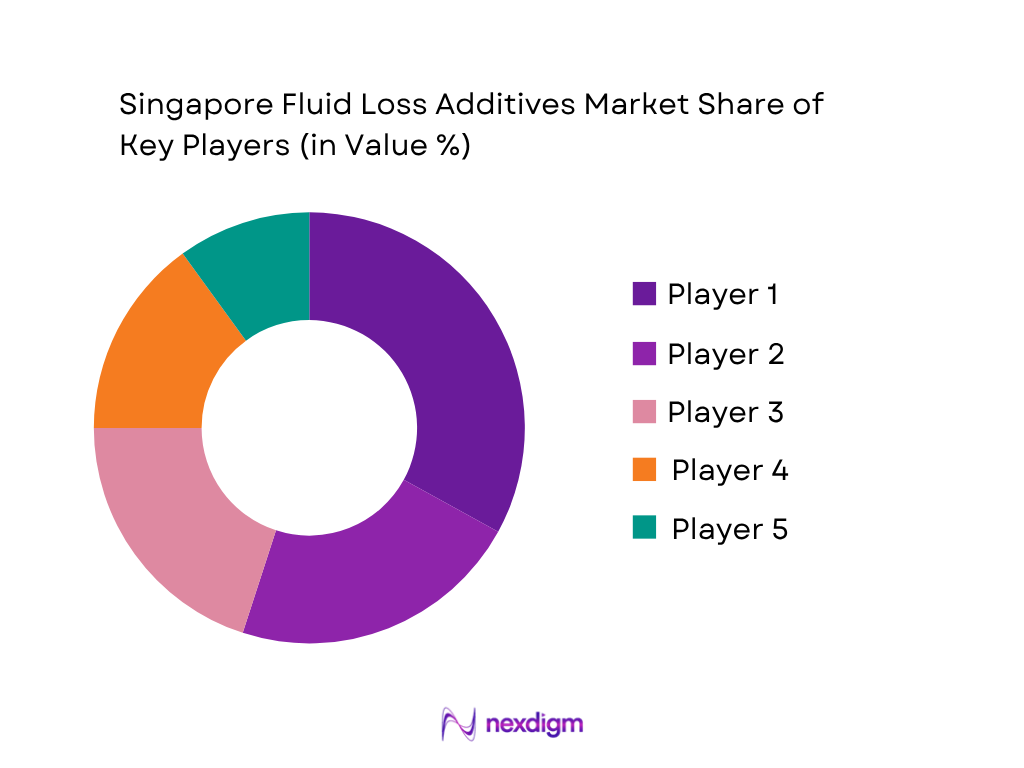
The Singapore Fluid Loss Additives Market is characterized by major international oilfield-service companies, independent drilling-fluid specialists and specialty-chemical manufacturers serving Southeast Asia through Singapore-based supply, technical and logistics infrastructure. Competition centres on HPHT performance, salt tolerance, reservoir compatibility, environmental profile, laboratory support and product availability. Singapore is particularly valuable as a regional supply base: Baker Hughes operates a 40,000-square-metre Jurong Island chemical facility capable of producing 55,000 metric tons annually, supported by 45 bulk tanks, 5 reactors and 3 blenders.
| Major Player | Establishment Year | Headquarters | Core Fluid-Loss Capability | Drilling Fluid Coverage | Cementing / Well Construction Capability | HPHT Capability | Asia-Pacific Supply Capability | Singapore / Regional Position |
| SLB / M-I SWACO | 1926 | Houston, USA | ~ | ~ | ~ | ~ | ~ | ~ |
| Halliburton / Baroid | 1919 | Houston, USA | ~ | ~ | ~ | ~ | ~ | ~ |
| Baker Hughes | 1907 roots | Houston, USA | ~ | ~ | ~ | ~ | ~ | ~ |
| Newpark Fluids Systems | 1932 roots | The Woodlands, USA | ~ | ~ | ~ | ~ | ~ | ~ |
| Nouryon | 2018 current identity | Amsterdam, Netherlands | ~ | ~ | ~ | ~ | ~ | ~ |
Singapore Fluid Loss Additives Market Analysis
Growth Drivers
Singapore’s Regional Energy and Chemicals Hub Strengthens Fluid Loss Additive Distribution
Singapore’s Fluid Loss Additives Market benefits from the country’s position as a major energy, chemicals, trading and offshore-services hub serving Southeast Asia rather than depending on domestic drilling activity. Jurong Island hosts more than 100 companies across the chemical production value chain and has attracted more than S$50 billion of investment, while Singapore’s wider energy and chemicals ecosystem has accumulated more than S$60 billion of investment and supports over 27,000 skilled workers. This infrastructure provides the storage, handling, formulation, blending, laboratory and logistics capabilities required for fluid-loss additives used in drilling, completion and cementing applications. Singapore’s total merchandise trade reached S$1.3 trillion in 2024, providing a strong platform for imports of specialty polymers and onward regional distribution. The macroeconomic backdrop also supports this hub role: Singapore’s nominal GDP reached USD547.5 billion in 2024, GDP per capita stood at USD90,689, the current-account balance reached USD96.0 billion, and gross official reserves totaled USD371.4 billion. For fluid-loss additive suppliers, these factors support inventory holding, regional re-export activity and technical-service functions for offshore projects in Malaysia, Indonesia, Brunei, Thailand and Vietnam.
High-Value Commodity and Chemical Trading Supports Regional Oilfield Chemical Flows
Singapore’s deep commodities and chemical-trading ecosystem is another important driver for the Fluid Loss Additives Market because specialty drilling chemicals frequently move through global trading, storage and redistribution networks before reaching regional offshore operations. International commodity trades conducted through Singapore reached approximately USD1.9 trillion in 2024, demonstrating the scale of the country’s commodity intermediation capability. Total merchandise trade reached S$1.3 trillion, while total services trade amounted to S$998 billion, supporting financing, logistics, marine transport, insurance and technical services associated with oilfield chemical supply. Singapore’s energy and chemicals industry also employs more than 27,000 skilled workers, providing a technical base for specialty chemical handling, process operations and offshore-support activities. Macroeconomic indicators reinforce the ability of Singapore to maintain this regional supply role: nominal GDP reached USD547.5 billion in 2024, gross official reserves stood at USD371.4 billion, and the current-account balance was USD96.0 billion. These conditions are directly relevant to fluid-loss additives because PAC, CMC, starch derivatives, AMPS polymers and other filtration-control chemicals often depend on international feedstocks and regional redistribution. Singapore’s trading and logistics infrastructure therefore supports reliable procurement, stock management and cross-border delivery for Southeast Asian drilling-fluid and cementing operations.
Market Challenges
Limited Domestic Upstream Activity Creates Dependence on Regional Offshore Demand
A structural challenge for the Singapore Fluid Loss Additives Market is the country’s limited domestic hydrocarbon production, which means demand depends heavily on offshore drilling, completion and intervention activity elsewhere in Southeast Asia. Singapore has no large domestic upstream drilling base comparable with Indonesia, Malaysia or Brunei, so fluid-loss additive suppliers must serve regional wells through distribution, blending and logistics rather than relying on local well consumption. Jurong Island’s more than 100 chemical companies and over S$50 billion of accumulated investment provide strong infrastructure, but utilization of oilfield-specific inventory ultimately depends on external drilling campaigns and operator procurement cycles. Singapore’s macroeconomic position is strong, with nominal GDP of USD547.5 billion in 2024, GDP per capita of USD90,689, a current-account balance of USD96.0 billion, and gross official reserves of USD371.4 billion, yet these figures do not eliminate market exposure to regional exploration activity. For suppliers, dependence on external markets creates challenges in forecasting consumption of PAC, CMC, modified starch, synthetic copolymers and cementing fluid-loss reducers. Inventory planning is particularly complex because well conditions vary considerably across Southeast Asia, requiring different additive chemistries for temperature, pressure, salinity, reservoir sensitivity and fluid-system compatibility.
Imported Feedstock Dependence and Global Supply-Chain Exposure
Singapore’s Fluid Loss Additives Market is highly exposed to international feedstock and specialty-chemical supply chains because many cellulose derivatives, synthetic monomers, polymer intermediates and formulation components are imported before being blended, stocked or re-exported. Total merchandise trade reached S$1.3 trillion in 2024, reflecting the scale of Singapore’s external dependence as a trading economy. This trade intensity supports the market but also exposes fluid-loss additive suppliers to shipping disruptions, upstream plant outages and changes in availability of specialist polymers required for high-temperature and brine-resistant formulations. Singapore’s chemicals ecosystem has attracted more than S$60 billion of investment and employs over 27,000 skilled workers, yet local infrastructure cannot fully insulate suppliers from shortages originating in overseas polymer or chemical plants. Macroeconomic indicators illustrate the country’s strong external buffer, with nominal GDP of USD547.5 billion, a current-account surplus of USD96.0 billion, and gross official reserves of USD371.4 billion in 2024. Nevertheless, fluid-loss additives must often meet precise API, HPHT, salinity and compatibility specifications, limiting the ability to substitute unavailable raw materials quickly. Suppliers therefore require multi-source procurement, local safety stock, flexible formulations and strong warehousing capabilities to protect regional offshore customers from supply interruptions.
Market Opportunities
High-Performance and HPHT Fluid Loss Additives Offer Future Growth Potential
Singapore is well positioned to capture future demand for high-performance fluid-loss additives as Southeast Asian offshore wells become more technically demanding and require stronger filtration control, thermal stability and brine tolerance. Jurong Island already provides a dense chemical ecosystem with more than 100 companies and over S$50 billion in accumulated investment, while Singapore’s broader energy and chemicals sector has attracted over S$60 billion and employs more than 27,000 skilled workers. This infrastructure gives suppliers the capability to stock, formulate, test and distribute AMPS-based polymers, synthetic copolymers, specialty PAC grades and other advanced additives used in high-temperature or high-salinity drilling systems. Singapore’s macroeconomic strength supports investment in technical capabilities, with nominal GDP of USD547.5 billion in 2024, GDP per capita of USD90,689, current-account receipts resulting in a USD96.0 billion surplus, and gross official reserves of USD371.4 billion. These current indicators support future expansion in laboratory services, application engineering and regional inventories rather than providing future forecasts themselves. As offshore operators increasingly encounter extended-reach, deepwater and depleted-reservoir conditions, Singapore-based suppliers can differentiate through HPHT filtration testing, brine-compatibility screening, customized formulations and technical support for complex well programs across Southeast Asia.
Regional Re-Export, Blending and Specialty Chemical Logistics Can Expand Further
Singapore has a clear future opportunity to strengthen its role as a regional fluid-loss additive blending, warehousing and re-export hub for Southeast Asian drilling markets. Total merchandise trade reached S$1.3 trillion in 2024, while total services trade reached S$998 billion, creating a strong logistics, shipping, finance and trade-services platform for specialty oilfield chemicals. Re-export activity remains a central part of Singapore’s trading model, enabling imported polymer feedstocks and finished additives to be redistributed efficiently to Malaysia, Indonesia, Brunei, Thailand, Vietnam and other offshore markets. The country also hosts more than 100 companies across the Jurong Island chemical value chain, with over S$50 billion invested in the cluster, providing storage terminals, process infrastructure and specialist chemical-handling capabilities. Macroeconomic fundamentals further support expansion of this regional role: Singapore’s nominal GDP reached USD547.5 billion in 2024, gross official reserves were USD371.4 billion, and the current-account balance stood at USD96.0 billion. These conditions create future scope for dedicated oilfield additive warehouses, toll blending, customized packaging, laboratory qualification and rapid offshore dispatch. Suppliers that establish larger regional inventories in Singapore can reduce delivery lead times and support operators requiring project-specific fluid-loss chemistries for drilling, reservoir drill-in, cementing and workover applications.
Future Outlook
The Singapore Fluid Loss Additives Market is projected to expand at approximately ~X.X% CAGR during 2026-2035, with growth increasingly tied to Southeast Asian offshore drilling rather than domestic hydrocarbon production. Singapore is expected to retain an important role as a regional formulation, storage, technical-support and re-export centre for specialty drilling and cementing chemicals. Regional deepwater and technically complex wells will support increasing demand for high-temperature synthetic polymers, salt-tolerant additives and reservoir-friendly filtration-control systems. Complex wells require fluid systems capable of maintaining filtration performance while exposed to elevated temperature, pressure and contaminant concentrations.
Singapore’s established chemical ecosystem gives suppliers a structural advantage in serving this demand. More than 100 global chemical companies operate in the country, while the energy and chemicals sector supports over 27,000 skilled workers and more than S$60 billion of accumulated investment. This infrastructure supports chemical sourcing, formulation, testing, packaging, storage and regional logistics.
Major Players
- SLB / M-I SWACO
- Halliburton / Baroid
- Baker Hughes
- Clariant Oil Services
- Newpark Fluids Systems
- ChampionX
- Nouryon
- BASF
- Solvay
- Dow
- SNF
- Kemira
- Third Wave Group
- TRIKO Solutions
- Cramoil Singapore
Key Target Audience
- Fluid Loss Additive and Oilfield Specialty Chemical Manufacturers
- Drilling Fluid and Well Cementing Service Companies
- Specialty Chemical Importers, Distributors and Blenders
- Oil and Gas Operators and Offshore Well Developers
- Offshore Drilling Contractors and Well Construction Companies
- Investments and Venture Capitalist Firms
- Government and Regulatory Bodies (Singapore Economic Development Board, Enterprise Singapore, National Environment Agency, Singapore Customs, Ministry of Manpower, Maritime and Port Authority of Singapore)
- Marine Logistics, Chemical Warehousing and Regional Re-Export Companies
Research Methodology
Step 1: Identification of Key Variables
The initial phase involves constructing an ecosystem map of the Singapore Fluid Loss Additives Market covering specialty-chemical manufacturers, polymer suppliers, oilfield-service companies, drilling-fluid providers, distributors, chemical blenders, storage operators and offshore logistics companies. Desk research is used to identify relevant product chemistries, fluid systems, regional drilling activity, Singapore supply infrastructure and re-export channels. Critical variables include consumption volume, product mix, application intensity, additive dosage and regional supply exposure.
Step 2: Market Analysis and Construction
Historical demand is assessed across drilling fluids, reservoir drill-in fluids, completion fluids and cementing applications. A top-down approach evaluates Singapore’s specialty-chemical trade, regional offshore activity and oilfield-service footprint, while bottom-up analysis examines supplier revenues, import volumes, product shipments, regional inventories and project-level chemical demand. Singapore-originating consumption and ASEAN-directed re-export activity are separated to avoid overstating purely domestic end-use demand.
Step 3: Hypothesis Validation and Expert Consultation
Market assumptions are validated through structured discussions and computer-assisted telephone interviews with oilfield chemical suppliers, drilling-fluid companies, distributors, offshore service companies and technical specialists. Interviews test product dosage, procurement routes, chemistry preference, HPHT requirements, supply lead times and customer qualification procedures. Particular attention is given to distinguishing commodity filtration-control products from specialized high-temperature and reservoir-protection formulations.
Step 4: Research Synthesis and Final Output
The final phase triangulates supplier-side data with Singapore trade flows, regional offshore project activity, product portfolios and primary interviews. Fluid-loss additive demand is reconciled across water-based drilling fluids, nonaqueous systems, reservoir fluids and cementing applications. Forecast assumptions incorporate Southeast Asian offshore development, well complexity, environmental requirements, Singapore’s logistics position, specialty-polymer innovation and regional re-export activity to establish the final Singapore Fluid Loss Additives Market outlook.

- Executive Summary
- Research Methodology (Market Definitions and Assumptions, Fluid Loss Additives Market Boundary, Drilling Fluid and Cementing Additive Classification, Consumption Volume Assessment, Offshore Application Mapping, Water-Based Mud Assessment, Oil-Based Mud Assessment, Synthetic-Based Mud Assessment, Reservoir Drill-In Fluid Assessment, Cement Slurry Additive Assessment, Polymer Chemistry Assessment, Polyanionic Cellulose Assessment, Carboxymethyl Cellulose Assessment, Modified Starch Assessment, Synthetic Polymer Assessment, AMPS-Based Polymer Assessment, Lignite and Humate Assessment, Latex-Based Additive Assessment, API Fluid Loss Testing Assessment, HPHT Filtration Assessment, Filter Cake Quality Assessment, Thermal Stability Assessment, Salt and Brine Compatibility Assessment, Formation Damage Assessment, Regional Re-Export Assessment, Offshore Drilling Activity Assessment, Top-Down Market Sizing, Bottom-Up Market Sizing, Demand-Side Assessment, Supply-Side Assessment, Distributor and Blender Mapping, Primary Industry Interviews, Regional Offshore Project Pipeline Assessment, Data Triangulation, Forecasting Framework)

- Definition and Scope
- Evolution of Fluid Loss Control Technologies in Singapore, Development from Conventional Cellulose and Starch-Based Additives to Synthetic High-Temperature Polymers, Evolution of Water-Based and Nonaqueous Fluid Loss Control Systems, Singapore Fluid Loss Additives Industry Value Chain, Oilfield Chemical Supply Chain, Regional Offshore Chemical Ecosystem Mapping
- Polymer Feedstock Suppliers, Cellulose Derivative Producers, Starch Derivative Suppliers, Synthetic Polymer Manufacturers, Specialty Chemical Producers, Fluid Loss Additive Formulators, Chemical Blenders, Oilfield Chemical Distributors, Bulk Chemical Storage Operators, Drum and IBC Packaging Providers, Offshore Logistics Providers, Drilling Fluid Service Companies, Cementing Service Companies, Well Construction Contractors, Offshore Drilling Contractors, Oil and Gas Operators, Testing Laboratories, Waste Management Providers, Marine Supply Companies

- Growth Drivers (Southeast Asian Offshore Drilling Activity, Deepwater Well Development, High-Pressure High-Temperature Drilling Requirements, Extended-Reach Wells, Singapore Regional Oilfield Service Hub Position, Offshore Chemical Logistics, Formation Damage Control Requirements, High-Performance Water-Based Mud Adoption, Mature Field Workovers, Regional Re-Export Demand)
- Market Challenges (Limited Domestic Upstream Drilling, Dependence on Regional Exploration Budgets, Imported Polymer Dependency, Feedstock Price Volatility, Stringent Offshore Environmental Requirements, Product Qualification Timelines, Oilfield Service Company Procurement Concentration, Inventory Management, Specialty Chemical Lead Times, Technical Substitution Risk)
- Market Opportunities (High-Temperature Polymer Additives, Environmentally Preferred Fluid Loss Reducers, Southeast Asia Deepwater Projects, Reservoir Drill-In Fluid Additives, Low-Dosage High-Efficiency Polymers, Offshore Cementing Additives, Custom Chemical Blending, Regional Warehousing and Re-Export, Mature Field Intervention Fluids, Digital Fluid Performance Optimization)
- Market Trends (High-Temperature Synthetic Polymers, Low-Toxicity Additives, Salt-Tolerant Polymers, Biodegradable Fluid Loss Reducers, High-Performance Water-Based Fluids, Reservoir-Friendly Drill-In Fluids, Customized Polymer Blends, Reduced Additive Dosage, HPHT Testing, Regional Supply Consolidation, Sustainable Packaging)
- Government Regulations and Standards (Singapore Workplace Safety and Health Requirements, National Environment Agency Chemical Management Requirements, Maritime Dangerous Goods Handling Requirements, Singapore Customs Chemical Import Requirements, Globally Harmonised System Classification, Offshore Chemical Documentation, Hazardous Substance Storage Requirements, Waste Chemical Management Requirements)
- SWOT Analysis
- Porter’s Five Forces Analysis
- PESTLE Analysis
- Stakeholder Ecosystem
- Oilfield Chemical and Offshore Supply Ecosystem

- By Market Value (2020-2025)
- By Consumption Volume (2020-2025)
- By Drilling Fluid Fluid Loss Additive Volume (2020-2025)
- By Cementing Fluid Loss Additive Volume (2020-2025)
- By Completion and Workover Fluid Loss Additive Volume (2020-2025)
- By Water-Based Fluid Additive Volume (2020-2025)
- By Oil-Based and Synthetic-Based Fluid Additive Volume (2020-2025)
- By Polymer-Based Fluid Loss Additive Volume (2020-2025)
- By Cellulose and Starch-Based Additive Volume (2020-2025)
- By High-Temperature Fluid Loss Additive Volume (2020-2025)
- By Offshore Application Demand (2020-2025)
- By Regional Re-Export Volume (2020-2025)

- By Product Chemistry (In Value %)
Polyanionic Cellulose
Carboxymethyl Cellulose
Modified Starch
Pregelatinized Starch
Synthetic Copolymers
Acrylamide-Based Polymers
AMPS-Based Polymers
Polyacrylate Fluid Loss Additives
Lignite and Modified Lignite
Humate-Based Additives
Latex-Based Fluid Loss Additives
Asphaltic and Gilsonite-Based Additives
Resin-Based Additives
Specialty High-Temperature Polymers
Biodegradable and Low-Toxicity Polymers - By Fluid System (In Value %)
Water-Based Drilling Fluids
Freshwater Mud Systems
Saltwater Mud Systems
Seawater Mud Systems
KCl Polymer Systems
High-Performance Water-Based Mud
Oil-Based Drilling Fluids
Invert Emulsion Systems
Synthetic-Based Drilling Fluids
Reservoir Drill-In Fluids
Completion and Workover Fluids
Cement Slurries - By Application (In Value %)
Drilling Fluid Filtration Control
Reservoir Drill-In Fluid Filtration Control
Completion Fluid Loss Control
Cement Slurry Fluid Loss Control
Wellbore Strengthening Support
Filter Cake Formation
Formation Damage Reduction
High-Temperature Filtration Control
Deepwater Well Construction
Extended-Reach Drilling
Workover and Intervention Operations
Offshore Plug and Abandonment Operations - By Well Environment (In Value %)
Conventional Offshore Wells
Deepwater Wells
High-Pressure High-Temperature Wells
Extended-Reach Wells
High-Angle Wells
Depleted Reservoir Wells
High-Salinity Wells
Reactive Shale Formations
Permeable Sandstone Reservoirs
Carbonate Reservoirs
Mature Field Workovers - By Performance Grade (In Value %)
Standard Temperature Fluid Loss Additives
Medium-Temperature Fluid Loss Additives
High-Temperature Fluid Loss Additives
Ultra-High-Temperature Fluid Loss Additives
High-Salinity Compatible Additives
Calcium-Tolerant Additives
Low-Dosage High-Efficiency Additives
Environmentally Preferred Additives - By End-Use Service (In Value %)
Drilling Fluids
Well Cementing
Completion Fluids
Workover Fluids
Well Intervention
Reservoir Drill-In Fluids
Offshore Well Construction
Plug and Abandonment - By Region Served (In Value %)
Singapore Domestic Offshore Services
Malaysia
Indonesia
Brunei
Thailand
Vietnam
Myanmar
Australia
Other Southeast Asian Offshore Markets

- Market Share of Major Players (By Singapore Revenue, Fluid Loss Additive Sales, Drilling Fluid Portfolio, Cementing Additive Portfolio, Water-Based Fluid Product Capability, Oil-Based and Synthetic-Based Fluid Capability, HPHT Product Capability, Regional Distribution Coverage, Southeast Asia Offshore Project Exposure, Singapore Inventory Availability, Chemical Blending Capability, Technical Laboratory Support, Field Service Capability, Environmental Product Portfolio)
- Cross Comparison Parameters (Fluid Loss Additive Chemistry Portfolio Breadth, HPHT Filtration Control Capability, Water-Based and Nonaqueous Fluid Compatibility, Salt and Brine Tolerance, Southeast Asia Offshore Project References, Singapore Stocking and Logistics Capability, Technical Laboratory and Field Support, Environmental and HSE Product Credentials)
- SWOT Analysis of Major Players
- Competitive Positioning Matrix
- Major Companies
SLB / M-I SWACO
Halliburton / Baroid
Baker Hughes
Clariant Oil Services
Newpark Fluids Systems
ChampionX
Nouryon
BASF
Solvay
Dow
SNF
Kemira
Third Wave Group
TRIKO Solutions
Cramoil Singapore

- Drilling Fluid Service Company Requirement Assessment
- Cementing Service Company Requirement Assessment
- Oil and Gas Operator Procurement Assessment
- Offshore Drilling Contractor Requirement Assessment
- Regional Distributor Requirement Assessment
- Chemical Blender Requirement Assessment
- Marine Logistics Provider Requirement Assessment
- Reservoir Drill-In Fluid Requirement Assessment
- Deepwater Well Fluid Requirement Assessment
- High-Pressure High-Temperature Well Fluid Requirement Assessment
- Completion and Workover Fluid Requirement Assessment
- Mature Field Intervention Requirement Assessment
- Salt and Brine Compatibility Requirement Assessment
- Environmental and HSE Requirement Assessment

- By Market Value (2026-2035)
- By Consumption Volume (2026-2035)
- By Drilling Fluid Fluid Loss Additive Volume (2026-2035)
- By Cementing Fluid Loss Additive Volume (2026-2035)
- By Completion and Workover Fluid Loss Additive Volume (2026-2035)
- By Water-Based Fluid Additive Volume (2026-2035)
- By Oil-Based and Synthetic-Based Fluid Additive Volume (2026-2035)
- By Polymer-Based Fluid Loss Additive Volume (2026-2035)
- By Cellulose and Starch-Based Additive Volume (2026-2035)
- By High-Temperature Fluid Loss Additive Volume (2026-2035)
- By Offshore Application Demand (2026-2035)
- By Regional Re-Export Volume (2026-2035)


 Request a Sample
 Ask for Customization
 Get a Quote
 Enquire Now