
 Download PDF
Market Overview
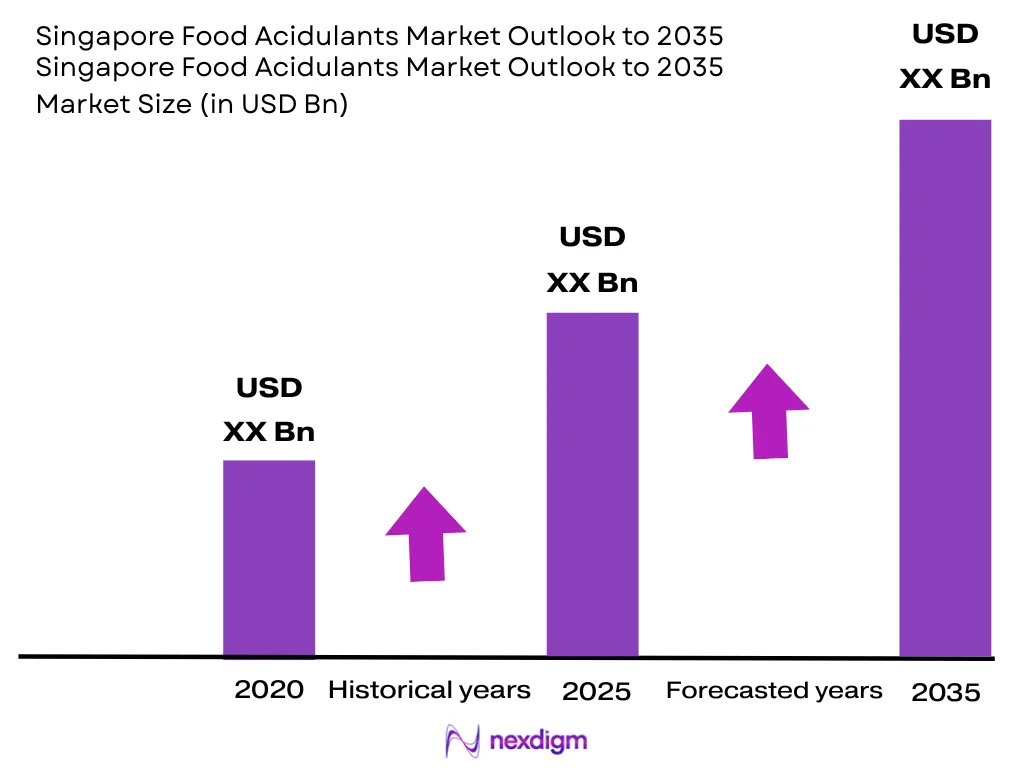
The Singapore food acidulants market was valued at approximately USD 44.62 million in 2024 and is projected to reach USD 63.84 million by 2032, growing at a CAGR of 6.49% during the forecast period. Despite its compact geographic scale, Singapore represents one of Southeast Asia’s most strategically significant food acidulants markets, functioning simultaneously as a domestic consumption centre, a regional food processing hub, and a major re-export gateway for food ingredients across ASEAN. According to the Singapore Food Agency (SFA), Singapore imports more than 90% of its food supply, with food ingredients including acidulants sourced from a diverse network of suppliers across China, Europe, Australia, and ASEAN. The SFA regulates the use of food additives, including acidulants, under Singapore’s Food Regulations, aligned with international Codex Alimentarius standards, creating a rigorous compliance environment that governs procurement, labeling, and application across the domestic food manufacturing and foodservice sectors. Growth is driven by the expansion of Singapore’s food processing industry under the government’s 30 by 30 food production goal, a highly active HoReCa and foodservice sector, rising demand for functional and halal-certified food ingredients, and Singapore’s growing position as a regional food innovation and alternative protein development hub.
Market Segmentation
By Acidulant Type
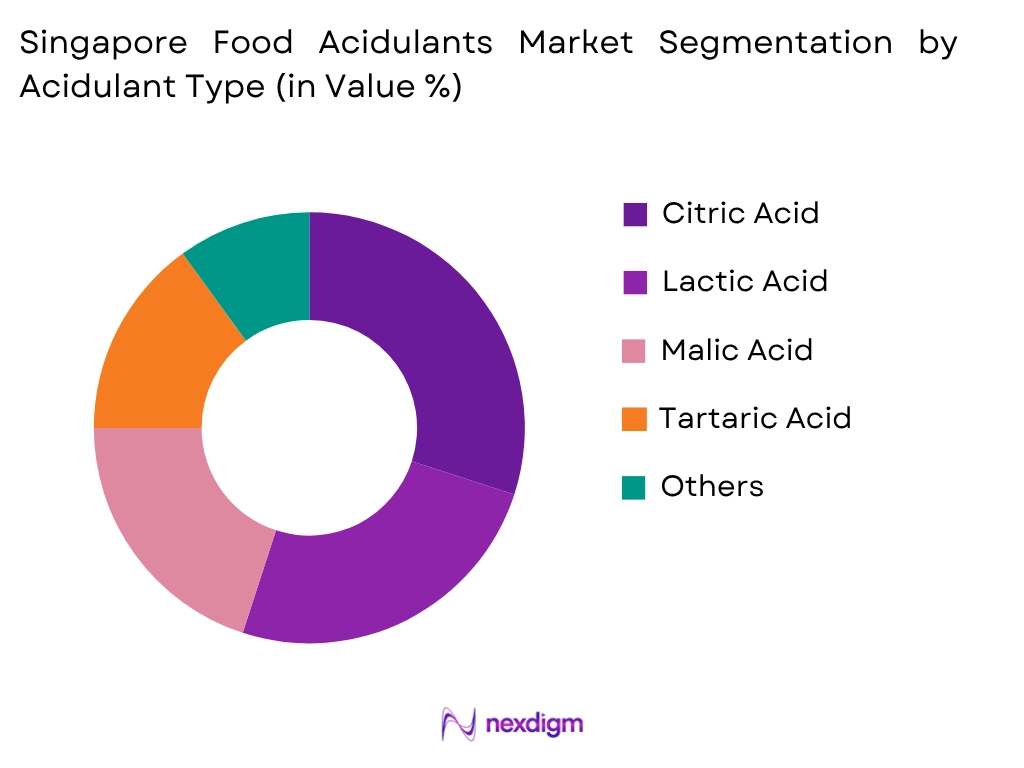
Citric acid dominates the Singapore food acidulants market, accounting for the largest revenue share with a market value of approximately USD 27.16 million in 2024, and is projected to deliver the fastest growth at a CAGR of 7.01% during the forecast period. Citric acid’s dominance reflects its exceptional versatility across Singapore’s diverse food and beverage manufacturing base, including its extensive use in carbonated and functional beverages, fruit juices, confectionery, dairy products, processed sauces and condiments, and bakery items. Its natural origin, GRAS status, and compatibility with halal certification make it the preferred acidulant for Singapore’s large halal food manufacturing sector, which supplies both domestic and regional export markets. Singapore’s role as a significant re-export centre for food ingredients further amplifies import volumes of citric acid, with a substantial proportion of inbound supply redirected to food manufacturers across Malaysia, Indonesia, Thailand, and Vietnam. Lactic acid represents the second major segment, used in fermented dairy products, plant-based food formulations, and processed meat and seafood applications, and is gaining growing commercial traction in Singapore’s expanding alternative protein and precision fermentation food technology sectors. Malic acid, tartaric acid, and fumaric acid serve specialized applications in functional beverages, confectionery, and craft food products, with demand growing in line with Singapore’s premiumization trend and expanding functional beverage market.
By End User
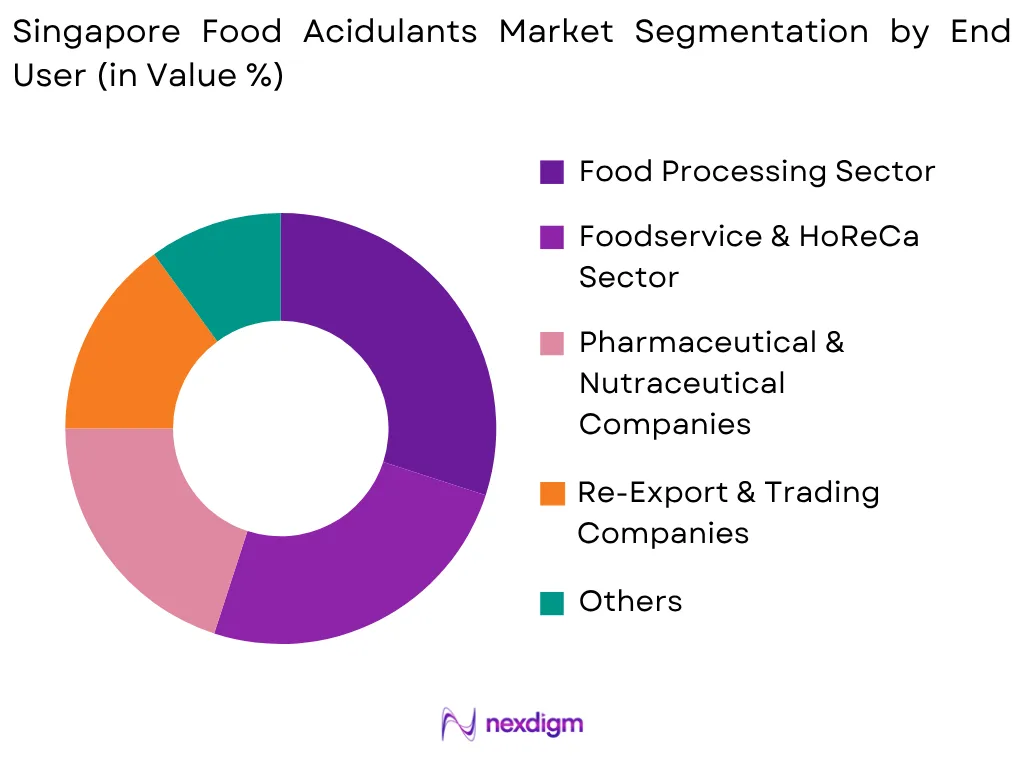
The food processing sector represents the largest end-user segment in the Singapore food acidulants market, accounting for approximately USD 37.53 million in 2024 and projected to grow at a CAGR of 6.63% during the forecast period. Singapore hosts a well-developed food processing industry spanning beverage manufacturing, dairy and frozen food production, processed meat and seafood, bakery and confectionery, and halal food manufacturing for both domestic consumption and ASEAN export. Major multinational food companies including Nestlé, Unilever, and F&N Coca-Cola maintain manufacturing operations in Singapore, generating consistent industrial demand for food-grade acidulants across multiple categories. The foodservice and HoReCa sector represents the second major end-user segment, driven by Singapore’s thriving restaurant, hotel, catering, and institutional dining market, which generates strong demand for acidulants used in food preparation, sauce production, and beverage formulation. Singapore’s vibrant hawker culture and the continued expansion of quick-service restaurants, cloud kitchens, and premium dining establishments create sustained demand across the foodservice distribution channel. Re-export and trading companies represent a further significant end-user category, leveraging Singapore’s strategic port infrastructure, sophisticated logistics networks, and trusted regulatory standing to redistribute imported food-grade acidulants across the wider ASEAN region.
Competitive Landscape
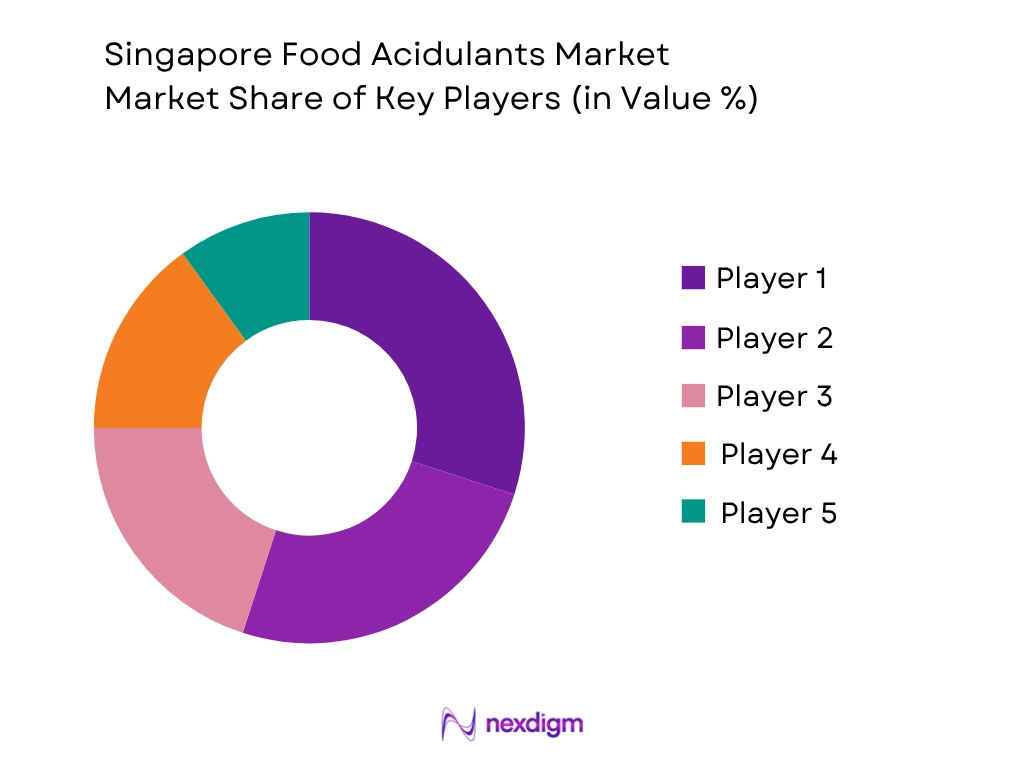
The Singapore food acidulants market is characterized by the predominance of specialty ingredient distributors and trading companies, as Singapore does not maintain significant domestic acidulant production capacity and relies almost entirely on imported product. Global ingredient distribution companies including Brenntag, Univar Solutions, Hawkins Watts, DKSH, and Foodchem International are the primary market participants, sourcing acidulants from international manufacturers and distributing them to Singapore’s food processing, foodservice, pharmaceutical, and re-export sectors. These distributors compete on the breadth of their acidulant portfolios, SFA regulatory compliance expertise, halal certification capabilities, warehousing and cold chain infrastructure, and technical application support services for food and beverage manufacturers. Multinational ingredient producers including Cargill, Tate & Lyle, ADM, Corbion, and Kerry also maintain direct sales and representative presences in Singapore, serving major food manufacturing accounts and leveraging the country’s status as a regional headquarters base.
| Company | Establishment Year | Headquarters | Primary Acidulant Portfolio | Key Application Industries
|
Manufacturing Presence | R&D Capability | Distribution Network | Clean Label Solutions |
| Univar Solutions Singapore | 1924 | ~ | ~ | ~ | ~ | ~ | ~ | ~ |
| Hawkins Watts Singapore | 1945 | ~ | ~ | ~ | ~ | ~ | ~ | ~ |
| Foodchem International Singapore | 2006 | ~ | ~ | ~ | ~ | ~ | ~ | ~ |
| DKSH Singapore | 1865 | ~ | ~ | ~ | ~ | ~ | ~ | ~ |
| Brenntag Singapore | 1874 | ~ | ~ | ~ | ~ | ~ | ~ | ~ |
Singapore Food Acidulants Market Analysis
Growth Drivers
Singapore’s Food Processing Expansion and the 30 by 30 Initiative
The Singapore government’s commitment to strengthening domestic food production and food security represents one of the most significant structural growth drivers for the food acidulants market. The Singapore Food Agency (SFA) has established the national 30 by 30 goal, targeting the local production of 30% of Singapore’s nutritional needs by 2030, with food processing, aquaculture, controlled-environment farming, and alternative protein development forming the core pillars of this strategic initiative. According to Enterprise Singapore, the food manufacturing sector contributed approximately SGD 4.3 billion in output value, making it one of Singapore’s most significant manufacturing industries. The SFA’s Agri-Food Cluster Transformation (ACT) Fund and the Singapore Food Story Research and Development Programme have channelled substantial investment into food innovation, processing technology upgrades, and novel food category development across Singapore’s manufacturing base. Expansion of food processing operations directly increases industrial demand for food-grade acidulants used as pH regulators, preservatives, flavor enhancers, and functional ingredients across beverages, dairy, bakery, meat, and convenience food categories. Furthermore, Singapore’s ambition to become a global food innovation hub has attracted major multinational food companies and food technology start-ups to establish processing, research, and regional headquarters operations in the country, further amplifying ingredient demand. According to the Department of Statistics Singapore (SingStat), Singapore’s manufactured food exports continue to grow in value, reflecting the expanding output of a domestic food processing industry that depends on consistent, high-quality acidulant supply.
Singapore as a Regional Food Ingredient Trading and Re-Export Hub
Singapore’s strategic geographic position, world-class port infrastructure, sophisticated logistics networks, and highly trusted regulatory environment make it one of Asia’s most important food ingredient trading and re-export hubs, generating significant import and re-distribution volumes of food acidulants beyond what domestic consumption alone would require. According to Enterprise Singapore, Singapore is a leading global trading hub with merchandise trade totalling more than SGD 1 trillion annually, providing an extensive commercial infrastructure for the importation, warehousing, and regional redistribution of food ingredients including citric acid, lactic acid, malic acid, and phosphoric acid. Singapore’s port, ranked consistently among the world’s top container ports by throughput, provides efficient access to global acidulant supply chains from China, Europe, Australia, and the Americas, enabling distributors to maintain competitive sourcing costs and reliable supply continuity. The country’s well-established free trade agreements, including those with ASEAN member states, Australia, the United States, and the European Union, facilitate cost-effective cross-border food ingredient trade and reduce tariff barriers for imported acidulant products. Food ingredient distributors operating in Singapore leverage these advantages to supply food manufacturers across Malaysia, Indonesia, Thailand, Vietnam, and the Philippines from Singapore-based warehousing and distribution centres. This re-export function significantly expands the effective addressable market for food acidulants transiting through Singapore beyond the country’s immediate domestic processing requirements.
Market Challenges
Near-Total Import Dependency and Supply Chain Vulnerability
Singapore’s near-complete dependence on imported food acidulants represents a fundamental structural challenge for the market, exposing domestic food manufacturers and ingredient distributors to global supply chain disruptions, shipping delays, and international commodity price volatility. Unlike larger food-producing economies such as Brazil, the USA, or China, Singapore maintains no significant domestic acidulant manufacturing capacity, relying entirely on imported citric acid, lactic acid, malic acid, phosphoric acid, and other acidulant types sourced from producers in China, Europe, and other international supply origins. According to the SFA, Singapore imports food ingredients from more than 170 countries and regions, reflecting the scale and diversity of its import dependency. Supply disruptions arising from geopolitical tensions, port congestion, shipping cost spikes, or production constraints at major acidulant manufacturing facilities in China or Europe can rapidly affect ingredient availability and pricing for Singapore-based food processors. Chinese citric acid producers dominate global supply, meaning any disruption to Chinese export capacity or changes in Chinese domestic agricultural feedstock pricing can materially affect the cost and availability of citric acid in the Singapore market. The COVID-19 pandemic illustrated the acute vulnerability of Singapore’s ingredient supply chains, with shipping delays and container shortages increasing lead times and logistics costs for food ingredient importers. Distributors and food manufacturers must therefore maintain diversified supplier networks, strategic inventory buffers, and long-term supply agreements to manage Singapore’s structural import dependency risks.
SFA Regulatory Compliance and Permitted Additives Management
Singapore’s rigorous food additive regulatory framework, administered by the Singapore Food Agency under the Food Regulations, creates ongoing compliance obligations for acidulant importers, distributors, and food manufacturers operating in the domestic market. The SFA maintains a comprehensive Permitted Food Additives List that specifies approved acidulants, allowable concentration levels, and the food categories in which each additive may be used, aligned with international Codex Alimentarius Commission standards. According to SFA guidance documentation, food businesses are required to regularly verify that all additives used comply with the Permitted Additives List, maintain accurate records of all additives used including their sources and concentrations for audit purposes, and submit formal applications to SFA supported by scientific safety evidence for any additive not currently listed. The SFA’s risk-based import inspection approach, including periodic hold-and-test procedures for incoming food ingredient consignments, adds operational complexity and potential delays to the acidulant supply chain for Singapore-based distributors and their food manufacturing customers. The TradeNet permit system requires importers to apply for import permits for each shipment, accompanied by supporting documentation including halal certificates where applicable, adding administrative requirements to the procurement process. Companies that develop strong internal regulatory affairs capabilities, maintain proactive compliance monitoring, and invest in accurate SFA-aligned documentation are better positioned to maintain uninterrupted market access and avoid supply disruptions arising from non-compliance.
Market Opportunities
Alternative Protein, Plant-Based Food, and Precision Fermentation Applications
Singapore’s emergence as a global leader in alternative protein research, food technology innovation, and novel food commercialisation creates significant new acidulant demand opportunities across the food processing value chain. The Singapore Food Agency was among the first regulatory authorities globally to approve the commercial sale of cultivated meat, and the SFA’s progressive Novel Food regulatory framework provides an internationally recognized pathway for approving innovative food products and ingredients. Enterprise Singapore and Temasek Holdings have co-invested in numerous food technology ventures, including cultivated protein, plant-based meat analogues, precision fermentation platforms, and functional food ingredient producers that require specialized acidulants for pH management, flavour optimization, preservation, and texture development. According to the Good Food Institute Asia Pacific, Singapore attracted more than SGD 1.6 billion in alternative protein investment between 2016 and 2023, reflecting the scale of the country’s food technology ecosystem. Lactic acid, citric acid, and acetic acid play critical functional roles in plant-based meat formulation, fermented food production, and precision fermentation processes, creating growing demand for high-purity, clean-label, and halal-certified acidulant grades. Collaboration with leading research institutions including the National University of Singapore (NUS), Nanyang Technological University (NTU), and the Singapore Institute of Food and Biotechnology Innovation (SIFBI) further strengthens Singapore’s position as a centre for food ingredient and acidulant application innovation. Companies supplying high-purity, certified, and application-specialized acidulants for alternative protein and food technology ventures are well positioned to capture premium growth opportunities in this rapidly expanding segment of Singapore’s food ingredient market.
Halal Food Manufacturing Expansion and ASEAN Export Growth
Singapore’s well-developed halal food manufacturing sector and its strategic gateway position for ASEAN export markets represent a significant and growing opportunity for acidulant suppliers capable of providing halal-certified ingredient solutions. Singapore’s Islamic Religious Council (MUIS) administers one of the world’s most internationally recognized halal certification frameworks, with Singapore-certified halal food products accepted in markets across ASEAN, the Middle East, and beyond. According to the Singapore Economic Development Board (EDB), Singapore’s halal food industry generates annual revenues exceeding SGD 1 billion, with strong export demand from Muslim-majority markets across Malaysia, Indonesia, Brunei, and the wider Islamic world. Halal food manufacturing requires acidulants sourced from halal-certified supply chains and produced in accordance with Islamic dietary requirements, creating specialized procurement criteria that favor established ingredient distributors with documented halal supply chain capabilities. Brenntag, Univar Solutions, DKSH, and Hawkins Watts have all developed halal-certified ingredient distribution capabilities in Singapore to serve this growing demand segment. The continued expansion of ASEAN’s middle-class Muslim consumer population, growing intra-ASEAN food trade, and increasing international demand for halal-certified processed foods are expected to sustain strong growth in Singapore’s halal food manufacturing output through 2035. Acidulant suppliers that invest in halal certification, transparent supply chain documentation, and MUIS-aligned compliance capabilities are well positioned to capture expanding commercial opportunities across Singapore’s halal food manufacturing and ASEAN export sectors.
Future Outlook
The Singapore food acidulants market is expected to maintain a steady growth trajectory through the forecast period, supported by the continued expansion of the domestic food processing industry, increasing demand for halal-certified and clean-label acidulant formulations, and Singapore’s growing role as a regional food innovation and alternative protein development hub. Progress toward the 30 by 30 food production goal will increase local food manufacturing output and correspondingly expand industrial acidulant consumption. Investments in alternative protein technologies, precision fermentation, and functional beverage development will create new premium acidulant demand across Singapore’s food technology ecosystem. The country’s re-export function will continue to amplify acidulant import volumes as Singapore-based distributors serve expanding food manufacturing industries across ASEAN. Ongoing adherence to SFA regulatory requirements, development of halal-certified supply chains, and investment in sustainable sourcing and distribution practices will shape competitive positioning across the market through 2035.
Major Players
- Brenntag Singapore
- Univar Solutions Singapore
- Hawkins Watts Singapore
- Foodchem International Singapore
- DKSH Singapore
- Cargill Singapore
- Tate & Lyle Singapore
- ADM Singapore
- Corbion Singapore
- Kerry Singapore
- Ingredion Singapore
- Jungbunzlauer Singapore
- Olam Food Ingredients (OFI) Singapore
- Chemvera Specialty Chemicals Singapore
- Richest Group Singapore
Key Target Audience
- Food and Beverage Manufacturers and Industrial Processors
- Specialty Food Ingredient Distributors and Specialty Chemical Trading Companies
- Pharmaceutical, Nutraceutical, and Dietary Supplement Manufacturers
- Halal Food Manufacturers and Exporters
- Alternative Protein, Plant-Based Food, and Food Technology Companies
- Investments and Venture Capitalist Firms
- Government and Regulatory Bodies (Singapore Food Agency (SFA), Enterprise Singapore, Economic Development Board (EDB), Islamic Religious Council of Singapore (MUIS), Department of Statistics Singapore (SingStat))
- Research Institutions and Food Innovation Centres (NUS, NTU, Singapore Institute of Food and Biotechnology Innovation (SIFBI))
Research Methodology
Step 1: Identification of Key Variables
The research begins by identifying the major stakeholders across the Singapore food acidulants value chain, including international acidulant producers, specialty ingredient distributors, food and beverage manufacturers, halal food processors, re-export trading companies, regulatory authorities, and food technology innovators. Extensive secondary research is conducted using SFA regulatory publications, Enterprise Singapore industry data, SingStat trade statistics, industry association reports, and proprietary databases to establish the key variables influencing market performance.
Step 2: Market Analysis and Construction
Historical market information is compiled and evaluated to estimate the overall market size, acidulant type penetration, application volumes, import and re-export volumes, consumption trends, pricing dynamics, and revenue generation across major categories. Both demand-side and supply-side indicators are analyzed using bottom-up and top-down market sizing approaches, incorporating Singapore’s unique characteristics as both a domestic consumer and regional distribution hub for food acidulants.
Step 3: Hypothesis Validation and Expert Consultation
Preliminary market estimates and analytical assumptions are validated through Computer Assisted Telephone Interviews (CATIs) and structured discussions with acidulant distributors, food and beverage manufacturers, halal food producers, procurement specialists, SFA regulatory compliance experts, and food technology industry consultants operating in Singapore and the broader ASEAN region. These interviews provide valuable commercial and regulatory insights that strengthen the reliability and accuracy of market estimates.
Step 4: Research Synthesis and Final Output
The final stage integrates primary research findings with secondary information to develop a comprehensive assessment of market size, segmentation, competitive landscape, end-user behaviour, and future opportunities specific to the Singapore food acidulants market. Multiple validation techniques, including data triangulation and cross-verification against SFA import permit data, SingStat trade statistics, and company disclosures, are employed to ensure the consistency, accuracy, and credibility of the final market report.

- Executive Summary
- Research Methodology (Market Definitions and Assumptions, Abbreviations, Market Taxonomy, Market Sizing Approach, Top-Down Analysis, Bottom-Up Analysis, Demand-Side Assessment, Supply-Side Assessment, Primary Industry Interviews, Secondary Research Validation, Data Triangulation, Forecasting Framework, Limitations and Future Conclusions)

- Definition and Scope
- Market Evolution and Industry Genesis
- Timeline of Major Industry Developments
- Industry Value Chain Analysis
- Supply Chain Analysis

- Growth Drivers (Expansion of Food Processing Sector and 30 by 30 Initiative, Strong HoReCa and Foodservice Demand, Singapore as Regional Food Innovation and Trading Hub, Rising Demand for Functional and Fortified Foods, Clean-Label and Natural Acidulant Preference, Growing Alternative Protein and Plant-Based Food Industry, Halal Food Manufacturing Expansion, Re-Export Market Opportunities Across ASEAN)
- Market Challenges (Near-Total Import Dependency for Acidulant Supply, SFA Regulatory Compliance Complexity and Permitted Additive List Management, Price Sensitivity Among Local Food Processors, High Operating and Warehousing Costs, Competition from Regional Low-Cost Suppliers, Limited Domestic Production Scale)
- Market Opportunities (Alternative Protein and Plant-Based Food Acidulant Applications, Functional Beverage Innovation, Halal-Certified Acidulant Supply Chain Development, Regional Distribution Hub Expansion, Clean-Label Acidulant Premiumization, Food Technology Collaboration with NUS and NTU, SFA Novel Food Framework Alignment)
- Market Trends (Shift Toward Fermentation-Derived and Natural Acidulants, Clean-Label Formulation Across Food Categories, Functional and Reduced-Sugar Beverage Growth, Halal-Certified Ingredient Supply, Sustainable Sourcing and Green Chemistry, Multifunctional Acidulant Blends, Precision Fermentation Alignment)
- Government Regulations (SFA Food Regulations and Permitted Food Additives List, Codex Alimentarius-Aligned Acidulant Standards, SFA Guidance on Food Additive Requirements, Novel Food Regulatory Framework, Halal Certification by MUIS, SFA Import Licensing and TradeNet Permit System, Regulated Source Programme for Higher-Risk Products)
- Raw Material Supply Analysis (Import-Dependent Citric Acid Supply, Regional Feedstock Availability, Price Dynamics for Imported Acidulant Grades, Halal-Certified Acidulant Sourcing, Regional Trade Routes from China, Europe, and ASEAN)
- Application Demand Analysis (Beverage Industry Demand, Food Processing Sector Usage, Dairy and Frozen Product Volumes, Halal Food Manufacturing Demand, HoReCa and Foodservice Volumes)
- Innovation Landscape (Alternative Protein Formulation, Halal-Aligned Acidulant Systems, Functional Beverage Acid Profiles, Food Technology Partnerships, Clean-Label Processing, Sustainable Packaging for Acidulant Products)
- Sustainability Analysis (Sustainable Import Sourcing, Halal Certified Supply Chains, Carbon Footprint Reduction in Distribution, Green Procurement Policies, Eco-Friendly Packaging for Ingredient Products)
- SWOT Analysis
- Porter’s Five Forces Analysis
- PESTLE Analysis
- Stakeholder Ecosystem
- Competition Ecosystem

- By Market Value (2020-2025)
- By Volume Consumption (2020-2025)
- By Average Selling Price (2020-2025)

- By Acidulant Type (In Value %)
Citric Acid
Lactic Acid
Phosphoric Acid
Acetic Acid
Malic Acid
Tartaric Acid
Fumaric Acid
Other Acidulant Types - By Application (In Value %)
Beverages
Dairy and Frozen Products
Bakery
Meat Industry
Confectionery
Snacks & Convenience Foods
Other Applications - By End User (In Value %)
Food Processing Sector
Foodservice & HoReCa Sector
Pharmaceutical & Nutraceutical Companies
Re-Export & Trading Companies
Household / Retail - By Distribution Channel (In Value %)
B2B Specialty Ingredient Distributors
Direct Sales from Manufacturers
B2C Retail
Online & Digital Procurement Platforms - By Region (In Value %)
Central Singapore
North Singapore
East Singapore
West Singapore
North-East Singapore

- Market Share Analysis (By Value, Volume, Acidulant Type, Application Sector, Price Segment)
- Cross Comparison Parameters (Acidulant Portfolio Breadth, Bio-Based and Halal-Certified Product Range, Annual New Product Launches, Distribution Reach Across Singapore and ASEAN, Application-Specific Portfolio Strength, Premium Product Mix, Warehousing and Cold Chain Capability, SFA Compliance Track Record)
- SWOT Analysis of Major Players
- Pricing Analysis (By Acidulant Type, Purity Grade, Source, Application, Pack Size)
- Detailed Profiles of Major Companies
Brenntag Singapore
Univar Solutions Singapore
Hawkins Watts Singapore
Foodchem International Singapore
DKSH Singapore
Cargill Singapore
Tate & Lyle Singapore
ADM Singapore
Corbion Singapore
Kerry Singapore
Ingredion Singapore
Jungbunzlauer Singapore
Olam Food Ingredients (OFI) Singapore
Chemvera Specialty Chemicals Singapore
Richest Group Singapore

- End-User Demand Pattern Analysis (Application Frequency, Formulation Preference, Functional Requirement, Halal Compliance, Seasonal Usage)
- Demographic End-User Analysis (Company Size, Industry Sector, Geographic Concentration, Processing Scale)
- Procurement Expenditure Analysis
- Premium vs Standard Acidulant Preference
- Halal-Certified Ingredient Procurement Behaviour
- Clean-Label and Natural Ingredient Purchase Behaviour
- Product Attribute Preference Analysis (Purity, Solubility, pH Range, Source, Halal Status, Regulatory Compliance, Price, Consistency)
- Bulk vs Packaged Procurement Behaviour
- Online vs Offline Procurement Behaviour
- Procurement Pain Point Analysis
- Supplier Selection Decision-Making Process

- By Market Value (2026-2035)
- By Volume Consumption (2026-2035)
- By Average Selling Price (2026-2035)


 Request a Sample
 Ask for Customization
 Get a Quote
 Enquire Now