
 Download PDF
Market Overview
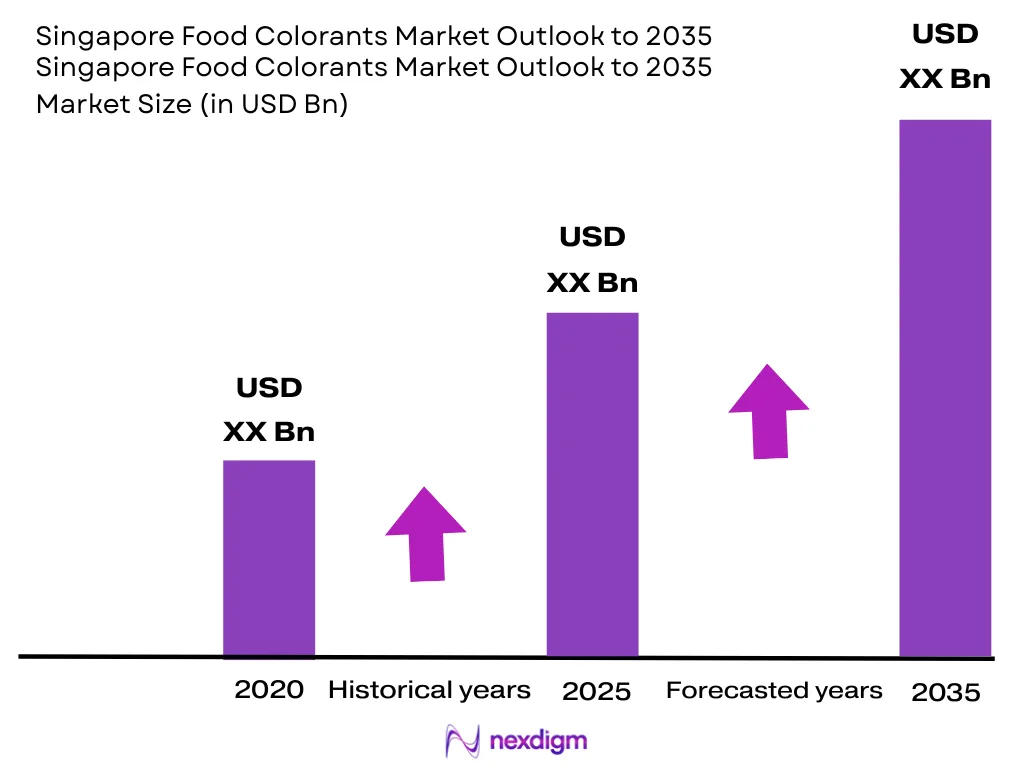
The Singapore Food Colorants Market was valued at USD ~ Billion in 2024 and is anticipated to expand at a CAGR of ~% during 2026-2035. The market is primarily driven by Singapore’s position as a leading regional hub for food and ingredient trade, increasing demand for clean-label ingredients across the country’s food manufacturing and food services sectors, and growing preference for naturally derived food additives. According to the Singapore Food Agency (SFA), Singapore imports more than 90% of its food supply from over 170 countries, reinforcing the country’s role as a major distribution and re-export hub for food ingredients across Southeast Asia. Meanwhile, Enterprise Singapore continues to support the food manufacturing sector through trade facilitation and export promotion initiatives, creating sustained demand for functional ingredients such as food colorants across bakery, dairy, confectionery, beverages, snacks, and processed meat applications.
Market Segmentation
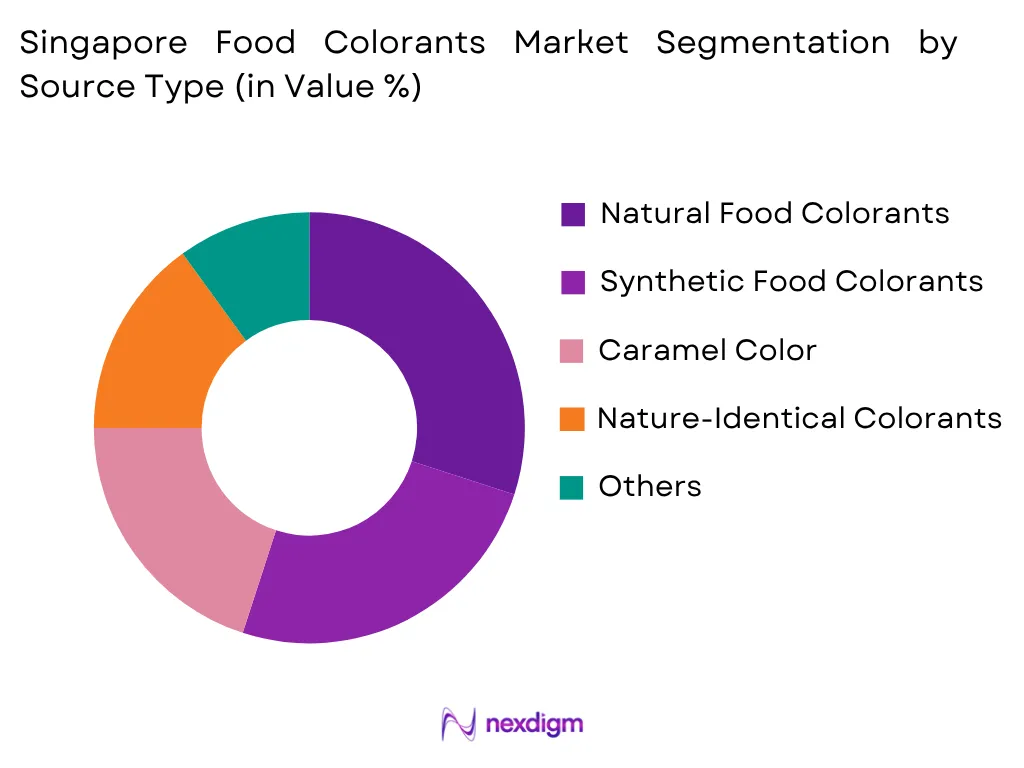
By Source Type
Among these, Natural Food Colorants dominate the Singapore Food Colorants Market owing to the rapid shift toward clean-label formulations, increasing regulatory scrutiny of synthetic dyes under SFA norms, and growing consumer awareness regarding naturally sourced ingredients. Given Singapore’s limited domestic agricultural land, food manufacturers rely primarily on imported botanical extracts such as turmeric, annatto, beetroot, paprika, and spirulina sourced from regional suppliers across India and Southeast Asia to satisfy premium and health-conscious consumer demand. Singapore’s extensive free trade network, including the Regional Comprehensive Economic Partnership (RCEP) and ASEAN trade agreements, provides a competitive advantage by ensuring efficient and duty-free access to natural pigment sources from across the region. Multinational ingredient manufacturers operating regional headquarters and innovation centers in Singapore have accelerated investments in natural color innovation to comply with evolving global clean-label strategies, further strengthening the dominance of this segment across dairy, confectionery, beverages, bakery, and plant-based food applications.
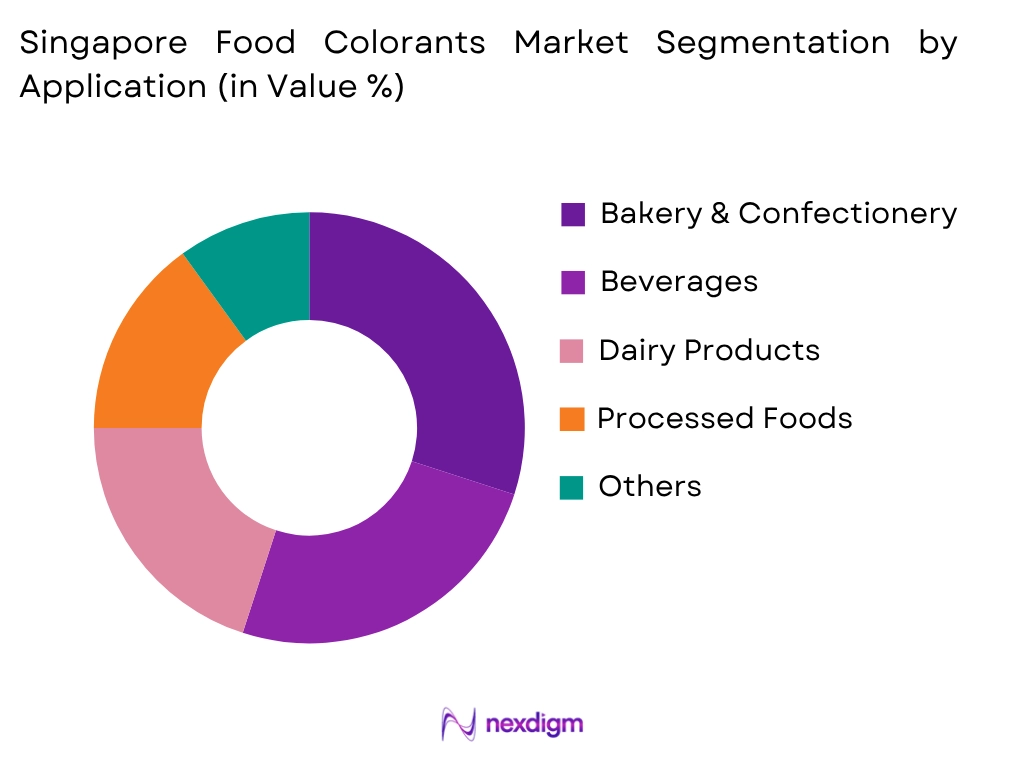
By Application
The Bakery & Confectionery segment holds the largest share owing to the extensive use of food colorants for product differentiation, visual appeal, festive product launches, and premium product positioning. Manufacturers increasingly utilize stable natural pigments to enhance cakes, cookies, chocolates, fillings, candies, gummies, frostings, and decorative toppings while maintaining compliance with evolving food safety regulations under the Singapore Food Agency (SFA). The growth of premium confectionery, artisanal bakery products, and festive product launches around occasions such as Lunar New Year, Hari Raya, and Deepavali has further increased demand for customized color solutions offering heat stability, pH stability, and extended shelf life. In addition, Singapore’s dense network of bakery chains, hawker centers, and modern trade formats continues introducing visually attractive baked and confectionery products, making colorants an essential functional ingredient that directly influences consumer purchasing decisions and brand recognition among the country’s affluent, well-traveled consumer base.
Competitive Landscape
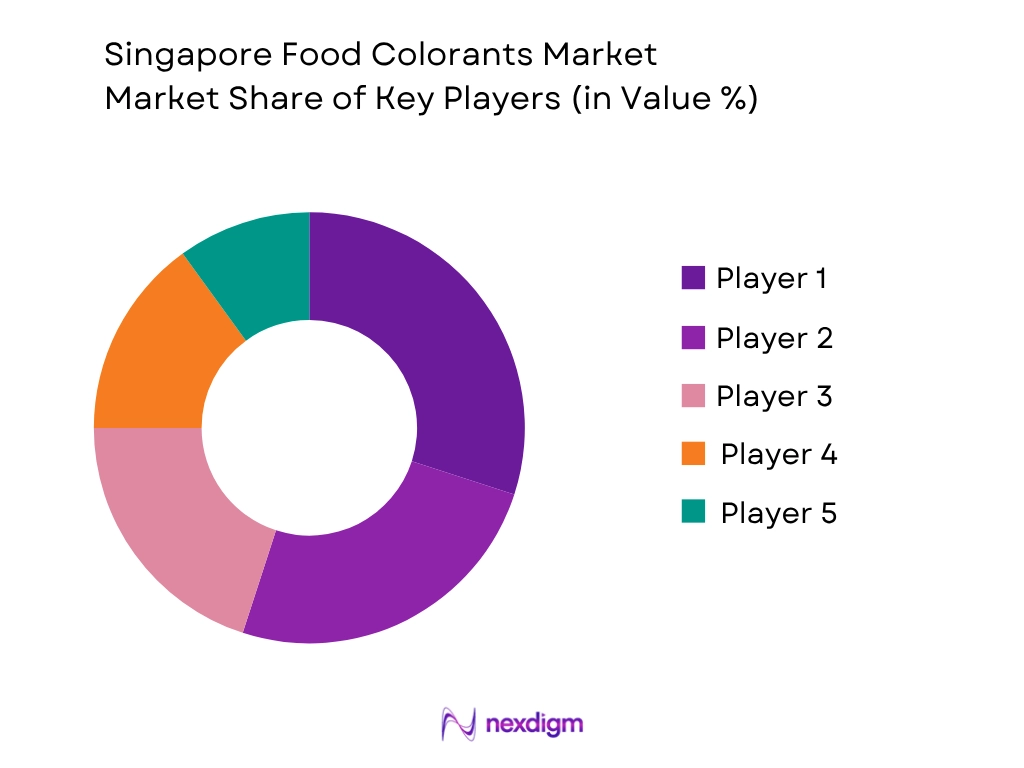
The Singapore Food Colorants Market is moderately consolidated, with the presence of several multinational ingredient manufacturers that operate regional headquarters, innovation centers, or distribution hubs within the country. Competition is primarily based on product innovation, regulatory compliance, application-specific formulations, pricing, technical support, and the ability to provide clean-label solutions. Companies are increasingly investing in research and development to improve the stability, heat resistance, pH tolerance, and shelf life of natural colorants. Strategic collaborations with food manufacturers across Southeast Asia, expansion of regional distribution capabilities, and sustainable sourcing of botanical raw materials have become key competitive differentiators. The growing preference for natural food colorants has also prompted manufacturers to expand their portfolios through acquisitions, partnerships, and fermentation-based pigment technologies.
| Company | Establishment Year | Headquarters | Primary Product Portfolio | Natural Color Portfolio
|
Manufacturing Presence | Major End-Use Industries | Key Strategic Focus | Certifications & Compliance |
| Döhler | 1838 | ~ | ~ | ~ | ~ | ~ | ~ | ~ |
| Kerry Group | 1972 | ~ | ~ | ~ | ~ | ~ | ~ | ~ |
| DSM-Firmenich | 2023 | ~ | ~ | ~ | ~ | ~ | ~ | ~ |
| Sensient Technologies | 1882 | ~ | ~ | ~ | ~ | ~ | ~ | ~ |
| Givaudan | 1895 | ~ | ~ | ~ | ~ | ~ | ~ | ~ |
Singapore Confectionary Market Analysis
Growth Drivers
Singapore’s Strategic Position as a Regional Food and Ingredient Trading Hub
Singapore’s food colorants market is experiencing sustained growth due to the country’s role as a leading regional hub for the trade, distribution, and re-export of food ingredients across Southeast Asia. According to the Singapore Food Agency (SFA), Singapore imports more than 90% of its food supply from over 170 countries, with agricultural and related product imports reaching approximately USD 18.4 billion in 2023, ensuring a steady flow of raw materials and finished ingredients, including natural colorants such as turmeric, beetroot, annatto, paprika, and spirulina extracts. Singapore’s extensive network of free trade agreements, including the Regional Comprehensive Economic Partnership (RCEP) and bilateral agreements such as the US-Singapore Free Trade Agreement, continues to support its position as a preferred base for ingredient trading and regional distribution. Enterprise Singapore actively supports food manufacturers through trade facilitation, innovation grants, and export promotion initiatives, encouraging the establishment of regional headquarters and application laboratories by global ingredient companies. Singapore’s population of approximately 5.9 million residents, coupled with one of the highest per-capita incomes globally, continues to stimulate demand for premium packaged foods, confectionery, and beverages where food colorants are essential for product differentiation. This combination of trade connectivity, regulatory efficiency, and strong purchasing power continues to stimulate demand for both natural and specialty food colorants.
Expansion of Food Manufacturing and Premium F&B Consumption
The steady expansion of Singapore’s food manufacturing and premium food and beverage sectors remains a major driver for food colorant consumption. According to the Ministry of Trade and Industry, Singapore’s food and beverage services sector continues to demonstrate resilient growth, supported by rising consumer spending and continued recovery in tourism-linked consumption. Singapore’s GDP per capita of approximately USD 85,548 ranks among the highest in the world, reflecting an affluent and well-traveled consumer base that continues to drive demand for premium bakery products, confectionery, functional beverages, and clean-label dairy products that increasingly utilize natural pigments to enhance product appeal. Singapore’s food manufacturing base also benefits from designated food zones and dedicated industrial infrastructure in the North and West regions of the country, which continue to attract investment in food processing facilities and central kitchens. Rising demand for convenience foods, ready-to-eat meals, and specialty beverages across Singapore’s dense urban population further supports industrial demand for caramel colors, turmeric extracts, paprika oleoresins, and beetroot-derived pigments across multiple food categories. These structural developments continue to strengthen long-term demand for advanced food coloring solutions throughout the country.
Market Challenges
Import Dependency and Raw Material Supply Chain Vulnerability
Given Singapore’s limited domestic agricultural land, the food colorants market remains highly dependent on imported botanical raw materials, exposing manufacturers to fluctuations in global commodity availability and pricing. According to the Singapore Food Agency (SFA), the country imports more than 90% of its food supply, making natural pigment feedstocks such as turmeric, annatto, beetroot, paprika, and spirulina vulnerable to disruptions in exporting countries caused by climate variability, geopolitical tensions, and shipping constraints. Global supply chain challenges affecting key commodities such as palm oil, wheat, and seafood have already demonstrated the extent of Singapore’s exposure to imported price volatility, with the Monetary Authority of Singapore noting continued food inflation pressures in recent years. Since natural food colorants require consistent pigment concentration and raw material quality, disruptions in overseas agricultural yields increase manufacturing complexity, procurement costs, and inventory management challenges for ingredient companies operating in Singapore. Furthermore, manufacturers must maintain strict quality specifications required by international food safety regulations across the multiple export destinations that Singapore-based operations typically serve, making supply consistency a critical challenge for the industry.
Stringent Regulatory Compliance for Food Additives
Singapore’s regulatory framework for food additives presents another significant challenge for food colorant manufacturers. The Singapore Food Agency (SFA) maintains rigorous requirements under the Sale of Food Act and Food Regulations governing the approval, labeling, purity specifications, and permitted usage levels of food colorants used in processed foods and beverages. Manufacturers introducing new botanical extracts or fermentation-derived pigments must provide extensive toxicological, stability, and safety documentation before commercialization. Singapore’s role as a regional re-export and distribution hub further requires compliance with the differing regulatory standards of multiple destination markets across ASEAN, requiring manufacturers to align with several international regulatory frameworks simultaneously. In addition, increasing consumer demand for transparency has encouraged stricter ingredient labeling requirements, prompting food manufacturers to reformulate existing products by replacing synthetic dyes with natural alternatives while maintaining product appearance and shelf stability. These regulatory obligations require continuous investments in research, quality assurance, laboratory testing, and documentation, extending product development timelines and increasing operational complexity for food colorant manufacturers serving both the domestic Singapore market and its regional export destinations.
Market Opportunities
Growing Role as a Regional Innovation and Distribution Hub for Natural Colorants
Singapore’s status as a global business and innovation hub provides significant opportunities for the food colorants industry, particularly in research, product development, and regional distribution. Several multinational ingredient manufacturers, including Givaudan, Kerry Group, and Sensient Technologies, maintain regional headquarters, innovation centers, or application laboratories in Singapore to serve the broader Asia Pacific market. The Singapore Economic Development Board continues to identify advanced manufacturing and food innovation as strategic contributors to the country’s economic development, while Singapore’s ’30 by 30′ vision, which aims to locally produce 30% of the nation’s nutritional needs by 2030, is encouraging investment in urban agriculture, fermentation technologies, and alternative protein and pigment sources. Advances in encapsulation, spray drying, and fermentation technologies further improve pigment stability under heat, light, and varying pH conditions, increasing commercial applications across bakery, beverages, dairy products, confectionery, and plant-based foods. As multinational food companies continue replacing synthetic additives with naturally derived alternatives, ingredient producers based in Singapore are well positioned to capitalize on both domestic demand and regional export opportunities through value-added pigment manufacturing and formulation services.
Expansion of Premium and Export-Oriented Food Manufacturing
Singapore’s extensive trade connectivity creates substantial long-term opportunities for food colorant manufacturers supplying regional and export-oriented food processors. According to Enterprise Singapore, the country continues to serve as a strategic re-export and distribution base for food and beverage products across the Asia Pacific region, supported by its extensive free trade agreement network, including the Regional Comprehensive Economic Partnership (RCEP) and the ASEAN Free Trade Area. Export-oriented manufacturers and regional distributors based in Singapore increasingly require internationally compliant natural food colorants to satisfy labeling regulations across diverse destination markets in Southeast Asia, North Asia, and beyond, encouraging greater adoption of premium botanical pigments. Simultaneously, Singapore’s affluent and increasingly health-conscious population of approximately 5.9 million continues to stimulate domestic demand for convenience foods, ready-to-eat meals, and functional beverages. Continuous investment in food manufacturing facilities, cold-chain logistics, and port and airfreight infrastructure further strengthens Singapore’s capacity to serve as a value-added coloring solutions base. These structural developments create favorable conditions for ingredient manufacturers to introduce innovative, sustainable, and application-specific food colorants capable of serving both Singapore’s domestic food industry and its extensive regional customer base.
Future Outlook
The Singapore Food Colorants Market is expected to witness sustained expansion over the forecast period, supported by increasing consumer preference for naturally derived food ingredients, continuous product reformulation by food manufacturers, and advancements in color stabilization technologies. Growing investment in plant-based foods, premium confectionery, functional beverages, and clean-label dairy products will further accelerate demand for innovative coloring solutions. The market is also likely to benefit from Singapore’s position as a regional trade and innovation hub, enabling efficient access to natural pigment feedstocks such as turmeric, beetroot, paprika, and tropical fruit extracts sourced from across Southeast Asia and beyond.
Major Players
- Givaudan
- DSM-Firmenich
- Döhler
- Kerry Group
- Sensient Technologies
- Chr. Hansen
- Oterra
- IFF (International Flavors & Fragrances)
- ADM
- Symrise
- Kalsec
- Naturex
- LycoRed
- Roha Group
- GNT Group (EXBERRY)
Key Target Audience
- Food Colorant Manufacturers
- Food & Beverage Processing Companies
- Bakery and Confectionery Manufacturers
- Dairy Product Manufacturers
- Nutraceutical and Functional Food Manufacturers
- Investment and Venture Capitalist Firms
- Government and Regulatory Bodies (SFA – Singapore Food Agency, Enterprise Singapore, Ministry of Trade and Industry (MTI))
- Food Ingredient Distributors and Industrial Raw Material Suppliers
Research Methodology
Step 1: Identification of Key Variables
The research process begins with identifying the complete ecosystem of the Singapore Food Colorants Market, including raw material suppliers, pigment manufacturers, ingredient distributors, food processors, retailers, and regulatory authorities. Extensive secondary research is conducted using company annual reports, government publications, trade associations, customs statistics, industry journals, and proprietary databases to determine the variables influencing market demand, pricing, production, consumption, and technological developments.
Step 2: Market Analysis and Construction
Historical market information is collected and analyzed to estimate market size, production volumes, import-export activity, application-wise demand, and pricing trends. A combination of top-down and bottom-up approaches is used to estimate market revenues and validate segment-level performance. Consumption patterns across bakery, dairy, beverages, confectionery, processed foods, and nutraceuticals are evaluated to establish an accurate representation of the industry.
Step 3: Hypothesis Validation and Expert Consultation
The preliminary findings are validated through Computer-Assisted Telephone Interviews (CATIs) and structured discussions with food ingredient manufacturers, procurement managers, distributors, food technologists, regulatory experts, and senior executives operating within the Singaporean food industry. These interviews help verify market assumptions, competitive developments, technology adoption trends, pricing dynamics, and future investment opportunities while refining the overall market estimates.
Step 4: Research Synthesis and Final Output
The final stage integrates insights obtained from primary interviews with quantitative information collected through secondary sources. Data triangulation techniques are applied to reconcile differences between supply-side and demand-side estimates, ensuring robust market forecasting. The report is then reviewed through multiple quality assurance checkpoints to deliver a comprehensive analysis covering market size, segmentation, competitive landscape, future outlook, and strategic recommendations for industry stakeholders.

- Executive Summary
- Research Methodology (Market Definitions and Assumptions, Abbreviations, Market Sizing Approach, Top-Down Analysis, Bottom-Up Analysis, Demand-Side Assessment, Supply-Side Assessment, Primary Industry Interviews, Secondary Research Validation, Data Triangulation, Forecasting Framework, Limitations and Future Conclusions)

- Definition and Scope
- Market Evolution and Industry Genesis
- Timeline of Major Industry Developments
- Food Colorants Industry Value Chain Analysis
- Supply Chain Analysis

- Growth Drivers (Growing Clean Label Food Demand, Rising Consumption of Processed Foods, Expansion of Beverage Manufacturing, Increasing Demand for Natural Pigments, Premiumization of Food Products, Growth in Plant-Based Foods)
- Market Challenges (High Cost of Natural Colorants, Color Stability Issues, Raw Material Price Volatility, Regulatory Compliance Complexity, Limited Shelf Stability of Natural Pigments, Import Dependency for Specialty Ingredients)
- Market Opportunities (Microencapsulation Technologies, Fermentation-Based Natural Pigments, Organic Food Expansion, Functional Food Innovation, Export-Oriented Ingredient Manufacturing, Clean Label Reformulation Projects)
- Market Trends (Replacement of Synthetic Colors, Blue Spirulina Adoption, Botanical Extract Innovation, Sustainable Pigment Sourcing, Heat-Stable Natural Color Development, Multi-Functional Ingredients)
- Government Regulations (SFA Food Additive Regulations, Food Labeling Requirements, Maximum Permitted Usage Levels, Natural Color Approval Standards, Import Compliance, Food Safety Standards)
- Import and Export Analysis (Trade Volume, Major Import Sources, Export Destinations, HS Code Analysis, Trade Balance)
- Raw Material Availability Analysis (Imported Turmeric, Imported Annatto Seeds, Imported Paprika, Imported Beetroot, Imported Spirulina, Caramel Feedstocks)
- Technology Landscape (Extraction Technologies, Encapsulation Technologies, Spray Drying, Fermentation Technologies, Stability Enhancement Technologies)
- Sustainability Assessment (Renewable Raw Materials, Carbon Footprint Reduction, Sustainable Farming Practices, Waste Valorization, Eco-Friendly Processing)
- PESTLE Analysis
- SWOT Analysis
- Porter’s Five Forces Analysis
- Stakeholder Ecosystem
- Competition Ecosystem

- By Market Value (2020-2025)
- By Volume Consumption (2020-2025)
- By Average Selling Price (2020-2025)

- By Source Type (In Value %)
Natural Food Colorants
Synthetic Food Colorants
Nature-Identical Colorants
Caramel Color
Mineral-Based Colorants
Fermentation-Derived Colorants - By Application (In Value %)
Bakery & Confectionery
Beverages
Dairy Products
Processed Foods
Snacks & Savory Products
Meat, Poultry & Seafood Products
Frozen Foods
Plant-Based Foods
Nutraceuticals & Functional Foods
Infant Nutrition - By Distribution Channel (In Value %)
Direct Sales to Food Manufacturers
Ingredient Distributors
Industrial Ingredient Suppliers
Online B2B Ingredient Platforms
Specialty Ingredient Suppliers - By End User (In Value %)
Food Processing Companies
Beverage Manufacturers
Bakery Manufacturers
Confectionery Manufacturers
Dairy Processors
Nutraceutical Manufacturers
Foodservice Manufacturers - By Region (In Value %)
Central Region
East Region
North Region
North-East Region
West Region

- Market Share of Major Players (By Value, Volume, Source Type, Application Industry, Product Category)
- Cross Comparison Parameters (Natural Colorant Portfolio Breadth, Synthetic Colorant Portfolio, Color Stability Performance, Application Technical Support Capability, Manufacturing Capacity, Regulatory Compliance & Certifications, Food & Beverage Customer Base, Innovation & New Product Launch Frequency)
- SWOT Analysis of Major Players
- Pricing Analysis by Product Category and SKU
- Production Capacity Analysis
- Manufacturing Footprint Analysis
- Distribution Network Analysis
- Innovation Benchmarking
- Detailed Profiles of Major Companies
Givaudan
DSM-Firmenich
Döhler
Kerry Group
Sensient Technologies
Chr. Hansen
Oterra
IFF (International Flavors & Fragrances)
ADM
Symrise
Kalsec
Naturex
LycoRed
Roha Group
GNT Group (EXBERRY)

- Consumption Pattern Analysis (Industrial Usage, Batch Size, Product Category Penetration, Seasonal Demand, Reformulation Activity)
- Purchasing Criteria (Color Stability, Regulatory Compliance, Cost Efficiency, Heat Stability, Light Stability, Shelf Life)
- Procurement and Supplier Selection Analysis
- Clean Label Adoption Assessment
- Premium vs Conventional Product Demand
- Product Attribute Preference Analysis (Hue Consistency, Dispersion Performance, pH Stability, Solubility, Natural Origin, Label Friendliness)
- Consumer Health & Wellness Influence on Product Development
- Pain Point Analysis
- Decision-Making Process

- By Market Value (2026-2035)
- By Volume Consumption (2026-2035)
- By Average Selling Price (2026-2035)


 Request a Sample
 Ask for Customization
 Get a Quote
 Enquire Now